




This site is made possible by member support. 💞
Big thanks to Arcustech for hosting the site and offering amazing tech support.
When you buy through links on kottke.org, I may earn an affiliate commission. Thanks for supporting the site!
kottke.org. home of fine hypertext products since 1998.
Beloved by 86.47% of the web.
Entries for November 2018
America’s Last Chance at a Gospel Archive

This is a fascinating Longread from Oxford American, on Baylor University’s Robert Darden’s efforts to create a comprehensive archive (physical and digital) of American gospel music:
In 2001, when Darden set out to write the first comprehensive history of black gospel music, from its African origins into the twenty-first century, he came across citations to many fundamental songs—early recordings by the Staple Singers; “There Is Not a Friend Like Jesus” by the Roberta Martin Singers; “Peace in the Valley” by the Southern Sons— but found that the recordings were long gone, never to be heard again. So he sought what could be salvaged. In Chicago, he climbed to the top floor of a tenement building, where he listened in awe as a woman sang lines to old freedom songs. In Memphis, he swayed and clapped in the pews of Al Green’s church. But when he finished People Get Ready!: A New History of Black Gospel Music in 2004, having painstakingly laid out the history of the genre, he almost couldn’t bear that many of its core components were lost to us.
After Darden finished the book, he got in touch with some of his old contacts from Billboard, gospel scholars and collectors like Bob Marovich, Opal Nations, and Ray Funk. He wanted to determine how much of black gospel music from its golden age was lost or unavailable. They estimated seventy-five percent.
Ask them why, and the answer gets complicated. “Part of it is racism,” Darden says. “Part of it is economic.” Part of it has to do with the consolidation in the music industry (some record companies hold the copyrights to these songs, but, lacking financial incentive, don’t make them available in any form). And the last part, as he sees it, is the religious aspect of this music. Marovich put it to me this way: “When I was growing up, there was always, in our neighborhood, a couple of guys in white shirts and black ties that wanted to talk to you about Jesus. And you wanted to run the opposite direction from those guys… . Gospel is a little frightening to the unknowledgeable.”
In February of 2005, Darden wrote an op-ed in the New York Times lamenting the loss of these treasures from gospel’s golden age: “It would be more than a cultural disaster to forever lose this music,” he writes. “It would be a sin.” The apparent imbalance of that remark stuck with me. By any honest standard, we sin regularly. A cultural disaster seems like a much more grievous affair. But I also had the feeling that he was onto something—that the loss of this music was a moral failing born out of a history of oppression and neglect. He explained to me that when he wrote that, he had in mind Jim Wallis’s (at the time controversial) claim that racism was America’s original sin.
One of the songs referenced in the article as the archival project’s unofficial anthem is “Old Ship of Zion,” recorded by The Mighty Wonders. I found it on YouTube:
There’s a beauty to these recordings that belies their historical importance. John Lewis has said that “without music the civil rights movement would have been like a bird without wings.” Some antebellum spirituals are said to have held instructions for slaves to escape. You can also find the roots of almost every major American popular music in the various strands of gospel, from country to hip-hop. It would be very American to lose these strands, but it’s the better kind of American to bring our collective resources and technology to bear to save and recirculate these records for the public good.
‘No Way To Prevent This,’ Says Only Nation Where This Regularly Happens
For the past few years, whenever a mass shooting occurs in the US that gets wide press coverage, the satirical news site The Onion runs an article with this headline written by Jason Roeder: “‘No Way To Prevent This,’ Says Only Nation Where This Regularly Happens”. The reason they only do it when a shooting gets big coverage is that there have been 307 mass shootings so far this year and if they covered every one, about half of The Onion’s content would be this same article.
Each of these articles consists of an identical paragraph save for the dateline, the number of people killed by the shooter, the photo, and a couple of details from the shooting. From the piece on the Las Vegas shooting:
In the hours following a violent rampage in Las Vegas in which a lone attacker killed more than 50 individuals and seriously injured 400 others, citizens living in the only country where this kind of mass killing routinely occurs reportedly concluded Monday that there was no way to prevent the massacre from taking place. “This was a terrible tragedy, but sometimes these things just happen and there’s nothing anyone can do to stop them,” said Iowa resident Kyle Rimmels, echoing sentiments expressed by tens of millions of individuals who reside in a nation where over half of the world’s deadliest mass shootings have occurred in the past 50 years and whose citizens are 20 times more likely to die of gun violence than those of other developed nations. “It’s a shame, but what can we do? There really wasn’t anything that was going to keep these individuals from snapping and killing a lot of people if that’s what they really wanted.” At press time, residents of the only economically advanced nation in the world where roughly two mass shootings have occurred every month for the past eight years were referring to themselves and their situation as “helpless.”
From the headline on down, the piece is designed to skewer the tragic truth of contemporary America: we consider ourselves a civilized country but also accept without any real action that 10 or more people are going be executed in public every once in awhile while gathering to dance, to worship, to learn. Each successive posting of the article underscores that point with a clever cruelty: it happened here again and nowhere else.
In chronological order, here is every mass shooting article The Onion has posted, representing a total of 177 people killed.
‘No Way To Prevent This,’ Says Only Nation Where This Regularly Happens. 5/27/14. Isla Vista, CA. 6 people killed.
‘No Way To Prevent This,’ Says Only Nation Where This Regularly Happens. 6/17/15. Charleston, SC. 9 people killed.
‘No Way To Prevent This,’ Says Only Nation Where This Regularly Happens. 10/1/15. Roseburg, OR. 9 people killed.
‘No Way To Prevent This,’ Says Only Nation Where This Regularly Happens. 12/3/15. San Bernardino, CA. 14 people killed.
‘No Way To Prevent This,’ Says Only Nation Where This Regularly Happens. 10/2/17. Las Vegas, NV. 58 people killed (851 injured).
‘No Way To Prevent This,’ Says Only Nation Where This Regularly Happens. 11/5/17. Sutherland Springs, TX. 26 people killed.
‘No Way To Prevent This,’ Says Only Nation Where This Regularly Happens. 2/14/18. Parkland, FL. 17 people killed.
‘No Way To Prevent This,’ Says Only Nation Where This Regularly Happens. 5/18/18. Sante Fe, NM. 10 people killed.
‘No Way To Prevent This,’ Says Only Nation Where This Regularly Happens. 9/13/18. Bakersfield, CA. 5 people killed.
‘No Way To Prevent This,’ Says Only Nation Where This Regularly Happens. 10/28/18. Pittsburg, PA. 11 people killed.
‘No Way To Prevent This,’ Says Only Nation Where This Regularly Happens. 11/8/18. Thousand Oaks, CA. 12 people killed.
‘No Way To Prevent This,’ Says Only Nation Where This Regularly Happens. 6/1/2019. Virginia Beach, VA. 12 people killed.
In between the San Bernardino and Las Vegas shootings, they missed the shooting at the Pulse nightclub in Orlando, FL on 6/12/16 in which 49 people were killed as well as shootings in Dallas, TX, Lincoln County, MS, Plano, TX, and a second shooting in Orlando, FL in which 6 or more people were killed in each case.
I’ll keep this list updated, but I’m eagerly looking forward to a time when I never have to see a new version of this article ever again.
Fascism is Not an Idea to Be Debated, It’s a Set of Actions to Fight
Writing for Literary Hub, author Aleksandar Hemon writes about his friend Zoka — who he grew up with in Sarajevo before Hemon moved away and Zoka became a Serbian nationalist — in the context of the media trying to figure out if debating with racists & fascists is a good idea.
The public discussion prompted by the (dis)invitation [of Steve Bannon from the New Yorker Festival] confirmed to me that only those safe from fascism and its practices are likely to think that there might be a benefit in exchanging ideas with fascists. What for such a privileged group is a matter of a potentially productive difference in opinion is, for many of us, a matter of basic survival. The essential quality of fascism (and its attendant racism) is that it kills people and destroys their lives-and it does so because it openly aims so.
Witness Stephen Miller and Donald Trump’s “zero tolerance for illegal immigration” policy. Fascism’s central idea, appearing in a small repertoire of familiar guises, is that there are classes of human beings who deserve diminishment and destruction because they’re for some reason (genetic, cultural, whatever) inherently inferior to “us.” Every fucking fascist, Bannon included, strives to enact that idea, even if he (and it is usually a he-fascism is a masculine ideology, and therefore inherently misogynist) bittercoats it in a discourse of victimization and national self-defense. You know: they are contaminating our nation/race; they are destroying our culture; we must do something about them or perish. At the end of such an ideological trajectory is always genocide, as it was the case in Bosnia.
The effects and consequences of fascism, however, are not equally distributed along that trajectory. Its ideas are enacted first and foremost upon the bodies and lives of the people whose presence within “our” national domain is prohibitive. In Bannon/Trump’s case, that domain is nativist and white. Presently, their ideas are inflicted upon people of color and immigrants, who do not experience them as ideas but as violence. The practice of fascism supersedes its ideas, which is why people affected and diminished by it are not all that interested in a marketplace of ideas in which fascists have prime purchasing power.
Learning to Read in Your 30s Profoundly Transforms the Brain. “The learning process leads to a reorganization that extends to deep brain structures in the thalamus and the brainstem.”
The Stylish & Colorful Computing Machines of Yesteryear
Holy moly, these photographs of vintage computers & peripherals by “design and tech obsessive” James Ball are fantastic.



He did a similar series with early personal computers subtitled “Icons of Beige”.

(via @mwichary)
How VW Turned Beastie Boys-Inspired Theft of Car Parts into a Clever 80s Ad
In the music video for (You Gotta) Fight for Your Right (To Party!) and in promotional material surrounding the release of the band’s debut album Licensed to Ill, the Beastie Boys’ Mike D wore a chain with a VW emblem around his neck.

In the US and around the world, fans of the band started stealing VW emblems from the fronts of cars on the street and in dealer lots. In the UK, facing down some potential bad publicity, Volkswagen cleverly turned this into a marketing opportunity with this magazine ad:

Using the iconic layout of the groundbreaking “Think Small” and “Lemon” ads and calling their logo a “designer label”, VW offered fans of Beasties a free emblem just for writing into the company and requesting one. Brilliant ad. (via @imperica)
Why Are Humans Suddenly Getting Better at Tetris?
Tetris was invented in 1984 by Alexey Pajitnov. It was a hit from the start but became a sensation after it was bundled with Nintendo’s Game Boy. It’s perhaps the most popular video game of all time and was played casually (and not so casually) by hundreds of millions of people around the world. You’d think with all those people playing, the limits of the game were fully probed and the highest scores reached, right? Not quite…
As John Green explains in this video, a few people are actually getting much better at the NES version of Tetris than anyone was back in the 90s. One of the reasons for this is that a smaller dedicated group working together can be more effective than a massive group of people working alone on a problem. Today’s top players can not only compare scores (as people did in the pages of Nintendo Power), but they get together for competitions, share techniques, and post videos of their gameplay to Twitch and YouTube for others to mine for tricks.
The two approaches boil down to ants solving problems vs. deliberate practice. The hundreds of millions of players were able to map out seemingly all corners of the game, but only up to a point. It took a smaller group engaging in a collective deliberate practice to push beyond the mass effort.
Green’s discussion also reminded me of something Malcolm Gladwell said in his conversation with Tyler Cowen:
The most interesting thing happening, to me, in distance running right now is the rise of Japan as a distance-running power. And what’s interesting about Japan is that Japan does not have any one runner, particularly in marathons, does not have any one marathoner who is in the top 10 in the world, or even the top 20 in the world, but they have an enormous number of people who are in the top 100. So, your notion of whether Japan is a distance-running power depends on how you choose to define distance-running power.
We have one definition that we use, where we say we recognize a country as being very good at distance running if they have lots and lots of people in the top 10, but that strikes me as being incredibly arbitrary and it goes to my point about we’re not encouraging mediocrity. Why? All that says is… OK, Kenya’s got 9 of the top 10 of the fastest marathoners right now — why is that better than having 300 of the top 1,000? It’s purely arbitrary that we choose to define greatest as just the country that most densely occupies the 99th percentile. Why can’t we define it as the country that most densely occupies the 75th through 100th percentiles?
Tetris today is like Kenya in distance running…all the best-ever players are active right now. With Tetris in the 90s, you had a much broader group of people who were really good at the game but none of whom would crack the all-time top 20 (or perhaps even top 100).
Maybe you don’t give a flying flip about excellence in Tetris or distance running, but how about education? Should we direct the resources of our educational system to ensure that most people get a pretty good education or that fewer get an excellent education? Having a few super-educated people might result in more significant discoveries in science and achievements in literature or music (that everyone can then take advantage of) but having a broader base of educated citizens would result in better decisions being made in untold numbers of everyday situations. Which of those two situations is better? Which is more just? I’d suggest the answer maybe isn’t that obvious…
The United States of Guns
Like many of you, I read the news of a single person killing at least 12 people in Thousand Oaks, California last night. While this is an outrageous and horrifying event, it isn’t surprising or shocking in any way in a country where more than 33,000 people die from gun violence each year.
America is a stuck in a Groundhog Day loop of gun violence. We’ll keep waking up, stuck in the same reality of oppression, carnage, and ruined lives until we can figure out how to effect meaningful change. I’ve collected some articles here about America’s dysfunctional relationship with guns, most of which I’ve shared before. Change is possible — there are good reasons to control the ownership of guns and control has a high likelihood of success — but how will our country find the political will to make it happen?
An armed society is not a free society:
Arendt offers two points that are salient to our thinking about guns: for one, they insert a hierarchy of some kind, but fundamental nonetheless, and thereby undermine equality. But furthermore, guns pose a monumental challenge to freedom, and particular, the liberty that is the hallmark of any democracy worthy of the name — that is, freedom of speech. Guns do communicate, after all, but in a way that is contrary to free speech aspirations: for, guns chasten speech.
This becomes clear if only you pry a little more deeply into the N.R.A.’s logic behind an armed society. An armed society is polite, by their thinking, precisely because guns would compel everyone to tamp down eccentric behavior, and refrain from actions that might seem threatening. The suggestion is that guns liberally interspersed throughout society would cause us all to walk gingerly — not make any sudden, unexpected moves — and watch what we say, how we act, whom we might offend.
We’re sacrificing America’s children to “our great god Gun”:
Read again those lines, with recent images seared into our brains — “besmeared with blood” and “parents’ tears.” They give the real meaning of what happened at Sandy Hook Elementary School Friday morning. That horror cannot be blamed just on one unhinged person. It was the sacrifice we as a culture made, and continually make, to our demonic god. We guarantee that crazed man after crazed man will have a flood of killing power readily supplied him. We have to make that offering, out of devotion to our Moloch, our god. The gun is our Moloch. We sacrifice children to him daily — sometimes, as at Sandy Hook, by directly throwing them into the fire-hose of bullets from our protected private killing machines, sometimes by blighting our children’s lives by the death of a parent, a schoolmate, a teacher, a protector. Sometimes this is done by mass killings (eight this year), sometimes by private offerings to the god (thousands this year).
The gun is not a mere tool, a bit of technology, a political issue, a point of debate. It is an object of reverence. Devotion to it precludes interruption with the sacrifices it entails. Like most gods, it does what it will, and cannot be questioned. Its acolytes think it is capable only of good things. It guarantees life and safety and freedom. It even guarantees law. Law grows from it. Then how can law question it?
Roger Ebert on the media’s coverage of mass shootings:
Let me tell you a story. The day after Columbine, I was interviewed for the Tom Brokaw news program. The reporter had been assigned a theory and was seeking sound bites to support it. “Wouldn’t you say,” she asked, “that killings like this are influenced by violent movies?” No, I said, I wouldn’t say that. “But what about ‘Basketball Diaries’?” she asked. “Doesn’t that have a scene of a boy walking into a school with a machine gun?” The obscure 1995 Leonardo Di Caprio movie did indeed have a brief fantasy scene of that nature, I said, but the movie failed at the box office (it grossed only $2.5 million), and it’s unlikely the Columbine killers saw it.
The reporter looked disappointed, so I offered her my theory. “Events like this,” I said, “if they are influenced by anything, are influenced by news programs like your own. When an unbalanced kid walks into a school and starts shooting, it becomes a major media event. Cable news drops ordinary programming and goes around the clock with it. The story is assigned a logo and a theme song; these two kids were packaged as the Trench Coat Mafia. The message is clear to other disturbed kids around the country: If I shoot up my school, I can be famous. The TV will talk about nothing else but me. Experts will try to figure out what I was thinking. The kids and teachers at school will see they shouldn’t have messed with me. I’ll go out in a blaze of glory.”
In short, I said, events like Columbine are influenced far less by violent movies than by CNN, the NBC Nightly News and all the other news media, who glorify the killers in the guise of “explaining” them. I commended the policy at the Sun-Times, where our editor said the paper would no longer feature school killings on Page 1. The reporter thanked me and turned off the camera. Of course the interview was never used. They found plenty of talking heads to condemn violent movies, and everybody was happy.
Jill Lepore on the United States of Guns:
There are nearly three hundred million privately owned firearms in the United States: a hundred and six million handguns, a hundred and five million rifles, and eighty-three million shotguns. That works out to about one gun for every American. The gun that T. J. Lane brought to Chardon High School belonged to his uncle, who had bought it in 2010, at a gun shop. Both of Lane’s parents had been arrested on charges of domestic violence over the years. Lane found the gun in his grandfather’s barn.
The United States is the country with the highest rate of civilian gun ownership in the world. (The second highest is Yemen, where the rate is nevertheless only half that of the U.S.) No civilian population is more powerfully armed. Most Americans do not, however, own guns, because three-quarters of people with guns own two or more. According to the General Social Survey, conducted by the National Policy Opinion Center at the University of Chicago, the prevalence of gun ownership has declined steadily in the past few decades. In 1973, there were guns in roughly one in two households in the United States; in 2010, one in three. In 1980, nearly one in three Americans owned a gun; in 2010, that figure had dropped to one in five.
A Land Without Guns: How Japan Has Virtually Eliminated Shooting Deaths:
The only guns that Japanese citizens can legally buy and use are shotguns and air rifles, and it’s not easy to do. The process is detailed in David Kopel’s landmark study on Japanese gun control, published in the 1993 Asia Pacific Law Review, still cited as current. (Kopel, no left-wing loony, is a member of the National Rifle Association and once wrote in National Review that looser gun control laws could have stopped Adolf Hitler.)
To get a gun in Japan, first, you have to attend an all-day class and pass a written test, which are held only once per month. You also must take and pass a shooting range class. Then, head over to a hospital for a mental test and drug test (Japan is unusual in that potential gun owners must affirmatively prove their mental fitness), which you’ll file with the police. Finally, pass a rigorous background check for any criminal record or association with criminal or extremist groups, and you will be the proud new owner of your shotgun or air rifle. Just don’t forget to provide police with documentation on the specific location of the gun in your home, as well as the ammo, both of which must be locked and stored separately. And remember to have the police inspect the gun once per year and to re-take the class and exam every three years.
Australia’s gun laws stopped mass shootings and reduced homicides, study finds:
From 1979 to 1996, the average annual rate of total non-firearm suicide and homicide deaths was rising at 2.1% per year. Since then, the average annual rate of total non-firearm suicide and homicide deaths has been declining by 1.4%, with the researchers concluding there was no evidence of murderers moving to other methods, and that the same was true for suicide.
The average decline in total firearm deaths accelerated significantly, from a 3% decline annually before the reforms to a 5% decline afterwards, the study found.
In the 18 years to 1996, Australia experienced 13 fatal mass shootings in which 104 victims were killed and at least another 52 were wounded. There have been no fatal mass shootings since that time, with the study defining a mass shooting as having at least five victims.
From The Onion, ‘No Way To Prevent This,’ Says Only Nation Where This Regularly Happens:
At press time, residents of the only economically advanced nation in the world where roughly two mass shootings have occurred every month for the past eight years were referring to themselves and their situation as “helpless.”
But America is not Australia or Japan. Dan Hodges said on Twitter a few years ago:
In retrospect Sandy Hook marked the end of the US gun control debate. Once America decided killing children was bearable, it was over.
This can’t be the last word on guns in America. We have to do better than this for our children and everyone else whose lives are torn apart by guns. But right now, we are failing them miserably, and Hodges’ words ring with the awful truth that all those lives and our diminished freedom & equality are somehow worth it to the United States as a society.
The Former Chief of Disguise of the CIA Explains How Spies Use Disguises
In this video, Jonna Mendez, the former Chief of Disguise of the CIA, explains how disgu — Wait, wait, wait…Chief of Disguise!! That is an actual job title!?! WHAT! Ok, back to the post… — explains how disguises are used in the CIA.
With women, you have a broader range of what you can do. You also have one extra step: you can turn a woman into a man. I would mention that it’s almost impossible to turn a man into a woman. What we do is always additive — we can make you taller, we can make you heavier, we can make you older — we can’t go the other direction. You want to be the person that gets on the elevator and then gets off and nobody even remembers that you were really there. That is a design goal at the disguise labs at CIA.
Interesting throughout. As a fan of the disguises on The Americans and as someone who got to wear some bitchin’ makeup for a short extra appearance on Halt and Catch Fire, I really enjoyed this video, but now I’m wondering what my “dead giveaway” mannerisms are. Friends, any thoughts?
Some Reflections from My Short Trip to Istanbul
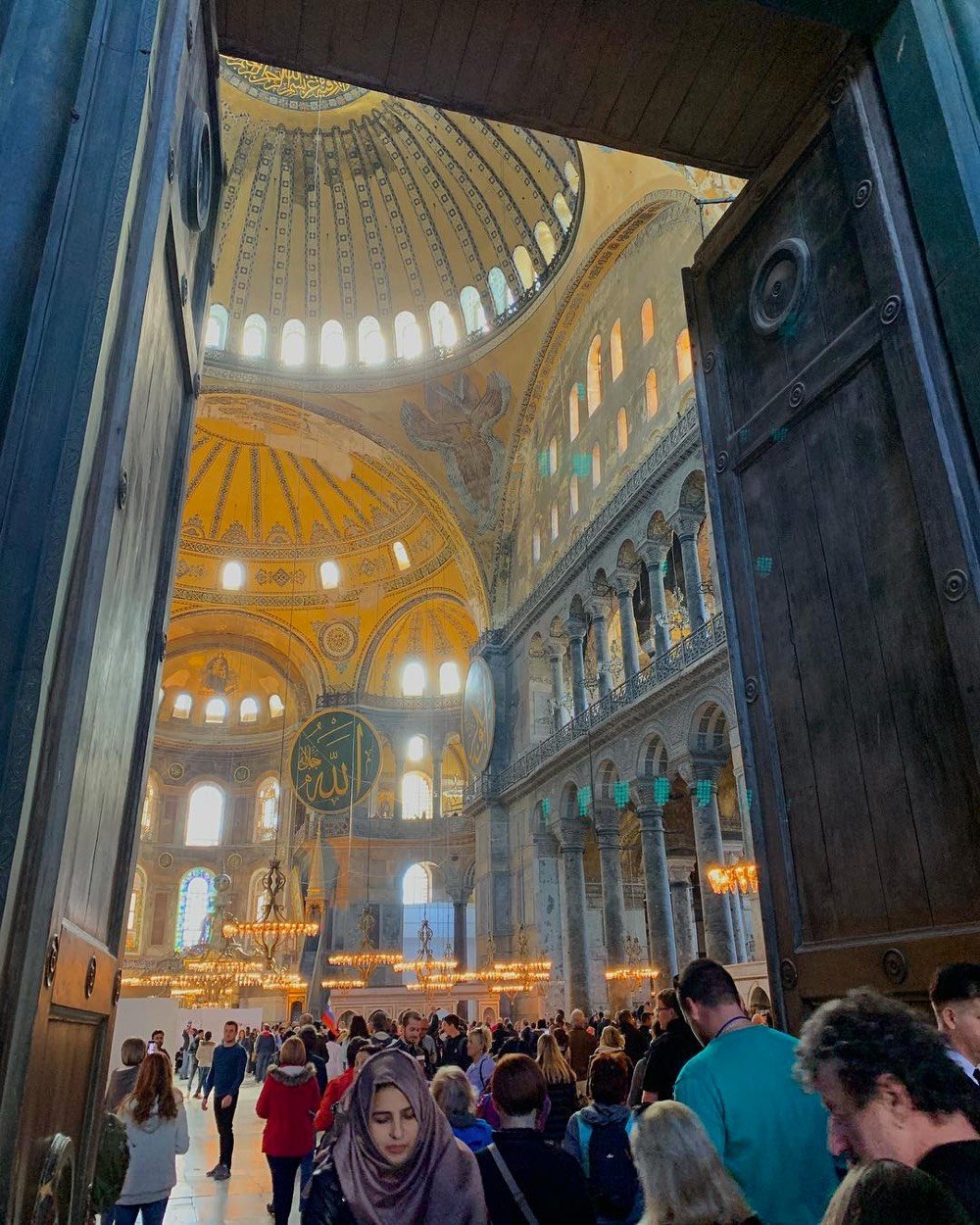
At the end of October, I spent barely 48 hours in Istanbul — too quick, but I saw a lot of stuff in a short time. When planning this trip, I had a lot of different thoughts about places I could go — the American Southwest, Barcelona, London, Edinburgh, Seattle/Portland, Miami — but the thing that really sold me was a relatively cheap plane ticket that would take me to both Berlin and Istanbul. A two-fer? Sign me up. I’d been to Berlin before, but I was a bit nervous about Istanbul because it seemed so culturally different than other places I’d been. I needn’t have worried.
Just after I had checked into my hotel room, I heard a chanting voice over a loudspeaker coming from outside. I opened my window for a better listen — it was the adhan (the Muslim call to prayer) for the sunset prayer (probably from the Hagia Sophia, which was quite close). As I walked around the city for the next day and a half, I heard the adhan several more times. Watching the sunset in Kadikoy, you could hear the call ringing out from several mosques across the city, nearly in unison. I’m not Muslim or even remotely religious, so I was surprised at how much I liked hearing it. As with tolling European church bells, the calls to prayer knits cities together in an auditory way that secularism has yet to manage.
The nightstand in my hotel room had a sticker on it pointing the direction to Mecca. (There are apps to help with this as well.)
There are cats all over the place in Istanbul — I must have seen a dozen inside Hagia Sophia alone. My friend Jodi investigated why there are so many cats in the city.
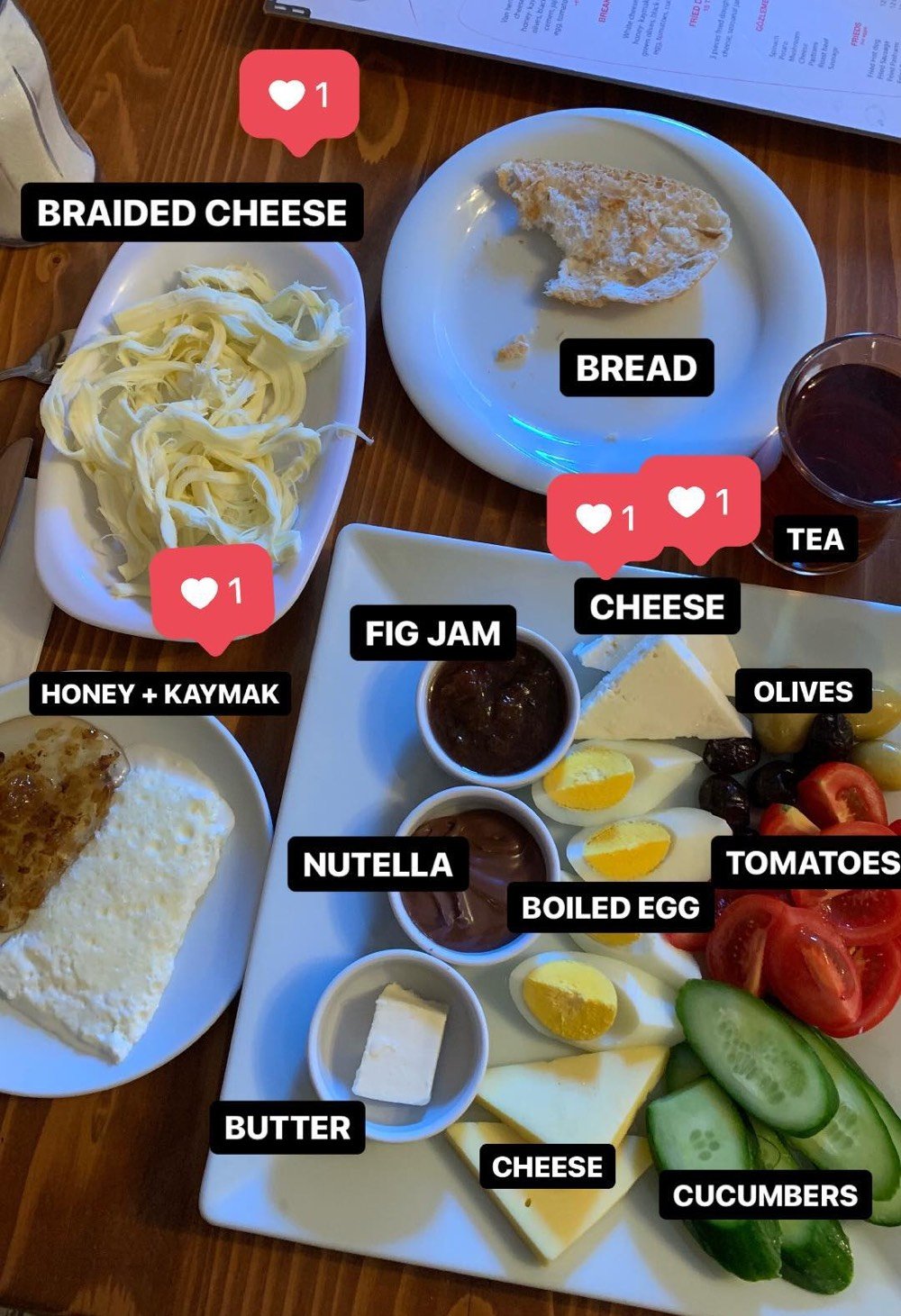
My first morning in Istanbul, I headed to Van Kahvalti Evi for breakfast on the strong recommendation of a reader. What greeted me was an amazing breakfast, the best I have had in quite some time (annotated above). As I was dining solo, I wasn’t able to get full breakfast (it was for 2+ people only), but I did pretty well. My favorites were the braided cheese, kaymak & honey, and the saltiest fresh cheese. The couple sitting next to me ordered the full breakfast and the waiter’s tray was like a magical clown car…he just kept putting little plates of delicious cheeses and pastes and fruits onto the table until it was completely covered. The freshness of everything was underscored by that morning’s food delivery coming in through the front door and streaming past me, a seemingly endless procession of fresh fruit, vegetables, and such. Highly recommended.
Everything I read about Istanbul taxis basically said to avoid them at all costs because they try to rip you off (and I’m not a huge fan of taxis on a good day), so that’s what I did. Upon landing, I bought an Istanbulkart to use the metro & ferries the whole time I was there. Getting from the airport to my hotel was pretty easy on the metro (thanks Citymapper), didn’t take too much longer than a taxi would have, and cost a lot less. Tip: machines are cash only, so you’d better have some Turkish lira on hand before exiting the airport.
Istanbul is not a bicycle city, at least not in the areas I visited. I saw maybe three people on bikes the entire time I was there? For starters, the city streets in the oldest parts of town are so small there’s nowhere to even put bike lanes. And then there are the hills, which made walking challenging at times, never mind biking. Even where there are dedicated lanes, they can be overwhelmed by pedestrians. In a park in Kadikoy, the balık ekmek (fish sandwich) vendors set up their carts right in the bike lane.
Although the interior was being renovated when I visited, Hagia Sophia was staggeringly impressive. Originally built in just under six years by Emperor Justinian, ruler of the Byzantine Empire (aka what was left of the Holy Roman Empire after the fall of Rome in the 5th century), it was completed in 537 as the world’s largest building and largest cathedral, retaining the latter title for almost 1000 years. Justinian wanted Hagia Sophia to be the biggest church in the world, partially for the glory of God and partially to best his peers. At the building’s dedication, he was recorded as saying, “My Lord, thank you for giving me chance to create such a worshipping place” followed by “Solomon, I have outdone you.” in reference to Solomon’s temple in Jerusalem. IN YOUR FACE SOLOMON!
Hagia Sophia was Byzantine until 1204, Roman Catholic for more than 50 years, and Greek Orthodox for about 200 years after that. In 1453, Mehmed the Conqueror of the Ottoman Empire — wait for it… — conquered Constantinople and turned Hagia Sophia into a mosque. It became a museum in 1935. Walking around inside it, you can see and feel all of this history, layered all around you. The marble floors are worn down from centuries of devoted foot traffic. The wear pattern is uneven due to differing hardnesses of the rocks in the marble, giving the floor a marvelous wavy quality. The Christian aspects of the church were covered or destroyed when the church was converted to a mosque, but now they peek through here and there again. A remarkable experience of time travel through cultures, mirroring Istanbul’s own long and varied history as a crossroads between East and West.
I pretty much had the They Might Be Giants cover of Istanbul (Not Constantinople) on repeat in my head the entire time I was in town.
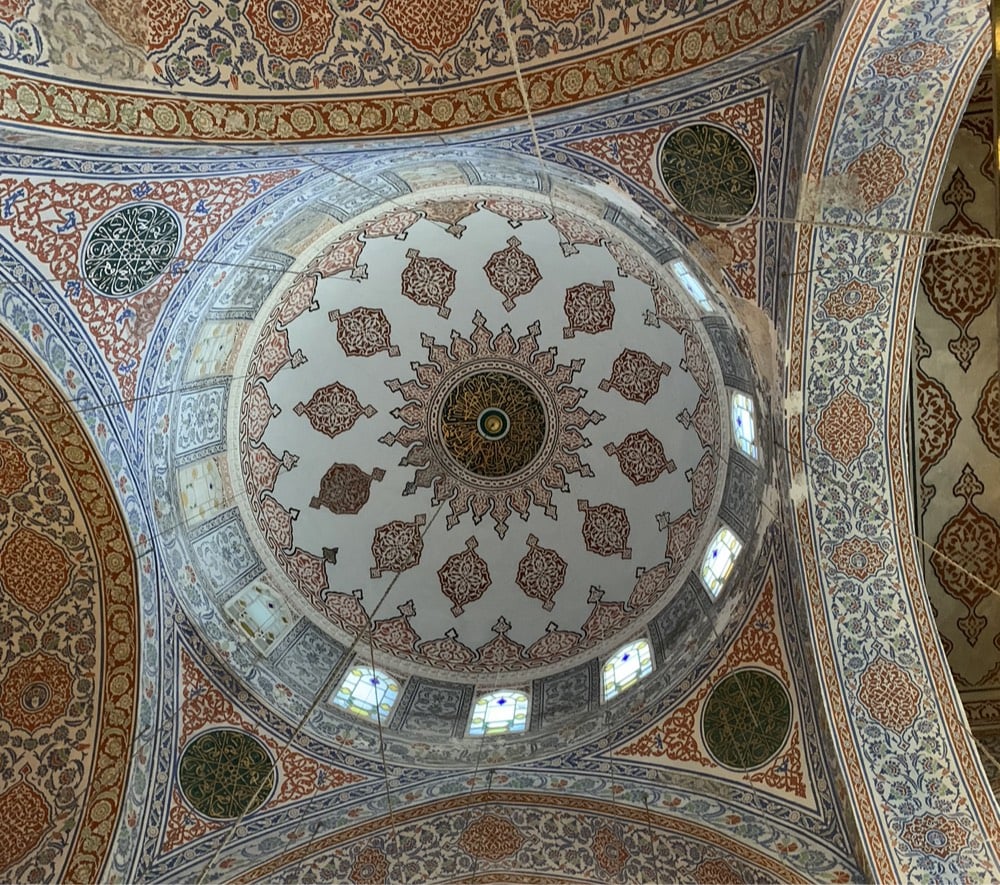
Along with many of its tourists, the overwhelming majority of Turkey’s population is Muslim, so it wasn’t surprising to see women with headwear like hijabs and niqabs all over in Istanbul. I have lots of thoughts about this religious and cultural practice, but mostly it made me think about how the dress of women in the US and other western countries is also restricted by our culture in many ways.
As I had less than 48 hours to spend in Istanbul, I mainly stayed in the central part of the city where most of the tourists were. Walking around was unpleasant at times because it seems like almost everyone is trying to sell you something. In the busiest areas near the top attractions and restaurants, someone tried to sell me a tour, a rug, a meal, or some sweets about every 30 seconds. It was oppressive. I mentioned this to a friend of mine and she said, “Now you know how women feel all the time walking around pretty much everywhere.”
The constant selling also put my guard up far more than it normally is (which is admittedly pretty high). In Taksim Square, a guy asked me for a light and we struck up a conversation. Super friendly guy, said his name was Ahmed, hailed from Qatar, in town for the day on his way to London, was a computer programmer, wasn’t particularly religious, liked travlling alone because his girlfriend (a lawyer) worked and talked too much. He was pleased to find me because this meant us two solo travellers could hang out for the evening. He’d asked at his hotel where to go and was heading towards this place with whiskey and belly dancing. Now, this is the point in the story where I’m supposed to head off into the evening with Ahmed and have an adventure. But because of the constant barrage of selling (plus I was sick and tired and wasn’t drinking), I mostly felt like I was being scammed and that “Ahmed” was actually pals with the guy who owned this belly dancing establishment and was tasked with suckering tourists like me into the place to spend money. Was he just a friendly guy or just another salesman? I still don’t really know, but I bid Ahmed a firm goodbye and still have not crossed “see belly dancing in Istanbul with a stranger” off of my bucket list.
But the next day, I finally succumbed to the relentless pressure. As I was contemplating joining the longish line at the Basilica Cistern, I made the mistake of looking contemplative, as if I were perhaps confused. A man came up to me, asked me if I spoke English, and then said I should come back later when the line is shorter. “Don’t worry,” he said, “I’m not trying to sell you a tour. I’m just on my way back to work from lunch.” Thus disarmed, we started chatting. His name was Musa and he had a business just up the street…perhaps he could give me his card and I could come for a visit tomorrow? Maybe, I said, wanting to be polite. We chatted some more, about other things. I agreed to go with him to get his business card; he still had not mentioned what business he was in…something to do with art, he said.
When we got to his place, it was a rug store. Musa’s friendly onboarding process had worked to get me into the store, penetrating my defenses by using my midwestern politeness against me. We sat down on a nice sofa and Musa served me apple tea; it materialized seemingly out of nowhere, part of a practiced routine. We chatted for about 5 or 10 minutes, sometimes about rugs and sometimes about other things. He told me about watching a TV program that featured this strange street food from NYC: hot dogs. At this point, I was feeling totally suckered, helpless under the thrall of this master salesman. But then I had another thought: this guy is not actually in control of this situation because I’m never in a million years buying a rug from him. Emboldened by my newfound power in our relationship, I thanked Musa politely for the tea, accepted his card, and left to join the line at the cistern.
For dinner on my last night, I sat down at an outdoor table at Meşhur Filibe Köftecisi, figuring that one of the few restaurants where no one was trying to get me to look at a menu was actually a good place to find delicious food. It’s a tiny place on a small street with several other restaurants filled with what looked like locals, another good sign. I asked for a menu but the owner shrugged me off with a friendly gruffness. “We have köfte,” he told me. “Meatballs. Someone like you orders nine. Nine meatballs. Salad to begin. What’s not to like?” I gave him a thumbs up and he yelled something to the chef, an older man who I never saw without a cigarette and had probably made about 10 million köfte over the course of his life.
While I waited for my food, I noticed an order of köfte going out of the kitchen…to a diner at the restaurant across the street. When he was finished, the staff at that place bussed the dishes back across the way. Meanwhile, my meal arrived and the köfte were flavorful and tender and juicy, exactly what I wanted…no wonder the place across the street had outsourced their meatballs to this place. I’d noticed the owner, the waiter, and the cook drinking tea, so after I finished, I asked if I could get a tea. The owner nodded and started yelling to a guy at the tea place two doors down. A few minutes later, a man bearing a tray with four glasses of tea arrived, dropping one at my table and the other three for the staff. Just then, a server from the place across the street came over to break a 100 lira bill. Me being a big nerd, this all reminds me of Unix and the internet, all of these small pieces loosely joined together to create a well-functioning and joyous experience. There’s only one thing on the menu at Meşhur Filibe Köftecisi, but you can get anything else within yelling distance. I declined dessert…who knows where that would have come from.
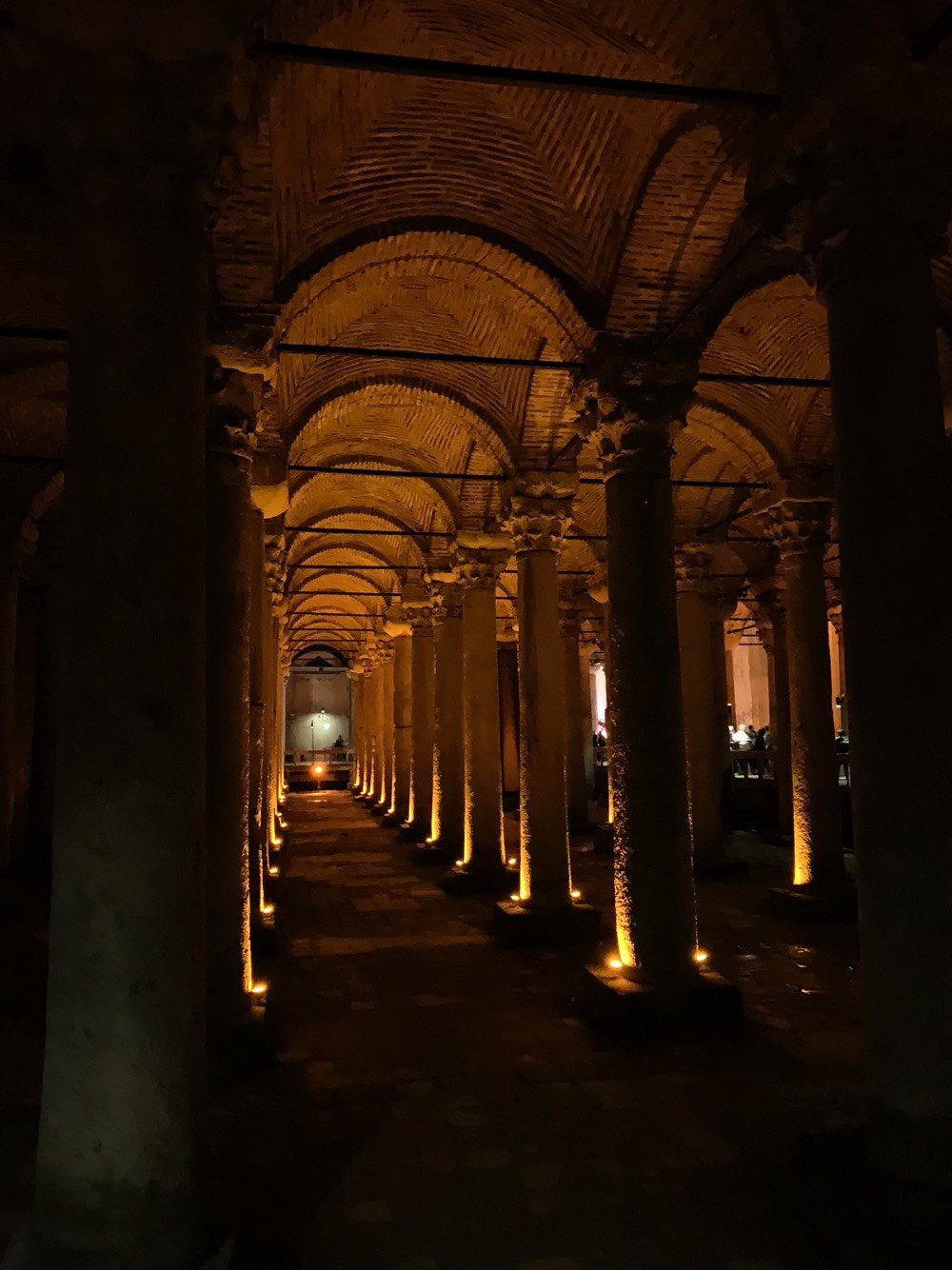
I also visited the Basilica Cistern (impressive ancient infrastructure), The Blue Mosque (under construction and so underwhelming), Topkapi Palace (underwhelming, but I was pretty museumed out by this point so perhaps an unfair assessment), Taksim Square (very crowded on a Friday night), and walked the length of Istiklal Avenue (very commercial in a Western sort of way).
Getting to my departure flight from Ataturk Airport was the tightest security I have ever gone through. To even enter the airport, you go through a metal detector. Then in the line to check into the flight, my passport was checked by three different people before my boarding pass was issued. Passport & boarding pass were checked again to get into the security line and then went through security, where most people’s bags got searched (but not mine). At the gate, my boarding pass was checked by at least six different people, who each put a different mark or stamp or signature on it, and then my carry-on luggage was searched (mandatory search…everyone got this treatment). Only then were we allowed on the plane. (Upon arrival in Boston, after waiting in a massive line, the border control officer barely glanced at my passport before waving me through.)
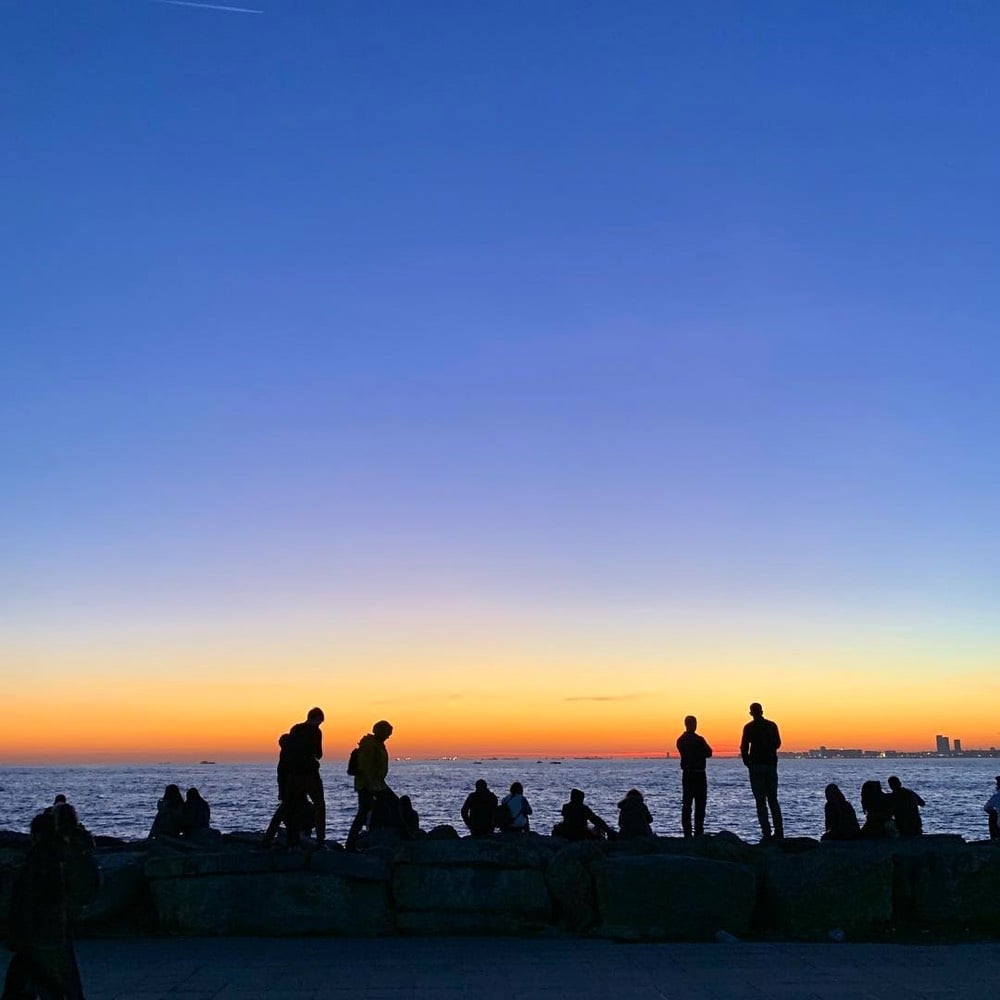
I only posted a couple of Istanbul photos on Instagram but posted a bunch of Instagram Stories (collected here). And big thanks to everyone who offered advice on where to go and what to eat. I really enjoyed Istanbul and hope to make it back someday.
Watching a Teen Music Star Grow Up
Vanity Fair interviewed singer/songwriter Billie Eilish last October just as her career was taking off. A year later, they repeated the interview with her, now 16 years old, using the same questions to see what had changed — 2017: 257K followers on Insta, playing to crowds of 500 people. 2018: 6.3 million Insta followers, crowds of 40,000+. The result is really affecting, particularly on questions like “Do you feel pressure?” where the difference in answers is greatest.
Eilish’s situation is extreme, but some version of this is playing out with all of America’s youth right now, dealing with how to be in the world when interacting with thousands or even hundreds of thousands or millions of other people, far beyond Dunbar’s number, is increasingly commonplace. Now if you’ll excuse me, I have something in my eye and who’s playing that Cat’s in the Cradle song anyway?!
Phew: Flickr Commons will remain available. Flickr Commons is still one of the very best things on the web.
An Incredible Video of What It’s Like to Orbit the Earth for 90 Minutes
This is easily the most awe-inspiring and jaw-dropping thing I’ve seen in months. In its low Earth orbit ~250 miles above our planet, the International Space Station takes about 90 minutes to complete one orbit of the Earth. Fewer than 600 people have ever orbited our planet, but with this realtime video by Seán Doran, you can experience what it looks like from the vantage point of the IIS for the full 90 minutes.
The video is in 4K so find the largest monitor/TV you can, turn up the sound, watch for awhile (even if it’s only for a few minutes), and see if you don’t experience a little bit of the Overview Effect, what NASA astronaut Kathryn Sullivan described as a life-altering experience:
I first saw the earth — the whole earth — from the shuttle Challenger in 1984. The view takes your breath away and fills you with childlike wonder. An incredibly beautiful tapestry of blue and white, tan, black and green seems to glide beneath you at an elegant, stately pace. But you’re actually going so fast that the entire map of the world spins before your eyes with each 90-minute orbit. After just one or two laps, you feel, maybe for the first time, like a citizen of a planet.
We could use more global citizenry these days.
Exit Polls: How Voting Blocs Have Shifted From the 80s to Now. Interesting charts.
Long-Delayed Documentary About Aretha Franklin Finally Set for Release
In January 1972, the Southern California Community Choir, a group of Atlantic Records musicians, and Aretha Franklin gathered at the New Temple Missionary Baptist Church in Los Angeles to record music for a live album. That album, Amazing Grace, went on to be Franklin’s best selling album and is still the top-selling gospel album of all time.
Director Sydney Pollack, who would later win a Best Director Oscar for Out of Africa, filmed the two-day recording for a documentary but wound up not being able to complete the film because the picture and sound couldn’t be synced — they hadn’t used a clapperboard before takes. So the footage, which includes the Rolling Stones’ Mick Jagger and Charlie Watts jamming out in the back of the church, was shelved. Before he died in 2008, Pollack entrusted the footage to Alan Elliott, who was able to sync the sound and make a 87-minute film out of it.
The film was going to be released a few times over the past decade, but Franklin successfully sued to keep it from the public, saying that her likeness was being used without her permission Even though she professed to liking the film, Franklin was strident about her finances. After Franklin’s death, Elliott screened it for her family and they approved its release. According to Variety, the film will screen at the DOC NYC film festival on November 12th and then later in NYC and LA to qualify for the Oscars.
The trailer for the film is embedded above. Elliott seems to have snuck it online without anyone noticing — as of now, it’s got fewer than 800 views on YouTube.
How Sevilla Became a Bicycle City in Just 18 Months
In just a few years, Sevilla, Spain went from almost no bike paths and low ridership to robust network of bike paths and many people using them. To do it, the ruling party used the positive results of a public poll to move quickly, annexing 5000 parking spots and spending a relatively meager €32 million to build 80+ kilometers of bike paths in just 18 months.
The year after the basic network opened, Calvo said, it seemed like every family in the city had suddenly bought one another bicycles for Christmas.
“Everyone was talking about the success of the bike lanes at that point,” he said. “The sports shops, they ran out of bikes. They needed to get bikes from Barcelona, from Madrid, and over from France.”
Once that happened, it became clear that the huge bike network investment had been a fiscal bargain.
“The whole network is €32 million,” he says. That’s how many kilometers of highway - maybe five or six? It’s not expensive infrastructure. … We have a metro line that the cost was €800 million. It serves 44,000 trips every day. With bikes, we’re serving 70,000 trips every day.”
What the Hell Happened to Darius Miles?
Darius Miles was drafted 3rd overall by the LA Clippers in the 2000 NBA Draft. After 8 seasons, a major injury, and $62 million, Miles was out of the league and bankrupt. In this entertaining and affecting article for The Players’ Tribune, Miles explains how he got to the NBA and what went wrong.
It’s crazy to think about, but six years after we were at the peak with the Young Clippers, I was basically out of the league. I was 27 years old, and I had doctors telling me that my knee was too messed up to play basketball ever again.
My whole life, I used basketball as an escape. When you grow up how I grew up, I think you’re probably bound to have some kind of PTSD. I ain’t a doctor, but when you grow up running from gunshots all the time, I think there’s something inside you that never leaves. I used to feel this pressure on me — I’m talking like a physical pressure, you know? But I used to be able to go out onto a basketball court and just unleash it. You could let it all out. You could dunk the shit outta that motherfucker in front of 100 people or 20,000 people and feel good for a minute.
Basketball got taken away from me at 27, and I was lost. I was just kind of going through the motions. Then a couple years later, my momma got taken away from me, and I pretty much went insane.
Miles’ friend and former teammate Quentin Richardson edited the piece and wrote one of his own for the Tribune as well.
Winners of the 2018 Wildlife Photographer of the Year Awards
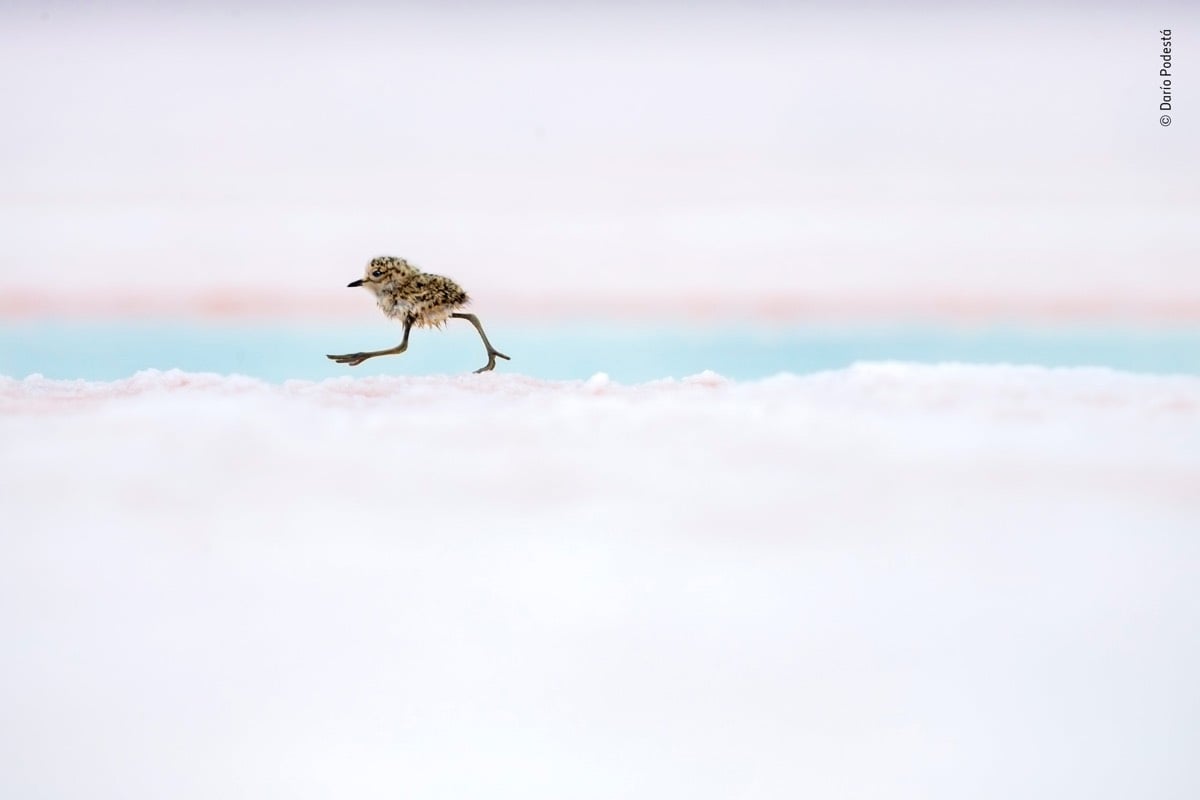



London’s Natural History Museum has announced the winners of the 2018 Wildlife Photographer of the Year contest.
I included some of my favorites above. From top to bottom, Darío Podestá,
Marsel van Oosten, Cristobal Serrano, and Carlos Perez Naval (who competed in the 11-14 year-old category).
Hours and Hours of Relaxing & Meditative Videos
Today is Election Day in the US and even President Obama is saying these elections “might be the most important of our lifetimes”. Everyone is a liiiittle on edge. Instead of exhorting you to go vote, I dug through the kottke.org archives for some videos to watch if you need a calm moment or hour or entire afternoon and deep into the evening’s election returns.
From the BBC Earth team, long videos of relaxing sounds and scenes from their groundbreaking documentaries like Planet Earth II and Blue Planet II (more here):
A 10-hour version of the world’s most relaxing song:
This is one of my personal favorites, a Norwegian icebreaker idling in the frozen Arctic — “natural white noise sounds generated by the wind and snow falling, combined with deep low frequencies with delta waves from the powerful icebreaker idling engines”:
A 30-day time lapse of a container ship traveling from the Red Sea to Hong Kong:
Claude Debussy’s Clair de Lune is always relaxing and is the perfect accompaniment to snow surfing, an acrobatic art performance, and a tour of the Moon:
A realtime orbit of the Earth in 92 minutes, as seen from the International Space Station:
Somehow, watching someone unslice a tomato is super relaxing:
Recording of a live view of a Norwegian train making its way through the wintery countryside:
Julian Baumgartner restoring a damaged painting:
90-minute video of the sea filmed from the bow of a container ship (no sound but you could combine w/ the most relaxing song):
An 18-minute tour of the International Space Station:
One of Michael Shainblum’s many nature time lapse videos:
A 24-hour generative soundtrack to a trip around Iceland by Sigur Rós (thx, lisa):
This isn’t relaxing but it is funny — a meditation guided by a Dalek:
That’s all I’ve got. Do you have any particular favorites I haven’t posted? Let me know!
New Yorker writer & national treasure Roger Angell is 98 years old, first voted in 1944 for FDR (!), and has a message for us all: go vote.
My Recent Media Diet for Fall 2018
I’ve been keeping track of every media thing I “consume”, so here are quick reviews of some things I’ve read, seen, heard, and experienced in the last month or so. Ok, two months in this case…it’s been awhile. There are a lot of movies on this installment of the list, but I’ve actually gotten some reading done as well. I’m still making my way through Making a Murderer’s second season, just started Small Fry, and am looking forward to seeing the Fantastic Beasts sequel with my kids in a couple of weeks. I’m trying to convince them to dress up when we go to the theater but no dice so far.
Origin Story by David Christian. This is a book based on Christian’s Big History concept, a story that weaves everything from quarks to water to dinosaurs to humans fighting entropy through greater energy & resource usage into one long history of the universe. (B+)
Slow Burn Season 2. Leon Neyfakh and his team are operating at a high level…this is one of the best podcasts out there. I had two major and conflicting thoughts while listening to this season: 1. Bill Clinton is not a good human being, should not have been President, and should not be embraced by contemporary progressives, and 2. The investigation of Clinton by the “independent” counsel was motivated entirely by partisan politics, was mostly bullshit, and shouldn’t have led to anything close to Clinton’s impeachment. (A+)
Three Identical Strangers. Fascinating entry in the nature vs nurture debate. This movie had at least two more gears than I expected. (A-)
Prohibition. Really interesting three-part documentary from Ken Burns & Lynn Novick about Prohibition in America. For instance, I didn’t know that the early temperance movement was led by women who were basically fed up with their husbands coming home and beating & raping them. Between this and some other stuff I’ve been thinking about, I’m convinced that while prohibition isn’t the answer, the US would be a better place to live if alcohol consumption were much lower. (A-)
Seeing White. What even to say about this? Fantastic and fascinating podcast series about the notion of “whiteness”, where racism comes from, and a lot of related topics. For instance, the synopsis for the second episode is “For much of human history, people viewed themselves as members of tribes or nations but had no notion of “race.” Today, science deems race biologically meaningless. Who invented race as we know it, and why?” Two episodes particularly stick out: the one about Native Americans and the one on white affirmative action, which was extraordinarily eye-opening. Top recommendation, a must-listen. (A+)
Smokey and the Bandit. This always seemed to be on TV when I was a kid. I gotta say, it’s still entertaining. But whoa, the casual overt racism that made it into movies in 1977. Oof. (B)
First Reformed. Ethan Hawke is terrific in this spare film. (B+)
Deadpool 2. I feel like I should feel bad for liking this so much. Probably did laugh until I cried. (A-)
A Beautiful Mind. I saw this when it came out and it seemed more straightforward than Oscar-winning this time around. Best Picture? I don’t see it. (B)
Mad Max: Fury Road. Fourth or fifth viewing? God, this movie is just so simple and devastatingly effective. It just *works*. (A)
Now My Heart Is Full by Laura June. Roxane Gay wrote of this book: “Sometimes, a book swells into something far lovelier than you assume it will be.” Exactly right. (B+)
Montreal bagels. Better than NYC bagels. And it’s not close. (A-)
The Good Neighbor: The Life and Work of Fred Rogers by Maxwell King. A bit uneven in spots, but there’s some really great stuff in here. Rogers really was an incredible person. (A-)
Fantastic Beasts and Where to Find Them. Getting ready for the sequel. (B+)
Maniac. I’ve watched the first four episodes of this. Good aesthetics and quirky but I’m wondering if I really need to finish the rest of it. (B)
Searching. Worth watching for the unique way the story is told. Solid & engaging plot too. (B+)
Jurassic World: Fallen Kingdom. I’ve already forgotten what happens in this movie. (C)
Last Seen. No one knows who stole $500 million worth of art from the Isabella Stewart Gardener Museum in 1990 nor has the art ever been recovered. This podcast details the major theories and suspects. (B)
Civilizations. This wannabe art history nerd loved this series. (A-)
Reply All: The Crime Machine. Fascinating story about how the NYPD got hooked on crime statistics, which helped them to clean up the city but then went wrong. (A-)
Schwartz’s Deli. The smoked meat sandwich somehow lives up to the hype. Don’t skip the pickle! (A-)
First Man. I noticed many of the things that Richard Brody did in his review but don’t consider the film a “right-wing fetish object”, Armstrong’s red baseball cap aside. It seemed to me that the arrested emotional development of Armstrong & his fellow astronauts was not played for heroic effect but actually seemed rather sad. If this was the great America we need to get back to, count me out. (B+)
Kingsman: The Golden Circle. Not as fun as the original. (B-)
Tomb Raider. This should have been better. (B-)
Bohemian Rhapsody. Pro tip: always go to fandom movies on opening night, even if you’re not particularly interested in the movie. I saw this with a packed theater of Queen fans. People were dressed up and they sang along to the songs. During We Will Rock You, the theater was actually shaking. Really fun. Like this guy, I also have a new appreciation on Queen’s music. Oh and if you’re bent about the liberties taken with the story, this take on the film by a Queen superfan is worth reading. (A-)
The TED Interview podcast w/ Elizabeth Gilbert. The second section, on the grief she left after her partner died earlier this year, in particularly worth a listen. (B+)
X-Men. Viewed during an 11-hour plane ride. Solid but shows its age with the action stuff, which was slow and inconsequential. I also watched the two sequels. (B)
Moneyball. I somehow hadn’t seen this before and really liked it. I think I need to read the book again. (A-)
Ocean’s Thirteen. Surprisingly fresh for the 13th movie in the series. Don’t @ me. (B+)
Volver. I need more Almodovar (and Penelope Cruz) in my life. (B+)
Farsighted by Steven Johnson. The advice on how you can make better long-term decisions is actually quite short, but Johnson’s explanation is typically well-informed and buoyed by keen storytelling. Favorite line: “The novel is an empathy machine.” (B+)
Conversations with Tyler w/ Paul Krugman. Tyler Cowen might have the best interview questions around. My favorite aspect of this episode is how many times Krugman, a Nobel Prize winner, says some version of “I don’t know” in reply to a question. (B+)
Conversations with Tyler w/ Malcolm Gladwell. Another thought-provoking episode. Gladwell answered every question. (B+)
Conversations with Tyler w/ Michael Pollan. Psychedelics seem increasingly promising. Time to read Pollan’s book on the subject perhaps. (B+)
Making a Murderer. The second season isn’t as compelling as the first (at least through the first 2/3s) but the show is still an intriguing examination of our legal system, class & wealth, the power of the human imagination, and all things Wisconsin. (A-)
I also covered a bunch of stuff I experienced in Berlin in this post so I won’t repeat myself. I plan on writing a similar post for Istanbul this week.
Past installments of my media diet are available here.
The Art of Film Grain
Like Instagram filters and vinyl records, the use of film grain in movies is now a conscious choice on the part of media creators and consumers. In this video featuring the recent Nic Cage horror movie Mandy (which I hadn’t even been aware of), Evan Puschak discusses how film grain can function as an integral part of a film’s story & mood, not just as a “byproduct of chemical processing”. I found Steven Spielberg’s comment about film grain especially interesting:
The grain is always moving, it’s swimming, which means that even in a still life, let’s say a flower on a table, that flower is alive even if it’s not moving.
Noah and PJ’s Surprise Wedding First Dance. The ending is *amazing*.
Rainy Day People is a potential new AMC show from the creators of Halt and Catch Fire. “…a workplace drama set in a wellness center-style mental health and rehab facility…”
Koyaanisqatsi Made with Animated GIFs
Koyaanisqatsi is a 1982 experimental film by Godfrey Reggio with a soundtrack from Philip Glass. The movie has no dialogue or narrative and mainly features slow motion and time lapse footage of nature, technology, and cities.
Rico Monkeon has built a tool called Gifaanisqatsi that constructs the trailer for Koyaanisqatsi using a random assortment of slow motion and time lapse animated GIFs from Giphy. The trailer you get is different each time. You can compare it to the actual trailer.
I wondered how easy it would be to make an internet version using random Giphy ‘gifs’ which have been tagged as slow motion or time-lapse, playing them along with the Philip Glass soundtrack.
I *love* this and have watched at least 5 or 6 different trailers now…the slow motion cats and dogs are best. I recorded one of the trailers it generated for me:
I miiiiight just want to watch a feature-length version of this accompanied by the full soundtrack.
Gorgeous Low-Angle Satellite Photo of San Francisco


For practical reasons, satellite images are usually taken from straight overhead. But as this low-angle shot of San Francisco taken by DigitalGlobe’s Worldview-3 satellite illustrates, satellites are also capable of capturing more artful & surprising photographs of our planet. Due to the odd angle, it almost looks fake, computer-generated. Look at that toy Golden Gate Bridge connecting SimCity to a hyperrealist painting of the rugged California coast!
The image is worth seeing at full-resolution…you can find it at DigitalGlobe (they released it under a Creative Commons license) or Imgur. In the nearly full-res view of one slice of the map above, you can make out boats in the bay and even cars on the bridges.
Charlie Loyd of Mapbox explains how they captured such a crisp image:
We don’t often see pictures like this one. The problem is haze: as a camera in space looks toward the horizon, it sees more water vapor, smog, and other stuff in the atmosphere that obscures the Earth. But our friends at DigitalGlobe built WorldView-3 with a sensor suite called CAVIS, which lets it quantify and subtract haze - making atmospheric effects virtually invisible. Only WorldView-3 can see so clearly at this angle.
See also more satellite images taken from the side. (via daily overview)
Over the past century, we’ve redefined our basic units of measure (meters, seconds, etc.) in terms of constant properties of the universe. The last holdout, the kilogram, has finally been cracked.
From XKCD, a zoomable map of the 2018 midterm election challengers. “The bigger the candidate’s name, the higher the office and the better their chances of success”
Socials & More