Entries for February 2018
In the fourth episode of the first season of The Wire, the one that really hooks you fully into the show, detectives Bunk and McNulty enter a crime scene and scour it for potential clues, communicating with each other almost entirely using variations of the word “fuck”.
It’s a great scene, almost pure visual filmmaking and an homage to a singularly versatile word. In his new book, All the Pieces Matter: The Inside Story of The Wire, Jonathan Abrams details how this scene came to be made. New York Magazine has an excerpt.
David comes up to us and describes a scene. He says, “You’re going to go to the scene. You’re going to realize that [the previous] detective, he did a bad job. Wendell, you’re going to see the photos of the girl. Dominic, you’re going to start getting the stats, looking at what the report was. Going back over, you’re going to realize it’s impossible to have gone down the way it was reported, because the guy would have to be like eight feet tall to get that trajectory. If he did, then something must be left in here, and you’re looking for any evidence that may be around, and Wendell, you discover that there’s a shot through the window. The glass is on the inside. It means it came from the outside. That means whoever the perpetrator was wasn’t inside, like the person they say in the report. The bullet came from outside. From there, let’s see the trajectory. It would be right here, in the refrigerator. Let’s see, not the wall. In the refrigerator, we find the bullet here. Let’s go outside, make a new discovery.” He explained the whole scene to us. He said, “Now you guys are going to do that whole thing, but they’re going to be on me about the profanity and language that we use.” So, I said, “Let’s just come out the box with it.” He said, “You’re going to do that whole scene, but the only word you can say is ‘fuck.’” I said, “What?”
“Here” is a comic by Richard McGuire that tells the story of a single room over the course of billions of years.
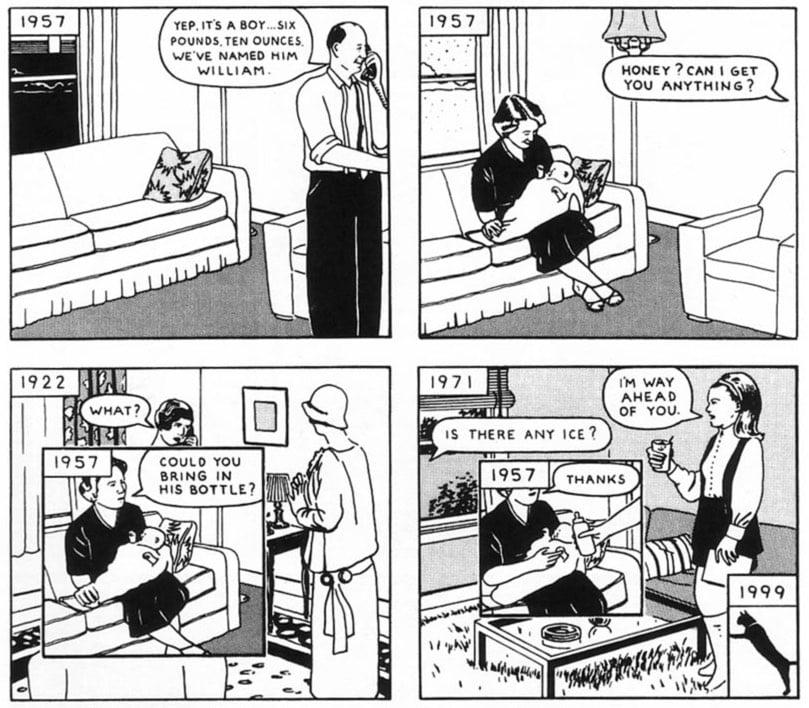
In 2014, McGuire expanded the comic into a very well-received graphic novel. In the NY Times, Luc Sante called the book “brilliant and revolutionary”:
The book originated as a 36-panel story published in 1989 in Raw, the comics journal edited by Art Spiegelman and Francoise Mouly. No one who saw that story ever forgot it: a chronicle of a life, running from 1957 to 2027, as situated in one room, with kaleidoscopic intrusions from various pasts and a wisp of a future — the house burns in 2029 and is torn down in 2030; a time capsule is interred on the site in 2033. The time capsule, perhaps too neat a detail, has not survived the translation to the book, and the story no longer follows a single human life but fully widens its scope to the life of the place. You might say that the book is “Fantasia” to the story’s “Steamboat Willie,” for example, considering the latter’s black-and-white panels that draw their style from generically jocular 1950s illustration.
(via @davextreme)
Candy heart messages written by a neural network. “LOVE BOT” “COOL CUD” “TIME HUG” “SWEAT PEAR” “YOU ARE BAG”
These two teachers, Jerusha Willenborg of Mueller Elementary in Wichita, KS and Barry White Jr. of Ashley Park Elementary School in Charlotte, NC, both greet each of their students with a personalized handshake every day.
I love watching these. I can barely remember to shake with my right hand…no idea how the teachers memorize all that.
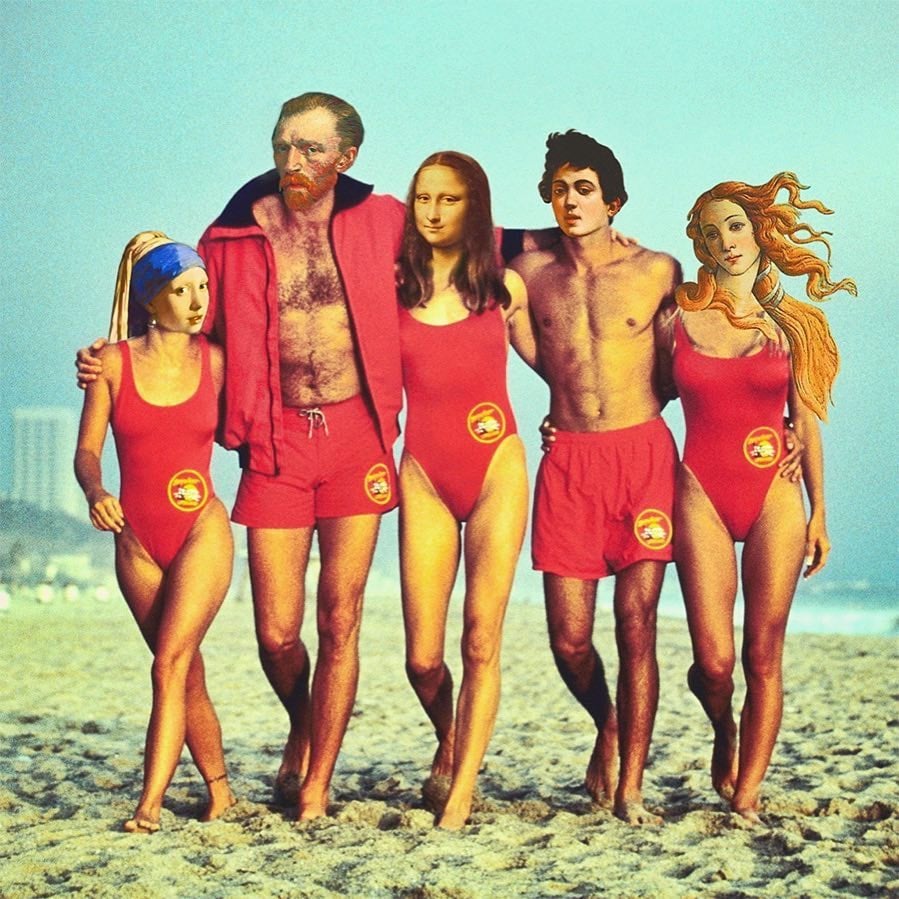
Photo collage by Dan Cretu.

The UK’s Engineering and Physical Sciences Research Council just announced the winner of their annual science photography contest: a photo of a single strontium atom suspended in an electric field taken by David Nadlinger. The atom is that tiiiiny dot in the middle of the photo above.
‘Single Atom in an Ion Trap’, by David Nadlinger, from the University of Oxford, shows the atom held by the fields emanating from the metal electrodes surrounding it. The distance between the small needle tips is about two millimetres.
When illuminated by a laser of the right blue-violet colour the atom absorbs and re-emits light particles sufficiently quickly for an ordinary camera to capture it in a long exposure photograph. The winning picture was taken through a window of the ultra-high vacuum chamber that houses the ion trap.
Laser-cooled atomic ions provide a pristine platform for exploring and harnessing the unique properties of quantum physics. They can serve as extremely accurate clocks and sensors or, as explored by the UK Networked Quantum Information Technologies Hub, as building blocks for future quantum computers, which could tackle problems that stymie even today’s largest supercomputers.

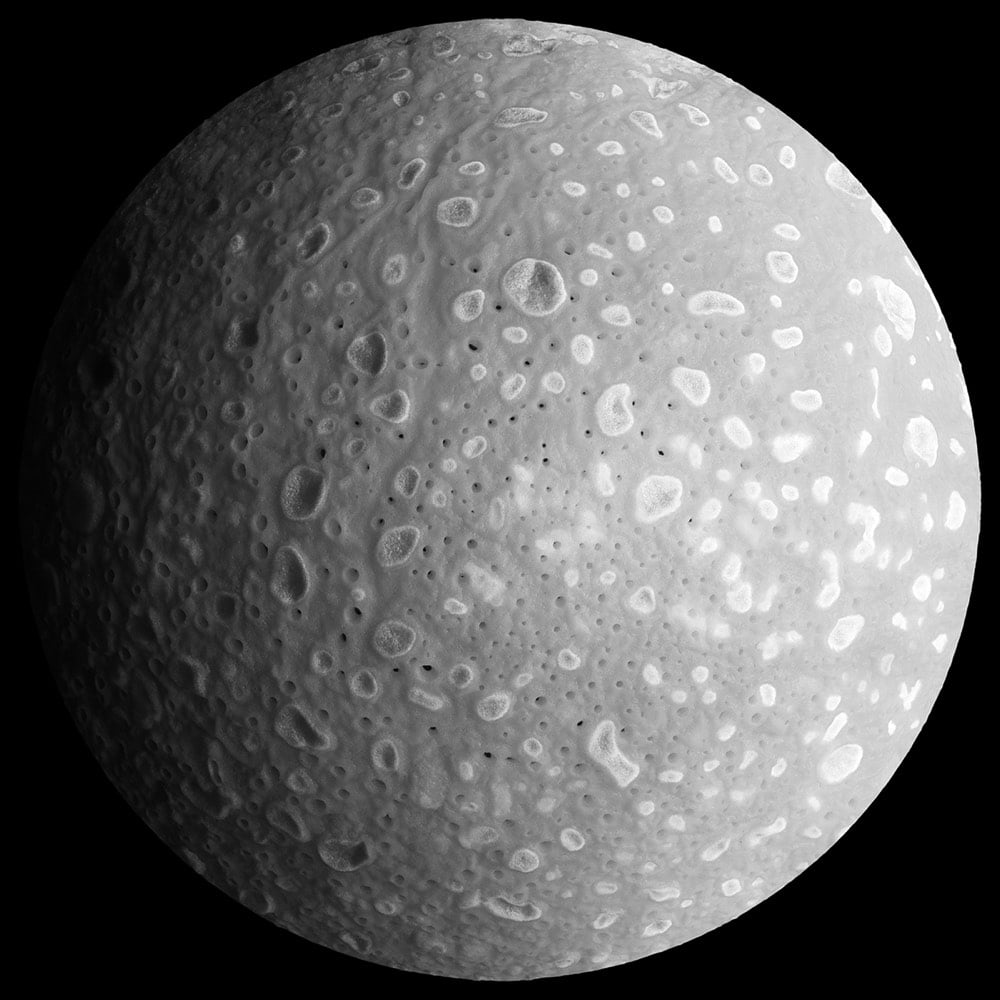
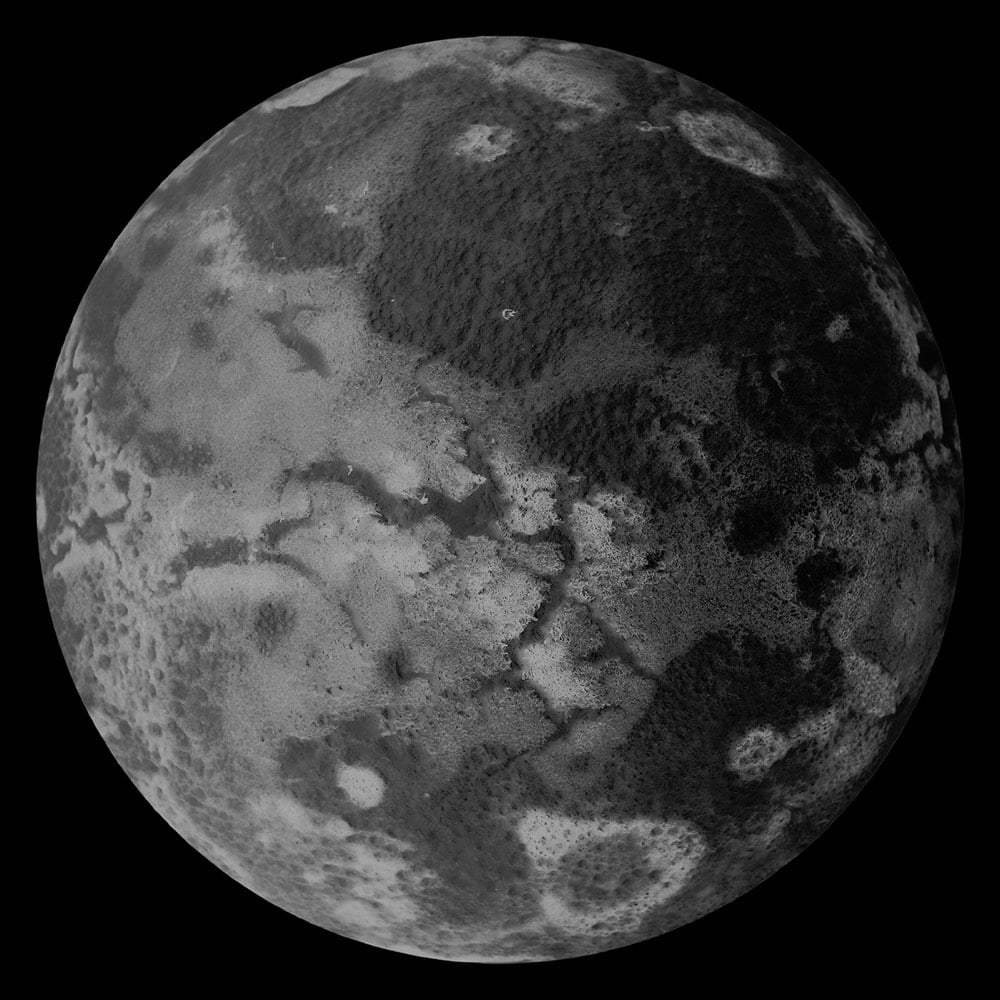
Nadine Schlieper and Robert Pufleb have published a book called Alternative Moons. The book is filled with photographs of pancakes that look like moons.
See also Christopher Jonassen’s photos of frying pans that look like Europa, one of Jupiter’s moons. Oh, and don’t forget about the world’s best pancake recipe.
Every reason that provoked David Banner to turn into the Hulk. “Being pushed down a mountainside by a bigfoot impersonator.” “Being fed poisoned sushi.”
Let’s say you’re doing 100 mph in a car and suddenly a downed tree, stopped car, or person appears in the road up ahead and you need to slam on the brakes. How much more dangerous is that situation than when you’re doing 70 mph? Your intuition might tell you that 70 mph is only 30% less than 100 mph. But as this video shows, the important factor in stopping a car (or what happens to the car when it collides with something else) is not speed but energy, which increases at the square of speed. In other words, going from 70 mph to 100 mph more than doubles your energy…and going from 55 to 100 more than triples it. (thx, david)
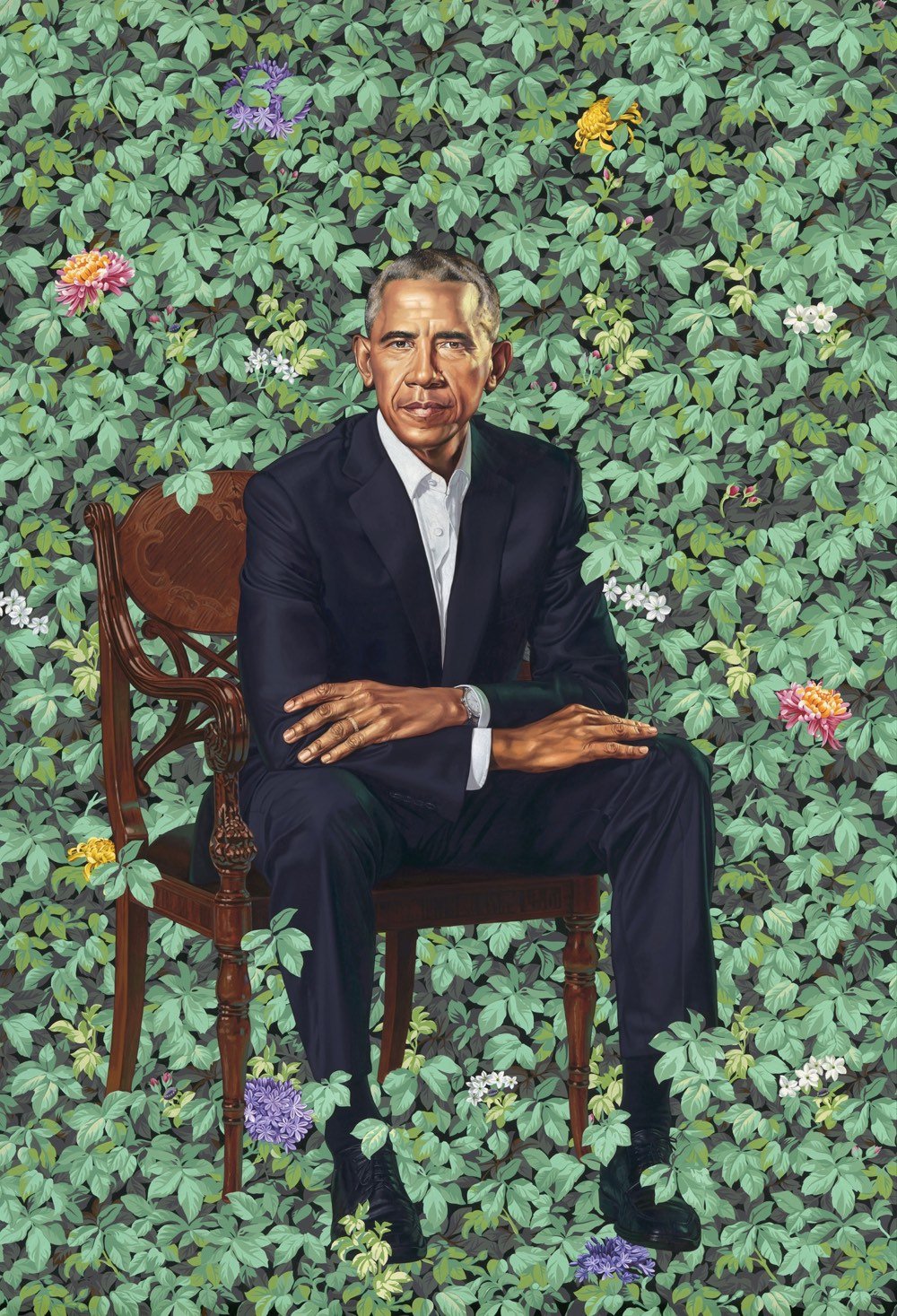

The Smithsonian’s National Portrait Gallery commissions paintings of each outgoing President and First Lady. The Obamas selected a pair of black artists, Kehinde Wiley and Amy Sherald, to paint their portraits, which were unveiled today. From Colossal:
Wiley’s depiction of President Obama features the artist’s signature style of richly-hued background patterns setting a vibrant symbolic environment for the portrait’s subject. President Obama is surrounded by a carefully selected variety of foliage: jasmine, which represents Hawaii; African blue lilies for his father’s Kenyan heritage; and Chicago’s official flower, the chrysanthemum. For Mrs. Obama’s portrait, Sherald engaged her distinctive combination of depicting skin tone in grayscale, offset by the sharply rendered full-color fabric of Mrs. Obama’s floor-length dress.
Even a cursory glance at other Presidential portraits shows how different the Obamas’ portraits are.
I was very sad to hear about the death of Icelandic composer Jóhann Jóhannsson at the age of 48. Jóhannsson’s soundtrack to Arrival is one of my favorite soundtracks in recent years.
He also scored Sicario & Prisoners for director Denis Villeneuve as well as The Theory of Everything, earning a pair of Oscar nominations for his work. Back in 2016, Jóhannsson did a breakdown of one of his Arrival tracks for Song Exploder.
Update: This is a great little story about Jóhannsson from musician Ólafur Arnalds:
My favorite Jóhann story is when he had spent a year writing the score for Darren Aronofsky’s “Mother” and at some point realised that the film was better with no music at all. He proceeded to convince Darren to delete everything. It takes a real, selfless artist to do that. To realise the piece is better without you.
The most important part of creating art is the process, and Jóhann seemed to understand process. The score needed to be written first in order to realise that it was redundant. So in my view, Mother still has a score by Jóhann. The score is just silence… deafening, genius silence.
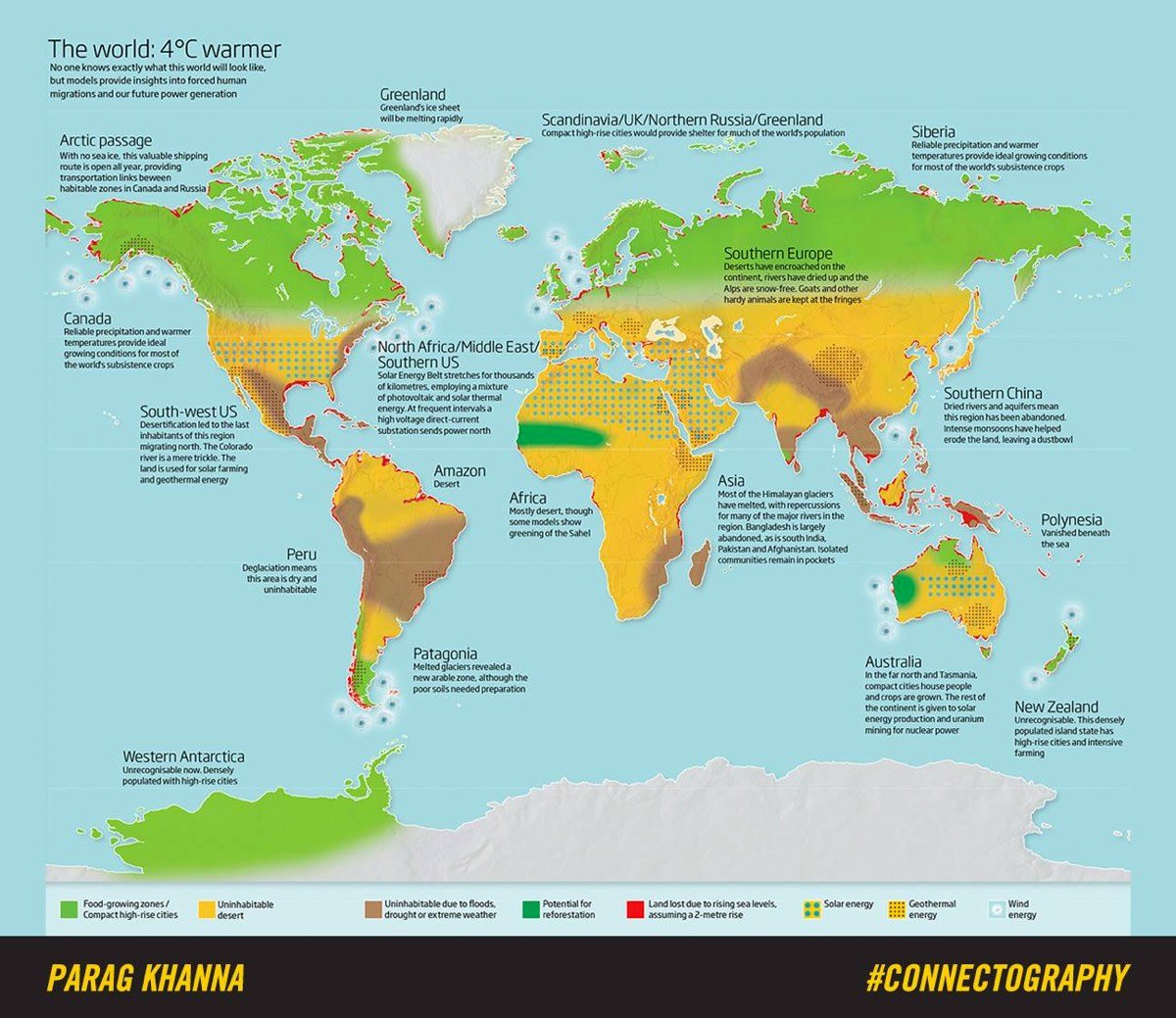
In this speculative world map published in 2009, New Scientist imagines what the world might look like if (or more likely, when) the Earth warms by 4ºC. Many current coastal areas would be underwater and much of the most heavily populated areas of the Earth would be desert or otherwise uninhabitable while the northern parts of Canada and Russia would become the new bread baskets of the world. But on the plus side, western Antartica would be habitable and possibly “densely populated with high rise cities”. In an article that accompanied the map, Gaia Vince wrote:
Imagine, for the purposes of this thought experiment, that we have 9 billion people to save — 2 billion more than live on the planet today. A wholesale relocation of the world’s population according to the geography of resources means abandoning huge tracts of the globe and moving people to where the water is. Most climate models agree that the far north and south of the planet will see an increase in precipitation. In the northern hemisphere this includes Canada, Siberia, Scandinavia and newly ice-free parts of Greenland; in the southern hemisphere, Patagonia, Tasmania and the far north of Australia, New Zealand and perhaps newly ice-free parts of the western Antarctic coast.
The citizens of the world’s wealthiest and most populous nations will become climate refugees, which means things are going to get really, really ugly for everyone else.
The long-awaited sequel to Alto’s Adventure is coming out soon! Alto’s Odyssey will be out on Feb 22nd and is available for pre-order on the App Store. The game takes place in the desert and has a very similar vibe to the original, which is one of my top five favorite video games of all time.
I’ve played Alto’s Adventure a lot over the past year and a half. Like very a lot. At first, I played because the game was fun and I wanted to beat it. But eventually, I started playing the game when I was stressed or anxious. It became a form of meditation for me; playing cleared my mind and refocused my attention on the present. Even the seemingly stressful elements in the game became calming. The Elders, who spring up to give chase every few minutes, I don’t even notice anymore…which has become a metaphorical reminder for me to focus on my actions and what I can control and not worry about outside influences I can’t control.
Here’s the trailer for Alto’s Odyssey, which shows many of the new gameplay elements like bounce-able balloons, walls you can ride, water features, etc.:
I’ve been playing the beta version of Alto’s Odyssey for the past few days and while I can’t say much about it, I will share that fans of the original will be very pleased. It strikes a good balance between familiarity and novelty. So go forth and pre-order!
Recently frozen lake ice has some interesting properties: it looks completely black and makes some interesting sounds when you skate over it. Swedish mathematician Mårten Ajne is a black ice skating enthusiast and he demonstrates his technique in this National Geographic video. You’ll want to turn up the sound or use headphones…the ice sounds like a cross between sci-fi phaser fire and getting pinged by sonar in a submarine.
The most desirable condition is virgin black ice, when a lake has caught its first ice cover and it has grown just thick enough to bear your joy. In favorable weather conditions this will take two days after freeze-over.
Five centimeters [2 inches] is often the limit [to how thin it can be]. If you’re close to shore, you can go thinner, up to about 3.5 centimeters, before it breaks. That’s for fresh, cold black ice. Brackish ice, which contains salt, needs to be thicker and is more difficult to assess.
At one point, Anje measures the ice with a caliper — it’s only 45 mm thick — but what really illustrates the crazy thinness of the ice is that you can see the surface flex as the water moves under it (wait for him to skate by the camera at ~1:42 in the video) and the ice cracking behind him (at ~2:02). Whaaaaa?!! (via the kid should see this)

Adi Robertson at The Verge has a fun, informative history of old cathode ray tube television sets, plus the people who study them, keep them working, and continue to use them. One maybe-surprising constituency: retro gamers.
Old games may look torn or feel laggy on a new TV. That’s in part because LCD screens process an entire frame of an image and then display it, rather than receiving a signal and drawing it right away.
Some games are completely dependent on the display technology. One of the best-known examples is Duck Hunt, which uses Nintendo’s Zapper light gun. When players pull the trigger, the entire screen briefly flashes black, then a white square appears at the “duck’s” location. If the optical sensor detects a quick black-then-white pattern, it’s a hit. The entire Zapper system is coded for a CRT’s super fast refresh rate, and it doesn’t work on new LCD TVs without significant DIY modification.
Old-school arcades, too, need to constantly maintain and replace their old tube monitors. Weirdly, this makes old television sets extremely valuable, even as it’s more and more difficult to have them recycled or thrown away.
“CRTs are essentially the bane of the electronic recycling industry,” says Andrew Orben, director of business development at Tekovery, one of the companies Barcade uses to dispose of irrevocably broken hardware. The tubes contain toxic metals that could leach into a dump site, and 18 states specifically ban sending them to landfills. They’re made of raw materials that are often impossible to sell at a profit, primarily glass that’s mixed with several pounds of lead.
They’re also insanely heavy. Even in 2002, a 40” tube TV would weigh more than 300 pounds. (Bigger TVs used to be rear-projections, remember?)
In Thailand, Buddhist monks, and students studying to be monks, play video games sometimes like everyone else. But many of them are ambivalent about the games’ value.
The danger in playing a game is not the game itself, but the desire it may cause—since in Buddhist thought, desire is the cause of suffering. “If you lose or win, you want to do it again and again. You’re always thinking about the game. If you cling to that mindset, it causes mental suffering or physical suffering.”
This danger of competition and desire are why monks are generally not allowed to play sports. (Though, to be honest, I’ve seen more than a few novices playing covert soccer games.) Sports offer many benefits, both men agree, but if they become too much about winning or lead to bad feelings it can damage attempts to attain enlightenment.
Robert Rath, the author, tries to get the monks to dive deep on the connection between spawning, dying, and respawning in video games and an idea of a cycle of life and rebirth, but for the most part, the monks aren’t buying it. Games are fun, they’re challenging, they’re big distractions from study and meditation — and that’s about it. Not a lot of deeper meaning there.
Which to me, is refreshing, and very Buddhist (as I understand it). Why does everything have to mean anything? Most things are just nonsense. Let them be what they are, and be wary of the power you give them.

Zito Madu interviewed eight Olympic athletes to tell stories about their scars, their bodies, and major injuries they’d suffered in competition or training. It’s a fascinating look at how top athletes see their bodies. For example, here’s freestyle skier Devin Logan, on how injuries make athletes smarter:
I have had countless injuries throughout my whole life. Broken bones, sprains, and surgeries. I wouldn’t say the injuries get easier because it is always a hard time dealing with an injury that takes you out of something you love, but I would say injuries make you smarter. They make you smarter with how you train to come back and smarter with knowing what is best for you. You start to know yourself and body better, and that’s the greatest thing to take away from injuries because things that work for you may not work for others.
Or Ashley Caldwell, on how they can make you doubt yourself:
You train your body and your mind to be the best it can be and when an injury presents itself you feel as though your body betrayed you. That all the hard work, dedication and care you took to be a professional athlete was wasted because your body didn’t quite want to do it or couldn’t handle it.
J.R. Celski on the difference between athletes and regular people:
An athlete’s best friend is their body. A regular person’s might be their mind. Athletes spend all day training their bodies, whereas regular people might be required to complete tasks using their minds.
And Alana Nichols, a wheelchair basketball and alpine skier, on her most devastating injury:
Breaking my back and becoming paralyzed wasn’t enough to keep me from skiing, but after I destroyed my right shoulder up at Mt. Hood in June 2013, I seriously considered never skiing again. I was left with one functioning limb for six-plus weeks (legs paralyzed and right arm in a sling) but luckily living at the Olympic training center in Colorado Springs. Right dead in the middle of that recovery process, taking medication to manage my pain, and struggling day in and day out to do the simplest tasks of daily living (with my left arm) was when I completely wanted to give up. The doctors at the OTC said I wouldn’t make it back to for the Sochi Games the following March, but my physical therapist thought differently. My rehab was excruciating; seven days-a-week (thankfully) of aggressive soft tissue manipulation, dry needling with STEM, and active mobility stretching. I definitely had moments of doubt, but all I could do was take it one struggle bus day at a time.
Madu, who was a professional soccer player himself, has a philosophical approach to all this, influenced by Dante Aligheri:
My fascination with scars stems from my belief of the body as an integral part of the miracle of human beings. The body, to me, is not a shell a person is trapped in. I see the body and mind as inseparable and do not put the mind as the greater of the two. The body is neither inferior nor a limitation. It is necessary and equally glorious.
Ahh, this photo takes me back to the early 90s. Boom box, IBM PC AT (with a 286 processor), NES cartridge, JUST DO IT.
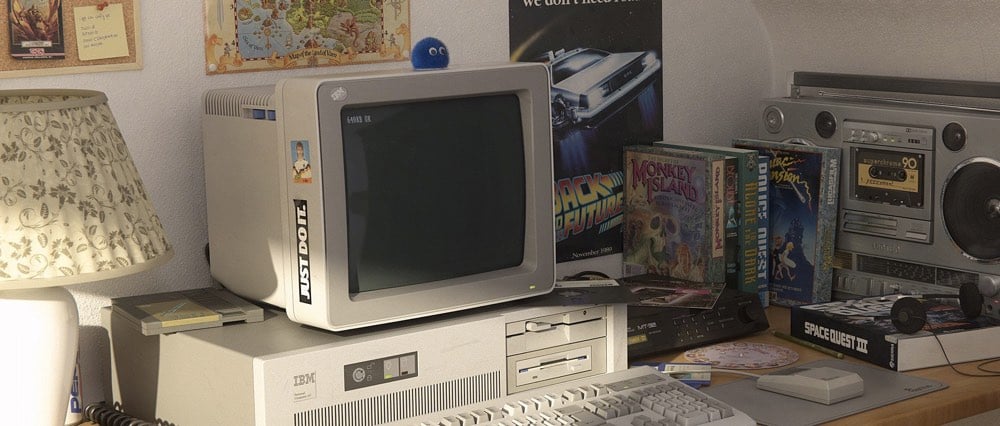
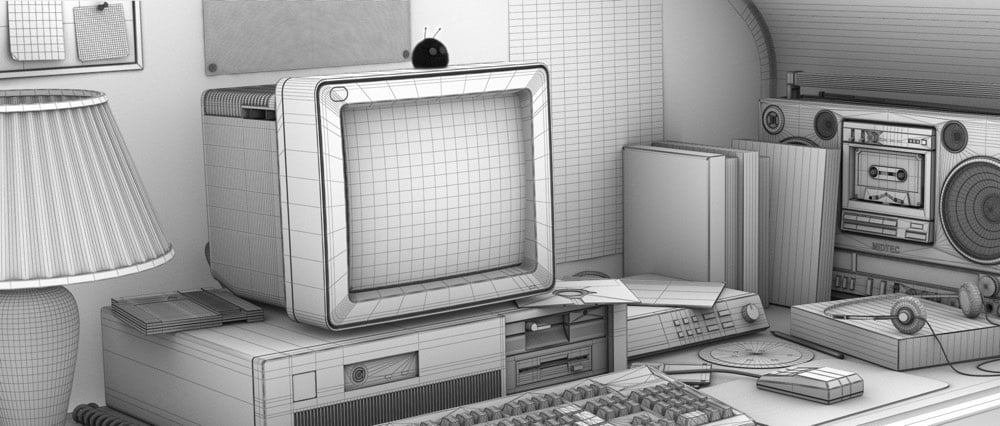
Except that’s not actually a photo. Daniel Karner rendered that scene in 3D using 3ds Max and V-Ray. Here’s the wireframe:
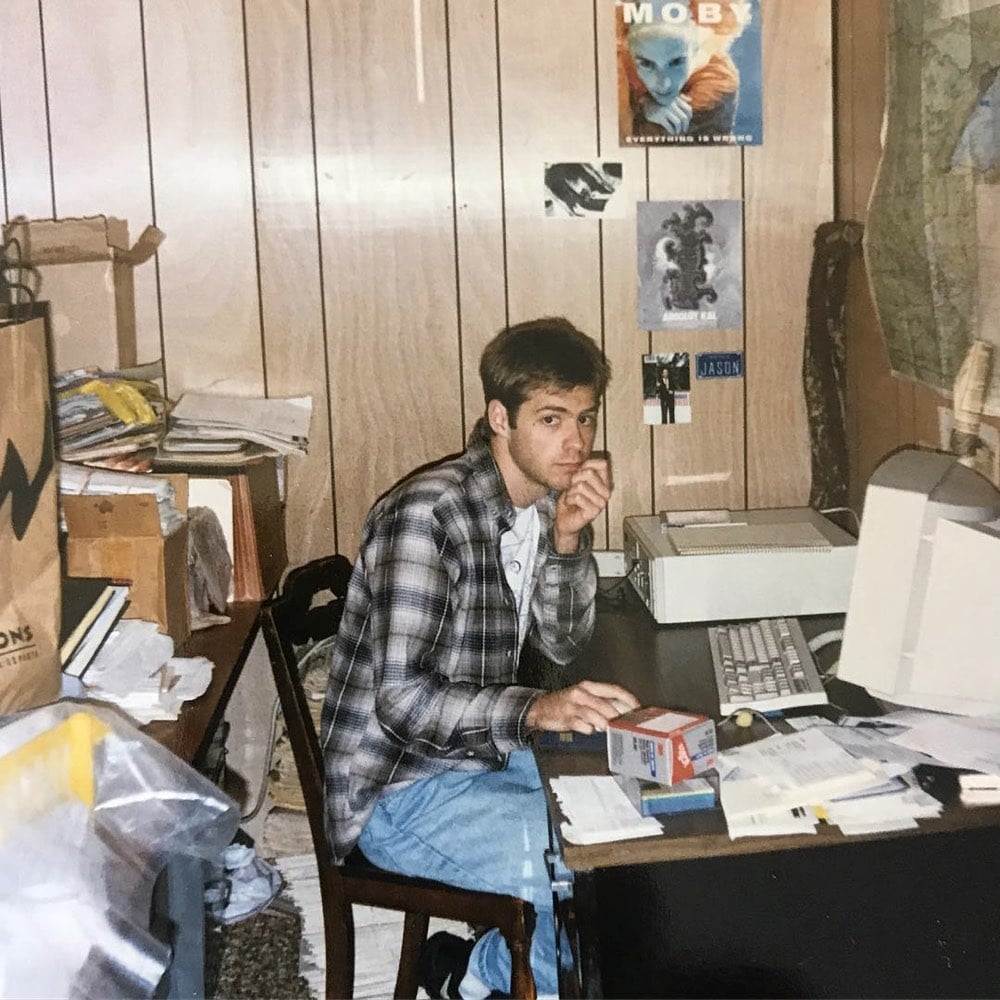
See also celebrities using computers in the 80s/90s (Corey Haim, Shakira, Brad Pitt, Christian Bale) and me using a computer in 1996.

In response to a New Yorker article by Jill Lepore about fashion dolls like Barbie and Bratz, 11-year-old Violette Skilling sent in a letter to the magazine with her take on the dolls. It reads, in part:
I never wanted a Barbie or a Bratz doll until I discovered doll reconstruction. What you do is erase the features of the doll with nail-polish remover, and then remove the hair and make other body modifications. Then you give the doll a new face, new hair, and new clothing. (My favorite part is ripping out the hair, which is very therapeutic.)
What I like about doll reconstruction is that I am in control. I can make them pretty, or not. The two dolls that I have reconstructed represent two parts of me: one nerdy and very unfashionable, and one strong and cool. I make up their stories, and they represent my passions, my hopes, and my feelings.
Doll reconstruction is definitely a thing. Sonia Singh repaints the faces of Bratz dolls in a “down-to-earth style” and displays the results on her blog; that’s one of her doll makeovers pictured above. A profile of Singh on YouTube has been viewed more than 20 million times:
She sells a PDF guide to doll re-styling on Etsy. But you can also find tutorials for removing your doll’s “factory paint” on YouTube.
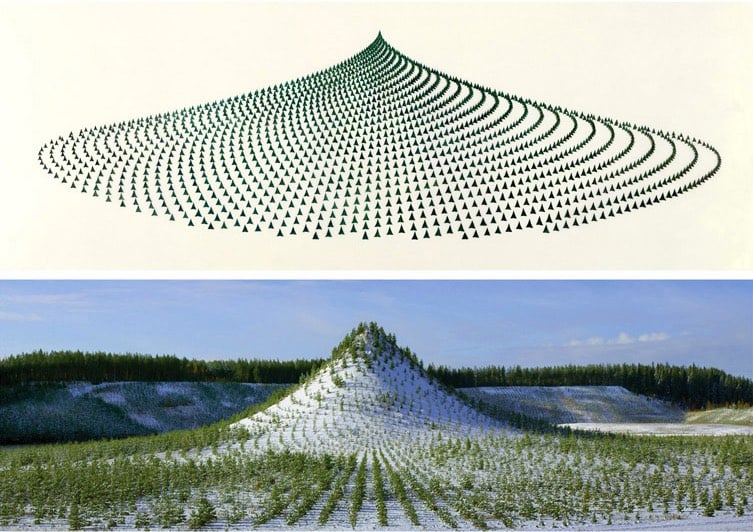
Tree Mountain is a man-made mountain 125 feet high covered in 11,000 trees planted in a configuration according to the Golden Ratio. This art installation was conceived and built by artist Agnes Denes in Finland and is designed to endure for 400 years.
A mountain needed to be built to design specifications, which by itself took over four years and was the restitution work of a mine that had destroyed the land through resource extraction. The process of bioremediation restores the land from resource extraction use to one in harmony with nature, in this case, the creation of a virgin forest. The planting of trees holds the land from erosion, enhances oxygen production and provides home for wildlife. This takes time and it is one of the reasons why Tree Mountain must remain undisturbed for centuries. The certificate the planters received are numbered and reach 400 years into the future as it takes that long for the ecosystem to establish itself. It is an inheritable document that connects the eleven thousand planters and their descendents reaching into millions, connected by their trees.
Here’s Tree Mountain on Google Maps and a lovely video of the mountain shot from a drone:
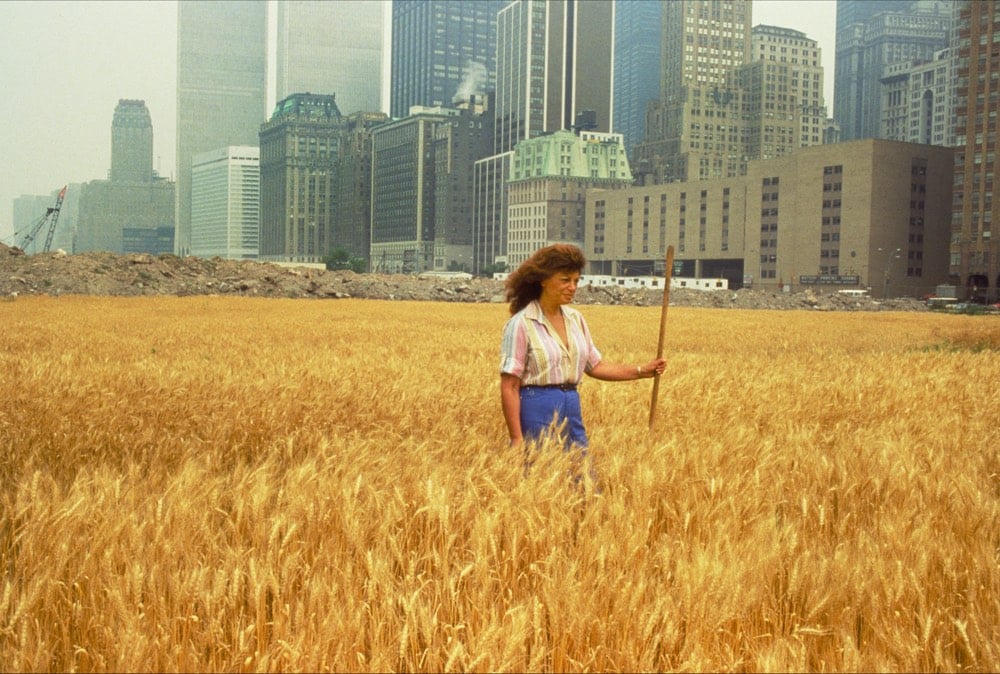
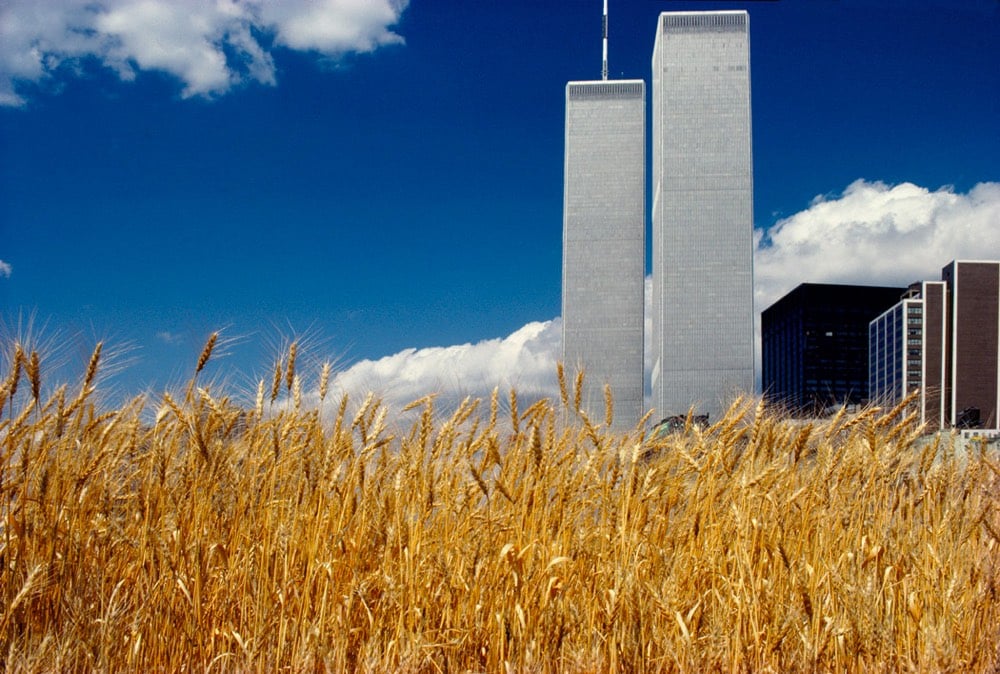
You may have seen another of Denes’ projects: a 2-acre wheat field she planted in 1982 near the World Trade Center in Manhattan.
(via shane)
When producing their claymation-style feature films or Wallace and Gromit & Shaun the Sheep animations, Aardman Animations goes through 100s of pounds of modeling clay. As Adam Savage learned on a recent visit to Aardman, bulk clay from the factory is run through several processes to ensure that Gromit’s fur is the same shade in frame #6800 as it was in frame #1 and that the consistency is appropriate for the modelers.
See also the mesmerizing paint mixing videos on Instagram and YouTube.
Silicon Valley visionary John Perry Barlow died last night at the age of 70. When he was 30, the EFF founder (and sometime Grateful Dead lyricist) drew up a list of what he called Principles of Adult Behavior. They are:
1. Be patient. No matter what.
2. Don’t badmouth: Assign responsibility, never blame. Say nothing behind another’s back you’d be unwilling to say, in exactly the same tone and language, to his face.
3. Never assume the motives of others are, to them, less noble than yours are to you.
4. Expand your sense of the possible.
5. Don’t trouble yourself with matters you truly cannot change.
6. Expect no more of anyone than you yourself can deliver.
7. Tolerate ambiguity.
8. Laugh at yourself frequently.
9. Concern yourself with what is right rather than who is right.
10. Never forget that, no matter how certain, you might be wrong.
11. Give up blood sports.
12. Remember that your life belongs to others as well. Do not endanger it frivolously. And never endanger the life of another.
13. Never lie to anyone for any reason. (Lies of omission are sometimes exempt.)
14. Learn the needs of those around you and respect them.
15. Avoid the pursuit of happiness. Seek to define your mission and pursue that.
16. Reduce your use of the first personal pronoun.
17. Praise at least as often as you disparage.
18. Never let your errors pass without admission.
19. Become less suspicious of joy.
20. Understand humility.
21. Forgive.
22. Foster dignity.
23. Live memorably.
24. Love yourself.
25. Endure.
Here’s what these principles meant to Barlow:
I don’t expect the perfect attainment of these principles. However, I post them as a standard for my conduct as an adult. Should any of my friends or colleagues catch me violating one of them, bust me.
You can read remembrances of Barlow from the EFF and from his friends Cory Doctorow and Steven Levy. The EFF’s Executive Director Cindy Cohn wrote:
Barlow was sometimes held up as a straw man for a kind of naive techno-utopianism that believed that the Internet could solve all of humanity’s problems without causing any more. As someone who spent the past 27 years working with him at EFF, I can say that nothing could be further from the truth. Barlow knew that new technology could create and empower evil as much as it could create and empower good. He made a conscious decision to focus on the latter: “I knew it’s also true that a good way to invent the future is to predict it. So I predicted Utopia, hoping to give Liberty a running start before the laws of Moore and Metcalfe delivered up what Ed Snowden now correctly calls ‘turn-key totalitarianism.’”
Barlow’s lasting legacy is that he devoted his life to making the Internet into “a world that all may enter without privilege or prejudice accorded by race, economic power, military force, or station of birth … a world where anyone, anywhere may express his or her beliefs, no matter how singular, without fear of being coerced into silence or conformity.”
Update: I’ve amended the list slightly from when I first posted it to match more closely an email sent by Barlow to friends on his 60th birthday.
Great no-holds-barred interview with Quincy Jones. Michael Jackson’s thievery, Brando sexcapades, the Kennedy assassination, and a short history of pop music.
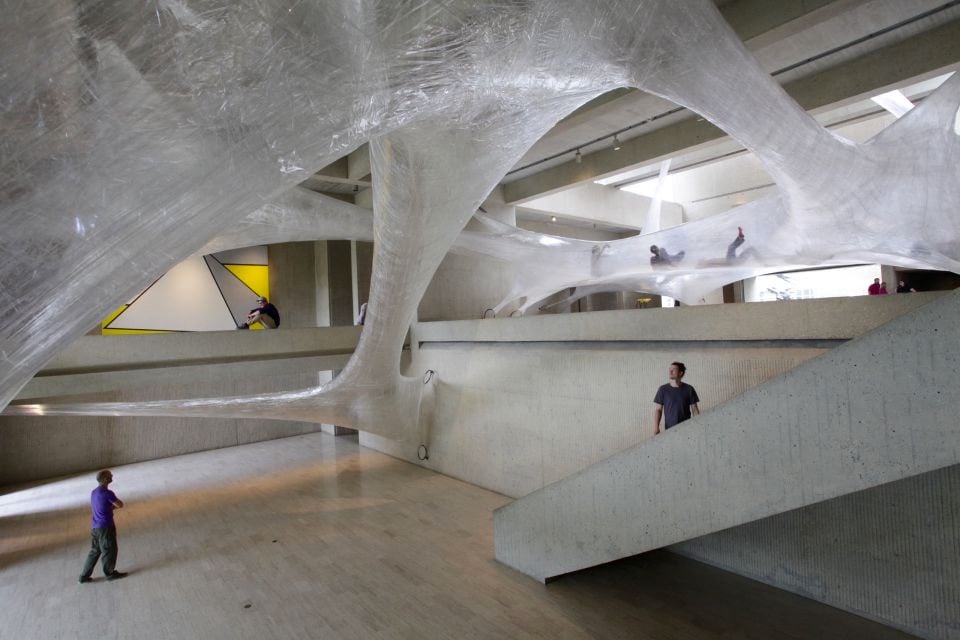
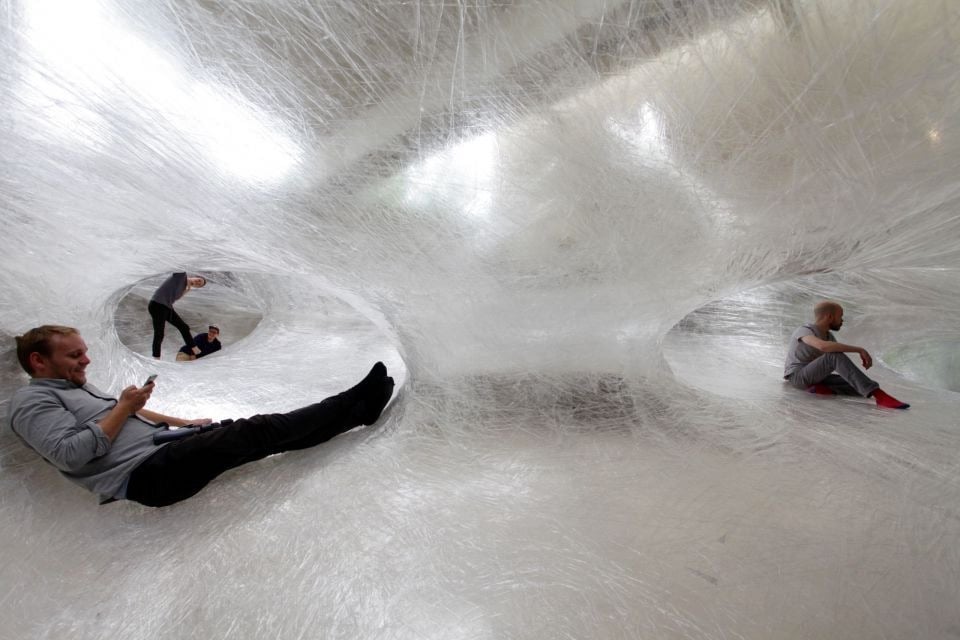
For their project Tape Des Moines, art collective Numen / For Use constructed tunnels in the Des Moines Art Center building made out of packing tape and invited people to crawl around in them. They’ve previously done tape tunnels in Vienna, Paris, and Frankfurt, but I have a looootta questions related to the structural soundness of packing tape. Like: how would puncturing the tunnel with a sharp object (accidentally or otherwise) affect the overall stability of the tunnel? (via colossal)
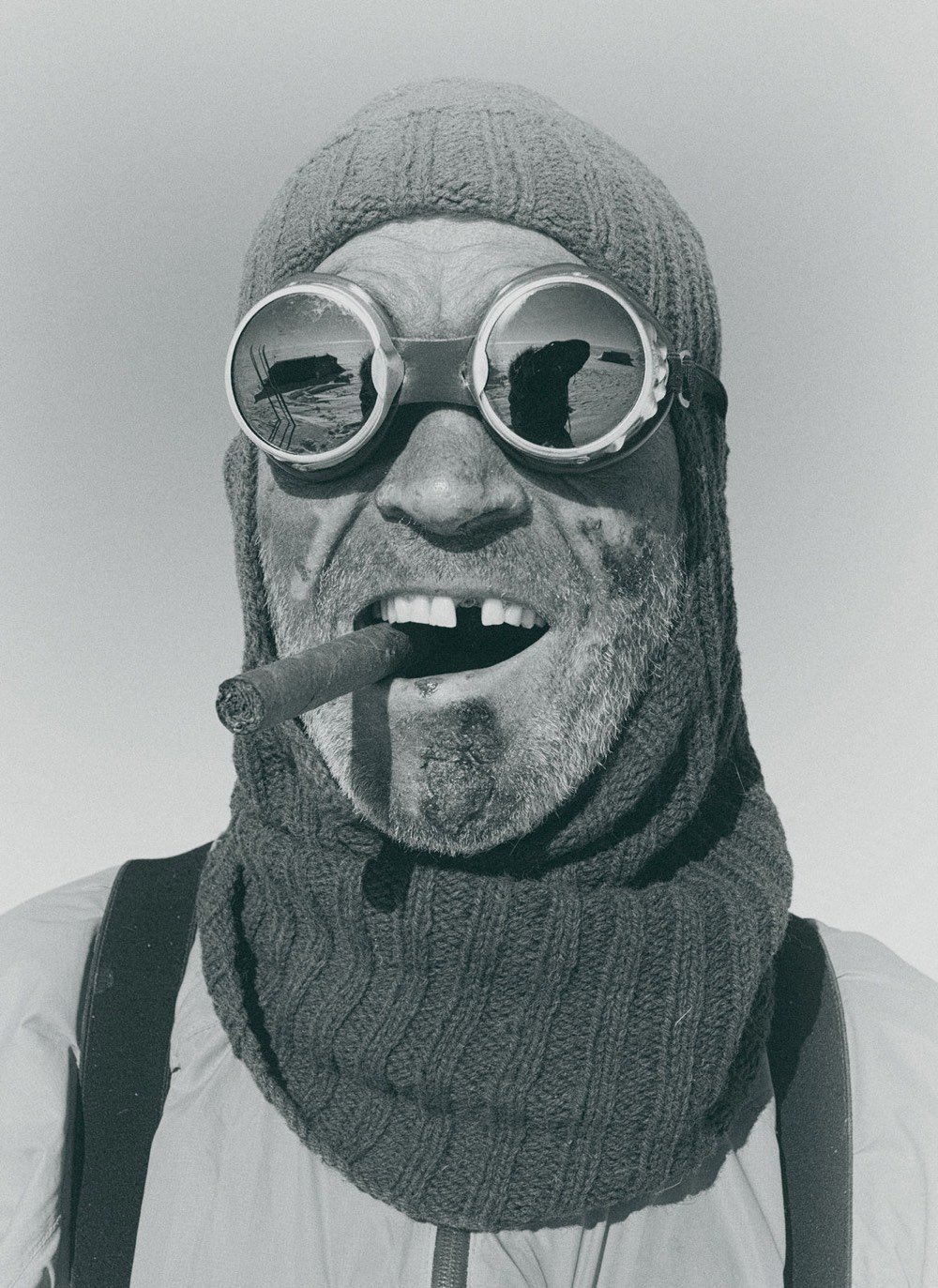
After a long hiatus during which he wrote The Killers of the Flower Moon, David Grann is back in the pages of the New Yorker with The White Darkness, a piece about modern-day polar explorer Henry Worsley, who attempted to cross Antartica in 2015, solo and unaided.
By the middle of January, 2016, he had travelled more than eight hundred miles, and virtually every part of him was in agony. His arms and legs throbbed. His back ached. His feet were blistered and his toenails were discolored. His fingers had started to become numb with frostbite. In his diary, he wrote, “Am worried about my fingers — one tip of little finger already gone and all others very sore.” One of his front teeth had broken off, and the wind whistled through the gap. He had lost some forty pounds, and he became fixated on his favorite foods, listing them for his broadcast listeners: “Fish pie, brown bread, double cream, steaks and chips, more chips, smoked salmon, baked potato, eggs, rice pudding, Dairy Milk chocolate, tomatoes, bananas, apples, anchovies, Shredded Wheat, Weetabix, brown sugar, peanut butter, honey, toast, pasta, pizza and pizza. Ahhhhh!”
He was on the verge of collapse. Yet he was never one to give up, and adhered to the S.A.S.’s unofficial motto, “Always a little further” — a line from James Elroy Flecker’s 1913 poem “The Golden Journey to Samarkand.” The motto was painted on the front of Worsley’s sled, and he murmured it to himself like a mantra: “Always a little further … a little further.”
This was the same trip attempted by Ben Saunders a few months ago. It’s also worth noting the Snow Fall aesthetic of the piece. What is it about winter that inspires this sort of multimedia package? Is it the white space?
Science writer Ed Yong noticed that the stories he was writing quoted sources that were disproportionately male. Using a spreadsheet to track who he contacted for stories and a few extra minutes per piece, Yong set about changing that gender imbalance.
Skeptics might argue that I needn’t bother, as my work was just reflecting the present state of science. But I don’t buy that journalism should act simply as society’s mirror. Yes, it tells us about the world as it is, but it also pushes us toward a world that could be. It is about speaking truth to power, giving voice to the voiceless. And it is a profession that actively benefits from seeking out fresh perspectives and voices, instead of simply asking the same small cadre of well-trod names for their opinions.
Another popular critique is that I should simply focus on finding the most qualified people for any given story, regardless of gender. This point seems superficially sound, but falls apart at the gentlest scrutiny. How exactly does one judge “most qualified”? Am I to list all the scientists in a given field and arrange them by number of publications, awards, or h-index, and then work my way down the list in descending order? Am I to assume that these metrics somehow exist in a social vacuum and are not themselves also influenced by the very gender biases that I am trying to resist? It would be crushingly naïve to do so.
Journalism and science both work better with the inclusion and participation of a diverse set of voices bent on the pursuit of truth.
Update: NY Times’ columnist David Leonhardt conducted his own experiment and discovered I’m Not Quoting Enough Women.
Remember The King of Kong, that documentary about Donkey Kong high scorers? Billy Mitchell has been caught cheating and his highest scores have been scrubbed from the list.
Martin Hollis has fallen in love with Tetris. In this series of tweets, he explains that “Tetris is good because of the emergent things that arise from simple rules”.
In the beginning, you gather heuristics like ‘try to keep the surface flat and without overhangs, and without holes’. These rules of thumbs are emergent.
As you learn more, you realize that every one of your heuristics is wrong, and in the right circumstances a hole can be built and destroyed in two moves, or in more, or in less, to your considerable advantage.
Ultimately, everything becomes dynamic, and the rules of best play turn out to be baroque. The complexity seems to me to be large compared to any other video game.
Hollis also rightly notes that like other great games, sports, and human endeavors, Tetris boils down to a battle with the self, which I’ve previously stated, perhaps absurdly, is “the true struggle in life”.
Tetris produces narrative, or narrative emerges from the shape and flow of the surface, your hopes and needs, and the wax and wane of your doom.
You come to believe you are in control of your fate and that as the board stacks up, that is a monument to your mistakes.
A reversal feels like a release from a crushing end, or an angel’s redemption. You snatch a victory from death. You put a twist in your story.
Tetris is about you. That is its simple power. (via ben pieratt)
That time Jimi Hendrix covered Sgt. Pepper’s right after the album was released with McCartney and George Harrison in the audience
I’ve slept on it and my mind & soul are still reeling from the SpaceX launch of Falcon Heavy yesterday. I can’t tell you why exactly, but when the two side boosters landed safely back on Earth at nearly the same instant, as in a beautifully choreographed ballet, I nearly burst into tears. Just watching the replay gets me all verklempt:
Of course, the boosters were supposed to land at the same time. They broke away from the main stage at the same time and were controlled by identical computer systems in their descent; it’s a simple matter of high school physics to solve for the time it takes two uniform objects to travel from point A to point B. But as Richard Feynman said about the beauty of a flower, knowing the science makes moments like this more wondrous.
And then right after that, the video showed what appears to be a human driving a car in Earth orbit to the strains of David Bowie’s Life on Mars. What an incredible, ridiculous, ludicrous thing:
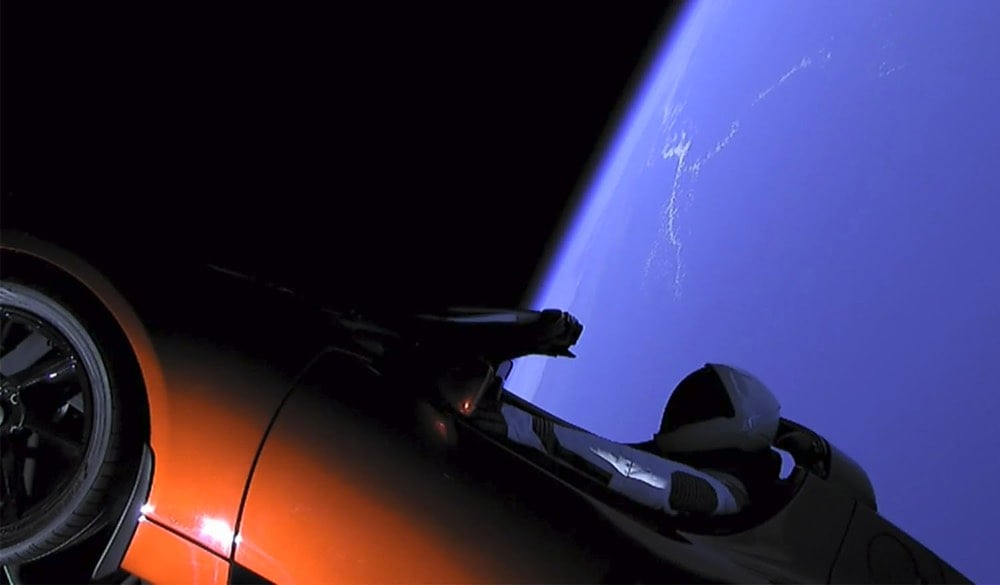
There is ample prior art, but I suspect Elon Musk launching a Tesla Roadster into orbit will go down in history as the first notable advertisement in space, a marketing stunt for the ages. However, it seems problematic that billionaires can place billboards in orbit and then shoot them willy nilly into the asteroid belt without much in the way of oversight. As the Roadster recedes from Earth and our memory, will it become just another piece of trash carelessly tossed by humanity into a pristine wilderness, the first of many to come? Or as it ages, will it become an historic artifact, a orbiting testament to the achievement and naivety of early 21st century science, technology, and culture? It’s not difficult to imagine, 40 or 50 years from now, space tourists visiting the Roadster on its occasional flybys of Mars and Earth. I wonder what they’ll think of all this?
Update: The Roadster has been assigned an interplanetary ID by NASA: Tesla Roadster (AKA: Starman, 2018-017A). Using data from a Chilean telescope, astronomers have been able to figure out how fast the car is tumbling in space from the changes in brightness: 1 rotation every ~4.8 minutes (although there’s some disagreement in the comments that it might be twice that). At any rate (har har), here’s a time lapse video of the car taken with the 4.1-m SOAR telescope in Chile:
Astrophotographer Rogelio Bernal Andreo also captured the Roadster moving across the sky in this video:
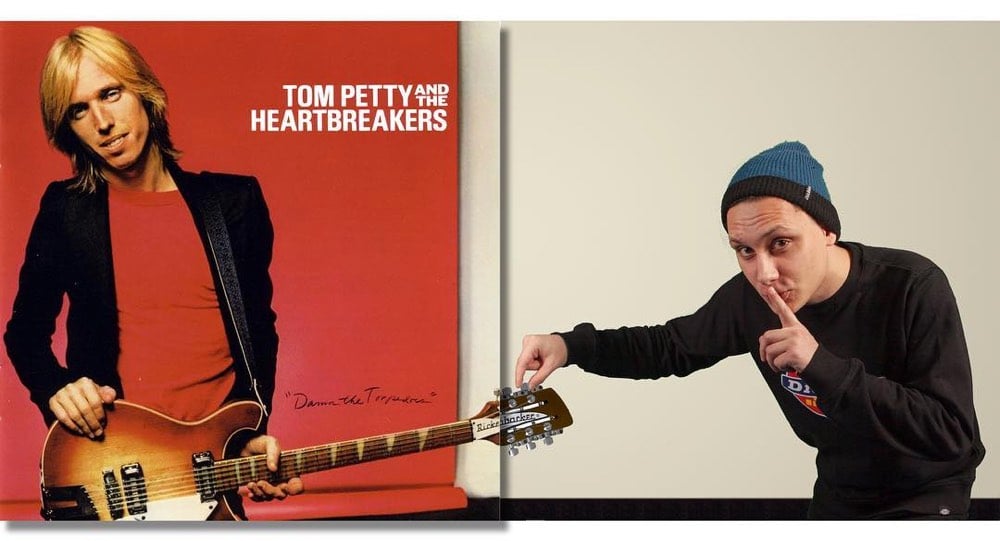
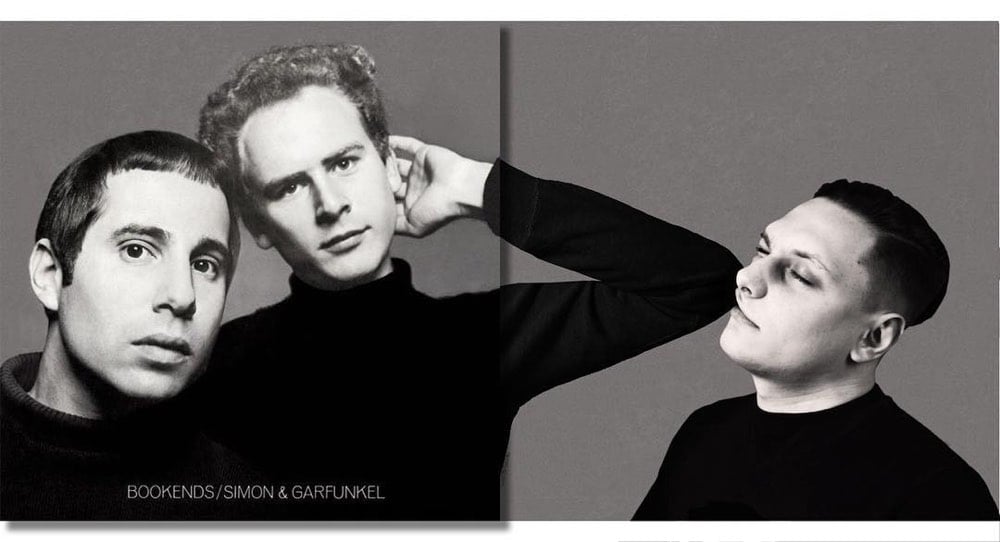
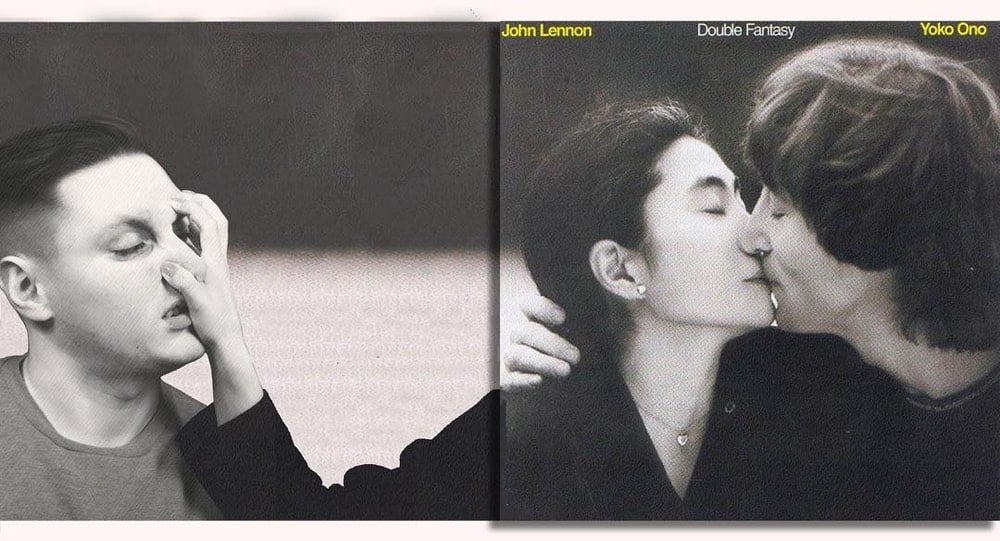
On his Instagram account, Igor Lipchanskiy is imagining what’s happening just “offscreen” of musical album covers.
Newer posts
Older posts




Socials & More