Entries for January 2014

Photographer Jeremy Cowart writes about a rare time he made a real connection with one of his celebrity subjects. It happened during a shoot with the cast of The Haves and the Have Nots, a show on Oprah’s network. As usual with shoots like this, Cowart only got a few minutes with each subject, time to shoot but not much else. But then John Schneider pulled him aside.
Once we wrapped up his session, Tika walked off set and John came to me and whispered in my ear “Hey can you sneak a few more portraits of me?” and I said “sure of course”. He said “there’s something going on and I just need a photo.”
So I grabbed my camera again and John walked back on set.
He immediately began weeping. Legitimately crying. He was so good at impressions that I thought this was another impression and I thought “wow, what an acting talent.”
(via @gavinpurcell)
Bill Murray does the Ask Me Anything thing over at Reddit and I think it’s even better than Seinfeld’s.
Q: If you could go back in time and have a conversation with one person, who would it be and why?
A: That’s a grand question, golly.
I kind of like scientists, in a funny way. Albert Einstein was a pretty cool guy. The thing about Einstein was that he was a theoretical physicist, so they were all theories. He was just a smart guy. I’m kind of interested in genetics though. I think I would have liked to have met Gregor Mendel.
Because he was a monk who just sort of figured this stuff out on his own. That’s a higher mind, that’s a mind that’s connected. They have a vision, and they just sort of see it because they are so connected intellectually and mechanically and spiritually, they can access a higher mind. Mendel was a guy so long ago that I don’t necessarily know very much about him, but I know that Einstein did his work in the mountains in Switzerland. I think the altitude had an effect on the way they spoke and thought.
But I would like to know about Mendel, because i remember going to the Philippines and thinking “this is like Mendel’s garden” because it had been invaded by so many different countries over the years, and you could see the children shared the genetic traits of all their invaders over the years, and it made for this beautiful varietal garden.
It’s amazing the amount of creativity you can pack into just 6 seconds of video. Many of these left me scratching my head as to how they were done (assuming they weren’t shot with Vine).
Oh, wow. Tobias Frere-Jones is suing his business partner Jonathan Hoefler over ownership of world-reknowned type foundry Hoefler & Frere-Jones.
Type designer Tobias Frere-Jones claims he has been cheated out of his half of the company by his business partner, Jonathan Hoefler. In a blistering lawsuit filed today in New York City, Frere-Jones says he was duped into transferring ownership of several fonts, including the world-famous Whitney, to Hoefler & Frere-Jones (HFJ) on the understanding that he would own 50% of the company.
“In the most profound treachery and sustained exploitation of friendship, trust and confidence, Hoefler accepted all of the benefits provided by Frere-Jones while repeatedly promising Frere-Jones that he would give him the agreed equity, only to refuse to do so when finally demanded,” the suit claims.
The full complaint is here. A descendant of Whitney (Whitney ScreenSmart) is what you’re reading right now and I was an early beta tester of H&FJ’s webfont service. This is gobsmacking news…I have no idea what to think about it. What a sad and strange situation. (via @khoi)
Update: H&FJ has released a statement from their general counsel:
Last week, designer Tobias Frere-Jones, a longtime employee of The Hoefler Type Foundry, Inc. (d/b/a “Hoefler & Frere-Jones”), decided to leave the company. With Tobias’s departure, the company founded by Jonathan Hoefler in 1989 will become known as Hoefler & Co.
Update: According to a document filed with the New York County Clerk, the matter between Hoefler and Frere-Jones “has been settled”. No other details are available at this time.
Rino Stefano Tagliafierro took more than 100 paintings (from the likes of Reubens, Caravaggio, Rembrandt, and Vermeer) and set them in motion to music to form a slow motion oil painted dreamland.
Lots of boobs, butts, penises, and even the occasional hint of sexual gesture in this one — the motion sometimes fills in the blanks on all of those frolicking nymph-type paintings, making them seem to modern eyes even more sexist and outdated than the static paintings. There are some definite porny moments, is what I’m saying. So yeah, probably NSFW.
And for those looking to supplement their GIF collections, this page contains links to an animated GIF for each painting represented in the video. (via digg)
John Siracusa shares how he became an Apple geek, an RC car geek, and a huge U2 geek.
You don’t have to be a geek about everything in your life — or anything, for that matter. But if geekdom is your goal, don’t let anyone tell you it’s unattainable. You don’t have to be there “from the beginning” (whatever that means). You don’t have to start when you’re a kid. You don’t need to be a member of a particular social class, race, sex, or gender.
Geekdom is not a club; it’s a destination, open to anyone who wants to put in the time and effort to travel there. And if someone lacks the opportunity to get there, we geeks should help in any way we can. Take a new friend to a meetup or convention. Donate your old games, movies, comics, and toys. Be welcoming. Sharing your enthusiasm is part of being a geek.
From the clueless British announcer who brought you this bad baseball commentary (“No! Caught by the chap in the pajamas with the glove that makes everything easier. And they all scuttle off for a nap.”) comes some hilariously misinformed NFL game commentary.
Alabama’s fullback has a handkerchief in his back pocket. He must have a cold but he’s pressing on regardless. That’s stoicism for you.
What do you think you get if you add 1+2+3+4+5+… all the way on up to infinity? Probably a massively huge number, right? Nope. You get a small negative number:
This is, by a wide margin, the most noodle-bending counterintuitive thing I have ever seen. Mathematician Leonard Euler actually proved this result in 1735, but the result was only made rigorous later and now physicists have been seeing this result actually show up in nature. Amazing. (thx, chris)
Update: Of course (of course!) the actual truth seems more complicated, hinging on what “sum” means mathematically, etc. (via @cenedella)
Update: As usual, Phil Plait sorts things out on this complicated situation. (via @theory)
Well lookie here, a restored full-length version of Stanley Kubrick’s very first film, 1953’s Fear and Desire, has popped up on YouTube:
Kubrick famously disliked his first film. From a 1994 episode of All Things Considered:
D’Arcy: But Stanley Kubrick hates the film and to keep it off the screen he threatened Film Forum with copyright violations, even though Fear and Desire is in the public domain. Through a Warner Brothers’ publicist, Kubrick called his first feature ‘a bumbling amateur film exercise’.
Goldstein: Kubrick had Warner Brothers send a letter out to all the press in town saying that the picture was boring and pretentious and of course, that only drew more attention to it. So it now, now it really is a must see, because now it’s the picture Kubrick wants to suppress. So that makes it even sexier as a box office attraction. So I think he’s increased our attendance four-fold.
(via @SebastianNebel)
Hoop Dreams is a tremendous documentary that will be re-screened at Sundance this year, two decades after its initial release. Here’s an oral history of the making of the film.
Basketball fanatics Steve James, Frederick Marx, and Peter Gilbert originally set out to make Hoop Dreams as a half-hour doc for PBS that would focus on the culture surrounding streetball. But as quickly as they got on the blacktop, they left it. The dreams of their subjects, Arthur Agee and William Gates, were too grand for just the playground, and instantly, the filmmakers were immersed in the young men’s lives, showcasing both the good and bad.
Twenty years after the film premiered at Sundance and was awarded the festival’s Audience Award, it’s grown into an iconic work. Its snub in the Best Documentary category at the 67th Academy Awards in 1995 led to changes in the voting process. NBA players treat the movie as their own life story. It’s been added to the Library Of Congress’ National Film Registry. And when looking back on the film’s 15th anniversary, Roger Ebert declared it “the great American documentary.”
As the government has cracked down on the large drug labs located in jungles, the Colombian drug cartels have begun to decentralize their operations, operating small labs in city apartments and cooking batches in microwaves. Here’s a look at one of those apartment labs, which includes an interview with a dealer and a look at the smuggling technique du jour.
It turns out that the latest trend in Colombia’s cocaine trade is moving processing out of the huge plants in the jungle to small, mobile and disposable urban labs. In this new, decentralized world of cocaine production, two men with some buckets, a handful of microwave ovens and only the most basic knowledge of chemistry can take naturally growing coca leaves and turn them into 100 percent pure cocaine powder. And here’s the craziest part…they show us how they do it.
(via digg)
This is undoubtably the best story you’ll ever read about the Bay Area’s latest food craze: $4 artisanal toast.
Trouble’s owner, and the apparent originator of San Francisco’s toast craze, is a slight, blue-eyed, 34-year-old woman with freckles tattooed on her cheeks named Giulietta Carrelli. She has a good toast story: She grew up in a rough neighborhood of Cleveland in the ’80s and ’90s in a big immigrant family, her father a tailor from Italy, her mother an ex-nun. The family didn’t eat much standard American food. But cinnamon toast, made in a pinch, was the exception. “We never had pie,” Carrelli says. “Our American comfort food was cinnamon toast.”
The other main players on Trouble’s menu are coffee, young Thai coconuts served with a straw and a spoon for digging out the meat, and shots of fresh-squeezed grapefruit juice called “Yoko.” It’s a strange lineup, but each item has specific meaning to Carrelli. Toast, she says, represents comfort. Coffee represents speed and communication. And coconuts represent survival-because it’s possible, Carrelli says, to survive on coconuts provided you also have a source of vitamin C. Hence the Yoko. (Carrelli tested this theory by living mainly on coconuts and grapefruit juice for three years, “unless someone took me out to dinner.”)
Fancy $4 toast seems like something to chuckle at or cluck your tongue about, but this story takes an unexpected left turn about halfway through and is well worth the read.
Aaron Cohen, a frequent contributor to kottke.org famous for his late-night (and, I would assume, drunken) extreme sports posts, is putting on a pair of events in Boston in February. The first is Up Up Down Down, a mini-conference on side projects. Which is such a great idea for a conference.
The second event is Whiskey Rebellion, “a showcase of American brown spirits”. The tasting list includes more than 75 whiskies and bourbons. This one is sold out (unsurprisingly) but there appears to be a waiting list. My schedule for that weekend is up in the air, but I hope I can make it to one or both of these.
From a presentation at SIGGRAPH Asia 2013, a demonstration of a program that learns how to walk by evolving the orientation of its muscles.
Love these kinds of things. I remember another video like this that went around a few months ago…but instead of bipeds, it was a a shambling collection of cubes that learned how to move around. Anyone have a link?
Update: Ah, here’s that other video; I posted it back in April. (thx, @_DavidSmith)
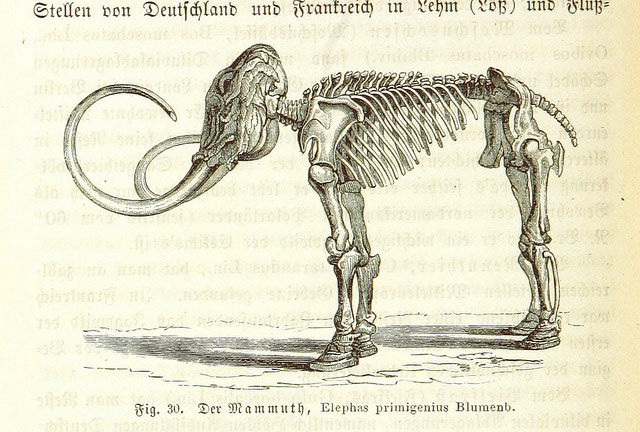
The British Library has a million images up at Flickr. 1,019,998 to be precise. And it appears that most (all?) of the images are copyright-free. An amazing resource.
From the Washington Post, an interesting collection of 80 maps (in two parts: one and two) that explain the world and how it works. One of my favorites is this map of actual European discoveries of land previously unknown by humans.
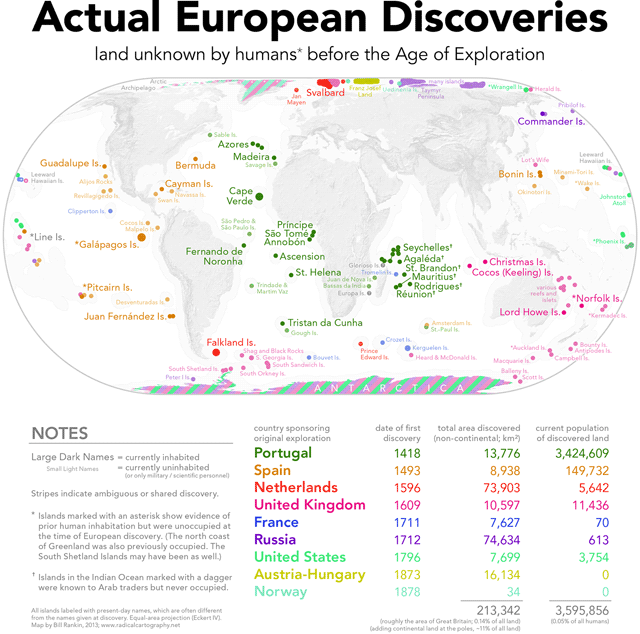
Antarctica is all stripey on that map and I realized I didn’t know who had first clapped their peepers on the only continent discovered in the last millennia, so I did some reading on the subject. From the Holy Book of Wikipedia:
The first land south of the parallel 60° south latitude was discovered by the Englishman William Smith, who sighted Livingston Island on 19 February 1819. A few months later Smith returned to explore the other islands of the South Shetlands archipelago, landed on King George Island, and claimed the new territories for Britain.
In the meantime, the Spanish Navy ship San Telmo sank in September 1819 when trying to cross Cape Horn. Parts of her wreckage were found months later by sealers on the north coast of Livingston Island (South Shetlands). It is unknown if some survivor managed to be the first setting foot on these Antarctic islands.
The first confirmed sighting of mainland Antarctica cannot be accurately attributed to one single person. It can, however, be narrowed down to three individuals. According to various sources, three men all sighted the ice shelf or the continent within days or months of each other: von Bellingshausen, a captain in the Russian Imperial Navy; Edward Bransfield, a captain in the British navy; and Nathaniel Palmer, an American sealer out of Stonington, Connecticut. It is certain that the expedition, led by von Bellingshausen and Lazarev on the ships Vostok and Mirny, reached a point within 32 km (20 mi) from Princess Martha Coast and recorded the sight of an ice shelf at 69°21′28″S 2°14′50″W that became known as the Fimbul ice shelf. On 30 January 1820, Bransfield sighted Trinity Peninsula, the northernmost point of the Antarctic mainland, while Palmer sighted the mainland in the area south of Trinity Peninsula in November 1820. Von Bellingshausen’s expedition also discovered Peter I Island and Alexander I Island, the first islands to be discovered south of the circle.
(via @daveg)
Video of Shaun White snowboarding at age 10:
Pencil portraits of young men and women incarcerated on Rikers Island by Ricardo Cortés.

Cortés wrote an essay about the portraits and his experience at Rikers.
The grossest irony is that increasing levels of imprisonment may exacerbate the very problems it is intended to solve. Imagine a drug-dealer, a check forger, a prostitute or a burglar who comes to Rikers. They’re often leaving family behind, possibly as the primary breadwinner, breaking up a critical support network and causing measurable damage to spouses, siblings, parents and especially children. They’re losing a job during their incarceration, thus falling further behind in bills, rent, and ultimately housing. They’re being released after their stay with little treatment or prospects for a new job; their completed sentence may stain their record such that it’s even harder to find employment. And they’re back on the street with the same personal struggles of addiction, domestic abuse, health issues and difficulty in finding sustainable housing and legal employment. It’s not hard to guess what happens next.
(via @jessicalustig)
vintage post from Jan 2014
· gift link
Korean artist group Shinseungback Kimyonghun made a video of every time they clicked their mouse. It’s mesmerizing.
Ride along with Anders Jacobsen as he takes flight off the end of a ski jump in Lillehammer, Norway.
Very nice, but this fourth grader’s first time on a bigger ramp is by far my favorite ski jump video of all time.
David Munson, CEO of Saddleback Leather, gives some advice to those who want to rip off his high quality leather bags…basically how to save money by cutting corners, using cheaper leather, etc.
Like Twitter, HBO’s Game of Thrones started out with 140 characters but now most of them are dead so I have no idea what this season is going to be about. But dragons!
Michael Lewis made the case in The Blind Side that football players are the smartest in sports because the game is complex and moves fast. For the New Yorker, Nicholas Dawidoff takes a look at what makes a football player smart.
The Redskins’ London Fletcher is undersized and thirty-eight years old, but he’s been able to play for so long because he is a defensive Peyton Manning: seeing the game so lucidly, yelling out the offensive play about to unfold, changing alignments before the snap, organizing the field in real time. Similarly, Lavonte David, who has been with the Tampa Bay Buccaneers for two years, is just two hundred and thirty-four pounds — ten to fifteen pounds lighter than most at his position — the Wonderlic scores out on the Internet for him are not especially high, and, like all players, he makes the occasional boneheaded play. But he possesses dedicated study habits and a football clairvoyance that, come Sunday, finds him ignoring the blocking flow only at the one moment during a game when the offense runs the ball away from it.
The Hall of Fame Minnesota Vikings defensive lineman Alan Page weighed two hundred and forty-five pounds, the dimension of a modern fullback. Even so, Page was terrifying. His forty-yard-dash time wasn’t anything special, either, but he says that he could run down faster opponents because he always had sense where he was in relation to the blur of bodies around him-he could “understand the situation.” Page is now an Associate Justice on the Minnesota Supreme Court. “Being a football player requires you to take your emotional self to places that most people shouldn’t go,” he said. “You wouldn’t want to get to know the person who was in my head on a football field. I likely see some of these people in my current job — those who can’t control that person — and they do not very nice things.”
I asked him, “You could control that person on a field?”
“Most of the time,” Page said.
The safety, standing at the rear of the defense, must compensate for the mistakes of others; football intelligence matters more at this position than any other on the defense. At five-eight, a hundred and eighty-eight pounds, the Bills safety Jim Leonhard, a nine-year veteran, is among the smallest and also the slowest starting defensive backs in the game. And yet, watching him on film, he appears to teleport to the ball. Leonhard’s name seems to enter any conversation about football intelligence; he knows every teammate’s responsibilities in every call, and understands the game as twenty-two intersecting vectors. “He’d walk off the bus and you’d think he was the equipment manager,” Ryan Fitzpatrick said. “He’s still in the league because he’s the quarterback of the defense.”
This is wonderful: an hour-long PBS documentary from 1981 on the making of Raiders of the Lost Ark. Lots of behind the scenes footage, interviews with Spielberg, Lucas, Ford, etc.
I love how delighted Spielberg is after the idol exchange scene.
No one uses slow motion more consistently than Wes Anderson; all his films except Fantastic Mr. Fox use the technique. Here are all the slow-mo scenes from his films strung together:
(via devour)
First of all, how cute are these foxes jumping up and diving down into the snow after mice?
So. Cute. Here’s Robert Krulwich on what they’re up to:
Think about this … an ordinary fox can stalk a mole, mouse, vole or shrew from a distance of 25 feet, which means its food is making a barely audible rustling sound, hiding almost two car lengths away. And yet our fox hurls itself into the air — in an arc determined by the fox, the speed and trajectory of the scurrying mouse, any breezes, the thickness of the ground cover, the depth of the snow — and somehow (how? how?), it can land straight on top of the mouse, pinning it with its forepaws or grabbing the mouse’s head with its teeth.
Look at those ears and how the fox moves his head around to zero in on the mouse’s location…reminds me of the pre-radar acoustic location devices (sometimes called war tubas) used in the early 20th century to detect approaching aircraft:

Let slip the tubas of war! Aaaaanyway, as the acoustic location device gave way to the more effective radar, so too is the fox more successful at hunting when he is pointed northeast — a kind of magnetic radar, if you will. Fascinating.
From Bret Victor, a reading list of meaty material from the past year. His Reading Tip #1 in the sidebar is how I’d like my ideal self to read:
It’s tempting to judge what you read:
I agree with these statements, and I disagree with those.
However, a great thinker who has spent decades on an unusual line of thought cannot induce their context into your head in a few pages. It’s almost certainly the case that you don’t fully understand their statements.
Instead, you can say:
I have now learned that there exists a worldview in which all of these statements are consistent.
And if it feels worthwhile, you can make a genuine effort to understand that entire worldview. You don’t have to adopt it. Just make it available to yourself, so you can make connections to it when it’s needed.
Fantastic tip.
Often, cocktail menus are a little ridiculous.
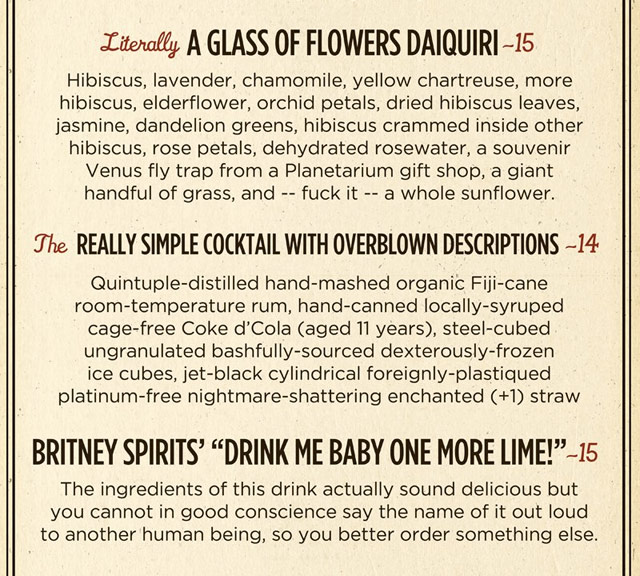
I am totally going to order some drinks like these at my usual fancy but still cool bar pub speakeasy tonight!
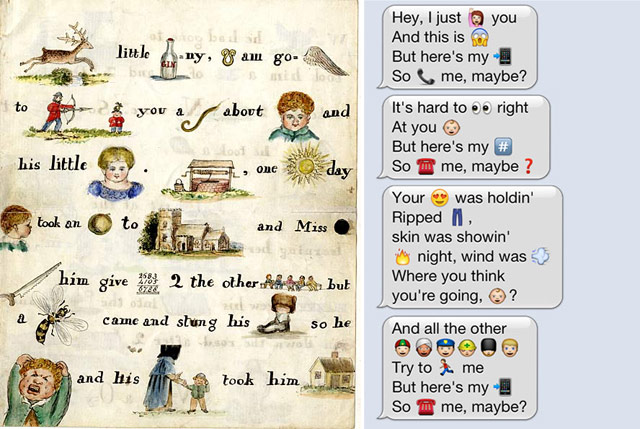
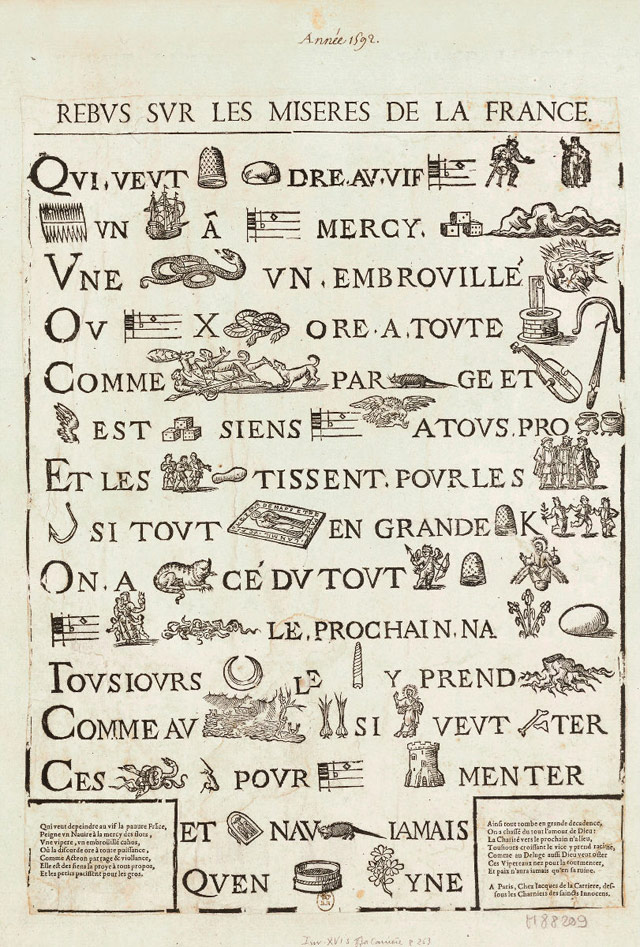
Using pictures to represent words dates back to Egyptian hieroglyphics and Chinese pictographs. But in the 1500s in France, a particular format of picture writing called the rebus was invented. A rebus is a word puzzle which uses pictures to represent words (or parts of words). The rebus became very popular in Europe and elsewhere. Here’s a French rebus from 1592:
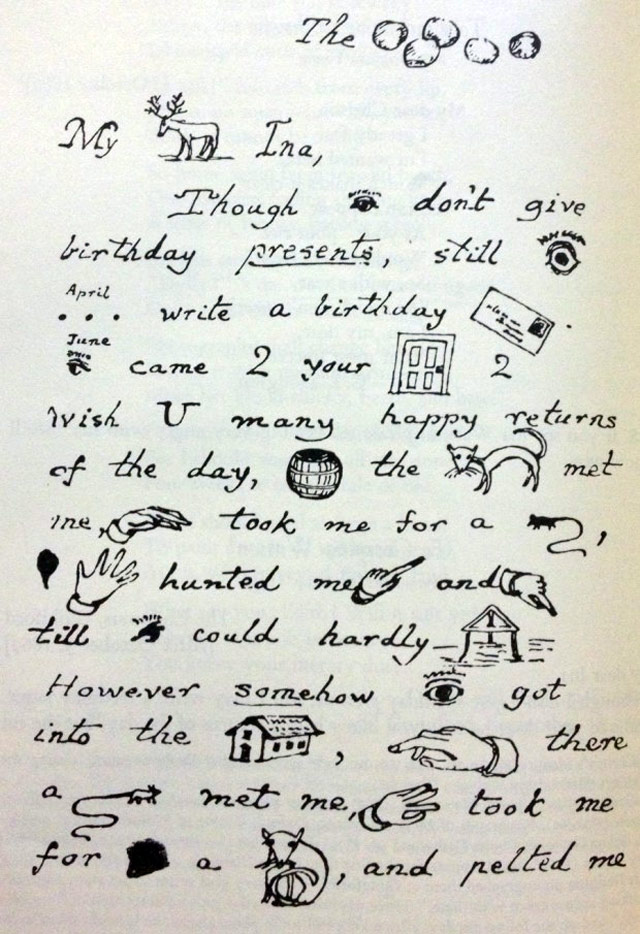
Alice in Wonderland’s author, Lewis Carroll, was fond of rebuses…here’s the first page of a letter he wrote in 1869:
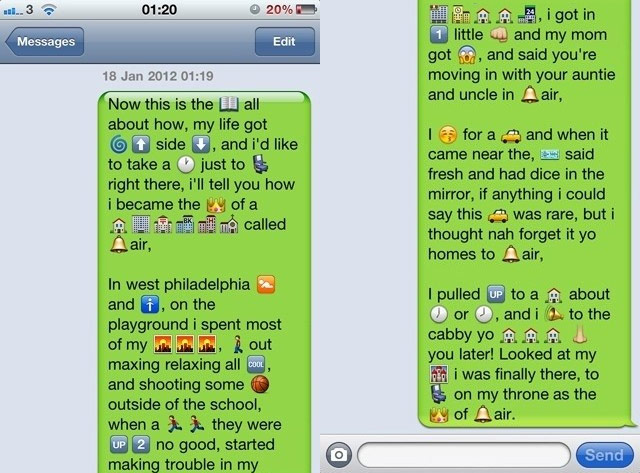
Compare the rebus with the use of emoji on mobile devices and social media, like this emoji version of the Fresh Prince of Bel Air theme song:
George Mason University’s speech accent archive collects English speech samples from all over the world. Each speaker is asked to say the same snippet of text:
Please call Stella. Ask her to bring these things with her from the store: Six spoons of fresh snow peas, five thick slabs of blue cheese, and maybe a snack for her brother Bob. We also need a small plastic snake and a big toy frog for the kids. She can scoop these things into three red bags, and we will go meet her Wednesday at the train station.
From photographer Greg Alessandrini, a collection of photos of diners in New York City taken in the 1990s. I was pleased to see a shot of Jones Diner, which I ate at several months before moving to NYC:
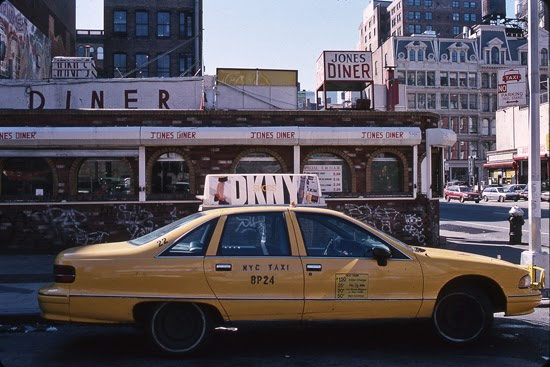
It closed shortly before we moved and I never got to eat there again. At the time, word was some condos were being built on the site, but it took ten years for construction to start. What a waste.
BTW, the rest of Alessandrini’s site is well worth a look…hundreds and possibly thousands of photographs of NYC from the 80s and 90s. (via @UnlikelyWorlds)
In 1963, Studs Terkel interviewed a 21-year-old Bob Dylan, before he was famous.
In the spring of 1963 Studs Terkel introduced Chicago radio listeners to an up-and-coming musician, not yet 22 years old, “a young folk poet who you might say looks like Huckleberry Finn, if he lived in the 20th century. His name is Bob Dylan.”
Dylan had just finished recording the songs for his second album, “The Freewheelin’ Bob Dylan”, when he traveled from New York to Chicago to play a gig at a little place partly owned by his manager, Albert Grossman, called “The Bear Club”. The next day he went to the WFMT studios for the hour-long appearance on “The Studs Terkel Program”.
Dangerous Minds has more detail about the interview.
Bob Dylan is a notoriously tough person to interview and that’s definitely the case here, even this early in his life as a public persona. On the other hand, Terkel is a veteran interviewer, one of the best ever, and he seems genuinely impressed with the young man who was just 21 at the time and had but one record of mainly covers under his belt. Terkel does a good job of keeping things on track as he expertly gets out of the way and listens while gleaning what he can from his subject. It’s an interesting match-up.
Dylan seems at least fairly straightforward about his musical influences. He talks about seeing Woody Guthrie with his uncle when he was ten years old (Is this just mythology? Who knows?), and he mentions Big Joe Williams and Pete Seeger a few times.
Much of the rest is a little trickier. Terkel has to almost beg Dylan to play what turns out to be an earnest, driving version of “A Hard Rain’s a-Gonna Fall.” Dylan tells Terkel that he’d rather the interviewer “take it off the disc,” but relents and does the tune anyways.
(via @mkonnikova)
Nico Muhly is a young and celebrated classical music composer. His review of Beyonce’s new album is a pretty lyrical composition itself.
This is a beautiful song. On the video, there is a long introduction with piano and strings. Use real strings, please, Beyoncé. The piano might be real but it sounds like the most expensive fake piano on the market. One would love to think that this is a comment on the artificiality of beauty — we’ve become accustomed to an expensive fake in favor of the built-in and beautiful imperfections of reality — but I doubt that was the reason for this particular oversight. Bey: call me; you know where I stay.
(via @fchimero)

In March, the New York Historical Society is mounting an exhibition of photographer Bill Cunningham’s project, Façades.
Scouring the city’s thrift stores, auction houses, and street fairs for vintage clothing, and scouting sites on his bicycle, Cunningham generated a photographic essay entitled Façades, which paired models — in particular his muse, fellow photographer Editta Sherman — in period costumes with historic settings.
Jerry Seinfeld did an AMA (Ask Me Anything) at Reddit yesterday. His answers are real, and they’re spectacular.
Q: Where did the idea of, in Seinfeld, your character being a comedian for a profession, but be the straight man for your friends, come from? I always thought that juxtapositioning for the show was genius.
A: Very good observation and analysis on your part, Baxter. You are truly exhibiting a good comedic eye. The reason I would play straight was it was funnier for the scene. And very few people have ever remarked on this, because it was a conscious choice of mine, only because I knew it would make the show better, and I didn’t care who was funny as long as somebody was funny and that the show was funny. So you have hit upon one of the great secret weapons of the Seinfeld series, was that I had no issue with that.
I have seen every episode of the show at least twice and never realized this. Gold, Jerry! Gold!
ps. Favorite episode of Seinfeld? Aside from the nearly perfect The Contest, I’ll go with The Marine Biologist. If I ever decide to be an actor, my audition tape will be me telling George’s whale rescue story:
(via @gavinpurcell)
Amy Parker grew up with super health-conscious parents who provided her with a healthy diet and active lifestyle. But they also didn’t vaccinate her and she was sick all the time as a kid.
As healthy as my lifestyle seemed, I contracted measles, mumps, rubella, a type of viral meningitis, scarlatina, whooping cough, yearly tonsillitis, and chickenpox. In my 20s I got precancerous HPV and spent six months of my life wondering how I was going to tell my two children under the age of 7 that Mummy might have cancer before it was safely removed.
This is the part that really gets to me: Parker wasn’t vaccinated but was given so many antibiotics for her childhood illnesses that she became immune to them! [Hair-tearing-out noise]
My two vaccinated children, on the other hand, have rarely been ill, have had antibiotics maybe twice in their lives, if that. Not like their mum. I got so many illnesses requiring treatment with antibiotics that I developed a resistance to them, which led me to be hospitalized with penicillin-resistant quinsy at age 21 — you know, that old-fashioned disease that supposedly killed Queen Elizabeth I and that was almost wiped out through use of antibiotics.
Update: Slate has corrected the passage above, taking out the part about Parker’s resistance to antibiotics. It now reads:
My two vaccinated children, on the other hand, have rarely been ill, have had antibiotics maybe twice in their lives, if that. Not like their mum. I got many illnesses requiring treatment with antibiotics. I developed penicillin-resistant quinsy at age 21 — you know, that old-fashioned disease that supposedly killed Queen Elizabeth I and that was almost wiped out through use of antibiotics.
People do not develop antibiotic resistance, microorganisms do. I regret the idiotic error and tearing out my hair. (thx @chrismize)
Diana Hardeman is 30, healthy, and has no history of past medical issues. A few days before Christmas, she had a stroke.
My right arm seemed no longer a part of my body. I couldn’t control it; it was limp at my side, like the worst dead arm you can imagine, but completely out of nowhere. My boyfriend was just coming to check on what time we are leaving and I exited the bathroom, slumped on the ground, and told him what was going on. Except I didn’t. I couldn’t. What I was saying in my head came out as gibberish. I could not get words out of my mouth. I felt stupid, even laughing at myself, saying, “It’s ok, it’s ok” to him, thinking it might just go away. But then the reminder that something was wrong set in again. In a whisper, I finally got out the words “call my dad.” He did. My parents happened to be right outside and my father, a physician, ran up the stairs to find us. When he saw me stuttering and holding my dead arm, he called for an ambulance. By now I was crying, perhaps in hysterics, as the numbness had seeped from my arm to my whole right side. I then calmed, stopped tying to speak, as it was frustrating and pointless, and looked into my boyfriend’s eyes saying to him with mine, I may not walk again. I may die, somewhat acquiescing to whatever it was that was happening to me. I caught myself, though, and thought, No, that can’t happen, I gotta fight it, and kicked off my boots to try to move legs and focused my mind on, well, not dying.
Hardeman also posted the original unedited version of her story written during recovery. Its less-than-flowing prose bears the mark of a semi-functioning arm and brain.
In case you don’t know me, Hi. Im Diana. I’m a 30 year old lady. Itallerthan your average girl, thinner tha your average girl, and and active than your average girl. Yeah I run an ice crea business for a living, but like to thing I’m healthier than your average girl too. No priorn medical history. Nothing.
my first ever ride in an ambulance was uneventful - the hops;ital is a 5 minute drive from my folks’ house. By now I had somehow regained some ability to sspeak and answered the EMT’s incessant questionsining. still stuumbling over my words, even laughin at my mstakes.
Found this via the Kickstarter for Hardeman’s ice cream company.
Update: The NY Times just covered torn arteries, which was the cause of Hardeman’s stroke.
I know we’re past the point of saying “happy new year” and lingering on last year, but this is my favorite annual best of list: Regret the Error’s The best and worst media errors and corrections in 2013. This correction from Marie Claire is pretty good:
In our July issue we wrongly described Tina Cutler as a journalist. In fact she is a practitioner of vibrational energy medicine.
And some quality historical truthiness from The Huffington Post:
An earlier version of this story indicated that the Berlin Wall was built by Nazi Germany. In fact, it was built by the Communists during the Cold War.
And Slate, get your Girls on some more in 2014 please:
This review misspelled basically everyone’s name. It’s Hannah Horvath, not Hannah Hovrath; Marnie is played by Allison Williams, not Alison Williams; and Ray is played by Alex Karpovsky, not Zosia Mamet.
A pair of scientists recently searched the internet for evidence of time travel.
Here, three implementations of Internet searches for time travelers are described, all seeking a prescient mention of information not previously available. The first search covered prescient content placed on the Internet, highlighted by a comprehensive search for specific terms in tweets on Twitter. The second search examined prescient inquiries submitted to a search engine, highlighted by a comprehensive search for specific search terms submitted to a popular astronomy web site. The third search involved a request for a direct Internet communication, either by email or tweet, pre-dating to the time of the inquiry. Given practical verifiability concerns, only time travelers from the future were investigated.
Spoiler: they didn’t find any. (via @CharlesCMann)
David Carr writes about the surprising success of Kevin Kelly’s Cool Tools book, which is based on his long-running website of the same name.
But last year, he had what sounded to me like a dumb idea. Mr. Kelly edits and owns Cool Tools, a website that writes about neat stuff and makes small money off referral revenue from Amazon when people proceed to buy some of those things. He decided to edit the thousands of reviews that had accrued over the last 10 years into a self-published print catalog — also called “Cool Tools” — which he would then sell for $39.99.
So, to review, his idea was to manufacture a floppy 472-page catalog that would weigh 4.5 pounds, full of buying advice that had already appeared free on the web, essentially turning weightless pixels into bulky bundles of atoms. To make it happen, he crowdsourced designs from all over the world, found a printer in China and then arranged for shipping and distribution. It all seemed a little quixotic and, well, beside the point.
Except the first printing of 10,000 copies, just in time for Christmas, sold out immediately, a second printing of 12,000 will go on sale at Amazon next week and a third printing of 20,000 copies is underway. So, not so dumb after all.
I haven’t had a chance to dig too deeply into my copy yet, but my six-year-old sat down with it a few weeks ago and had about a million questions per page for me. Which seems a like a positive sign.
James Surowiecki writes about the similarities between confidence games and American entrepreneurial spirit.
It seems that con artists, for all their vices, represent many of the virtues that Americans aspire to. Con artists are independent and typically self-made. They don’t have to kowtow to a boss — no small thing in a country in which people have always longed to strike out on their own. They succeed or fail based on their wits. They exemplify, in short, the complicated nature of American capitalism, which, as McDougall argues, has depended on people being hustlers in both the positive and the negative sense. The American economy wasn’t built just on good ideas and hard work. It was also built on hope and hype.
Dear God, watch this moustache explode into — well, you’ll see — and you’ll never have to watch it again. You’ll see it every time you close your eyes.
We may not have our jetpacks and hover cars, but our future-now has given us Tavi Gevinson interviewing Lorde and that’s just as good.
Tavi: On that note, you have a very unique way of looking at the suburb where you live, which I think you’ve called “the Bubble.” When did you realize the suburbs could be a source of inspiration?
Lorde: Well…this sounds so lame, but I grew up reading your blog, man! [Laughs]
Tavi: Oh no! “Ugh, that’s so LAME, shut up!”
Lorde: [Laughs] But no, I think there is something really cool about that whole Virgin Suicides vibe of making even the bad parts bearable. I hate high school so much, but there’s something kind of cool about walking around on the coldest day listening to “Lindisfarne” by James Blake or something and feeling like something has happened, even though it’s the worst thing ever. The album The Suburbs by Arcade Fire was influential to me in that as way well. I just think that record is really beautiful and nostalgic and so well-written. It’s a super-direct way of talking about what it’s like to grow up [in the suburbs], and I think that’s quite lovely.
You’re asking about stuff I’m not used to talking about in interviews, so I don’t have a stock way of driving the question.
Tavi: OK, then: “Do you feel 17?”
Lorde: AGHHHH! What do you even say to that, honestly?
Tavi: It’s kind of a trap, because if you say yes you’re shitting on their question by making it seem obvious, but if you say no you seem like you think you’re older and better.
Lorde: I always get these weird people being like, “Oh, she’s growing up way too fast, she looks 30.” Oh, god.
Tavi: People always say that. I remember — not to be all Mother Hen —
Lorde: No, go for it!
Tavi: I remember when people started paying attention to what I was doing, and it was like, “She should be getting knocked up like all the other kids her age!” It’s like, you complain when you think teenagers are stupid, and then when they try to do something, you’re all, “Oh, they’re growing up too fast, they don’t know what’s good for them.”
Lorde: It seems like a double standard to me. And there’s another part of it which I find really strange, which is that so many interviewers, even ones that I consider really intelligent and good writers, will do the, like, “Oh, you’re not taking your clothes off like Miley Cyrus and all these girls” thing, which to me is just the weirdest thing to say to someone. But then people will say, “She’s always talking about being bored, that’s petulant,” which I feel like is kind of taking the piss out of teenage emotions-just, like, making light of how teenagers feel. When people react that way about things that every teenager experiences, how can you expect to make anything good?
Craig Mod, writing for the New Yorker, says goodbye to cameras as photography transitions to the use of “networked lenses”.
After two and a half years, the GF1 was replaced by the slightly improved Panasonic GX1, which I brought on the six-day Kumano Kodo hike in October. During the trip, I alternated between shooting with it and an iPhone 5. After importing the results into Lightroom, Adobe’s photo-development software, it was difficult to distinguish the GX1’s photos from the iPhone 5’s. (That’s not even the latest iPhone; Austin Mann’s superlative results make it clear that the iPhone 5S operates on an even higher level.) Of course, zooming in and poking around the photos revealed differences: the iPhone 5 doesn’t capture as much highlight detail as the GX1, or handle low light as well, or withstand intense editing, such as drastic changes in exposure. But it seems clear that in a couple of years, with an iPhone 6S in our pockets, it will be nearly impossible to justify taking a dedicated camera on trips like the Kumano Kodo pilgrimage.
And indeed, the mid-tier Japanese camera makers (Panasonic, Fujifilm and Olympus) are struggling to find their way in the networked lens era. A few years ago, I wrote a post called “Your company? There’s an app for that.” about how smartphones were not only going to make certain devices obsolete, but drive entire companies and industries out of business. This bit, about cameras, seems almost quaint now:
Point and shoot camera — While not as full-featured as something like a PowerShot, the camera on the iPhone 3GS has a 3-megapxiel lens with both auto and manual focus, shoots in low-light, does macro, and can shoot video. Plus, it’s easy to instantly publish your photos online using the iPhone’s networking capabilities and automatically tag your photos with your location.
The best camera is the one you have with you the one with built-in posting to Facebook.
70 days ago, Ben Saunders and Tarka L’Herpiniere set out from the edge of Antarctica, bound south. Their goal was to ski, alone and unsupported, to the South Pole and back along the route Captain Robert Falcon Scott travelled in 1912. I’ve been following their blog every day since then, and they were making the whole thing — skiing 19 miles/day in -30° white-outs hauling 300 lbs. and blogging about it the whole way — seem easy somehow. They reached the Pole the day after Christmas were hauling ass (and sled) back toward the coast.
But their seemingly steady progress hid a potentially life-threatening truth: they needed to be skiing more miles a day in order to travel quickly enough to not exhaust their food supply. They’d been missing their mileage goals and in an attempt to catch up, weren’t sleeping and eating as much as they should have been. Things could have gone very wrong at this point, but luckily Ben and Tarka came out ok.
Our depot was still 74km away and we had barely more than half a day’s food to reach it; eight energy bars each, half a breakfast and half an evening meal. 16km into the following day Tarka started to slow again as he led, before stopping entirely and waving me forward to talk. “I feel really weak in the legs again”, he said. “OK. What do you want to do?” I answered snappily, before realising this was on me. I came here to be challenged and tested, to give my all to the hardest task I have ever set myself and to the biggest dream I have ever had. And here was the crux. This was the moment that mattered, not standing by the Pole having my photograph taken, but standing next to my friend, in a howling gale, miles away from anyone or anything. “Let’s put the tent up”, I said, “I’ve got an idea”.
Adventure is never about battling the environment or elements or whatever. It’s always a struggle with the self. And as this battle reached a fevered pitch, Ben and Tarka were not found wanting. Calling for resupply, and thereby giving up on one of the major goals of this expedition 10 years in the making, was probably the hardest thing Ben has ever had to do in his entire life. But he did it, for his family, his loved ones, and his teammate. Ben, Tarka, I’m proud of you. Thank you for letting us follow along on your journey, for showing us what is humanly possible, and for the reminder that pushing the boundaries is never about how far you can tow a sled but about what you do when confronted with the no-win scenario: beating yourself.
Inspired by the escalating blade count of the razor industry, Nabisco has developed a new snack called the Quadriscuit.
“At the moment, this hyperwafer can only exist for six milliseconds in a precisely calibrated field of magnetic energy, positrons, roasted garlic, and beta particles,” lab chief Dr. Paul Ellison told reporters at a press conference outside Nabisco’s $200 million seven-whole-grain accelerator.
The last line of the piece made me LOL for real. (thx, meg)
The editorial board of the NY Times is urging clemency for Edward Snowden.
Considering the enormous value of the information he has revealed, and the abuses he has exposed, Mr. Snowden deserves better than a life of permanent exile, fear and flight. He may have committed a crime to do so, but he has done his country a great service. It is time for the United States to offer Mr. Snowden a plea bargain or some form of clemency that would allow him to return home, face at least substantially reduced punishment in light of his role as a whistle-blower, and have the hope of a life advocating for greater privacy and far stronger oversight of the runaway intelligence community.
Drew Dernavich submitted a cartoon to the New Yorker in 2007 and it was rejected. He refined and simplified the concept and the result ran in a recent issue. Here’s how Dernavich achieved this result:
My approach was to say “whatever,” move on to the next thing, forget completely that I had ever done this cartoon in the first place, go to sleep, get up the next day and drink coffee, eat and drink as I usually do, work at some stuff, work at some other stuff, get up earlier some days and later some days, do social things every once in a while…
And it goes on like that for awhile until concluding:
…and then wake up one day and then think “hey - I have a funny idea about warning shots that’s better than the one I had several years ago.”
Csikszentmihalyi aside, this might be the truest description of the creative process ever written. Shit just takes time and creative people make time. (via @Atul_Gawande)
Newer posts





Socials & More