Entries for April 2013
Ms. Fobes, who lives in Raymore, Mo., plans meals around discounts offered at the grocery store and always checks coupon apps on her cellphone before buying clothes. When, a little over a year ago, J. C. Penney stopped promoting sales and offering coupons and instead made a big deal about its “everyday” low prices, Ms. Fobes stopped shopping there. It wasn’t that she thought the prices were bad, she said. She just wasn’t having any fun.
“It may be a decent deal to buy that item for $5,” said Ms. Fobes, who runs Penny Pinchin’ Mom, a blog about couponing strategies. “But for someone like me, who’s always looking for a sale or a coupon — seeing that something is marked down 20 percent off, then being able to hand over the coupon to save, it just entices me,” she said. “It’s a rush.”
That’s from an article in the NY Times about J.C. Penney’s recent overhaul by Ron Johnson, who sought to apply his Apple Store experience to the mid-range department chain. Being the sort of person who a) doesn’t like to shop, and b) doesn’t want any nonsense when I do need to shop, I don’t often think about shopping as a game. But it clearly is a game for some. As we don’t spend so much time on the savana anymore, the hunting of bargains and the gathering of sale items is about as primal as we get these days, aside from Halo and Call of Duty. But not every shopping experience is the same type of game. And maybe that’s where Johnson slipped up. The Apple Store game is more aspirational: buying the best products for reasonable prices and feeling part of a place & company that’s so minimalist, simple, smart, and cool. Maybe Penneys shoppers didn’t want to play that game…not at Penneys anyway.
Great article by Burkhard Bilger about NASA’s Curiosity mission to Mars.
The search for life on Mars is now in its sixth decade. Forty spacecraft have been sent there, and not one has found a single fossil or living thing. The closer we look, the more hostile the planet seems: parched and frozen in every season, its atmosphere inert and murderously thin, its surface scoured by solar winds. By the time Earth took its first breath three billion years ago, geologists now believe, Mars had been suffocating for a billion years. The air had thinned and rivers evaporated; dust storms swept up and ice caps seized what was left of the water. The Great Desiccation Event, as it’s sometimes called, is even more of a mystery than the Great Oxygenation on Earth. We know only this: one planet lived and the other died. One turned green, the other red.
Perfect read if you’ve been curious about what Curiosity is up to on Mars but needed something a bit more narrative than the mission home page or Wikipedia page to guide you. Also features the phrase “a self-eating watermelon of despair”, so there’s that. Oh, and here’s the Seven Minutes of Terror video referred to in the story.
This is supposedly a leaked version of the song Get Lucky from Daft Punk’s forthcoming album, but from what I can tell, this is just an extended version of the song cobbled together from this minute-long commercial that ran during SNL this weekend. Not that that’s a bad thing…I’ve had it on repeat for the last 30 minutes.
The duo have, however, given their first interview about the album to Rolling Stone. (via kyleread)
Update: Hmm, getting some reports that this is the actual radio edit of Get Lucky…and it does have some Pharrell lyrics that weren’t in the promos and commercials. And if not, we’re getting closer!
(via @djrange)
Update: Ha! Probably still fake. But it’s the best fake so I’ll take it for now. Would probably take DP, Pharrell, and Rodgers themselves to top this one. (via @Robbie)
Update: Guess that last one actually was the genuine article, which is now available on iTunes, on Spotify, on Rdio, and at Amazon.
For a project called The Fundamental Units, Martin John Callanan used a very powerful 3D microscope to take 400-megapixel images of the lowest denomination coin from each of the world’s 166 active currencies. This is the 1 stotinki coin from Bulgaria:

And this is a small part of that same coin at tremendous zoom:

More information is available here.
Starting with cubes of four simple materials (bone, tissue, 2 types of muscles) and one simple rule (faster bots have more offspring) results in a surprising amount of complexity among walking robots.
(via buzzfeed)
vintage post from Apr 2013
· gift link
Filmed at 780 fps with a Phantom Flex from the back of a moving SUV, James Nares’ Street depicts people walking New York streets in super slow motion.
The film runs 60 minutes (depicting about three minutes of real time footage), Sonic Youth’s Thurston Moore did the soundtrack, and it’s on display at The Met until the end of May.
Update: Here’s another short clip of the full film from the National Gallery of Art.
A former baseball card dealer now admits he cut the edges of the world’s most expensive baseball card to make it appear in better condition. The card in question is the T206 Honus Wagner card once owned by Wayne Gretzky; this video is a great overview of the card’s history.
One question I always had about the card was: why did Gretzky ever sell it? The Wagner might just have been an investment for him, but if you’re rich and a huge sports guy and you own the most pristine copy of the world’s rarest and most valuable sports card, why would you ever sell it? One possible answer: you suspected (or discovered) that the card had been doctored and got rid of the damn thing before the truth came out. That Gretzky, always skating to where the puck is going to be.
If you’re compiling a list of the least cool brands, Kmart deserves serious consideration. But you’ve got to give them props for this daring ad touting free home shipping of out-of-stock merchandise.
I almost shipped my pants laughing at this. (via ★interesting)
What if each member of the Bluth family made an album? The album covers might look something like these.

(via @aaroncoleman0)
Abel Rodríguez waxes floors for a living in Los Angeles and takes two weeks of vacation a year to work gratis for Real Madrid when the European football club trains in Los Angeles every summer. He had always dreamed of seeing Real Madrid playing their Spanish rivals Barcelona in Madrid, so his family persuaded him to go. He went. With no hotel or ticket to the game, he sat outside the club’s training complex for hours until manager José Mourinho spotted him as he was leaving…”Stop! It’s the guy from Los Angeles.” Thus began Abel Rodríguez’s magical journey.
You never know when karma will come back and reward you for something. For seven summers Rodriguez worked for free for Real Madrid, even when the club was willing to pay him for his efforts in Los Angeles. Now he was about to experience the thrill of a lifetime.
Oh man, I’ve got something in my eye.
Deceptive Practice is a documentary about Ricky Jay which features, among other things, a shaggy-haired Jay playing Three-card Monte with Steve Martin on an 80s chat show.
Jay is a fascinating guy, as this 1993 New Yorker profile of him by Mark Singer demonstrates.
Ricky Jay, who is perhaps the most gifted sleight-of-hand artist alive, was performing magic with a deck of cards. Also present was a friend of Mamet and Mosher’s named Christ Nogulich, the director of food and beverage at the hotel. After twenty minutes of disbelief-suspending manipulations, Jay spread the deck face up on the bar counter and asked Nogulich to concentrate on a specific card but not to reveal it. Jay then assembled the deck face down, shuffled, cut it into two piles, and asked Nogulich to point to one of the piles and name his card.
“Three of clubs,” Nogulich said, and he was then instructed to turn over the top card.
He turned over the three of clubs.
Mosher, in what could be interpreted as a passive-aggressive act, quietly announced, “Ricky, you know, I also concentrated on a card.”
After an interval of silence, Jay said, “That’s interesting, Gregory, but I only do this for one person at a time.”
Mosher persisted: “Well, Ricky, I really was thinking of a card.”
Jay paused, frowned, stared at Mosher, and said, “This is a distinct change of procedure.” A longer pause. “All right-what was the card?”
“Two of spades.”
Jay nodded, and gestured toward the other pile, and Mosher turned over its top card.
The deuce of spades.
A small riot ensued.
Anyway, the film is coming out next week in NYC. (via @aaroncoleman0)
Oh hello, what’s this? M83 did the soundtrack to Oblivion, the new sci-fi movie where Tom Cruise plays Wall-E? That will do quite nicely. Here it is on iTunes, Amazon, or Rdio.
Vanity Fair’s William Langewiesche takes a behind the scenes look at what drove Felix Baumgartner from being a stunt jumper to stepping out of a capsule 24 miles above New Mexico. Grab a few Red Bulls and read all about the man who pierced the sky (and the world of brand advertising).
His goal now was to break the altitude record for a human free fall, and in the process also to exceed the speed of sound. Otherwise known as Mach 1, that speed varies with temperature but is upwards of 660 miles per hour. Baumgartner was not there to advance mankind. That was for others to claim, if they liked. His own purpose was promotional. He was a showman for the Red Bull company, which had plowed a fortune into this endeavor in order to associate its energy drink with his feats. Baumgartner, who was 43 at the time, is certainly a manly man. He is photogenic. He is fit. His fiancée was Miss Lower Austria in 2006. When he furrows his brow he looks determined and intense. On-camera he becomes the very image of a middle-aged action figure, the perfect emblem for an important market segment of middle-aged men. When I drink Red Bull, I go supersonic. I am fearless. I am an Übermensch.
The term of art for time lapse videos in which the camera moves is hyperlapse. In playing around with the hyperlapse technique, Teehan+Lax developed a system to make hyperlapse videos using Google Street View. Like this one:
Make your own here.
I don’t read music so it’s difficult for me to say how useful this is, but the folks behind Hummingbird claim their new system of music notation is “easier to learn, faster to read, and simpler for even the trickiest music”.
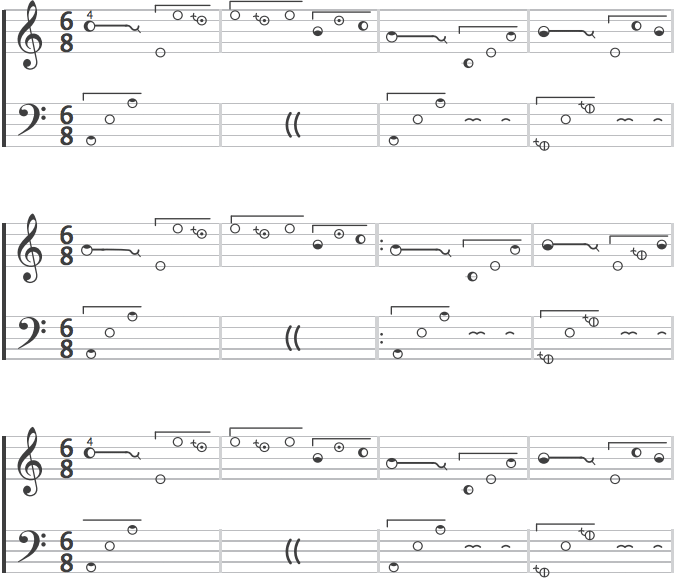
Roll over, Beethoven. (via @veen)
This video would be a lot better without the first 15 seconds (sippy cups? talking? who cares?) but the rest of it is pants-wettingly amazing.
I have checked the publication date on this story ten times and it’s not April 1st, so I guess Daft Punk really is launching their new album at a farm show in the small town of Wee Waa, Australia.
I remember tearing baseballs apart as a kid and seeing the rubber core, but I guess I had forgotten that a baseball is mostly a leather-covered yarn ball. See also how footballs are made and homemade soccer balls. (via @marklamster)
NPR’s Planet Money talked to Ed Herr of Herr Foods about how potato chip manufacturing has changed since 1946, when the company was housed in a barn on his family’s land.
Herr estimates that if they currently made chips the way they did back in the 1940s, they’d cost about $25 a bag.
Human behavior in elevators is endlessly fascinating and so is this tidbit about social organization in elevators from an ethnographic study of elevator users.
Yet, moving back to the interaction with elevator interior design elements, it was noticed that interaction went hand-in-hand with social organisation. As a result of 30 elevator journeys (15 in each building) a clear social order could be seen regarding where people positioned themselves inside the elevators and how they interacted with the design features, such as mirrors and monitors. More senior men in particular seemed to direct themselves towards the back of the elevator cabins. In front of them were younger men, and in front of them were women of all ages. Men watched the monitors, looked in the side mirrors (in one building) to see themselves, and in the door mirrors (of the other building) to also watch others. Women would watch the monitors and avoid eye contact with other users (unless in conversation) and the mirrors. It was only when the women travelled with other women, and just a few at that, that women elevator users would utilise the mirrors. One interviewee even mentioned that she only looked in the mirrors when there was no one else in the elevator.
(via @triciawang)
Quora is full of questions college students ask each other while high, except that sometimes they get answered seriously. Case in point: What is the political situation in the Mario universe? The top answer starts out:
Without going into too much detail, Mario generally lives and works in the Mushroom Kingdom, one of the largest geo-political structures on Mushroom World, in the Grand Finale Galaxy in, yes, the Mushroom Universe.
For the purposes of this answer I will deliberately restrict the terms to discussing Mushroom World, as a comprehensive answer on the entire Mushroom Universe would require covering 20-22 (depending on how you count) Galaxies and frankly, I doubt it would be any more fun to read than it would be to write.
Also, Bowser is probably a fascist.
No, this story is not spot on at all. No one at our house is doing this. Nope.
“Well, I’m not making the same mistake he did,” Campbell continued as he pulled out vinyl copies of Television’s Marquee Moon, Miles Davis’ Sketches Of Spain, and Big Star’s #1 Record, highly influential albums that will in no way help his daughter interact with her peers at a particularly delicate time in her social development. “There’s a lot of cool stuff out there, and it’s never too early to start learning what’s worth your time. I’m just glad I have the know-how to guide her.”
Campbell said he has also been vigilant in ensuring Emma develops an increased familiarity with timeless classic films, a parenting strategy that will inevitably hobble her as she attempts to achieve individuation while negotiating an adolescence heavily influenced by the very latest pop culture.
Yeah, our kids definitely do not listen to Philip Glass, Ella Fitzgerald, Edith Piaf, Burl Ives, Joan Jett, and Miles Davis on a regular basis. Or watch Chuck Jones-era Looney Toons shorts. Or Miyazaki films. Oh God, what are kids into these days? Pokebots? Blay blays? Yo-yos?
From Phil Plait at Bad Astronomy, a list of ten things you might not know about black holes. Some of this I knew, but this one is incredible:
If you were to rope off the solar system out past Neptune, enclose it in a giant sphere, and fill it with air, it would be a black hole!
See also this recent tweet from physicist Brian Greene:
Remove all the space within the atoms making up the human body, and every person that’s ever lived would fit inside a baseball.
(via @daveg & @rosecrans)
Someone built a robotic goalkeeper and then someone else had the bright idea to pit reigning best player in the world Lionel Messi against it:
Iker Casillas, your job is in jeopardy. But maybe not quite yet…by the final attempt, Messi seems to have figured out how to send the goalie the wrong way, at least for an instant. (via digg)
I’ve spent part of the last couple of days trying to figure out what Thomas Keller is getting at here with his distinction between passion and desire:
It’s not about passion. Passion is something that we tend to overemphasize, that we certainly place too much importance on. Passion ebbs and flows. To me, it’s about desire. If you have constant, unwavering desire to be a cook, then you’ll be a great cook. If it’s only about passion, sometimes you’ll be good and sometimes you won’t. You’ve got to come in every day with a strong desire. With passion, if you see the first asparagus of the springtime and you become passionate about it, so much the better, but three weeks later, when you’ve seen that asparagus every day now, passions have subsided. What’s going to make you treat the asparagus the same? It’s the desire.
“Follow your passion” is something you hear really often in tech/design/startup circles, so it’s interesting to see Keller take it to task.
The other day I posted a video about how differential gears work to help cars go smoothly around curves. Trains don’t have differential gears, so how do they manage to go around curves without slipping or skidding? Richard Feynman explains:
Ha, it looks like I’ve posted this one before as well. Can never get enough Feynman. (thx, kerry)
In an interview last month with Esquire’s Eric Spitznagel, Michel Gondry talked about his newest movie, The We and the I, and about how time travel is depressing.
ES: In your real life. If you, Michel Gondry, found a time machine and could go anywhere, to any period in history, where would you take it?
MG: I would travel back a few years ago and fix some screw-up I did.
ES: A personal or professional screw-up?
MG: In my personal life.
ES: Can you be more specific?
MG: I would come back and say yes to a girl. That’s all. Actually, I find the whole idea of traveling back in time to be profoundly depressing.
ES: Really? Why so?
MG: Because I know the future. Living in the past, it would feel weird to know what’s going to happen next. You couldn’t escape it. That future’s already in your head. You know it doesn’t get better.
ES: You’d rather not know about the future?
MG: The future is about hope. If you travel from the present to the past, you don’t have that hope anymore. You know how everything turns out.
ES: There are no surprises.
MG: No surprises, exactly! To me, that just sounds so… depressing.
XKCD has linked all the subway systems of North America into one map. That South Ferry to San Juan submarine line is a hike.
Baidu, the biggest search engine in China, is building their own version of Google Glass.
We really are developing something similar in its basic functionality to what was described in the Sina Tech report and other sources in the Chinese press; the reports were correct in their essentials though they got some of the details wrong (and those inaccuracies may have have its origins in an April Fool’s prank gone awry!). The project’s internal name is Baidu Eye. Not sure whether that’s going to be its final name. We’re doing some internal testing on it now on a small scale, and evaluating where this goes from here. That’s why we didn’t make any public official announcement on this.
Extreme Kidnapping is a company that offers a kidnapping service to those who want to know what it feels like for a few hours. GQ gave the company $1500 to kidnap Drew Magary.
Romeo slapped me hard across the face, much harder than I had been slapped all night. Then he shocked me with a stun gun. Then Cody doused me with cold water, which was the worst part by far. When you get hit with a stun gun, it lasts a second. When someone throws cold water on you, it makes you miserable for hours. I hadn’t thought about cold water before this. I had thought about guns and billy clubs and knives. It never occurred to me how desperately I would want to stay dry. Now I would have gladly taken another jolt from the stun gun in exchange for a fresh T-shirt.
“I know this was originally meant to be a fake kidnapping,” the voice said.
That’s right.
“And I know that you guys did your homework on me, and that you know I went to prison for a while.”
I do know that.
“But there are other things about me that you don’t know, Drew. And the reason you don’t know them is because you never asked.”
Oh shit.
That was the moment it felt real. That was the moment I was paying for.
I loved his safe word.
As chess increased in popularity across Europe in the 1800s, the proliferation in the variety of chess sets caused confusion amongst competitors, especially those hailing from different countries. The English typically used Barleycorn sets:

or St. George sets:

The Germans often used Selenus sets:

Regence sets were popular in France:

Chess set collector Ty Kroll explains the confusion:
English saw a different design for every chess club: St. George sets with their appearance of stacked disks, Dublin sets with more rounded middles, and Northern Uprights with columns instead, as well as elaborate, easily tipped Barleycorn sets. Germany had delicate Selenus sets, beautiful beyond belief, but fragile, tippable, and problematic for play. To tell which piece is which on some of these sets one must count the stacked crown. France saw elegant Regence style sets with some of the most confusing signatures in history. As in the English sets, queen’s were represented by orbs. The king’s floral crown closely resembles the modern Staunton signature for the queen. Knights were always taller than bishops the old French sets. Bishops were represented as fools, not clergymen, and therefore lacked the signature miter. What was worse, the knights in these sets were sometimes simple turned designs, not the recognizable horse’s head. This lead to common confusion as to which minor piece was which. The confusion of antique French knights and bishops is still a common problem today.
Then in the 1849, Nathaniel Cook designed and John Jaques began to sell a set that eventually came to be called the Staunton chess set:

Howard Staunton was regarded as the top chess player of his era and organized the first international chess tournament in 1851. Staunton endorsed the set and it soon became the standard in chess competitions and, later, the official standard of the World Chess Federation. The most recent iteration of the official Staunton set is Daniel Weil’s design for World Chess:
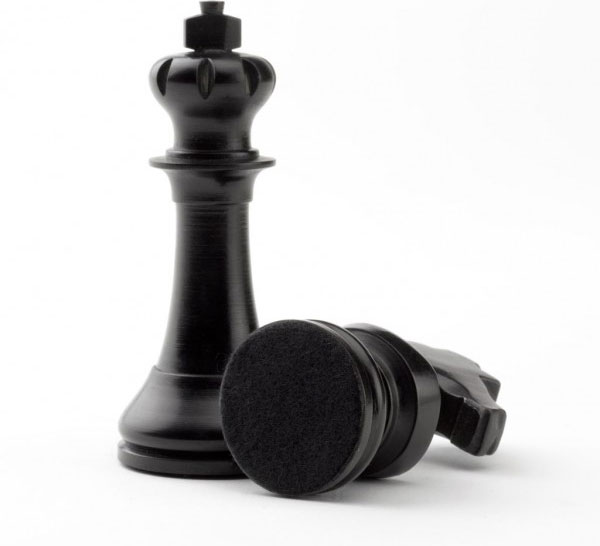
If you’re interested in learning more, Jimmy Stamp has a nice piece about the design of the original Staunton set and Weil’s update at Smithsonian magazine.
You should design URLs for people because they are important UI elements.
URLs can contain information about the page contents before they are even clicked. This is very advantageous in some communication mediums, such as chats, IMs, tweets, emails and forums.
(via hacker news)
From the Onion:
Calling the overall human experience “poignant,” “thought-provoking,” and a “complete tour de force,” film critic Roger Ebert praised existence Thursday as “an audacious and thrilling triumph.”
Earliest known aerial photograph is of Boston orig. from Apr 04, 2013
The social force in elevators orig. from Sep 30, 2003
* Q: Wha? A: These previously published entries have been updated with new information in the last 24 hours. You can find past updates here.
I’m reading back through my archive of stuff written by and about Roger Ebert and I realized I’ve never written about my favorite piece of his: Dwarfs, Little People and the M-Word. It’s nothing particularly earthshattering or insightful, but the piece demonstrates what I really liked about Ebert: humanist, happy to be corrected when in the wrong, not afraid to poke fun at himself, and a lover of both language and knowledge.
I had no idea the word “midget” was considered offensive, and you are the only person who has ever written to me about it. In my mind it is a descriptive term, like “dwarf.” “Little People” has seemed to me to have a vaguely condescending cuteness to it. If I am now informed that “midget” is offensive, I will no longer use it. What is your feeling about “dwarf?” Is “Little Person” always the preferred term? Our newspaper’s style book, based on Associated Press, does not consider “midget” or “dwarf” to be offensive terms, but perhaps we have not caught up.
Earlier today, I linked to a post by Roger Ebert announcing his leave of presence. The Chicago Sun-Times has announced that Ebert died today at 70.
Ebert, 70, who reviewed movies for the Chicago Sun-Times for 46 years and on TV for 31 years, and who was without question the nation’s most prominent and influential film critic, died Thursday in Chicago. He had been in poor health over the past decade, battling cancers of the thyroid and salivary gland.
He lost part of his lower jaw in 2006, and with it the ability to speak or eat, a calamity that would have driven other men from the public eye. But Ebert refused to hide, instead forging what became a new chapter in his career, an extraordinary chronicle of his devastating illness that won him a new generation of admirers. “No point in denying it,” he wrote, analyzing his medical struggles with characteristic courage, candor and wit, a view that was never tinged with bitterness or self-pity.
Always technically savvy - he was an early investor in Google - Ebert let the Internet be his voice. His rogerebert.com had millions of fans, and he received a special achievement award as the 2010 “Person of the Year” from the Webby Awards, which noted that “his online journal has raised the bar for the level of poignancy, thoughtfulness and critique one can achieve on the Web.” His Twitter feeds had 827,000 followers.
Ebert was both widely popular and professionally respected. He not only won a Pulitzer Prize - the first film critic to do so - but his name was added to the Hollywood Walk of Fame in 2005, among the movie stars he wrote about so well for so long. His reviews were syndicated in hundreds of newspapers worldwide.
Rest in peace, Roger. And fuck cancer.
Mark Bittman explores the world of healthy fast food and discovers that’s slowly becoming a thing.
Good Fast Food doesn’t need to be vegan or even vegetarian; it just ought to be real, whole food. The best word to describe a wise contemporary diet is flexitarian, which is nothing more than intelligent omnivorism. There are probably millions of people who now eat this way, including me. My own style, which has worked for me for six years, is to eat a vegan diet before 6 p.m. and then allow myself pretty much whatever I want for dinner. This flexibility avoids junk and emphasizes plants, and Lyfe Kitchen, which offers both “chickin” and chicken — plus beans, vegetables and grains in their whole forms (all for under 600 calories per dish) — comes closest to this ideal. But the menu offers too much, the service raises prices too high and speed is going to be an issue. My advice would be to skip the service and the wine, make a limited menu with big flavors and a few treats and keep it as cheap as you can. Of course, there are huge players who could do this almost instantaneously. But the best thing they seem able to come up with is the McWrap or the fresco menu.
Sad news from Chicago: Roger Ebert’s cancer has returned and he’s taking what he calls a “leave of presence” to focus on recovery and a few different projects.
What in the world is a leave of presence? It means I am not going away. My intent is to continue to write selected reviews but to leave the rest to a talented team of writers handpicked and greatly admired by me. What’s more, I’ll be able at last to do what I’ve always fantasized about doing: reviewing only the movies I want to review.
At the same time, I am re-launching the new and improved Rogerebert.com and taking ownership of the site under a separate entity, Ebert Digital, run by me, my beloved wife, Chaz, and our brilliant friend, Josh Golden of Table XI. Stepping away from the day-to-day grind will enable me to continue as a film critic for the Chicago Sun-Times, and roll out other projects under the Ebert brand in the coming year.
Love that first sentence. Get well soon, Roger.
After an exhaustive search, I have decided this photo most exemplifies life in these United States during the 1980s:

And if not that one, then one of several other possible candidates from Roger Minick’s Sightseer project, for which he took photos of tourists at popular US tourist destinations during the early 1980s and into the 2000s.
When I approached people for a portrait, I tried to make my request clear and to the point, making it clear that I was not trying to sell them anything. I explained that my wife and I were traveling around the country visiting most of the major tourist destinations so that I could photograph the activity of sightseeing. I would quickly add that I hoped the project would have cultural value and might be seen in years to come as a kind of time capsule of what Americans looked like at the end of the Twentieth Century; at which, to my surprise, I would see people often begin to nod their heads as if they knew what I was talking about.
Slate did a feature on this series last week.
For his Alpha Beauties project, artist Nazareno Crea retouches paintings and sculpture from throughout history, a process which normalizes each period’s ideal of female beauty to that of the present day. That is, much skinnier, with smaller noses, higher cheekbones, and larger breasts.
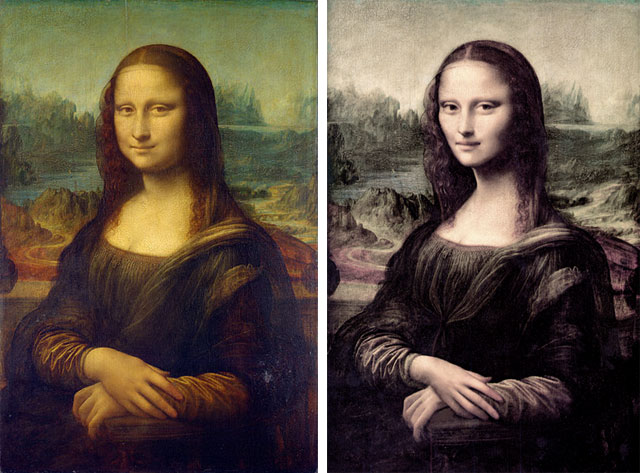

Similar projects: Venus and Eye of the Beholder.
Netflix has announced that the 15 episodes of the new season of Arrested Development will be released, all at once, on May 26th. Netflix did not announce that later that day, all 15 episodes will be available on BitTorrent.
Designer Adam Harvey, who gave the world the anti-paparazzi purse and dazzle camouflage for the face, has developed a hoodie that makes the wearer invisible to the sort of thermal imaging utilized by surveillance drones.
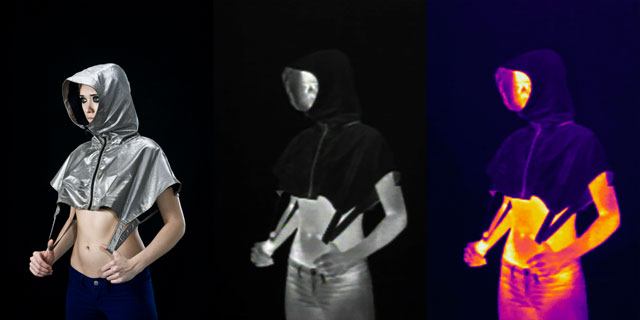
This is the most New Aesthetic thing I have ever seen. The Guardian has more:
“These are primarily fashion items and art items,” Harvey tells me. “I’m not trying to make products for survivalists. I would like to introduce this idea to people: that surveillance is not bulletproof. That there are ways to interact with it and there are ways to aestheticise it.”
I imagine that at some point, anti-drone clothing will eject chaff as a countermeasure against incoming drone-launched missiles. (via @DavidGrann)
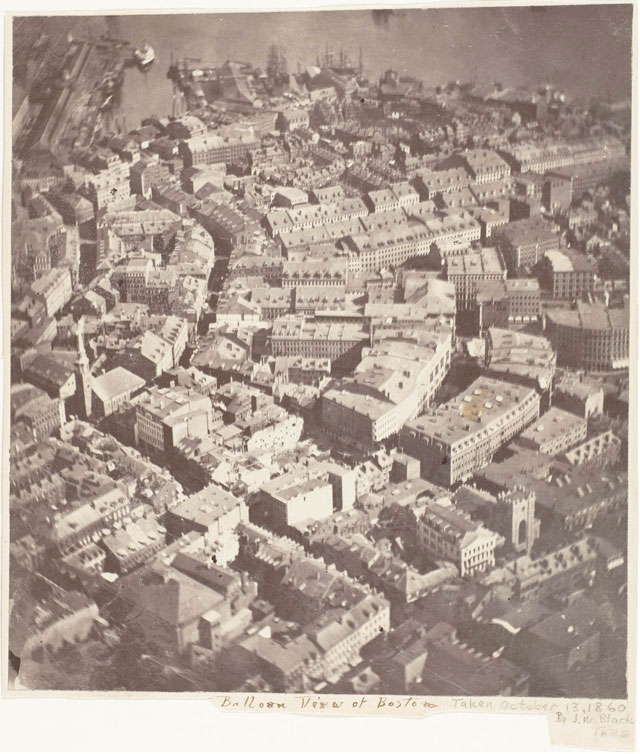
While French balloonist Gaspard-Félix Tournachon first photographed Paris by air in 1858, those photos were lost, and this photograph of Boston from 1860 by James Wallace Black is the earliest known aerial photo. The title is ‘Boston, as the Eagle and the Wild Goose See It.’ If I had to guess where in Boston this is, I’d say somewhere along Atlantic Ave.
Update: Several people have identified the steepled building at center left as the Old South Meeting House, which Wikipedia confirms: “Depicts area resembling Old South Meeting House; Milk Street; India Wharf, Central Wharf; and vicinity.” Looks a bit different these days.
But more importantly, a photo of Providence, RI taken by Black in August of 1860 predates his Boston photograph by two months. The print, which is part of the MoMA’s collection, is badly damaged but it looks like some detail would be discernable in person.

So for some sufficiently flexible definition of “surviving”, Black’s photo of Providence is the oldest surviving aerial photo. (thx, david)

I still remember the first time I saw a guy at a restaurant talking on one of those prehistorically massive cellphones. My dad leaned over and said, “Look at that poor guy. Never let that happen to you. Never take a job that’s so all-consuming that you have to carry a phone around, even during lunch.” A lot has changed since then (although I still often see a lot of validity in my dad’s initial response to these devices) and in the forty years since Motorola engineer Martin Cooper made the first cellphone call. Wired takes a look back at the twelve cellphones that changed our world forever.
Or at least unbeneficial. A comprehensive study out of Croatia complements other evidence that stretching your muscles before exercise results in less strength, power, and performance than if you hadn’t stretched.
The numbers, especially for competitive athletes, are sobering. According to their calculations, static stretching reduces strength in the stretched muscles by almost 5.5 percent, with the impact increasing in people who hold individual stretches for 90 seconds or more. While the effect is reduced somewhat when people’s stretches last less than 45 seconds, stretched muscles are, in general, substantially less strong.
They also are less powerful, with power being a measure of the muscle’s ability to produce force during contractions, according to Goran Markovic, a professor of kinesiology at the University of Zagreb and the study’s senior author. In Dr. Markovic and his colleagues’ re-analysis of past data, they determined that muscle power generally falls by about 2 percent after stretching.
And as a result, they found, explosive muscular performance also drops off significantly, by as much as 2.8 percent. That means that someone trying to burst from the starting blocks, blast out a ballistic first tennis serve, clean and jerk a laden barbell, block a basketball shot, or even tick off a fleet opening mile in a marathon will be ill served by stretching first. Their performance after warming up with stretching is likely to be worse than if they hadn’t warmed up at all.
Streaming music service Rdio (which I have been enjoying the hell out of for the past couple months1) is launching a streaming video service called Vdio.
The first thing you’ll notice about Vdio is that it’s designed to solve the “what to watch” problem. It’s not just that we’ve got amazing content, but that the experience is now geared to get you from searching to watching faster. We’re introducing the notion of Sets — playlists for TV shows and movies — so anyone can make and share lists of their favorites, making it easier than ever to discover new stuff. Or, you can just check out what your friends are watching in the moment and jump in. Beyond that, Vdio has the beautiful design and social features that people love about Rdio, with plenty more to come.
I haven’t played with it too much, but it looks like it’s not an all-you-can-eat service like Rdio…you buy/rent movies and TV shows just like iTunes, Amazon, etc.
[1] And that’s actually a huge understatement. I ignored streaming music services like Rdio and Spotify when they came out, opting for the familiarity of iTunes, but Rdio has completely reignited my love of music over the past two months. Should write a whole post about this at some point. ↩
vintage post from Apr 2013
· gift link
I’ve posted this before, but it’s so good, here it is again: a super-simple explanation of why differential gears are necessary in cars and how they work.
(via @stevenstrogatz)
When Elvis Presley died in 1977, legendary rock critic Lester Bangs wrote a piece on the singer for the Village Voice.
I got taken too the one time I saw Elvis, but in a totally different way. It was the autumn of 1971, and two tickets to an Elvis show turned up at the offices of Creem magazine, where I was then employed. It was decided that those staff members who had never had the privilege of witnessing Elvis should get the tickets, which was how me and art director Charlie Auringer ended up in nearly the front row of the biggest arena in Detroit. Earlier Charlie had said, “Do you realize how much we could get if we sold these fucking things?” I didn’t, but how precious they were became totally clear the instant Elvis sauntered onto the stage. He was the only male performer I have ever seen to whom I responded sexually; it wasn’t real arousal, rather an erection of the heart, when I looked at him I went mad with desire and envy and worship and self-projection. I mean, Mick Jagger, whom I saw as far back as 1964 and twice in ‘65, never even came close.
(via @gavinpurcell)
Caught a rerun of an episode of This American Life on reruns the other day. The first segment is about a movie I’d never heard about before, The Beaver Trilogy. I don’t want to spoil it too much (the Wikipedia page contains spoilers as well) but the first part of the film features documentary footage of a kid from Beaver, Utah doing impressions and putting on a talent show. The second and third parts are recreations of that footage featuring, well, just listen to the story or watch the first two parts of the movie for yourself (one, two). (thx, @eventi)
Newer posts
Older posts







Socials & More