

Bee vision
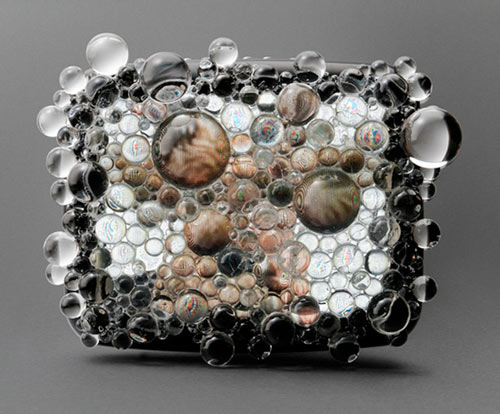
This computer display covered by glass beads must be how bees see the web.
(via today and tomorrow, which is celebrating five years of excellence this week)

This site is made possible by member support. 💞
Big thanks to Arcustech for hosting the site and offering amazing tech support.
When you buy through links on kottke.org, I may earn an affiliate commission. Thanks for supporting the site!
kottke.org. home of fine hypertext products since 1998.
Beloved by 86.47% of the web.
This computer display covered by glass beads must be how bees see the web.
(via today and tomorrow, which is celebrating five years of excellence this week)
The legendary Braun designer talks about his craft.
A design should not dominate people.
And hey, I didn’t know that a book had been published on Rams’ work. I bet Jony Ive has at least three copies. (via monoscope)
The Asia Society has an exhibition of photos taken of Himalayan glaciers as early as 1899 paired with photos taken more recently from the same vantage points. The differences are stark. Be sure to check out the Comparative Photography section to get a sense of the scale involved. More photos at the NY Times Lens blog.
It’s not so much a video of a total solar eclipse (the recent one, as seen from Argentina on July 11) as a video of people watching a total solar eclipse.
The sound is key…the reaction is very much The Rapture/End Times/high on ecstasy. If I had a bucket list, seeing a total solar eclipse would be on it. (via bobulate)
The Art of the Title Sequence blog highlights the opening titles for Moon. Love, love, love that song…the whole soundtrack (by Clint “Requiem for a Dream” Mansell) is good actually.
Some photos of the production line at the Real Doll factory.
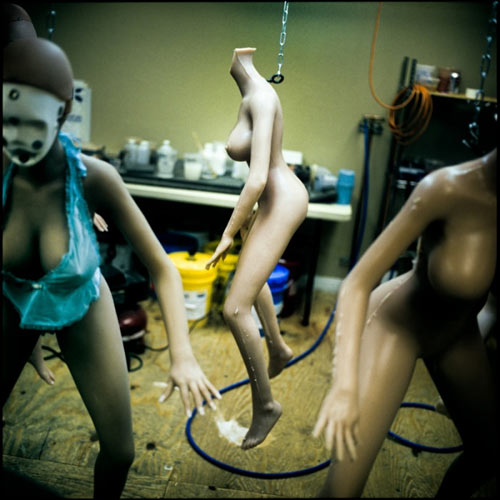
NSFW, probably. There is also a short documentary on Vimeo about the manufacturing process:
Posting this one mainly for the title: Gene Weingarten Column Mentions Lady Gaga, a perfectly succinct skewering of the HuffPo-lead SEO crapathon that is online headline writing these days. All that’s missing is the 20 misspelled tags — Gene Weingarten, Gene Wiengarten, Gene Weingarden, Jean Weingarten, Gene Wine Garden, etc. — for true Master Douche-level SEO. (via the browser)
The Chicago Manual of Style addresses some recent questions about citation, grammar, and even fashion.
Q. Hi there! For a sign for bachelorette parties, would the phrase “Bachelorette Out of Control” be more appropriate than “Bachelorette’s Out of Control”? The question is one of contraction, because I don’t see how “Bachelorette’s Out of Control” can be correct without “The” prefacing it. Thank you!
A. Out-of-control bachelorettes who require appropriate signage aren’t very convincing, but the first version is better.
I think they punted a bit on the “how to cite a tshirt” question.
A two part (one, two) series on using psychological techniques to improve your creativity.
Interviews with 22 Nobel Laureates in physiology, chemistry, medicine and physics as well as Pulitzer Prize winning writers and other artists has found a surprising similarity in their creative processes (Rothenberg, 1996).
Called ‘Janusian thinking’ after the many-faced Roman god Janus, it involves conceiving of multiple simultaneous opposites. Integrative ideas emerge from juxtapositions, which are usually not obvious in the final product, theory or artwork.
Physicist Niels Bohr may have used Janusian thinking to conceive the principle of complementarity in quantum theory (that light can be analysed as either a wave or a particle, but never simultaneously as both).
(via lone gunman)
Paul Graham’s Hackers and Painters, published in 2004, contained the following footnote:
If the Mac was so great, why did it lose? Cost, again Microsoft concentrated on the software business and unleashed a swarm of cheap component suppliers on Apple hardware. It did not help either that suits took over during a critical period. (And it hasn’t lost yet. If Apple were to grow the iPod into a cell phone with a web browser, Microsoft would be in big trouble.)
Then again, a few footnotes later Graham writes:
I would not even use Javascript, if I were you; Viaweb didn’t. Most of the Javascript I see on the Web isn’t necessary, and much of it breaks. And when you start to be able to browse actual web pages on your cell phone or PDA (or toaster), who knows if they’ll even support it.
Maybe he meant Flash? (via oddhead)
Apple is holding a press conference today, which will presumably address the antenna problems that few actual customers seem to be having on the still-selling-like-hotcakes iPhone 4. I have a number of sources at Apple and based on my conversations with them, here’s my prediction on how today’s event will play out:
Steve Jobs will come out on stage and will sit in front of a large olde tyme cash register. He will immediately begin taking questions from the assembled journalists and bloggers. As the first-question scrum begins, Jobs will start madly ringing up purchases on the very loud register while pointing to his ears, shaking his head, and shouting “gosh, I’m sorry I can’t hear you guys over the sound of the register”. This will continue for several minutes and then the press conference will be over.
Someone on Apple’s board suggested a more conventional press event but Jobs quickly wrote an email back saying that they were not going to “hold it that way”.
No, this is not a story from The Onion or about a new Facebook game called Pharmaville. The state of Oklahoma is concerned about kids listening to audio files “designed to induce drug-like effects” because that might be a gateway to actual drug use.
“Kids are going to flock to these sites just to see what it is about and it can lead them to other places,” said OBNDD spokesperson Mark Woodward. The digital drugs use binaural or two-toned technology to alter your brainwaves and mental state. “Well it’s just scary, definitely scary. Just one more thing to look out for,” said parent Kelly Johnson.
I just got so wasted on this and then did a whole kilo of pure heroin; stuffed it right into my ears:
Look at that, I’m a drug dealer now! Now you’ll all be pounding on my door in the middle of the night looking to score some tunes. (via clusterflock)
Does quantum entanglement hold DNA together? Some physicists say it’s possible.
Rieper and co ask what happens to these oscillations, or phonons as physicists call them, when the base pairs are stacked in a double helix.
Phonons are quantum objects, meaning they can exist in a superposition of states and become entangled, just like other quantum objects.
To start with, Rieper and co imagine the helix without any effect from outside heat. “Clearly the chain of coupled harmonic oscillators is entangled at zero temperature,” they say. They then go on to show that the entanglement can also exist at room temperature.
That’s possible because phonons have a wavelength which is similar in size to a DNA helix and this allows standing waves to form, a phenomenon known as phonon trapping. When this happens, the phonons cannot easily escape. A similar kind of phonon trapping is known to cause problems in silicon structures of the same size.
I would be fucking remiss in my duties here if I didn’t inform you of this bloody awesome periodic table of swearing, you bunch of stupid old wankers.
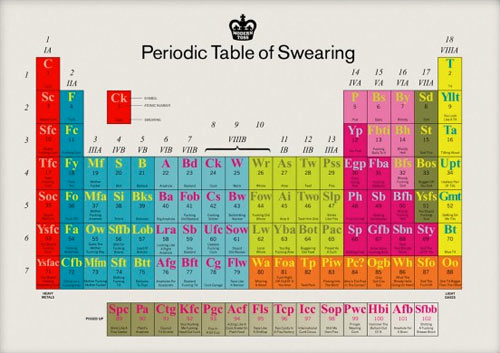
There’s goddamned prints available. (via clusterflock)
New Statesman has an excerpt of the new-for-the-paperback postscript from Nassim Taleb’s The Black Swan, which book was probably the most interesting one I’ve read in quite some time (if you can handle some of the ridiculous posturing).
An economist would find it inefficient to carry two lungs and two kidneys — consider the costs involved in transporting these heavy items across the savannah. Such optimisation would, eventually, kill you, after the first accident, the first “outlier”. Also, consider that if we gave Mother Nature to economists, it would dispense with individual kidneys — since we do not need them all the time, it would be more “efficient” if we sold ours and used a central kidney on a time-share basis. You could also lend your eyes at night, since you do not need them to dream.
Read through to the end for Taleb’s list of ten principles for a Black Swan-robust society.
Ferris Bueller. Fight Club. You see where this is headed, right?
Well done. (via matt)
Well, we kinda knew that. But a recently published study indicates that regularly sitting for long periods of time — say, in front of a computer writing or programming or reading kottke.org — increases your risk of heart disease even when you augment all that sitting with regular exercise. Yipes!
Men who spent more than 23 hours a week watching TV and sitting in their cars (as passengers or as drivers) had a 64 percent greater chance of dying from heart disease than those who sat for 11 hours a week or less. What was unexpected was that many of the men who sat long hours and developed heart problems also exercised. Quite a few of them said they did so regularly and led active lifestyles. The men worked out, then sat in cars and in front of televisions for hours, and their risk of heart disease soared, despite the exercise. Their workouts did not counteract the ill effects of sitting.
(via waxy)
I love these minimalist Mad Men posters by Christina Perry.
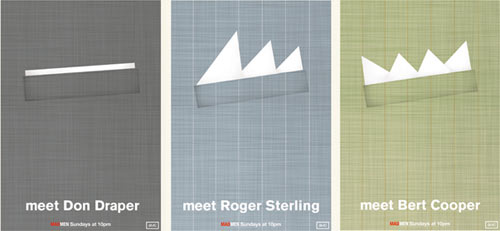
Prints are available. (via footnotes of mad men)
As a casual Penn & Teller fan, I didn’t know that the pair rarely socialize outside of work…and that they might not even like each other (although the respect is obviously there). That and more from this interesting interview.
“But then you come out here and it turns out, as insane as this is, that you have more artistic freedom in Las Vegas than you have in New York. Much more. And the reason is this…” He leans forward conspiratorially and says, in a stage whisper. “In Vegas, our investors don’t give a f—- about us. The people who are our bosses see our show maybe once a year. One of them will bring their kids and come by. And they are pleasant and they love us and they sincerely enjoy the show. Then they leave and they don’t think about us. And because nobody’s paying attention we do exactly the show we want. As long as people come to see it nobody cares what we do. And it means that we have done wilder things and more new stuff here than we ever did in New York. The contract is 100 per cent between us and the audience. And that’s crazy.”
“The contract is 100 per cent between us and the audience”…I love that.
Hair, makeup, and style tips from an ugly girl about “creating a human optical illusion”.
(via clusterflock)
Over at The Millions, Conor Dillon notes the increase in use of colon in contemporary journalism, including a new kind of colon called the jumper colon, “the Usain Bolt of literature”.
For grammarians, it’s a dependent clause + colon + just about anything, incorporating any and all elements of the other four colons, yet differing crucially in that its pre-colon segment is always a dependent clause.
For everyone else: its usefulness lies in that it lifts you up and into a sentence you never thought you’d be reading by giving you a compact little nugget of information prior to the colon and leaving you on the hook for whatever comes thereafter, often rambling on until the reader has exhausted his/her theoretical lung capacity and can continue to read no longer.
Bottom line: the 140 character limit of Twitter and general move towards concision in online writing is credited for the rise of the jumper colon.
Funny or Die got Jewel to dress up in a disguise and go sing some of her own songs at a karaoke bar. Instant classic.
If Smashing Telly were still going, this would be perfect for it: every feature-length Andrei Tarkovsky film is available for viewing online for free.
A fantastically entertaining story about a NY Post employee, short pants, and Rupert Murdoch’s hidden camera in the cafeteria.
Sal looks at me oddly and goes, “Mr. Murdoch would like to know why you’re wearing short pants.” So I look at Sal and am like, “Dude, what the hell are you talking about?” And he continues talking into the phone without taking his eye off me and is like, “Yes, I see, okay, I’ll ask,” and then looks at me and goes, again, “Mr. Murdoch is inquiring again as to why you are wearing short pants in the office.” And I look at Sal and am like, “I do not follow. How does he know I’m wearing shorts?” And Sal covers the receiver and says, “He is in his office but he can see you. He has a camera down here.”
(via @choire)
Bang on essay by Adam Rifkin about the differences in approach and culture between Google (Orkut, Wave, Buzz) and other recent social successes (Twitter, Foursquare, Facebook). Lots of good stuff here:
Google apps are for working and getting things done; social apps are for interacting and having fun.
Social apps offer a steady diet of junk food to keep us addicted; Google apps offer mostly bamboo.
Social apps are whimsical and fun; Google apps are whittled and functional.
(via sippey)
Talking Carl is an iPhone app that records snippets of audio and then plays it back at a higher pitch. If you put two Talking Carls next to each other, this is what you get:
Note to Mouser and Aaron: parrot feedback! (thx, matt)
The Takeaway has several audio clips from David Lipsky’s 1996 road trip with David Foster Wallace which eventually ended up in book form.
NY Times readers recently had a bunch of their questions answered by a NYC window washer. (This is more interesting than it sounds.)
For safety reasons, music and cellphones are not allowed up in the scaffolding, but some of us listen to our own music in our heads.
Here’s part two. (via @nicolatwilley)
Sam Kean is blogging the periodic table of elements over at Slate.
Starting today, I’ll be posting on a different element each weekday (the blog will run through early August), starting with the racy history of an element we’ve known about for hundreds of years, antimony, and ending on an element we’ve only just discovered, the provisionally named ununseptium. I’ll be covering many topics-explaining how the table works, relaying stories both funny and tragic, and analyzing current events through the lens of the table and its elements. Above all, I hope to convey the unexpected joys of the most diverse and colorful tool in all of science.
If you like that, Kean has written a whole book on the topic.
It’s two weeks until season four of Mad Men starts but in the meantime, you can pre-order Mad Men Unbuttoned, the book that sprang from the loins of the excellent and well-reviewed The Footnotes of Mad Men blog. I’ve only skimmed bits of it here and there, but it looks good so far.
I’m hoping this will be a new option on Google Maps alongside “satellite” soon: thermographic view. It’s basically a heat map of all the buildings on a map…pop in your address and see how energy efficient your roof is. Belgium only. Unfortunately…unless you live in Belgium. (via infosthetics)
So, every time I post one of these HTML5 games or apps (like The Game of Life), I got tons of email from people who say that it could be done much easier or better in Flash. Which is probably true. But I post these experiments because I’ve been using HTML since 1994 and I love it. It’s simple (or can be), open, can be edited with any old text editor, and increasingly capable. Oh sure, HTML can be maddening at times, but I’m fascinated and happy to see it maturing into something that has so much functionality.
Terry Kniess, a former weatherman with a knack for numbers and seeing patterns, went on The Price is Right and won more than $50,000 in prizes because of an exact bid on his Showcase. His secret? He watched hundreds of hours of the show and discovered its secrets and weaknesses.
Before they stepped foot in the Bob Barker Studio, they were going to be prepared; “Good TV is rehearsed TV,” Terry likes to say. For four months during the summer of 2008, they recorded The Price Is Right every morning and watched it together in bed every night, Terry hunting for patterns and Linda doing the math. It didn’t take long for them to find their edge. In The Price Is Right’s greatest strength, he and Linda also found its greatest weakness: It had survived all those years because it seemed never to change. Even when Drew Carey replaced Bob Barker — the show’s own version of Vatican II — he rocked a similar skinny microphone. Behind all the screaming and seeming chaos, there was a precise and nostalgic order. Terry says he first sat upright in bed when a distinctive grill called the Big Green Egg came up for bid again and again. It was always $1,175.
(via @longreads)
Design Observer has a slideshow of Michael Zinman’s unusual collection: signs he has purchased from panhandlers.
I did engage with all the individuals I purchased signs from, and quite often, my offer of purchase was declined. I would guess at least two out of every five people on the street turned me down, and I was not able to purchase their signs. They were just unwilling to part with them. I think it was a matter of self dignity, and I was ever sensitive to their condition and never tried to further persuade them to sell.
Golan Levin and Kyle McDonald took some old code for converting between polar and cartesian geometries and hacked it to flatten out photos of flowers into panoramic landscapes.


Polar-to-cartesian unwrapping of flower photographs is the new flattening flowers between the pages of books. The Processing source code is available. NotCot applied the effect to chandeliers. I dorked around in Photoshop a little and you can get similar results using the “Polar Coordinates” filter…you just have to stretch out the image first. (via today and tomorrow)
Unsurprisingly finding itself on the bestseller list is a book by Kenneth Rogoff and Carmen Reinhart called This Time is Different, an economic history of the dozens of financial crises that have occurred over the past 800 years. The NY Times has a profile of the authors.
Mr. Rogoff says a senior official in the Japanese finance ministry was offended at the suggestion in “This Time Is Different” that Japan had once defaulted on its debt and sent him an angry letter demanding a retraction. Mr. Rogoff sent him a 1942 front-page article in The Times documenting the forgotten default. “Thank you,” the official wrote in apology, “for teaching the Japanese something about our own country.”
Scott Snibbe’s interactive art projects are available for sale on the iPhone/iPad and he’s pretty happy about it.
Over the past few days my first three apps became available on the iTunes store: Gravilux, Bubble Harp, and Antograph. I’ve been dreaming of this day for twenty years: a day when, for the first time, we can enjoy interactive art as a media commodity no different from books, music, and movies.
I remember the Gravilux Java applet from back in the day and happily bought it for the iPad.
Novelist Nic Brown plays his childhood friend Tripp Phillips (former ATP circuit pro) in tennis. The challenge? To win a single point.
What I can’t do, no matter how hard I try, is win a single point. Not one. “You have no weapons,” he tells me two days later, over a lunch of cheap tacos and cheese dip. He reviews the match in this specific analytical way I’ve experienced with other professional athletes. To them, match review is engineering, not personal nicety. The performance is fact, not opinion. “No matter what,” he says, “I was going to have you off balance. And no matter what you did, I was going to be perfectly balanced. I knew where you were going to hit it before you hit it. It’s the difference between me and you. But if I played Roger Federer right now, he’d do the exact same thing to me.”
That bit reminds me of David Foster Wallace’s article on tennis pro Michael Joyce (Esquire, July ‘96). Specifically, how much of a skill difference there was between Joyce (the 79th best player in the world), the players he competed against in qualifiers, and the then-#1 ranked Andre Agassi.
The majority owner of the Cleveland Cavaliers has an epic car wreck of a goodbye/fuck you letter to LeBron James.
As you now know, our former hero, who grew up in the very region that he deserted this evening, is no longer a Cleveland Cavalier. This was announced with a several day, narcissistic, self-promotional build-up culminating with a national TV special of his “decision” unlike anything ever “witnessed” in the history of sports and probably the history of entertainment.
And that, my friends, is how you take the low road. (via @hurtyelbow)
David Galbraith tracked down the birthplace of the web and confirmed the location with Tim Berners-Lee.
The reason I’m interested in this is that recognizing the exact places involved in the birth of the web is a celebration of knowledge itself rather than belief, opinion or allegiance, both politically and spiritually neutral and something that everyone can potentially enjoy and feel a part of.
Secondly, many places of lesser importance are very carefully preserved. The place where the web was invented is arguably the most important place in 2 millennia of Swiss history and of global historical importance.
According to a study by Jakob Nielsen, people read at a slower rate on the Kindle and iPad devices than on paper…at least when reading Ernest Hemingway.
It’s not an Americanism:
“Soccer,” by the way, is not some Yankee neologism but a word of impeccably British origin. It owes its coinage to a domestic rival, rugby, whose proponents were fighting a losing battle over the football brand around the time that we were preoccupied with a more sanguinary civil war. Rugby’s nickname was (and is) rugger, and its players are called ruggers-a bit of upper-class twittery, as in “champers,” for champagne, or “preggers,” for enceinte. “Soccer” is rugger’s equivalent in Oxbridge-speak. The “soc” part is short for “assoc,” which is short for “association,” as in “association football,” the rules of which were codified in 1863 by the all-powerful Football Association, or FA-the FA being to the U.K. what the NFL, the NBA, and MLB are to the U.S.
Congratulations to the Dutch for reaching the World Cup final. To celebrate, here’s a great Dutch moment from a past World Cup…Dennis Bergkamp’s epic goal vs. Argentina in the 1998 WC. Turn the speakers up…the sound is everything.
Congrats also to Spain, but I couldn’t find a Spanish WC highlight as entertaining to match.
Drowning people look calm, not crazy flail-y like they do on the TV.
Throughout the Instinctive Drowning Response, drowning people cannot voluntarily control their arm movements. Physiologically, drowning people who are struggling on the surface of the water cannot stop drowning and perform voluntary movements such as waving for help, moving toward a rescuer, or reaching out for a piece of rescue equipment.
(via df)
The answer is yes, sorta, and no.
People are not tiring of the chance to publish and communicate on the internet easily and at almost no cost. Experimentation has brought innovations, such as comment threads, and the ability to mix thoughts, pictures and links in a stream, with the most recent on top. Yet Facebook, Twitter and the like have broken the blogs’ monopoly.
After sitting out 11 months awaiting the results of gender testing, runner Caster Semenya has been cleared to compete in IAAF-sanctioned competitions. For some background, check out this New Yorker piece on Semenya from last November.
ScienceBlogs has added a blog about “innovations in science, nutrition and health policy” sponsored by Pepsi to their roster. Posters to the blog will include Pepsi research staff. Some of the other bloggers on ScienceBlogs are not happy.
However, that said, I am completely mystified by ScienceBlogs’ latest development: adding the PepsiCo “nutrition” Blog. How does ScienceBlogs expect to maintain their (OUR) credibility as a science news source (we are picked up by Google news searches afterall) when they are providing paid-for content under the guise of news? Further, I cannot imagine what sorts of credible nutrition research PepsiCo is doing that they can or will actually talk about publicly, nor can I possibly imagine any “food” corporation actually caring about promoting public health. PepsiCo is a corporation, not a research institute, fer crissakes!
(via @tcarmody)
That parents hate parenting is verified by study after study, but most parents think the opposite is true.
From the perspective of the species, it’s perfectly unmysterious why people have children. From the perspective of the individual, however, it’s more of a mystery than one might think. Most people assume that having children will make them happier. Yet a wide variety of academic research shows that parents are not happier than their childless peers, and in many cases are less so. This finding is surprisingly consistent, showing up across a range of disciplines. Perhaps the most oft-cited datum comes from a 2004 study by Daniel Kahneman, a Nobel Prize-winning behavioral economist, who surveyed 909 working Texas women and found that child care ranked sixteenth in pleasurability out of nineteen activities. (Among the endeavors they preferred: preparing food, watching TV, exercising, talking on the phone, napping, shopping, housework.) This result also shows up regularly in relationship research, with children invariably reducing marital satisfaction. The economist Andrew Oswald, who’s compared tens of thousands of Britons with children to those without, is at least inclined to view his data in a more positive light: “The broad message is not that children make you less happy; it’s just that children don’t make you more happy.” That is, he tells me, unless you have more than one. “Then the studies show a more negative impact.” As a rule, most studies show that mothers are less happy than fathers, that single parents are less happy still, that babies and toddlers are the hardest, and that each successive child produces diminishing returns. But some of the studies are grimmer than others. Robin Simon, a sociologist at Wake Forest University, says parents are more depressed than nonparents no matter what their circumstances-whether they’re single or married, whether they have one child or four.
I appreciated the description of being a parent as living in “a clamorous, perpetual-forward-motion machine almost all of the time”. Bang on.
In a “major breakthrough”, researchers have discovered fossils in Gabon of multicellular organisms that are 2.1 billion years old.
These new fossils, of various shapes and sizes, imply that the origin of organized life is a lot older than is generally admitted, thus challenging current knowledge on the beginning of life.
Socials & More