Visitors to the restaurant are ushered into an air-conditioned, flood-lit hall filled with dozens of glass-topped tables. Unlike North Korea proper, which is wracked by economic sanctions and constant famines, the food here is fresh and abundant. The menu features specialties such as Pyongyang “cold noodle” (served encrusted with ice), barbecued cuttlefish, stringy dangogi (dog meat) soup, and countless variations on the kimchi theme, all served with glutinous white rice.
Now this is interesting…Fred Brooks, author of The Mythical Man-Month (which should be subtitled “If You Make Software As Part of a Team You Should Read This Book Immediately Like Now What Are You Waiting For Dummy?”) has a new book out called The Design of Design.
Effective design is at the heart of everything from software development to engineering to architecture. But what do we really know about the design process? What leads to effective, elegant designs? The Design of Design addresses these questions.
These new essays by Fred Brooks contain extraordinary insights for designers in every discipline. Brooks pinpoints constants inherent in all design projects and uncovers processes and patterns likely to lead to excellence. Drawing on conversations with dozens of exceptional designers, as well as his own experiences in several design domains, Brooks observes that bold design decisions lead to better outcomes.
The author tracks the evolution of the design process, treats collaborative and distributed design, and illuminates what makes a truly great designer. He examines the nuts and bolts of design processes, including budget constraints of many kinds, aesthetics, design empiricism, and tools, and grounds this discussion in his own real-world examples-case studies ranging from home costruction to IBM’s Operating System/360. Throughout, Brooks reveals keys to success that every designer, design project manager, and design researcher should know.
Globish is a “decaffeinated English” that is increasingly becoming a widely used international language.
The Times journalist Ben Macintyre described how, waiting for a flight from Delhi, he had overheard a conversation between a Spanish UN peacekeeper and an Indian soldier. “The Indian spoke no Spanish; the Spaniard spoke no Punjabi. Yet they understood one another easily. The language they spoke was a highly simplified form of English, without grammar or structure, but perfectly comprehensible, to them and to me. Only now,” he concluded, “do I realise that they were speaking ‘Globish’, the newest and most widely spoken language in the world.”
The Chairman of Committees: My Lords, I am well aware that there are still mice around. I saw one in the Bishops’ Bar only yesterday evening. I do not know whether it was the same one that I saw the day before or a different one; it is always difficult to tell the difference between the various mice that one sees. We believe that the problem is getting better. Cleaning is one of the measures we are taking, as I outlined in my original Answer. As I speak here this afternoon, the Bishops’ Bar and the Guest Room are being hoovered, so we can get rid of the food scraps from lunch. If you were a mouse, you would rather eat the crumbs of a smoked salmon sandwich than the bait. Therefore, we want to remove the crumbs as quickly as possible.
Lord Pilkington of Oxenford: Why should I and noble Lords trust the Executive to deal with mice when they cannot deal with the economy?
The Chairman of Committees: My Lords, I do not actually deal with the economy. I am glad to say that that would be above my pay grade, whereas trying to deal with the mice is probably just about right for me.
Baroness Symons of Vernham Dean: My Lords, I was in total ignorance that there was anything of the nature of a mouse helpline until this Question Time. Can the Chairman of Committees tell us what helplines there are for Members of the House on other issues that we do not know about?
The Chairman of Committees: I rather hope that we do not have too many other ones. I was not going to advertise the existence of the mouse helpline, although it was advertised some time ago. Indeed, I invited Members of the House to telephone when they saw mice. The trouble is that when the person at the other end of the helpline goes to check this out, very often the mouse has gone elsewhere.
What we did here was quite different than what most homeless people would do. We focused on a different angle. We already have the “I’m homeless, help me” stigma attached to people that are sitting on the side of the street with a cup, so we don’t necessary need to make that a prominent part of our banner. The next big difference is that we changed colors and went from cardboard to white to spark the interest of people walking by instead of automatically having negative associations that they have with cardboard and homeless people.
Oh yes. A long time ago, back in June of 2009, when we were planning the launch of The Year of the Flood and I was building a Web site for it. Why was I doing this building, rather than the publishers? Well, they had their own sites, and I wanted to do some non-publishing things on mine, such as raise awareness of rare-bird vulnerability and heighten Virtuous Coffee Consumption (Arabica, shade-grown, doesn’t kill birds) and blog the seven-country dramatic-and-musical book tour we were about to do. Anyway, the publishers were at that time hiding under rocks, as it was still the Great Financial Meltdown, not to mention the Horrid Tsunami of Electronic Book Transmission. “That sounds wonderful, Margaret,” they said, with the queasy encouragement shown by those on the shore waving goodbye to someone who’s about to shoot Niagara Falls in a barrel.
Oops! I shouldn’t have said that. Which is typical of “social media”: you’re always saying things you shouldn’t have said.
This is probably the first article someone has written about Twitter that references Wordsworth, Hammurabi, and Greek mythology. (via mr)
These winter storms have dropped 30-40 inches of rain (and liquid snow) in the I-95 corridor, which would normally only receive 20-25 inches over the winter.
If you’re into old school video games and pinball, the place to be in mid-July is at California Extreme, a classic arcade games show. Tickets are $60 for the weekend but the relevant pullquote here is:
Everything is on free play. You can play from the moment you arrive until we shut off the power at closing — Play as many games as you want, in whatever order you want to. There are *HUNDREDS* of games, all set to play for free. This is a your chance to try those older games, or the newer games that you’d never put money into in an arcade. There are also many games that never got produced, and are very hard to find.
I went with some friends several years ago and it was a lot of fun.
“If you want to discover new particles, you have to produce them; and these new particles are massive. To produce them, you need higher energies. For the first time [on Tuesday], we will be producing particles that have energy 3.5 times higher than the maximum energy achieved so far. […] At the end of the 7 TeV (3.5 TeV per beam) experimental period, the LHC will be shut down for maintenance for up to a year. When it re-opens, it will attempt to create 14 TeV events.
Trophy Books - books that are most frequently purchased, but never actually read. Burning the midnight oil - books that keep people up late at night. Read Speed - which books/authors/genres have the lowest word-per-minute average reading rate? Do readers of Glenn Beck read faster or slower than readers of Jon Stewart?
Verlinde suggested that gravity is merely a manifestation of entropy in the Universe. His idea is based on the second law of thermodynamics, that entropy always increases over time. It suggests that differences in entropy between parts of the Universe generates a force that redistributes matter in a way that maximises entropy. This is the force we call gravity.
I’m a sucker for would-be GUTs; this one seems especially interesting to consider.
We bought one of those things that no one wanted, one of those things that almost brought down the global economy: our very own toxic asset. This one has more than 2,000 mortgages in it. We paid $1,000, with our own money, for our piece. It used to be worth more like $75,000. Click on the timeline and roll over the states to watch a disaster in progress.
Somewhat of a surprise: they’ve made more than a third of their money back already.
The semifinals in The Morning News Tournament of Books begin today with yours truly attempting to decide between The Lacuna by Barbara Kingsolver and Let the Great World Spin by Colum McCann.
Consider the book as an object, as a vessel for the novel. Readers are warned against judging books by their appearances before they’ve read the novels within, but designers, publishing companies, and bookstores conspire against us. They use what economists refer to as signalling to compel people to buy (but not necessarily read) books. The physical size and shape, the page thickness, the fonts and colors used, the choice of title, the back- and front-cover blurbs, the embossed book award and/or Oprah stickers, and the cover — especially the cover — are all signals to the potential buyer that (a) this book is worth her time and money, and more importantly, (b) make her feel a certain way about herself: intelligent, hip, involved, safe. When you see a book, you can’t not have an immediate reaction to it. Your brain does so without consent.
Twenty minutes into Let the Great World Spin and I knew everyone would expect it to beat The Lacuna. But which did I go with? Read on…
Babies is a documentary that follows the lives of four newborn babies for the first year of life…in Namibia, Mongolia, Japan, and San Francisco. (via clusterflock)
Bob Kramer’s handcrafted knives take more than a full day to make and cost $300 per inch (8” chef’s knife is $2400). The New Yorker did a interesting piece on Kramer in 2008. (via 37signals)
As the bank was being built, Blanchard frequently sneaked inside — sometimes at night, sometimes in broad daylight, disguised as a delivery person or construction worker. There’s less security before the money shows up, and that allowed Blanchard to plant various surveillance devices in the ATM room. He knew when the cash machines were installed and what kind of locks they had. He ordered the same locks online and reverse engineered them at home. Later he returned to the Alberta Treasury to disassemble, disable, and remount the locks.
The take at this bank was a modest 60 grand, but the thrill mattered more than the money anyway. Blanchard’s ambition flowered, as did his technique. As Flanagan had observed, Blanchard always wanted to beat the system, and he was getting better at it.
In some cases, a single multiplex required different versions for different auditorium configurations. Creative decisions involving light levels also led to additional versions. 3D projection and glasses cut down the light the viewer sees, so “Avatar” also had separate color grades at different light levels, which are measured in foot lamberts. “If we had just sent out one version of the movie, it would have been very dark (in the larger theaters),” Barnett says. “We had a very big flow chart with all of the different steps, so we could send the right media to the right theater.”
To be eligible for employment as a pirate, a volunteer should already possess a firearm for use in the operation. For this ‘contribution’, he receives a ‘class A’ share of any profit. Pirates who provide a skiff or a heavier firearm, like an RPG or a general purpose machine gun, may be entitled to an additional A-share. The first pirate to board a vessel may also be entitled to an extra A-share.
He wants to inject the DNA with a string of nucleotides that form a comprehensible poem, and he also wants the protein that the cell produces in response to form a second comprehensible poem.
Speakers move air to make sound. Some clever developer has used this fact to make a foosball game that uses small puffs of air from the iPhone’s speakers to move a tiny real-life Styrofoam ball around. Video (or it didn’t happen):
Another app from the same company called the iPhone Blower can blow out birthday candles. (via convo.us)
THINK LIKE A FILMMAKER RATHER THAN A FUNCTIONARY, BECAUSE, IN TRUTH, YOU ARE MAKING THE FILM. WHAT YOU WRITE, THEY WILL SHOOT.
HERE ARE THE DANGER SIGNALS. ANY TIME TWO CHARACTERS ARE TALKING ABOUT A THIRD, THE SCENE IS A CROCK OF SHIT.
ANY TIME ANY CHARACTER IS SAYING TO ANOTHER “AS YOU KNOW”, THAT IS, TELLING ANOTHER CHARACTER WHAT YOU, THE WRITER, NEED THE AUDIENCE TO KNOW, THE SCENE IS A CROCK OF SHIT.
In 1994, the spot of the kickoff was moved to the 30-yard line from the 35, allowing for longer returns that put the receiving team into field-goal range with just a few plays or a long penalty. Since then, the team that won the toss won 59.8 percent of the time, because even if it did not win on the first possession, it often controlled field position. The team that lost the toss won just 38.4 percent of the time. And before the kickoff was moved, teams won with a field goal on the opening possession just 17.9 percent of the time. After the kickoff moved, it rose to 26.8 percent of the time.
I’m pretty happy about this. Like I said after the Saints/Vikings game in January:
Congrats to the Saints, but the coin-toss sudden death OT thing has to be the worst rule in sports.
A “racing freak” named Bill Caswell bought an old BMW off of Craigslist for $500, fixed it up, and entered it in a rally car race against teams with new $400,000 cars and support crews. He came in third in his class.
Some kids threw boulders in the road on a transit and I punctured my gas tank losing nearly a half tank in 24 km on the next stage. Best part, the officials pointed out our leak and showed a handful of gas to us when we asked how big it was — I knew we were screwed, but they said we could start the stage so we did. I patched it with just stuff in the trunk — RTV and balls of duct tape — twenty feet after the stage finish, on the side of the road, with the officials watching. Didn’t have time at service to fix it so five stages tomorrow with RTV patch.
I’d really like to watch Life, the newest multi-part nature documentary from the BBC, but the version showing on Discovery in the US is narrated by Oprah Winfrey and not David Attenborough. Guess I’ll wait for the Blu-ray version for the full English experience. Or maybe they’ll release a German version narrated by Herzog? Pretty please? In English?
The state would be ruined, though (imagine a Brooklyn-like sprawl of that size), but the rest of the country would be green and pleasantly devoid of people!
If you used Manhattan’s population density, Dense US would shrink to more than half that size, roughly the area of Teton County in Wyoming. Manila, the capital of the Philippines, has the highest population density of any city in the world (111,000 people per square mile)…if the US was that dense, the population would fit into any number of tiny Alaskan islands you’ve never heard of or a square 52 miles on a side.
Researchers at Princeton have shown that if you keep the number of calories the same, rats eating high-fructose corn syrup “gained significantly more weight” than rats who ate table sugar.
Some people have claimed that high-fructose corn syrup is no different than other sweeteners when it comes to weight gain and obesity, but our results make it clear that this just isn’t true, at least under the conditions of our tests,” said psychology professor Bart Hoebel, who specializes in the neuroscience of appetite, weight and sugar addiction. “When rats are drinking high-fructose corn syrup at levels well below those in soda pop, they’re becoming obese — every single one, across the board. Even when rats are fed a high-fat diet, you don’t see this; they don’t all gain extra weight.
But not so fast sugar lovers:
The new research complements previous work led by Hoebel and Avena demonstrating that sucrose [i.e. “regular sugar”] can be addictive, having effects on the brain similar to some drugs of abuse.
From the 52 paintings, which date between 1000 and 2000 A.D., the sizes of loaves of bread, main dishes and plates were calculated with the aid of a computer program that could scan the items and rotate them in a way that allowed them to be measured. To account for different proportions in paintings, the sizes of the food were compared to the sizes of the human heads in the paintings.
You will get caught, either by a US spy satellite (as in the case of North Korea), a disgruntled defector (as in the case of Iraq), or even an indigenous human rights group (as in the case of Iran). So what should you do if you get caught? First and foremost, do not overreact. Deny. Should the evidence become too powerful, then, change tack. Create a distraction. Argue that the uranium particles found in your country were purposely scattered by a hostile nation. Challenge the credibility of the information provided to the IAEA. Bring up Israel again.
From Cory Arcangel, two dancing display stands that spin at slightly different speeds. I actually watched the whole thing.
These sculptures are made from 2 over the counter ‘Dancing Stands’ (the tacky kinetic product display stands you can often see in down market stores) which have been modified to spin at slightly different speeds. When my modified stands are placed next to each other they go in and out of phase slowly.
They discuss blogging for a living, general vs. niche blogs, content longevity, making the transition to full-time blogging, how taking a break (even for a week) can affect traffic, finding links, guest bloggers, the good and bad of comments, and more.
(Christ, is that my voice? I *was* just getting over a cold…)
Cross-site scripting and SQL injection are the 1-2 punch of security weaknesses in 2010. Even when a software package doesn’t primarily run on the web, there’s a good chance that it has a web-based management interface or HTML-based output formats that allow cross-site scripting. For data-rich software applications, SQL injection is the means to steal the keys to the kingdom. The classic buffer overflow comes in third, while more complex buffer overflow variants are sprinkled in the rest of the Top 25.
The Most Number of Dishes On Display, In a Single Day
The Largest Cycling Class
The Biggest Plate of Hummus
The Most People Running Dressed as Santa
The Largest Meatball
But I have to admit, this is almost poetic in its neat summary of the modern condition:
Sultan Kosen, the world’s tallest man, unveils the world’s largest gingerbread man at an Ikea store in Oslo.
In defending itself against a copyright lawsuit brought by Viacom, YouTube notes that the media company has been surreptitiously uploading its copyrighted content to YouTube for years.
For years, Viacom continuously and secretly uploaded its content to YouTube, even while publicly complaining about its presence there. It hired no fewer than 18 different marketing agencies to upload its content to the site. It deliberately “roughed up” the videos to make them look stolen or leaked. It opened YouTube accounts using phony email addresses. It even sent employees to Kinko’s to upload clips from computers that couldn’t be traced to Viacom. And in an effort to promote its own shows, as a matter of company policy Viacom routinely left up clips from shows that had been uploaded to YouTube by ordinary users. Executives as high up as the president of Comedy Central and the head of MTV Networks felt “very strongly” that clips from shows like The Daily Show and The Colbert Report should remain on YouTube.
I heard that the staff of the Daily Show and Colbert Report upload the shows to YouTube as soon as they can after the shows air and then the next day, lawyers from Comedy Central hit YouTube with takedown requests for the uploaded shows.
The acquisition of @ takes one more step. It relies on the assumption that physical possession of an object as a requirement for an acquisition is no longer necessary, and therefore it sets curators free to tag the world and acknowledge things that “cannot be had” — because they are too big (buildings, Boeing 747’s, satellites), or because they are in the air and belong to everybody and to no one, like the @ — as art objects befitting MoMA’s collection. The same criteria of quality, relevance, and overall excellence shared by all objects in MoMA’s collection also apply to these entities.
Carlsen: I have no idea. I wouldn’t want to know it anyway. It might turn out to be a nasty surprise.
SPIEGEL: Why? You are 19 years old and ranked the number one chess player in the world. You must be incredibly clever.
Carlsen: And that’s precisely what would be terrible. Of course it is important for a chess player to be able to concentrate well, but being too intelligent can also be a burden. It can get in your way. I am convinced that the reason the Englishman John Nunn never became world champion is that he is too clever for that.
SPIEGEL: How that?
Carlsen: At the age of 15, Nunn started studying mathematics in Oxford; he was the youngest student in the last 500 years, and at 23 he did a PhD in algebraic topology. He has so incredibly much in his head. Simply too much. His enormous powers of understanding and his constant thirst for knowledge distracted him from chess.
SPIEGEL: Things are different in your case?
Carlsen: Right. I am a totally normal guy. My father is considerably more intelligent than I am.
His comparison of his abilities with Garry Kasparov’s later in the interview is interesting as well.
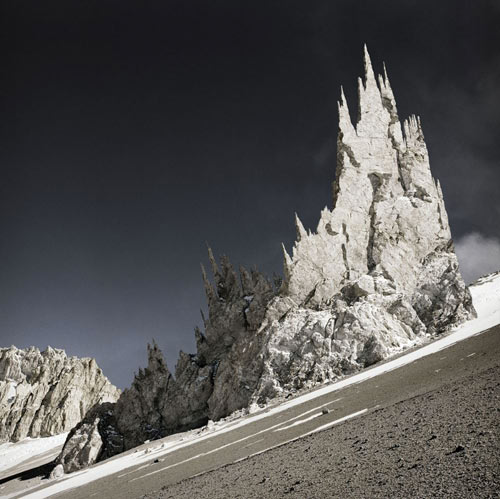
Photographer Michael Najjar took some of his photos from the Andes and turned them into stock market infographics. Here’s Lehman Brothers stock price from 1980 to 2008.
Boy, their stock price really fell off a cliff there, didn’t it? The rest of the series is worth a look as well, although Najjar’s site features the worst use of Flash I’ve seen in many months…it automatically fullscreens and generally wastes a bunch of time with transitions. To find the rest of the photos, wait until the map starts loading and put your mouse at the bottom of the screen. A menu will s.l.o.w.l.y. slide up…High Altitude is what you’re looking for. (via info aesthetics)






Socials & More