And so adventurer Ben Saunders is off again on one of his little jaunts. This time, he’s headed to the North Pole in 30 days, skiing alone and unsupported, attempting to shave six days off the 2005 record set by an entire team that used dog sleds and resupplying. Dangerous? Yep: his equipment page has a “bear safety” section. Watch his journal (and perhaps his Twitter) for updates…he’ll be posting entries and photos via satellite phone as soon as he gets underway.
Companies who target the middle of the market (Sony, Dell, General Motors) are losing customers to companies like Apple & Hermes at the high end and Ikea & H&M at the low end. From James Surowiecki:
The products made by midrange companies are neither exceptional enough to justify premium prices nor cheap enough to win over value-conscious consumers. Furthermore, the squeeze is getting tighter every day. Thanks to economies of scale, products that start out mediocre often get better without getting much more expensive — the newest Flip, for instance, shoots in high-def and has four times as much memory as the original — so consumers can trade down without a significant drop in quality. Conversely, economies of scale also allow makers of high-end products to reduce prices without skimping on quality. A top-of-the-line iPod now features video and four times as much storage as it did six years ago, but costs a hundred and fifty dollars less. At the same time, the global market has become so huge that you can occupy a high-end niche and still sell a lot of units. Apple has just 2.2 per cent of the world cell-phone market, but that means it sold twenty-five million iPhones last year.
Chicken availability over the past 100 years illustrates the effects of new technologies and product development. Increased chicken availability from 10.4 pounds per person in 1909 to 58.8 pounds in 2008 reflects the industry’s development of lower cost, meaty broilers in the 1940s and later, ready-to cook products, such as boneless breasts and chicken nuggets, as well as ready-to-eat products, such as pre-cooked chicken strips to toss in salads or pasta dishes.
The interview is a little rough in spots but people — like Lagerfeld — who have strong opinions but don’t try to push them on others are always interesting to listen to, even if you disagree.
The whole culture of cell phones, texting, and instant messaging is very impersonal and also very distracting. I’m not working at a switchboard. I have to concentrate on what I’m doing. The few people I have in my telephone are already too much. When I’m on the phone I talk, but I really want to be alone to sketch, to work, and to read. I am reading like a madman because I want to know everything.
I think that you might have Asperger syndrome. Do you know what that is? It’s a kind of autism. It’s like an idiot savant. That’s exactly what I am. As a child I wanted to be a grown-up. I wanted to know everything-not that I like to talk about it. I hate intellectual conversation with intellectuals because I only care about my opinion, but I like to read very abstract constructions of the mind. It’s very strange.
That’s quite Asperger’s. There’s a boy who’s 20 years old; you can see him on YouTube. He’d never seen Paris from the air before and they flew him over Paris in a helicopter. Then they took him to a studio and he drew the entire city. Building by building, street by street. I can do that with the antique Greek world.
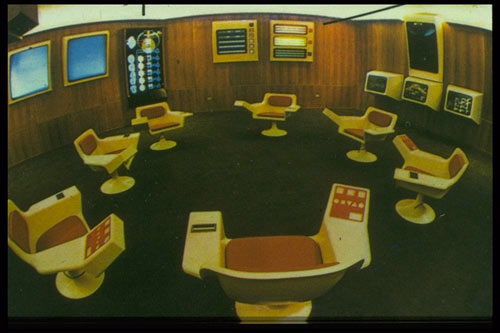
This is the control room for Project Cybersyn, which was actually a real thing and not some Pertwee-era UNIT thing from Doctor Who.
Project Cybersyn was a Chilean attempt at real-time computer-controlled planned economy in the years 1970-1973 (during the government of president Salvador Allende). It was essentially a network of telex machines that linked factories with a single computer centre in Santiago, which controlled them using principles of cybernetics. The principal architect of the system was British operations research scientist Stafford Beer.
More information on Project Cybersyn can be found here. (thx, brandon)
BuzzFeed is a venture-funded startup building an innovative platform for publishing and tracking viral media. We are seeking a talented New York-based designer to join us full-time in our brand new 4000 sq ft SOHO office space. This is an great opportunity to make a huge impact as an integral part of our small team.
I’m an advisor to Buzzfeed…if you get hired, tell them I sent you and I get to eat the office’s employee-only granola bars again.
I straight-up loved this movie. It’s a fascinating look at the creative process of a team with strong leadership operating at a very high level. The trailer is pretty misleading in this respect…the main story in the film has little to do with fashion and should be instantly recognizable to anyone who has ever worked with a bunch of people on a project. Others have made the comparison of Anna Wintour with Steve Jobs and it seems apt. At several points in the film, my thoughts drifted to Jobs and Apple; Wintour seems like the same sort of creative leader as Jobs.
A team of scientists has succeeded in putting an object large enough to be visible to the naked eye into a mixed quantum state of moving and not moving.
Wait, what? Like, WHAT? Ok, let’s start over:
Andrew Cleland at the University of California, Santa Barbara, and his team cooled a tiny metal paddle until it reached its quantum mechanical ‘ground state’ — the lowest-energy state permitted by quantum mechanics. They then used the weird rules of quantum mechanics to simultaneously set the paddle moving while leaving it standing still.
The fuck? In my day, we were taught, with the help of non-graphing calculators and paper notebooks, that quantum mechanics was a lot of wand-wavey nonsense about wave/particle duality that you never had to worry about because it belonged to some magical tiny land that no one visits with their actual eyes. This…this is straight-up magic. [Cue Final Countdown]
Now available for download. For an app from a company that’s trying to establish and dominate a new and potentially lucrative industry, the lack of polish on this app is kind of amazing.
Paul Ford is moving along from Harper’s to work on some other stuff. This part of his reasoning, especially the part in italics (mine), resonates with me on all of my frequencies:
I had an opportunity to be an editor at Harper’s, to edit pieces for the magazine. It was something I expected to really want. I had wonderful editors to learn from. I did a little of it for print and a lot for the web. I wasn’t bad at it, even. Not great, but not bad. I could have been a respected editor instead of a huge nerd. But all the editing in the world can’t compare to building little websites and mangling text and writing things and messing around in spreadsheets and figuring out what’s wrong with comments. I wake up thinking about how all the pieces fit together and I want to do more of it and with lots of people.
To appreciate the importance of a pre-modern blog, consult a database such as Eighteenth Century Collections Online and download a newspaper from eighteenth-century London. It will have no headlines, no bylines, no clear distinction between news and ads, and no spatial articulation in the dense columns of type, aside from one crucial ingredient: the paragraph. Paragraphs were self-sufficient units of news. They had no connection with one another, because writers and readers had no concept of a news “story” as a narrative that would run for more than a few dozen words. News came in bite-sized bits, often “advices” of a sober nature — the arrival of a ship, the birth of an heir to a noble title — until the 1770s, when they became juicy. Pre-modern scandal sheets appeared, exploiting the recent discovery about the magnetic pull of news toward names. As editors of the Morning Post and the Morning Herald, two men of the cloth, the Reverend Henry Bate (known as “the Reverend Bruiser”) and the Reverend William Jackson (known as “Dr. Viper”) packed their paragraphs with gossip about the great, and this new kind of news sold like hotcakes.
“No headlines, no bylines, no clear distinction between news and ads, and no spatial articulation in the dense columns of type”…that sounds damned familiar. (via @bobulate)
There’s a category of information that slowly changes throughout the course of a lifetime. Sam Arbesman calls them mesofacts.
These are facts which we tend to view as fixed, but which shift over the course of a lifetime. For example: What is Earth’s population? I remember learning 6 billion, and some of you might even have learned 5 billion. Well, it turns out it’s about 6.8 billion. […] If, as a baby boomer, you learned high school chemistry in 1970, and then, as we all are apt to do, did not take care to brush up on your chemistry periodically, you would not realize that there are 12 new elements in the Periodic Table. Over a tenth of the elements have been discovered since you graduated high school!
Tiger, Tiger burning bright In the sex clubs of Orlando Guess it’s time you took a break And lived life with more candor Must’ve been weird, your secret life Never an unserviced erection Shouldn’t you, though, have taught the wife Some proper club selection?
Almost more fun than watching Lady Gaga’s music videos is watching people try to figure out what it all means. One of the most entertaining analyses of the Telephone video is this Robert Langdon-esque take:
Lady Gaga’s 9-minute video featuring Beyonce is steeped in weirdness and shock value. Behind the strange aesthetic, however, lies a deeper meaning, another level of interpretation. The video refers to mind control and, more specifically, Monarch Programming, a covert technique profusely used in the entertainment industry. We’ll look at the occult meaning of the video “Telephone”.
Spies use sex, intelligence, and the thrill of a secret life as bait. Cleverness, training, character, and patriotism are often no defense against a well-set honey trap.
Free-throw success is also improved by adding a little backspin, which pushes the ball downward if it hits the back of the rim. The North Carolina State engineers calculated the ideal rate of free-throw backspin at three cycles per second. That is, a shot that takes one second to reach the basket will make three full revolutions counterclockwise as seen from the stands on the player’s right side.
A 26-gigapixel image of Paris. Fully zoomable and pannable. Sacré-Coeur starts out as a tiny speck and you can zoom in to see a bunch of people sitting on the steps outside.
NYC’s Board of Health has lifted the ban on keeping bees in the city.
The unanimous vote amends the health code to allow residents to keep hives of Apis mellifera, the common, nonaggressive honeybee. Beekeepers will be required to register with the Department of Health and Mental Hygiene and to adhere to appropriate practices. That means they must be able to control bee swarms and ensure that the hives do not interfere with pedestrians or neighbors.
Ten dollars says my wife utters the following words to me tonight: “we should raise some bees on the roof!”
Diet is 85% of where results come from…for muscle and fat loss. Many don’t focus here enough.
If you eat whole foods that have been around for 1000s of years, you probably don’t have to worry about counting calories
Our dependence on gyms to workout may be keeping people fat…as walking down a street and pushups in your home are free everyday…but people are not seeing it that way.
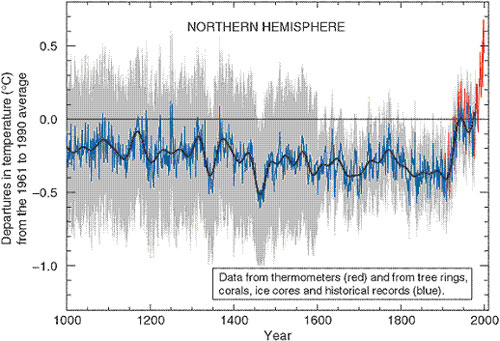
In a review in Prospect, Matt Ridley, who is no slouch as a science writer himself, calls Andrew Montford’s The Hockey Stick Illusion “one of the best science books in years”. Pretty high praise for what Ridley also calls “the biography of a graph”. Specifically, this graph:
You may have seen it in An Inconvenient Truth in this form. The graph shows the dramatic rise in temperature in the northern hemisphere over the past 100 years caused, presumably, by humans. But as Montford details in his book, the graph is incorrect.
[The author] had standardised the data by “short-centering” them — essentially subtracting them from a 20th century average rather than an average of the whole period. This meant that the principal component analysis “mined” the data for anything with a 20th century uptick, and gave it vastly more weight than data indicating, say, a medieval warm spell.
Sitting in my hide, I would have to remain motionless for hours as I watched the zebra herd’s painfully tentative approach. The sound of my shutter alone, would send them running.
In addition to the photos (larger versions here), du Toit contracted snail fever, malaria (twice), hook worm, and several other parasites.
I’ve noticed an increasing tendency by reviewers on Amazon (and Apple’s iTunes and App Stores) to review things based on the packaging or format of the media with little regard shown to the actual content/plot. Here are two recent examples.
Reviews for the theatrically released versions of The Lord of the Rings on Blu-ray are mostly negative — the aggregate rating is 1.5 out 5. These are award-winning movies but the reviews are dominated by people complaining about New Line’s decision to release the theatrical versions before the extended versions that the True Fans love. A representative review:
If I were reviewing the movie itself it would get a five. This review is for the product, as listed — in other words, I DO NOT RECOMMEND BUYING THIS PRODUCT/DVD. This product is being created FOR NO OTHER REASON than to dupe people into buying this movie twice…again.
Similarly, the early reviews for Michael Lewis’ The Big Short are dominated by one-star reviews from Kindle owners who are angry because the book is not available for the device. (thx, jason)
I have always enjoyed Michael Lewis’ books and was looking forward to reading The Big Short. With no availability in the US on Kindle, however, I will pass until the publisher/Amazon issue is cleared up. I actually believe that the availability of an item is relavent when giving it a review.
Compare this with traditional reviewers who focus almost exclusively on the content/plot, an approach that ignores much about how people make buying decisions about media today. Packaging is important. We judge books by their covers and even by how much they weigh (heavy books make poor subway/bus reading). Format matters. There’s an old adage in photography: the best camera is the one you have with you. Now that our media is available in so many formats, we can say that the best book is the one on your Kindle or the best movie is the one on your iPhone.
Newspaper and magazine reviewers pretty much ignore this stuff. There’s little mention of whether a book would be good to read on a Kindle, if you should buy the audiobook version instead of the hardcover because John Hodgman has a delightful voice, if a magazine is good for reading on the toilet, if a movie is watchable on an iPhone or if you need to see it in 1080p on a big TV, if a hardcover is too heavy to read in the bath, whether the trailer is an accurate depiction of what the movie is about, or if the hardcover price is too expensive and you should get the Kindle version or wait for the paperback. Or, as the above reviewers hammer home, if the book is available to read on the Kindle/iPad/Nook or if it’s better to wait until the director’s cut comes out. In the end, people don’t buy content or plots, they buy physical or digital pieces of media for use on specific devices and within certain contexts. That citizen reviewers have keyed into this more quickly than traditional media reviewers is not a surprise.
Before Minna was born, we didn’t know if she was a boy or a girl, so we had a bunch of names picked out for both genders. Since we are so so (SO!) done having kids, I thought I’d share our list in case someone else finds any of them useful.
Girls:
Beatrix
Greta
Coralie
Boys:
Milton
Emory
Milo
Emmett
Max/Maximilian
Hugo
Nico
Oscar
Finn
Sam
Ford
Of the girls names, Minna was my frontrunner from when we first heard it. Meg favored Beatrix for a long time but I finally convinced her of Minna’s intrinsic correctness. Milo was the clear frontrunner had Minna been a boy.
Marwencol is the name of fictional town built by Mark Hogancamp in his backyard in an attempt to cope with a near-fatal beating. Jeff Malmberg has made a documentary of the same name about Hogancamp’s fantasy world.
After being beaten into a brain-damaging coma by five men outside a bar, Mark built a 1/6th scale World War II-era town in his backyard. Mark populated the town he dubbed “Marwencol” with dolls representing his friends and family and created life-like photographs detailing the town’s many relationships and dramas. Playing in the town and photographing the action helped Mark to recover his hand-eye coordination and deal with the psychic wounds from the attack. Through his homemade therapy, Mark was able to begin the long journey back into the “real world”, both physically and emotionally — something he continues to struggle with today.
The Guardian asked several film directors to choose their favorite movie scenes. Ryan Fleck chose the chase scene from The French Connection and discovered that the 80+ mph chase was done through normal traffic with Hackman just driving like a crazy person.
I did a little bit of research about how they shot the scene. Phenomenal. Basically they just did it. There was no security blocking off other traffic, just Hackman in a car with a camera mounted on the front. They went crazy, lost their minds, and went for it. It was the kind of thing that you just would never get away with these days.
I don’t know if it’s my favorite or not, but the opening scene in The Matrix where the cops walk into a dusty old building to find Trinity working alone at a computer and then she flies up in the air and the camera circles around her as she kicks those cops’ asses, well, let’s just say I want to be that excited about seeing the rest of every single movie I watch. (via @brainpicker)
As often as not, he turned up what he called “ick” investments. In October 2001 he explained the concept in his letter to investors: “Ick investing means taking a special analytical interest in stocks that inspire a first reaction of ‘ick.’” A court had accepted a plea from a software company called the Avanti Corporation. Avanti had been accused of stealing from a competitor the software code that was the whole foundation of Avanti’s business. The company had $100 million in cash in the bank, was still generating $100 million a year in free cash flow-and had a market value of only $250 million! Michael Burry started digging; by the time he was done, he knew more about the Avanti Corporation than any man on earth. He was able to see that even if the executives went to jail (as five of them did) and the fines were paid (as they were), Avanti would be worth a lot more than the market then assumed. To make money on Avanti’s stock, however, he’d probably have to stomach short-term losses, as investors puked up shares in horrified response to negative publicity.
“That was a classic Mike Burry trade,” says one of his investors. “It goes up by 10 times, but first it goes down by half.” This isn’t the sort of ride most investors enjoy, but it was, Burry thought, the essence of value investing. His job was to disagree loudly with popular sentiment. He couldn’t do this if he was at the mercy of very short-term market moves, and so he didn’t give his investors the ability to remove their money on short notice, as most hedge funds did. If you gave Scion your money to invest, you were stuck for at least a year.
Really fascinating. In a recent review, Felix Salmon called The Big Short “probably the single best piece of financial journalism ever written”.
Who’s your favorite basketball player?
Have you every met anyone famous?
Can you really see Jupiter’s moons with binoculars?
Do you know the guy who made the Sidekick?
Have you met any hip hop stars?
‘Smolt’, ‘grilse’: as Richard Shelton observes, salmon are spoken of in a ‘stained-glass language’ of their own, their life stages marked by an ichthyological lexicon unchanged since Chaucer’s time. Born in a ‘redd’, a shallow, gravel-covered depression dug by the female in the days before spawning, newly hatched salmon begin life as ‘alevins’, tiny, buoyant creatures with their yolk sacs still attached.
This might be the last great music video. Beyonce picks up Gaga from jail in the Pussy Wagon from Kill Bill! But Christ, the product placement. This thing has more brands in it than Logorama.
Do yourself a favor: take the next five minutes and watch this tilt-shift video of NYC in fullscreen HD. The construction stuff that starts about a minute in is just great.
Whereas Koyaanisqatsi made NYC look big and busy, The Sandpit turns the city into something you can hold in your hands or put in your pocket. The making of is worth a read…all the tilt-shift effects were done in post. (via quips)
Note: If you are a member and tried to log in, it didn't work, and now you're stuck in a neverending login loop of death, try disabling any ad blockers or extensions. Or try logging out and then back in. Still having trouble? Email me!









Socials & More