Philip K. Dick never got to see Blade Runner, Ridley Scott’s film adaptation of his book Do Androids Dream of Electric Sheep?, but he did catch a snippet of the film on TV a few months before he died and was over the moon about it.
I can only say that I did not know that a work of mine or a set of ideas of mine could be escalated into such stunning dimensions. My life and creative work are justified and completed by Blade Runner.
We will never become dependent on the kindness of strangers. Too-big-to-fail is not a fallback position at Berkshire. Instead, we will always arrange our affairs so that any requirements for cash we may conceivably have will be dwarfed by our own liquidity. Moreover, that liquidity will be constantly refreshed by a gusher of earnings from our many and diverse businesses.
When the financial system went into cardiac arrest in September 2008, Berkshire was a supplier of liquidity and capital to the system, not a supplicant. At the very peak of the crisis, we poured $15.5 billion into a business world that could otherwise look only to the federal government for help. Of that, $9 billion went to bolster capital at three highly-regarded and previously-secure American businesses that needed — without delay — our tangible vote of confidence. The remaining $6.5 billion satisfied our commitment to help fund the purchase of Wrigley, a deal that was completed without pause while, elsewhere, panic reigned.
We pay a steep price to maintain our premier financial strength. The $20 billion-plus of cash-equivalent assets that we customarily hold is earning a pittance at present. But we sleep well.
With traditional cookery, when you are exposing your meat to temperatures much hotter than their final desired temperature (say, cooking a steak to 130°F in a 550°F skillet), timing is crucial. The center of your steak is getting hotter and hotter, and it’s your job as cook to take it off the flame at precisely the moment that it reaches the desired final temperature. Miss that precise moment, and dinner is ruined.
The beauty of sous-vide cooking is that since you are cooking your steak in a 130°F water bath to begin with, there is absolutely no chance your meat will ever get above that temperature. Guests are an hour late? No problem — leave the steaks in the water bath, and they’ll be exactly the same an hour later.
This list of secret restaurant menus is informative, hilarious, and possibly innaccurate in places. Fatburger will serve you something called the Hypocrite (veggie burger topped with bacon) and at the classy Long John Silvers you can get a Side of Crumbs, a free box of the fried batter parts that have fallen off of the fried seafood items. Mmmmmm!!! (via cyn-c)
Update: Several of my British moles have informed me that it is common practice at some fish and chips shops to ask for a “bag of scraps”, which is where LJS got the idea for their Side of Crumbs. More info here.
He tells how the job came about: “I was a well-known advertising agency guy, and the former editor of Esquire, Harold Hayes, he called me up. We met at The Four Seasons, and he said, ‘Could you help me try to do better covers?’ I got this Bronx accent, and he had this southern drawl, and it must have been a funny discussion. ‘You have to go outside and find a designer, a guy who’s talented at graphic design, but understands politics, culture, and movies,’ I told him, and he said, ‘Do me a favor, could you do me just one cover?’ I said, ‘Okay, I’ll do you one.’”
Here’s one I’d never seen before, featuring Chief John Big Tree, the supposed model for the Indian Head nickel.
An interesting article about how composer and programmer David Cope found a unique solution for making computer-composed classical music sound as though it was composed by humans: he wrote algorithms that based new works on previously created works.
Finally, Cope’s program could divine what made Bach sound like Bach and create music in that style. It broke rules just as Bach had broken them, and made the result sound musical. It was as if the software had somehow captured Bach’s spirit — and it performed just as well in producing new Mozart compositions and Shakespeare sonnets. One afternoon, a few years after he’d begun work on Emmy, Cope clicked a button and went out for a sandwich, and she spit out 5,000 beautiful, artificial Bach chorales, work that would’ve taken him several lifetimes to produce by hand.
Gosh it’s going to get interesting when machines can do some real fundamental “human” things 10,000x faster and better than humans can.
Time to break the ice. You hate doing interviews, don’t you? I ask, sitting down (there is no desk; he works on an old sofa). “No, not at all,” he says. There is a look of mild amazement on his face as he tells me this and it’s not disingenuous; as he will explain later, he feels a certain sense of distance from his old self. Perhaps he prefers not to remember exactly how he used to be.
After analyzing dozens of Hollywood films, a team of researchers has found evidence that the visual rhythm of movies at the shot level matches a pattern called the 1/f fluctuation, the same pattern that is found in dozens of natually occurring phenomena, including the length of the human attention span.
These results suggest that Hollywood film has become increasingly clustered in packets of shots of similar length. For example, action sequences are typically a cluster of relatively short shots, whereas dialogue sequences (with alternating shots and reverse-shots focused sequentially on the speakers) are likely to be a cluster of longer shots. In this manner and others, film editors and directors have incrementally increased their control over the visual momentum of their narratives, making the relations among shot lengths more coherent over a 70-year span.
Modern action movies are particularly adept at matching the audience’s attention span in this manner. The full paper is available here.
“We found that the people who were sensitive to fat, who could taste very low concentrations, actually consumed less fat than the people who were insensitive,” Keast told AFP. “We also found that they had lower BMIs (Body Mass Indexes).”
The Morning News Tournament of Books is underway with a first round matchup between Nami Mun’s Miles From Nowhere and Colum McCann’s Let the Great World Spin. As a semifinal judge, I know at least one of the final two books and for your betting purposes, I’ll open the bidding on that knowledge at, say, $50K.
This is a good example of how the very ubiquity of vitamin C made it hard to identify. Though scurvy was always associated with a lack of greens, fresh meat contains adequate amounts of vitamin C, with particularly high concentrations in the organ meats that explorers considered a delicacy. Eat a bear liver every few weeks and scurvy will be the least of your problems.
But unless you already understand and believe in the vitamin model of nutrition, the notion of a trace substance that exists both in fresh limes and bear kidneys, but is absent from a cask of lime juice because you happened to prepare it in a copper vessel, begins to sound pretty contrived.
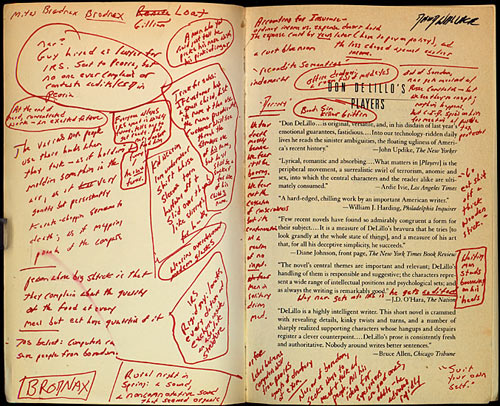
The archive contains manuscript materials for Wallace’s books, stories and essays; research materials; Wallace’s college and graduate school writings; juvenilia, including poems, stories and letters; teaching materials and books.
Highlights include handwritten notes and drafts of his critically acclaimed “Infinite Jest,” the earliest appearance of his signature “David Foster Wallace” on “Viking Poem,” written when he was six or seven years old, a copy of his dictionary with words circled throughout and his heavily annotated books by Don DeLillo, Cormac McCarthy, John Updike and more than 40 other authors.
Materials for Wallace’s posthumous novel “The Pale King” are included in the archive but will remain with Little, Brown and Company until the book’s publication, scheduled for April 2011.
If you read a site and care about its well being, then you should not block ads (or you subscribe to sites like Ars that offer ads-free versions of the site). If a site has advertising you don’t agree with, don’t go there. I think it is far better to vote with page views than to show up and consume resources without giving anything in return. I think in some ways the Internet and its vast anonymity feeds into a culture where many people do not think about the people, the families, the careers that go into producing a website. People talk about how annoying advertisments are, but I’ll tell you what: it’s a lot more annoying and frustrating to have to cut staff and cut benefits because a huge portion of readers block ads. Yet I’ve seen that happen at dozens of great sites over the last few years, Ars included.
They also ran an interesting little experiment: for those running ad blockers, they also blocked the content.
It’s not exactly a shiny ball of mud but until it dried out and fell apart the next day, this little fellow was surprisingly round, dense, and rock-like. Ollie started making his own after watching me; after a minute of effort on each, he liked to throw them into the water.
Note: If you are a member and tried to log in, it didn't work, and now you're stuck in a neverending login loop of death, try disabling any ad blockers or extensions. Or try logging out and then back in. Still having trouble? Email me!










Socials & More