kottke.org posts about video
File this under Things I Definitely Want to Do Sometime: riding electric-assist railbikes through a California redwood forest. Check out how fun this looks:
From the LA Times:
To pedal the rails at Fort Bragg, you book a trip, show up at the station, settle into a vehicle, don a helmet and seat belt, pedal through four downtown intersections (train signals halt traffic) and pass a cemetery.
Then suddenly you’re in the woods, hearing only birdsong and the gentle hum of wheels on tracks. There’s no need to exert yourself pedaling: The railbikes, which weigh about 250 pounds each, are outfitted like e-bikes with quiet electric motors that can push you along at 10 mph even if you don’t pedal.
(via the morning news)
To celebrate the 30th anniversary of their 16x platinum Black Album, Metallica is releasing an album on Sept 10th called The Metallica Blacklist, which contains Black Album covers featuring 53 different artists. One of those covers is Enter Sandman by Weezer, which you can watch above. Some of the other songs on the album include:
St. Vincent — Sad but True
The Hu — Through the Never
Phoebe Bridgers — Nothing Else Matters
Miley Cyrus Feat. Watt, Elton John, Yo-yo ma, Robert Trujillo, Chad Smith — Nothing Else Matters
Darius Rucker — Nothing Else Matters
Rodrigo y Gabriela — The Struggle Within
All profits from the album will be donated to charity. You can listen to the songs that have already been posted on Spotify, pre-save or pre-order the album, or check out this album trailer to hear what you’re getting into:
I’ve been listening to the Black Album a little bit recently (it came out my freshman year in college and so hits me right between the eyes) so I’m looking forward to checking this out.
BuzzFeed enlisted NYU track athlete Jon Diaz to help answer a burning question: Can a fast runner beat an NYC subway train from one station to the next? I don’t want to spoil the answer, but they probably wouldn’t have made the video if he’d failed, right? (via clive thompson)
Update: See also subway races in other cities like London & Paris. (via @philipkennedy)
In a series of four short time lapse films, Casper Rolsted captures the changing of the seasons in Denmark, from summer (top) all the way through to spring (bottom). I’ve gotta say, the springtime video in particular put a smile on my face — all those flowers emerging from the snowy ground, reaching out for the strengthening sunlight.
See also Four Seasons in the Life of a Finnish Island. (via colossal)
Update: See also David Hockney’s The Four Seasons, Woldgate Woods. (thx, phil)
Black holes are the largest single objects in the universe, many times larger than even the biggest stars, and have no upper limit to their size. But practically, how big is the biggest, heaviest black hole in the universe? (A: More massive than the entire Milky Way.)
The largest things in the universe are black holes. In contrast to things like planets or stars they have no physical size limit, and can literally grow endlessly. Although in reality specific things need to happen to create different kinds of black holes, from really tiny ones to the largest single things in the universe. So how do black holes grow and how large is the largest of them all?
Videos about space are where Kurzgesagt really shines. I’ve seen all their videos about black holes and related objects, and I always pick up something I never knew whenever a new one comes out. This time around, it was quasistars and the surprisingly small mass of supermassive black holes located at galactic centers compared to the galaxies themselves.


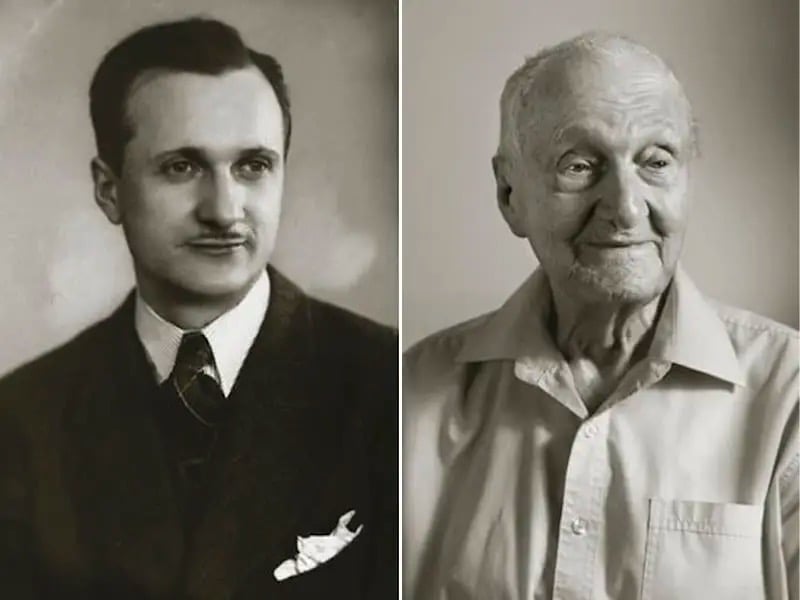
For his Faces of Century project, photographer Jan Langer made portraits of Czech people who are 100+ years old that mimic the style of photos of those same people 70 or 80 years before. If you click on the ⓘ below each pair of photographs, you can read a short biography of each person. All of these folks lived through two world wars, the Cold War, the space age, the computer age, and so much more. Incredible. (via life is so beautiful)
I was 16 years old on the day the Berlin Wall fell. I remember coming home from school that day and watching the events unfold on television, completely shocked at how quickly it had all happened. Politics & protests had been pushing the Eastern Bloc countries toward more openness for years, but before watching this video, I’d never heard that the catalyst for that world-changing event was a short mistaken statement at the end of an otherwise boring press conference. From the BBC:
East German leaders had tried to calm mounting protests by loosening the borders, making travel easier for East Germans. They had not intended to open the border up completely.
The changes were meant to be fairly minor — but the way they were delivered had major consequences.
Notes about the new rules were handed to a spokesman, Günter Schabowski — who had no time to read them before his regular press conference. When he read the note aloud for the first time, reporters were stunned.
“Private travel outside the country can now be applied for without prerequisites,” he said. Surprised journalists clamoured for more details.
Shuffling through his notes, Mr Schabowski said that as far as he was aware, it was effective immediately.
In fact it had been planned to start the next day, with details on applying for a visa.
But the news was all over television — and East Germans flocked to the border in huge numbers.
How did the Berlin Wall fall? Two ways. Gradually, then suddenly.
In this video, Tomorrow’s Build takes a look at the $7 billion flood defense system that was built to protect Venice, Italy from increased flooding due to climate change. They detail how the system was built, how well it works, how it compares with other defense systems, the challenges associated with keeping it working, and how well this sort of defense system might work for other coastal cities (NYC, SF, Sydney).
Here’s the thing about humans: they will danceify every possible activity — and canoeing is no exception.
American Freestyle canoeing is the art of paddling a canoe on flat water with perfect control of its movements. The canoe is usually leaned over to the side to help the boat turn sharply and efficiently and paddle strokes are taken on either side of the canoe depending on the individual move. Balance, paddle placement and turn initiation are a few keys to this control. Since the movements seem dance-like, some practice this art timed to music, which is the ultimate in control.
The vest & bow tie, the choice of music (The Lady in Red by Chris de Burgh), his control of the canoe — it’s all perfect.
See also It’s Reflective Fjord Season, Watch As a Master Woodworker Turns a Giant Log into an Elegant Dugout Canoe, and Kayaking Down a Drainage Ditch. (via life is so beautiful)
For his video series for Eater, Daniel Geneen took a tour of the Lodge Cast Iron factory in South Pittsburg, Tennessee to see how cast iron skillets are made.
While all of this is happening, molds for pans are being made out of fine, pliable sand that’s compressed in massive machines. The ladles pour the molten metal into these molds. Once the metal is poured and cooled, the sand molds get placed into a shake-out machine that shakes the sand away from the pan, and then into an enormous drum to shake off the rest. The pans are finally put on a giant conveyor belt to be sorted and inspected. Any pans that are not up to muster get thrown back into the original scrap heap to be melted down again and remade into another pan.
In comparison, here’s how Borough Furnace makes their cast iron pans by hand in their much smaller workshop:
Very similar process, down to the sand molds, just on a much smaller and more hands-on scale.
Among Giants is a short documentary about a group of activists who lived in the trees of a Humboldt County redwood forest for four years in order to stop logging in the area.
Risking injury and incarceration, an environmental activist disrupts the clear-cutting of an ancient redwood grove by sitting on a tiny platform a hundred feet up in the tree canopy. Already three years into the tree-sit when filming begins, AMONG GIANTS blends vérité cinematography with intimate personal reflection to create a vivid picture of life in the trees and the unwavering dedication of the activists.
The activists’ tree-sit was successful — 1000 acres of the redwood forest were transferred to a public trust to create the McKay Community Forest. (via the morning news)
Before this morning, I had never heard of Lusia Harris and now she’s one of my favorite basketball players. Playing in the 1970s, before the enforcement of Title IX in athletics, the 6’3” Harris dominated in high school, led a small university to three consecutive national basketball championships in the first 5 years of the program (while averaging 25.9 points and 14.5 rebounds per game), scored the first basket in Olympics women’s basketball history, is the only woman ever officially drafted by an NBA team, and was inducted into the National Basketball Hall of Fame. And those aren’t even her proudest achievements — you’ll have to watch the video for that.
For an electrifying young basketball player on the national stage, success often comes with a lucrative professional contract and brand deals — but Harris’s moment came in the 1970s, decades before the W.N.B.A. was founded, when few opportunities were available to female athletes interested in pursuing a professional career. In Ben Proudfoot’s “The Queen of Basketball,” Harris tells the story of what happens when an unstoppable talent runs out of games to win.
This video is part of the NY Times’ Almost Famous series, which also includes stories about radio astronomer Jocelyn Bell Burnell and actress/singer Kim Hill.
Here’s a description of what the machine featured in this video does: “The HD Video Feedback Kinetic Sculpture creates fractals and organic-looking images in real-time, without a computer: this is old-school video feedback.” But just watch the video for the full effect — this thing produces some amazing imagery.
This is part sculpture, part performance art, and may make the most complex video feedback ever created, using three cameras, two video switchers, a sheet of beam-splitter glass, and an HDMI input from a phone or live video feed.
Much like a musical instrument, the operator at the helm of this device plays it, but instead of making sounds, makes entire worlds, spirals within spirals, loops within loops, galaxies, classical fractal imagery and primordial organisms, leaves, trees, and insects. It really is the God machine.
This video from Vox takes a look at how Taiwan avoided a Covid-19 outbreak for more than a year (and kept total deaths to just 7 in 2020 in a country of 23.6 million) while residents were mostly able to go about their normal lives. The video features photojournalist Ed Ou, who underwent a mandatory 14-day quarantine when he traveled to Taiwan last year. Ou had this to say after spending time in Taiwan, doing normal things without lockdowns or restrictions:
This was an alternate universe of what America, and the rest of the world, had seen all year. The Taiwanese people had been able to just live their lives, as if nothing had happened. Like, to me, that’s freedom.
After more than a year of almost no cases, Taiwan experienced its first Covid-19 outbreak in May (after relaxing their quarantine rules and, presumably, the rise of the delta variant) but has since gotten it under control. Other countries that had been successful in controlling the virus until recently — like Vietnam, Thailand, and Mongolia — are also seeing outbreaks now. When the rest of the world is teeming with the virus, it becomes more likely over time that even the most organized and protected systems are going to be vulnerable.
Using dozens of bot accounts, The Wall Street Journal did an investigation and determined that TikTok’s algorithm needs only one piece of information to determine what you want to watch: the amount of time you spend watching individual videos. Observing your watch time and rewatching is enough for them to fill your “For You” page with recommended videos that are right in your wheelhouse after just an hour or two. That this happens so quickly and completely — 90-95% of what users see on TikTok is algorithmically determined — leads to users going down narrow-interest rabbit holes that can be dangerous, e.g. if someone’s Covid interest turns into anti-vax QAnon crap or sadness turns into video after video about depression or harming yourself.
As someone who built an entire web app that collected people’s social media likes/faves, this focus on a single signal is fascinating. API limitations and rate limits on the number of requests would keep you from building a service with a TikTok-like algorithm for Twitter or Instagram that used likes as the only signal for whether to show someone a piece of content or not, but if you could, I bet it would be amazing.
Newer posts
Older posts




Socials & More