kottke.org posts about video
This morning, my friend Anil Dash tweeted this question out to his followers (here’s my incomplete answer):
Who is a person (not counting family) that opened doors for you in your career when they didn’t have to? Anytime is a good time to show gratitude!
Yesterday, I finished this podcast episode about Mister Rogers and they talked about when he made public appearances, either as an entertainer or a minister, he would often begin by asking the audience for a moment of silence to think about “the people who have helped you become who you are, those who cared about you and wanted what was best for you in life”. He even did it at the Emmys when accepting a Lifetime Achievement Award:
I’ve been thinking about Fred Rogers a lot lately…how much I miss him, how much I learned from him, and how much the world could benefit from his perspective and example right now. After this week/month/year, I think we could all use some of Mister Rogers’ radically compassionate humanism. So, if you wish, take a moment right now in silence to think about those who have cared about you and helped you become the person that you are.
Have a good weekend. I’ll see you back here next week.
New Zealand drift racer Mike Whiddett recently travelled to Japan to explore Tokyo’s “extraordinary after-dark modified auto scene”. He found people making California-style lowriders, Dekotora (my favorite, if only for the sheer spectacle), illegally modified cars, and a man who says with a straight face that “driving an unmodified Lamborghini is boring”.
What’s interesting is that more than one of these guys in the video repeated some variation of “I don’t care what anyone thinks about me”. I….don’t believe you? If there’s one thing most humans care deeply about, it’s what other people think about them, particularly when you’re driving million-dollar, pulsing-neon supercars around the world’s most populous city.
In their distinctive style, Kurzgesagt tries to explain the concepts behind and pros & cons of Universal Basic Income in just 10 minutes. In US, UBI would be a massive change to how our economy and society functions, so much so that it’s challenging to predict what the effects would be. Nonlinear systems, yo!
Update: Aw dammit… I totally forgot to connect the part of the video where they talk about the non-monetary value of work — which is a worry of UBI critics — to something that Ludicorp (the small company that built Flickr and sold to Yahoo! in the mid-2000s) had on the company’s about page. It was a passage from Disclosing New Worlds: Entrepreneurship, Democratic Action and the Cultivation of Solidarity by Charles Spinosa, Fernando Flores & Hubert Dreyfus:
Business owners do not normally work for money either. They work for the enjoyment of their competitive skill, in the context of a life where competing skillfully makes sense. The money they earn supports this way of life. The same is true of their businesses. One might think that they view their businesses as nothing more than machines to produce profits, since they do closely monitor their accounts to keep tabs on those profits.
But this way of thinking replaces the point of the machine’s activity with a diagnostic test of how well it is performing. Normally, one senses whether one is performing skillfully. A basketball player does not need to count baskets to know whether the team as a whole is in flow. Saying that the point of business is to produce profit is like saying that the whole point of playing basketball is to make as many baskets as possible. One could make many more baskets by having no opponent.
The game and styles of playing the game are what matter because they produce identities people care about. Likewise, a business develops an identity by providing a product or a service to people. To do that it needs capital, and it needs to make a profit, but no more than it needs to have competent employees or customers or any other thing that enables production to take place. None of this is the goal of the activity.
In only 90 seconds with the use of a few props (and some profanity), entertainers Penn & Teller offer a succinct and compelling argument of the benefits of vaccinating our children.
So even if vaccination did cause autism, WHICH IT FUCKING DOESN’T, anti-vaccination would still be bullshit.
Along with “Vaccines. And now my kids don’t die.”, this might be my favorite anti-vaxxers broadside ever.
In this video, Bradley Dixon argues that Jackie Chan belongs on the Mt. Rushmore of silent comedy, along with Harold Lloyd, Buster Keaton, and Charlie Chaplin. Like those three legends of the silent film era, Chan uses simple stories, stunts, visual humor, ordinary props, and practical effects to connect with his audience on a non-verbal level.
See also Every Frame a Painting on how to do action comedy, Buster Keaton and the Art of the Gag, and silent film special effects revealed. Oh, and just for fun, Mad Max vs. Buster Keaton and Charlie Chaplin’s time traveller.
Imagine you’re sending a rover to Mars. The rover’s tires need to be light, durable, and also flexible enough to tackle a variety of terrain. NASA has spent decades trying to craft the perfect rover wheels, but something always comes up short in the pick-two situation…typically durability. Now researchers at the NASA Glenn Research Center have come up with a promising new rover wheel for the next generation of rovers.
The wheels are made from nickel titanium, a shape memory alloy that allows the tires to bounce back into their former shape even when they’re severely deformed.
The story of how the team stumbled upon this solution is a classic case of how important cross-disciplinary knowledge is for creation and invention. All it takes is one person in a different area of expertise to solve a seemingly intractable problem:
It is what it says on the tin: a toy Thomas the Tank Engine doing stunts on wooden tracks. My favorite part is that the slowed-down audio makes it sound somewhat like a skateboard.
In The Wizard of Oz, when Dorothy lands after being brought to Oz by a tornado, she opens the door and, bang!, Technicolor. It’s a surprising transition, one of the most effective in film history. But it wouldn’t have been a complete shock for audiences in 1939 because Oz was not the first film to feature the color technology. In this video, Phil Edwards details the history of Technicolor, how it works, and how it changed movie making.
Many people recognize Technicolor from The Wizard of Oz, but the technology existed long before then. Two strip Technicolor and three strip Technicolor both revolutionized the film industry and shaped the look of 20th century film.
But Technicolor also influenced movies through its corporate control of the technology. People like Natalie Kalmus shaped the aesthetic of color films, and directors redesigned their sets and films based on the Technicolor look that the company — and viewers — demanded.
Edwards also did a “director’s cut” video with further information that wasn’t in the first video.
Ten years ago, electronic musician Burial released his second album, Untrue, which went on to be quite influential.
Where would UK dance music be without Burial’s Untrue? The South Londoner’s second album, released ten years ago this month on Hyperdub, has arguably done more than any other record in recent history to shape electronic music, presenting not only novel production techniques but the power of rooting a record in a specific time, mood and place.
This video from Resident Advisor explores that influence and how Burial’s novel production methods contributed to the album’s success. For one thing, instead of using music software that everyone else used to build and layer beats, Burial used Soundforge, which only shows the waveforms.
So I thought to myself fuckit I’m going to stick to this shitty little computer program, Soundforge. I don’t know any other programs. Once I change something, I can never un-change it. I can only see the waves. So I know when I’m happy with my drums because they look like a nice fishbone. When they look just skeletal as fuck in front of me, and so I know they’ll sound good.
Basically, he eyeballed it, which makes the whole thing feel more natural (and makes it difficult for DJs to mix). (via @pieratt)
Using a combination of satellite data and mathematical weather models, scientists at NASA’s Goddard Space Flight Center made this simulation that shows how aerosols like dust, smoke, and salt were circulated in the atmosphere during the 2017 hurricane season. It’s amazing to see how far some of these things spread.
During the 2017 hurricane season, the storms are visible because of the sea salt that is captured by the storms. Strong winds at the surface lift the sea salt into the atmosphere and the particles are incorporated into the storm. Hurricane Irma is the first big storm that spawns off the coast of Africa. As the storm spins up, the Saharan dust is absorbed in cloud droplets and washed out of the storm as rain. This process happens with most of the storms, except for Hurricane Ophelia. Forming more northward than most storms, Ophelia traveled to the east picking up dust from the Sahara and smoke from large fires in Portugal. Retaining its tropical storm state farther northward than any system in the Atlantic, Ophelia carried the smoke and dust into Ireland and the UK.
I watched this several times to pick up on different things…the hurricanes of course, but also how smoke from the forest fires in the Pacific Northwest makes it all the way to Scotland (!!!) and dust from the Sahara desert makes it to the Caribbean (also !!!). (via phil plait)
Update: All that dust from the Sahara blowing across the ocean? Some of the dust, 27 million tons per year on average, is deposited in the Amazon basin in South America, providing the ecosystem there vital phosphorus:
This trans-continental journey of dust is important because of what is in the dust, Yu said. Specifically the dust picked up from the Bodélé Depression in Chad, an ancient lake bed where rock minerals composed of dead microorganisms are loaded with phosphorus. Phosphorus is an essential nutrient for plant proteins and growth, which the Amazon rain forest depends on in order to flourish.
(via tom whitwell)
Nothing makes me want to quit my job and just watch movies all day than David Ehrlich’s annual video countdowns of the year’s best movies. Although I’m still a little irritated at him for leaving Arrival off of last year’s list, I’m looking forward to seeing Phantom Thread, The Post, Columbus, Lady Bird (which has been difficult to come by living in a rural area), and many others from this year’s list.
At Indiewire, Ehrlich explains his picks. I wasn’t as keen on Baby Driver and Get Out as Ehrlich and seemingly everyone else was, but here’s what he wrote about Dunkirk, one of my favorite films of the year:
“Virtual reality without the headset.” That’s what Nolan has called the experience of seeing this film’s aerial sequences in their proper glory, and he wasn’t kidding — “Dunkirk” is the ultimate fuck you to the idea of streaming a new movie to your phone. The director and his team customized an IMAX rig so the camera could squeeze into the cockpit of a WWII fighter plane, and the footage they captured from the sky is so transportive that every ticket should earn you frequent flier miles. One shot, in which we share a pilot’s POV as they make a crash landing on the water, singlehandedly justifies this entire portion of the film long before Nolan inevitably converges it with the other two for the rousing final act.
I might splurge on a bigger, better TV just to watch this one in 4K at home.
P.S. Also from Ehrlich: Wreath Witherspoons. LOL.
Sad but expected news: Tony Zhou and Taylor Ramos have shut down their excellent video series on film, Every Frame a Painting. They wrote about their decision in the form of the script for a final episode that never got made:
(TONY) As many of you have guessed, the channel more or less ended in September 2016 with the release of the “Marvel Symphonic Universe” video. For the last year, Taylor and I have tinkered behind-the-scenes to see if there was anything else we wanted to do with this YouTube channel.
(TAYLOR) But in the past year, we’ve both started new jobs and taken on other freelance work. Things started piling up and it took all our energy to get through the work we’d agreed to do.
When we started this YouTube project, we gave ourselves one simple rule: if we ever stopped enjoying the videos, we’d also stop making them. And one day, we woke up and felt it was time.
I was a huge fan of the series and posted many episodes on kottke.org. Here are a few particular favorites:
Cheers to Tony and Taylor…you made a great thing and knew when to quit (unlike some people).
P.S. Poking around, I found a mini Every Frame a Painting that Zhou and Ramos did for Criterion about The Breaking Point, posted to YouTube back in August:
Gah, that just makes me miss it even more!
Vox and 99% Invisible take a look at the movement to remove signs and traffic lights from traffic intersections in favor of building “shared spaces”, intersections in which cars, pedestrians, and cyclists are equally free to roam.
In traditional intersections, right-of-way has essentially been outsourced to unthinking objects like stop lights and signs. Shared spaces place the responsibility of determining right-of-way back with the individual motorists, pedestrians, and cyclists. Both approaches have their pros and cons. As the video notes, accessibility is an issue with shared spaces. But in traditional traffic schemes, cars are often given too much power to harm people, in the form of speed and the implied “I have the right-of-way so get out of my way” legal authority of the green light.
While watching traffic interact in the shared spaces in the video, you realize the assumption that makes them work: that as a general rule, people do not want to harm others. Cars, being so much more dangerous than pedestrians or cyclists, could bully their way these spaces but mostly they don’t because they don’t want to menace or injure others. However, as we’ve seen in the American political sphere recently, social norms can erode and force re-evaluation of assumptions. There will always be individual bad actors — asshole drivers or those who deliberately want to harm — but what happens to shared traffic spaces if the general assumption of people not wanting to harm others breaks down? And would traffic lights and signs fix that problem?
P.S. This is off topic (or is it?!), but I was in Amsterdam last week and it was interesting to observe the hierarchy of traffic there compared with other cities. In the absence of signs or traffic lights, who has the assumed right-of-way in these places?
In NYC (especially Manhattan), cars rule the streets, followed by pedestrians and cyclists…you only need to look at the city’s policy of not prosecuting murder-by-car to understand this. In California and esp. San Francisco (at least when I lived there years ago), if a pedestrian steps out into the street, cars will usually stop, even if they’re jaywalking. This also holds for many other places in the US, especially outside of large cities…cars are generally assumed to have the right-of-way but will also stop for pedestrians. But not in Boston…the sheer insanity of the drivers there gives cars a certain authoritative wide berth, not unlike that of a tottering Jenga tower. In Amsterdam though, cyclists seem to take priority in most situations…cars and pedestrians had to be on the lookout for them whether the cyclists had the light or not. Fascinating to observe.
The New Yorker interviewed a bunch of top Scrabble players about favorite moves they’ve played…their best, worst, and most humbling. I dislike playing Scrabble1 but love watching expert practitioners talk about about their areas of expertise.
In the latest installment of the newish video series Internetting with Amanda Hess, Hess discusses The White Internet’s Love Affair with Digital Blackface. From Teen Vogue, an explanation of digital blackface by Lauren Michelle Jackson:
Adore or despise them, GIFs are integral to the social experience of the Internet. Thanks to a range of buttons, apps, and keyboards, saying “it me” without words is easier than ever. But even a casual observer of GIFing would notice that, as with much of online culture, black people appear at the center of it all. Or images of black people, at least. The Real Housewives of Atlanta, Oprah, Whitney Houston, Mariah Carey, NBA players, Tiffany Pollard, Kid Fury, and many, many other known and anonymous black likenesses dominate day-to-day feeds, even outside online black communities. Similar to the idea that “Black Vine is simply Vine,” as Jeff Ihaza determined in The Awl, black reaction GIFs have become so widespread that they’ve practically become synonymous with just reaction GIFs.
If you’ve never heard of the term before, “digital blackface” is used to describe various types of minstrel performance that become available in cyberspace. Blackface minstrelsy is a theatrical tradition dating back to the early 19th century, in which performers “blacken” themselves up with costume and behaviors to act as black caricatures. The performances put society’s most racist sensibilities on display and in turn fed them back to audiences to intensify these feelings and disperse them across culture. Many of our most beloved entertainment genres owe at least part of themselves to the minstrel stage, including vaudeville, film, and cartoons. While often associated with Jim Crow-era racism, the tenets of minstrel performance remain alive today in television, movies, music and, in its most advanced iteration, on the Internet.
AI scientist Clayton Blythe fed a video of someone walking around Times Square into an AI program that’s been trained to detect objects (aka “a state of the art object detection framework called NASNet from Google Research”) and made a video showing what the algorithm sees in realtime — cars, traffic lights, people, bicycles, trucks, etc. — along with its confidence in what it sees. Love the cheeky soundtrack…a remix of Daft Punk’s Something About Us.
See also a neural network tries to identify objects in Star Trek:TNG intro. (via prosthetic knowledge)
Update: Well, it looks like the video is offline for whatever reason. You can see some animated screengrabs at prosthetic knowledge.
Netflix has released two trailers ahead of the release of season four: one for an episode called Arkangel and the other for one called Crocodile. Arkangel, directed by Jodie Foster, seems particularly Black Mirror-ish…helicopter parenting x100 in a society where people live for hundreds of years.
Update: Here’s the trailer for a third episode, Black Museum.
Update: Trailers for two more episodes:
Eventually they might tell us when the full episodes will be available on Netflix?
Update: Finally…a premiere date (Dec 29th) and a full trailer. (thx, david)
Using a single page from Art Spiegelman’s Maus (considered by many as one of the finest graphic novels ever written), Evan Puschak considers how Spiegelman used the page (and not the individual panel) as the atomic unit of the narrative of his father surviving the Holocaust. Designing the page is the thing. In making this point, he quotes the cartoonist Seth (Gregory Gallant):
The ‘words & pictures’ that make up the comics language are often described as prose and illustration combined. A bad metaphor: poetry and graphic design seems more apt. Poetry for the rhythm and condensing; graphic design because cartooning is more about moving shapes around — designing — then it is about drawing.
For his project called Years, Bartholomäus Traubeck specially modified a record player to make piano music from the patterns of ringed growth on the cross-sections of trees.
A tree’s year rings are analysed for their strength, thickness and rate of growth. This data serves as basis for a generative process that outputs piano music. It is mapped to a scale which is again defined by the overall appearance of the wood (ranging from dark to light and from strong texture to light texture). The foundation for the music is certainly found in the defined ruleset of programming and hardware setup, but the data acquired from every tree interprets this ruleset very differently.
A digital album of recording from seven different trees (spruce, ash, oak, maple, alder, walnut, and beech) is available on Bandcamp.
At the Museum is a new video series by MoMA in NYC that offers a behind-the-scenes look at what it takes to run a world-class modern art museum. The first episode, embedded above, follows the staff as they prepare for new exhibitions, both in the museum and across the Atlantic.
As the Museum of Modern Art prepares to ship 200 masterworks by artists like Picasso, C’ezanne, Rothko and de Kooning for a special exhibition at the Louis Vuitton Foundation in Paris, other MoMA staff begin to install a new line-up of exhibitions in New York.
New videos are posted each week. (via the kid should see this)
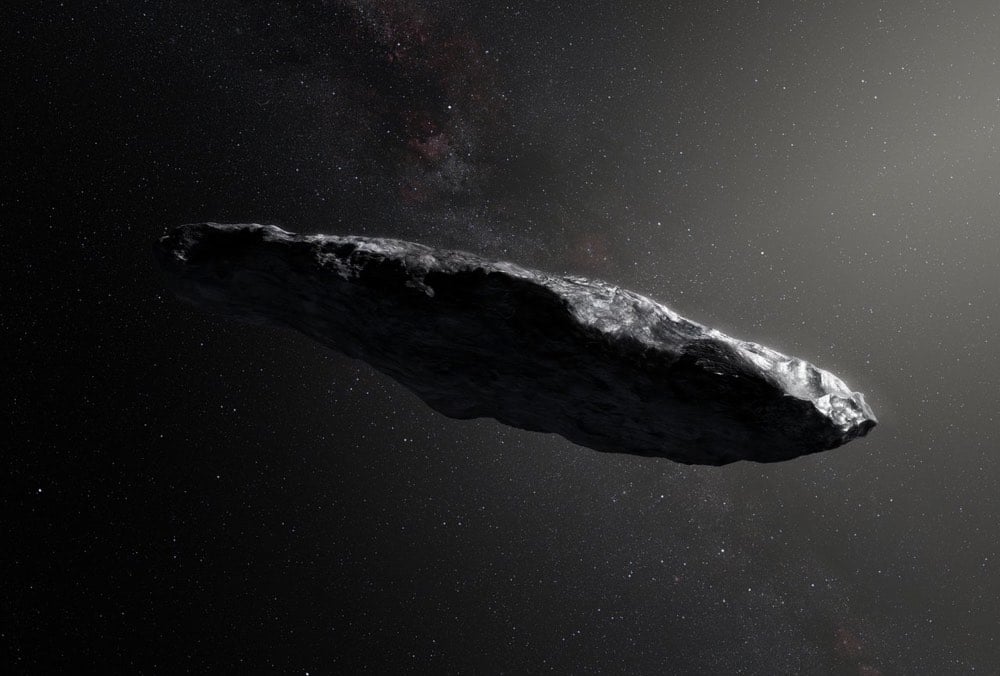
Back in October, the solar system welcomed a visitor from interstellar space…the first interstellar asteroid ever detected.
Astronomers have confirmed that an object that recently passed by our planet is from outside our Solar System — the first interstellar asteroid that’s ever been observed. And it doesn’t look like any object we’ve ever seen in our cosmic neighborhood before.
Follow-up observations, detailed today in Nature, have found that the asteroid is dark and reddish, similar to the objects in the outer Solar System. It doesn’t have any gas or dust surrounding it, like comets do, and it’s stretched long and skinny, looking a bit like an oddly shaped pen. It’s thought to be about a quarter-mile long, and about 10 times longer than it is wide. That makes it unlike any asteroids seen in our Solar System, none of which are so elongated.
Here’s a video of the asteroid’s path through the solar system:
Um, folks…that looks like a rocket. How do we know this “asteroid” isn’t actually an ancient alien ship that’s become encrusted with rock over millions of years? Or an ancient weapon gone awry? We’ve all seen the first Star Trek movie, right? (I am only a little bit kidding about this.)
Update: Scientists — or at least one scientist who has a billionaire’s ear — think that’s there’s something a little odd about Oumuamua, so they’re going to check it for radio signals. Spoiler: they’re not going to find any, but wouldn’t it be fun if they did!?
Update: They listened and did not find any radio signals coming from Oumuamua.
Update: As of October 2018, here’s what we know about Oumuamua.
A few months later, another collaboration found that ‘Oumuamua wasn’t just being pulled by the sun’s gravity. Instead, it was being slightly accelerated by an unseen force, which they argued could only be attributed to comet “outgassing” acting like a thruster. With this additional information, the case appeared to be closed. “Interstellar asteroid is really a comet,” read the headline of a press release put out by the European Space Agency.
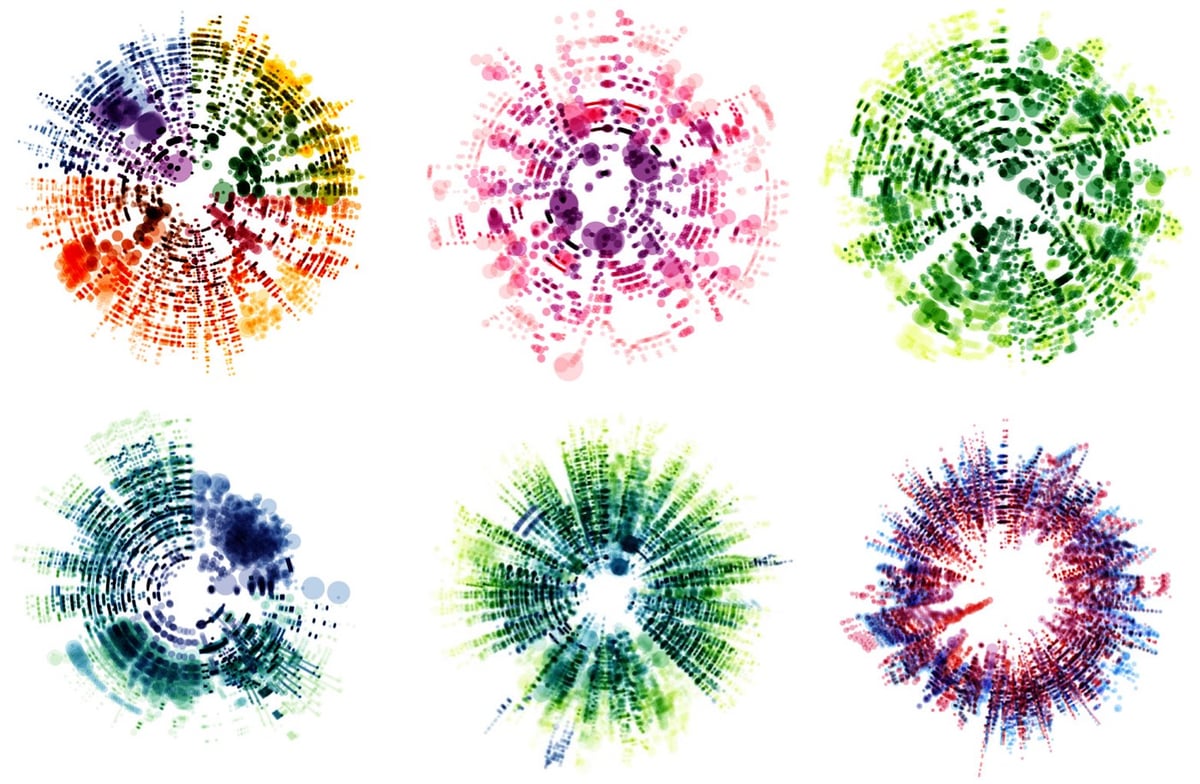
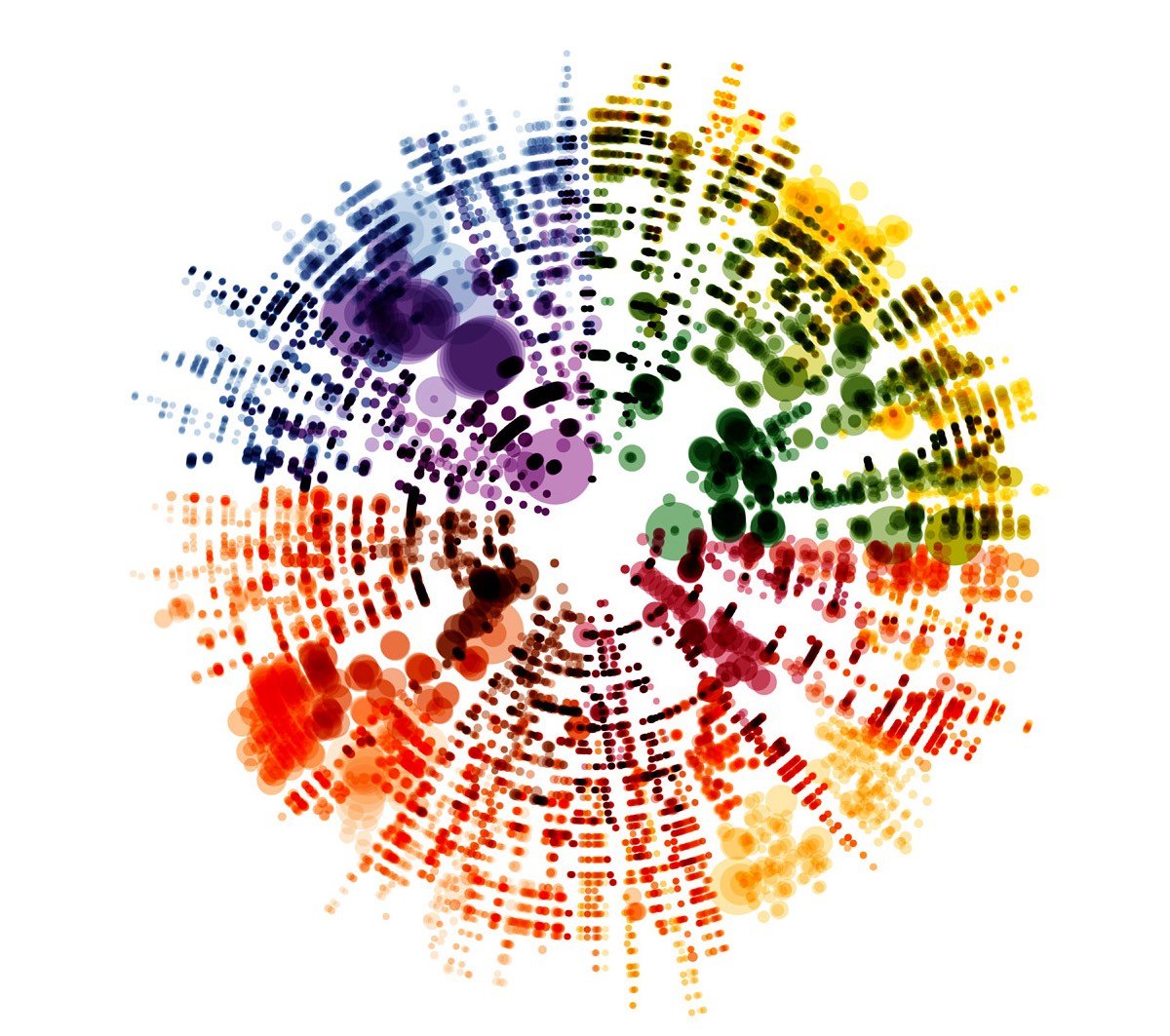
Nicholas Rougeux, who describes himself as a “designer, data geek, fractal nut”, designed a process to turn musical scores into ultra-colorful images. He outlined his process here.
Rougeux also made video versions where you can see the visualizations form as the songs play. Here’s Vivaldi’s The Four Seasons:
Posters are available.
I’m posting this mostly for my son. We were talking about this movie the other day and he remembered exactly where we were and what we were doing when I first told him Pixar was making an Incredibles sequel. Like it was the Moon landing or JFK getting shot.
I barely know how to describe this so maybe you should just watch it. Animator Ismael Sanz-Pena took a single image of a medieval cathedral and used the facade’s repeating elements to find the movement within, kind of like a zoetrope. (Ok, I guess that’s a pretty good description. I still think you should just watch it though.) See also Sanz-Pena’s earlier attempts of the same effect. (via colossal)
So, the jumping from box to box seemed cool. Hey, robot parkour! It seemed awfully agile for something that looks like it weighs quite a bit, but ok. But the casual gymnastics about 20 seconds in broke my brain. Holy. Crap.
A nice overview of emergence by Kurzgesagt. I continue to find the concept of emergence endlessly fascinating — order from disorder, complexity from simplicity, more is different. As a society, we tend to underestimate how much emergence plays a role in why things happen the way they do and are therefore often wrong-footed in our analysis and response.
For a good primer on emergence and other related phenomena, check out Steven Johnson’s Emergence: The Connected Lives of Ants, Brains, Cities, and Software.
The Road Movie, out in theaters in January, consists of nothing but videos taken from Russian dashboard cameras. There are car accidents, animal hijinks, fistfights, high/drunk people, meteors, and fires. The trailer is really entertaining…I’m curious to see the entire film to see how it’s stitched into something resembling a narrative that can sustain a viewer’s attention for more than 20 minutes.
Bruce Yeany teaches physical science to 8th graders in Annville, PA and he is very enthusiastic about it. On his popular Homemade Science YouTube channel, Yeany highlights all sorts of physics experiments and demonstrations without using any special equipment. In one of his latest videos, he shares a bunch of marble tracks that he’s built to demonstrate motion and momentum.
The “identical track race” starting at 1:43 might blow your noodle a little bit unless you’re familiar with Galileo’s pendulum research. (via digg)
As a follow-up to Beautiful Chemistry, the Beauty of Science and the Chinese Chemical Society have teamed up to showcase the natural beauty of chemical reactions in Envisioning Chemistry.
To achieve this goal, we took two approaches. The first was the artistic approach, in which we used chemical reactions as an essential element in the film media, together with music and editing, to explore the new possibility of film-making. The second was the technical approach, in which we took advantages of the state-of-the-art photography equipment, including high-resolution microscopes, infrared thermal imaging cameras, high-speed cameras, and 4K Ultra HD cameras, to reveal beauty of chemical reactions like never before.
You’ll notice while watching some of these videos how alive these reactions look and how common the growing/branching structures of crystals & skeletons & trees & circulatory systems are in nature, on all scales.
From software developer and writer Tero Parviainen, an interactive presentation on how generative music works. (Roughly speaking, generative music is “about making music by designing systems that make music”.)
The presentation includes many examples — Terry Riley’s In C, Brian Eno’s recent app, Listen to Wikipedia, Steve Reich’s work, neural nets for generating music — and a few interactive generative music toys you can play around with. (via waxy)
Newer posts
Older posts




Socials & More