kottke.org posts about video
In her series “opsec and beauty”, artist Addie Wagenknecht efficiently combines two YouTube genres into one, giving tips on cybersecurity while reviewing beauty products. In this video, Wagenknecht recommends using pass phrases instead of passwords while reviewing a Korean facial sheet mask:
I also like this one, titled “Dry shampoo review Herbal Essence and blocking Chad from calling”:
It makes your hair smell really good. It kinda makes you look like you’ve washed it. I’m going on like day 10 right now of not washing my hair but you can tell it’s transformed. I also want to talk about having secondary phone numbers because that way you can block the guy once he realizes you actually have to do things to yourself to be perfect.
Merle Hazard bills himself as “America’s foremost country singer/economist”. In this delightful performance, he sings about his daddy, who was a composer of atonal music along the same lines as Arnold Schoenberg and Alban Berg.
It is a genuinely catchy tune and the part where Alison Brown comes in atonally on the banjo killed me. This might be my new favorite country song?
In the past, Hazard has done songs about the Fiscal Cliff and Inflation or Deflation. You might remember his recent country tune about self-driving trucks. (via @tedgioia)
Purl, directed by Kristen Lester, is an animated short from Pixar about a ball of yarn that starts a new job at B.R.O. Capital and quickly feels out of place among all the men in suits. The story was inspired by Lester’s experience working in animation as the only woman at her company.
In order to do the thing that I loved, I sort of became one of the guys. And then I came to Pixar and I started to work on teams with women for the first time. And that actually made me realize how much of the female aspect of myself I had buried and left behind.
(via @cabel)
Time lapse video tours of big cities are a common sight on YouTube — see this Dubai hyperlapse or this Paris time lapse — and the technique has become an aesthetic of its own. But seeing the super-stylized & ultra-HD practice applied to a place like Pyongyang, North Korea broke my brain a little bit. The video was shot by Joerg Daiber, who writes of the experience:
Pyongyang is by far the weirdest and strangest place I have ever been to. At the same time it’s also one of the the most interesting and intriguing places and unlike anywere else I have ever been to. You go there with 100 questions and you return with 1000!
(via @kbandersen)
At the World Economic Forum held in Switzerland at the end of January, Mohammed Hassan Mohamud, a refugee in Kenya for the past 20 years, spoke about the unethical practice of keeping people in long-term refugee camps, what he calls “putting people in faraway places and pretending that they don’t exist”.
It surprises me that money and capital moves around the world in second, but it takes a refugee decades, or in the case of my mother, she never had the chance to get out, waiting for 25 years for a place to go, a place to call home.
We talk about ethical and sustainable development. We talk about how we can be ethical with robots and machines. We want to solve death. And there’s so much human suffering. We haven’t figured out life yet.
In the first couple of minutes of this video, Roald Dahl introduces us to the writing hut behind his house that he used to write all of his famed children’s books like Charlie and the Chocolate Factory and Danny the Champion of the World. Dahl describes his working routine and details how he’s designed his writing environment, his “nest”, to be as free from distraction as possible.
The Guardian used to run a series about writers’ rooms and in 2008, illustrator Quentin Blake, who worked with Dahl on many of his books, wrote a piece about Dahl’s shed.
The whole of the inside was organised as a place for writing: so the old wing-back chair had part of the back burrowed out to make it more comfortable; he had a sleeping bag that he put his legs in when it was cold and a footstool to rest them on; he had a very characteristic Roald arrangement for a writing table with a bar across the arms of the chair and a cardboard tube that altered the angle of the board on which he wrote. As he didn’t want to move from his chair everything was within reach. He wrote on yellow legal paper with his favourite kind of pencils; he started off with a handful of them ready sharpened.
I like that he tied the footrest to the chair to keep it from sliding away when he rested his feet on it.
As someone who sits down daily to write, nothing seems so luxurious to me as a separate writing hut that is off limits to everyone and everything else. George Bernard Shaw and Mark Twain both had separate houses in which to write; Shaw’s shed could even rotate to catch the light throughout the day. Someday I’ll have one of my own…
P.S. Ernest Hemingway used a standing desk, as did Winston Churchill, Charles Dickens, and Virginia Woolf, among others. I got this one a few weeks ago and am still getting used to it. (via @ftrain)
As part of their YouTube series on how the Saturday Night Live sausage is made, this short video details how the cue cards that the actors read from during the show are made and used. There’s even a tiny little bit in there about how they use whitespace (between words and lines) to make sure the cards are readable from a distance.
I am kind of amazed that the cue card process is still done by hand. I don’t want to see any hard-working staffers or interns getting fired, but it seems like a couple of fast large-format color printers capable of printing on poster stock and a block letter handwriting font could dramatically streamline the workflow, particularly when late-stage changes are needed.
In this video, Vox takes a look at how El Chapo leveraged his use of tunnels for transporting drugs into the United States and became one of the richest and most powerful drug lords of all time.
Throughout his career as a drug trafficker, tunnels have been the common theme in El Chapo’s story. When he gained control of a major drug trafficking corridor in the late 1980s, Joaquin Guzman Loera — then known as “el Rapido” — was the first to create super tunnels for transporting drugs across the border.
At the time, a crackdown by the U.S. Drug Enforcement Agency (DEA) meant Colombian cocaine was in decline and the Mexican narcotrafficker saw an opportunity. By using tunnels to facilitate fast transport, El Chapo leveraged his role as a trafficker to claim new responsibilities as a cultivator and distributor of drugs.
El Chapo is currently on trial in the US and the proceedings thus far indicate that the Trump administration’s proposed border wall likely wouldn’t stop the flow of drugs into the US from Mexico. Most of the drugs shipped by El Chapo into the US went through regular old border crossings on trucks and trains, hidden in truck panels, packed into fake plastic bananas, or surrounded by food.
At one point, testimony at the trial has shown, Mr. Guzmán sent tons of cocaine across the border in cans of jalapeños marked with the label La Comadre chiles. The cans were stacked on pallets in the backs of commercial tractor-trailers, which simply drove through official border entry points. To protect his product from being found, witnesses said, Mr. Guzmán often placed the cans filled with cocaine in the middle of the pallets, surrounded by cans with actual chiles.
The NY Times link is via Geoff Manaugh, whose take on this tunnelling I’d love to read.
These visualizations of the speed of light I posted last week somehow demonstrate both how fast light speed is and how slow it is compared the vastness of the galaxy & universe. Science fiction often bends the rules of physics as we currently understand them, with fictional spacecraft pushing beyond the speed of light. In Star Trek, the measure of a ship’s velocity is warp speed. Warp 1 is the speed of light, Warp 6 is 392 times the speed of light, etc. In this Warp Speed Comparison video, EC Henry compares the top speeds of various Star Trek vessels (the original Enterprise, Voyager, the Defiant), racing them from Earth to the edge of the solar system.
Once again, you get a real sense of how fast these ships would be if they actually existed but also of the vastness of space. It would take 10 seconds for the fastest ship to reach the edge of the solar system at maximum warp and just over 6 hours to get to the nearest star, Proxima Centauri. Wikipedia lists a few dozen stars that are within a day’s journey at full warp…a trip that takes light more than 16 years. The mighty speed of light is no match for the human imagination. (thx, jim)
We’re coming up on the 50th anniversary of the Apollo 11 mission, which means an increase in Apollo 11 media. This is a strong early entrant: “Apollo 11”, a feature-length documentary on the mission, featuring “a newly discovered trove of 65mm footage” of starting clarity.
Miller and his team collaborated with NASA and the National Archives (NARA) to locate all of the existing footage from the Apollo 11 mission. In the course of sourcing all of the known imagery, NARA staff members made a discovery that changed the course of the project — an unprocessed collection of 65mm footage, never before seen by the public. Unbeknownst to even the NARA archivists, the reels contained wide format scenes of the Saturn V launch, the inside of the Launch Control Center and post-mission activities aboard the USS Hornet aircraft carrier.
The find resulted in the project evolving from one of only filmmaking to one of also film curation and historic preservation. The resulting transfer — from which the documentary was cut — is the highest resolution, highest quality digital collection of Apollo 11 footage in existence.
The film is 100% archival footage and audio. They’ve paired the footage with selections from 11,000 hours of mission audio.
The other unexpected find was a massive cache of audio recordings — more than 11,000 hours — comprising the individual tracks from 60 members of the Mission Control team. “Apollo 11” film team members wrote code to restore the audio and make it searchable and then began the multi-year process of listening to and documenting the recordings. The effort yielded new insights into key events of the moon landing mission, as well as surprising moments of humor and camaraderie.
This. Sounds. Amazing. The film premiered at the Sundance Film Festival a few days ago and the reviews have been overwhelmingly positive. Here’s David Erhlich writing for Indiewire:
It’s rare that picture quality can inspire a physical reaction, but the opening moments of “Apollo 11,” in which a NASA camera crew roams around the base of the rocket and spies on some of the people who’ve come to gawk at it from a beach across the water, are vivid enough to melt away the screen that stands between them. The clarity takes your breath away, and it does so in the blink of an eye; your body will react to it before your brain has time to process why, after a lifetime of casual interest, you’re suddenly overcome by the sheer enormity of what it meant to leave the Earth and land somewhere else. By tricking you at a base sensory level into seeing the past as though it were the present, Miller cuts away the 50 years that have come between the two, like a heart surgeon who cuts away a dangerous clot so that the blood can flow again. Such perfect verisimilitude is impossible to fake.
And Daniel Fienberg for The Hollywood Reporter:
Much of the footage in Apollo 11 is, by virtue of both access and proper preservation, utterly breathtaking. The sense of scale, especially in the opening minutes, sets the tone as rocket is being transported to the launch pad and resembles nothing so much as a scene from Star Wars only with the weight and grandeur that come from 6.5 million pounds of machinery instead of CG. The cameraman’s astonishment is evident and it’s contagious. The same is true of long tracking shots through the firing room as the camera moves past row after row after row of computers, row after row after row of scientists and engineers whose entire professional careers have led to this moment.
There will be a theatrical release (including what sounds like an IMAX release for museums & space centers) followed by a showing on TV by CNN closer to July.
The “Tolkien: Maker of Middle-earth” exhibition at NYC’s Morgan Library & Museum is “the most extensive public display of original Tolkien material for several generations”. Running from January 25 through May 12, the exhibition includes drafts, drawings, maps, and memorabilia related to J.R.R. Tolkien’s books, including hand-drawn maps done by Tolkien of Middle-earth.
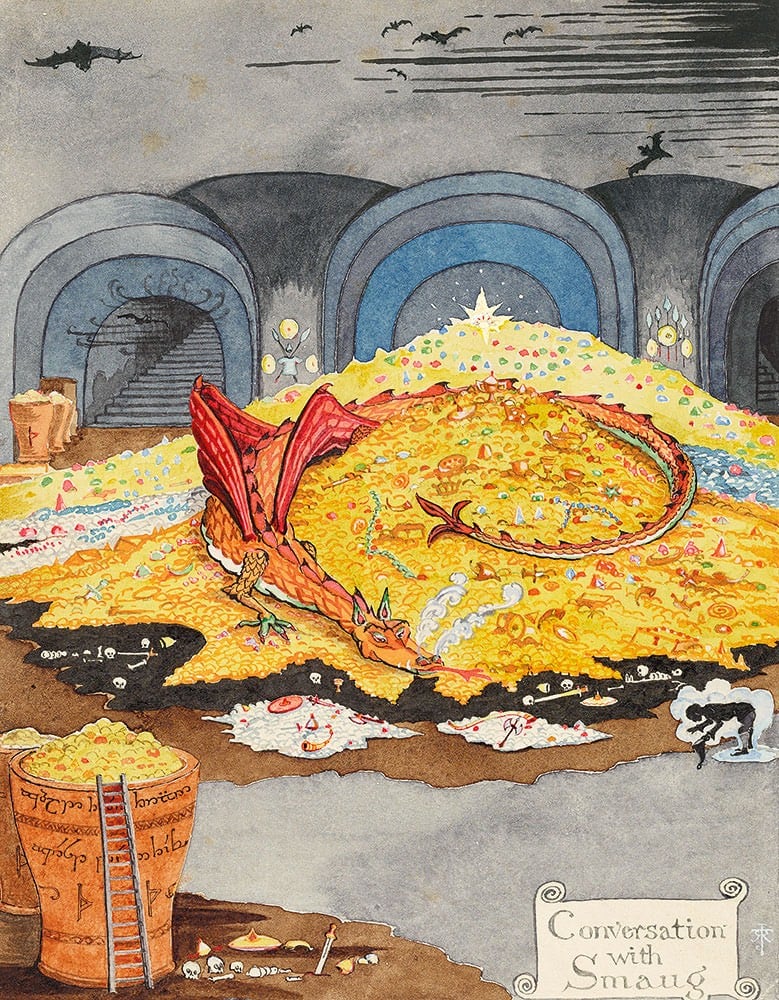
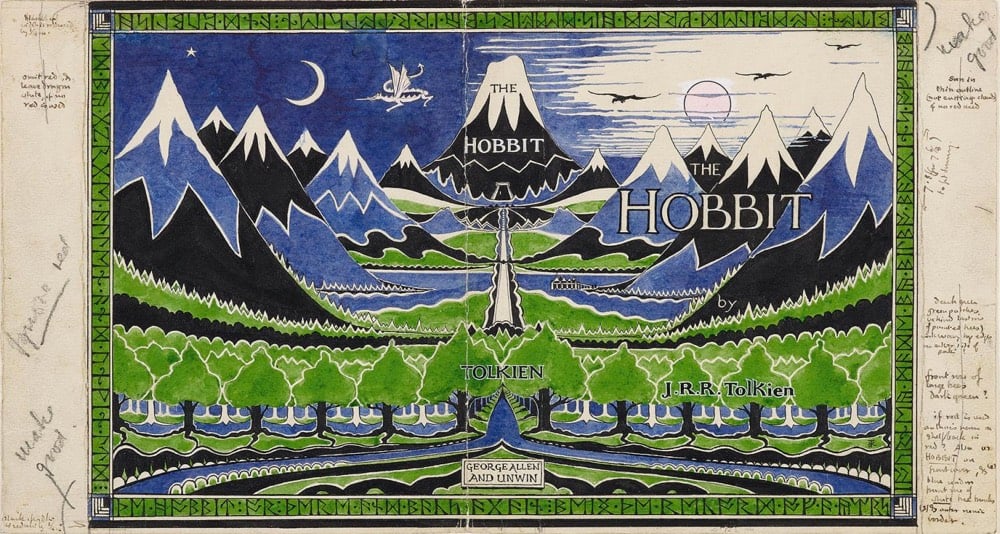
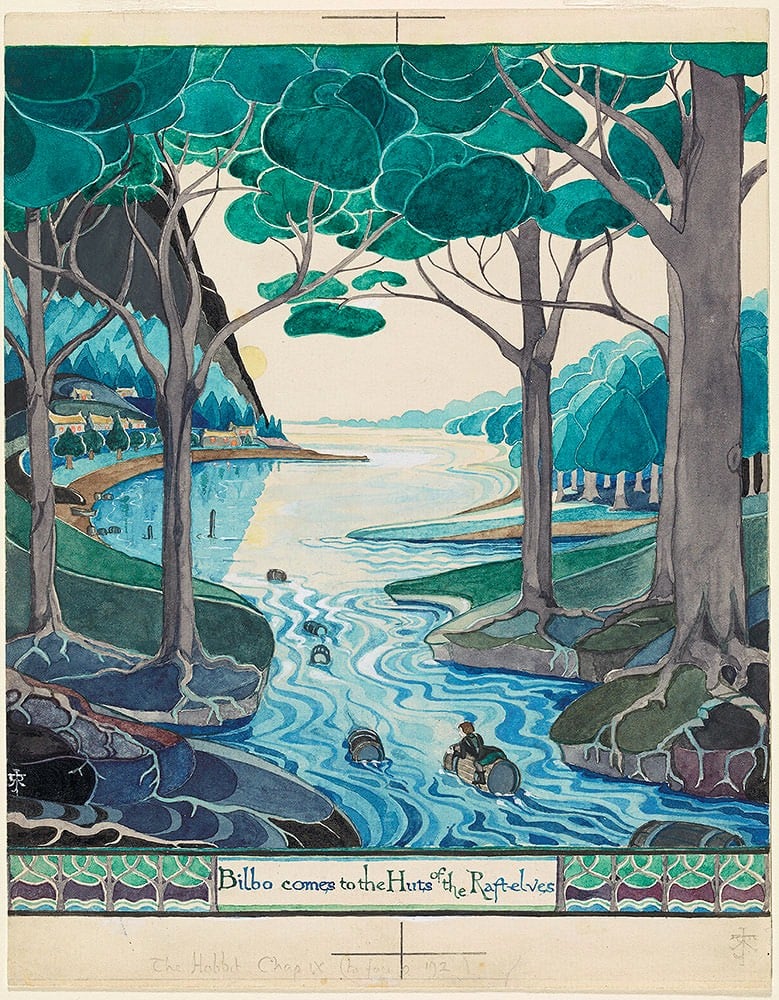
I’m totally going to this the next time I’m in NYC.
Update: Note to those who are heading to exhibition: cosplaying your favorite LoTR character at the Morgan Library is totally permissible.
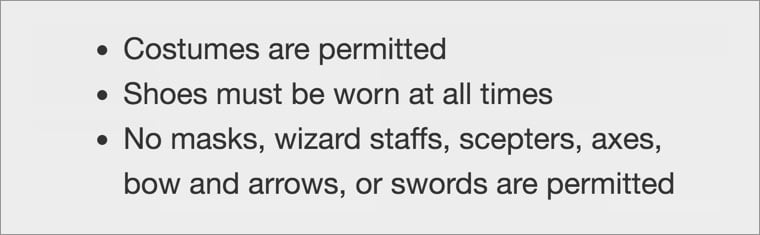
But all Gimlis, Legolases, and Gandalfs, leave your weaponry at home. (via @arbesman)
For this video, freelance animator Nick Murray Willis took the audio from football commentators and made these little animated vignettes to go along with each line. Here’s a sample:
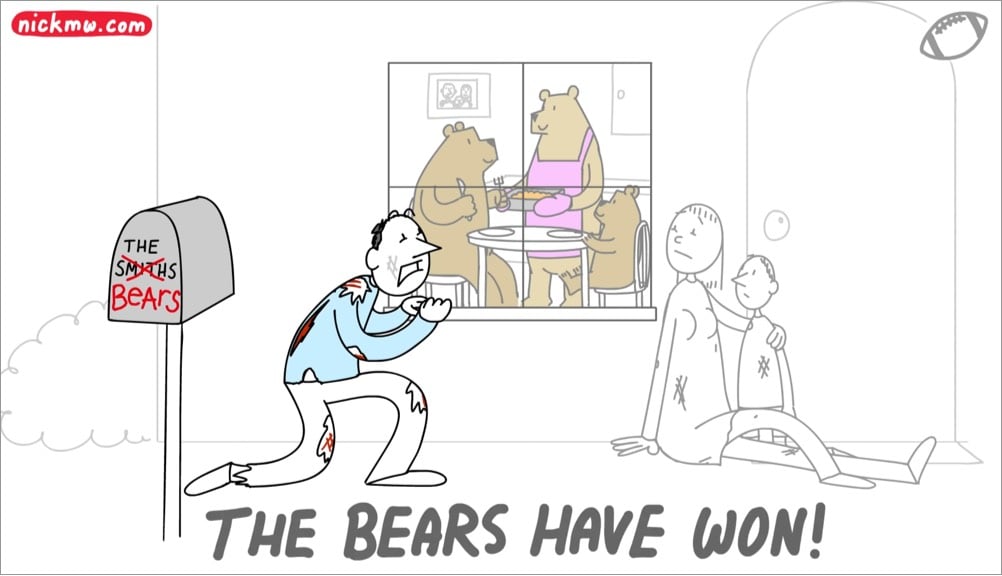
My only complaint about this video is that it was over too quickly. Luckily Willis has done the same thing in videos for NBA, soccer, movie lines, etc.
Meet the spider-tailed horned viper, native to western Iran. As the name suggests, the snake has a tail that, when moved about in the right way, looks like a spider crawling on a rock. The crawling “spider” attracts small birds who eat insects…and then the viper eats the birds:
Sweeeeeeet Fancy Moses! If an animal with venomous snake jaws on one end and a spider on the other isn’t everyone’s idea of a nightmare animal, I don’t know what is.
But what an incredible evolutionary adaptation. This mimicry is right up there with the bee orchid. (via @jasonfried)
Light is fast! In a recent series of animations, planetary scientist James O’Donoghue demonstrates just how fast light is…and also how far away even our closest celestial neighbors are. Light, moving at 186,000 mi/sec, can circle the Earth 7.5 times per second and here’s what that looks like:
It can also travel from the surface of the Earth to the surface of the Moon in ~1.3 seconds, like so:
That seems both really fast and not that fast somehow. Now check out light traveling the 34 million miles to Mars in a pokey 3 minutes:
And Mars is close! If O’Donoghue made a real-time animation of light traveling to Pluto, the video would last over 5 hours. The animation for the closest undisputed galaxy, Seque 1, would last 75,000 years and 2.5 million years for the Andromeda galaxy animation. The farthest-known objects from Earth are more than 13 billion light years away. Light is slow!
See also The Leisurely Pace of Light Speed.
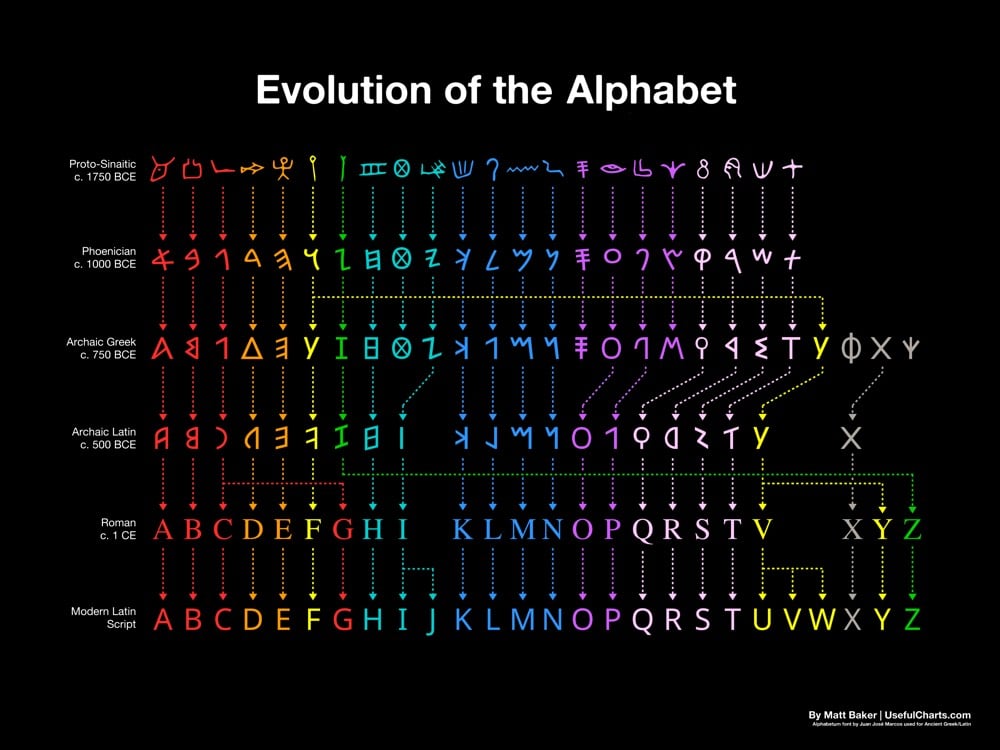
From Matt Baker of UsefulCharts, this chart traces the evolution of our familiar alphabet from its Proto-Sinaitic roots circa 1850-1550 BC. It’s tough to see how the pictographic forms of the original script evolved into our letters; aside from the T and maybe M & O, there’s little resemblance. Prints are available. (via the morning news)
Update: Baker recently did an updated version of the alphabet evolution chart.
Mountain Monks is a short film by Fritz Schumann about a group of Japanese monks called the Yamabushi who regularly commune with nature to get in touch with their true selves.
The Yamabushi in northern Japan practice a once forbidden ancient religion. While their tradition is at risk of disappearing, it offers a way for those seeking a different path in Japan’s society.
Walking barefoot through rivers, meditating under waterfalls and spending the nights on mountaintops — that is the way of the Yamabushi. They walk into the forest to die and be born again.
You may remember another short film by Schumann that I posted last year about Hoshi Ryokan, a 1300-year-old family-run hotel in central Japan. (via laughing squid)
Moon Rivas, a cyborg artist, has sensors implanted in her feet that vibrate whenever an earthquake is detected anywhere in the world. A dancer and choreographer, Rivas uses the randomly occurring vibrations to perform dance pieces like “Waiting for Earthquakes”. This video from Quartz gives a good overview of Rivas’ art and process (back when an implant was located in her arm instead of her feet).
CNN and Bloomberg both have recently updated reports on Rivas’ work.
Ribas then transforms that data into dance or music, often incorporating elements of spontaneity and uncertainty. For example, the movements in the dance “Waiting for Earthquakes,” in which the artist stands perfectly still until seismic activity occurs, can take many shapes.
“I’m a dancer and a choreographer, so I wanted to experience movement in a deeper way,” she explains. “Whenever there is an earthquake, I move according to the intensity of the earthquake. It’s a bit like a duet between the earth and myself. Earth is actually the choreographer of the piece and I’m just imitating the data that she gives.”
Her partner Neil Harbisson is also a cyborg. He was born colorblind but is outfitted with an antenna implanted in his head that vibrates when it detects colors. (via @boletrone)
Something incredible happened during the super blood wolf moon eclipse that took place on Sunday night: a meteorite struck the moon during the eclipse and it was captured on video, the first time this has ever happened.
Jose Maria Madiedo at the University of Huelva in Spain has confirmed that the impact is genuine. For years, he and his colleagues have been hoping to observe a meteorite impact on the moon during a lunar eclipse, but the brightness of these events can make that very difficult — lunar meteorite impacts have been filmed before, but not during an eclipse.
The 4K video of the impact above was taken by amateur astronomer Deep Sky Dude in Texas…he notes the impact happening at 10:41pm CST. I couldn’t find any confirmation on this, but the impact looks bright enough that it may have been visible with the naked eye if you were paying sufficient attention to the right area at the right time.
Phil Plait has a bunch more info on the impact. If the impact site can be accurately determined, NASA will attempt to send the Lunar Reconnaissance Orbiter to get photos of it.
Interestingly, I talked to Noah Petro, Project Scientist for LRO, and he noted that the impact may have created secondary craters, smaller ones made by debris blown out by the main impact. Those will spread out over a larger area, and are easier to spot, so it’s possible that even with a rough location known beforehand the crater can be found. Also, fresh craters look distinct from older ones — they’re brighter, and have a bright fresh splash pattern around them — so once it’s in LRO’s sights it should be relatively easy to spot.
It’s not clear how big the crater will be. I’ve seen some estimates that the rock that hit was probably no more than a dozen kilograms or so, and the crater will be probably 10 meters across. That’s small, but hopefully its freshness will make it stand out.
In 1960, the National Film Board of Canada released a short documentary called Universe. The film follows the work of astronomer Donald MacRae at an observatory in Ontario, which is accompanied a special effects-heavy tour of the solar system, galaxy, and universe: “a vast, awe-inspiring picture of the universe as it would appear to a voyager through space”. Universe was nominated for an Oscar in 1961 and also caught the eye of Stanley Kubrick, who used it as inspiration for 2001: A Space Odyssey.
“Stanley had seen the National Film Board movie Universe.” Most of the crew on 2001 were familiar with the Canadian production, made by filmmakers Colin Low and Roman Kroitor, all having seen it at the early stages of 2001’s production, it being “required watching” at the insistence of Kubrick himself, who had seen the documentary “almost 100 times”, “until the sprockets wore out,” 2001 special effects supervisor Con Pedersen remembers.
Kubrick was so taken by the depiction of the celestial objects in the film that he hired the co-director and a special effects technician from Universe to work on 2001. The narrator of Universe, Douglas Rain, also became a integral part of Kubrick’s masterpiece. After ditching the idea that 2001 would be narrated by Rain — “as more film cut together, it became apparent narration was not needed” — Kubrick chose Rain as the now-iconic voice of HAL 9000.
After finally excising the narrator altogether, he simply made Rain the voice of HAL, liking his “bland mid-Atlantic accent”. The decision was entirely Kubrick’s, who had become concerned with the character of the computer. “Kubrick was having,” Rain says, “a problem with the computer. ‘I think I made him too emotional and too human,’ he said. ‘I’m having trouble with what I’ve got in the can. Would you consider doing his voice?’ So we decided on the voice of the computer.”
But back to Universe, which is a marvelous little film (even though it asserts at one point that “it is reasonably certain” that Mars contains vegetation). I love the early sequence of the astronomer setting up his telescope — the way he walks along inside of it and then casually lifts it up into place. It’s really just a bigger version of the small reflector that I have, not any more complicated than a couple of mirrors pointed in the right direction. It’s incredible what we humans have learned about the universe simply by collecting ancient starshine with polished lenses and mirrors. (via clayton cubitt)
This commercial from Mexican airline AeroMexico cleverly reminds some Americans of the melting pot nature of our nation, where even “white” folks living near the border share significant amounts of DNA with those in Mexico. According to this piece in Adweek, the ad features non-actors and their actual DNA test results.
For those wondering how legit the scenarios shown in the ad are, Agost Carreño says it’s all real and that each person featured in the video was a non-actor who did have a 23andMe DNA test done in advance of the reveal.
Update: A possible inspiration for the AeroMexico video is The DNA Journey commercial by travel search engine Momondo:
The folks in that commercial may seem a bit naive about how DNA and ancestry works, but I took the 23andMe DNA test many years ago and was also surprised to find a few significant possible geographic outliers (British/Irish, Dutch) that were not accounted for in the handed-down family genealogy. (via @rudhraigh)
Featuring the ideas of cheese expert Paul Kindstedt, this TED-Ed video is a quick animated look at the history of cheese and cheesemaking over the last 10000 years.
The best indication of ancient cheese-making lies in pottery fragments that migrating peoples left behind as they moved to new locations. Neolithic peoples sometimes stored cheese and butter in pottery vessels, which left embedded residues of milkfat in the pottery. Even after thousands of years, these ancient milkfat residues can be identified by sophisticated archaeochemical techniques. By following the pottery trail, it is possible to reconstruct the movement of Neolithic cheesemakers out of the Fertile Crescent into northwest Turkey, and then westwards to Europe, where cheese-making evolved into countless new varieties, and eastwards to the Eurasian steppes. With respect to Africa, it is still unclear whether cheese-making arrived from the Fertile Crescent or developed independently there.
Kindstedt is the author of Cheese and Culture: A History of Cheese and its Place in Western Civilization and is based at the University of Vermont, not too far from where I live in VT, land of plentiful hyper-local cheeses…the nearest cheese-making dairy is 1/4 mile from my house. Some of Kindstedt’s recent research uses techniques like x-ray diffractometry to study stuff like crystal formation and packing density in cheeses, which takes me back to my research days in college studying the structure of glass. What a fun thing, to discover a whole new vector into cheese appreciation! (via open culture)
Comics fans and the internet at large have been enchanted by the new author of the classic Nancy comic, Olivia Jaimes. This comic from Sunday shows why:
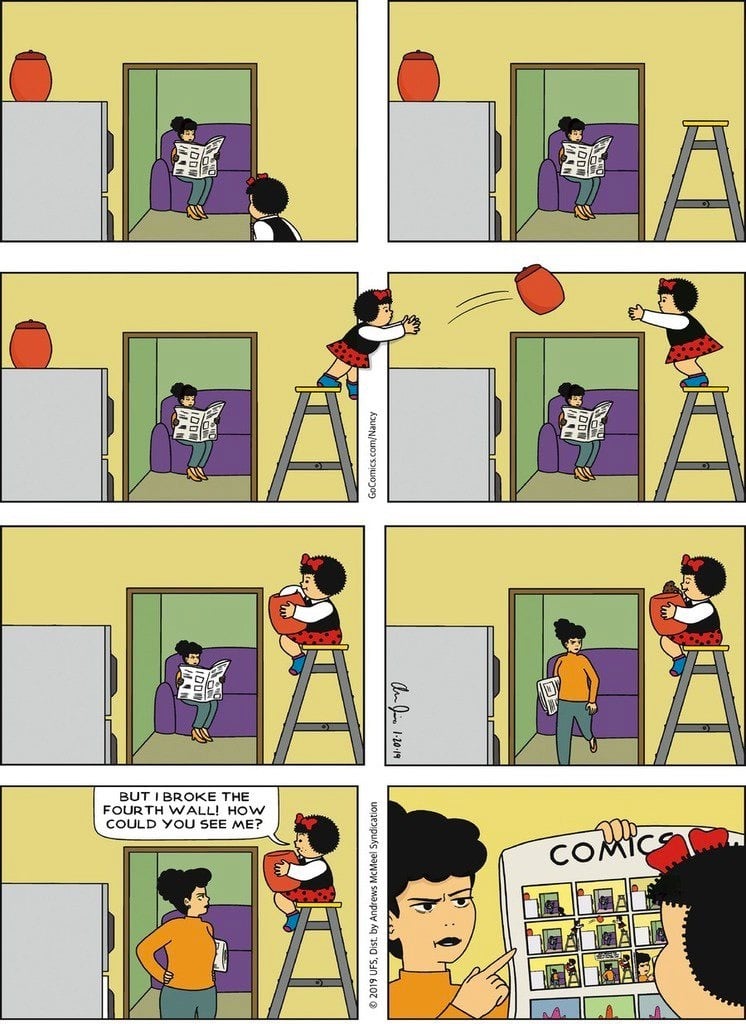
If you check out the thread for the comic on Twitter, there are several instances of comics that mess with time and space like this, but the final panel by Jaimes is particularly strong. I definitely Laughed Out Loud.
Update: Delta’s current onboard safety video takes place within the illustrated world of the seat-back safety card and contains several instances of fourth-wall breaking.
Spinning disks of ice can form naturally in slow-moving parts of streams and rivers. What happens is a large chunk of ice gets caught in a quiet part of the river and then is spun and shaped into a circle by the nearby current.
In the video above, Tina Radel captured a particularly huge ice circle in the Presumpscot River in Westbrook, Maine…it’s about 100 yards across!
A couple of years ago, a smaller ice circle was observed in Washington and “went viral”:
The Westbrook ice circle isn’t that much smaller than the world’s largest man-made ice circle, which was fashioned in Maine last year and turned into a carousel by attaching several outboard motors to it.
For more than a year now, Jon Lefkovitz has been making short videos of iconic scenes from films backed by the same musical score, a short clip of “Canis Lupus” from Alexandre Desplat’s Fantastic Mr. Fox score. Here’s Groundhog Day, 2001: A Space Odyssey, Jurassic Park (featuring a great example of the Spielberg Face), and the beautiful 2-minute shot from Big Night:
Each clip is between 30 seconds and 2 minutes 30 seconds long. Here’s the whole playlist.
Yesterday on Twitter, Guillermo del Toro shared “10 personal musings about ROMA”, the film by Alfonso Cuarón that just won best film at the Critics’ Choice awards. It is also a tiny masterclass in how to watch a film.
1) The opening shot suggests that earth (the shit-infested ground) and heaven (the plane) are irreconcilably far even if they are joined — momentarily — and revealed, by water (the reflection). All truths in ROMA are revealed by water.
2) These planes of existence, like the separation within classes in the household cannot be broached. The moments the family comes “closer” are fleeting… “She saved our lives” is promptly followed by “Can you make me a banana shake?”
This bit in particular makes me want to watch the whole thing again:
In every sense, ROMA is a Fresco, a Mural, not a portrait. Not only the way it is lensed but the way it “scrolls” with long lateral dollies. The audio visual information (context, social unrest, factions & politics / morals of the time) exists within the frame to be read.
If you haven’t seen it, I highly recommend Roma. It’s still showing in a few theaters but is also available on Netflix.
In a Nutshell is a mesmerizing stop motion animation directed by Fabio Friedli that attempts to sum up the entire world in just five minutes, “from a seed to war, from meat to love, from indifference to apocalypse”. This is very very well done. (via waxy)
In their latest video, Kurzgesagt asks: “Is Organic Really Better? Healthy Food or Trendy Scam?” Using the results of dozens of studies (their extensive list of sources is here), they examine the evidence that organic food is better for our health and for the environment than food produced by conventional methods (with artificial pesticides, fertilizers, etc.). The result is pretty much a toss-up. Their ultimate conclusion: eating more fruits and vegetables of any kind and buying local food that is in season is a better option than eating organic. (Note: the video and studies they used seem to cover only organic produce and not meat. That comparison might have a different outcome.)
In 1995, Fred Rompelberg set the record for the fastest speed on a bicycle: 167 mph. In September 2018, drafting behind the same custom-made dragster that Rompelberg used to set his record, Denise Mueller-Korenek smashed that record by almost 17 mph.
Mueller-Korenek mounted a specially equipped bike with a massive gear and tethered it to a race car, which then accelerated to 100-plus mph-the velocity necessary for the rider to turn over the cranks on her own volition. Then she unhooked from the car and stayed in the slipstream, smashing the pedals around to hit the highest speed possible under her own power.
Her speed on her final mile on the Bonneville Salt Flats was 183.93 mph. This short film from WSJ shows how Mueller-Korenek became the world’s fastest human on a bike. The salty maelstrom whipped up as she pushed past 180 is incredible. Tough. As. Nails.
This gave me a solid laugh this morning: perhaps the most local local commercial I’ve ever seen. Jemele Hill called it “the worst-best commercial I’ve ever seen”.
The ad was filmed by comedy duo Rhett & Link for Roller Kingdom in Reno, NV, so the whole thing is definitely tongue-in-cheek…but still worth watching. (via @jemelehill)
I don’t know about you, but my house was blanketed with VHS tapes. The tapes were filled with episodes of Star Trek and movies meticulously taped from network TV without commercials — you had a to be a real Johnny-on-the-spot with the pause button or you’d miss a few post-commercial seconds of Chevy Chase’s antics in the G-rated version of National Lampoon’s Vacation. This video is a quick two-minute ode to the colorfully designed cases those tapes were sold in. Total memory bomb seeing these again.
Newer posts
Older posts



Socials & More