kottke.org posts about science
I really enjoyed this piece by Tom Vanderbilt on how time is kept, coordinated, calculated, and forecast. It’s full of interested tidbits throughout, like:
Care to gawk at one of the world’s last surviving original radium standards, a glass ampoule filled with 20.28 milligrams of radium chloride prepared by Marie Curie in 1913? NIST has it in the basement, encased in a steel bathtub, buried under lead bricks.
And:
For GPS to work, it needs ultra-exact timing: accuracy within fifteen meters requires precision on the order of fifty nanoseconds. The 5G networks powering our mobile phones demand ever more precise levels of cell-tower synchronization or calls get dropped.
And:
And as Mumford could have predicted, nowhere has time become so fetishized as in the financial sector, with the emergence over the past decade of algorithmic high-frequency trading. Donald MacKenzie, the author of Trading at the Speed of Light, estimated in 2019 that a trading program could receive market data and trigger an order in eighty-four nanoseconds, or eighty-four billionths of a second.
And:
All this makes F1 staggeringly accurate: it will gain or shed only one second every 100,000,000 years. Since the days when time was defined astronomically, the accuracy of the second is estimated to have increased by a magnitude of eight.
And:
“A clock accurate to a second over the age of the cosmos,” Patrick Gill, a physicist at the U.K.’s National Physical Laboratory, is quoted as saying in New Scientist, “would allow tests of whether physical laws and constants have varied over the universe’s history.”
And:
“If you were to lift this clock up a centimeter of elevation,” Hume told me, “you would be able to discern a difference in the ticking rate.” The reason is Einstein’s theory of relativity: Time differs depending on where you are experiencing it.
And I could go on and on. If any or all of those tidbits is interesting to you, you should go ahead and read the whole thing.
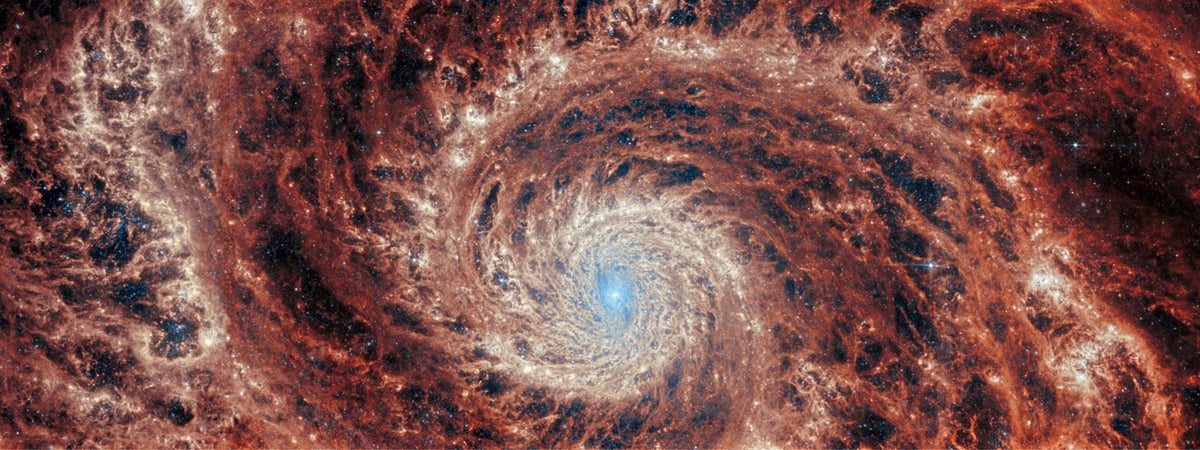
Love this recent JWST shot of the M51 spiral galaxy.
The graceful winding arms of the grand-design spiral galaxy M51 stretch across this image from the NASA/ESA/CSA James Webb Space Telescope. Unlike the menagerie of weird and wonderful spiral galaxies with ragged or disrupted spiral arms, grand-design spiral galaxies boast prominent, well-developed spiral arms like the ones showcased in this image. This galactic portrait was captured by Webb’s Mid-InfraRed Instrument (MIRI).
In this image the reprocessed stellar light by dust grains and molecules in the medium of the galaxy illuminate a dramatic filamentary medium. Empty cavities and bright filaments alternate and give the impression of ripples propagating from the spiral arms. The yellow compact regions indicate the newly formed star clusters in the galaxy.
(via bad astronomy)
From the Journey to the Microcosmos YouTube channel, this is an exploration of the tiny worlds contained in rainwater puddles and their connection to the discovery of microbial organisms in the 1670s by Dutch scientist Antonie van Leeuwenhoek. What a trip that must have been, to be the first person to peer microscopically into some water and observe tiny organisms swimming around. (via @JenLucPiquant)
Craig Mod has my favorite take to date on Oppenheimer: that it should have been more like Richard Rhodes’ The Making of the Atomic Bomb:
My ideal version of this film would have begun in the 1900s or ’10s, with flashes of Relativity and then the steps of Quantum Mechanics with Planck, Bohr, and Heisenberg. Quantum tunneling with Gamow and Gurney. The nuclear shell model with Maria Goeppert Mayer and J. Hans D. Jensen. Chadwick’s discovery of the neutron. Anderson’s positron unveiling. Hold the camera longer on Lawrence and his cyclotron. What’s going on there? (I mean, ya got Josh Hartnett’s pretty head, plaster it up!) Shoot in high-grade mega-IMAX-bokeh the oddly simple experimental setups, the beakers, the blips, the radiation tick-tick-ticks, the iterations, the step-by-step expansion of understanding the fabric of everything around us. Give us an hour of this, this arguably greatest moment of human insight. You can still call the film Oppenheimer. Let the man loom, weave him between it all as he makes his way through Europe, sets up at Berkeley, is selected to lead Los Alamos. Ramp up the Nazi threat. Show the diaspora of brilliance more clearly. Believe the audience is willing to sit through more than just “Is it a wave … or is it particle?” Oh! There is so much excitement, so much incredible science to be mined, and Nolan mined so little.
Mod and I both share a love for that masterpiece of a book and I would watch the hell out of an 10-part HBO series (in the vein of Chernobyl) based on it, American Prometheus, and John Hersey’s Hiroshima.
Madeline Miller (Circe, Song of Achilles) got sick in February 2020 with what turned out to be Covid, which then turned into Long Covid. It has profoundly affected her life (gift link).
I reached out to doctors. One told me I was “deconditioned” and needed to exercise more. But my usual jog left me doubled over, and when I tried to lift weights, I ended up in the ER with chest pains and tachycardia. My tests were normal, which alarmed me further. How could they be normal? Every morning, I woke breathless, leaden, utterly depleted.
Worst of all, I couldn’t concentrate enough to compose sentences. Writing had been my haven since I was 6. Now, it was my family’s livelihood. I kept looking through my pre-covid novel drafts, desperately trying to prod my sticky, limp brain forward. But I was too tired to answer email, let alone grapple with my book.
When people asked how I was, I gave an airy answer. Inside, I was in a cold sweat. My whole future was dropping away. Looking at old photos, I was overwhelmed with grief and bitterness. I didn’t recognize myself. On my best days, I was 30 percent of that person.
I turned to the internet and discovered others with similar experiences. In fact, my symptoms were textbook — a textbook being written in real time by “first wavers” like me, comparing notes and giving our condition a name: long covid.
Even if Miller were physically able to get back to some semblance of “normal life”, the current policies and attitudes w/r/t Covid make it next to impossible.
Despite the crystal-clear science on the damage covid-19 does to our bodies, medical settings have dropped mask requirements, so patients now gamble their health to receive care. Those of us who are high-risk or immunocompromised, or who just don’t want to roll the dice on death and misery, have not only been left behind — we’re being actively mocked and pathologized.
I’ve personally been ridiculed, heckled and coughed on for wearing my N95. Acquaintances who were understanding in the beginning are now irritated, even offended. One demanded: How long are you going to do this? As if trying to avoid covid was an attack on her, rather than an attempt to keep myself from sliding further into an abyss that threatens to swallow my family.
I cannot remember where I read this (it was likely more than a year ago), but it would be more accurate/helpful if we thought of the disease caused by the SARS-CoV-2 virus as a chronic vascular disease (aka Long Covid) that often comes with short-term symptoms and acute, life-threatening effects instead of the other way around.
This short, relaxing, mesmerizing video of an Martian impact crater called Aram Chaos was taken by the HiRISE camera on the Mars Reconnaissance Orbiter. The images were run through an enhanced color red-green-blue filter, which tends to highlight the structure and geology rather than the true color. For example, the blue in the video often represents basalt, an igneous rock of volcanic origin.
When you apply power with higher-than-normal voltage to electric kids toys, they tend to move faster. When you apply 30V instead of the usual 2.5V or 5V, they move really fast:
This reminds me of when I was in grade school. Does anyone remember Stompers? They were battery-operated cars and trucks that were bigger than HotWheels and, while not remote-controlled, were able to move around under their own power. But they weren’t that speedy…maybe they could do 1-2 mph.
Anyway, some kid at school figured out that you could remove the AA battery, connect wires to the battery terminals, and then connect those wires to as many C- and D-cell batteries as you could gang together in a series. So instead of the usual 1.5V, you could pump 4.5V, 6V, 7.5V, or even 9V into those tiny cars. And boy, did they go. We could barely keep up as we raced them against each other down the halls, running behind them holding our battery packs. But the thrills were short-lived — I think the school banned them and all that current burned the tiny Stomper motors out after awhile. Fun while it lasted though! (via waxy)
After my post about Soap Bubble Worlds yesterday, several people sent me this video of the rainbow colors that can be seen on the surface of and in the steam above a swirling cup of hot water. I was expecting a straight-forward visual display accompanied by some relaxing music (and that version does exist) but it also includes a fascinating explanation of where all these colors and swirls come from.
Scientific investigations into beautiful phenomena always makes me think of physicist Richard Feynman’s thoughts on beauty:
I have a friend who is an artist, and has sometimes taken a view which I don’t agree with very well. He’ll hold up a flower and say “Look how beautiful it is” and I’ll agree. And he says, “you see, as an artist I can see how beautiful this is, but you as a scientist take this all apart and it becomes a dull thing.” And I think that he’s kind of nutty.
First of all, the beauty that he sees is available to other people, and to me too, I believe - although I may not be quite as refined aesthetically as he is, but I can appreciate the beauty of a flower. At the same time, I see much more about the flower than he sees. I could imagine the cells in there, the complicated actions, which also have a beauty. I mean, it’s not just beauty at this dimension of one centimeter, there’s also beauty at smaller dimensions. The inner structure, also the processes, the fact that the colors and the flower are evolved in order to attract insects to pollinate it is interesting. It means that insects can see the color.
It adds a question: Is this aesthetic sense also exist in the lower forms that… why is it aesthetic… all kinds of interesting questions which the science, knowledge, only adds to the excitement, and mystery, and the awe of a flower. It only adds. I don’t understand how it subtracts.
(thx, everyone)
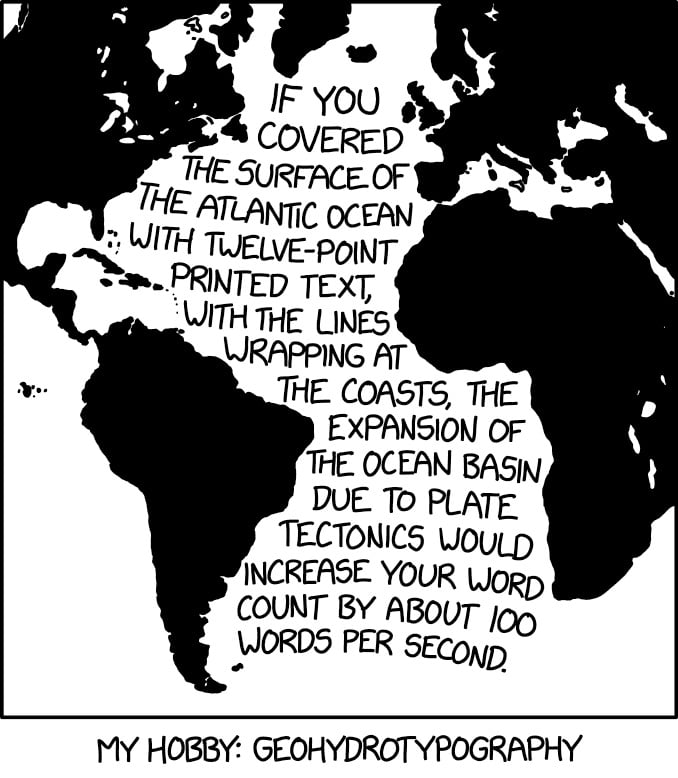
This, from XKCD, hits my science and design interests right in the sweet spot.
If you covered the surface of the Atlantic Ocean with twelve-point printed text, with the lines wrapping at the coasts, the expansion of the ocean basin due to tectonics would increase your word count by about 100 words per second.
This reminds me of Ben Terrett’s calculation of how many helveticas from here to the Moon and my subsequent calculations about the point size of the Earth and the Moon (50.2 billion and 13.7 billion, respectively).
Using the metaphor of a cancerous tumor as an unruly village, Kurzgesagt explains how cancer develops in the human body, how the body fights against it, and how, sometimes, the cancer develops into something unmanageable.
In a sense this tiny tumor is like a rogue town. Imagine a group of rebels in Brooklyn decided that they were no longer part of New York but started a new settlement called Tumor Town, which happens to occupy the same space. The new city wants to grow, so it orders tons of steel beams, cement and drywall. New buildings follow no logic, are badly planned, ugly and dangerously crooked. They are built right in the middle of streets, on top of playgrounds and on existing infrastructure. The old neighborhood is torn down or overbuilt to make room for new stuff. Many of the former residents are trapped in the middle of it and begin to starve. This goes on for a while until the smell of death finally attracts attention. Building inspectors and police show up.

Using imagery from the Mars Reconnaissance Orbiter, the Bruce Murray Laboratory for Planetary Visualization at Caltech has created a 5.7 terapixel mosaic image that covers 99.5% of the surface of Mars. The whole image is available to navigate with a 3D viewer in your browser.
Astronomers believe that there’s a black hole at the center of almost every large galaxy in the universe. Some of those black holes are particularly energetic, chewing up the galaxies in which they reside and releasing massive amounts of energy out into the cosmos. Those black holes and the energy emitted from matter and gas falling towards their centers are what astronomers call quasars.
But if we look closely, we see who is actually in charge. Small as a grain of sand compared to the filaments, the centers of some of these galaxies shine with the power of a trillion stars, blasting out huge jets of matter, completely reshaping the cosmos around them. Quasars, the single most powerful objects in existence, so powerful that they can kill a galaxy.
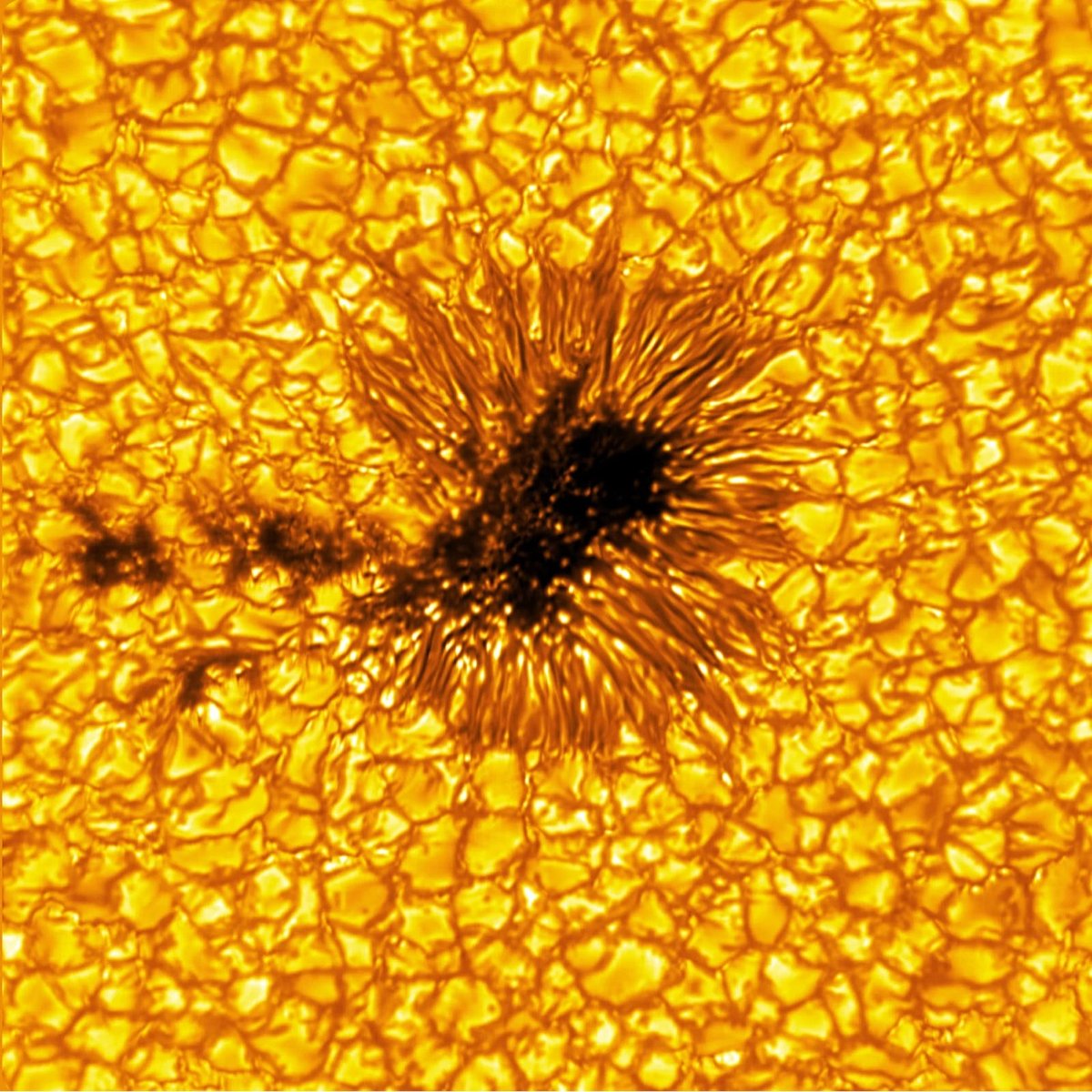
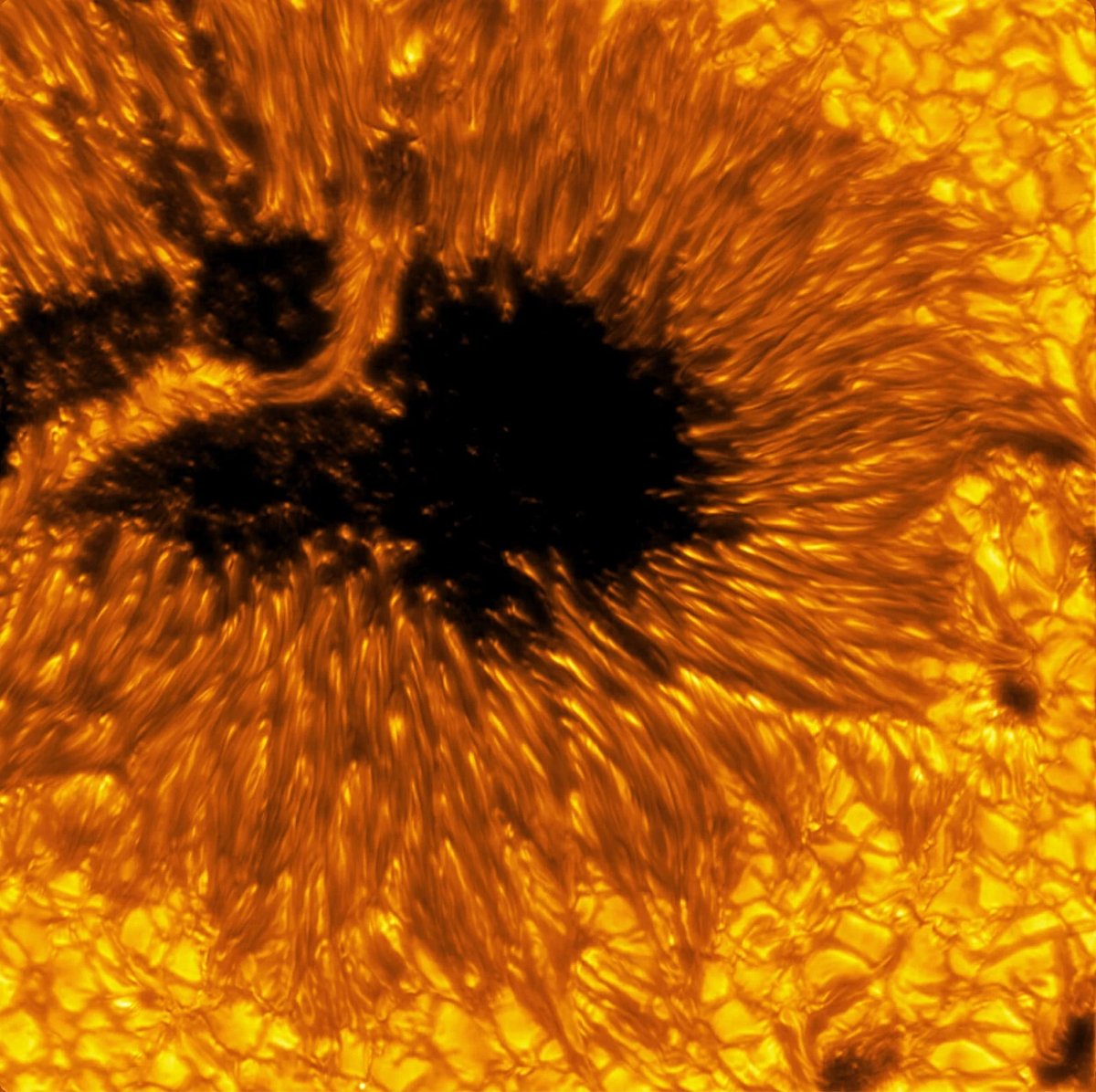
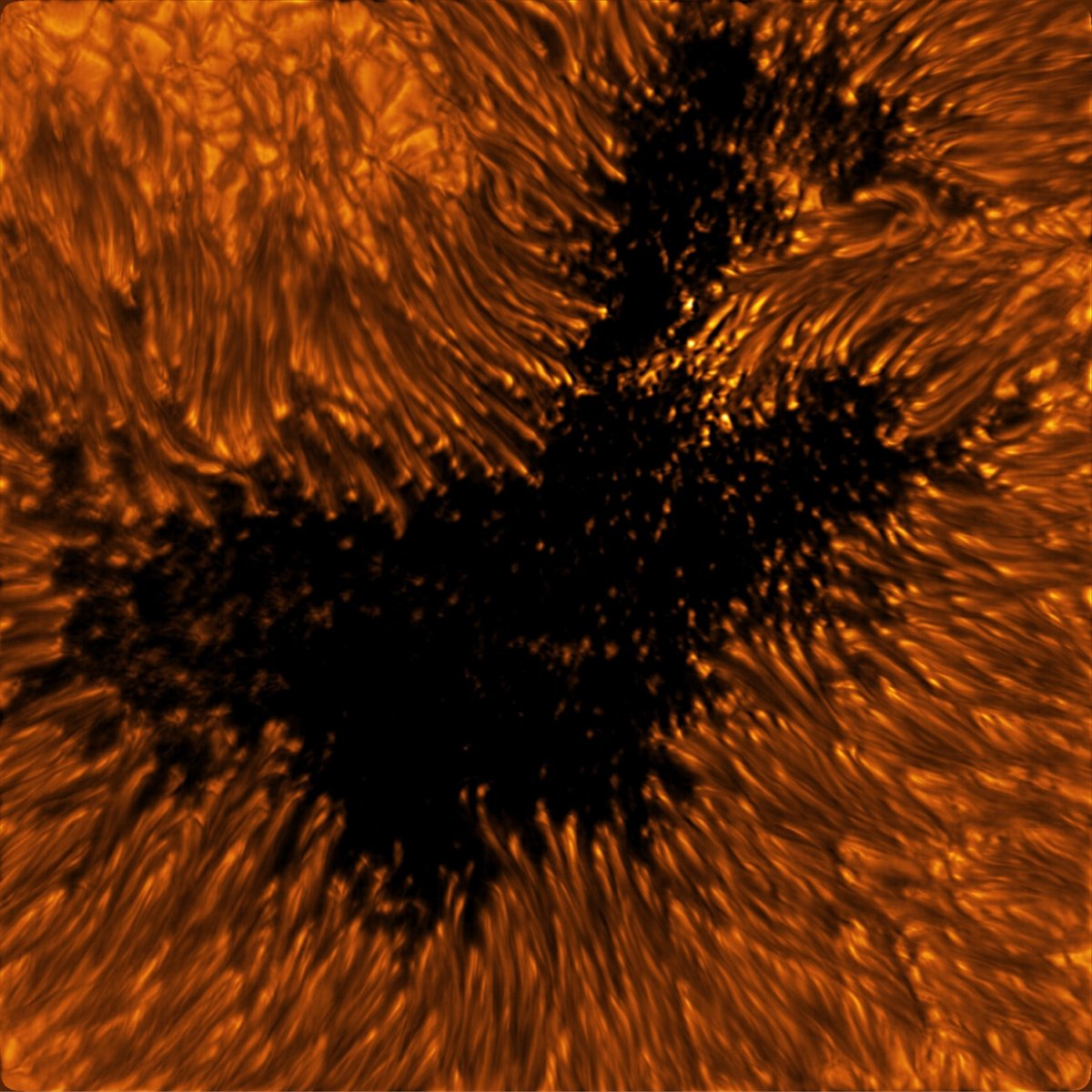
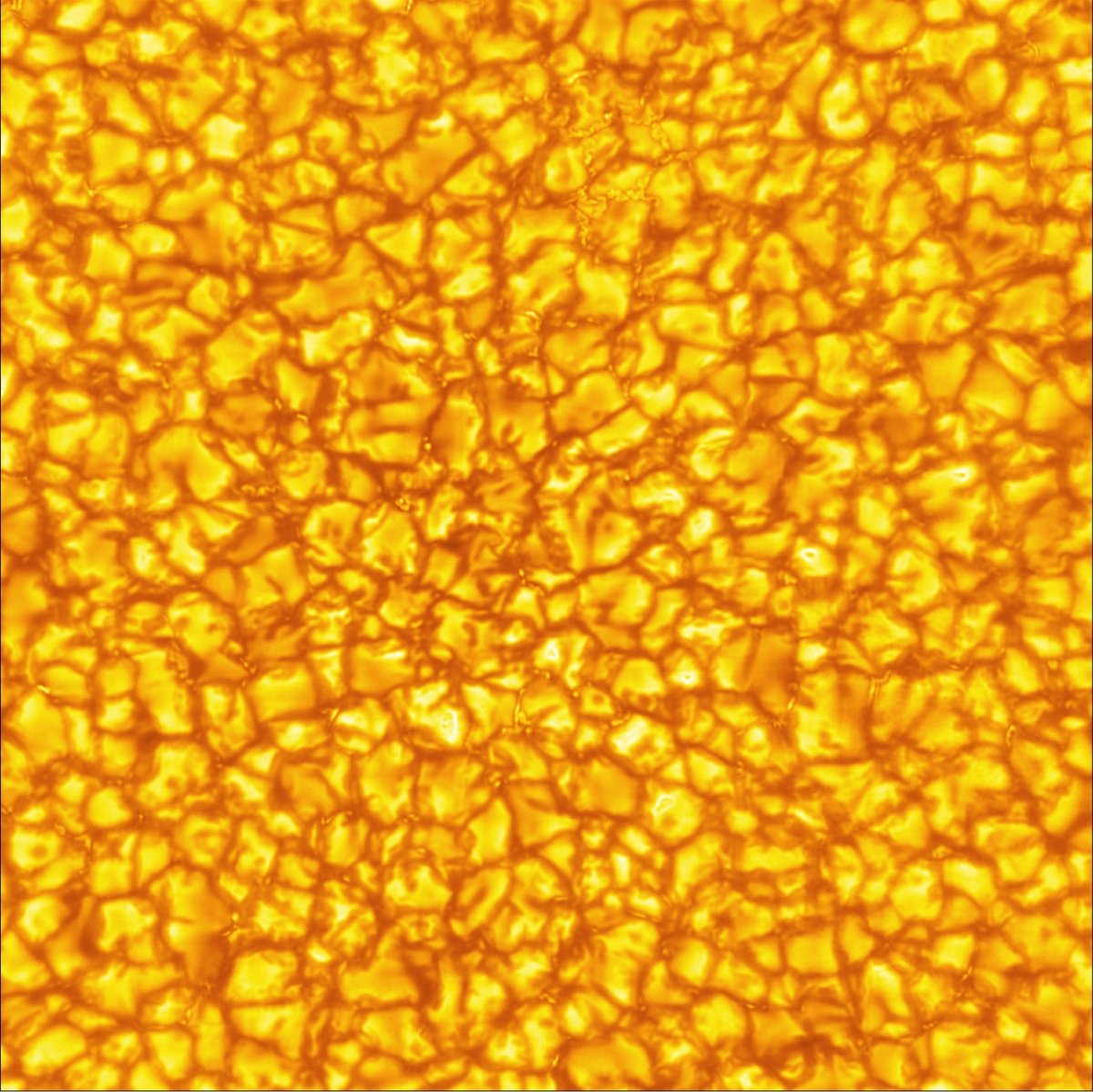
The Inouye Solar Telescope is the largest and most powerful solar telescope in the world. The telescope is still in a “learning and transitioning period” and not up to full operational speed, but scientists at the National Solar Observatory recently released a batch of images that hint at what it’s capable of. Several of the photos feature sunspots, cooler regions of the Sun with strong magnetic fields.
The sunspots pictured are dark and cool regions on the Sun’s “surface”, known as the photosphere, where strong magnetic fields persist. Sunspots vary in size, but many are often the size of Earth, if not larger. Complex sunspots or groups of sunspots can be the source of explosive events like flares and coronal mass ejections that generate solar storms. These energetic and eruptive phenomena influence the outermost atmospheric layer of the Sun, the heliosphere, with the potential to impact Earth and our critical infrastructure.
In the quiet regions of the Sun, the images show convection cells in the photosphere displaying a bright pattern of hot, upward-flowing plasma (granules) surrounded by darker lanes of cooler, down-flowing solar plasma. In the atmospheric layer above the photosphere, called the chromosphere, we see dark, elongated fibrils originating from locations of small-scale magnetic field accumulations.
(via petapixel)
Oh this is so nerdy and great: Veritasium introduces us to Micromouse, a maze-solving competition in which robotic mice compete to see which one is the fastest through a maze. The competitions have been held since the late 70s and today’s mice are marvels of engineering and software, the result of decades of small improvements alongside bigger jumps in performance.
I love stuff like this because the narrow scope (single vehicle, standard maze), easily understood constraints, and timed runs, combined with Veritasium’s excellent presentation, makes it really easy to understand how innovation works. The cars got faster, smaller, and learned to corner better, but those improvements created new challenges which needed other solutions to overcome to bring the times down even more. So cool.
The length of a human life is around 80 years. You might get 100 if you’re lucky. The universe is about 13.7 billion years old. The vast difference between a human lifespan and the age of the universe can be difficult to grasp — even the words we use in attempting to describe it (like “vast”) are comically insufficient.
To help us visualize what a difference of eight orders of magnitude might look like, Wylie Overstreet and Alex Gorosh have created a scale model of time in the Mojave Desert, from the Big Bang to the present day. This is really worth watching and likely to make you think some big think thoughts about your place in the universe and in your life.
This is a followup of the scale model of the solar system they built and a video they made about people seeing the Moon through a telescope for the first time.
See also a behind-the-scenes: How We Built a Scale Model of Time. (via colossal)
Newer posts
Older posts





Socials & More