


Super Mario Bros, the Typewriter Edition

Super Moxio Bros is a version of World 1-1 of the original Super Mario Bros done using typewriter characters. I didn’t check for sure, but there’s a good chance I got this link from waxy.org.

This site is made possible by member support. 💞
Big thanks to Arcustech for hosting the site and offering amazing tech support.
When you buy through links on kottke.org, I may earn an affiliate commission. Thanks for supporting the site!
kottke.org. home of fine hypertext products since 1998.
Beloved by 86.47% of the web.
Super Moxio Bros is a version of World 1-1 of the original Super Mario Bros done using typewriter characters. I didn’t check for sure, but there’s a good chance I got this link from waxy.org.

Using the official instructions and bricks from their own collection, a father & son team built a colorful DIY version of Lego’s massive Millennium Falcon (7541 pieces, $830 MSRP, kitty for scale).
I love this — much better than that dingy gray. I know it’s not quite the same, but the colorful Falcon harkens back to when Lego was more about throwing together whatever kaleidoscopic Franken-creations you could from your pile of bricks instead of completing just-so kits. (via @migurski)
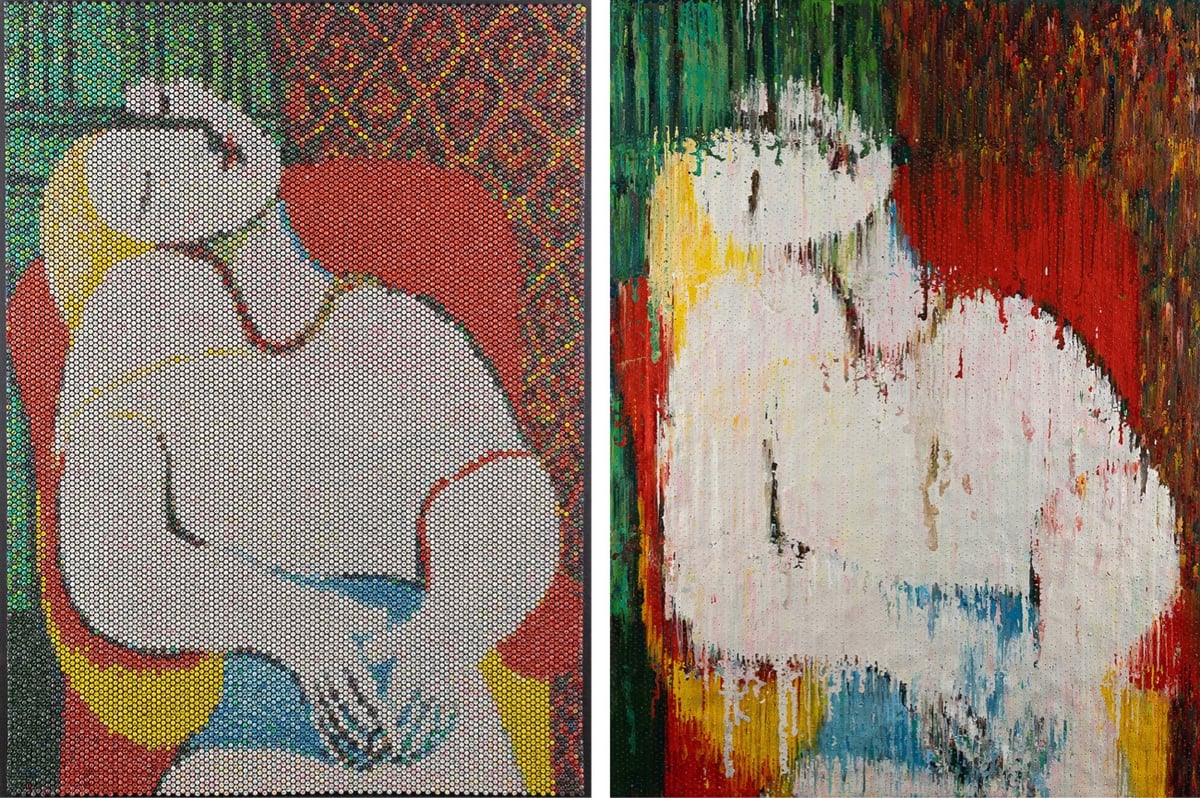
Bradley Hart creates pointillist paintings by painstakingly injecting acrylic paint into the individual bubbles in bubble wrap. The paint leaks out of the bubbles and onto a canvas backing, which also becomes part of the creative output (which he calls the “impression”). Here’s Hart’s version of Picasso’s Le Rêve, bubble wrap and impression:
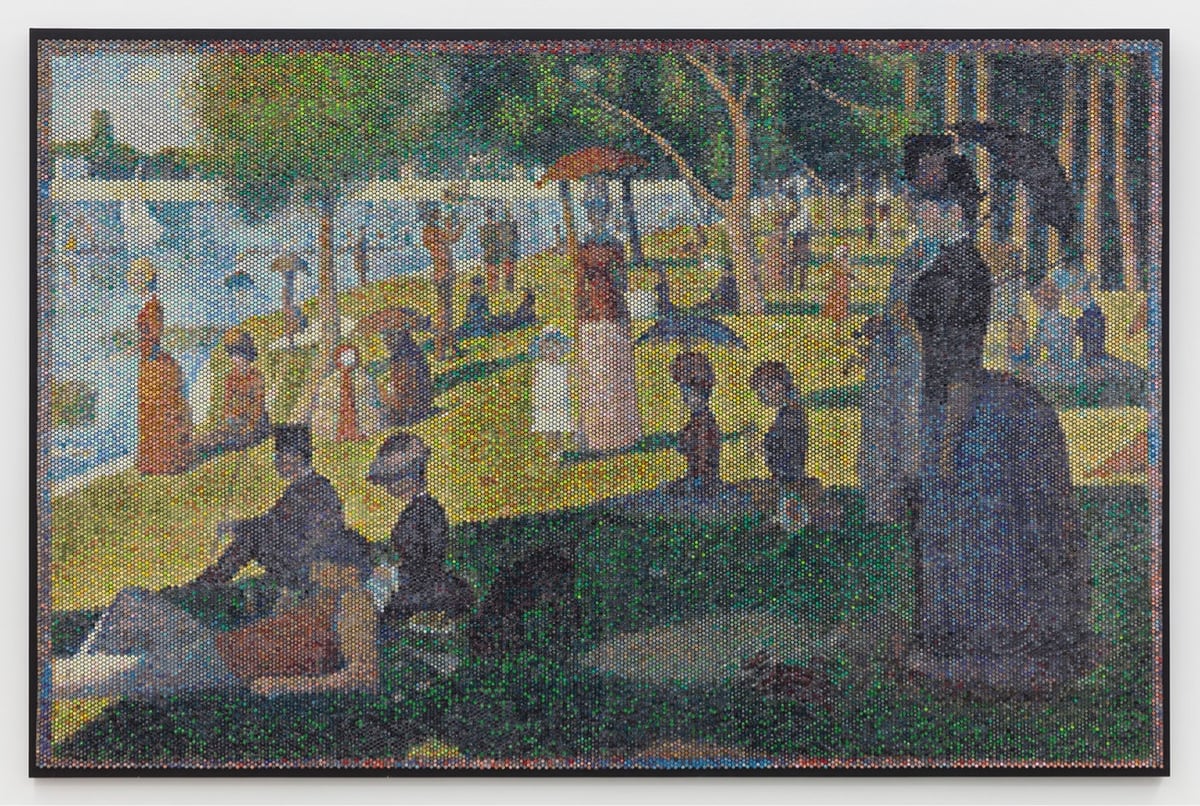
And here’s Georges Seurat’s A Sunday on La Grande Jatte:
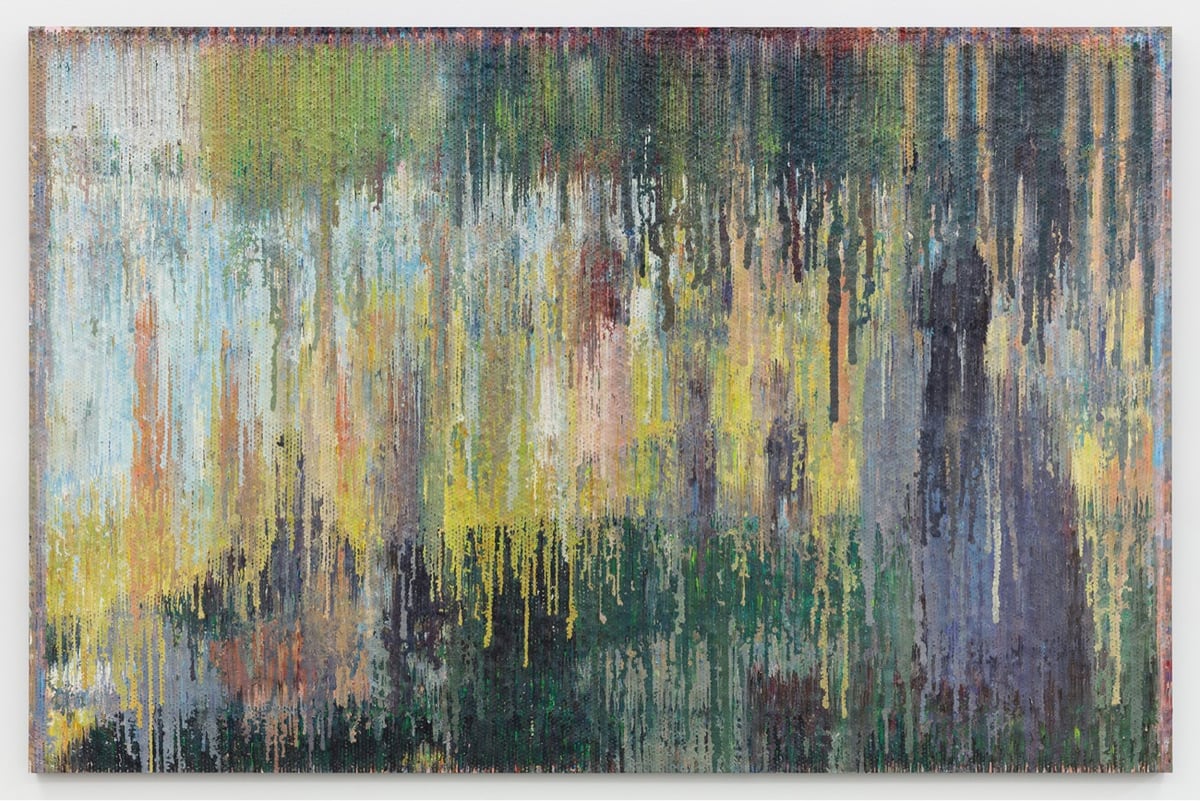
And the impression:
From Hart’s artist’s statement:
The bare bubbles in the bubble wrap reference dots or pixels, echoing various movements in art history and other media, including pointillism, screen-printing, TVs and LCD monitors. In today’s world people do not print their pictures for an album. Their albums are on Facebook, Flickr and Instagram, all exotic rote, yet combinations of 1’s and 0’s. The process of injecting paint into bubble wrap directly references pixilation (and those 1’s and 0’s) and at the same time harkens back to the time of family portrait painting, when a family’s personal “photo” album consisted of paintings hanging on its walls.
It’s such a genius idea to use the backing canvas as a separate artwork — I love that. (via clive thompson)
Ok, this is super freaky: this is a regular analog piano being played by a computer-controlled mechanical machine and it sounds like a person speaking. If you hadn’t seen this before, (it’s from 2009) take a listen:
Deus Cantando is the work of artist Peter Ablinger. He recorded a German school student reciting some text and then composed a tune for the mechanical player to sound like the recitation. I cannot improve upon Jason Noble’s description of the work:
This is not digital manipulation, nor a digitally programmed piano like a Disklavier. This is a normal, acoustic piano, any old piano. The mechanism performing it consists of 88 electronically controlled, mechanical “fingers,” synchronized with superhuman speed and accuracy to replicate the spectral content of a child’s voice. Watching the above-linked video, it may seem that the speech is completely intelligible, but this is partially an illusion. The visual prompt of the words on the screen are an essential cue: take them away, and it becomes much harder to understand the words. But it is still remarkable that the auditory system is able to group discrete notes from a piano into such a close approximation of a continuous human voice, and that Ablinger was able to do this so convincingly using a conventional instrument (albeit, played robotically).
This is so cool, I can’t believe I’d never seen it before. (via @roberthodgin)
This weekend I was doing some programming work (comments, another small project) and listening to some old-school electronica (DJ-Kicks by Kruder & Dorfmeister anyone?). When I write, I tend to listen to chill stuff so I can concentrate — classical, vaporwave, soundtracks, Jon Hopkins, Sigur Rós, Tycho, Boards of Canada, things like that — but when designing or programming, I need something faster with a beat to spur me onwards.
So anyway, I was about to switch from electronica to something by kottke.org favorites The Hood Internet when I thought to check their website to see if they’d released any new mixtapes. And lo — they had (sorta). The Lost Mixtape is a 45-minute mix of music from circa 2005-2009, discovered on some dusty old hard drive and recently finished up & released for our listening pleasure.
The bit at around 16:00 where they mix Milkshake and So Electric is just superb. You can find streaming options and a downloadable MP3 on their website.
This video is more than 10 years old, but I hadn’t seen it before: a version of Bonnie Tyler’s music video for Total Eclipse of the Heart where the lyrics describe what we literally see.
Pan the room
Random use of candles, empty bottles, and cloth,
and can you see me through this fan?Slo-mo dove
Creepy doll, a window, and what looks like a bathrobe.
Then, a dim-lit shot of dangling balls.Metaphooor?
(via aaron)
Pub Choir is an Australia-based organization that gets large crowds singing popular tunes, in three-part harmony no less.
Everybody can sing. Like, not well, but literally. Why should being average at something stop you from doing it!? It hasn’t yet… Singing is good for you, it’s EASY, and Pub Choir is here to show you how.
With a show that is equal parts music, comedy, and beer, Pub Choir is a euphoric sensation that transforms a crowd of tipsy strangers into a legendary choir.
By the end of the show the YOU will be belting out a popular song in three-part harmony.
In the video above, they get a crowd of 1600 people signing Creep by Radiohead. Beautiful.
You can find more of their performances on their YouTube channel, including Tina Turner’s The Best, Africa by Toto, and Free Fallin’ by Tom Petty.
See also Choir! Choir! Choir! and their performances of Sinéad O’Connor’s Nothing Compares 2 U and David Byrne singing David Bowie’s Heroes. (thx, matthew)
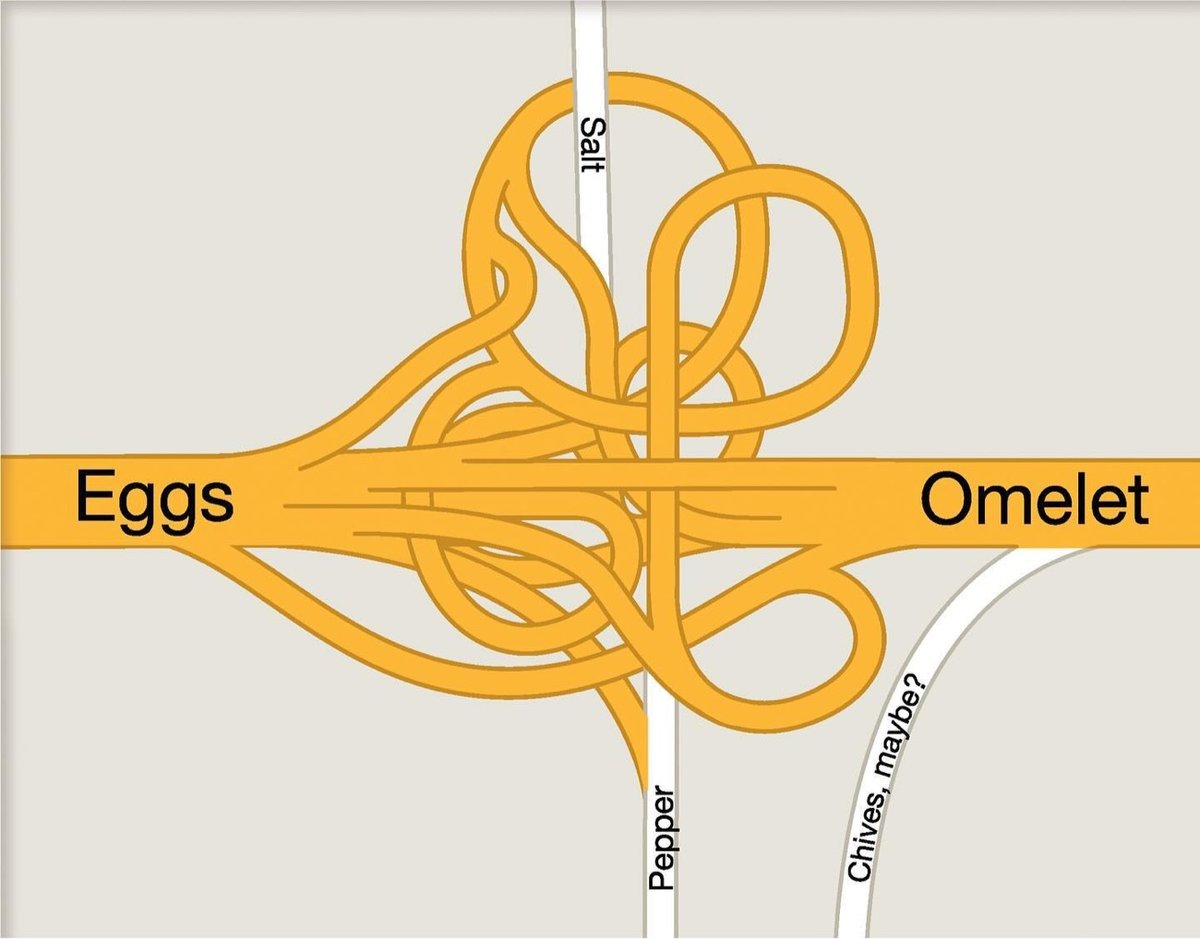
Always a good day to highlight the creative work of designer/illustrator Christoph Niemann: a collection of map-based work, including a cheeky metaphorical recipe for an omelet. That intersection isn’t actually that outlandish: see A Bonkers Highway Interchange and Crazy Whirlpool Traffic Interchange in Dubai.
This is so highbrow that it’s looped back around to being lowbrow: a cover of Smells Like Teen Spirit sung in classical Latin.
Sine lúce, angor minus
Oblectáte, nunc híc sumus
Mé sentió aeger, stultus
Oblectáte, nunc híc sumus
Barbarus, albínus, culex et, mea libídó
Hei! Hae, ha ha ha ha!
See also Bardcore: Medieval-Style Covers of Pop Songs. (via open culture)
This video is 9 years old and has 169 million views so I’m possibly the last person on Earth to see it,1 but I ran across a clip of it on Instagram the other day and just had to share. Steve ‘n’ Seagulls is a country band from Finland that went viral for their covers of classic rock tunes, including AC/DC’s “Thunderstruck”:
I love the way this starts off — and it seems to have become somewhat of a bit in subsequent videos. Open Culture has more in a post from August 2014. Kottke.org: only the freshest viral content for you!
See also AC/DC’s Thunderstruck on the bagpipes, ukelele cover of Thunderstruck, and Thunderstruck accompanied by a washing machine. (Does the internet get any better than this?)
Ok, this video is targeted at a pretty small audience and is super goofy, but it hit me square in the forehead and so I can’t help but post it here: it’s footage from Rowan Atkinson’s Mr. Bean with Bush’s 1994 alternative rock hit Glycerine playing over it. And yes, there is a change of lyrics at a critical point. 100/100, no notes. (via @jamesjm)
OpenAI unveiled their prototype video generator called Sora. It does text-to-video and a ton more. Just check out the videos here and here — I literally cannot believe what I’m seeing.
For reference, this is what AI-generated video looked like a year ago. For more context and analysis, check out Marques Brownlee video about Sora:
(via waxy)
Yeah, you heard me: the 1993 video game Doom, which has been ported to every platform imaginable (an Apple Pippin, a jailbroken John Deere tractor, a Peloton), can now run on a display made of phosphorescent E. coli bacteria.
Ramlan’s paper doesn’t go to the enormous trouble of actually encoding all of Doom to run in bacterial DNA, which the author describes as “a behemoth feat that I cannot even imagine approaching.” Instead, the game runs on a standard computer, with isolated E. coli cells in a standard 32x48 microwell grid serving as a crude low-res display.
After shrinking each game frame down to a 32x48 black-and-white bitmap, Ramlan describes a system whereby a display controller uses a well-known chemical repressor-operator pair to induce each individual cell in the grid to either express a fluorescent protein or not. The resulting grid of glowing bacteria (which is only simulated in Ramlan’s project) can technically be considered a display of Doom gameplay, though the lack of even grayscale shading makes the resulting image pretty indecipherable, to be honest.
Technicalities aside, that’s still pretty cool.
Kyle Branchesi has created some fanciful “urban oddities” that imagine different locales in the UK being fully optimized for cars. For instance, here are Buckingham Palace and Westminster:


Writes Branchesi:
Amidst a political landscape where the ‘war on motorists’ is wielded as a populist tool, this series captures a future where this rhetoric has prevailed. The transformation of UK landmarks like Stonehenge into vast vehicular realms underscores the absurdity and danger of prioritizing short-term political gains over sustainable urban planning. These images mirror the contentious debates in the UK, challenging the narrative that prioritizes car ownership at the expense of public health and environmental sustainability.
Of course, in an America engineered by Robert Moses and his acolytes, many of those images don’t even look that far-fetched.
Ok, if you haven’t seen this before (or even if you have), I need to warn you that Emoji Kitchen is just a little bit addictive. They’re mashup apps for making new emoji like these:

Curiously, the eggplant seems to be missing from both kitchens… 🤔
Update: I switched the Emoji Kitchen link to the proper URL at Google. From Jennifer Daniel:
Sadly, the site you link to about emoji kitchen (.dev) is not mine. This developer has taken my artwork without permission 😐 and worse, hosts a repo so others can steal it too
Here’s more from Daniel about the project.
Socials & More