The Library of Congress has an online photography exhibit called Bound for Glory: America in Color, 1939-1943 (thx, shay). The photos were a little low contrast, so I color corrected a few of them in Photoshop:
My goal was not to blow out the contrast or unnecessarily accentuate colors, but attempt to duplicate what these photos would look like had they been taken with a contemporary camera and processed using contemporary techniques and materials.
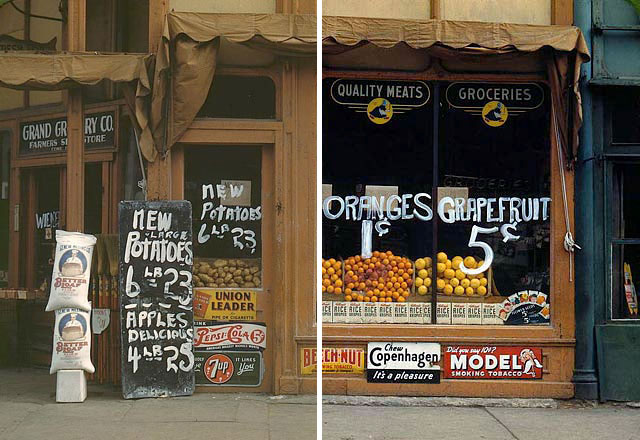
Bound for Glory and Color Corrected »
In 1965, the Washburn A mill, the last operating flour mill in Minneapolis, became also the last flour mill to close its doors, having been preceded by an entire industry that, at one time, produced more flour than any other place in the U.S. The closure came when the mill’s operating company, General Mills, moved its headquarters to Golden Valley, where real estate was plentiful and inexpensive. The area around St. Anthony Falls, the geological feature responsible for the beginnings of industry in the area, had long since fallen into general disrepair and it wasn’t long before the Washburn A was deserted and inhabited by the homeless.
The area started to show signs of life again in the 70s and 80s after being added to the National Register of Historic Places in 1971. Old mill buildings were converted for non-industrial business and residential use as people began to recognize the unique character and history of the area around the falls. In 1991, the Washburn A building burned and part of its structure collapsed, but firefighters saved the rest of the historic building from destruction. The remnants of the building and the adjacent grain elevators remained empty for years afterwards, save for the occasional graffiti artist and urban spelunker.
I knew very little of this when I moved to the Twin Cities in 1996 and not much more when I left Minneapolis for San Francisco in 2000. Almost every weekday for two years I drove or pedaled past the shell of the Washburn A mill on the way to and from work on Washington Avenue in the warehouse district, where we manufactured web pages to fill a growing online space. Topped by the Gold Medal Flour sign, the mill became my favorite building in the Twin Cities, leading me to include it in The Minneapolis Sign Project I did for 0sil8 shortly before I left for the West Coast.
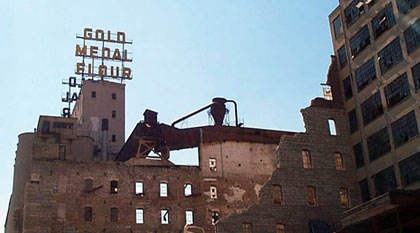
It seemed the perfect symbol of a time and industry long past, broken down but not entirely wiped away. I returned to visit Minneapolis occasionally and would drive past the Falls, wondering what would happen to my building, hoping against hope that they wouldn’t eventually tear it down. With the structure in such bad shape, demolition seemed to be the only option.
Last week, Meg and I spent a day in Minneapolis on our way to visit my parents in Wisconsin, my first stay in Mpls since mid-2002. Meg wanted to investigate running trails and I wanted to sneak a peek at the Gold Medal Flour Building (as I had taken to calling it), so we walked the three blocks to the river from our hotel, housed in the former Milwaukee Depot. The Gold Medal Flour sign was visible from several blocks away, so I knew they hadn’t torn down the grain elevators, but it wasn’t until I saw the shell of the Washburn A building peeking out around one of the other mill buildings that I knew it had been spared as well. As more of the building came into view, I saw a glass elevator rising from the ruins, backed by a glass facade.
What the??!?
Now practically running along the river in excitement and bewilderment, dragging poor Meg along with me in a preview of her jog the next morning, I saw a wooden boardwalk in front of the building and headed for what looked like the entrance. The burned out windows and broken glass remained; except for the elevator and the 8-story glass building sticking out the top, it looked much the same as it had after burning in 1991. I scrambled through the entrance and, lo, the Mill City Museum.
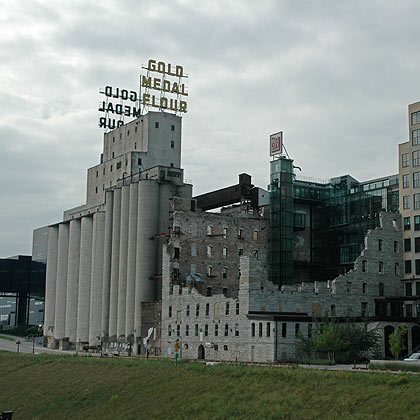
And what a museum. It was just closing when we got there, but we returned the next morning for a full tour of the museum and the Mill Ruins Park. The highlight of the museum is an elevator tour of the mill as it was back in the early 20th century. They load 30 people at a time into a giant freight elevator, which takes the group up to the 8th floor of the museum, stopping at floors along the way to view and hear scenes from the mills workings, narrated by former mill workers. After the elevator tour, you’re directed to an outdoor deck on the 9th floor, where you can view the shell of the mill building, St. Anthony Falls, the Stone Arch Bridge, the Gold Medal Flour sign, and the rest of the historic area.
Meyer, Scherer & Rockcastle are the architects responsible for the project, and they deserve all the accolades they get from one of the most unique museums I’ve ever been to. The statement from the American Institute of Architects jury explains the design of the museum:
A creative adaptive reuse of an extant shell of a mill building, with contrasting insertion of contemporary materials, weaving the old and the new into a seamless whole…A complex and intriguing social and regional story that reveals itself as the visitor progresses through the spaces. It is museum as a verb…A gutsy, crystalline, glowing courtyard for a reemerging waterfront district that attracts young and old and has stimulated adjacent development.
I still can’t quite believe they turned my favorite Minneapolis building (of all buildings) into a museum….and that it was done so well. More than anything, I’m happy and relieved that the Gold Medal Flour Building will always be there when I go back to visit. If you’re ever in Minneapolis, do yourself a favor and check it out.
Photos on Flickr tagged “mill city”
Photos on Flickr tagged “mill city museum”
Mill City: A Visual History of the Minneapolis Mill District was helpful in writing this post
A Washington Post review of the museum from September 2005
The new Guthrie Theater is right next door and is a dazzling building in its own right (photo, more photos)
I picked up a Kodak Duaflex II camera at an antique store this weekend. I’m going to use to it do some through the viewfinder shots with the D70. The idea is that you take a photo of the Duaflex viewfinder with the SLR camera, thereby picking up all the spots, scratches, and curves of the old lens. A lens hood is required to block unwanted light reflections. Here’s a tutorial describing the process. Of course, it was after I bought the Duaflex that I discovered the need for a different lens on the SLR to make it work properly. We’ll see if the 50 mm lens at home works. Some results soon. Hopefully.
This image of the participants of a 1927 conference on quantum mechanics sets the record for the most brainpower in one photograph. Schrodinger, Pauli, Heisenberg, Dirac, Compton, Bohr, Einstein, Planck, Curie, de Broglie, and Lorenz, all in one place.
Update: A Great Day in Harlem depicts several of the world’s top jazz musicians. More here. (thx, jim & greg)
There’s a bit of a shout-out to citizen journalism in Superman Returns. Mid-movie, Daily Planet Editor in Chief White, Lois Lane, and Jimmy Olsen look at some photos of Superman spread across the chief’s desk. They’re great, iconic photos of the Man of Steel in action. White berates Olsen (and I’m paraphrasing here), “these are great and they were taken by a kid with a cameraphone. Whadda you got, Olsen?” Olsen throws his photos down on the desk; the one on top depicts a distant blurry streak across a blue sky.
“Look, in the sky, Chief.”
“It’s a bird.”
“It’s a plane.”
“No, look, it’s…”
Score one for the man on the scene.
Great photo of the surf in Puerto Escondido, Mexico. (Reminds me of the work of another photographer, very large prints of waves taken head on, the ocean very dark and the crashing waves a bright, vibrant white. Beautiful stuff. Can anyone help me out?)
Update: The photographer I was thinking of is Clifford Ross. He uses a camera that he built himself to take 2.6 gigabyte images. His Mountain IV is currently on display at MoMA. (thx, david, barbara, and john)






Socials & More