kottke.org posts about photography
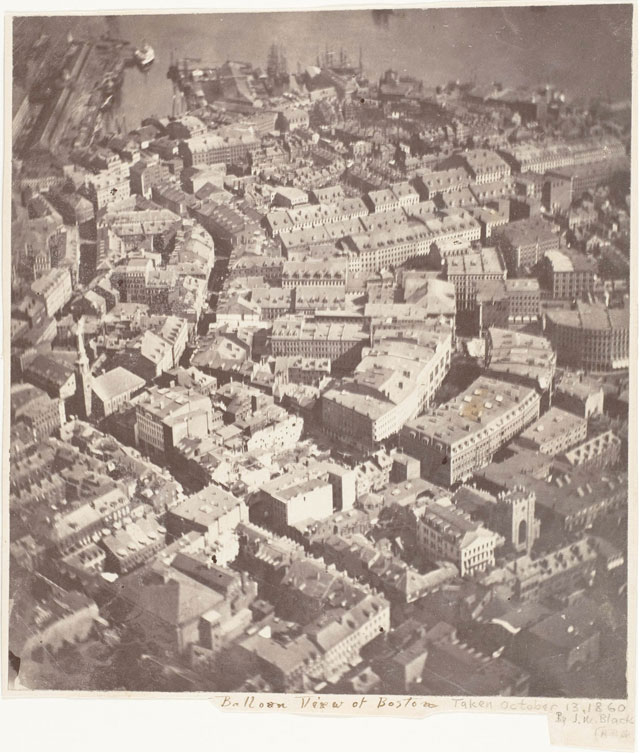
While French balloonist Gaspard-Félix Tournachon first photographed Paris by air in 1858, those photos were lost, and this photograph of Boston from 1860 by James Wallace Black is the earliest known aerial photo. The title is ‘Boston, as the Eagle and the Wild Goose See It.’ If I had to guess where in Boston this is, I’d say somewhere along Atlantic Ave.
Update: Several people have identified the steepled building at center left as the Old South Meeting House, which Wikipedia confirms: “Depicts area resembling Old South Meeting House; Milk Street; India Wharf, Central Wharf; and vicinity.” Looks a bit different these days.
But more importantly, a photo of Providence, RI taken by Black in August of 1860 predates his Boston photograph by two months. The print, which is part of the MoMA’s collection, is badly damaged but it looks like some detail would be discernable in person.
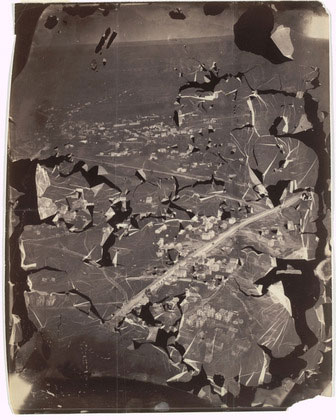
So for some sufficiently flexible definition of “surviving”, Black’s photo of Providence is the oldest surviving aerial photo. (thx, david)
Zoe Spawton often photographs a particularly well-dressed man who passes her cafe in Berlin each day. She’s documenting the results at What Ali Wore.

Wonderful. Ali used to be a doctor but is now working as a tailor.
Israeli artist Ronit Bigal does intricate calligraphy on the human body and photographs the results.

Update: I read the page wrong…the calligraphy is printed on the photographs to follow the contour of the skin, not on the skin itself. Still cool. (thx, @lorp)
Paris even does rainbows better than the rest of the world. This is a photo of a horizon rainbow taken over the Parisian skyline last week by Bertrand Kulik.

What the heck is going on there? Astronomy Picture of the Day explains:
Why is this horizon so colorful? Because, opposite the Sun, it is raining. What is pictured above is actually just a common rainbow. It’s uncommon appearance is caused by the Sun being unusually high in the sky during the rainbow’s creation. Since every rainbow’s center must be exactly opposite the Sun, a high Sun reflecting off of a distant rain will produce a low rainbow where only the very top is visible — because the rest of the rainbow is below the horizon.
(via @DavidGrann)
Technically this photo was taken several years (probably in 1986 or 1987) before Radiohead officially came to be, but it features four out of the five members, back when the group was called On a Friday.

From left to right, Thom Yorke, Phil Selway, Ed O’Brien, and Colin Greenwood. This occasion marked one of the last times that Yorke smiled for a photo. (via buzzfeed)

Maybe the most depressing part of this three part series of photographs of Iraq from the past ten years is not the photos of all the horrible things people are capable of doing to each other, not the [God, I can’t even think of the right set of rage-adjectives here] faces of Bush, Cheney, and Rumsfeld, but the fact that there is a part two to this series that starts in 2003, just after the fucking asinine MISSION ACCOMPLISHED banner.
But maybe it was all worth it? To see these happy faces riding an amusement ride? Or these young people able to express themselves? Was it the right thing done the wrong way for the wrong reasons? I dunno. I just don’t know.
Gabriele Galimberti takes photos of kids with their most prized possessions.
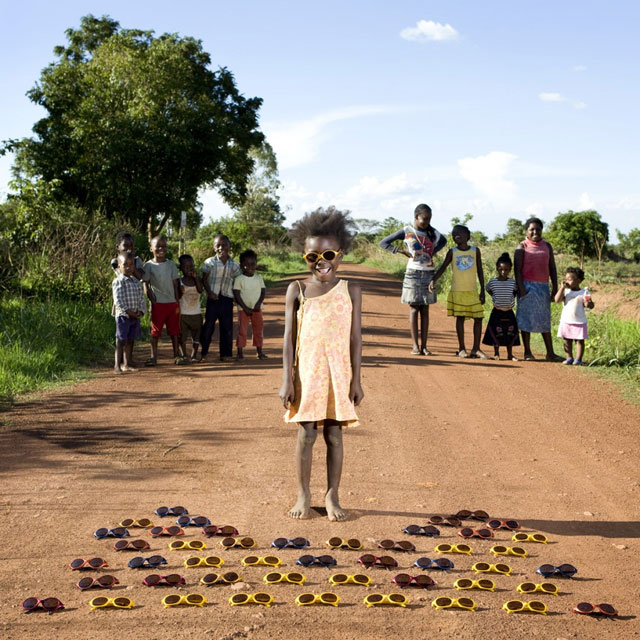
But how they play can reveal a lot. “The richest children were more possessive. At the beginning, they wouldn’t want me to touch their toys, and I would need more time before they would let me play with them,” says the Italian, who would often join in with a child’s games before arranging the toys and taking the photograph. “In poor countries, it was much easier. Even if they only had two or three toys, they didn’t really care. In Africa, the kids would mostly play with their friends outside.”
This reminds me of Peter Menzel’s photos of what families from different parts of the world eat in a typical week. (via df)
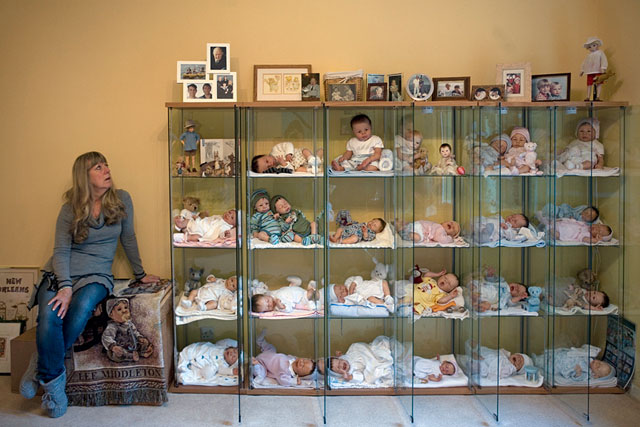
Photographer Rebecca Martinez photographs reborn dolls and the people who collect/care for them.
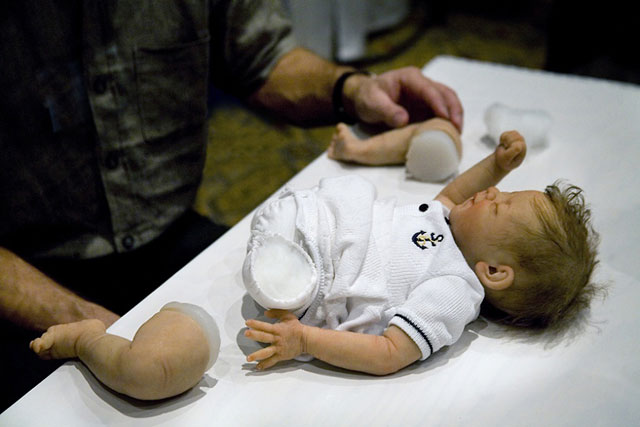
Babies create strong emotions for the bearer, holder, and observer. I have discovered this holds true even when it is known the baby is not real.
I am photographing dolls that are created to look and feel like living babies. They are constructed and weighted to feel like infants, which includes a head that must be supported while in one’s arms. They are the most powerful objects I have ever worked with, I am struck by the strong and palpable emotional reactions they produce. They provoke the dominant biological instinct to nurture and the entire spectrum of human behavior.
Some of the collectors care for their reborn dolls as if they were their own children:
Many of the women involved have an especially strong passion for the stage of mothering babies and this is a method to keep this stage permanently in their lives. There is a wide range of personal stories and motivations for being involved in this community. Some create or collect these dolls because they cannot continue to give birth to living babies, or have lost a child, or cannot have one of their own. Some women admire the art form and are doll collectors, others create nurseries in their homes and integrate the babies as part of their families and lives.
Sometimes literally:
Sometimes, women who have lost a newborn have commissioned artists to make a reborn doll that looks exactly like their deceased baby. Modeled after photographs of the real infant, these dolls are called portrait babies.
Mark Tipple takes underwater photos of people swimming under crashing waves, which happens to be my favorite genre of surfing photography.

Prints are available. (via @DavidGrann)
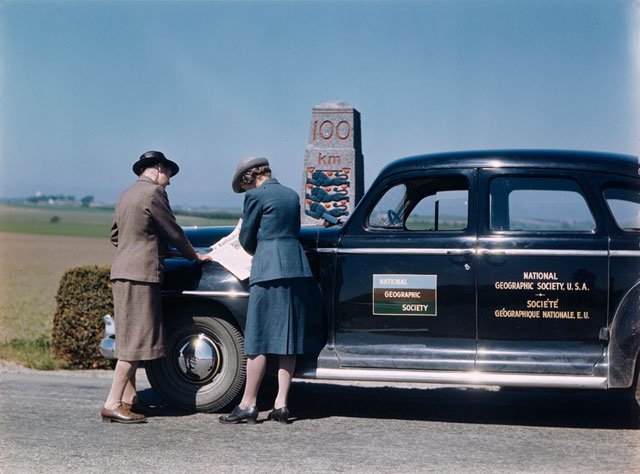
National Geographic has launched a new Tumblr site that features the less-celebrated-but-still-awesome parts of its vast photographic archive. I want this car:
(via the verge)
NYC Past has hundreds of large format historical photos of New York City. Like this one:

I’m not through all 49 pages yet, but I am getting pretty close.
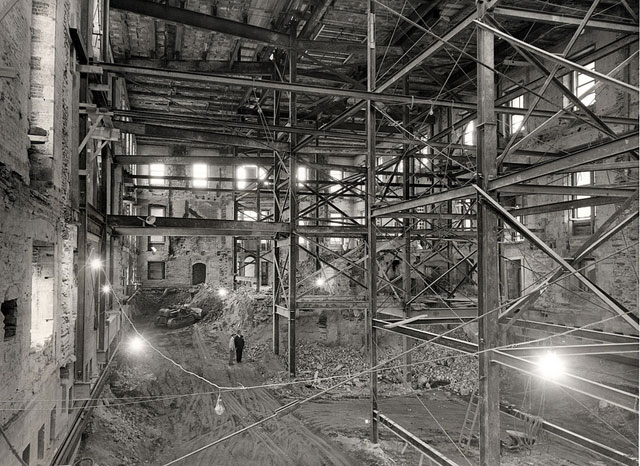
If this photo series from 1950 of the interior of the White House being ripped out so that the building could be structurally reinforced isn’t an apt metaphor for the current state of American politics, I don’t know what is.
Experts called the third floor of the White House “an outstanding example of a firetrap.” The result of a federally commissioned report found the mansion’s plumbing “makeshift and unsanitary,” while “the structural deterioration [was] in ‘appalling degree,’ and threatening complete collapse.” The congressional commission on the matter was considering the option of abandoning the structure altogether in favor of a built-from-scratch mansion, but President Truman lobbied for the restoration.
“It perhaps would be more economical from a purely financial standpoint to raze the building and to rebuild completely,” he testified to Congress in February 1949. “In doing so, however, there would be destroyed a building of tremendous historical significance in the growth of the nation.”
So it had to be gutted. Completely. Every piece of the interior, including the walls, had to be removed and put in storage. The outside of the structure-reinforced by new concrete columns-was all that remained.
(via digg)
After working at it for three years, Octavio Aburto finally got his shot:
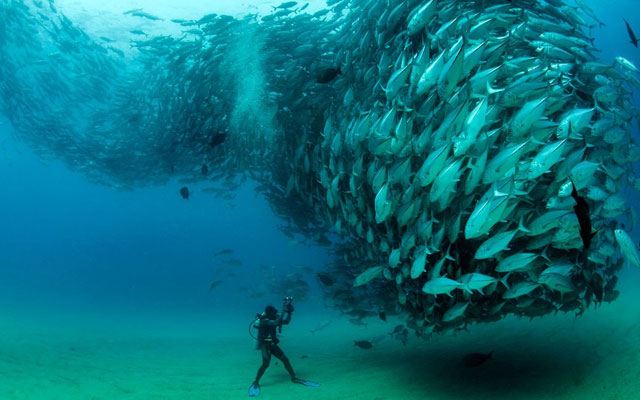
Beautiful. And holy crap, did you know that rays could fly?
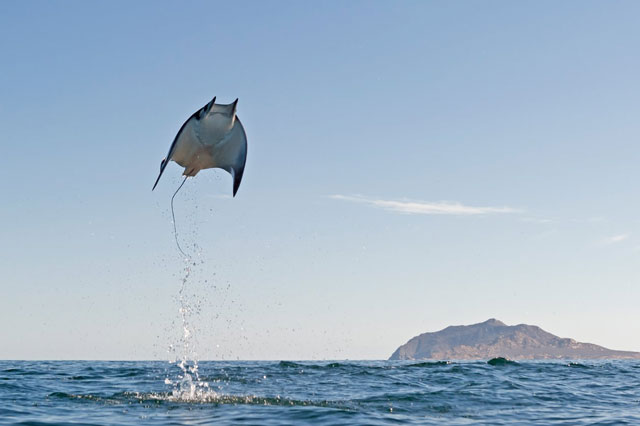
That sucker must be 10 feet out of the water! (via the telegraph)
Chris Buck takes pictures of celebrities after giving them 30 seconds to hide. Here’s Cindy Sherman:
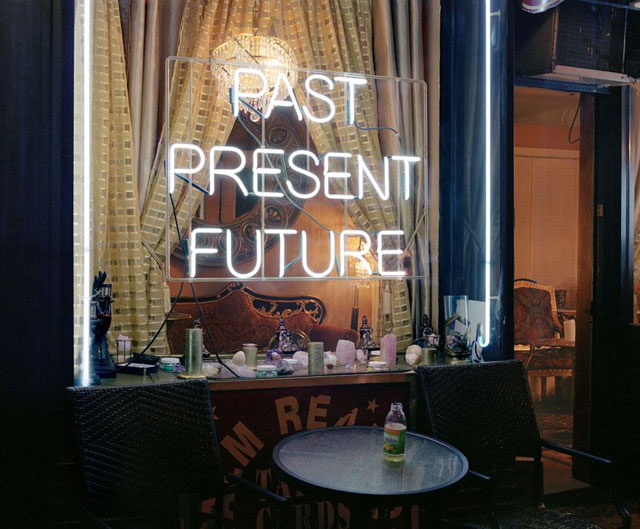
Buck’s photos are on display in NYC for a couple more days at Foley but are also available in book form. (via digg)
I love these 50th anniversary yearly round-ups that Alan Taylor is doing over at In Focus. This year marks the 50th anniversary of 1963:
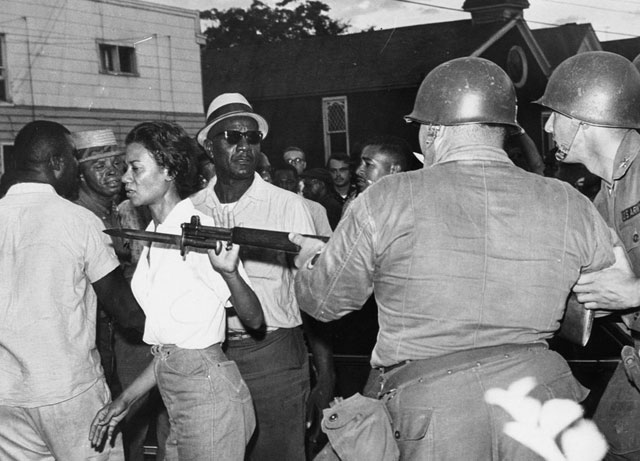
Previously: 1962 and 1961.
Newer posts
Older posts





Socials & More