



Chaos without energy
The opening title sequence for Tarsem Singh’s The Fall.
It is hard to define…I wanted chaos without energy.
Takes a bit to get going but is lovely throughout. (via capn design)

This site is made possible by member support. 💞
Big thanks to Arcustech for hosting the site and offering amazing tech support.
When you buy through links on kottke.org, I may earn an affiliate commission. Thanks for supporting the site!
kottke.org. home of fine hypertext products since 1998.
Beloved by 86.47% of the web.
The opening title sequence for Tarsem Singh’s The Fall.
It is hard to define…I wanted chaos without energy.
Takes a bit to get going but is lovely throughout. (via capn design)
A trio of movie-related links: Criticwatch runs down the movie critic whores of the year, DVD Beaver picks the Blu-rays of the year, and the best movies that you perhaps didn’t see in 2008.
A wide-ranging and carefully considered list of the top 50 special effects shots in movies. The Matrix bullet-time effect doesn’t make this list because:
An effect extraordinarily limited in what can usefully be done with it, it has nonetheless been flogged to death in the 10 years since The Matrix.
The Burly Brawl from the second Matrix movie thankfully didn’t make the list either, likely because the whole thing looks like a cartoonish video game (and not in a good way). The only quibble I can think of: maybe Titanic should have been on there somewhere? (via fimoculous)
Update: Titanic actually made the worst effects list. (thx, rob)
The trailer for Objectified, a new documentary film about industrial design by Gary Hustwit, who also made Helvetica.
The Onion AV Club has an interview with Darren Aronofsky about his new film, The Wrestler.
The more we thought about it, the more we realized the connections between the stripper and the wrestler were really significant. They both have fake stage names, they both put on costumes, they both charm an audience and create a fantasy for the audience, and they both use their body as their art, so time is their biggest enemy.
Toddler or not, I’m getting out of the damn house to see this movie.
From a 1977 film called Gizmo, some urban tumbling from the 1930s that strongly resembles the contemporary sport of parkour.
The full film is available on Google Video. (via waxy)
After posting the video of the chickens from the Muppets clucking their way through the Blue Danube waltz, I couldn’t resist putting it together with the most iconic use of that tune in contemporary culture. Here, then, is Stanley Kubrick’s 2001: A Space Odyssey, the Chicken Cordon Bleu Danube cut.
The HD trailer for Wolverine (or, more formally, X-Men Origins: Wolverine). Looks mighty sweet. (via airbag)
Film Addict takes the top 250 films on IMDB and quizzes you on how many you’ve seen. My score is 53.6% (I’ve hardly seen anything made before 1970). Compare your score. (thx, mathowie)
Update: Since posting this, I’ve been urged to watch Rope; The Good, The Bad, and The Ugly; M; The Third Man; Lawrence of Arabia; The Lives of Others; Roman Holiday; and Planet of the Apes. (thx, everyone)
Just Like the Movies is a short film by Michal Kosakowski that samples footage from movies that were made prior to September 2001 to recreate the events of 9/11. More info.
“It’s just like the movies!” was usually the first reaction of those watching the events of 9/11 in New York unfolding on their TV screens, no doubt recalling the endless number of catastrophes that Hollywood has proposed over the years. Now confronted with the reality of one such scenario — of unprecedented destructive and symbolic resonance — a feeling of deja vu arises while looking at these images.
Really well done. (thx, christopher)
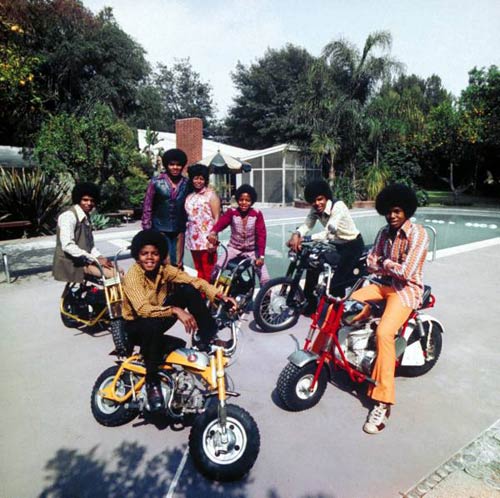

Top: The Jackson 5, Encino, CA, 1970. Photographed by John Olson for Life Magazine.
Bottom: “Bad Route” by Miguel Calderon, 1998. Featured in Wes Anderson’s The Royal Tenenbaums.
On the occasion of the upcoming Criterion release of Bottle Rocket on Blu-ray, the AV Club interviewed Wes Anderson. I love this bit about working with Gene Hackman.
But Gene, I don’t think loves being directed in the first place, and I had a lot of particular ideas for the way some things were to be done. He just wasn’t getting a huge kick out of it — but I don’t know that he ever does. The main thing is that everything he was doing was great. Even though he can be belligerent, there’s a lot of emotion there. I was always excited to be working with him, even when I was a little scared of him, just because this character that I’d spent so much time working on and was so invested in was being brought to life — not only in all the ways that I’d wanted, but something quite beyond.
An appreciation of Jim Carrey from an unlikely source, The Atlantic.
Jim Carrey will loom large in our shattered posterity, I believe, because his filmography amounts to a uniquely sustained engagement with the problem of the self. Who knows how the self became such a problem, or when we began to feel the falseness in our nature?
Count me among the Carrey fans; I wish all his movies were of Cable Guy / Eternal Sunshine / Truman Show quality.
Man in Space was a short film made by Disney about the possibility of putting humans into space. The film was first shown in 1955 and features several prominent scientists of the day, including Wernher von Braun. The film is available for viewing on YouTube in eight parts.
Prehistory of Rocketry (1/8)
Early Rockets (2/8)
How Rockets Work (3/8)
Space Medicine - Adapting to Space (4/8)
Space Medicine - Dangers in Space (5/8)
Werner von Braun - Designing a Rocket (6/8)
Conquest of Space - Launch! (7/8)
Conquest of Space - In Orbit (8/8)
Watch as they gloss over the use of rockets to bomb Europe during WWII and caution against smoking in space. Man in Space was followed by two other Disney short films, Man and the Moon and Mars and Beyond. Particularly entertaining is von Braun explaining his complicated plan to send a manned spaceship to the moon and back, which involves a permanent orbiting space station — which looks not unlike a giant bicycle wheel — with a crew of fifty and powered by a nuclear reactor.
The trailer for Carts of Darkness, a documentary film about Vancouver bottle collectors that have taken to racing shopping carts downhill. More excerpts are available on YouTube.
Lawyers representing Roman Polanski have asked a California judge to dismiss the statutory rape case against him because of evidence presented in Roman Polanski: Wanted and Desired, a documentary about the case, that the judge in the original case engaged in unethical and unlawful behavior.
Tuesday’s filing said Judge Rittenband, who is now dead, intentionally violated a plea agreement with Mr. Polanski after having engaged in what it called “repeated unethical and unlawful ex parte communications” with a deputy district attorney who was not involved in the prosecution, but was independently advising the judge.
On Stanley Kubrick, George Lucas, Robert Morris, Robert Smithson, Jane Jacobs, 2001, Star Wars, and minimalism: Star Wars: A New Heap.
Kubrick’s film presented a future of company men moving with assurance and clear intention toward a godlike minimalist object. Lucas, on the other hand, gave us a slapdash world of knuckleheads pursued by industrial-scale minimalists. Visually, Kubrick’s film is as seamless and smooth as the modernist authority it mirrored. Like the mid-century modernists, 2001 associated abstraction with the progressive ideals of the United Nations as embodied by its New York headquarters. Lucas, on the other hand, was a nonbeliever. Even the initially smooth and unitary form of the Death Star was shown, as the rebel fighters skimmed its surface, to be deeply fissured with an ever-diminishing body of structural fragments. These crenulated details suggested a depth and complexity to modern life that modernism’s pure geometries often obscured.
And this:
A flying saucer had never been a slum before. The immaculate silver sheen of the saucer was reinvented as a dingy Dumpster full of boiler parts, dirty dishes, and decomposing upholstery. Lucas’s visual program not only captured the stark utopian logic that girded modern urban planning, it surpassed it. The Millennium Falcon resisted the modernist demand for purity and separation, pushing into the eclecticism of the minimalist expanded field. Its tangled bastard asymmetry made it a truer dream ship than any of its purebred predecessors. It is the first flying saucer imagined as architecture without architects.
(thx, matt)
Ben Tesch proposes the following personality test:
What I find most interesting is which movie people consider the best movie from a particular director, as it is usually very telling and polarizing in a different way, so to this point I will propose a new personality test where you reblog your favorite movie from each of these directors:
1. Joel Coen: No Country for Old Men, The Big Lebowski, Fargo, The Hudsucker Proxy, Miller’s Crossing, Raising Arizona, etc
2. Wes Anderson: The Darjeeling Limited, The Life Aquatic with Steve Zissou, The Royal Tennenbaums, Rushmore, Bottle Rocket, etc
3. Hal Ashby: Being There, Shampoo, Harold and Maude, etc
4. Kevin Smith: Zack and Miri Make a Porno, Dogma, Chasing Amy, Mallrats, Clerks, etc
5. Quentin Tarantino: Grindhouse, Kill Bill, Pulp Fiction, Reservoir Dogs, etc
I would also personally throw in:
6. Stanley Kubrick: 2001, The Shining, A Clockwork Orange, Full Metal Jacket, Dr. Strangelove, Lolita, etc.
7. P.T. Anderson: Boogie Nights, Hard Eight, There Will Be Blood, Punch-Drunk Love, Magnolia.
8. Errol Morris: The Thin Blue Line, The Fog of War, Mr. Death, Fast, Cheap and Out of Control, Gates of Heaven, etc.
I’m a FRHMPDBF (Fargo, Rushmore, Harold and Maude, Mallrats, Pulp Fiction, Dr. Strangelove, Boogie Nights, and The Fog of War). Notes: I’ve only seen one Hal Ashby movie. I very easily could have gone with The Thin Blue Line, Magnolia, and perhaps even Kill Bill. I would choose anything else on the list over any of Kevin Smith’s movies. Most of my picks I’d seen for the first time around the same time period, approx. 1995-1998. And what a sausage fest…I’ll add Coppola’s Lost in Translation to the mix. (via sandwich, who intriguingly chose Darjeeling over Rushmore, Tenenbaums, Zissou, and Bottle Rocket. I wonder what personality defect that indicates?)
The Fine Brothers spoil 100 movies in less than 4 minutes. See also the spoilers t-shirt and an extensive text list of spoilers.
The Criterion Collection just launched their new web site, complete with the option to watch several movies online. It’s $5 for a week rental and that’s applied toward the cost of the film on DVD or Blu-ray. Not sure about the quality…the excellent intro movie on the home page says “high quality”…not sure if that means HD or what. There are only 17 movies online — including Au Revoir Les Enfants, Solaris, and Lord of the Flies — but they’ll be adding more as time goes on. (thx, jason, who did the illustration for the intro clip)
Clive Thompson writes up the Netflix Prize — which offers $1 million to the first team to improve upon Netflix’s default recommendation algorithm by 10% — and the vexing Napoleon Dynamite problem that is thwarting all comers.
Bertoni says it’s partly because of “Napoleon Dynamite,” an indie comedy from 2004 that achieved cult status and went on to become extremely popular on Netflix. It is, Bertoni and others have discovered, maddeningly hard to determine how much people will like it. When Bertoni runs his algorithms on regular hits like “Lethal Weapon” or “Miss Congeniality” and tries to predict how any given Netflix user will rate them, he’s usually within eight-tenths of a star. But with films like “Napoleon Dynamite,” he’s off by an average of 1.2 stars.
The reason, Bertoni says, is that “Napoleon Dynamite” is very weird and very polarizing. It contains a lot of arch, ironic humor, including a famously kooky dance performed by the titular teenage character to help his hapless friend win a student-council election. It’s the type of quirky entertainment that tends to be either loved or despised. The movie has been rated more than two million times in the Netflix database, and the ratings are disproportionately one or five stars.
This behavior was flagged as an issue by denizens of the Netflix Prize message board soon after the contest was announced two years ago.
Those are the movies you either loved loved loved or hated hated hated. These are the movies you can argue with your friends about. And good old ‘Miss Congeniality’ is right up there in the #4 spot. Also not surprising to see up here are: ‘Napoleon Dynamite’ (I hated it), ‘Fahrenheit 9/11’ (I loved it), and ‘The Passion of the Christ’ (didn’t see it, but odds are, I’d hate it).
After finding that post, I wrote a little bit about why these movies are so contentious.
The thing that all those kinds of movies have in common is that if you’re outside of the intended audience for a particular movie, you probably won’t get it. That means that if you hear about a movie that’s highly recommended within a certain group and you’re not in that group, you’re likely to hate it. In some ways, these are movies intended for a narrow audience, were highly regarded within that audience, tried to cross over into wider appeal, and really didn’t make it.
Trailer for The Wrestler, directed by Darren Aronofsky and starring Mickey Rourke.
Back in the late ’80s, Randy “The Ram” Robinson (Mickey Rourke) was a headlining professional wrestler. Now, twenty years later, he ekes out a living performing for handfuls of diehard wrestling fans in high school gyms and community centers around New Jersey. Estranged from his daughter (Evan Rachel Wood) and unable to sustain any real relationships, Randy lives for the thrill of the show and the adoration of his fans.
Rourke looks great in this and Aronofsky appears back on form. I’m not saying that The Fountain was bad…but it probably was. (thx, kabir)
I’ve been reading this site called I Keep a Diary for I don’t know how long, six years at least. The site is a hand-crafted throwback to an earlier web era, a series of annotated photo galleries that document the life, times, adventures, and friends of Brian Battjer Jr. Like its proprietor, the site is funny, enthusiastic, and good-natured, and that’s what keeps me coming back for more. I even visit the splash page each time I go because I like the quote that appears on it so much:
i feel nostalgia for things i’ve never known
IKAD is one of my favorite things on the web and the most recent entry is so truly magical that I had to share. Brian is more than a year behind in documenting his adventures so he’s just now getting around to telling the story of his July 2007 trip to Thailand and the United Arab Emirates with his girlfriend, Meredith. After telling his boss that he’s taking a month off of work, subletting his apartment, and arranging to stay with a friend in Dubai, he and Meredith speed off to the airport.
At this point, I urge you to just go read the story — it’s great and Brian tells it *way* better than I could — because I’m going to ruin a lot of it. If you need more convincing of this story’s wonderfulness, read on.
Anyway, off they go to JFK for their flight to Dubai. The woman at the Emirates check-in desk has no record of their tickets…becaue they got to the airport a whole day late. After some nervous moments, the woman finds them some seats on the plane.
Fast forward 12 hours or so: they land and deplane. Meredith discovers that she lost her passport and she swears that the thing is still on the plane. Emirates won’t let her get back on the plane to look for it but they send an employee to look for it. No dice. They then spent several hours trying to find somone to let them on the plane to search. No luck. Intense panic sets in; the plane is scheduled to leave for NYC in an hour or two.
At this point, Brian phones his friend in Dubai, Bernadette, whom he has never met in person, and explains to her the situation. She says, “I’m on the way to the airport now…I’ll see what I can do.” It turns out that Bernadette’s boss is a sheikh, one of the richest men in the world, and one of the most powerful men in Dubai. Bernadette arrives and tells them that her boss has dispatched his “fixer”, his Mr. Wolf. “You ain’t got no problems, Brian. I’m on the motherfucker. Chill out and wait for Mahmoun, who should be comin’ directly.”
“Shit Negro, that’s all you had to say.”
Sure enough, about ten minutes later a very large, serious-looking Emirati man walked up to the armed guards at immigration and with a nod, they let the dude through! We were like “Whoa.” Mahmoun came over to us, and asked us to tell him the problem (and he even whipped out a little pad to take notes just like Mr. Wolf!). After we’d finished explaining to him that we were almost 100% sure that the passport was still on the plane, he was like “Meredith you come with me. Bernadette and Brian, you wait here.”
He came back like two minutes later with ten airline employees in tow and said something like “This airplane is supposed to fly back to New York in forty-five minutes, but it’s not going anywhere until the passport that’s on there is found. So let’s go find it.”
Did Meredith recover the passport? Does Mahmoun go medieval on anyone’s ass? Oh, you’ll have to find out for yourself.
1. Speed Racer gets a whole extra star from me because I watched it in HD. This movie was made for 1080p…it’s a gorgeous gorgeous film. Too bad the rest of it couldn’t keep up.
2. When I first saw the trailer for the film, I remarked that the racing scenes seemed like Mario Kart. After seeing the movie, I’m tempted to say that the Wachowskis ripped off Nintendo wholesale. That scene at the beginning with the ghost car? That’s right out of racing video games and the aesthetic is all Kart (with a bit of F-Zero and Tokyo Drift thrown in for good measure).
Goldenfiddle has screenshots of the type done for each of the locations in Quantum of Solace, hand-crafted by Tomato.
I enjoyed these visual movie reviews, especially There Will Be Blood (“this is just pretentious afterbirth”) and The Darjeeling Limited.
Socials & More