Gates, the reserved one, has become an authoritative force who leads a church in the Cabrini area. He is married with four kids. Agee, a spirited charmer, doesn’t have a regular job but is launching a line of “Hoop Dreams” apparel. He has five kids by five different women.
Never before has a date in history been so significant to so many cultures, so many religions, scientists, and governments. ‘2012’ is an epic adventure about a global cataclysm that brings an end to the world and tells of the heroic struggle of the survivors.
12) Surprise details. Suggest a few “inside references” that are unique to this production. Small details that I can mention in interviews that stimulate second or third viewings — for example, a “teddy bear mascot” for the movie that appears occasionally in shots. This is a fun process to pursue, and most movies I’m aware of normally have hidden “inside references”. In the realm of fine art we refer to this as “second reading, third reading, etc.” A still image attracts the viewer with an overall impact, then reveals smaller details upon further study.
It is the eleventh Star Trek film and features the main characters of the original Star Trek series, who are portrayed by a new cast. It follows James T. Kirk enrolling at Starfleet Academy, his first meeting with Spock, and their battles with Romulans from the future, who are interfering with history.
I’m not a proponent of the idea that any Trek is good Trek so I really want to hate this movie but it looks kind of awesome. At least f’ing McG didn’t direct.
When I was a kid, “oldies” music and movies seemed ancient. Even though I’m now in my 30s, the entertainment that I watched and listened to in my youth still feels pretty recent to me. Raiders of the Lost Ark wasn’t all that long ago, right? But comparing my distorted recall of childhood favorites to the oldies of the time jogs my memory in unpleasant ways. For example:
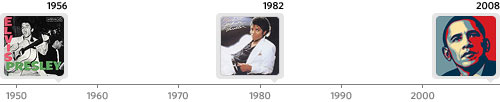
Listening to Michael Jackson’s Thriller today is equivalent to listening to Elvis Presley’s first album (1956) at the time of Thriller’s release in 1982. Elvis singles in 1956 included Blue Suede Shoes, Hound Dog, and Love Me Tender.
If you’re around my age, how old do you feel right now? Here are some other examples of timeline twins:
Watching Star Wars today is like watching It’s a Wonderful Life (1946) in 1977. It’s a Wonderful Life was nominated for an Oscar the following year along with Ethel Barrymore (b. 1879) and Lilian Gish (b. 1893).
Listening to Nirvana’s Smells Like Teen Spirit today is equivalent to playing Terry Jack’s Seasons In The Sun (1974) in 1991.
Watching The Godfather today is like watching Charlie Chaplin’s Modern Times (1936) in 1972. Modern Times was a silent film (Chaplin’s last).
Listening to the Sex Pistols’ Never Mind the Bollocks (1977) today…well, they didn’t really have rock or pop albums back in 1946. But popular songs on the radio were sung by Frank Sinatra, Perry Como, Nat King Cole, and Dinah Shore, as well as many performers and their orchestras.
Back to the Future (1985) —> To Kill a Mockingbird (1962)
Die Hard (1988) —> Bullitt (1968)
Radiohead, OK Computer (1997) —> Bon Jovi, Slippery When Wet (1986)
Dark Days is a documentary released in 2000 about a group of homeless people living in an abandoned Manhattan railway tunnel.
When he relocated from London to Manhattan, Marc Singer was struck by the number of homeless people he had seen throughout the city. Singer had befriended a good number of New York’s homeless and later, after hearing of people living underground in abandoned tunnel systems, he met and became close to a group of people living in The Freedom Tunnel community stretching north from Penn Station past Harlem. After living with them for a number of months, he decided to create a documentary in order to help them financially. The film’s crew consisted of the subjects themselves, who rigged up makeshift lighting and steadicam dollies, and learned to use a 16mm camera with black & white Kodak film. Singer himself had never been a filmmaker before, and saw the production of Dark Days as a means of gaining better accommodation for the residents of the tunnel.
“Berlin Alexanderplatz,” “The Singing Detective” and “The Sopranos” are something more than mini-series. Packed with characters and events of Dickensian dimension and color, their time and place observed with satiric exactitude, each has the kind of cohesive dramatic arc that defines a work complete unto itself. No matter what they are labeled or what they become, they are not open-ended series, or even mini-series.
They are megamovies.
That is, they are films on a scale imagined by the big-thinking, obsessive, fatally unrealistic Erich von Stroheim when, in 1924, he shot “Greed,” virtually a page-by-page adaptation of Frank Norris’s Zola-esque novel, “McTeague.” Stroheim intended it to be an exemplar of cinematic realism.
Megamovies take television seriously as a medium. They have dramatic arcs that last longer than single episodes or seasons. Megamovies often explore themes and ideas relevant to contemporary society — there’s more going on than just the plot — without resorting to very special episodes. Repeat viewing and close scrutiny is rewarded with a deeper understanding of the material and its themes. They’re shot cinematically and utilize good actors. Plot details sprawl out over multiple episodes, with viewers sometimes having to wait weeks to fit what might have seemed a throwaway line into the larger narrative puzzle.
Episodes of these megamovies, Canby argued presciently, are best watched in bunches, so that the parts more easily make the whole in the viewer’s mind. For many, bingeing on entire seasons on DVD or downloaded via iTunes has become the preferred way to watch these shows. If stamina and non-televisual responsibilities weren’t an issue, it would be preferable to watch these shows in one sitting, as one does with a movie.
Since The Sopranos kick-started things in 1999, the megamovie has become a far more common occurrence on TV. Virginia Heffernan recently stated that the creators of nearly all hour-long dramatic series are aiming to make megamovies. I’ve collected a few examples of megamovies accompanied by their total running times below. The list is incomplete but represents several of the best-known and -appreciated megamovies out there.
The Sopranos, 81 hours 46 minutes
Lost*, 61 hours 59 minutes
Mad Men*, 18 hours 6 minutes
Six Feet Under 57 hours 45 minutes
Deadwood*, 36 hours
The Wire, 60 hours 45 minutes
The West Wing, 111 hours 56 minutes
For The West Wing, that’s 4 days and 16 hours of continuous watching. An asterisk marks megamovies that are as-yet incomplete. In the case of Deadwood, it’s as if the film projector broke about halfway through the movie, only no one got their money back and eveyone left the theater pissed.
“People will now go to films with subtitles, you know,” she added. “They’re not afraid of them. It’s one of the upsides of text-messaging and e-mail.” She smiled. “Maybe the only good thing to come of it.”
The abundance of scrolling tickers on CNN, ESPN, and CNBC may be even more of a contributing factor…if in fact people are more willing to see films with subtitles. (via ben and alice)
Luckily, the Academy of Motion Picture Arts and Sciences had a print of The Godfather that was in perfect condition. (This was the approved master print that Technicolor stored with the academy when the film was complete. It had never been shown in a theater.) So, when Harris & Co. did the digital color correction, they could use this print as a reference. They also worked side by side with Allen Daviau, a brilliant cinematographer who, in turn, consulted by phone with Willis himself. (Harris is a stickler for this sort of thing. When he restored Hitchcock’s Vertigo, he asked Jaguar to send him a color chip from the 1957 model of one of its cars — the same car that Kim Novak drove in the film — so that he could match the shade of green exactly.)
But with that huge uptick in resolution for the consumer, Criterion is faced with a lot of problems that they didn’t have when their masters were converted to standard definition for DVD. After all, they’re often dealing with old films, created before there was fancy low-grain filmstock and digital processing. And with the technology they have today, how much restoration and processing is too much?
Really, the mission of Criterion is “trying to replicate the original experience of seeing that movie when it was first released,” according to Phillips. While they certainly have the ability to process old films until they look like they were shot on a DV cam, that’s not the goal.
It’s difficult to know if Blu-ray will actually take off as a format, given the competition from other methods of obtaining HD media (iTunes store, HD cable, etc.). It might become a niche option like the Criterion Collection itself but a welcome one all the same. We watched The Darjeeling Limited the other night on the Starz HD channel on Time Warner Cable. It was 1080p but compressed enough that if you’re paying attention, you can see artifacts, especially with fast motion. But the worst part is that Starz didn’t bother to show the film in its original aspect ratio, which, with Wes Anderson movies, is more than half of the point! They chopped off the sides to fit a 2.39:1 film into 16:9. So for fans of films that deserve to be seen as the director intended, Criterion on Blu-ray might be the only option.
Q. Yo dude, u missed out on “Disaster Movie,” a hardcore laugh-ur-@zz-off movie! Y U not review this movie!? It was funny as #ell! Prolly the funniest movie of the summer! U never review these, wat up wit dat? - S.J. Stanczak, Chicago
A. Hey, bro, I wuz buzier than $#i+, @d they never shoed it b4 hand. I peeped in the IMDb and saw it zoomed to #1 as the low$ie$t flic of all time, wit @ lame-@zz UZer Rating of 1.3. U liked it? Wat up wit dat?
Totally pwned. He’s not completely fluent, but Ebert should write all of his reviews in l33tspeak.
By all accounts, the original negatives of the first two films were so torn up and dirty that they could no longer be run through standard film laboratory printing equipment, and so the only option became a digital, rather than a photochemical, restoration.
The final product, which the studio is calling “The Godfather: The Coppola Restoration,” combines bits and pieces of film recovered from innumerable sources, scanned at high resolution and then retouched frame by frame to remove dirt and scratches. The color was brought back to its original values by comparing it with first-generation release prints and by extensive consultation with Gordon Willis, who shot all three films, and Allen Daviau, a cinematographer (“E.T.”) who is also a leading historian of photographic technology.
The article goes on to say that the Blu-ray version is like a “pristine 35-millimeter print projected in perfect focus” in your living room. Must get Blu-ray player. Amazon has the Blu-ray version for a whopping 50% off the retail price…it’s almost the same price as the DVD version.
Question of the week over at the Onion AV Club: what movie have you rewatched the most times? My short list: Star Wars, Ocean’s 11, The Day After Tomorrow, Bill & Ted’s Excellent Adventure. I’ve also seen Zoolander a fair number of times but not as many as the others.
The trailer for Synecdoche, New York, the first film directed by Charlie Kaufman, who wrote Being John Malkovich, Adaptation, and Eternal Sunshine of the Spotless Mind. A.O. Scott liked it at Cannes. The film will be out in limited release (NY & LA?) on Oct 24. Say sih-NECK-duh-kee…kinda like Schenectady. (via crazymonk)
Update: I removed the embedded video…I didn’t know it came with all that extra cruft around it.
Note: If you are a member and tried to log in, it didn't work, and now you're stuck in a neverending login loop of death, try disabling any ad blockers or extensions. Or try logging out and then back in. Still having trouble? Email me!





Socials & More