



The best word ever
Over the past two months, Ted McCagg has been running a contest on his blog to find the best word ever. A winner was recently announced.
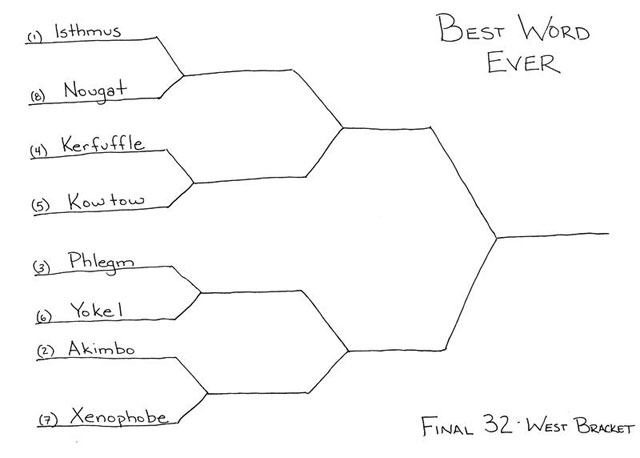
(via @bobulate)

This site is made possible by member support. 💞
Big thanks to Arcustech for hosting the site and offering amazing tech support.
When you buy through links on kottke.org, I may earn an affiliate commission. Thanks for supporting the site!
kottke.org. home of fine hypertext products since 1998.
Beloved by 86.47% of the web.
Over the past two months, Ted McCagg has been running a contest on his blog to find the best word ever. A winner was recently announced.
(via @bobulate)
According to research done by Stanford University’s Tyler Schnoebelen, the type of smiley you use is determined in part by your age.
Emoticons with noses are historically older. Since it is words that unite and distinguish clusters, this means that people who use old-fashion noses also use a different vocabulary — nose users don’t mention Bieber or omg.
I am obviously a non-noser because I am down, as we kids say, with Beibler and Carly Mae and Gandgum Style and Skillet. :) (via the atlantic)
In response to this question on Quora — What are some English phrases and terms commonly heard in India but rarely used elsewhere? — Pushpendra Mohta offers up a story with many examples.
As it turns out, the manager there is also my college batchmate. You can use my connection there. Just give your good name. We were both backbenchers but he was actually rusticated for ragging and bunking. The final straw was when he was caught eve-teasing the dean’s daughter. But, he did some jugaad and palm greasing, and got himself a license to manufacture Indian-made foreign liquor. Rags to riches story. Now he is a mover and shaker. For a while he was under the scanner of the IT authorities and they chargesheeted a disproportionate-asset case against him. I think he may have been doing some hawala transactions. The whole official machinery was after him. He tried to file a grievance but there was no redressal mechanism for such cases. Ultimately, he went on an indefinite fast.
My favorite term from the rest of the thread is “prepone”, which means to move something ahead in the schedule, i.e. the opposite of postpone. (via @ftrain)
This segment of the most recent episode of Radiolab about color is super interesting. It seems that people haven’t always seen colors in the same way we do today.
What is the color of honey, and “faces pale with fear”? If you’re Homer—one of the most influential poets in human history—that color is green. And the sea is “wine-dark,” just like oxen…though sheep are violet. Which all sounds…well, really off. Producer Tim Howard introduces us to linguist Guy Deutscher, and the story of William Gladstone (a British Prime Minister back in the 1800s, and a huge Homer-ophile). Gladstone conducted an exhaustive study of every color reference in The Odyssey and The Iliad. And he found something startling: No blue! Tim pays a visit to the New York Public Library, where a book of German philosophy from the late 19th Century helps reveal a pattern: across all cultures, words for colors appear in stages. And blue always comes last.
It’s worth listening to the whole thing…the bit at the end with the linguist’s daughter and the color of the sky is especially cool.
A large collection of expressions compiled by John Cowan in which languages are explained in terms of other languages. Like so:
English is essentially a half dozen other languages locked in a small room. They fight.
Icelandic is essentially Norwegian spoken with an American accent.
English is what you get from Normans trying to pick up Saxon girls.
Spanish is what happened when Moors tried to learn Latin and said “screw it.”
Dutch is English spelt funny and spoken in a Klingon accent.
English is essentially French converted to 7-bit ASCII.
(thx, rasmus)
On this day full of red, white, and blue in the US, it’s interesting to note that, in a large number of languages, when colors start getting their own words, red is usually the first color defined after black and white (or light and dark), and that blue and green are often not defined individually, at least at first. Those facts and more in this super long/interesting article about color and language and how colors got their names and and and…just read it already. Here’s part 2.
The figure above is really telling a story. What it says is this. If a language has just two color terms, they will be a light and a dark shade - blacks and whites. Add a third color, and it’s going to be red. Add another, and it will be either green or yellow - you need five colors to have both. And when you get to six colors, the green splits into two, and you now have a blue. What we’re seeing here is a deeply trodden road that most languages seem to follow, towards greater visual discernment (92 of their 98 languages seemed to follow this basic route).
Also note the Wikipedia entry for “distinguishing blue from green in language.” (via The Millions)
The food truck trend has invaded Paris, where young people use the phrase “très Brooklyn” to denote food that combines “informality, creativity and quality”.
On a bright morning last month at the Marché St.-Honoré, a weekly market in an elegant residential section of Paris, several sleekly dressed women struggled to lift the thick burgers to their mouths gracefully. (In French restaurants, and sometimes even fast-food joints, burgers are eaten with utensils, not hands.) A few brave souls were trying to eat tacos with a knife and fork. “C’est pas trop épicé,” said one, encouraging a tentative friend — “It’s not too spicy,” high praise from the chile-fearing French.
Street food itself isn’t new to France. At outdoor markets like this one, there is often a truck selling snacks like pizza, crepes or spicy Moroccan merguez sausages, cooked on griddles and stuffed into baguettes.
But the idea of street food made by chefs, using restaurant-grade ingredients, technique and technology, is very new indeed.
This thread at Ask MetaFilter contains several examples of English words and phrases that sound current but actually aren’t.
“Fly” mentioned above is one of my favorites (though it’s considered dated by youngsters today — they’ll basically only use it ironically), but one not mentioned so is “crib” (also a bit dated) which has meant something like “house” or “home” since 1600. OED: “A small habitation, cabin, hovel; a narrow room; fig. a confined space. In N.Z. now esp. a small house at the seaside or at a holiday resort.”
I particularly liked this early example of the maternal insult from Shakespeare’s Titus Andronicus:
Demetrius: “Villain, what hast thou done?”
Aaron: “That which thou canst not undo.”
Chiron: “Thou hast undone our mother.”
Aaron: “Villain, I have done thy mother.”
Prochronism analyzes word usage in shows like Mad Men and Downton Abbey to hunt down anachronisms…like “a callback for” and “pay phone” from a recent episode of Mad Men.
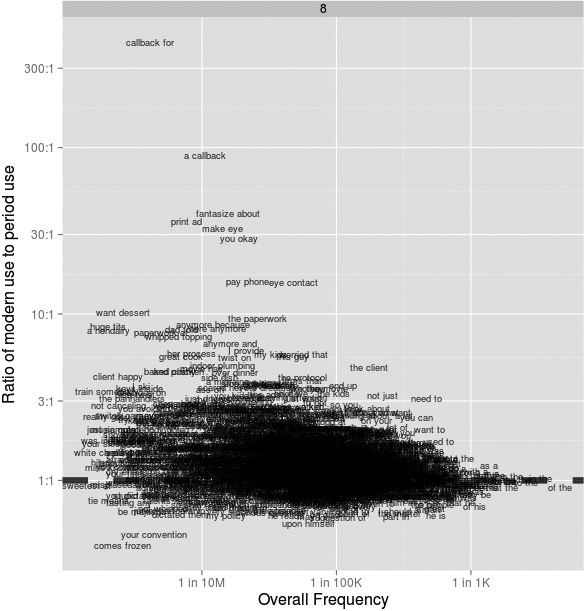
The big one from the charts: Megan gets “a callback for” an audition. This is, the data says, a candidate for the worst anachronism of the season. The word “callback” is about 100x more common by the 1990s, and “callback for” is even worse. The OED doesn’t have any examples of a theater-oriented use of “callback” until the 1970s; although I bet one could find some examples somewhere earlier in the New York theater scene, that may not save it. It wouldn’t really suite Megan’s generally dilettantish attitude towards the theater, or the office staff’s lack of knowledge of it, for them to be so au courant. “call-back” and “call back” don’t seem much more likely.
(via waxy)
A number of banking machines in London offer Cockney rhyming slang as a language option. Operating the machine is simple…just insert your barrel of lard and punch in your Huckleberry Finn to get your sausage and mash.
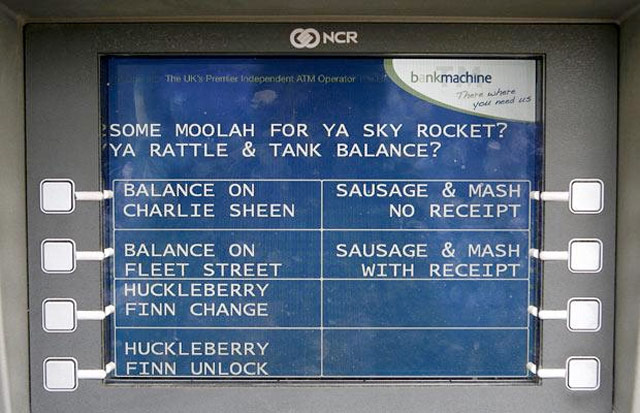
The company has also been responsible for introducing cash machines which only dispense £5 notes — fivers as they are colloquially named or Lady Godivas in cockney.
It also allows people to withdraw a pony — which is £25 to non-cockney folk.
“I was talking to Andrew Bailey, the chief cashier of the Bank of England, and he said they were trying to get more £5 notes into circulation,” Mr Delnevo reflects.
He came up with the idea that, rather than putting £5 notes in as one choice, it would be better to have £5-note only cash machines.
“We were getting to the state where we were a £20 note society - handing over £20 for an item which cost £4.50 and handed back enough metal to act as an anchor for the aircraft carrier Ark Royal,” he says.
See also ATMs in Latin. (via @nrturner)
New essay from Errol Morris in the NY Times, What’s in a Name? In it, he talks about the two Rockefellers that appeared in the newspapers a few years ago…one an imposter and one real.
Clearly, the name was also responsible for the attention he was getting in the newspaper. Clark is not just any impostor; he is a Rockefeller impostor. And as such he becomes more important, more significant. It is as if the name gives him some of the stature and allure of a real Rockefeller. A perfect example of this is the importance given to Clark in both The New York Times and The Boston Globe. He even managed to outshine Barack Obama and Joseph Biden during the week that Obama picked his running mate. Obama and Biden get a little picture at the bottom of the right-hand side of the front page. Clark gets a photo spread — one big picture and four little ones — at the top of the left-hand side. He also got more column inches in the newspaper than Clayton, the real Rockefeller. It’s impressive.
ATMs in the Vatican City have Latin as one of the language options:
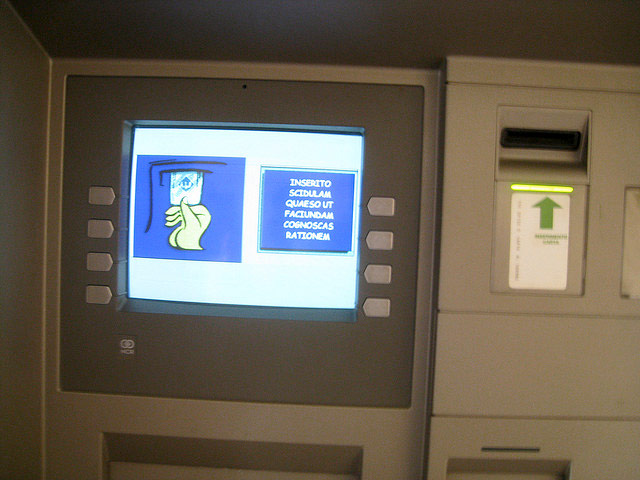
Anyone know what that means? Google Translate spits out a bunch of jibberish… (Photo by Seth Schoen)
Update: Lots of slightly different answers as to what this says, but this email from a Ph.D. candidate in Classics at Columbia is representative of the spread:
Anyhow, a super-literal translation would be something like this:
I ask that you insert [your] card in order that you come to understand the method needing to be used.
But more colloquially, we can do this:
Please insert your card to learn the instructions.
or even (although I’m really getting into sloppy translation territory here):
Please insert your card for instructions.
(thx, charles)
Update: And it may be more accurate to say that Vatican City ATMs previously offered a Latin option. According to @johnke, “they removed the Latin option with a software update sometime in late 2010/early 2011”.
Atomic sells a ski called the Blog.
The Blog is ideal for freeskiers who refuse to compromise on airs and tricks in the backcountry.
(via meg)
From Project Gutenberg, Francis Grose’s Dictionary in the Vulgar Tongue was published in 1811 and gives the reader a full account of the slang, swears, and insults used at the time.
FLOGGING CULLY. A debilitated lecher, commonly an old one.
COLD PIG. To give cold pig is a punishment inflicted on sluggards who lie too long in bed: it consists in pulling off all the bed clothes from them, and throwing cold water upon them.
TWIDDLE-DIDDLES. Testicles.
TWIDDLE POOP. An effeminate looking fellow.
ROUND ROBIN. A mode of signing remonstrances practised by sailors on board the king’s ships, wherein their names are written in a circle, so that it cannot be discovered who first signed it, or was, in other words, the ringleader.
A modern copy is available on Amazon.
The Pronunciation Book channel on YouTube shows you how to say various words in American English in a straightforward fashion. Here’s how to say Zegna, the men’s clothing brand:
This is not to be confused with the Pronunciation Manual channel, which does the same thing in the same format but much funnier and more incorrect.
I could have embedded a dozen more…I have no idea why I think these are so funny but I just cannot stop laughing at them. Ok, one more:
And this one! Make it stop!!
Update: My kids and I still use these mispronunciations around the house all the time. I cannot help looking at even the fanciest bottle of Châteauneuf-du-Pape without thinking choody-noofy-doopy-poopy.
This is a node.js module that determines if a sentence can be replied to with “that’s what she said”. You can use either a naive Bayes or k-nearest neighbor algorithm. This totally paves the way for a Michael Scott auto-replying Twitter bot. (via @kellan)
You’ve probably seen the NY Times correction that everyone’s talking about. Ok, not everyone, just everyone who works in media. Anyway, here it is:
An article on Monday about Jack Robison and Kirsten Lindsmith, two college students with Asperger syndrome who are navigating the perils of an intimate relationship, misidentified the character from the animated children’s TV show “My Little Pony” that Ms. Lindsmith said she visualized to cheer herself up. It is Twilight Sparkle, the nerdy intellectual, not Fluttershy, the kind animal lover.
Here is said article. Jim Romenesko talked to Amy Harmon, the reporter who wrote the article, and uncovered this magical tidbit:
I was accompanying Kirsten to school, taking notes on my laptop as she drove. She was listening to music on her iPod known to Pony fans as “dubtrot,” — a take-off on “dubstep,” get it? — in which fans remix songs and dialogue from the show with electronic dance music.
Dubtrot! And leave it Urban Dictionary to gild the lily.
Dubstep music relating to My Little Pony: Friendship is Magic. Often created by bronies, dubtrot can include dubstep remixes of songs from the show and original pieces created as homage or in reference to the show.
Bronies! Defined as:
The term used to describe the fan community(usually of the older group, males and females) of the show My Little Pony: Friendship is Magic.
Anyway, would you like to listen to some dubtrot? Of course you would: Rainbowstep, Rainbow Dubtrot, and fluttershymix.
In an outtake from his 2001 book Word Freak, author Stefan Fatsis introduces us to Nigel Richards, perhaps the best Scrabble player in the world.
If Nigel has a weakness, it’s that his wide-open, high-scoring style often leaves him vulnerable to counterattack by opponents who also have prodigious word knowledge. And Nigel is regarded as having a less-than-proficient endgame, which is variously attributed to his lack of interest in strategic play or his reluctance to study board positions. Indeed, Nigel doesn’t record his racks, doesn’t review games, rarely kibitzes about particular plays. The other top experts, particularly the Americans, talk disdainfully about this gap in Nigel’s ability, how it makes him an incomplete player. Naturally, Nigel doesn’t care.
According to Wikipedia, Richards has continued his winning ways since 2001…he’s a two-time World Championship winner and has won the U.S. National Scrabble Championship three out of the last four years.
The middle finger and the British “up yours” don’t make the abbreviated list, but if you want to know how to piss people off in their native land without talking, this is a nice little guide. From a book called Rude Hand Gestures of the World.
I don’t know if Samuel L. Ipsum is better than Hipster Ipsum, but the name is great.
Well, the way they make shows is, they make one show. That show’s called a pilot. Then they show that show to the people who make shows, and on the strength of that one show they decide if they’re going to make more shows. Some pilots get picked and become television programs. Some don’t, become nothing. She starred in one of the ones that became nothing.
Who else has a good lorem ipsum name? Lorem Bacall? Buddy Ipsum? Anthony Lorem Hall? Lorem Fishburne? Loremington Steele?
Well, I don’t know about that, but as an analogy enthusiast, I did enjoy reading through this list. Some favorites:
Her vocabulary was as bad as, like, whatever.
From the attic came an unearthly howl. The whole scene had an eerie, surreal quality, like when you’re on vacation in another city and Jeopardy comes on at 7:00 p.m. instead of 7:30.
He was as tall as a six-foot, three-inch tree.
John and Mary had never met. They were like two hummingbirds who had also never met.
That first one…I can’t decide if it’s bad or the best analogy ever.
Different languages are spoken at varying speeds but thanks to correlated differences in data-density, the same amount of information is conveyed within a given time period.
For all of the other languages, the researchers discovered, the more data-dense the average syllable is, the fewer of those syllables had to be spoken per second — and the slower the speech thus was. English, with a high information density of .91, is spoken at an average rate of 6.19 syllables per second. Mandarin, which topped the density list at .94, was the spoken slowpoke at 5.18 syllables per second. Spanish, with a low-density .63, rips along at a syllable-per-second velocity of 7.82. The true speed demon of the group, however, was Japanese, which edges past Spanish at 7.84, thanks to its low density of .49. Despite those differences, at the end of, say, a minute of speech, all of the languages would have conveyed more or less identical amounts of information.
(via @mulegirl)
Need some “artisanal text filler” for your latest project? Hipster Ipsum provides dummy text in two great flavors: “Hipster w/ a shot of Latin” and “Hipster, neat.”
Organic sustainable lomo, +1 irony McSweeney’s skateboard Portland PBR tattooed farm-to-table Terry Richardson Williamsburg. Organic farm-to-table wolf, next level shit put a bird on it freegan American Apparel Williamsburg chambray gentrify viral you probably haven’t heard of them keffiyeh Cosby sweater. Pitchfork photo booth fuck, DIY cardigan messenger bag butcher Thundercats tofu you probably haven’t heard of them whatever squid VHS put a bird on it. Thundercats fixie Williamsburg, photo booth synth vinyl dreamcatcher Wes Anderson cliche. You probably haven’t heard of them DIY mlkshk biodiesel McSweeney’s raw denim. Skateboard Pitchfork Etsy, photo booth messenger bag artisan raw denim beard Tumblr retro Austin. Wes Anderson sustainable keffiyeh, blog lomo craft beer cliche brunch homo skateboard biodiesel fanny pack Pitchfork you probably haven’t heard of them Stumptown.
(via ★dansays)
Julian Dibbell quotes H.W. Fowler’s A Dictionary of Modern English Usage on the correct pronounciation of French words while speaking English.
To say a French word in the middle of an English sentence exactly as it would be said by a Frenchman in a French sentence is a feat demanding an acrobatic mouth; the muscles have to be suddenly adjusted to a performance of a different nature, & after it as suddenly recalled to the normal state; it is a feat that should not be attempted; the greater its success as a tour de force, the greater its failure as a step in the conversational progress; for your collocutor, aware that he could not have done it himself, has his attention distracted whether he admires or is humiliated.
I think that’s what Feynman was getting at here in his discussion with Murray Gell-Mann, although, in typical Feynman fashion, not in so many words.
Richard Feynman, Gell-Mann’s chief competitor for the title of the World’s Smartest Man but a stranger to pretension, once encountered Gell-Mann in the hall outside their offices at Caltech and asked him where he had been on a recent trip; “Moon-TRAY-ALGH!” Gell-Mann responded in a French accent so thick that he sounded as if he were strangling. Feynman — who, like Gell-Mann, was born in New York City — had no idea what he was talking about. “Don’t you think,” he asked Gell-Mann, when at length he had ascertained that Gell-Mann was saying “Montreal,” “that the purpose of language is communication?”
Worknik has a fun post up about the language of the Harry Potter books & movies.
Characters’ names are often also common words. A dumbledore is a bumblebee. Snape is a ship-building term that means “to bevel the end of (a timber or plank) so that it will fit accurately upon an inclined surface.” Hagrid is the past participle of hagride, which means “to harass or torment by dread or nightmares.” Skeeter is a term for an annoying pest, and not just Rita Skeeter, blood-sucking journalist. Mundungus is “waste animal product” or “poor-quality tobacco with a foul, rancid, or putrid smell,” a good name for a sneaky thief.
(via @djacobs)
Young people in Chile, the Phillipines, and Mexico are using endangered regional languages to communicate and express themselves online and via text messaging.
Herrera also discovered teens in the Phillippines and Mexico who think it’s “cool” to send text messages in regional endangered languages like Kapampangan and Huave. Almost as soon as text messaging exploded on the world stage as a means to reach anyone, anywhere, and anytime, young people began to find a way to scale it back, make it more exclusive and develop their own code or doublespeak to use on the widely used devices.
(via @tcarmody?)
Using a Hot or Not style interface, Daniel Temkin is trying to crowdsource a list of the world’s top Unicode charaters. (via @cory_arcangel)
What the hell? Is the sky still blue?
As a general rule, do not use the serial/Oxford comma: so write ‘a, b and c’ not ‘a, b, and c’. But when a comma would assist in the meaning of the sentence or helps to resolve ambiguity, it can be used — especially where one of the items in the list is already joined by ‘and’.
The kottke.org style guide still advocates the use of the Oxford comma, but take that with a grain of salt; I also misuse semicolons, use too many (often unnecessary) parentheses — not to mention m-dashes that are actually rendered as two n-dashes in old-school ASCII fashion — use too many commas, and place punctuation outside quotation marks, which many people find, in the words of Bill S. Preston Esq. and Ted “Theodore” Logan, “bogus”. Oh, and in another nod to the old-school, I also use “dumb quotes” instead of the fancier and, I guess, technically more correct “smart quotes”. (via, who else?, @tcarmody (or should that be “whom else?”))
Update: The document I linked to above is from a branding style guide for Oxford University. It recommends against using the Oxford comma in most cases. The Oxford Style Manual, meant for the general public and last published in 2003 by Oxford University Press, “a department of the University of Oxford”, recommends using the Oxford comma in all cases. So basically, Oxford is telling us to use the Oxford comma but isn’t going to use it internally. Oxford gone schizo, y’all! (thx, @rchrd_h)
Update: Further clarification comes in the form of this official statement from Oxford University Press…they are definitely in favor of the Oxford comma.
At The Awl, Elon Green chronicles the first instances of various profanities in the pages of the New Yorker.
motherfucker
First used: 1994, Ian Frazier, “On the Floor”
It sounded like a chorus of high-pitched voices shouting the word “motherfucker” through a blender.
Quantitative pedants always wince whenever anyone — usually an athlete — rattles off a phrase like “we gave 110% out there tonight.”
“It’s impossible to give more than 100%,” they’ll say. “That’s what ‘percent’ means.”
But of course percentages greater than 100 are possible. That’s how Google’s Android Market can grow by 861.5% in year-over-year revenue, just to pick one example.
It all depends on what your baseline is — x percent of what. But it’s usually easier for tongue-clicking know-it-alls to just assume athletes are dumb than to try to actually figure out what it is they might be talking about.
Here’s actually a more serious (and more mathematically precise) way to look at this. Economist Stephen Shmanske has a new paper in the Journal of Quantitative Analysis in Sports titled “Dynamic Effort, Sustainability, Myopia, and 110% Effort” that actually brings some stats and benchmarks to bear to figure this out in the context of the NBA.
For Shmanske, it’s all about defining what counts as 100% effort. Let’s say “100%” is the maximum amount of effort that can be consistently sustained. With this benchmark, it’s obviously possible to give less than 100%. But it’s also possible to give more. All you have to do is put forth an effort that can only be sustained inconsistently, for short periods of time. In other words, you’re overclocking.
And in fact, based on the numbers, NBA players pull greater-than-100-percent off relatively frequently, putting forth more effort in short bursts than they can keep up over a longer period. And giving greater than 100% can reduce your ability to subsequently and consistently give 100%. You overdraw your account, and don’t have anything left.
I haven’t dived into the paper (it’s behind a subscription wall, natch), but doesn’t this seem like a rough-but-reasonable analysis of what athletes and other people mean when they use language this way? Shouldn’t we all calm down a little with rulers across the fingers, offering our ready-made “correct” use of the rhetoric of percentages?
Socials & More