kottke.org posts about language
Farnam Street is featuring a handout given by the late David Foster Wallace to his fiction writing class in 2002. It’s titled YOUR LIBERAL-ARTS $ AT WORK and covers five common usages gotchas.
2. And is a conjunction; so is so. Except in dialogue between particular kinds of characters, you never need both conjunctions. “He needed to eat, and so he bought food” is incorrect. In 95% of cases like this, what you want to do is cut the and.
From Wikipedia, a list of former trademarks and brands that have become generic terms. Some surprises: Heroin, Videotape, Zipper, Laundromat, Kerosene, Dry Ice, and Escalator.
Using Google Earth, dialect coach Andrew Jack gives a tour of the accents of Great Britain and Ireland.
The audio is originally from this BBC program. See also Peter Sellers doing various English accents. (via devour)
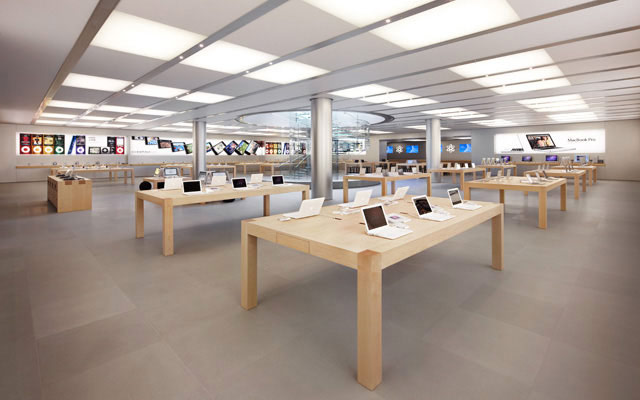
You’ve probably seen instances of knolling without knowing there was a word for it. Knolling at the Apple Store:
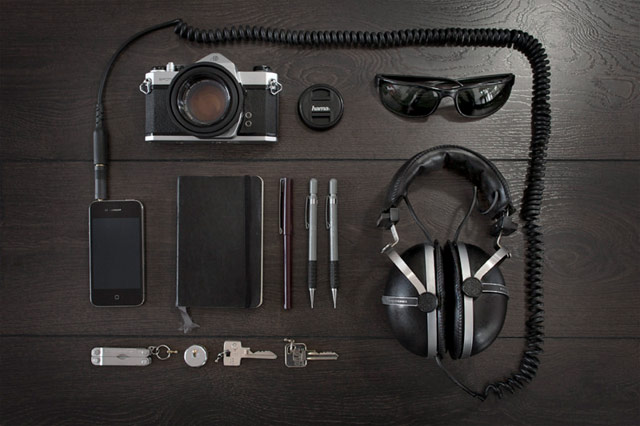
Knolling the contents of your bag:
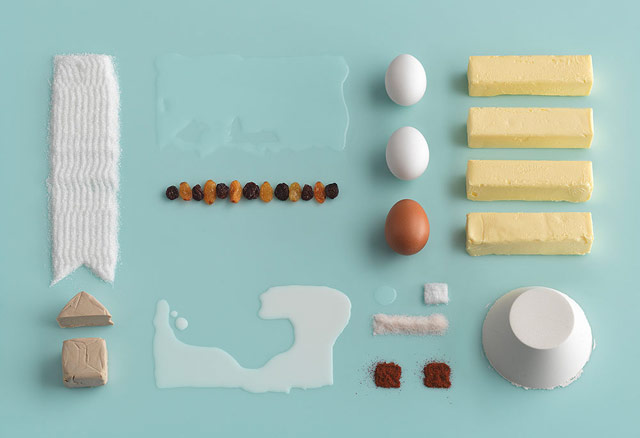
Knolling a recipe for a book:
Knolling the parts of a machine:

Knolling is the practice of organizing objects in parallel or at 90° angles. The term has been popularized by artist Tom Sachs; he picked it up from Andrew Kromelow when both were working at Frank Gehry’s furniture fabrication shop. Gehry was designing chairs for furniture company Knoll, and Kromelow would arrange unused tools in a manner similar to Knoll furniture. Hence, knolling.
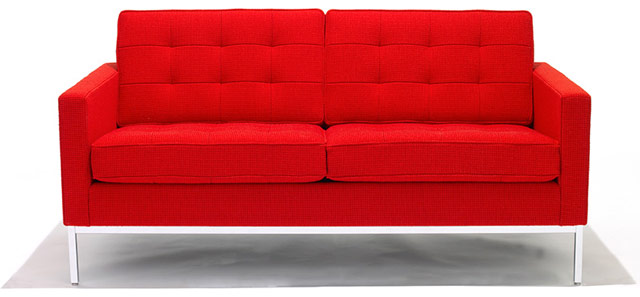
Update: Things Organized Neatly is really something. Lots of knolling.
Fit To Print is a Tumblr blog tracking the sometimes absurd instances of profanity avoidance in the NY Times. Like so:
Mr. Lee blasted a dictionary’s worth of unprintable words at developers who fluff gritty neighborhoods with glossy names (“East Williamsburg” for Bushwick, for instance), and at the “Christopher Columbus syndrome” of gentrifiers who were sweeping into the largely black neighborhood of his youth with little regard for “a culture that’s been laid down for generations.”
I have already been on record about the Times’ dumbass profanity policy, especially when it gets in the way of actually performing journalism.
Update: Language expert Jesse Sheidlower in a NY Times opinion piece:
When language can play such a hot-button role in our society, what we need is more reporting, not less. Some publications have loosened the restraints. The New Yorker has noticeably done so, British and Australian newspapers often print offensive words in full, and The Economist’s style guide reads: “if you do use swear words, spell them out in full, without asterisks or other coynesses.”
Jesse Hill made a music video for Beyonce’s Drunk in Love entirely out of emoji. Fantastic work.
Fist Eggplant! Poo! Surfbort! Oh man, that was fun.
Pop Chart Lab has produced a print of grammatical diagrams of the opening lines of notable novels. Here’s Hemingway’s The Old Man and the Sea:
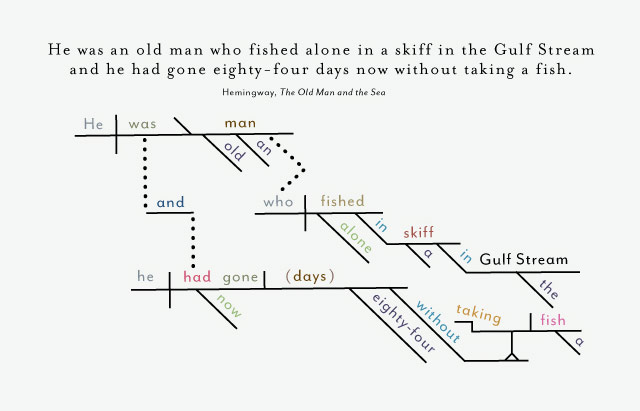
There are also sentences from DFW, Plath, and Austen. Prints start at $29.
While they still represent a small overall number, the popularity in the US of naming children after guns (Colt, Remington, Ruger, Gunner, Beretta) is up in recent years.
In 2002, only 194 babies were named Colt, while in 2012 there were 955. Just 185 babies were given the name Remington in 2002, but by 2012 the number had jumped to 666. Perhaps the most surprising of all, however, is a jump in the name Ruger’s (America’s leading firearm manufacturer) from just 23 in 2002 to 118 in 2012. “This name [Ruger] is more evidence of parents’ increasing interest in naming children after firearms,” Wattenberg writes. “Colt, Remington, and Gauge have all soared, and Gunner is much more common than the traditional name Gunnar.”
I don’t care if all of this vocabulary of NYC’s best bars is made up (it sure sounds made up), I still loved reading it. You can totally tell which places are about the drinks, which are about hospitality, which are bitchy, and which are all about the benjamins.
Sipper: A small pour (typically Mother’s Milk) gifted to a colleague, loved one, regular, etc.
Amuse-booze (experimental term): A tiny sipper to acknowledge a guest an reassure them they will be served soon.
The Cousins: Affectionate term for other cocktail bars (after the British secret service’s name for the CIA in Le Carre’s Smiley novels).
Even if it’s fake, it’s real.
Think you can distinguish between 80 of the world’s most spoken languages? Play the Great Language Game and find out. (Oof, I am bad at this.)
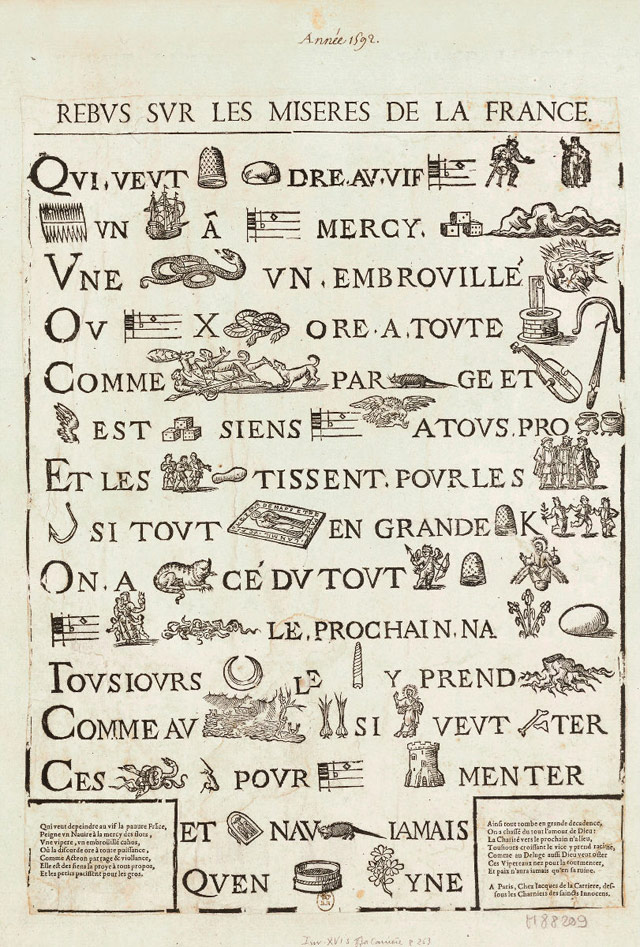
Using pictures to represent words dates back to Egyptian hieroglyphics and Chinese pictographs. But in the 1500s in France, a particular format of picture writing called the rebus was invented. A rebus is a word puzzle which uses pictures to represent words (or parts of words). The rebus became very popular in Europe and elsewhere. Here’s a French rebus from 1592:
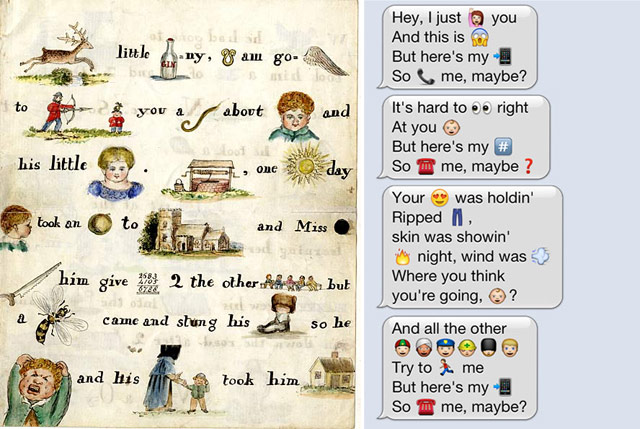
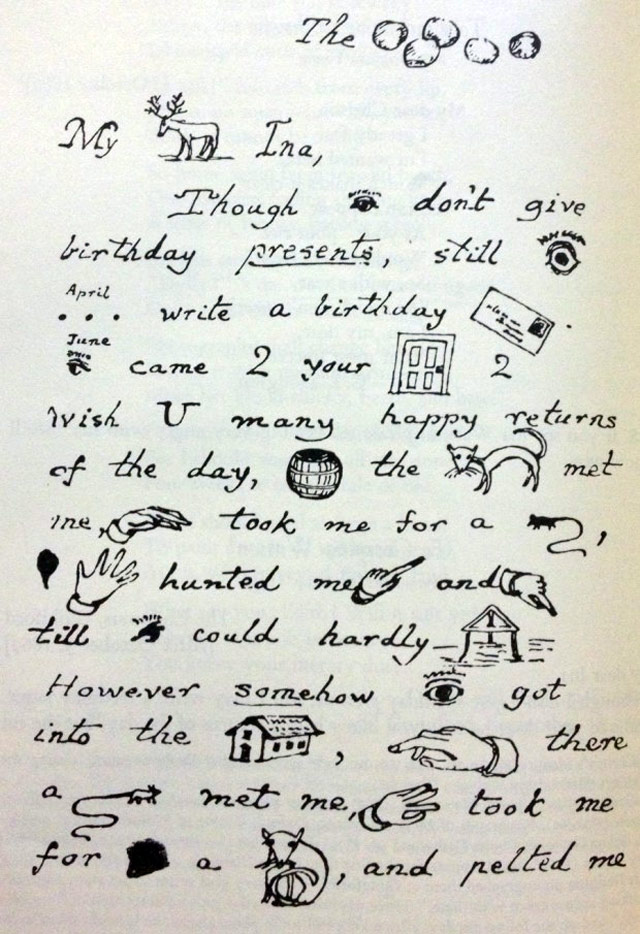
Alice in Wonderland’s author, Lewis Carroll, was fond of rebuses…here’s the first page of a letter he wrote in 1869:
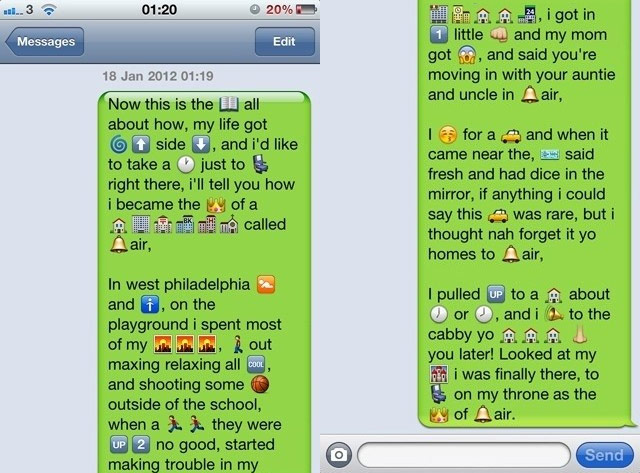
Compare the rebus with the use of emoji on mobile devices and social media, like this emoji version of the Fresh Prince of Bel Air theme song:
George Mason University’s speech accent archive collects English speech samples from all over the world. Each speaker is asked to say the same snippet of text:
Please call Stella. Ask her to bring these things with her from the store: Six spoons of fresh snow peas, five thick slabs of blue cheese, and maybe a snack for her brother Bob. We also need a small plastic snake and a big toy frog for the kids. She can scoop these things into three red bags, and we will go meet her Wednesday at the train station.
You’ve likely seen the various dialect maps of the US…the Coke/soda/pop maps. The Atlantic Video team did a wonderful thing with them…they called native speakers around the country and asked them to pronounce some of the words featured on these maps.
It’s one thing to read the difference between the pronounciations of “route”, it’s another thing entirely to hear them. I haven’t lived in the Midwest since 2000 and I have since transitioned from “pop” to “soda”, “waiting in line” to “waiting on line”, and am working on switching to “sneakers” from “tennis shoes” (or even “tennies”). But I was surprised to learn that I still pronounce “bag” differently than everyone else!
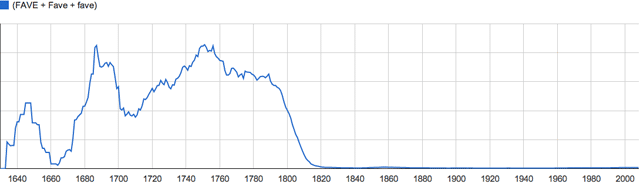
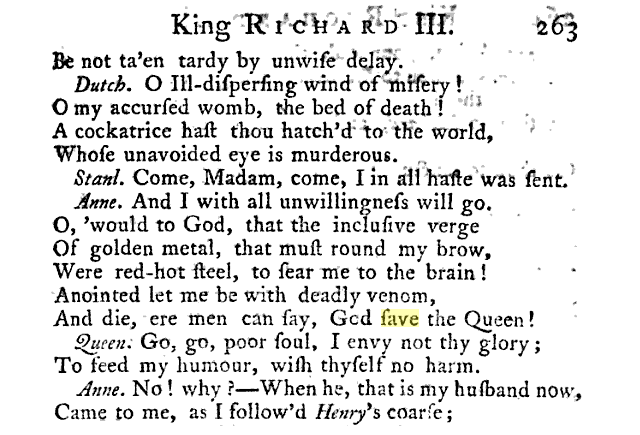
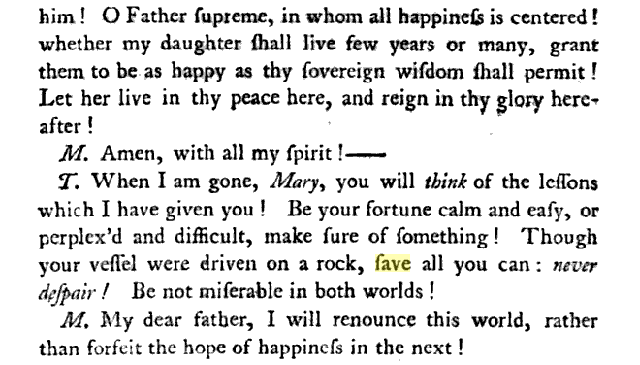
While researching the etymology of the word “fave”, a noun that’s in the process of being verbed,1 I noticed that, according to Google’s ngram viewer, the word was much more popular in the 1600-1700s than it is now.
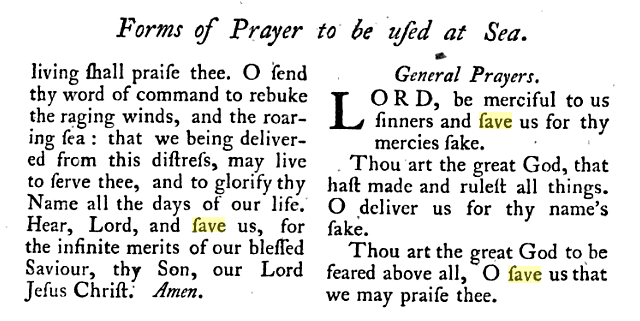
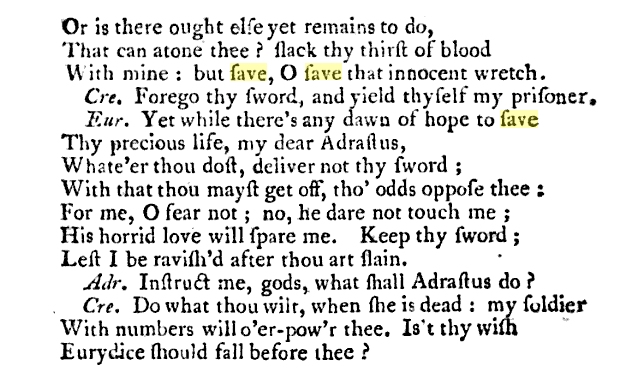
A bit of investigation reveals that Google’s book-scanning software is at fault; it can’t recognize the long s commonly used in books prior to the 1800s. So each time it encounters “save” with a long s, it sees “fave”:
Black Perl is a poem written in valid Perl 3 code:
BEFOREHAND: close door, each window & exit; wait until time.

    open spellbook, study, read (scan, select, tell us);

write it, print the hex while each watches,

    reverse its length, write again;

    kill spiders, pop them, chop, split, kill them.

        unlink arms, shift, wait & listen (listening, wait),

sort the flock (then, warn the "goats" & kill the "sheep");

    kill them, dump qualms, shift moralities,

    values aside, each one;

        die sheep! die to reverse the system

        you accept (reject, respect);

next step,

    kill the next sacrifice, each sacrifice,

    wait, redo ritual until "all the spirits are pleased";

    do it ("as they say").

do it(*everyone***must***participate***in***forbidden**s*e*x*).

return last victim; package body;

    exit crypt (time, times & "half a time") & close it,

    select (quickly) & warn your next victim;

AFTERWORDS: tell nobody.

    wait, wait until time;

    wait until next year, next decade;

        sleep, sleep, die yourself,

        die at last

# Larry Wall
It’s not Shakespeare, but it’s not bad for executable code.
When Shaquille O’Neal entered the NBA in 1992 after starring at LSU, people had already begun naming their children after him. 20-something years later, some of those kids are starting to play college basketball themselves. Ken Pomeroy is tracking the Shaq babies as they show up in their schools’ line-ups and offers a look at the future of children named after NBA stars.
We can never know those reasons for sure, but we can say that since 1997, Kobe has been the name of choice for parents opting to name their children after basketball players. (Lebron has yet to crack the top 1000.) From this we can be confident we’ll see the first-ever college basketball player named Kobe sometime in the 2016 to 2018 seasons. And while the supply of Shaqs will peter out right quick, Kobe’s name will be appearing on college basketball rosters well into the 2030’s. Kobe Bryant may have skipped college, but Kobe will be playing college basketball for many, many, many years to come.
(via http://marginalrevolution.com/)
Speaking of inexpensive time travel, listen as David and Ben Crystal perform selections from Shakespeare in the original accent, as it would have been heard at the Globe in the early 1600s. (via @KBAndersen)
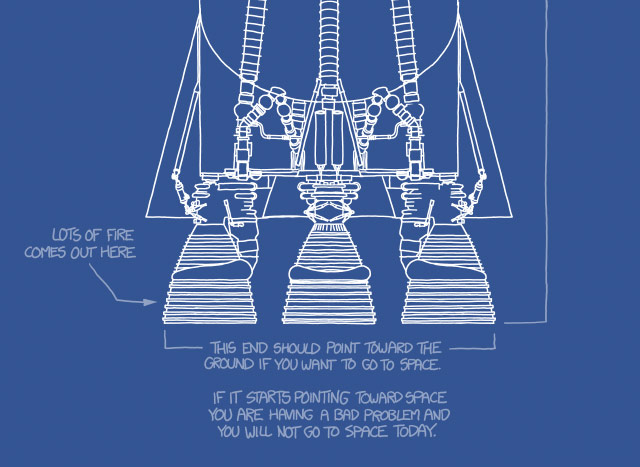
Randall Munroe of XKCD drew the Saturn V rocket (aka Up Goer Five) annotated using only the 1000 most common English words.
See also Albert Einstein’s Theory of Relativity In Words of Four Letters or Less.
This is a surprisingly helpful activity for learning about regular expressions. (via @bdeskin)
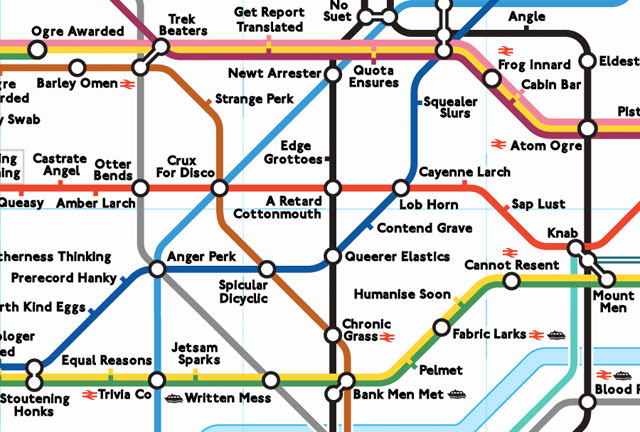
Otter Bends, Queer Spank, Frog Innard, and Lob Horn are some of the stations on the anagram map of the London Underground.
Joshua Katz has been studying American dialects and has made more than 120 maps of some of the differences in American speech. Here are a few examples:
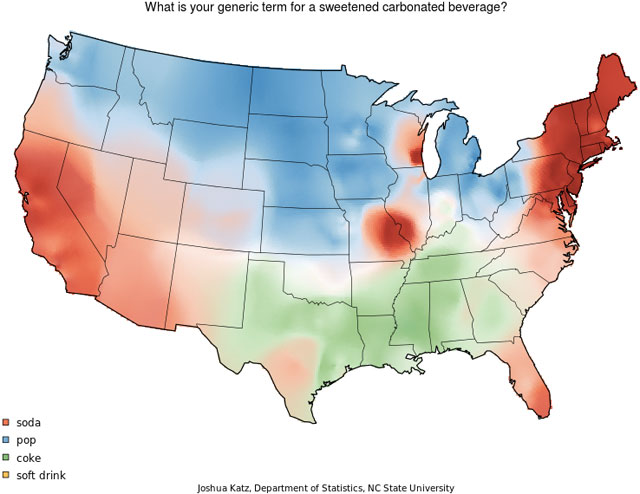
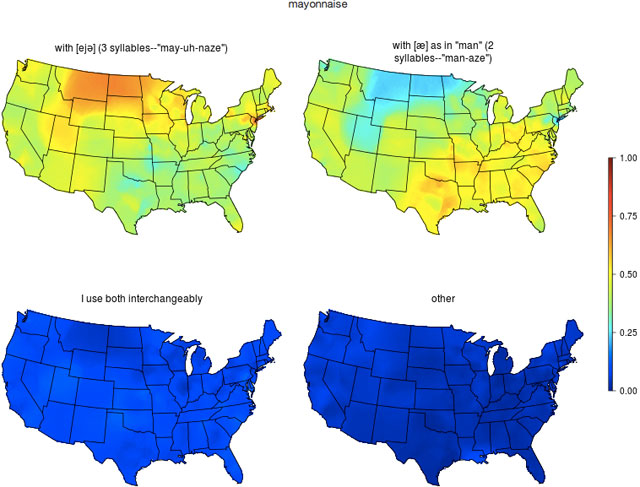
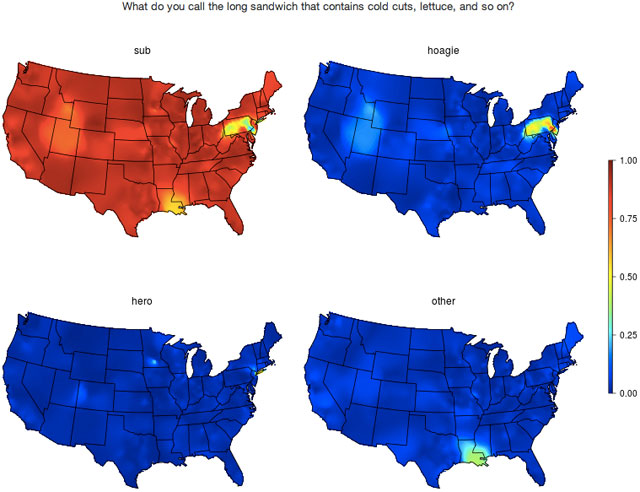
(thx, everyone)
Update: As he notes on the site, Katz’s maps are based on the research and work of Bert Vaux…Vaux’s maps of the same data can be found here. (thx, molly, margaret, & nicholas)
I’m reading back through my archive of stuff written by and about Roger Ebert and I realized I’ve never written about my favorite piece of his: Dwarfs, Little People and the M-Word. It’s nothing particularly earthshattering or insightful, but the piece demonstrates what I really liked about Ebert: humanist, happy to be corrected when in the wrong, not afraid to poke fun at himself, and a lover of both language and knowledge.
I had no idea the word “midget” was considered offensive, and you are the only person who has ever written to me about it. In my mind it is a descriptive term, like “dwarf.” “Little People” has seemed to me to have a vaguely condescending cuteness to it. If I am now informed that “midget” is offensive, I will no longer use it. What is your feeling about “dwarf?” Is “Little Person” always the preferred term? Our newspaper’s style book, based on Associated Press, does not consider “midget” or “dwarf” to be offensive terms, but perhaps we have not caught up.
Your endurance challenge for today: see how much of this video of the final round of the 2012 O. Henry Pun-Off World Championship you can watch before flinging your computing device across the room.
For bonus points, see if you can get through some of the comments…they are PUNishing. (Gah, I’ve been infected.)
For the NY Times, Ben Schott compiles an extensive list of wine-related jargon.
WHALE . PLAYER . BALLER . DEEP OCEAN
A serious drinker who will regularly DROP more than $1,000 on a single bottle. When on a furious spending spree, a WHALE is said to be DROPPING THE HAMMER. BIG WALES — or EXTRA BIG BALLERS (E.B.B.) — can spend more than $100,000 on wine during a meal.
Schott expanded on this list in a companion blog post:
But, vocabulary aside, the central thing I learned from these talented people is that if you are dining in a restaurant which employs a Sommelier, you should never, ever order your own wine.
If you know little or nothing about wine, they will guide you to a bottle far more interesting and suited to your food than you could possibly pluck from the list.
And if you are a wine aficionado, you will not know more than the Somm about their list - or what they are hiding off-list in the cellar.
See also What Restaurants Know (About You)
A study of 14,000 Twitter users was published recently (pdf) by a trio of linguists and computer scientists (Bamman, Eisenstein, Schnoebelen) that looks at the gendered expression of language online.
Female markers include a relatively large number of emotion-related terms like sad, love, glad, sick, proud, happy, scared, annoyed, excited, and jealous. All of the emoticons that appear as gender markers are associated with female authors, including some that the prior literature found to be neutral or male: :) :D and ;). […] Computer mediated communication (CMC) terms like lol and omg appear as female markers, as do ellipses, expressive lengthening (e.g., coooooool), exclamation marks, question marks, and backchannel sounds like ah, hmmm, ugh, and grr.
Swears and other taboo words are more often associated with male authors: bullshit, damn, dick, fuck, fucked, fucking, hell, pussy, shit, shitty are male markers; the anti-swear darn appears in the list as a female marker. This gendered distinction between strong swear words and mild swear words follows that seen by McEnry 2006 in the BNC. Thelwall 2008, a study of the social networking site MySpace produced more mixed results: among American young adults, men used more swears than women, but in Britain there was no gender difference
I don’t want to draw too many conclusions from a single study especially one that, in my opinion, makes some questionable methodology choices (people who follow or are followed by more than 100 people are excluded from the study?) but the results point to an interesting evolution in conversational, public speech.
Update 2: Tyler Schnoebelen, one of the study’s authors reached out to clarify. The study says “we selected only those users with between four and 100 friends”, with friends being defined not as people you follow, people who follow you, or even mutual follow backs. They poll accounts and if you and someone else mention each other with a separation of at least two weeks (to eliminate one-off convos with strangers), then for the purposes of the study you and the other person are defined as friends. And they’re looking to isolate people who have between 4 and 100 of those friend connections.
Now that that’s clarified, that seems a really reasonable way to try to determine friendships on Twitter.
Update 1: David Friedman reminded me of a post he did on telegraph operators in 1890 and how female operators have a different and identifiable transmission style.
It is a peculiar fact also that an experienced operator can almost invariably distinguish a woman’s sending from a man’s. There is nearly always some peculiarity about a woman’s style of transmission. it is not necessarily a fault. Many women send very clearly and make their dots and dashes precisely as they were intended to be made. It is impossible to describe the peculiarity, but there is no doubt of its existence. Nearly all women have a habit of rattling off a lot of meaningless dots before they say anything. But some men do that too. A woman’s touch is lighter than a man’s, and her dots and dashes will not carry so well on a very long circuit. That is presumably the reason why in all large offices the women are usually assigned to work the wires running to various parts of the cities.
This is perfect…Riker Ipsum is lorem ipsum dummy text from Commander Riker’s dialogue on Star Trek: The Next Generation.
Our neural pathways have become accustomed to your sensory input patterns. Computer, belay that order. The game’s not big enough unless it scares you a little. When has justice ever been as simple as a rule book? What’s a knock-out like you doing in a computer-generated gin joint like this? Did you come here for something in particular or just general Riker-bashing?
(via ★interesting)
James Fallows suggests talking about “gun safety” and not “gun control”.
I will henceforth and only talk about “gun safety” as a goal for America, as opposed to “gun control.” I have no abstract interest in “controlling” someone else’s ability to own a gun. I have a very powerful, direct, and legitimate interest in the consequences of others’ gun ownership — namely that we change America’s outlier status as site of most of the world’s mass shootings. No reasonable gun-owner can disagree with steps to make gun use safer and more responsible. This also shifts the discussion to the realm of the incremental, the feasible, and the effective.
Over on Quartz, Zach Seward takes a neat look at the 14 year rise and fall of AOL through the zeitgeist-y lens of clues for that short, double vowel word being used in the New York Times crossword.
Mar. 29, 1998: Netcom competitor
Jun. 17, 1998: Chat room inits.
Oct. 4, 1998: Part of some E-mail addresses
(via ★faketv)
NOC is a white whale that, for a period of four years, could make human speech-like sounds. Take a listen:
“The whale’s vocalizations often sounded as if two people were conversing in the distance,” says Dr. Sam Ridgway, President of the National Marine Mammal Foundation. “These ‘conversations’ were heard several times before the whale was eventually identified as the source. In fact, we discovered it when a diver mistook the whale for a human voice giving him underwater directions.”
As soon as the whale was identified as the source, NMMF scientists recorded his speech-like episodes both in air and underwater, studying the physiology behind his ability to mimic. It’s believed that the animals close association with humans played a role in how often he employed his ‘human’ voice, as well as in its quality.
Perhaps instead of the machines taking over as with Skynet in the Terminator movies, we should be worried about Seanet: talking whales, dolphins, and octopuses working together to fight humanity. (via @DavidGrann)
Actor & Scotsman Brian Cox pronounces the names of different kinds of Scotch, including Bruichladdich, Laphroaig, An Cnoc, Auchentoshan, and Lagavulin.
Of course, this is how you really pronounce Laphroaig, courtesy of Pronunciation Manual.
(via @benhammersley)
Newer posts
Older posts




Socials & More