“I don’t think that even chefs understood at the time what these tools made possible,” said Leonard Lee, founder of Lee Valley Tools in Ottawa, Canada. “When you grind a hard cheese, you get little cubes with little surface area. When you use a Microplane and shave a cheese into ribbons, you get five times the surface area.”
“And when you maximize the surface area, you put more of the cheese in contact with the taste buds,” said Mr. Lee, whose wife, Lorraine Lee, was one of the first to imagine the kitchen crossover possibilities in 1994. “That maximizes taste.”
Not only does it give you tasting notes on 200 North American oysters, but it lets you rate them — a great thing if you’re always forgetting which types you do or don’t like.
Maybe it’s because I have an oddly intense interest in croissants, but I found this 10-minute video about how to make them fascinating. Watch at least until the 1 kg sheet of butter is placed on the dough to be folded over several times.
Spoiler: they turn out great, which was unexpected because so often croissants are more bready and dry than flakey and moist, even in France. (thx, aaron)
With little more than two weeks before the planned opening, he was still formulating the initial menu and pricing. For one appetizer he envisioned a Gruyere, leek and potato veloute; for another, Arctic char in aspic. For entrees he was mulling a pork cheek, a veal shank, Dover sole for two. These would probably be served as part of a three-course prix fixe for $58, he said.
Nothing too unconventional there. But beyond the plate, he said, anything goes. Although he’ll take reservations, he’s bypassing the Web service Open Table (too cumbersome). And he’s curious about having a marching band stomp through some night. Obligatory resourcefulness has given way to revolutionary thoughts.
It’s called Finesse and it’s available at any of Thomas Keller’s restaurants.
The theme of the 64-page first issue is history, so Keller and co. have collected stories — and the expected gorgeous photography — all about the Laundry and every aspect of the restaurant: longtime staffers, former cooks, journalists.
Ruth Reichl and Michael Ruhlman pen articles. Chefs of all kinds make cameos. But it’s more than that — the magazine also highlights lesser known, yet essential parts of the French Laundry machine, like the wine producer who partners with the restaurant to create the Cuvee French Laundry.
Over at Serious Eats, Kenji Lopez-Alt has a long piece about a visit he took to a foie gras producer in New York’s Hudson Valley and what he learned about the ethics of foie gras production.
Even if you haven’t eaten foie, pretty much everyone is familiar with the abhorrent images of mistreated ducks peddled by PETA and sites like nofoiegras.org, and indeed they are truly disturbing. Ducks crammed into wire cages just big enough to stand in with their filth-encrusted heads sticking out a hole in the front. Their feathers are scraggly and wiry (if present at all), there’s often blood coming out of their nostrils, and their faces and feathers are caked with vomit and corn meal. A duck drinks scummy water out of a communal trough running in front of it while just upstream one of its less fortuitous bunkmates sits dead with its head lolling sideways, half submerged in the cloudy green water.
I’ve no doubt that farms like this exist in the world, and it is a terrible, atrocious tragedy. If this is how all foie-or even all meat-is produced, I’d become a vegetarian today. But video or photographic footage of one badly managed farm or even a thousand badly managed farms does not prove that the production of foie gras, as a practice, is necessarily harmful to the health or mental well-being of a duck. Foie gras production should be judged not by the worst farms, but by the best, because those are the ones that I’m going to choose to buy my foie from if at all.
So the real question is: is the production of foie gras torturous under even the best of conditions?
Those on one side would answer yes. How could force feeding an animal ever be considered anything but torture? On the other hand are those who claim that American foie farms are positively idyllic with ducks waddling around spacious pens, even queuing up for their gavage, that for a duck, none of the things we consider uncomfortable stress them out in the least. But who’s right?
With the current popularity of the craft cocktail bar, massive ice cubes, and vigorous cocktail shaking techniques, comes the risk of injury.
“When they’re shaking a drink, it’s very similar to the motion of a pitcher, or a tennis serve or throwing a football,” said Lisa Raymond-Tolan, an occupational therapist in New York. “It’s the same motion, back and forth, back and forth, rotating up high. You have a heavy weight at the end of the arm, out in the air. It’s not just the shoulder. It’s the wrist as well.”
One of the bartenders at Varnish, Chris Bostick, shook his cocktails so vigorously that he ripped out the screws that had been inserted in his clavicle after a snowboarding injury. He was sidelined for weeks.
Maybe instead of Tommy John surgery, they’ll start calling it Johnny Walker surgery.
Whether the mission is baking cookies or flipping pancakes, young Padawan cooks will love using our official Star Wars spatula featuring the fearsome Darth Vader.
Galactic Empire™ Cupcake Decorating Kit - “A long time ago in a galaxy far, far away, the Jedi Kitchen Council devised a powerful new way to spread fun through the galaxy. Jedi Master pastry chefs created this extraordinary collection of tools…”
Sandwich Cutters with Vintage-Style Tin - “Transform your Jedi’s favorite sandwiches into high-energy fuel for lunches, snacks and parties with Millennium Falcon™ and Darth Vader’s TIE fighter™ sandwich cutters. Created by the Jedi Kitchen Council to celebrate the Rebel Alliance’s victory over the evil Empire, these cutters are fun and easy to use — just press and cut.” [The “Vintage-Style Tin” is actually, how you say, a metal lunchbox.]
Pancake Molds - “A long time ago in a galaxy far, far away, a Jedi Kitchen Master used the Force to create three pancake molds in honor of his favorite galactic hero and villains: Yoda, Darth Vader and a stormtrooper. Use these molds to add whimsy and fun to your next pancake breakfast.” [The Vader pancake looks a lot like Hannibal Lector in his mask.]
What, no Jar-Jar Binks Home Preserves Kit? (thx, meg)
I wanted T.G.I. Friday’s to feel like a neighbourhood, corner bar, where you could get a good hamburger, good french fries, and feel comfortable. At the time, it was a sophisticated hamburger and french fry place — apparently, I invented the idea of serving burgers on a toasted English muffin — but the principle involved was to make people feel that they were going to someone’s apartment for a cocktail party.
The food eventually played a larger role than I imagined it would, because a lot of the girls didn’t have enough money to stretch from one paycheque to the other, so I became the purveyor of free hamburgers at the end of the month.
I don’t think there was anything else like it at the time. Before T.G.I. Friday’s, four single twenty-five year-old girls were not going out on Friday nights, in public and with each other, to have a good time. They went to people’s apartments for cocktail parties or they might go to a real restaurant for a date or for somebody’s birthday, but they weren’t going out with each other to a bar for a casual dinner and drinks because there was no such place for them to go.
I love this video of a guy rolling out dough and tossing it several feet to another man over and over and over again…and even over a passing waiter. They’re making parathas, an Indian flatbread.
Incanto owner Mark Pastore explains why his restaurant isn’t on Opentable. His analysis is that Opentable is too expensive and monopolistic to offer much in the way of value to restaurants.
The recurring themes were the opinion that OpenTable took home a disproportionate (relative to other vendors) chunk of the restaurants’ revenues each month and the feeling of being trapped in the service, it was too expensive to keep, but letting it go could be harmful. The GM of one very well known New York restaurant group, which spends thousands of dollars on OpenTable each month, put it to me this way, “OpenTable is out for itself, the worst business partner I have ever worked with in all my years in restaurants. If I could find a way to eliminate it from my restaurants I would.” Another high-profile, 3.5-star San Francisco restaurateur told me he feels held hostage by OpenTable. For the past several years, his payments to them have been substantially more than he has himself earned from 80-hour workweeks at his restaurant. But he believes that if he stops offering it, his customers will revolt and many would stop coming to his restaurant. So he keeps paying, but carries a grudge and wishes for something better.
Many of the fancy-dan cocktail bars serve their drinks with huge ice cubes so that even slow sippers don’t have to deal with over-watery cocktails (less surface area = slower melting). If you want to do the same thing at home, get yourself the impressively named Tovolo King Cube tray; it’ll churn out an infinite number of 2-inch cubes for about $8. (via american drink)
This amazing apple has three times the vitamin C of other apples and nearly half as much vitamin C as an orange. Use Calville Blanc d’Hiver apples for fresh eating out of hand, or baked in any cooked apple desert. It also makes a sprightly apple juice and hard cider. This apple is the French choice for tarte aux pommes and unlike its rival, the legendary English Bramley, Calville Blanc holds its shape when cooked.
This isn’t animal fat versus no animal fat. Before I was eating lots of butter, I was eating lots of pork fat. It’s one type of animal fat versus another type. Nor is it another example of modern processing = unhealthy. Compared to pork fat, butter is recent.
But watching the video of the talk, it’s unclear what’s actually being measured here…it could be that the butter is making his fingers faster at pushing the buttons. Or look at the graph…might a single line that indicates steady improvement over the course of the year also fit the data?
It was a cheeseburger that initially encouraged Mr. Blaustein, 36, to pursue his project, “The Value of a Dollar.” When the economy was in the midst of its downward spiral, he visited a fast-food chain in New Mexico, where he lives. “On one menu they had a cheeseburger for a dollar,” he said. What caught his eye, though, was another menu, which featured a double cheeseburger for the same price. That additional piece of meat, and the extra slice of cheese, somehow didn’t change the price.
4. Searing “Locks In” Juices. This is the oldest one in the book, and still gets repeated-by many highly respected cookbook authors and chefs!-to this day. It’s been conclusively proven false many times, including in our own post on How to Cook a Perfect Prime Rib, where we found that when roasting a standing roast, it in fact lost 1.68% more juice if it was seared before roasting rather than after! The same is true for pork roasts, steaks, hamburgers, chicken cutlets, you name it.
Last November, Chipotle made the decision to go it alone and bring advertising in-house. After spending at least six months selecting Butler Shine from a group of 27 agencies, Mr. Crumpacker said it didn’t make sense to take the time to pick another agency. “By the time we picked one and got them up to speed it would have been a year,” he said. “The only reasonable thing to do was to do it ourselves.”
The chain is shifting away from traditional advertising anyway, Mr. Crumpacker added, noting that advertising, generally, is becoming less important to Chipotle. Not to mention that Chipotle’s co-CEO, Steve Ells, isn’t exactly supportive of advertising. “For Chipotle, I guess I’d say [advertising] is not less important to our CEO, because he never thought it was that important,” Mr. Crumpacker said. “He’s asked me [whether] should we do advertising at all.”
On Metro-North and the Long Island Rail Road, beer is the best seller by far, accounting for more than half of all drink purchases. Budweiser and its calorie-conscious cousin, Bud Light, make up about 45 percent.
Vodka is far more popular than other spirits, making up half of all hard liquor sales. (One bartender, who spoke on the condition of anonymity for fear of losing her job, confided that her stockbroker customers “all drink vodka,” while construction workers “are all about the beer.”) Gin and scotch are a distant second and third.
While much has been made online about ginger ale’s unexpected aerial dominance (apparently one in ten drinks ordered in economy on American Airlines is a ginger ale, compared to its puny three percent terrestrial market share), there seems not to be a sustained geographical analysis of the beverage consumption patterns on different routes and airlines — or even different seat positions. Do window-seat people disproportionately favour vegetable juice, for example, or is that just the case on the routes I’ve been flying?
And what do people drink with goats? Would you, could you, with a goat? Oop, sorry, things got a little Seussical there.
And as long as we’re on the subject of factory food, this post has been making the rounds lately.
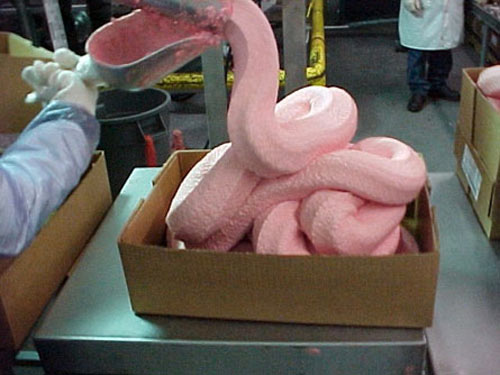
Say hello to mechanically separated chicken. It’s what all fast-food chicken is made from-things like chicken nuggets and patties. Also, the processed frozen chicken in the stores is made from it.
Basically, the entire chicken is smashed and pressed through a sieve — bones, eyes, guts, and all. it comes out looking like this.
There’s more: because it’s crawling with bacteria, it will be washed with ammonia, soaked in it, actually. Then, because it tastes gross, it will be reflavored artificially. Then, because it is weirdly pink, it will be dyed with artificial color.
I wish the person who wrote the original entry would correct it because I’m tired of seeing it popping up everywhere. The truth is strange enough without having to say that chicken nuggets contain eyeballs, bones, and large quantities of ammonia.
The limitations that we have are, I think, severe. We don’t have a freezer, anywhere. We don’t have ice cream or sorbet, we don’t have anything that needs to be frozen, it’s all fresh, fresh, fresh. We’ve got refrigerators touching each other over there. We’ve got ten burners, two ovens, a fryer and a salamander. That’s what most people have as a prep kitchen. It’s really impressive when I look at how we’ve got five seafood entrees, five meat entrees, thirteen appetizers, all done with these varying, beautiful techniques and preparations. I tip my hat to everything that Jim and the team in the kitchen have been able to pull off.
It took awhile for my wife and I to warm up to it, but Joe Leo is our go-to neighborhood restaurant now. On our one child-free night out a week, we generally end up there.
Mr. Kendall, 43, described himself as a bit of a wine poseur. He has vacationed in Italy and Napa Valley and has a cellar at home, but he cannot remember a label from meal to meal. He knows just enough, or perhaps just little enough, to become suspicious whenever a waiter recommends a vineyard he does not know.
“In the back of your mind,” he said, “you’re always thinking: ‘O.K., is this some kind of used-car special? Did they just get 200 bottles of this?’ “
But Mr. Kendall said the ratings he found on the iPad — by the wine writer Robert M. Parker Jr. — carried credibility. He decided that the price of the cabernet franc was justified by Mr. Parker’s award of 92 points out of 100. “I found a bottle of wine that I never would have tried, and it was wonderful,” he said.
Over at Serious Eats, Kenji Lopez-Alt assures us that while you can’t make restaurant-quality Neapolitan pizza at home, you can come damn close. Best thing is, his technique doesn’t involve lining your oven with bricks and is actually as easy as making regular pizza at home.
After cooking for around a minute and a half, the bottom crust achieved the perfect degree of char-even better than what I was getting on the stone. Interestingly enough, the pan was actually cooler than the stone I was using, maxing out at around 450 degrees. So how does a 450 degree pan brown better and faster than a 550 degree stone? It’s a matter of heat capacity and density.
The heat capacity of a material is directly related to the amount of energy that a given mass of material holds at a given temperature. Even though stone has almost twice the heat capacity than steel (.2 kcal/kg C vs. .1 kcal/kg C), it loses in two ways: it is far less dense than steel, and it has a much lower rate of heat conduction than steel. The pizza cooking in a skillet is not just getting energy from the pan-it’s getting energy from the burner below the pan as it gets rapidly conducted through the metal.
It’s a clear demonstration of how when cooking foods, what matters it the amount of energy transferred, not just the temperature you cook at. The two are often directly related, but not always.
I have said it before but will repeat: I love Kenji’s nerdiness about the science combined with the ability to come up with the solution that’s easiest for non-nerds to appreciate and implement. It is a rare and wonderful thing to observe.







Socials & More