Chef Dave is really inspired by a children’s book right now, and our next menu can be entirely built on that. Or we can be an exact replica of another time and place. One menu might be from my memory: My first day at The French Laundry. It comes down to trying to be expressive. You can be expressive with a plate of food, or with the whole concept of a restaurant.
Another menu we’re planning is El Bulli. One course from each year from 1983 to 2003. I’d work with Ferran [Adria] to choose the dishes that he feels are his most significant; I’d need to get him on board with that.
That El Bulli menu? Fucking crazytown. And this is the third or fourth time I’ve heard about the “first day at The French Laundry” menu and every single time my mouth starts watering and my hand reaches for my wallet. (via @kathrynyu)
At a Boston ice cream shop, the cost of ice cream cone has risen 10% in the last four months. The Boston Globe investigated down the supply chain and detailed where the price increases are coming from.
Ice cream may be a deliciously simple combination of milk, butter, and sugar, but the true cost of an ice cream cone is no simple business calculation. Toscanini’s price tag is part of complex and increasingly interconnected world economy, one that links a dairy farm in the tiny Western Massachusetts town of Colrain to the sprawling neighborhoods of Beijing.
Also of note: pistachio ice cream might be difficult to find this summer because the cost of pistachios has increased sharply in recent months. (via girlhacker)
The Inn at the Crossroads is a blog dedicated to exploring the cuisine of George R.R. Martin’s Fire and Ice book series, from which HBO’s Game of Thrones is adapted.
The Queen took a flagon of sweet plum wine from a passing servant girl and filled Sansa’s cup. “Drink,” she commanded coldly. “Perhaps it will give you courage to deal with truth for a change.”
A rare sighting, the A-Hole label is usually more than a label. Often, the whole bottle is some unique shape. Look! I’m a wine bottle in the shape of a shampoo bottle! Deal with it! Whatever. What to Expect: I wouldn’t know, for I do not condone this sort of behavior. And neither should you.
David McCandless made a data visualization comparing the Atlantic Ocean fishing stocks in 1900 and in 2000. It’s a literal jawdropper…here’s just a little bit of it:
That’s not just depleted…the fish are just gone. Click through for the full craziness. (via @daveg)
Using data from the ACNielsen HomeScan database, which employed bar-code scanners to track every purchase made by roughly 33,000 U.S. households in 2005, the two economists compared identical products sold in cities big and small, both at high-end grocery stores and discount retailers. In nearly every case, New York products were cheaper than in places such as Memphis, Indianapolis and Milwaukee.
Clearly the In-N-Out burgers making their trans-continental trip by plane would be at a disadvantage to the made-fresh-in-the-same-city burgers from Five Guys and Shake Shack, so in order to compensate for this, we made the decision to handicap all three burgers by the same amount. After a careful synchronization of watches, burgers were ordered from their respective establishments at precisely 1 a.m. Greenwich Mean Time (that’s 9 p.m. EST, 6 p.m. Pacific) and not tasted until the following morning.
I used to be a big In-N-Out fan (their burger is still a great fast food burger), but the slightly more upscale Shack Burger is my favorite burger in the whole wide world…it is indeed, as the article states, “a marvel of beefy engineering”.
Why can’t you get a slice of pizza at John’s on Bleecker or Patsy’s? Allegedly because of Al Capone:
In his 1981 book on the mob called Vicious Circles: The Mafia in the Marketplace, the late Jonathan Kwitny detailed how Al Capone — who owned a string of dairy farms near Fond Du Lac, Wisconsin — forced New York pizzerias to use his rubbery mob cheese, so different from the real mozzarella produced here in New York City since the first immigrants from Naples arrived in Brooklyn around 1900.
As the story goes, the only places permitted to use good mozzarella made locally were the old-fashioned pizza parlors like Lombardi’s, Patsy’s, and John’s, who could continue doing so only if they promised to never serve slices. According to Kwitny, this is why John’s Pizzeria on Bleecker Street still has the warning “No Slices” on its awning today.
Eric Schlosser’s Fast Food Nation came out ten years ago but this chapter on how much the taste and smell of food is chemically manipulated is still well worth a read.
Today’s sophisticated spectrometers, gas chromatographs, and headspace-vapor analyzers provide a detailed map of a food’s flavor components, detecting chemical aromas present in amounts as low as one part per billion. The human nose, however, is even more sensitive. A nose can detect aromas present in quantities of a few parts per trillion — an amount equivalent to about 0.000000000003 percent. Complex aromas, such as those of coffee and roasted meat, are composed of volatile gases from nearly a thousand different chemicals. The smell of a strawberry arises from the interaction of about 350 chemicals that are present in minute amounts. The quality that people seek most of all in a food — flavor — is usually present in a quantity too infinitesimal to be measured in traditional culinary terms such as ounces or teaspoons. The chemical that provides the dominant flavor of bell pepper can be tasted in amounts as low as 0.02 parts per billion; one drop is sufficient to add flavor to five average-size swimming pools. The flavor additive usually comes next to last in a processed food’s list of ingredients and often costs less than its packaging. Soft drinks contain a larger proportion of flavor additives than most products. The flavor in a twelve-ounce can of Coke costs about half a cent.
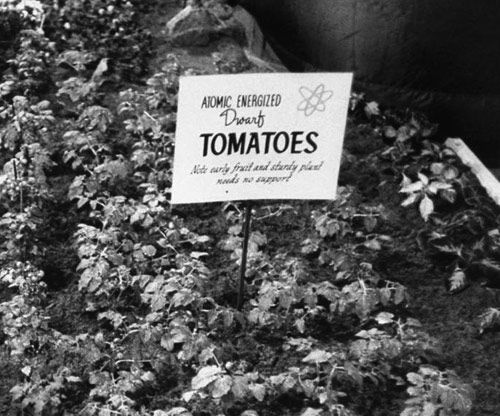
What’s more, the Times adds, nearly 2,000 gamma radiation-induced mutant crop varieties have been registered around the world, including Calrose 76, a dwarf varietal that accounts for about half the rice grown in California, and the popular Star Ruby and Rio Red grapefruits, whose deep colour is a mutation produced through radiation breeding in the 1970s. Similarly, Johnson tells Pruned that “most of the global production of mint oil,” with an annual market value estimated at $930 million, is extracted from the “wilt-resistant ‘Todd’s Mitcham’ cultivar, a product of thermal neutron irradiation.” She adds that “the exact nature of the genetic changes that cause it to be wilt-resistant remain unknown.”
Now, I’m not here to judge anyone, but I’m totally judging: this is insane. A gender cake party goes like this:
My husband and I would like to do a cake party to find out the sex of our baby. So basically we will have the ultrasound tech put the sex of the baby in an enveloppe and we will give that enveloppe to our cake maker. The inside of the cake will either be pink or blue so when we cut into it our family, friends, as well as ourselves will find out what were having. We planned on having our close family and freinds over for this big moment….sounds lovely right?
Another thing they love is magic — and recent culinary discoveries have opened up extraordinary possibilities for the chef to serve things that the customers had never thought were possible. Foods that change temperature when you eat them, a cup of tea that is cold on one side and hot on the other, an edible menu, a “Styrofoam” beaker that turns into a bowl of ramen when the server pours hot water over it, edible clay and rocks, a pocket watch that turns into mock-turtle soup, a bar of soap covered in foam that is actually a biscuit with honey bubbles, a milkshake volcano — these are the kinds of thing with which the modernist chefs amaze their audience.
“Marshmallow pillows are terrific,” shouted Mr. Wonka as he dashed by. “They’ll be all the rage when I get them into the shops! No time to go in, though! No time to go in!”
Lickable Wallpaper for Nurseries, it said on the next door.
“Lovely stuff, lickable wallpaper!” cried Mr. Wonka, rushing past. “It has pictures of fruits on it — bananas, apples, oranges, grapes, pineapples, strawberries, and snozzberries…”
“Snozzberries?” said Mike Teevee. “Don’t interrupt!” said Mr. Wonka. “The wallpaper has all these pictures of all these fruits printed on it, and when you lick the picture of the banana, it tastes of banana. When you lick a strawberry, it tastes of strawberry. And when you lick a snozzberry, it tastes just exactly like a snozzberry…”
“But what does a snozzberry taste like?”
“You’re mumbling again,” said Mr. Wonka. “Speak louder next time. On we go. Hurry up!”
Hot Ice Cream for Cold Days, it said on the next door.
“Extremely useful in the winter,” said Mr. Wonka, rushing on. “Hot ice cream warms you up no end in freezing weather. I also make hot ice cubes for putting in hot drinks. Hot ice cubes make hot drinks hotter.”
What you actually find when you arrive at L’Ami Louis is singularly unprepossessing. It’s a long, dark corridor with luggage racks stretching the length of the room. It gives you the feeling of being in a second-class railway carriage in the Balkans. It’s painted a shiny, distressed dung brown. The cramped tables are set with labially pink cloths, which give it a colonic appeal and the awkward sense that you might be a suppository. In the middle of the room is a stubby stove that also looks vaguely proctological.
Kenji from Serious Eats went to In-N-Out, found a willing employee accomplice (“Awesome! I’ve been waiting for this day ever since I started working here!”), and proceeded to order one of everything off of the menu, the well-known secret menu, and the not-so-well-known super secret menu.
That should make you feel better about yourself when you tuck into the meat and cheese fest known as the Flying Dutchman — the ultimate Atkins-friendly menu item. Two slices of cheese melted between two burger patties. No rabbit food, no wimpy buns, just pure protein and fat. Want to kick up the manliness by yet another factor? Ask for a Flying Dutchman Animal Style and they’ll add a scoop of diced onions to the cheese. Pickles and spread will come on the side, so you’ll have to add them yourself. “I wish we could add the spread and pickles for you, but it’s just too messy for the cooks,” explained an apologetic Thomas. The result definitely wins the award for messiest menu item of all time.
In On Food and Cooking, Harold McGee notes that there is a liquidy part of the egg white and a viscous one. If you let the liquidy part drain, before poaching, you will have a beautiful poached egg. (People tell you to put vinegar or lemon juice in poaching water — this does nothing in my experience.) The problem was, my perforated spoons were so shallow the egg always wanted to jump out. No longer. The deep bowl of The Badass Perf spoon easily contains even a jumbo egg, as well as heaps of beans, vegetables, and pasta.
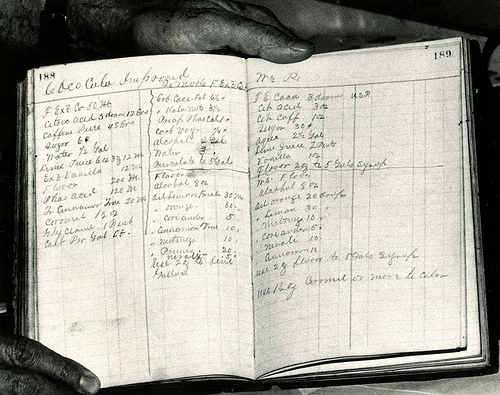
The formula for Coca-Cola is one of the most jealously guarded trade secrets in the world. So we were surprised to come across a 1979 newspaper article with what looked like the original recipe for Coke. Talking to historian Mark Pendergrast, author of For God, Country and Coca-Cola, we were even more surprised when we found reasons to believe the recipe is real.
For six months of the year, heralded chef Ferran Adrià and his team of experts concoct new dishes for the 30 course menu of the world famous El Bulli Restaurant. Here we watch their behind-the-scenes process, an artistic laboratory of tasting, smelling, designing and carefully recording each new idea, then selecting their top choices.
The two of them — the spare, driven artist and the comfortable, fluid patron — evoke a modern Michelangelo and Medici, bonded by mutual trust and now locked into a very public artistic endeavor. With Next, Mr. Achatz is operating at a level of creative and financial freedom enjoyed by very few artists and only a handful of chefs in history.
And this line got me more excited than I should admit:
A menu might be designed around a single day — say, the Napa Valley on Oct. 28, 1996, the day Mr. Achatz started work at the French Laundry, where he remained until 2001.
The moral logic in Pollan’s hugely successful book now informs all food writing: the refined palate rejects the taste of factory-farmed meat, of the corn-syrupy junk food that sickens the poor, of frozen fruits and vegetables transported wastefully across oceans-from which it follows that to serve one’s palate is to do right by small farmers, factory-abused cows, Earth itself. This affectation of piety does not keep foodies from vaunting their penchant for obscenely priced meals, for gorging themselves, even for dining on endangered animals-but only rarely is public attention drawn to the contradiction. This has much to do with the fact that the nation’s media tend to leave the national food discourse to the foodies in their ranks. To people like Pollan himself. And Severson, his very like-minded colleague at The New York Times. Is any other subculture reported on so exclusively by its own members? Or with a frequency and an extensiveness that bear so little relation to its size?
I tweeted earlier this evening about the Buffalo wings blue cheese dip I made for tomorrow’s football festivities and a couple people were wondering about the recipe, so here you go. Legend has it this is the original recipe from the Anchor Bar (aka the birthplace for Buffalo wings), clipped out of a Buffalo newspaper by Meg’s mother in the 70s and copied out longhand in Meg’s recipe notebook.
2 tbsp finely chopped onion
1 clove garlic, minced
1/4 cup finely chopped fresh parsley leaves
1/2 cup sour cream
1 cup mayonnaise
1 tbsp fresh-squeezed lemon juice
1 tbsp white vinegar
1/4 cup crumbled blue cheese
Salt, black pepper, and cayenne pepper to taste
Combine. Chill. Me? I did the onion and garlic first and then added the lemon juice and vinegar and let that sit while I measured out the mayo and sour cream. Salt and peppers after everything else is mixed. Tastes great! Go Buffalo!
Probably the most exciting thing about it is when you have real ice — that’s where the snow has been gradually compacted and eventually formed into ice, and the density has increased. When that happens, if the ice is old, it will often trap air bubbles in it. Those air bubbles can contain carbon dioxide from ten thousand years ago or even a hundred thousand years ago. And when you put an ice cube of that ice in a glass of water, it pops. It has natural effervescence as those gas bubbles escape. You get a little a puff of air into your nostrils if you have your nose over the glass. It’s not as though it necessarily smells like anything — but when you think about the fact that the last time that anything smelled that air was a hundred thousand years ago, that’s pretty interesting.
For his wedding reception, Mayewski had water from “Greenland ice and Antarctic ice” for his guests to drink. (thx, finn)
If I didn’t know any better, I’d have thought Twitter was built specifically for the purpose of cracking wise about the lack of everything on the everything bagel. In recent months, several tweetists have taken to site to complain in often amusing fashion:
Come on, Everything Bagels, who you tryin’ to fool? You got like 6 seasonings on there. That’s a lot, but it ain’t everything.
— @patrickmarkryan
Hey everything bagel, you don’t have everything on you, so shut the fuck up.
— @ihatejeffbaker
This “everything bagel” is great. Has onions, poppy seeds, garlic, cheese, q-tips, Greenland, fear, sandals, wolves, teapots, crunking…
— @johnmoe
You call this an everything bagel?! Where are the french fries & the pizza & the pot brownie & the Taco Bell fire sauce?!
— @ronniewk
Flossing after an everything bagel is important b/c as the name implies, you don’t just have *something* in your teeth, you have every thing.
— @phillygirl
Last time I had an everything bagel I got poppy seeds, Mira Sorvino, and Hegel’s Phenomenology of Spirit all over my shirt.
— @dwineman
The title “everything bagel” is a gross exaggeration.
— @avphibes
The “everything bagel” really only has like three things. Just what I want for breakfast. Lies.
— @missrftc
You might want to scale back on calling yourself an “everything bagel.” I mean, right away I can see there are no M&M’s on here.
— @friedmanjon
Aaand that’s about all there is to say about the everything bagel.
Life, on the Line is the forthcoming memoir of chef Grant Achatz about his early life, his training at The French Laundry under Thomas Keller, the opening of the reigning Best Restaurant in America, and his diagnosis of a life-and career-threatening illness. Somewhat unusually, the book was jointly written by Achatz and Nick Kokonas, his friend and business partner. The newly launched companion web site has more info, including excerpts.
“Chef, you have Ruth Reichl on line two,” one of the reservationists whispered to me as I peeled asparagus. I walked to the host area and saw the light for line two blinking; I grabbed the handle and pushed the button.
After exchanging greetings she spoke up. I was wildly and unexpectedly nervous.
“Grant, I don’t know if you know this, but every five years Gourmet does a restaurant issue where we rank the fifty best restaurants in the country.” I told her I recall seeing it back in 2001, and remembered that Chez Panisse coming in at number one and the Laundry at three.
“Well, the issue will come out this October, and I wanted to call you personally and tell you that we have chosen Alinea to be on the list.” She paused for dramatic effect. “At number one.”
Before we can figure out how to improve our end results, it’s important to understand exactly what’s going on when an onion browns. First, the onions begin by sweating. As they slowly heat up, moisture from their interior (they are roughly 75% water by weight) begins to evaporate, forcing its way out of the onion’s cells, and causing them to rupture in the process. This breakdown of the cells is what causes onions to soften during the initial stages of cooking.






Socials & More