



Soda Pop Stop
A short documentary about a grocery store in LA that sells only soda…500 different kinds and very little high fructose corn syrup.
And the store’s inventory seems to be mostly (or completely) glass bottles. (via @dunstan)

This site is made possible by member support. 💞
Big thanks to Arcustech for hosting the site and offering amazing tech support.
When you buy through links on kottke.org, I may earn an affiliate commission. Thanks for supporting the site!
kottke.org. home of fine hypertext products since 1998.
Beloved by 86.47% of the web.
A short documentary about a grocery store in LA that sells only soda…500 different kinds and very little high fructose corn syrup.
And the store’s inventory seems to be mostly (or completely) glass bottles. (via @dunstan)
From the Guardian, a review of a book called Meat: A Benign Extravagance by Simon Fairlie. In it, Fairlie argues that meat production isn’t actually that inefficient when done properly and veganism as an ethical response leaves something to be desired.
But these idiocies, Fairlie shows, are not arguments against all meat eating, but arguments against the current farming model. He demonstrates that we’ve been using the wrong comparison to judge the efficiency of meat production. Instead of citing a simple conversion rate of feed into meat, we should be comparing the amount of land required to grow meat with the land needed to grow plant products of the same nutritional value to humans. The results are radically different.
If pigs are fed on residues and waste, and cattle on straw, stovers and grass from fallows and rangelands — food for which humans don’t compete — meat becomes a very efficient means of food production. Even though it is tilted by the profligate use of grain in rich countries, the global average conversion ratio of useful plant food to useful meat is not the 5:1 or 10:1 cited by almost everyone, but less than 2:1. If we stopped feeding edible grain to animals, we could still produce around half the current global meat supply with no loss to human nutrition: in fact it’s a significant net gain.
New Yorker Clare Burson has in her possession a 117-year-old piece of cheese that belonged to her great grandfather.
The cheese was a going-away present for Burson’s paternal great-grandfather Charles Wainman (nee Yehezkel), upon his emigration from Lithuania, around 1893, to Johannesburg. For reasons lost to history, he never ate the cheese but kept it in a trunk that travelled with him while he worked as a trader among the Zulus, and then when he fought, on the Dutch side, in the Boer Wars.
Better than the real deal I’ve heard.
Warning: once you make edamame2003’s version, you may never be able to go back to commercial sriracha again. The vibrant color and piquancy of the fresh fresno peppers, combined with plenty of garlic and a boost of vinegar, make for a zippy, versatile condiment that would be great with anything from banh mi to scrambled eggs.
(via dj)
Pseudovariety — “the illusion of diversity, concealing a lack of real choice” — is when you go to the store and see an entire aisle filled with hundreds of different kinds of soda but most of those soda varieties are owned by three companies. Click through to see a neat visualization of soft drink brands and their market shares and owners.
Roger Ebert’s eating career is over, but his career as a food writer is just taking off. His new cookbook, which comes out in three weeks, is about how to prepare just about any meal in a rice cooker.
He both writes and thinks about food in the present tense. Ask about favorite foods and he’ll scribble a note: “I love spicy and Indian.” An offer to bring some New Jersey peaches to his summer home here on the shore of Lake Michigan brings a sharp defense of Michigan peaches and a menu idea. “Maybe for dessert we could have a salad of local fresh fruits.”
“Food for me is in the present tense,” he said. “Eating for me is now only in the past tense.” He says he has a “voluptuous food memory” that gets stronger all the time.
“I can remember the taste and smell of everything, even though I can no longer taste or smell,” he said.
Here are the opening couple of paragraphs from the post that evolved into the cookbook:
First, get the Pot. You need the simplest rice cooker made. It comes with two speeds: Cook, and Warm. Not expensive. Now you’re all set to cook meals for the rest of your life on two square feet of counter space, plus a chopping block. No, I am not putting you on the Rice Diet. Eat what you like. I am thinking of you, student in your dorm room. You, solitary writer, artist, musician, potter, plumber, builder, hermit. You, parents with kids. You, night watchman. You, obsessed computer programmer or weary web-worker. You, lovers who like to cook together but don’t want to put anything in the oven. You, in the witness protection program. You, nutritional wingnut. You, in a wheelchair.
And you, serving in Iraq or Afghanistan. You, person on a small budget who wants healthy food. You, shut-in. You, recovering campaign worker. You, movie critic at Sundance. You, sex worker waiting for the phone to ring. You, factory worker sick of frozen meals. You, people in Werner Herzog’s documentary about life at the South Pole. You, early riser skipping breakfast. You, teenager home alone. You, rabbi, pastor, priest,, nun, waitress, community organizer, monk, nurse, starving actor, taxi driver, long-haul driver. Yes, you, reader of the second-best best-written blog on the internet.
There’s also a Q&A on the Times site with Ebert.
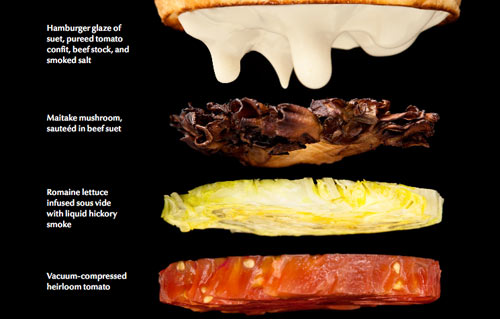
Microsoft billionaire Nathan Myhrvold’s monster 2400-page cookbook will be out in December but you can preorder it now for only $500. That’s steep but the book’s got some great blurbs from the likes of McGee, Blumenthal, Adrià, and Chang. A 20-page excerpt is available if you need convincing.
From Alan Richman in GQ, some no-nonsense guidelines for ordering wine at a restaurants.
14. I don’t care if the restaurant is pouring Chateau Latour into Minnie Mouse mugs, don’t walk into a restaurant carrying your own wine glasses. It’s more pretentious than wearing a monocle and spats.
One of the drinks that the Alinea crew is tinkering with for Aviary (a cocktail bar with food pairings) is like bubble tea crossed with gin and tonic.
(via svn)
To keep your bubbly bubbly, serve it cold and pour it like a beer into a tilted glass.
The beer-like way of serving champagne was found to impact its concentration of dissolved CO2 significantly less. Moreover, the higher the champagne temperature is, the higher its loss of dissolved CO2 during the pouring process, which finally constitutes the first analytical proof that low temperatures prolong the drink’s chill and helps it to retain its effervescence during the pouring process.
If you are filming a Girls Gone Wild video or are in the late stages of a wedding reception, pouring champagne directly into a person’s mouth is also an effective bubble-preservation technique. (via @matthiasrascher)
Jamon Iberico, the so-called “best ham in the world”, is made from a breed of pig that has been raised in Spain for 10,000 years. Fear of disease made it unavailable in the US until 2006, when one Spanish importer was finally approved. (An American company, La Quercia in Iowa, is also making waves, though purists will argue…)
In the 1500s, Spanish conquistadors exploring the new world would drop off pigs in the interest of creating a food source should they ever come back around that way again. These pigs were direct descendants of Iberian pigs, but as America settled, these pigs were passed over in favor of pigs easier to raise in captivity. Except for on Ossabaw Island, GA, where the breed remained mostly pure for 400 years. However, since pigs are about as destructive a breed as you can introduce into an ecosystem, Georgia has been working to cull the population on Ossabaw Island since 2000.
Thanks to the efforts of “hamthropologist” Peter Kaminsky, a few small farms in North Carolina are now raising Ossabaw pigs, and working to keep the breed alive. The Ossabaws suffer from insular dwarfism, making the pigs smaller, and low-grade diabetes caused by an advanced fat-storing tendency, but Kaminsky says the meat is a close approximation.
Things I learned from this article about a Thomas’ English muffin executive who wants to take a new job with Hostess Foods.
Only seven people “worldwide…know the recipe and manufacturing process that give Thomas’ English muffins their trademark ‘nooks and crannies’.”
Thomas’ English muffins’ parent company is named Bimbo USA.
Bimbo USA is a Division of a Mexican conglomerate called Grupo Bimbo.
English muffins, not found in England, are an American invention now sold by a Mexican company. Still completely delicious, though.
The number of states with an adult obesity rate of 30 percent or more has tripled, to nine, since 2007, the Centers for Disease Control and Prevention said in a report today. Mississippi had the highest rate, 34 percent. About 75 million Americans are considered obese, the Atlanta-based CDC said.
If less people drink sugary drinks, less fewer people will be obese.
It’s not all bad news, though, as school cafeterias are mobilizing to prevent things like this:
‘You’ve got gray, mushy broccoli out? They take a bite of that, and they may never eat broccoli again. Ever. Their whole lives,’ Schwisow said, her eyes wide.
Michael Pollan on $4 peaches and $8 for a dozen eggs.
The NYT on $10 ice cream.
And for those of you who have ever wanted to get pizza from a vending machine…
Smoothie shop Jamba Juice is responding to McDonald’s jump into the smoothie market with a mock campaign selling a smooth and creamy cheeseburger smoothies. The video is a nice touch.
Somewhat related to this story, the large McDonald’s smoothies have more calories than a cheeseburger. But it’s the good kind of calories. Now all I want to know is if the smoothie cheeseburger has more calories than either the regular cheeseburger or the fruit smoothie.
The new menu at Alinea is 21 courses long and takes about 2.5 hours for a meal according to a Tweet by Alinea chef Grant Achatz. In June, Alinea announced they would only be offering one menu, down from two, though that menu was discussed as 15-16 courses.
Today in the excellent Food Lab series, Kenji Lopez-Alt reverse engineers the In-N-Out burger.
According to the In-N-Out nutrition guideline, replacing the Spread with ketchup results in a decrease of 80 calories per sandwich. I know that ketchup has about 15 calories per tablespoon, so If we estimate that an average sandwich has about 2 tablespoons of sauce on it (that’s the amount that’s inside a single packet), then we can calculate that the Spread has got about 55 calories per tablespoon (110 calories in two tablespoons of Spread minus 30 calories in 2 tablespoons of ketchup = 80 calories difference in the sandwich). With me so far?
It just so happens that relish has about the same caloric density as ketchup (15 calories per tablespoon), and that mayonnaise has a caloric density of 80 calories per tablespoon. Using all of this information and a bit of 7th grade algebra, I was able to quickly calculate that the composition of the Spread is roughly 62 percent mayo, and 38 percent ketchup/relish blend.
Here’s the recipe to make your own at home. Pairs well with make-at-home McDonald’s french fries. See also make-at-home Shake Shack burger.
This video of a robotic arm learning how to flip pancakes is surprisingly funny.
(via eater)
Here’s what it looks like when you put a variety of fruits and vegetables into an MRI machine.

Someone took all of the corn slices and stitched them together in some 3-D modeling software to remake the whole cobs. See also Big Mac MRI and hot dog MRI. (via mr)
The world’s oldest drinkable champagne has been discovered…it dates back to the time of Louis XVI and may have even been in his actual possession.
The corks kept their seal and the cold and dark of the deep Baltic preserved the champagne. Inside the bottle they found champagne, and not just champagne but drinkable champagne, complete with fizz. Ekstroem contacted champagne vintners Moet & Chandon, and they identified it with 98% certainty from the anchor marking on the cork as 18th century Veuve Clicquot.
According to records, Veuve Clicquot was first produced in 1772, but the first bottles were laid down for 10 years. “So it can’t be before 1782, and it can’t be after 1788-89, when the French Revolution disrupted production,” Ekstroem said.
ScienceBlogs has added a blog about “innovations in science, nutrition and health policy” sponsored by Pepsi to their roster. Posters to the blog will include Pepsi research staff. Some of the other bloggers on ScienceBlogs are not happy.
However, that said, I am completely mystified by ScienceBlogs’ latest development: adding the PepsiCo “nutrition” Blog. How does ScienceBlogs expect to maintain their (OUR) credibility as a science news source (we are picked up by Google news searches afterall) when they are providing paid-for content under the guise of news? Further, I cannot imagine what sorts of credible nutrition research PepsiCo is doing that they can or will actually talk about publicly, nor can I possibly imagine any “food” corporation actually caring about promoting public health. PepsiCo is a corporation, not a research institute, fer crissakes!
(via @tcarmody)
Edible Geography pays a visit to La Central de Abasto in Mexico, a contender for the world’s largest wholesale food market.
La Central de Abasto de la Ciudad de México is enormous. It sprawls across a 327 hectare site on the eastern edge of the D.F., dwarfing fellow wholesale food markets such as Hunt’s Point (24 hectares), Tsukiji (23 hectares), or even the massive Rungis, outside Paris (232 hectares).
La Central has its own postcode, its own 700-member police force, and its own border-style entry gates, but during my visit, its enormity truly hit home only when we had to take a taxi to get from flowers to fish. It was a solid fifteen minute ride from one section of the market to another!
We just found this old bottle of Mellwood Whisky in Meg’s grandparents’ pantry. No date or anything on the label. Anyone know anything about it? I suspect it’s at least 50 years old…would it still be drinkable or would we go blind?
Paul Greenberg explores the current state of fishing for bluefin tuna and it’s not looking good.
Tuna then are both a real thing and a metaphor. Literally they are one of the last big public supplies of wild fish left in the world. Metaphorically they are the terminus of an idea: that the ocean is an endless resource where new fish can always be found. In the years to come we can treat tuna as a mile marker to zoom past on our way toward annihilating the wild ocean or as a stop sign that compels us to turn back and radically reconsider.
Greenberg has written extensively on this and related topics in his forthcoming book, Four Fish. Humans have primarily selected four mammals (cows, pigs, sheep and goats) and four birds (chickens, turkeys, ducks and geese) to utilize for food, and are now in the process of choosing four fish (cod, salmon, tuna, and bass).
From a collection of old menus from Colorado, the 1892 menu from a Denver restaurant called The Boston Bakery and Lunch Room (For Ladies and Gents).
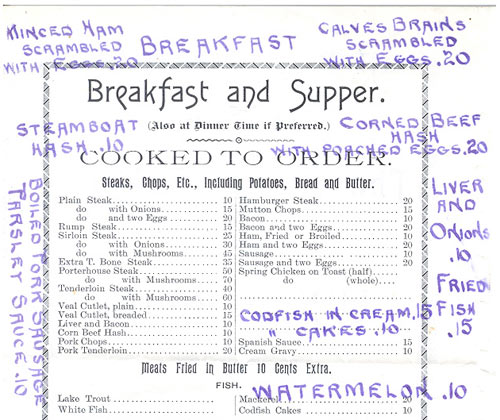
Porterhouse steak with mushrooms: 70 cents. This particular menu also contains a sort of customer bill of rights: an explanation of how waiters should treat customers and how the restaurant will catch you if you try to skip out on your check.
Now, we want your trade, and we do not care whether your check is 5¢ or $5; you will be rightly treated and correctly waited upon, or we will know the reason why, if you will only report any neglect to the head waiter or to us before leaving your seat.
The waiters are instructed to be civil and polite to every one, whether they are so to them or not, for even should the customer use bad manners, the waiter must not.
Have no conversation with the customer, except what is strictly necessary.
Give everyone a napkin who asks for it.
p>Give each one a glass of water as soon as seated.Be as quick and quiet as possible.
Place the orders down quietly; don’t slam them down.
Give each customer a check as son as you serve the order and see that it is kept in sight. Very few beats come in here, but experience has taught us that there are some. We will give any waiter $2.00 who will give us information that will enable us or the head waiter to detect any one in the act of Check Beating.
We want to call the customer’s attention to the fact that when we are looking at your checks and orders, it is as much to see that you are rightly served and not over-checked as that your not under-checked. Most would understand this but some might not.
See also the NYPL menu collection. (thx, micah)
Chinese masons used to make mortar using sticky rice. The practice originated at least 1500 years ago.
The secret ingredient that makes the mortar so strong and durable is amylopectin, a type of polysaccharide, or complex carbohydrate, found in rice and other starchy foods, the scientists determined. The mortar’s potency is so impressive that it can still be used today as a suitable restoration mortar for ancient masonry.
(via history blog)
A new Subway has recently opened in Manhattan…hanging on the outside of the 27th floor of the skeleton of 1 World Trade Center. The Subway will move upwards as the building is constructed and it is hoped that construction workers will dine there instead of heading off-site for long lunches via a slow hoist.
“I don’t think the veggies will be a big seller,” said Mr. Schragger, who owns four other Subways in Manhattan. “I imagine most of the guys will want protein. Philly Cheesesteaks and the Feast.”
Philly Cheesesteaks and the Feast would be a great name for a band.
I’ve only had a few of these…I am clearly not exercising my sandwich muscles enough these days. (Although the Brazilian sandwich at Project Sandwich has been treating me well lately.)
The manner in which tortillas and other bread are made in Mexico has had far-reaching societal effects.
Of course, there are trade-offs. Bimbo is not as good as a bolillo. A machine-made tortilla is not anything like a homemade tortilla — it’s not even in the same universe.
Mexican women that I have talked to are very explicit about this trade-off. They know it doesn’t taste as good; they don’t care. Because if they want to have time, if they want to work, if they want to send their kids to school, then taste is less important than having that bit of extra money, and moving into the middle class. They have very self-consciously made this decision. In the last ten years, the number of women working in Mexico has gone up from about thirty-three percent to nearly fifty percent. One reason for that-it’s not the only reason, but it is a very important reason-is that we’ve had a revolution in the processing of maize for tortillas.
This blog post and accompanying videos show you how to preheat your frying pan to the precise temperature at which your food won’t stick. It involves waiting until a small splash of water in the pan forms a single mercury-like ball that floats (literally!) around the pan. Too hot and the water will disperse into smaller balls; too cold and it’ll just boil off instantly.
The water “hovering” over the stainless steel pan like mercury happens due to the phenomenon known as the Leidenfrost effect. You can read more about it on wikipedia, but the basic idea is this: at a certain temperature known as the Leidenfrost point (roughly around 320F for water, but varying with surface and pressure), when the water droplet hits the hot pan, the bottom part of the water vaporizes immediately on contact. The resulting gas actually suspends the water above it and creates a pocket of water vapor that slows further heat transfer between the pan and the water. Thus it evaporates more slowly than it would at lower temperatures. At the proper temperature, a similar effect happens with the food you place in the pan, preventing the food from sticking.
This is possibly the best kitchen tip I’ve ever heard. (thx, jim)
My wife ate some pine nuts a few days ago and has had a weird metallic taste in her mouth ever since.
Monday for lunch I ate the leftovers, including a bunch of whole pine nuts that had fallen to the bottom of the dish. By Tuesday evening I had a weird taste in the back of my throat, so weird that when I when I woke up during the night, I couldn’t get back to sleep.
The taste was so bad that she doesn’t really feel like eating anything. That got me thinking: the pine nut diet. When you need to drop some pounds, eat a few of the offending pine nuts and boom!, eat as much as you want…as long as you can stand the taste.
P.S. Meg’s back to blogging over at Megnut.

Socials & More