kottke.org posts about NYC
Speaking of Mark Alan Stamaty, the illustrator did a pair of drawings in the late 1970s for the Village Voice: one of Times Square and one of Greenwich Village. They’re packed with details of how those areas were perceived in the 70s.
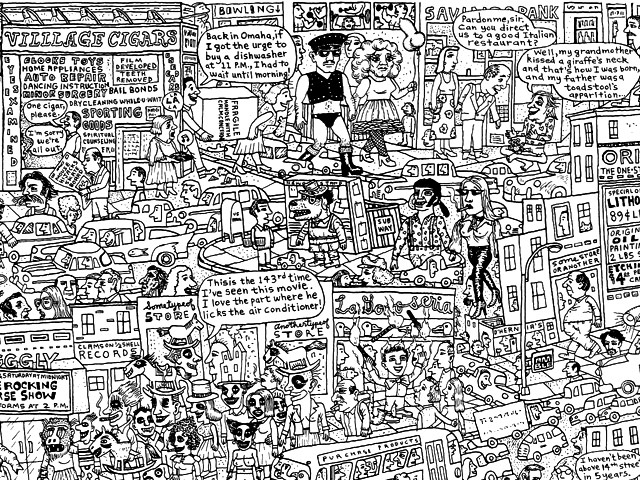
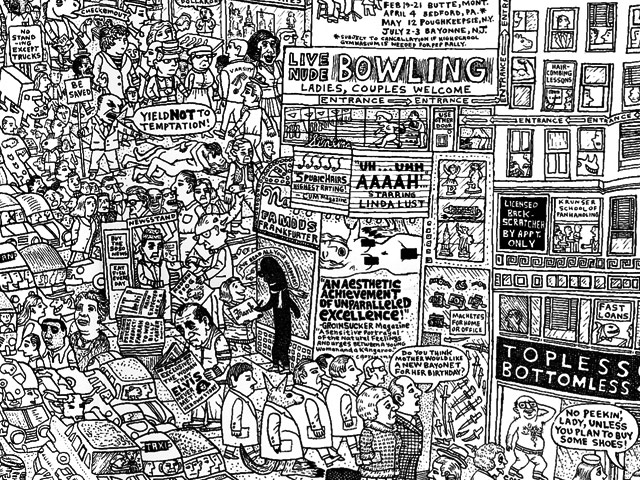
Prints of both are available.
Casey Neistat visited several Apple Stores in NYC on the eve of the iPhone 6 launch to observe the folks standing in line. He found that many of those in line, particularly right in the front, were Chinese resellers.
The iPhone 6 won’t be available in China for several months, so a lively and lucrative black market has sprung up. The video shows several typical transactions: two phones (the maximum allowed per person) are purchased with cash and then the people sell those phones to men who presumably have them shipped to China for resale.
I remember last year, when the iPhone 5s came out, there was always a line of mostly Asian people outside the Soho store in the morning, even months after the launch. (via @fromedome)
Join designer James Victore for an opinionated tour of the typography of Brooklyn and Queens.
We’re going to do a typographical tour of Brooklyn and Queens, We’re going to look at type on the street and signage on the street and try to figure out what the hell it’s for.
Favorite quote: [Pointing at a logo for a waxing salon] “There’s been a designer here. Which is not always a good thing.” (via gothamist)
This starts out ordinarily, but give it some time…it gets really good around 90 seconds in. The combination of panning and slow motion creates a powerful sense of energy around almost-still imagery; it’s a trippy effect. See also James Nares’ Street. (via subtraction)
Dang! It looks as though the Shake Shack is gonna IPO at a value of $1 billion. (BTW, $1 billion would buy you about 210 million ShackBurgers.)
At that level, Shake Shack would debut at 50 times projected earnings of about $20 million this year, the people said, asking not to be named because the details are private. The company has tapped JPMorgan Chase & Co. and Morgan Stanley to manage the share sale, said the people.
That valuation would put it in line with other dining chains that have tapped into investor appetite for new stocks in recent years. El Pollo Loco Holdings Inc. (LOCO), which raised $123 million in July, now trades at about 60 times projected 2014 earnings, while Potbelly (PBPB) Corp. trades at over 64 times estimated earnings, data compiled by Bloomberg show.
The Shack has about 50 locations worldwide. But their flagship Madison Square Park location will be closing for a few months soon for renovations…hopefully they’ll have it back open for the IPO.
Update: And the Shack filed for their IPO on Dec 29, 2014.
Shake Shack is a modern day “roadside” burger stand serving a classic American menu of premium burgers, hot dogs, crinkle-cut fries, shakes, frozen custard, beer and wine. Founded by Danny Meyer’s Union Square Hospitality Group, LLC (“USHG”), Shake Shack was created leveraging USHG’s expertise in community building, hospitality, fine dining, restaurant operations and sourcing premium ingredients. Danny’s vision of Enlightened Hospitality guided the creation of the unique Shake Shack culture that, we believe, creates a differentiated experience for our guests across all demographics at each of the 63 Shacks around the world. As Shake Shack’s Board Chairman and USHG’s Chief Executive Officer, Danny has drawn from USHG’s experience creating and operating some of New York City’s most acclaimed and popular restaurants, including Union Square Cafe, Gramercy Tavern, Blue Smoke, The Modern, Maialino and Marta, to build what we believe is a new fine casual restaurant category in Shake Shack.
There are now 63 Shake Shacks. 63! I just wish the one across from the office would reopen. (via @caseyjohnston)
Update: From Tyler Cowen, Does the Shake Shack IPO mean you should stop eating there?:
A simple theory of IPOs suggests that they arrive when a product or company is experiencing “peak buzz,” or at least when the insiders in the privately held company think they are at or near peak buzz. This will maximize the expected returns on the IPO when it comes to market.
When it comes to food, peak buzz usually arrives a wee bit after peak quality, given reputational lags. So if you are seeing peak buzz, it is probably time to bail on the restaurant, at least on a restaurant which is going to be sold. Bailing on the restaurant may in fact be slightly overdue.
To test Cowen’s theory1, I went to the Shake Shack in Grand Central today (12/31/14). I stood in line for 10 minutes, ordered my customary Shack burger with fries (long live the crinkle cut), and then waited an additional 10 minutes for my food. Verdict: as delicious as ever. Service was snappy and friendly. Well worth the wait and price for me: I got exactly what I wanted.
In 1984, Daniel Root took photos of the East Village in NYC. Root is revisiting the locations of those photos and posting comparisons to a Tumblr.
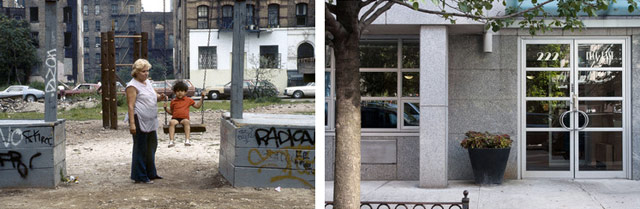
Wish the images were bigger…370x250 is more of a 1984 resolution.
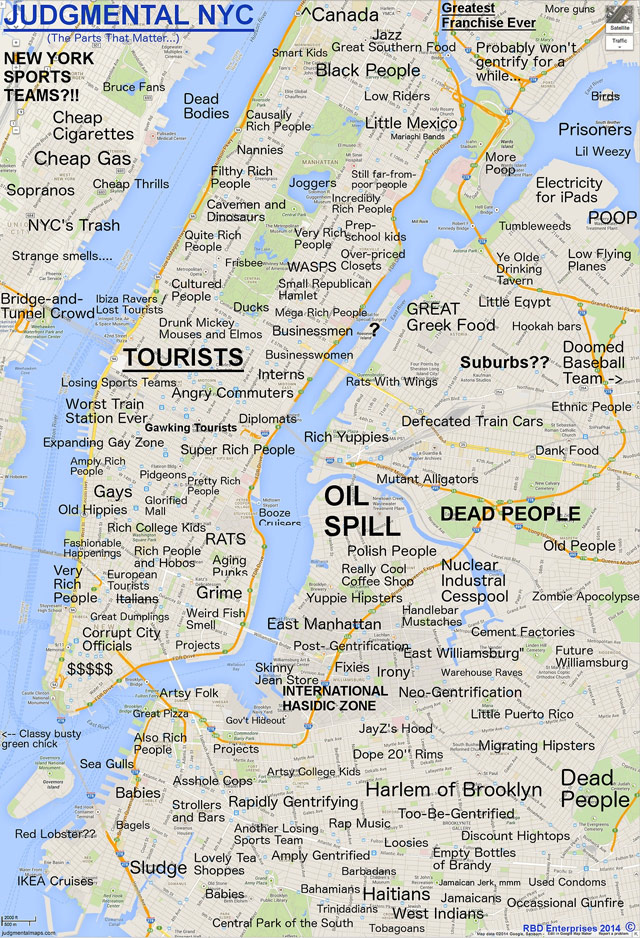
Tumblr of maps of cities with stereotypical labels. For example, NYC, land of Nuclear Industrial Cesspool, Asshole Cops, and Worst Train Station Ever.
(via subtraction)
In the latest installment of his excellent series Ask A Native New Yorker, Jake Dobkin tackles the question of how to react to those people holding clipboards asking if you have a minute for the environment or gay rights or whatever. The short answer is ignore them with “EXTREME PREJUDICE”.
This is because Clipboard People are grifters, who, in the name of various causes (Gay Rights, the Environment), have only a single aim: to get your credit card number authorized for recurring payments to a “charity.” In fact, the majority of that money does not go to the charity, but goes to pay the salary of the Clipboarder, and the evil canvas organizations that employ them. Even worse, the Clipboarders are themselves exploited-often young idealists from less vicious places, they are brought to New York on the promise of helping a charity they believe in, only to find out they’ve been dragooned into a commission-based predatory marketing scheme.
Well, good because that’s what I’ve been doing (for other reasons). Instead, give to an efficient charity listed on Charity Navigator.
Today I learned that iconic designer Milton Glaser co-wrote a column for New York magazine (which he co-founded) about where to find cheap-but-good food in NYC. It was called The Underground Gourmet. Here’s a typical column from the October 27, 1975 issue, reviewing a ramen joint in Midtown called Sapporo that is miraculously still around:
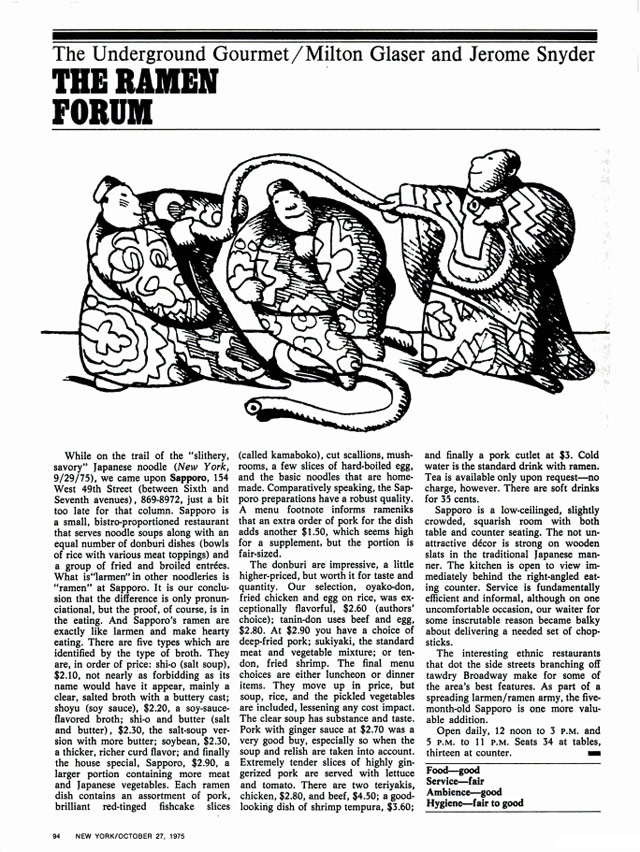
Glaser and his co-authior Jerome Snyder eventually packaged the column into a series of books, some of which you can find on Amazon…I bought a copy this morning.
I found out about Glaser’s food enthusiasm from this interview in Eye magazine about The Underground Gourmet and his long collaboration with restaurateur Joe Baum of the Rainbow Room and Windows on the World.
We just walked the streets … When friends of ours knew we were doing it we got recommendations.
There were parts of the city where we knew we could find good places … particularly in the ethnic parts. We knew if we went to Chinatown we would find something if we looked long enough, or Korea Town, or sections of Little Italy.
More then than now, the city was more locally ethnic before the millionaires came in and bought up every inch of space. So you could find local ethnic places all over the city. And people were dying to discover that. And it was terrific to be able to find a place where you could have lunch for four dollars.
In 2010, Josh Perilo wrote an appreciation of The Underground Gourmet in which he noted only six of the restaurants reviewed in the 1967 edition had survived:
Being obsessed with the food and history of New York (particularly Manhattan), this was like finding a culinary time capsule. I immediately dove in. What I found was shocking, both in the similarities between then and now, and in the differences.
The most obvious change was the immense amount of restaurants that no longer existed. These were not landmarked establishments, by and large. Most of them were hole-in-the wall luncheonettes, inexpensive Chinese restaurants and greasy spoons. But the sheer number of losses was stunning. Of the 101 restaurants profiled, only six survive today: Katz’s Delicatessen, Manganaro’s, Yonah Schimmel’s Knishes Bakery, The Puglia and La Taza de Oro. About half of the establishments were housed in buildings that no longer exist, especially in the Midtown area. The proliferation of “lunch counters” also illustrated the evolution of this city’s eating habits. For every kosher “dairy lunch” joint that went down, it seems as though a Jamba Juice or Pink Berry has taken its place.
Man, it’s hard not get sucked into reading about all these old places…looking forward to getting my copy of the book in a week or two.
Update: Glaser’s co-author Jerome Snyder was also a designer…and no slouch either.
Until his recent incarceration, Wilfred Rose was a very successful pickpocket operating on the streets of NYC.
Some of the thieves have a shtick. There is Francisco Hita, who when caught touching someone’s wallet, pretends to be deaf, the police say, responding with gesticulations of incomprehension. There is an older man who pretends to be stricken by palsy while on a bus, and then uses a behind-the-back maneuver to infiltrate the pocket of the passenger next to him.
There are flashy dressers, like the 5-foot-3 Duval Simmons, whose reputation is so well known among the police that he says he sometimes sits on his hands while riding the subway, so he cannot be accused of stealing. Mr. Simmons, an occasional partner of Mr. Rose’s, said he honed his skills on a jacket that hung in his closet, tying bells to it to measure how heavy his hand was.
Mr. Rose’s notoriety stems from how infrequently he has been arrested, and how, at least in the last 15 years, he has never been caught in the act by plainclothes officers.
See also Adam Green’s fascinating piece on Apollo Robbins from The New Yorker. Especially the bit about surfing attention:
But physical technique, Robbins pointed out, is merely a tool. “It’s all about the choreography of people’s attention,” he said. “Attention is like water. It flows. It’s liquid. You create channels to divert it, and you hope that it flows the right way.”
Robbins uses various metaphors to describe how he works with attention, talking about “surfing attention,” “carving up the attentional pie,” and “framing.” “I use framing the way a movie director or a cinematographer would,” he said. “If I lean my face close in to someone’s, like this” — he demonstrated — “it’s like a closeup. All their attention is on my face, and their pockets, especially the ones on their lower body, are out of the frame. Or if I want to move their attention off their jacket pocket, I can say, ‘You had a wallet in your back pocket — is it still there?’ Now their focus is on their back pocket, or their brain just short-circuits for a second, and I’m free to steal from their jacket.”
This clever and well-done visualization shows where individual NYC taxis picked up and dropped off their fares over the course of a day.
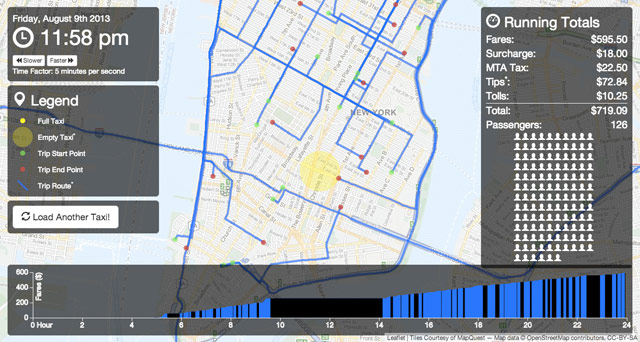
Mesmerizing. Has anyone done analysis on which drivers are the most effective and what the data shows as the most effective techniques? The best drivers must have their tricks on where to be at which times to get the most fares. (via @dens)
In the early 1930s, Western Union and AT&T built two new buildings in lower Manhattan to house their telecommunications infrastructure. Here’s a short film about their construction and ongoing use as hubs for contemporary telecom and internet communications.
Amazing that those buildings are still being used for the same use all these years later…they just run newer and newer technology through the same old conduits.
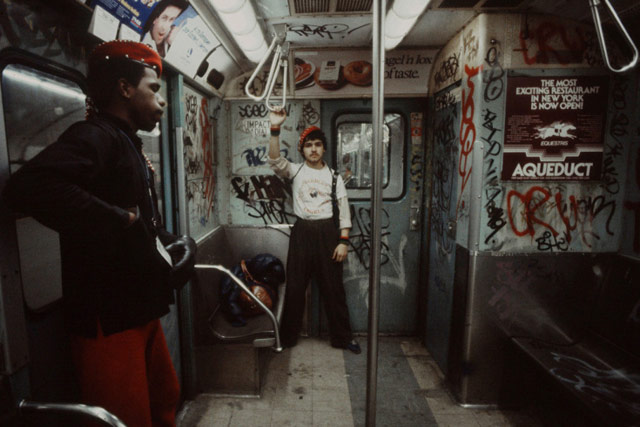
Nice episode of 99% Invisible on how New York City got rid of the graffiti on all of their subway trains.
For decades, authorities treated subway graffiti like it was a sanitation issue. Gunn believed that graffiti was a symptom of larger systemic problems. After all, trains were derailing nearly every two weeks. In 1981 there were 1,800 subway car fires — that’s nearly five a day, every day of the year!
When Gunn launched his “Clean Trains” program, it was not only about cleaning up the trains aesthetically, but making them function well, too. Clean trains, Gunn believed, would be a symbol of a rehabilitated transit system.
Remember, the train cars used to look like this:
NYC and the Central Park Five have agreed to a $40 million settlement that will bring a years-long civil rights lawsuit to an end.
The five men whose convictions in the brutal 1989 beating and rape of a female jogger in Central Park were later overturned have agreed to a settlement of about $40 million from New York City to resolve a bitterly fought civil rights lawsuit over their arrests and imprisonment in the sensational crime.
The agreement, reached between the city’s Law Department and the five plaintiffs, would bring to an end an extraordinary legal battle over a crime that came to symbolize a sense of lawlessness in New York, amid reports of “wilding” youths and a marauding “wolf pack” that set its sights on a 28-year-old investment banker who ran in the park many evenings after work.
Ken Burns made a documentary film about this case in 2012. Highly recommended viewing…and you can watch the whole thing on the PBS web site.
You’ve probably seen Bruce Davidson’s photos of the gritty 1980s NYC subway, which were collected into a book published in 1986.
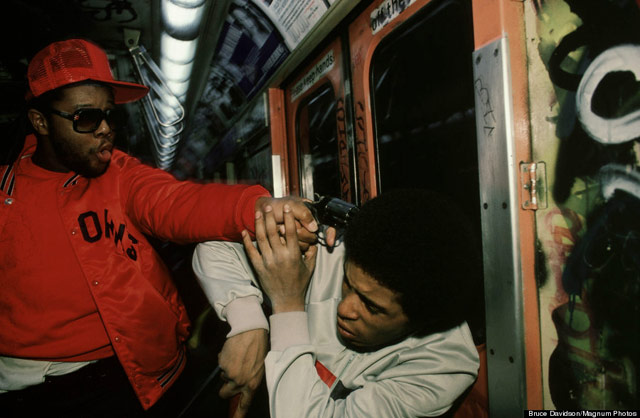
Earlier this year, Time posted some previously unpublished photos of the NYC subway taken in 1981 by Christopher Morris, an admirer of Davidson’s.
While not quite exhaustive in scope, Laura Turner Garrison’s piece in Mental Floss about how Manhattan neighborhoods got their names is worthwhile reading.
In recent decades, businesses and real estate agents have tried in vain to clean up the lively reputation of this west side neighborhood by renaming it “Clinton.” Gentrification and expansion from the neighboring theater district have certainly helped the beautification cause. Nonetheless, the area spanning 34th Street to 59th Street and 8th Avenue (or 9th, depending on who you ask) to the Hudson River just can’t shake the nickname “Hell’s Kitchen.”
Not included in the piece is the East Village, which was part of the Lower East Side until the 1960s, when the neighborhood’s new residents (artists, hippies, Beatniks) and real estate brokers recast the area as the eastern outpost of Greenwich Village. (via digg)
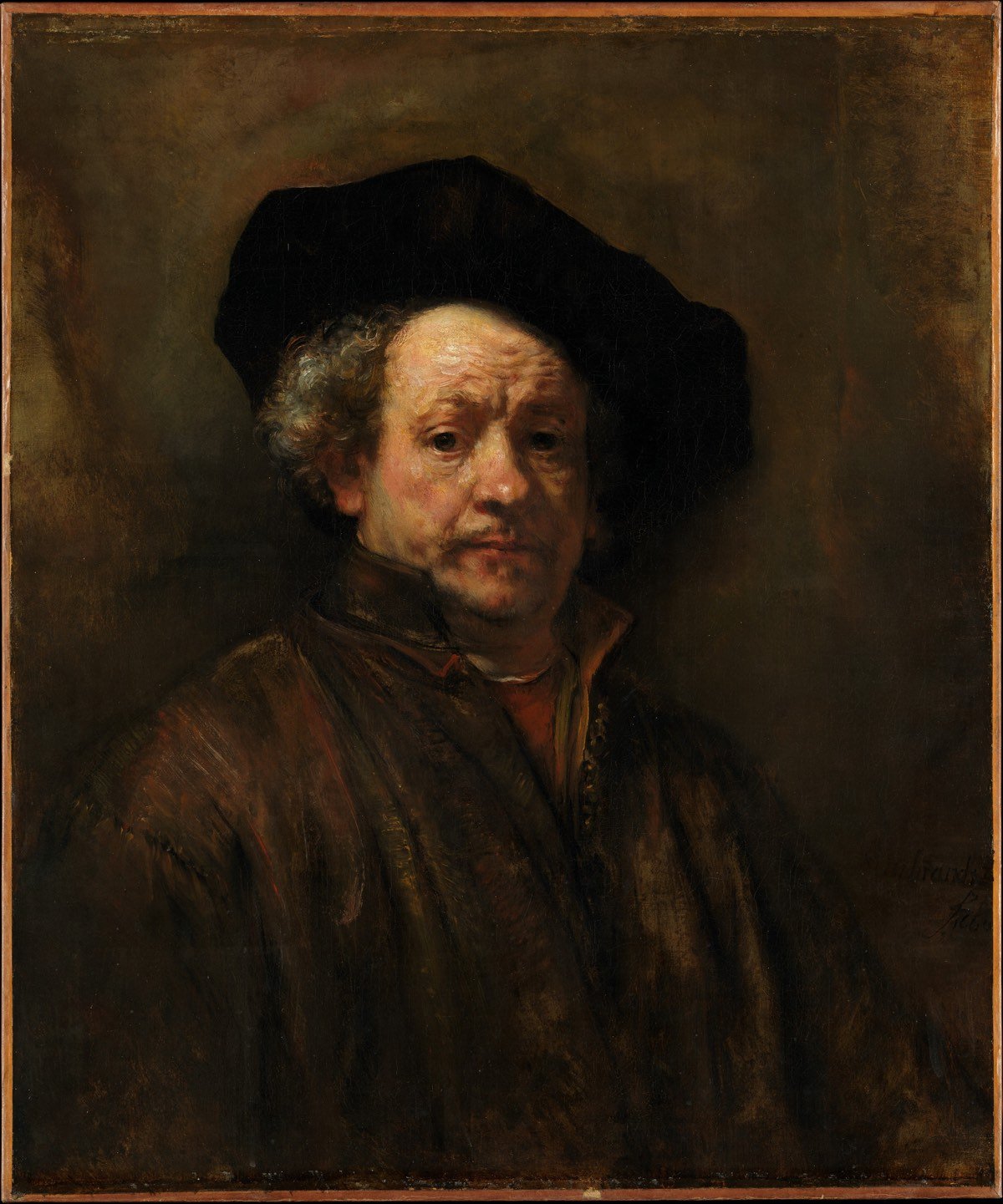
NYC’s Metropolitan Museum of Art has made a whopping 400,000 high-resolution digital images of its collection available for free download. You can browse the collection here.
In making the announcement, Mr. Campbell said: “Through this new, open-access policy, we join a growing number of museums that provide free access to images of art in the public domain. I am delighted that digital technology can open the doors to this trove of images from our encyclopedic collection.”
The Metropolitan Museum’s initiative-called Open Access for Scholarly Content (OASC)-provides access to images of art in its collection that the Museum believes to be in the public domain and free of other known restrictions; these images are now available for scholarly use in any media.
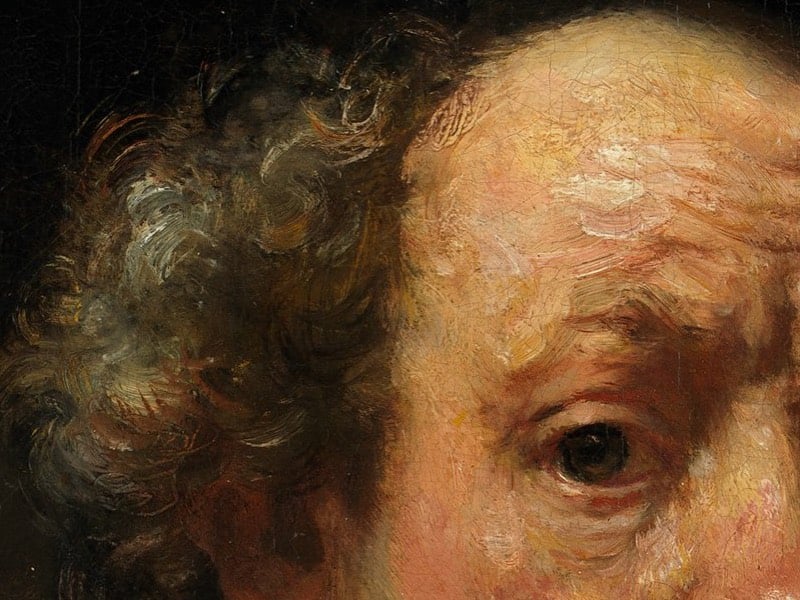
For instance, here’s a 12-megapixel image of Rembrandt’s 1660 self-portrait…you can see quite a bit of detail:
(thx, fiona)
Update: Wendy Macnaughton on why the high-resolution images released by the Met are such a big deal for art students and art history fans.
For someone who went to art school being able to do this is a revelation. I used to go to the museum with my sketchpad and copy the old masters. I’d get as close as I could to understand the brush strokes, colors, lines. The guards knew who to watch out for and would bark suddenly when we stuck our faces over the imaginary line.
As class assignments we were required to copy hundreds — literally hundreds — of the masters drawings and paintings. for those we mostly worked from images in books — a picture the size of a wallet photo.
Which is one of the many reasons this new met resource is fucking phenomenal.
You can get so, so close — far closer than one could in real life.
Update: Today (Feb 7, 2017) the Met announced that they’re releasing 375,000 images under Creative Commons’ CC0 license, which “allows anyone to use, re-use, and remix a work without restriction”. Previously, those works were restricted to non-commercial use only.
The Wordless Music Orchestra will offer live accompaniment of two screenings of There Will Be Blood in NYC in September. The composer of the film’s score, Radiohead’s Jonny Greenwood, will play a musical instrument called the ondes Martenot as part of the performances.
This fall, the Wordless Music Orchestra will once again collaborate with Jonny Greenwood for the U.S. premiere of There Will Be Blood Live: a full screening and live film score to Paul Thomas Anderson’s 2007 masterpiece, which will be projected onto a massive 50’ movie screen at the historic and absurdly beautiful United Palace Theatre: the second-largest movie screen in all of New York City.
For these shows, the film’s original score — comprising music by Jonny Greenwood, Arvo Part, and Brahms — will be conducted by Ryan McAdams, and performed by 50+ members of the Wordless Music Orchestra, including Jonny Greenwood, who will play the ondes martenot part in both performances of his own film score.
Tickets on sale now. See you there? (thx, gabe)
NYCgo has an extensive list of all free movie screenings happening around NYC this summer. Most of them are outdoors. Some highlights:
June 22: Coming to America, Habana Outpost
July 9: Jurassic Park, Museum of Jewish Heritage
July 30: The Princess Bride, Riverside Park
July 31: The Hunt for Red October, flight deck of the Intrepid
August 6: The Big Lebowski, McCarren Park
August 8: Groundhog Day, Hudson River Park at Pier 46
Someone should make an iCal/Google Calendar calendar of these screenings.
Update: Tim made a calendar of all the free movie events. (thx, tim!)
Update: And here’s a Twitter account you can follow for summer movie reminders: @nycsummerfilms. (via frank)
You may have previously read about the Citicorp Center. Joe Morgenstern wrote about the Manhattan skyscraper in a classic New Yorker piece from 1995. The building was built incorrectly and might have blown over in a stiff wind if not for a timely intervention on the part of a mystery architecture student and the head structural engineer on the project.
Tells about designer William J. LeMessurier, who was structural consultant to the architect Hugh Stubbins, Jr. They set their 59-story tower on four massive nine-story-high stilts and used an unusual, chevron-shaped system of wind braces. LeMessurier had established the strength of those braces in perpendicular winds. Now, in the spirit of intellectual play, in his Harvard class, he wanted to see if they were just as strong in winds hitting from 45 degrees. He discovered the design flaw and during wind tunnel tests in Ontario learned the weakest joint was at the building’s 30th floor.
The whole piece is here and well worth a read. Last month, the excellent 99% Invisible did a radio show about Citicorp Center and added a new bit of information to the story: the identity of the mystery student who prodded LeMessurier to think more deeply about the structural integrity of his building. (via @bdeskin, who apparently factchecked Morgenstern’s piece back in the day)
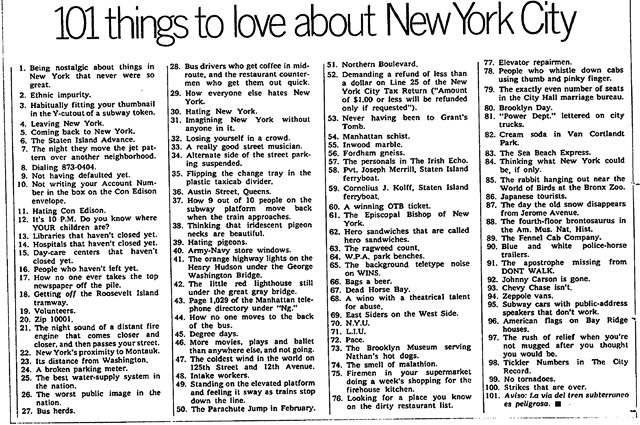
From the NY Times Magazine in June 1976, a list of 101 things to love about New York City. Some of the list is evergreen:
1. Being nostalgic about things in New York that were never so great.
11. Hating Con Edison.
25. The best water-supply system in the nation.
42. The little red lighthouse still under the great gray bridge.
And other items on the list, not so much:
8. Dialing 873-0404.
24. A broken parking meter.
43. Page 1,029 of the Manhattan telephone directory under “Ng.”
57. The personals in The Irish Echo.
Scouting New York has an explanation of some of the items on the list. Apparently 873-0404 was the number for the Dial-A-Satellite hotline; you could call it to get information about satellites passing overhead. (via @mkonnikova)
“My kids used to love math! Now it makes them cry.” So tweeted Louis C.K. earlier this week. His opinion of the new math and standardized tests is echoed by a lot of parents who “have found themselves puzzled by the manner in which math concepts are being presented to this generation of learners as well as perplexed as to how to offer the most basic assistance when their children are struggling with homework.” Rebecca Mead in the The New Yorker: Louis C.K. Against the Common Core.
From the incredible British Pathé archive, film footage from 1893 of the New York City fire brigade rushing to a fire.
Filmed nearly 120 years ago, this is quite possibly the first ever footage of the New York Fire Brigade. The film is very grainy but it clearly shows firemen rushing through New York on horse drawn engines. Behind them, you can see some sort of electric powered streetcar or trolley system with ‘Clinton Avenue’ on the back.
Man, I really like these paintings from Jeremy Mann’s Cityscape series. Particularly the NYC street scenes, like this one in Hell’s Kitchen:
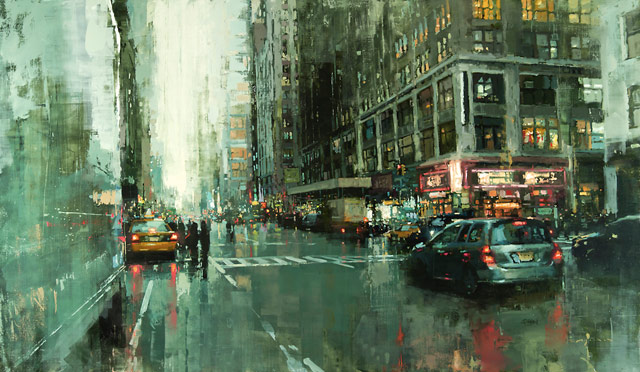
Mann’s paintings seem to hold a lot of detail, even up close, but there are also broader strokes visible only from afar. Not sure if that’s novel (unlikely) but I haven’t seen it elsewhere. (via colossal)
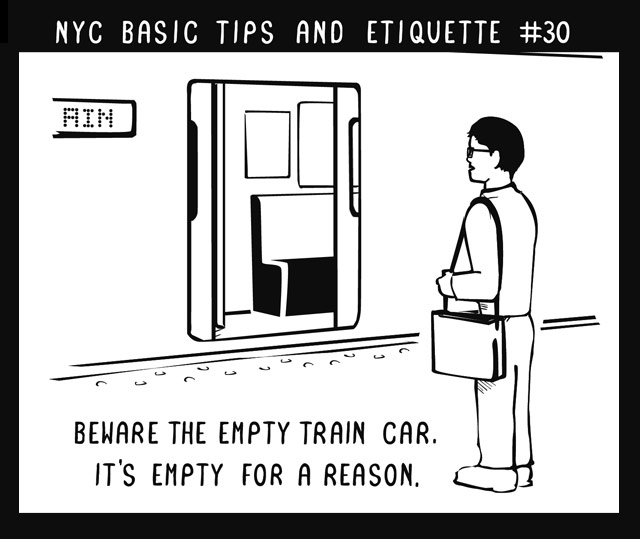
Nathan Pyle has written and illustrated a book about the unwritten rules for how to behave on the streets of NYC. It’s called NYC Basic Tips and Etiquette (only $6!).
In NYC Basic Tips and Etiquette, Pyle reveals the secrets and unwritten rules for living in and visiting New York including the answers to such burning questions as, how do I hail a cab? What is a bodega? Which way is Uptown? Why are there so many doors in the sidewalk? How do I walk on an escalator? Do we need be touching right now? Where should I inhale or exhale while passing sidewalk garbage? How long should I honk my horn? If New York were a game show, how would I win? What happens when I stand in the bike lane? Who should get the empty subway seats? How do I stay safe during a trash tornado?
In support of the book, Pyle animated a few of the tips and put them on Imgur. Also, the Apple ebook contains the animated versions of the illustrations. You fancy!
Data visualization of Citi Bike trips taken over a 48-hour period in NYC:
Love seeing the swarms starting around 8am and 5:30pm but hate experiencing them. I’ve been using Citi Bike almost since the launch last year and I can’t imagine NYC without it now. I use it several times daily, way more than the subway even. I hope they can find a way to make it a viable business.
Drone Week on Kottke continues with this beautiful drone video of NYC from Randy Scott Slavin.
I found two more videos and a bunch of stories about a drone crashing a crime scene last year. (thx, noah)
For the first post on his new blog, Tobias Frere-Jones discovers that most of the type foundries in New York in the 1800s and 1900s were all located within a few blocks of each other in lower Manhattan. Why there? Newspapers and City Hall.
I was able to plot out the locations for every foundry that had been active in New York between 1828 (the earliest records I could find with addresses) to 1909 (see below). All of the buildings have been demolished, and in some cases the entire street has since been erased. But a startling picture still emerged: New York once had a neighborhood for typography.
Gruber beat me to the punch in noting that Frere-Jones’ site doesn’t use any of the fonts from the company he was recently ousted from but instead a pair of faces (Benton Modern and Interstate) he designed before he formed his partnership with Jonathan Hoefler. Before I discovered Whitney (another Frere-Jones creation), Interstate was my go-to font for graphics for the site. Big TFJ fan, is what I’m saying.
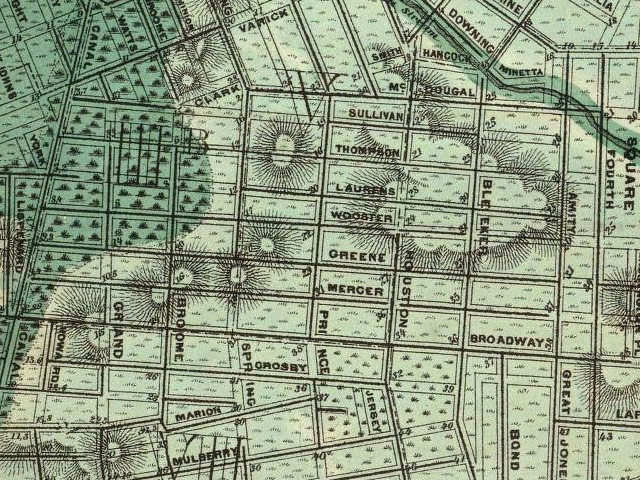
Last week, the New York Public Library released a massive collection of maps online…over 20,000 maps are available for high-resolution download. An incredible resource.
The MoMA is hosting a series of debates on the intersection of design and violence. The first one took place last week and pitted Rob Walker against Cody Wilson on the topic of open source 3D printed guns. The next two center on a machine that simulates the “pain and tribulation” of menstruation and Temple Grandin’s humane slaughterhouse designs.
The debates this spring will center upon the 3-D printed gun, The Liberator; Sputniko!’s Menstruation Machine; and Temple Grandin’s serpentine ramp. Debate motions will be delivered by speakers who are directly engaged in issues germane to these contemporary designs — the Liberator’s designer Cody Wilson; Chris Bobel, author of New Blood: Third-Wave Feminism and the Politics of Menstruation, and distinguished professor of law Gary Francione, to name a few. We want them — and you — to explore the the limits of gun laws and rights, the democracy of open-source design, the (im)possibility of humane slaughter, and design that supports transgender empathy.
Tickets are still available; only $5 for students!
Newer posts
Older posts






Socials & More