kottke.org posts about NYC
Shuttered storefronts. Abandoned retail locations. Small businesses that fall like the House of Cards & Curiosities on Eighth Avenue. These are the signs of urban blight we usually associate with economic downturns or poor, forgotten neighborhoods. But these shuttered storefronts are in one of America’s wealthiest neighborhoods; NYC’s West Village. As The New Yorker’s Tim Wu explains, some urban blight emerges when economic times are too good and rents get too high. And we’re not just talking about mom and pop here. Even Starbucks is closing some Manhattan locations due to rent hikes.
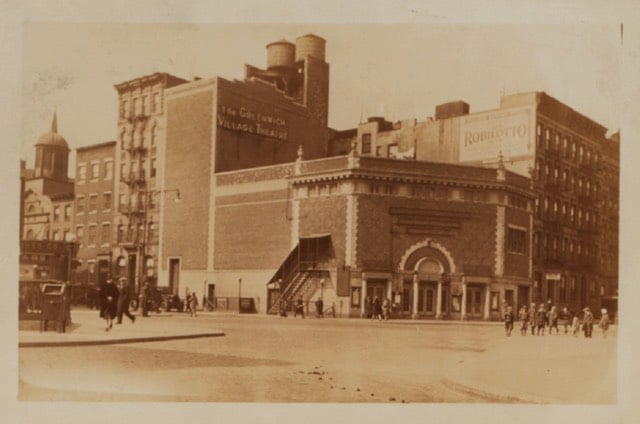
OldNYC offers a map view of old photos of New York City, drawn from the collection at the New York Public Library. This is fantastic, like a historical Google Street View. For instance, there used to be a huge theater on the corner of 7th Avenue and Christopher St, circa 1929:
If I didn’t have a thing to do this afternoon, I would spend all day exploring this. So so good. (via @mccanner)
Conrad Milster is the chief engineer at the Pratt Institute, which means he’s in charge of the 19th-century steam engines that provide the school’s heat and hot water. Dustin Cohen made this lovely short film about Conrad, an oddball who fits right into his life.
On the topic of New York, Conrad says, “It sucks, but it’s the Big Apple!” (via acl)
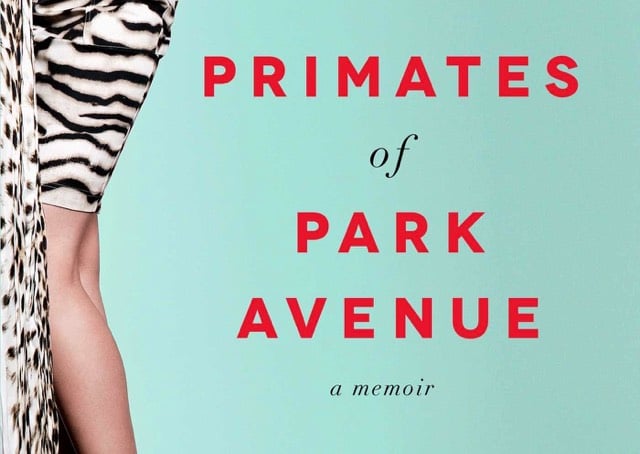
Wednesday Martin is an anthropologist and author whose upcoming book, Primates of Park Avenue, examines the wealthy stay-at-home moms of Manhattan’s Upper East Side like any other primate troop.
After marrying a man from the Upper East Side and moving to the neighborhood, Wednesday Martin struggled to fit in. Drawing on her background in anthropology and primatology, she tried looking at her new world through that lens, and suddenly things fell into place. She understood the other mothers’ snobbiness at school drop-off when she compared them to olive baboons. Her obsessional quest for a Hermes Birkin handbag made sense when she realized other females wielded them to establish dominance in their troop. And so she analyzed tribal migration patterns; display rituals; physical adornment, mutilation, and mating practices; extra-pair copulation; and more. Her conclusions are smart, thought-provoking, and hilariously unexpected.
Martin wrote an opinion piece in The New York Times about her findings called Poor Little Rich Women.
And then there were the wife bonuses.
I was thunderstruck when I heard mention of a “bonus” over coffee. Later I overheard someone who didn’t work say she would buy a table at an event once her bonus was set. A woman with a business degree but no job mentioned waiting for her “year-end” to shop for clothing. Further probing revealed that the annual wife bonus was not an uncommon practice in this tribe.
A wife bonus, I was told, might be hammered out in a pre-nup or post-nup, and distributed on the basis of not only how well her husband’s fund had done but her own performance — how well she managed the home budget, whether the kids got into a “good” school — the same way their husbands were rewarded at investment banks. In turn these bonuses were a ticket to a modicum of financial independence and participation in a social sphere where you don’t just go to lunch, you buy a $10,000 table at the benefit luncheon a friend is hosting.
Women who didn’t get them joked about possible sexual performance metrics. Women who received them usually retreated, demurring when pressed to discuss it further, proof to an anthropologist that a topic is taboo, culturally loaded and dense with meaning.
Please note that Martin’s book is a memoir…not an anthropological study, a memoir. I can’t wait to see how they turn this one into a movie.
Update: Polly Phillips in the NY Post: I get a wife bonus and I deserve it, so STFU.
These pricey pairs of designer footwear will join a lineup of Jimmy Choo, Manolo Blahnik, Diane Von Furstenburg and Rupert Sanderson heels and a closet crammed with handbags from Prada, Chanel and Anya Hindmarch. Every single one was bought with one of my annual bonuses — the nod from a happy boss for a job well done.
But, in this case, the boss in question is my husband, Al. The role he’s rewarding me for is my work as a stay-at-home wife and mother. And the luxury labels are purchased with the “wife bonus” — 20 percent of his own company bonus — that I’m proud to receive for putting his career before my own, and keeping our lives together.
After all, he readily admits that, without me staying at home with our 19-month-old daughter, Lala — not to mention the support and understanding I offer when his work intrudes on our home life — he couldn’t do his job. And he also knows that if we hadn’t followed his career abroad, I might still be doing very well in my own.
Weird thing #1: Phillips refers to her husband as her boss. No ironic scarequotes. He’s the boss. Which seems to be a point in favor of Martin’s thesis of a lack of empowerment.
Weird thing #2: Why the hell call it a “wife bonus” if their income is completely shared and they each get 20% of the end-of-year bonus? I mean, it seems completely reasonable and equitable that they each get some mad money to spend however they want on above-and-beyond items. Why load that arrangement down with the icky “wife bonus”?
Update: Remember when I said “Martin’s book is a memoir…not an anthropological study”? This is why: it turns out Martin monkeyed with the timelines quite a bit to create a better narrative.
She says she attended grueling exercise classes at Physique 57 to lose her baby weight after her second son’s birth. But the upscale gym did not exist when she claims to have exercised there.
She also describes a posh party where the guests bring the hostess gifts from an upscale macaroon shop. But Ladurée didn’t open in New York until 2011, four years after she had moved.
While at a lunch date just prior to the party, Martin and a friend do an accounting of how much their over-privileged peers spend on personal grooming, clothing and transportation. Her friend refers to Uber, even though the car service didn’t debut in the city until 2011.
The Times reports that the book’s publisher will append a note to future editions of the book explaining the tinkered details and timelines. (via @jtaylorhodge)
The real-life house that served as the stoop of Carrie Bradshaw’s apartment on Sex and the City is blurred out on Google Street View.
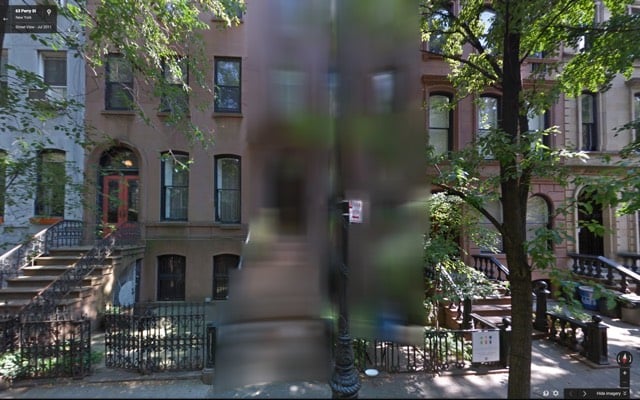
The house was on the Sex and the City tour for a time, before it was dropped due to pressure from neighborhood residents, and remains a popular tourist attraction. I go by there quite often and there is always someone taking a photo on the stoop. As I’m writing this, the most recent photo of someone standing in front of the stoop was posted to Instagram 16 minutes ago. I can see why the owners would want it blurred out, and it turns out getting your property blurred on Google Street View is a simple process.
P.S. What’s funny about the house is that Sarah Jessica Parker actually lives only a block or two away. I used to see her all the time, walking our respective kids to school. Ollie and I even got caught in a paparazzi shot one day…that’s me in the dark coat right behind Parker and Ollie on the scooter:

No way to fill out a form to blur out my son’s face though, I reckon. (via @michaeltsmith)
For lunch today, I was hungry for some noodles from Xi’an Famous Foods, one of my favorite places to eat in all of NYC. While preparing to trek to the East Village or up to Bryant Park, a friend told me about a relatively new location on 34th Street, just down the street from the Empire State Building and only 10 blocks from my office. When I looked it up on the website, I noticed something else: a real-time traffic meter that shows how busy each restaurant is.
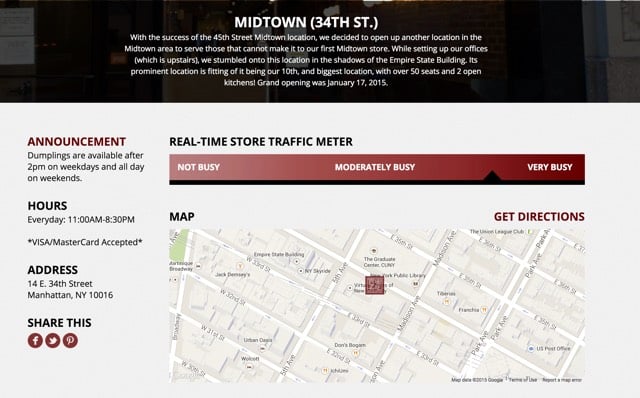
What a great idea. The Shake Shack cam is one thing, but I want a meter like this (w/ a forecast option as well) on every restaurant listing in Foursquare. Like Google Maps real-time traffic, except for restaurants.
From Sarah Nir at the NY Times, an investigation into the world of NYC nail salons, where workers need to pay a fee to get a job, are underpaid, subjected to abuse, and are crammed into one-bedroom apartments with several other workers.
Qing Lin, 47, a manicurist who has worked on the Upper East Side for the last 10 years, still gets emotional when recounting the time a splash of nail polish remover marred a customer’s patent Prada sandals. When the woman demanded compensation, the $270 her boss pressed into the woman’s hand came out of the manicurist’s pay. Ms. Lin was asked not to return.
“I am worth less than a shoe,” she said.
Prepare to be infuriated over and over as you read this.
The typical cost of a manicure in the city helps explain the abysmal pay. A survey of more than 105 Manhattan salons by The Times found an average price of about $10.50. The countrywide average is almost double that, according to a 2014 survey by Nails Magazine, an industry publication.
With fees so low, someone must inevitably pay the price.
“You can be assured, if you go to a place with rock-bottom prices, that chances are the workers wages’ are being stolen,” said Nicole Hallett, a lecturer at Yale Law School who has worked on wage theft cases in salons. “The costs are borne by the low-wage workers who are doing your nails.”
In a Q&A about the investigation, Nir shares how she became interested in nail salons:
About four years ago, I was at a 24-hour spa in Koreatown. It’s one of the Vogue top-secret best-bet salons — a really unusual place. It was my birthday, and I treated myself to a pedicure at 10 AM. And I said to the woman, “It’s so crazy that this is a 24-hour salon. Who works the night shift?” And she says, “I work the night shift.” And I said, “Well, it’s daytime. Who works the day shift? What do you mean?”
And she said, “I work six days a week, 24 hours a day, I live in a barracks above the salon, and on the seventh day, I go home to sleep in my bedroom in Flushing, and then I come right back to work.”
And I was like, This woman’s in prison. People had to shake her to keep her awake. And then she would do a treatment. I just thought it was crazy.
I don’t see how you can go to a NYC nail salon after reading this article. Even Nir’s tips about being a socially conscious nail salon customer aren’t much help.
Update: Part 2 of Nir’s series on nail salons is out. It’s about the health hazards faced by nail salon workers, including lung disease, miscarriages, and cancer. One woman even lost her fingerprints.
Similar stories of illness and tragedy abound at nail salons across the country, of children born slow or “special,” of miscarriages and cancers, of coughs that will not go away and painful skin afflictions. The stories have become so common that older manicurists warn women of child-bearing age away from the business, with its potent brew of polishes, solvents, hardeners and glues that nail workers handle daily.
A growing body of medical research shows a link between the chemicals that make nail and beauty products useful — the ingredients that make them chip-resistant and pliable, quick to dry and brightly colored, for example — and serious health problems.
Whatever the threat the typical customer enjoying her weekly French tips might face, it is a different order of magnitude, advocates say, for manicurists who handle the chemicals and breathe their fumes for hours on end, day after day.
The prevalence of respiratory and skin ailments among nail salon workers is widely acknowledged. More uncertain, however, is their risk for direr medical issues. Some of the chemicals in nail products are known to cause cancer; others have been linked to abnormal fetal development, miscarriages and other harm to reproductive health.
Update: Governor Cuomo has set up a task force to conduct investigations into the city’s nail salons.
Gov. Andrew M. Cuomo ordered emergency measures on Sunday to combat the wage theft and health hazards faced by the thousands of people who work in New York State’s nail salon industry.
Effective immediately, he said in a statement, a new, multiagency task force will conduct salon-by-salon investigations, institute new rules that salons must follow to protect manicurists from the potentially dangerous chemicals found in nail products, and begin a six-language education campaign to inform them of their rights.
Nail salons that do not comply with orders to pay workers back wages, or are unlicensed, will be shut down. The new rules come in response to a New York Times investigation of nail salons — first published online last week — that detailed the widespread exploitation of manicurists, many of whom have illnesses that some scientists and health advocates say are caused by the chemicals with which they work.
This is good news…as long as it results in real positive changes and doesn’t just get a bunch of salon workers deported.
Update: The Times continues its nail salon coverage with an interview with Sister Feng, a Chinese social media star who worked as a manicurist in NYC for four years.
Q. The Times reported that some immigrant manicurists said their bosses would withhold tips and verbally or physically abuse them. Did you ever experience this?
A. There were times when my tips were withheld. But as long as I thought my wages weren’t out of line with my labor, I wouldn’t go to my boss and ask for the tips. In nail salons run by Chinese, being verbally abused was commonplace, so I changed workplaces often. But it never happened in salons run by Koreans. I was never physically beaten.
(via mr)

Ben Fino-Radin of MoMA’s Department of Conservation wrote a brief post about how the museum manages their digital artworks, including a bit about how they think about futureproofing the collection.
The packager addresses the most fundamental challenge in digital preservation: all digital files are encoded. They require special tools in order to be understood as anything more than a pile of bits and bytes. Just as a VHS tape is useless without a VCR, a digital video file is useless without some kind of software that understands how to interpret and play it, or tell you something about its contents. At least with a VHS tape you can hold it in your hand and say, “Hey, this looks like a VHS tape and it probably has an analog video signal recorded on it.” But there is essentially nothing about a QuickTime .MOV file that says, “Hello, I am a video file! You should use this sort of software to view me.” We rely on specially designed software-be it an operating system or something more specialized-to tell us these things. The problem is that these tools may not always be around, or may not always understand all formats the way they do today. This means that even if we manage to keep a perfect copy of a video file for 100 years, no one may be able to understand that it’s a video file, let alone what to do with it. To avoid this scenario, the “packager” — free, open-source software called Archivematica — analyzes all digital collections materials as they arrive, and records the results in an obsolescence-proof text format that is packaged and stored with the materials themselves. We call this an “archival information package.”
Roger Pasquier hunts for coins on NYC sidewalks and keeps track of how much he finds. He discovered an odd consequence of everyone having a smartphone: people don’t pick up change on the sidewalk anymore.
From 1987 to 2006, he averaged about fifty-eight dollars a year. Then Apple introduced the iPhone, and millions of potential competitors started to stare at their screens rather than at the sidewalks. Since 2007, Pasquier has averaged just over ninety-five dollars a year.
I know, I know, that’s anecdotal and correlation != causation and whatever, but that’s an interesting theory.
From New York Magazine, a big feature on NYC after midnight. Several people shared their stories, including Bebe Buell:
In 1974, I was on Hudson and Horatio — it was still pretty shady over there at the time - and I could not get a cab. This big giant Cadillac pulls up, and a guy and a girl were in it. It was obviously a pimp and his girl. And the guy goes, “My name is Magic. Do you need a ride?” Who in their right mind would get in that car? But I did. His name was Magic, her name was Angel, and it was like a scene out of a Scorsese movie. I just remember the tranny girls yelling, “You go, girl!” They thought I had gotten a trick or something. I don’t know what made me think it was going to be okay. Angel let me know, “Don’t worry, honey, we’re not serial killers.” And for some godforsaken reason, I believed them.
And Alec Baldwin, who has always been interested in Saturday Night Live:
I was told that there was a place called Louis’s Toy Bar on the Upper East Side. And it was this narrow sliver of a shop that obviously had sold antique clothes or something. And this guy Louis who owned it would put out plates of, like, Velveeta cheese and crackers and very modest kinds of canapes. I was told, back then, that all the cast of the original Saturday Night Live went there after the show; this was their haunt, this was their after-party-after-party Copacabana. And I went there countless times, eating Velveeta cheese, waiting for them, and they never came. They never showed up.
And Lydia Lunch:
I made money by standing on the corner of Sixth Avenue and 8th Street, shaking down women with children, saying I worked for the Cancer Foundation, until I got \$10. I could live on that. The rent at my apartment on 12th Street between A and B was \$75 a month.
And Dr. Jason D’Amore, formerly a resident at Bellvue:
One night, we got this guy in who was riding his Harley down the FDR at high speed, and he got run over by a semi, and he comes in and is very close to death. […] So this guy, he was covered head-to-toe in iron crosses and swastikas and white-power tattoos. I’m looking around, and I’m D’Amore, and the ortho guy was Schwarzbaum, and we had to call neurosurgery, and that was Goldberg, and we intubated him and we got him stabilized and into the operating room, and he’s totally sedated, and I leaned down and said, “Dude, I just wanted you to know a bunch of Jews just saved your ass.”
And Colin Quinn:
It’s easier to be nostalgic now. It’s easier to look at it now and say, “Oh, I miss Taxi Driver.” Suddenly, we’re all like French film students who romanticize New York, even though when you lived it, it was bad. There were so many heroin dealers. If you were on, like, Avenue B and C, and somebody goes, “You want heroin?” and you said no, they’d get mad at you, like you were going browsing in a store and not buying anything. “You’re wasting our time! Trying to make money here.”
And Alexis Swerdloff:
The hand-delivered invite was a velvet-wrapped VHS tape. Five minutes and 42 seconds long, the video had Oprah, Ellen DeGeneres, Ananda Lewis, Todd Oldham, Veronica Webb, Ben Stiller, Pauly Shore, Derek Jeter, and dozens of other ’90s luminaries hyping Puff Daddy’s 29th-birthday party on November 4, 1998. Chris Rock said to leave your posse at home, Magic Johnson instructed guests to arrive at 10 p.m. on the dot, and Will Smith directed people to a 212 number in order to RSVP for the secret location. “It’s gonna be all that,” cooed Tyra Banks.
And there’s so much more…go read the whole thing. The photos are great too. Look for the one with Edith Piaf singing at a club; it’s just her in 1950 on a tiny stage with no microphone singing to people while they eat dinner. Man, if I had a time machine…
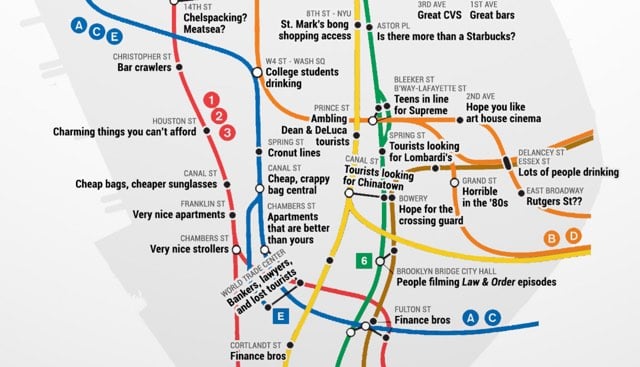
From Thrillist, the real subway map of Manhattan, your one-stop shop for Manhattan neighborhood stereotypes. (via @mkonnikova)
If you and a friend are walking around Manhattan trying to find dinner, this is how the conversation will go:
It’s funny because it’s true. That’s a clip from We’ll Find Something, a short film by Casey Gooden starring Upstream Color’s Shane Carruth and Amy Seimetz.
Update: The full film has been released online and it is excruciating to watch if you’ve ever had bad relationship moments while traveling.

Jeffrey Linn makes maps that show how extreme sea level increase will impact major cities around the globe. Recently he made a map of NYC showing what it would look like if sea levels rose by 100 feet, which is what would happen if a third of the world’s ice sheets melted. So long, most of Manhattan and Brooklyn; hello Coral Gardens, Prospect Beach, and Sunset Island. Prints are available.
See also Linn’s maps of a drowned London, the bay of LA, and islands of Seattle.
The producers of A Most Violent Year, one of the year’s most acclaimed movies, are doing something interesting to promote their film. They’re running a blog that posts all sorts of media and information about NYC in 1981, the year the film is set. Today, they released a short documentary that features interviews with some people who were scraping together lives in NYC circa 1981. It’s worth watching:
Featuring Guardian Angels founder Curtis Sliwa, performance artist and former Warhol Factory fixture Penny Arcade, actress Johnnie Mae, Harlem street-style legend Dapper Dan, auto body shop owner Nick Rosello, and trucking union rep Wayne Walsh.
The trailer for A Most Violent Year is here…I’ve heard good things about this one and hope to catch it soon.
Being an avid eater and cooker of steak,1 a passage at the end of Tom Junod’s profile of Wylie Dufresne / obit of WD-50 caught my eye:
“That’s why I’m really proud of what we did here,” he said over his cup of sake. “I’m proud of the big things, but I’m also proud of the little things we routinely did well. Do you know what made me most proud in the meal I served you? The Wagyu beef. It was perfectly cooked.”
“The advantage of sous vide,” someone said.
“But it wasn’t sous vide!” Dufresne said. “That’s the thing. It was cooked in a pan. And it had no gray on it! Do you know how hard that is? Do you know how much work that takes? Turning the beef every seven or eight seconds … And so that question you asked me before, about food and music — that’s my answer: a perfect piece of Wagyu beef cooked in a pan that comes out without any gray on it. It might not be ‘When the Levee Breaks,’ but it’s definitely ‘Achilles Last Stand.’”
I couldn’t recall hearing about this fast flipping technique from the many pieces Kenji Lopez-Alt has published about how to and how not to cook steak, so I pinged him on Twitter. He responded with Flip Your Steaks Multiple Times For Better Results.
Let’s start with the premise. Anybody who’s ever grilled in their backyard with an overbearing uncle can tell you that if there’s one rule about steaks that gets bandied about more than others, it’s to not play with your meat once it’s placed on the grill. That is, once steak hits heat, you should at most flip it just once, perhaps rotating it 90 degrees on each side in order to get yourself some nice cross-hatched grill marks.
The idea sort of makes sense at first glance: flipping it only once will give your steak plenty of chance to brown and char properly on each side. But the reality is that flipping a steak repeatedly during cooking — as often as every 30 seconds or so — will produce a crust that is just as good (provided you start with meat with a good, dry surface, as you always should), give you a more evenly cooked interior, and cook in about 30% less time to boot!
It works for burgers too. Thanks, Kenji!
A bit late for today, but for future snow day reference, here’s a crowdsourced map of good places to go sledding in NYC.
(via @alainabrowne)
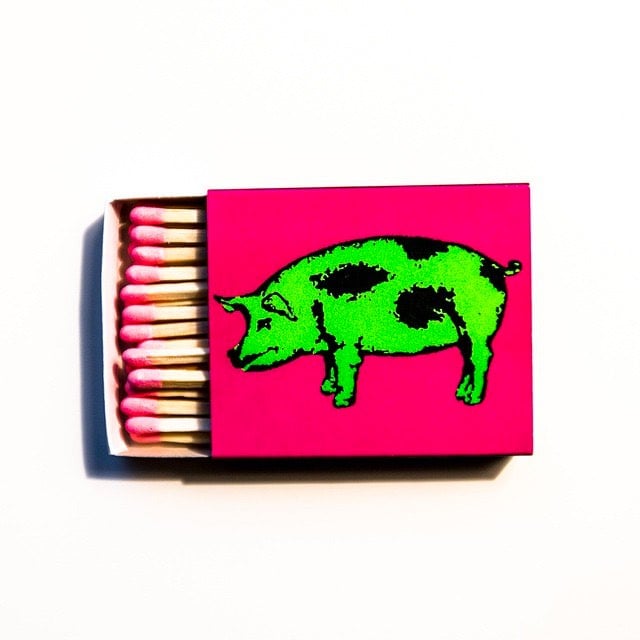
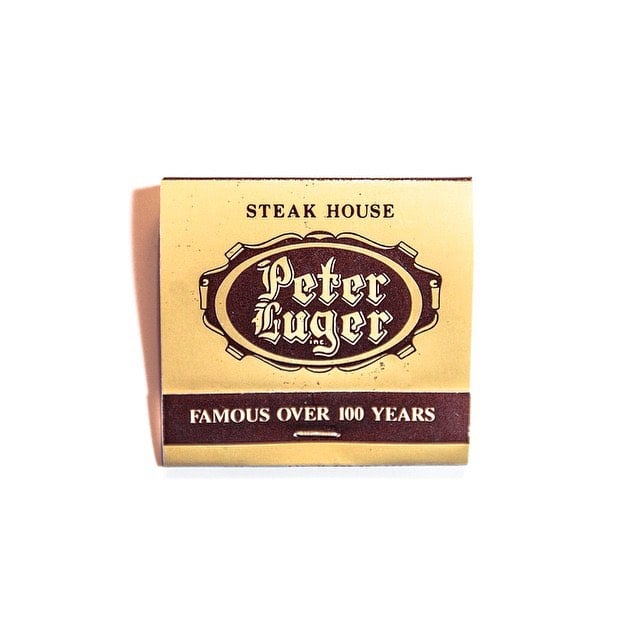
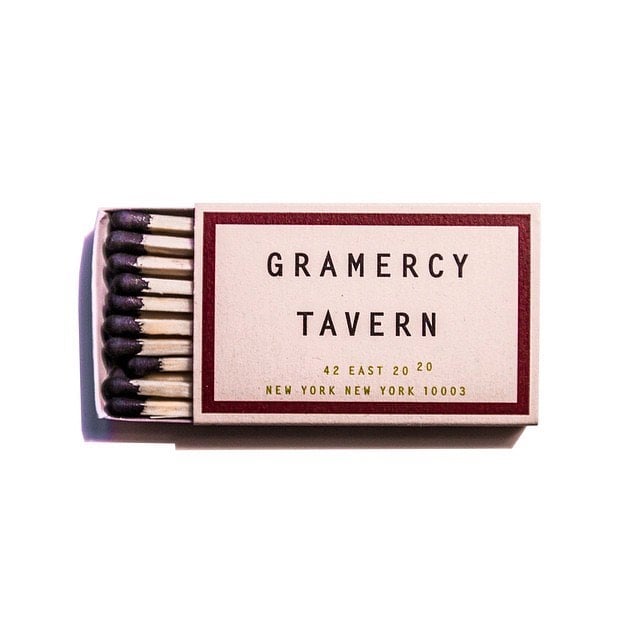
Matchbook Diaries is an Instagram account collecting photos of NYC restaurant matchbooks. Some notables:

The American Museum of Natural History’s research library has an online exhibit of bird illustrations taken from the book Extraordinary Birds. (via @kellianderson)
At Serious Eats, Ed Levine writes about Why Diners Are More Important Than Ever. From his ten-point list of what defines a diner:
8. All-occasion places: Diners must rise to many occasions, from first dates to pre- or post-game celebrations by fans or teammates, to wallowing in solitary self-pity. Diners are the best restaurants for planning murders, stick-ups, or other nefarious enterprises.
Being an all-occasion place is not the only egalitarian thing about diners:
People talk about Starbucks reintroducing the notion of what sociologist Ray Oldenburg coined the “third place” in American life: spaces where we gather besides home and work to form real, not virtual, communities. Starbucks and more high-minded cafes that followed in its wake have surely succeeded on this point, but long before 1971, when the first Starbucks opened in Pike Place Market in Seattle, diners were already serving that invaluable function for us, along with the corner tavern.
And that’s why we need to cherish our local diners, whether it’s a mom and pop or a Waffle House or a Greek coffee shop. They’re some of the few cheap, all-inclusive places to eat and hang out and laugh and cry and stay viscerally connected with other folks.
And it warmed my heart to see Ed include Cup & Saucer and Eisenberg’s on his list of notable NYC diners. An unusual thing I’ve noticed about Eisenberg’s: instead of getting your check at the table, you just tell the cashier what you ordered on the way out and pay for it. Like on the honor system! Is there anywhere else in NYC that does this? I wonder what their loss rate is compared to the norm?
Photographer Vincent Laforet hung himself out of a helicopter hovering at 7500 feet with his high-ISO cameras to capture these gorgeous shots of NYC at night. The blue-purple glow is Times Square.
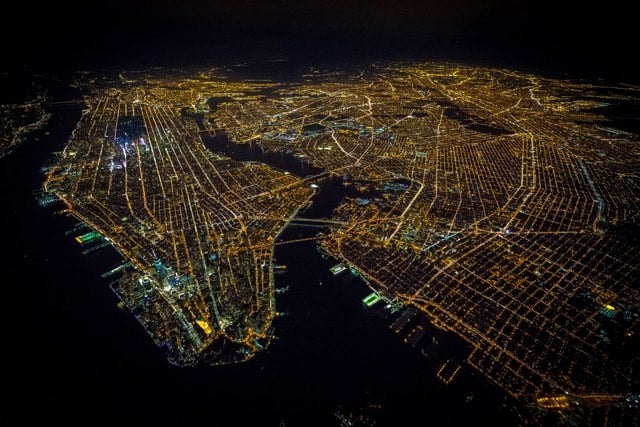

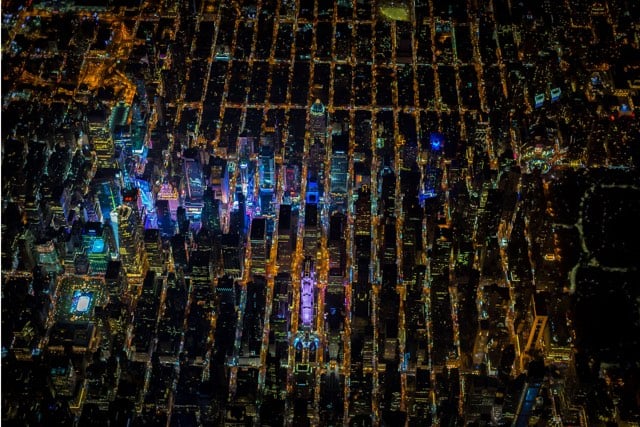
These are pictures I’ve wanted to make since I was in my teens, but the cameras simply have not been capable of capturing aerial images from a helicopter at night until very recently.
Helicopters vibrate pretty significantly and you have to be able to shoot at a relatively high shutter speed (even with tools like a gyroscope) and that makes it incredibly difficult to shoot post sunset.Special thanks to long time friend and aerial coordinator Mike Isler & Liberty Helicopters.
Armed with cameras such as the Canon 1DX and the Mamiya Leaf Credo 50 MP back — both capable of shooting relatively clean files at 3200 & 6400 ISO and a series of f2.8 to f1.2 lenses including a few tilt-shift lenses.
I was finally able to capture some of the images that I’ve dreamed of capturing for decades.
Check out the whole series on Laforet’s web site.
This is a great aerial tour (by drone) of all five boroughs of New York.
I bet the Coast Guard boats equipped with the scary-looking machine guns didn’t take kindly to a drone shadowing the Staten Island Ferry. (via @anildash)
An exhibition by Danny Lyon of color photos he took in the NYC subway is being staged by the MTA. The photos have never been publicly shown before.
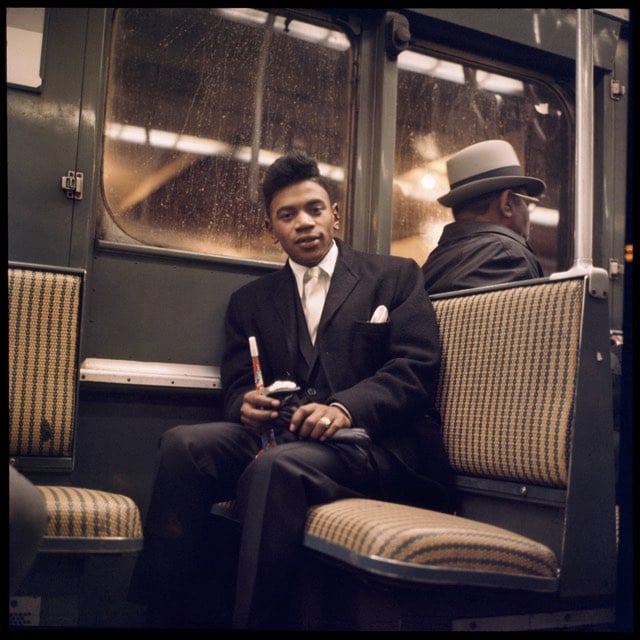
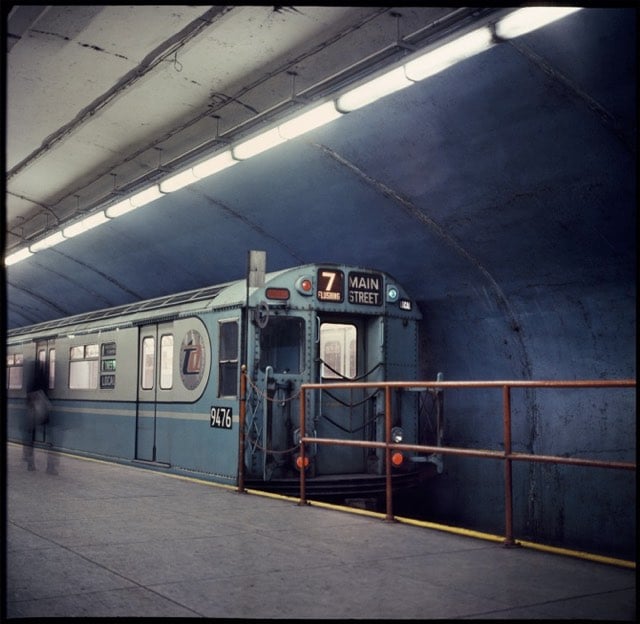
The trains shown in these two photos still run occasionally: just catch the M between 2nd Ave and Queens Plaza between 10am and 5pm on the two remaining Sundays in Dec.
The American Museum of Natural History is planning on expanding.
The American Museum of Natural History, a sprawling hodgepodge of a complex occupying nearly four city blocks, is planning another major transformation, this time along Columbus Avenue: a $325 million, six-story addition designed to foster the institution’s expanding role as a center for scientific research and education.
The new Richard Gilder Center for Science, Education and Innovation would stand on a back stretch of the museum grounds near West 79th Street that is now open space.
The addition, to be completed as early as 2019 — the museum’s 150th anniversary — would be the most significant change to the museum’s historic campus since the Art Deco Hayden Planetarium building became the glass-enclosed Rose Center for Earth and Space 14 years ago.
John Lennon died 34 years ago today. The night he died, someone made a six-minute recording of what was playing on FM radio in NYC:
Almost every station was either discussing the death or playing a Beatles song. See also the front page of the NY Times the next day and the article in the Daily News about the shooting. (via wfmu & @UnlikelyWorlds)
Update: Legendary reporter Jimmy Breslin wrote a piece shortly after the shooting about the police officers that drove Lennon to the hospital that night.
As Moran started driving away, he heard people in the street shouting, “That’s John Lennon!”
Moran was driving with Bill Gamble. As they went through the streets to Roosevelt Hospital, Moran looked in the backseat and said, “Are you John Lennon?” The guy in the back nodded and groaned.
Back on Seventy-second Street, somebody told Palma, “Take the woman.” And a shaking woman, another victim’s wife, crumpled into the backseat as Palma started for Roosevelt Hospital. She said nothing to the two cops and they said nothing to her. Homicide is not a talking matter.
And that last paragraph, wow. (via @mkonnikova)

The International Exhibition of Modern Art held at the The 69th Regiment Armory in NYC in 1913 was the first large public exhibition of modern art in the US. It has become known simply as The Armory Show. Among the artists represented at the show were Paul Cézanne, Georges Braque, Georges Seurat, Vincent van Gogh, Auguste Rodin, Pablo Picasso, Wassily Kandinsky, Claude Monet, Marcel Duchamp, Henri Matisse, and Fernand Léger. So yeah, important show.
John Ptak noticed in a book he was reading that the sales total for the show was $44,148, which is something like $1,000,000 in today’s dollars. Of that total, two artists were responsible for almost a third of the total: Odilon Redon made $7000 and Cézanne made $6700. Duchamp sold four pieces for $972. It goes without saying that the ~1600 pieces exhibited at The Armory Show would fetch billions of dollars at auction now.
On the walk back from soccer practice the other day, my sharp-eyed seven-year-old son spotted something through the partially papered-up window of a Chelsea gallery. “Hey, Kara Walker!” he says.1 And sure enough:

The gallery is Sikkema Jenkins on 22nd St and Walker’s show, Afterword, starts there tomorrow and runs through mid-January. The show is an extension of A Subtlety, Walker’s installation at the Domino Sugar Factory in Williamsburg over the summer. Several of the sugar statues and the left fist of the sugar sphinx from the Domino installation will be shown along with new video works and notes & sketches from the planning of A Subtlety. You can see some of the figures in the photo above (fashioned out of Domino Sugar, naturally) and I think that’s probably the fist in the background on the right, wrapped in plastic.
city.ballet is a video series about the workings of the New York City Ballet. The twelve episodes of season two cover everything from apprentice dancers to injuries to the sacrifices the dancers make to pursue their onstage dreams.
Imagine a city unto itself — a place where 16 year olds are professionals, 18 year olds are revered and many 30 year olds are retirees. Imagine a world so insular that nearly every one of these virtuosos has trained together in an academy since childhood, their lives forever intertwined by work, play, competition, friendship and love. Imagine a world in which the bottom line standard is to be, simply, the best on the planet, and where each night, an empty stage, in front of thousands, beckons with a challenge. This enclave has a name — New York City Ballet — and you are invited into this world, one that has never opened up to the outside before.
Season two just came out and is available at AOL. (via cup of jo)
Thirty years after starting Def Jam in his NYU dorm room, Rick Rubin returns to the room in question and talks about how Def Jam began.
(via ★interesting)
A woman recently took to the streets of NYC and walked around for 10 hours. She walked behind someone wearing a hidden camera that captured all of the catcalls and harassment directed toward her during that time…108 incidents in all. This is what it’s like being a woman in public:
At The Awl, John Herrman notes the parallels between a woman on the streets of NYC and a woman spending time on the internet.
But the video works in two ways: It’s also a neat portrayal of what it is like to be a woman talking about gender on the mainstream internet. This became apparent within minutes of publication, at which point the video’s comment section was flooded with furious responses.
A typical post in the YouTube comments thread:
are you fucking kidding me “verbal harassment”? most of all the guys called that woman “beautiful” or said to “have a good day”….it would be harassment if the guys called that woman a “hoe” or “bitch”…you are a fucktard.
On Tumblr, Alex Alvarez neatly dispenses with that sort of “logic”:
To anchor this more concretely, consider the behavior of the men in the video. Take a look at how they seek the woman out to wish her a good morning, despite her not having made eye contact or shown any interest in talking to them. Take a look at how they’re not wishing a good morning to any other person, particularly male people, also walking around. The woman is walking directly behind the man filming her (the camera is hidden in his backpack), and not one of the men shown in the video are seen to be greeting him and wishing him a good day. Just her.
Why is this?
It’s because they don’t care, really whether she has a good day or not. What they care about is letting her know that they have noticed her — her hair, her face, her body, her outfit. They want her to notice that they’ve noticed, and they want her to notice them, however fleetingly.
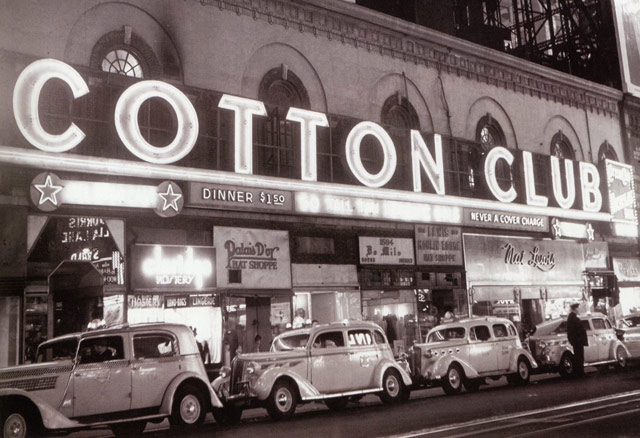
From A Continuous Lean, a review of some of NYC’s most beloved bygone music venues, including The Cotton Club (closed 1940), The Gaslight Cafe (closed 1971), and CBGB (closed 2006).
Despite being located in Harlem, and showcasing many black performers, The Cotton Club actually had a strict “whites only” policy.
Newer posts
Older posts





Socials & More