kottke.org posts about NYC
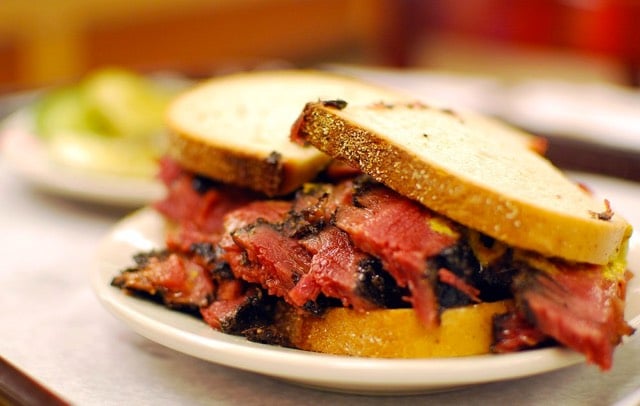
Pastrami on Rye is a full-length history of the NYC Jewish deli, written by Judaism scholar Ted Merwin. From a review in The Economist:
Jewish delicatessens may now be known for knishes, latkes and pastrami sandwiches, but back in their heyday, during the 1920s and 1930s in the theatre district in New York, they also served beluga caviar, pâté de foie gras and Chateaubriand steak. Jewish classics were gussied up and defiled: chopped chicken liver was served with truffles. Treyf, like oysters and pork chops, was eaten with abandon alongside kosher delicacies.
That reminds me…a trip to Katz’s is looooooong overdue.
A collection of old film footage of NYC, taken between 1896 and 1905, along with maps and descriptions of the locations.
Todd Schneider used a couple publicly available data sets (NYC taxis, Uber) to explore various aspects of how New Yorkers move about the city. Some of the findings include the rise of Uber:
Let’s add Uber into the mix. I live in Brooklyn, and although I sometimes take taxis, an anecdotal review of my credit card statements suggests that I take about four times as many Ubers as I do taxis. It turns out I’m not alone: between June 2014 and June 2015, the number of Uber pickups in Brooklyn grew by 525%! As of June 2015, the most recent data available when I wrote this, Uber accounts for more than twice as many pickups in Brooklyn compared to yellow taxis, and is rapidly approaching the popularity of green taxis.
…the plausibility of Die Hard III’s taxi ride to stop a subway bombing:
In Die Hard: With a Vengeance, John McClane (Willis) and Zeus Carver (Jackson) have to make it from 72nd and Broadway to the Wall Street 2/3 subway station during morning rush hour in less than 30 minutes, or else a bomb will go off. They commandeer a taxi, drive it frantically through Central Park, tailgate an ambulance, and just barely make it in time (of course the bomb goes off anyway…). Thanks to the TLC’s publicly available data, we can finally address audience concerns about the realism of this sequence.
…where “bridge and tunnel” folks go for fun in Manhattan:
The most popular destinations for B&T trips are in Murray Hill, the Meatpacking District, Chelsea, and Midtown.
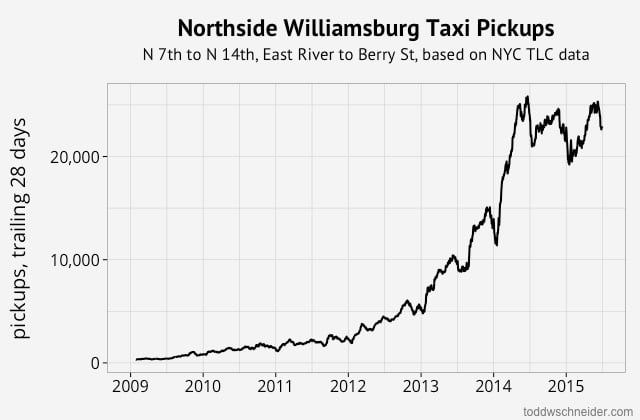
…the growth of north Williamsburg nightlife:
…the privacy implications of releasing taxi data publicly:
For example, I don’t know who owns one of theses beautiful oceanfront homes on East Hampton’s exclusive Further Lane (exact address redacted to protect the innocent). But I do know the exact Brooklyn Heights location and time from which someone (not necessarily the owner) hailed a cab, rode 106.6 miles, and paid a $400 fare with a credit card, including a $110.50 tip.
as well as average travel times to the city’s airports, where investment bankers live, and how many people pay with cash vs. credit cards. Read the whole thing and if you want to play around with the data yourself, Schneider posted all of his scripts and knowhow on Github.
Update: Using summaries published by the New York City Taxi & Limousine Commission, Schneider takes a look at how taxi usage in NYC is shrinking and how usage of Uber is growing.
This graph will continue to update as the TLC releases additional data, but at the time I wrote this in April 2016, the most recent data shows yellow taxis provided 60,000 fewer trips per day in January 2016 compared to one year earlier, while Uber provided 70,000 more trips per day over the same time horizon.
Although the Uber data only begins in 2015, if we zoom out to 2010, it’s even more apparent that yellow taxis are losing market share.
Lyft began reporting data in April 2015, and expanded aggressively throughout that summer, reaching a peak of 19,000 trips per day in December 2015. Over the following 6 weeks, though, Lyft usage tumbled back down to 11,000 trips per day as of January 2016 — a decline of over 40%.
Here is one of the original architectural drawings done for the Empire State Building by William Lamb:
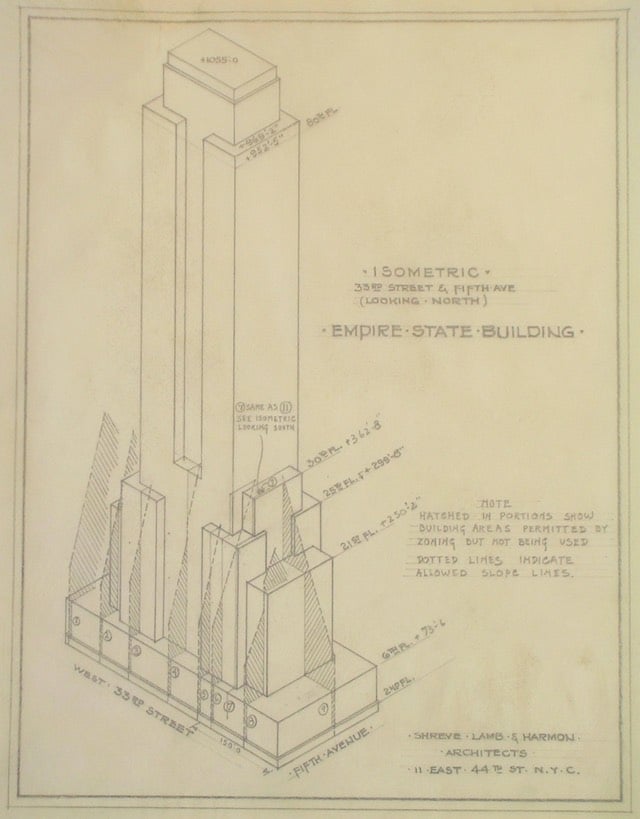
Scott Christianson wrote a brief piece (taken from his new book 100 Documents That Changed the World: From the Magna Carta to Wikileaks) on how the building was designed and built. The whole thing happened incredibly fast: the first architectural contract was signed in September 1929 and after only 410 days of construction, the building was opened in May 1931.
Ada Calhoun, author of St. Marks Is Dead: The Many Lives of America’s Hippest Street, writes about the ever-changing neighborhoods in NYC.
I think there’s more to these “the city is dead now” complaints than money. People have pronounced St. Marks Place dead many times over the past centuries — when it became poor, and then again when it became rich, and then again when it returned to being poor, and so on. My theory is that the neighborhood hasn’t stopped being cool because it’s too expensive now; it stops being cool for each generation the second we stop feeling cool there. Any claim to objectivity is clouded by one’s former glory.
From Zain Khalid at McSweeney’s, The Four Horsemen of Gentrification: Brine, Snark, Brunch, and Whole Foods. From the book of Millennials of the New Standard Greenpoint Bible, chapter 6, verse 1:
Then I saw when the Landlord broke one of the rent-controlled seals. I heard one of the four living creatures saying as with a voice of thunder, “Gentrify.” I looked, and behold, a green horse, and he who sat on it had a mason jar; and a fedora was his crown, and he went out pickling and to pickle.
Katherine Rosman recently wrote an article for the NY Times called How Organic Avenue Lost All Its Juice about a small NYC-based chain of juice stores recently going out of business. The piece is also a quote gold mine reflecting the zeitgeist of contemporary Manhattan.
“I kind of freaked out,” she said. “I was distraught. I lost my yoga for a minute.”
There is an admitted emperor’s new clothes quality to paying $25 for a lunch of vegetable shavings and a smoothie made of Swiss chard, cashew milk and Himalayan salt.
You can’t build a long-term business off what Gwyneth Paltrow likes.
A lot of vegans I know are now making stews out of meat bones and dairy.
Everyone is talking about coal and charcoal.
Bleeeeeaauuuckk. See also your detoxing juice cleanse is bullshit.
Update: Some locations are reopening, but shared this mainly for the headline: Organic Avenue Is the Jon Snow of Overpriced Juice Chains.
I don’t know what is going on, but in the past few days, several sites have linked to rarely seen or recently uncovered photos of vintage New York. In no particular order:
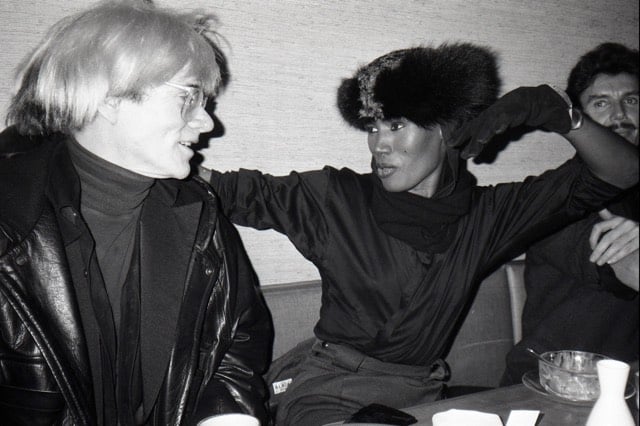
Paige Powell’s photos of 80s culture in NYC, stored in boxes under her bed until very recently. She dated Basquiat and hung with Haring, Warhol, and Madonna. Below, Warhol and Grace Jones chat. Click through…there’s another photo of Sting, Bob Dylan, and Warhol having dinner together.
David Attie’s photographs of Brooklyn Heights from 1958, stored in wooden boxes in closets until recently. Attie was accompanied on his journey through the neighborhood by Truman Capote, a resident of the area. The photos are featured in a new edition of Capote’s Brooklyn: A Personal Memoir.
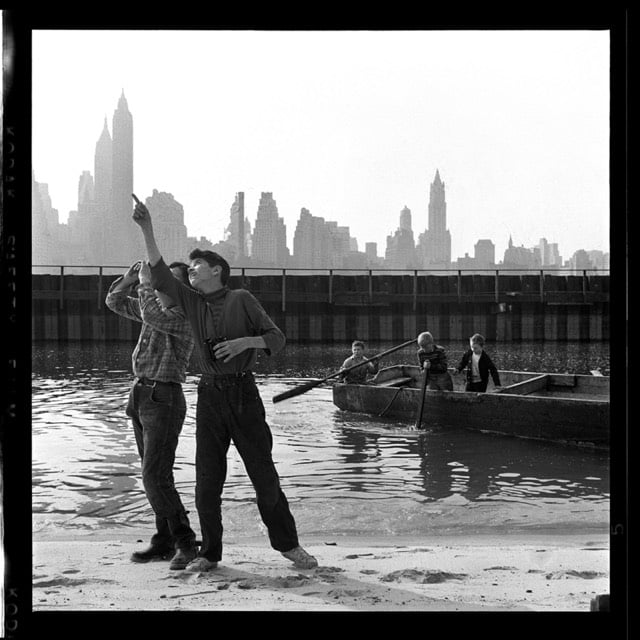
Charles Traub’s street style photos from the late 70s. He took the photos during his lunch breaks of everyday people he thought were interesting in some way. Traub’s photos are collected in a new book, Lunchtime.

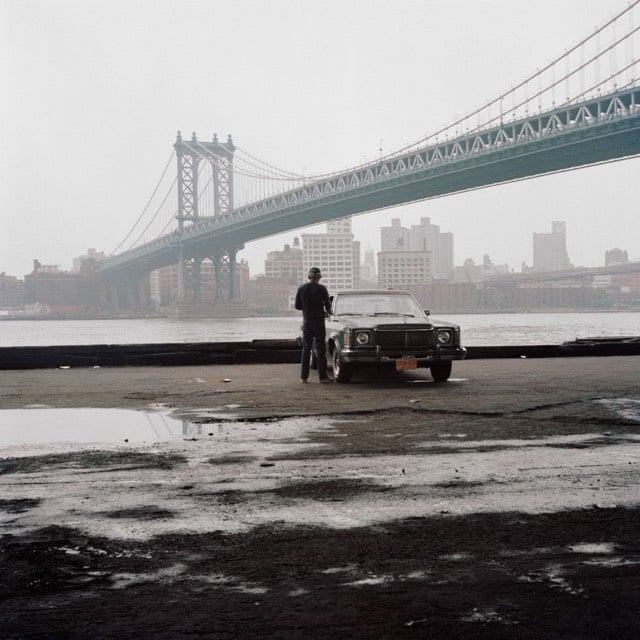
Janet Delaney’s photos of NYC in the mid-80s. These photos have also been stored in a box until recently. Delaney also took dozens of photographs of SoMa in SF from 1978-1986.
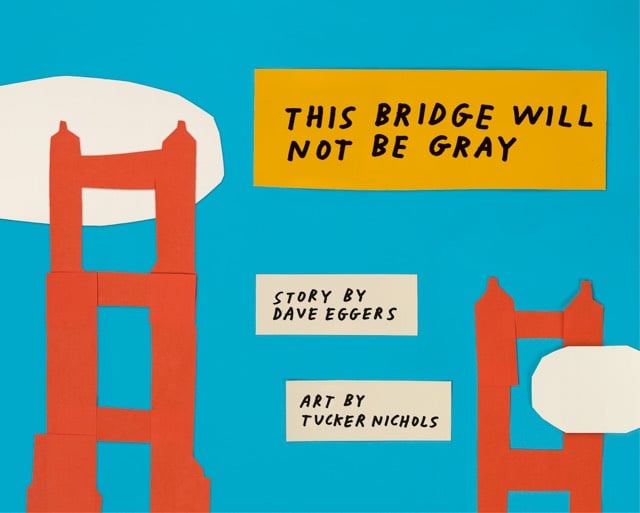
From Dave Eggers and Tucker Nichols comes This Bridge Will Not Be Gray (at Amazon), a children’s book about how the Golden Gate Bridge came to be painted orange.
In this book, fellow bridge-lovers Dave Eggers and Tucker Nichols tell the story of how it happened — how a bridge that some people wanted to be red and white, and some people wanted to be yellow and black, and most people wanted simply to be gray, instead became, thanks to the vision and stick-to-itiveness of a few peculiar architects, one of the most memorable man-made objects ever created.
The kids and I sat down with the book last week and they loved it. The pages on the design of the bridge prompted a discussion about Art Deco, with detours to Google Images to look at photos of the bridge,1 The Empire State Building, and the Chrysler Building. The next day, on the walk to school, we strolled past the Walker Tower, a 1929 building designed by Ralph Thomas Walker, one of the foremost architects of the 20th century. We were running a little early, so I stopped and asked the kids to take a look and think about what the building reminded them of. “Art Deco” came the reply almost immediately.
I’m really gonna miss reading to my kids — Ollie mostly reads by himself now and Minna is getting close — but I hope that we’re able to keep exploring the world through books together. NYC is a tough place to live sometimes, but being able to read about something in a book, even about a bridge in far-away San Francisco, and then go outside the next day to observe a prime example of what we were just reading is such a unique and wonderful experience.
Manhattan is home to many small clusters of businesses around a common theme. For example, the Garment District in the west 30s, the Diamond District on 47th St, and, formerly, the Meatpacking District. Here is a short guide to some of them.
A few weeks ago, as I walked to work in the Flatiron district of Manhattan, I noticed something unusual — not one, not two, but four tile stores, side by side, on 21st Street between Fifth and Sixth Avenue. Strange. Then, I remembered rumors about a magical street in Chelsea populated by dozens of flower nurseries. I already knew of Manhattan’s legendary Garment District. I wondered — how many microdistricts could there be in the city?
(thx, david)

From Mapzen’s exploration of map projections other than the familiar (and often misleading) Mercator, an Inception-style view of Manhattan (or anywhere you want to point the map to…like Paris or London), inspired by Berg’s Here & There project (which I was a fan of, obviously).
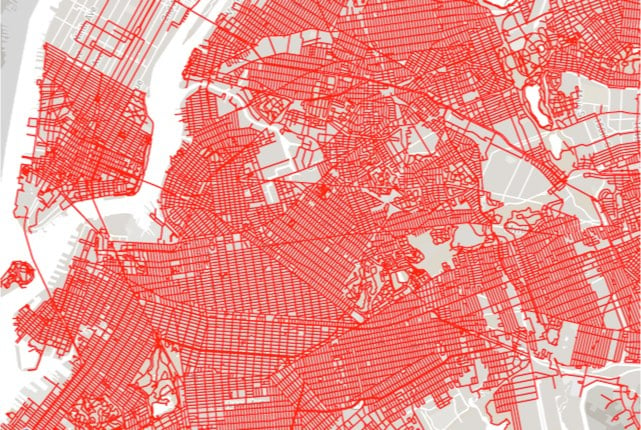
Matt Green plans to walk on every single street in NYC. Of an estimated 8-9000 miles of streets, trails, and paths in the city, he has already covered 7000 miles, including what looks like nearly all of Brooklyn.
I am going to walk every block of every public street in all five boroughs of New York City, excluding only the high-speed expressways and parkways that prohibit pedestrian traffic. I will also walk every bridge with pedestrian facilities, as well as many private streets, multi-use greenway paths, pedestrian paths and trails through parks and cemeteries, boardwalks, and accessible stretches of coastline.
It is my understanding that the total length of all the public streets in NYC is somewhere in excess of 6,000 miles. Add the bridges, private streets, paths, and coastline to that, as well as all the blocks I will end up covering more than once, and I expect to have walked more than 8,000 miles before I’m done.
Matt previously walked across the United States and visited every NYC subway station in one go.
William Helmreich is also attempting to walk every block in the city, and he and Green recently met to compare notes.
That video is wonderful, btw…two curious souls fully engaging with their surroundings. If you click on none of the other links in this post, you should at least watch the video. (thx, mike)

A much tinier number die alone in unwatched struggles. No one collects their bodies. No one mourns the conclusion of a life. They are just a name added to the death tables. In the year 2014, George Bell, age 72, was among those names.
That has changed since the NY Times’ N.R. Kleinfield wrote a piece on the life and death of a random New Yorker: The Lonely Death of George Bell.
Astronaut Scott Kelly, who is spending a continuous year in space,1 tweeted out a photo by fellow ISS resident Oleg Kononenko of NYC on Saturday night.
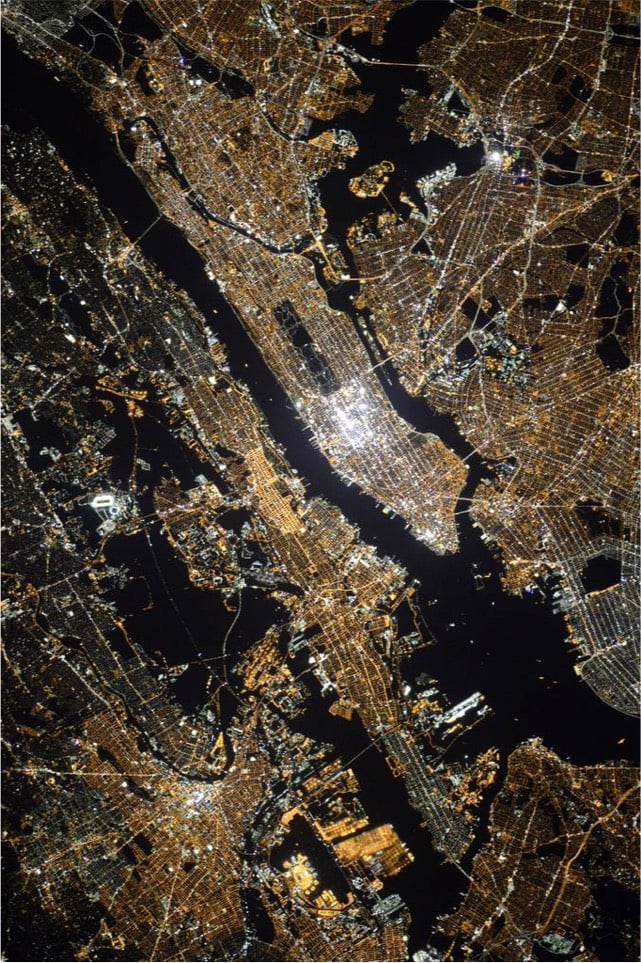
Of the many possibilities, I’d like to point out just three interesting things.
1. Times Square! And not just that, but the whole of central Midtown is now lit up like a Christmas tree from 34th Street to Central Park.
2. The bright spot of light in the upper right corner of the image above is Citi Field. The photo must have been taken during Game 1 of the NLCS between the Mets and the Cubs. The Mets won that game 4-2. #LGM!
3. You’ll notice that the streetlights in much of the city are orange. But in the bottom right corner, in Brooklyn, you can see the future. NYC is currently replacing all of the orange-glowing sodium vapor streetlights with blue-glowing LED lights that are longer lasting and more energy efficient. But they are also brighter and some are already complaining about the harsh blue light.
The new LEDs may be environmentally sensitive, but they are also optically harsh.
“The old lights made everybody look bad,” said Christopher Stoddard, an architect, who lives at the corner of Fuller Place. “But these are so cold and blue, it’s like ‘Night of the Living Dead’ out there.”
“We’re all for saving energy,” his wife, Aida Stoddard, also an architect, said, “but the city can do so much better.”
A few blocks away, Rose Gallitelli taped up black garbage bags on her bedroom windows so that she could sleep. “They’re the heavy-duty kind,” she said.
The lighting refit is scheduled to be completed in two years. The city will look different when it’s done, in real life, on Instagram, and in film. (via @ginatrapani)
Update: Photographer Pari Dukovic has a shot of one of the old sodium vapor street lamps in the New Yorker this week.
Eater has the scoop: Danny Meyer’s Union Square Hospitality Group is eliminating tipping at all of their full-service restaurants.
Big news out of Manhattan: Dining out is about to get turned on its head. Union Square Hospitality Group, the force behind some of New York’s most important restaurants, will announce today that starting in November, it will roll out an across-the-board elimination of tips at every one of its thirteen full-service venues, hand in hand with an across-the-board increase in prices.
Why are they doing this? In part because cooks get the shaft at restaurants:
Under the current gratuity system, not everyone at a restaurant is getting a fair shake. Waiters at full-service New York restaurants can expect a full 20 percent tip on most checks, for a yearly income of $40,000 or more on average — some of the city’s top servers easily clear $100,000 annually. But the problem isn’t what waiters make, it’s what cooks make. A mid-level line cook, even in a high-end kitchen, doesn’t have generous patrons padding her paycheck, and as such is, on average, unlikely to make much more than $35,000 a year.
I hope this catches on.

The Silicon City exhibit at the New York Historical Society takes a look at the long history of computing in NYC.
Every 15 minutes, for nearly a year, 500 men, women, and children rose majestically into “the egg,” Eero Saarinen’s idiosyncratic theater at the 1964 World’s Fair. It was very likely their first introduction to computer logic. Computing was not new. But for the general public, IBM’s iconic pavilion was a high profile coming out party, and Silicon City will harness it to introduce New York’s role in helping midwife the digital age.
The exhibit opens on November 13, 2015 and runs through next April. The museum is using Kickstarter to help bring the Telstar satellite back to NYC for the exhibit.
Two weeks ago, 99% Invisible broadcast an audio documentary from 1998 about one of the last remaining flophouses on The Bowery in NYC called The Sunshine Hotel. It is an amazing time capsule from a Manhattan that just doesn’t exist anymore.
The Sunshine Hotel opened in 1922. Rooms — or really, cubicles — were 10 cents a night. The Sunshine, like other flop houses, was always a men-only establishment. In 1998, the hotel had raised it’s rates to 10 dollars a night and it was managed by resident Nathan Smith. He sat behind a metal cage at the front desk, answering the phone and doling out toilet paper to residents for 35 cents. Smith had once worked in a bank until he was injured, and then fired. His wife left him and he ended up in the Bowery, and eventually at the Sunshine Hotel.
The interviewees sound like they’re characters in a play, not real people. It’s so good. There is also a documentary film released in 2001 about The Sunshine Hotel which is available on Amazon Instant; here’s a trailer:
Economist William Easterly and some of his colleagues built a site that focuses on the economic development of a single block in NYC, Greene Street between Houston and Prince. In the past 175 years, use of the block has gone from wealthy residential to sex work to garment manufacturing to artist galleries to luxury retail.
133 Greene Street, for example, has been part of the large Bayard farm, a grand residential home, a brothel, a garment factory, part of a slum, an art gallery, and is today the home of luxury co-op residences and a Dior Homme store.
Many of these shifts took only a decade and could have been very difficult to anticipate.
The site was built to accompany an academic paper on economic development.
By 1870, the Greene Street Block contained 14 brothels, the highest concentration of any block in the City. Just as surprising was the sudden end of prostitution on the block. Brothels still abounded in 1880, but during the next decade entrepreneurs demolished and rebuilt almost the entire block as castiron factories and warehouses, and what was left of the red-light district moved up town.
The site is a little confusing to navigate, but is worth checking out in detail. For instance, check out how quickly the garment manufacturing industry shifted from downtown to the present-day Garment District.
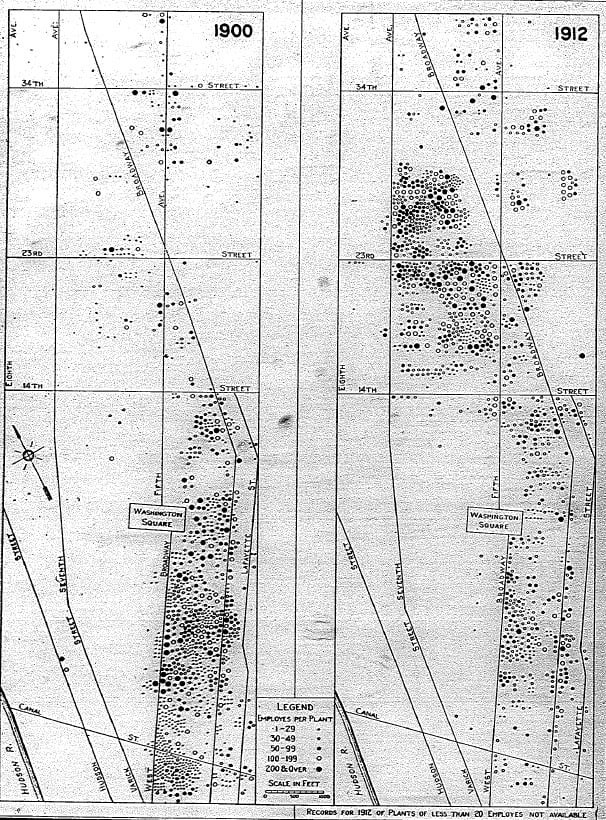
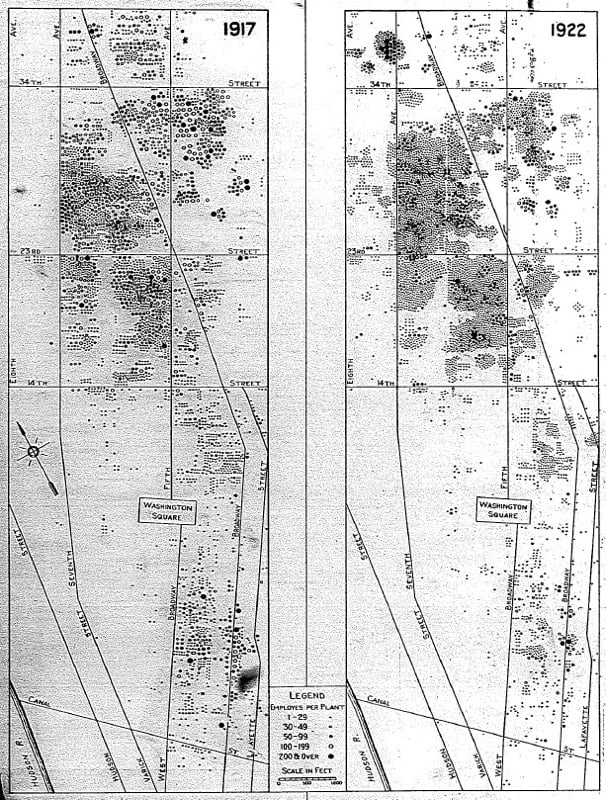
(via wired)
Mark Reay is a former model, actor, and fashion photographer who was homeless in NYC for six years. Homme Less is a documentary on Reay; here’s a trailer:
So began a period of my life sleeping rough. It was pretty tiring, and I didn’t have much luck with the photos, but I stuck it out. I’ve never let the lack of money stop me having a good time, and I still had (dwindling) savings from my modelling. It was a happy time. At night I would always treat myself to a rotisserie chicken, but I always wanted a chilled rosé with it. So, in the afternoon, I would sneak into a minimarket, get the cheapest one from the shelf and hide it under the frozen peas. Then, at night, I would put on a fresh shirt and go to one of the fancy bars with my wine in my bag. Again, maybe because I had a certain look, no one ever checked my bag. I’d just go in, nick a glass off the counter and drink my wine surrounded my millionaires.
You can get away with anything if you’re confident. Oh, and male, white, and good looking.
The walls of the elevator to the observatory at the top of 1 World Trade Center are covered with screens and when you ride it to the top, you see a time lapse of NYC’s development, from 1500 to the present.
The observatory is open daily from 9am to 8pm.
As something of an expert on the topic, I thought this New York Magazine piece about spending time alone in the Big Apple is pretty good. The opening of the piece gets at why busy, crowded NYC is actually a good place for an introvert to be:
Being alone here is a state of mind, a perpetual choice, and an occasional imposition, a burden, and a gift — and sometimes the very best way to meet a fellow stranger. “Every form of human expressiveness is on display,” Vivian Gornick writes of walking the streets by herself, “and I am free to look it right in the face, or avert my eyes if I wish.”
And this tip on the Empire State Building is one for the ol’ bucket list:
A lot of people don’t know this, but the Empire State Building is open until 2 a.m. The last elevator leaves at 1:15. If you go up then, it’s empty, it’s beautiful, and the city sounds like the ocean.
This video from the MTA shows some of the vintage technologies that are still in use to control many of the NYC’s subway lines and how they are upgrading (ve. ry. slow. ly.) to safer and more reliable computerized systems. Some of control systems are more than 80 years old.
Whoa, after watching that, I’m shocked that the trains ever get anywhere at all. (via the kid should see this)
Update: The NY Times has a look at the political and logistical challenges related to upgrading the NYC subway’s antiquated infrastructure.
A computerized signal system like C.B.T.C. is also safer because trains can be stopped automatically. New York’s quest to install the new system began in 1991, after a subway derailment at Union Square in Manhattan killed five people. The train operator was speeding after he had been drinking.
More than 25 years later, the authority has little to show for its effort to install modern signals. The L line began using computerized signals in 2009 after about a decade of work. A second line, the No. 7, should have received new signals last year, but the project was delayed until the end of this year.
The process is complicated. It requires installing transponders every 500 feet on the tracks, along with radios and zone controllers, and buying new trains or upgrading them with onboard computers, radios and speed sensors. The authority also had to develop a design and software that was tailored to New York’s subway.
Over the years, the authority has kept pushing back the timeline for replacing signals. In 1997, officials said that every line would be computerized by this year. By 2005, they had pushed the deadline to 2045, and now even that target seems unrealistic.
40 years to upgrade the entire system? Embarrassing.

Pixar: The Design of Story is an upcoming exhibition at the Cooper Hewitt National Design Museum here in NYC.
Through concept art from films such as Toy Story, Wall-E, Up, Brave, The Incredibles and Cars, among others, the exhibition will focus on Pixar’s process of iteration, collaboration and research, and is organized into three key design principles: story, believability and appeal. The exhibition will be on view in the museum’s immersive Process Lab — an interactive space that was launched with the transformed Cooper Hewitt in December 2014 — whose rotating exhibitions engage visitors with activities that focus on the design process, emphasizing the role of experimentation in design thinking and making.
More details are available in the press release. Definitely going to check this out and take the kids.
This video was shot in NYC on July 18, 1990, mostly in Times Square and Central Park.
The first 30 seconds of the video (stumbling drunk, trash digger, overheating car) is pretty much a perfect representation of how NYC felt to many at the time. A squeegee man can also been seen at work near the end of the video.
The New Yorker did a short feature on Charlie Pellett, the voice of the NYC subway.
This deep, sometimes vexing voice — which also apologizes for “unavoidable delays” — belongs to a man named Charlie Pellett. A radio anchor for Bloomberg News, Pellett was raised in London but cultivated an American accent by listening to the radio. His work for the M.T.A., which is done on a volunteer basis, is the only non-reporting voice-over work that he’s done.
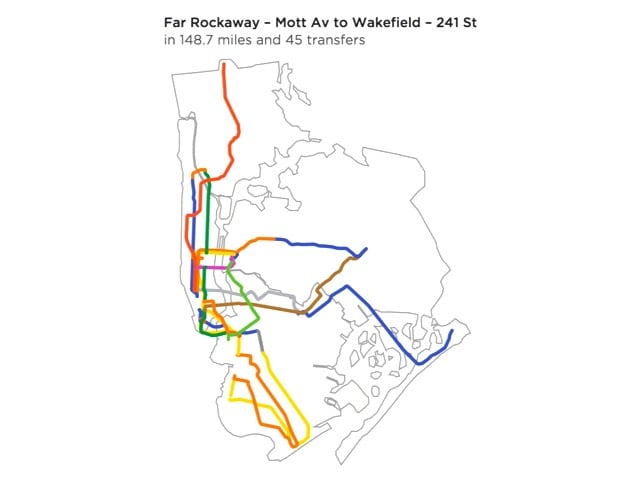
The WNYC Data News Team is looking for the longest possible NYC subway ride. The MTA says the longest direct trip is 38 miles, but WNYC found one that’s 148 miles, requiring 45 transfers. They’re running a little competition to see who can find a longer ride…check the rules for more details (short version: you can repeat stations but not track segments). This is basically a variant of the travelling salesman problem, yes? Anyone care to take a crack at it? (via @ryandawidjan)
An NYPD officer anonymously shares what it’s like to be a cop in NYC.
I’m walking in Boerum Hill on one of the first really good days of summer. It’s been a long week but I’m feeling good in a flowing sundress and sandals, relieved to be freed from what I’ve begun to think of as my blue polyester prison. I look up and realize with amusement that I’m walking by an actual prison, or, to be precise, a jail: Brooklyn Central Booking.
The doors to the courtroom lobby open and a man emerges, pausing to survey the street. He’s a little scruffy but then the newly arraigned usually are — there aren’t many opportunities to freshen up in the holding cells. He has an open, pleasant face, and the recognition on my part is immediate. My heart sinks as I see him cross the street and make a beeline for me.
“Miss? Miss?” He doesn’t sound particularly confrontational and I give him my best blank smile, hoping he has some kind of mundane procedural question.
“I don’t mean to like bother you or anything, but if you’re not busy, and a beautiful lady such as yourself is probably busy, but if you’re not busy I’d love to buy you a cup of coffee.”
Now I have to grin. This is my new favorite person in the world. What chutzpah! I’m so delighted by this guy that I almost chuck him on the shoulder. Then it hits me. He doesn’t recognize me, at all. He has no idea that I’m the person who arrested him two nights before.
(via @choire, who called it “BY FAR the most interesting thing i read all week”)
Eater’s Nick Solares accompanies the proprietor of Peter Luger Steakhouse to one of the few remaining butchers in the Meatpacking District1 to see how she selects meat for the restaurant.
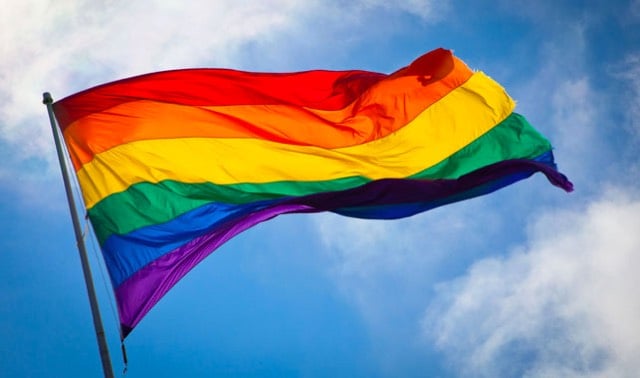
MoMA has announced that they’ve acquired the Rainbow Flag for their permanent collection. The flag has been a symbol of the LGBT community around the world since its creation in 1978. As part of the acquisition, MoMA Curatorial Assistant Michelle Millar Fisher interviewed the man who designed the flag, artist Gilbert Baker.
And I thought, a flag is different than any other form of art. It’s not a painting, it’s not just cloth, it is not a just logo — it functions in so many different ways. I thought that we needed that kind of symbol, that we needed as a people something that everyone instantly understands. [The Rainbow Flag] doesn’t say the word “Gay,” and it doesn’t say “the United States” on the American flag but everyone knows visually what they mean. And that influence really came to me when I decided that we should have a flag, that a flag fit us as a symbol, that we are a people, a tribe if you will. And flags are about proclaiming power, so it’s very appropriate.
So the American flag was my introduction into that great big world of vexilography. But I didn’t really know that much about it. I was a big drag queen in 1970s San Francisco. I knew how to sew. I was in the right place at the right time to make the thing that we needed. It was necessary to have the Rainbow Flag because up until that we had the pink triangle from the Nazis — it was the symbol that they would use [to denote gay people]. It came from such a horrible place of murder and holocaust and Hitler. We needed something beautiful, something from us. The rainbow is so perfect because it really fits our diversity in terms of race, gender, ages, all of those things. Plus, it’s a natural flag — it’s from the sky! And even though the rainbow has been used in other ways in vexilography, this use has now far eclipsed any other use that it had…
Update: Baker died at his home on March 30, 2017. He was 65 years old.
Mr. Baker replicated his flag dozens of times over the years. He crafted a mile-long banner to parade down Fifth Avenue in Manhattan, and he sent flags around the world in support of gay rights protests. He sewed the rainbow flag used in the movie “Milk,” along with a new flag for this year’s television miniseries “When We Rise.”
“I remember the most fabulous queen I’d ever seen in my life shows up in sequins with a sewing machine in his arms, and he insisted on creating that flag exactly the same way he’d created it then,” said Dustin Lance Black, who wrote “Milk” and wrote and directed “When We Rise,” which was based on Jones’ memoir of the same name.
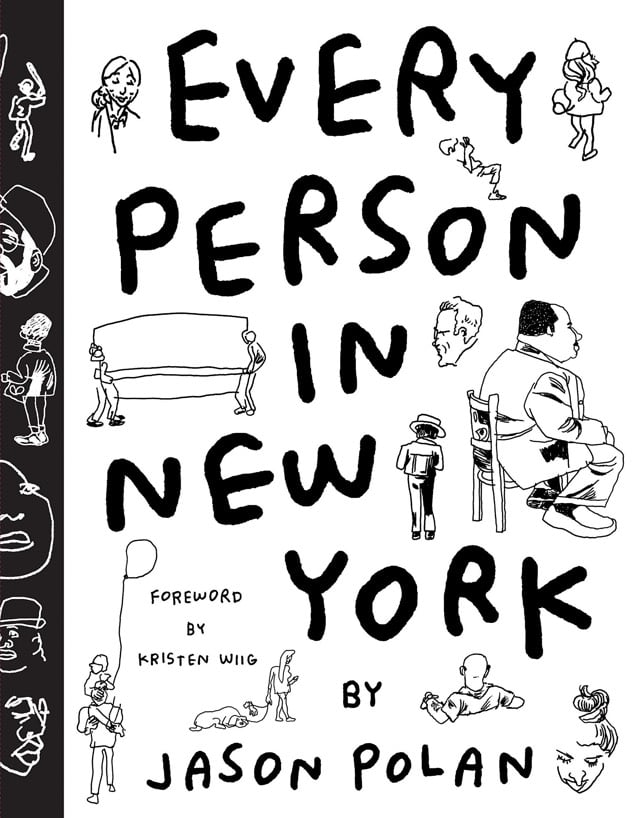
Jason Polan has turned his long-term project to draw each and every person in New York into a book coming out in August. As a long-time Polan fan, I’m looking forward to this.
Newer posts
Older posts






Socials & More