



Simon Willison: The October Inflection Point for Vibe Game Development. “The thing I find both exciting and shameful about this is that I have got interesting results from so little creative input.”

Advertise here with Carbon Ads
This site is made possible by member support. 💞
Big thanks to Arcustech for hosting the site and offering amazing tech support.
When you buy through links on kottke.org, I may earn an affiliate commission. Thanks for supporting the site!
kottke.org. home of fine hypertext products since 1998.
Beloved by 86.47% of the web.

Arkivism is a search and visual discovery engine for millions of public domain works from the collections of the Smithsonian, The Met, NASA, Library of Congress, National Gallery of Art, Rijksmuseum, and more.

Ted Chiang: “There’s no way to write fiction and guarantee your readers will understand it correctly. There is no way you will ever be able to write something so straightforward that Elon Musk will understand it the way that you intend it.”
Let’s get this out of the way: Olivia Colman will be great as Mrs. Bennet in the new Pride and Prejudice series; here’s the trailer. But the rest of it has some awfully large shoes to fill — both the 1995 and 2005 adaptations are rightly beloved.
Are contemporary technologies like GPS, phones, and AI deskilling the human body? “In surrendering to a quick technological fix, we are, moment by moment, doing less sensing, navigating, remembering, walking, choosing, and attending.”
Love the idea of a volta, a pivotal point. “The moment when an acquaintance becomes a friend, when a song goes from background noise to what I will demand people play at my funeral.” Or when a novel goes from boring to incredible.
The Collectively Drawn World



The Drawn Maps are the borders of the countries, state, provinces, and other official territories collectively drawn by more than 300,000 people playing an online daily game called Borderline. There’s a world map as well as maps of the USA, Canada, Italy, and more. There are also timelapse versions of some of the maps.

Trailer for season four of The Gilded Age, which started yesterday. I love this show for reasons that are unclear to me. But I don’t care! The heart wants what it wants!
Readwise announces Readwise Books. “We’ve built Readwise Books: our very own ebook store and app. In simple terms, you can think of it as a cross between the Kindle and Goodreads apps, where you can buy, read, and track books.”

The Ten Best Captain Picard Episodes of Star Trek
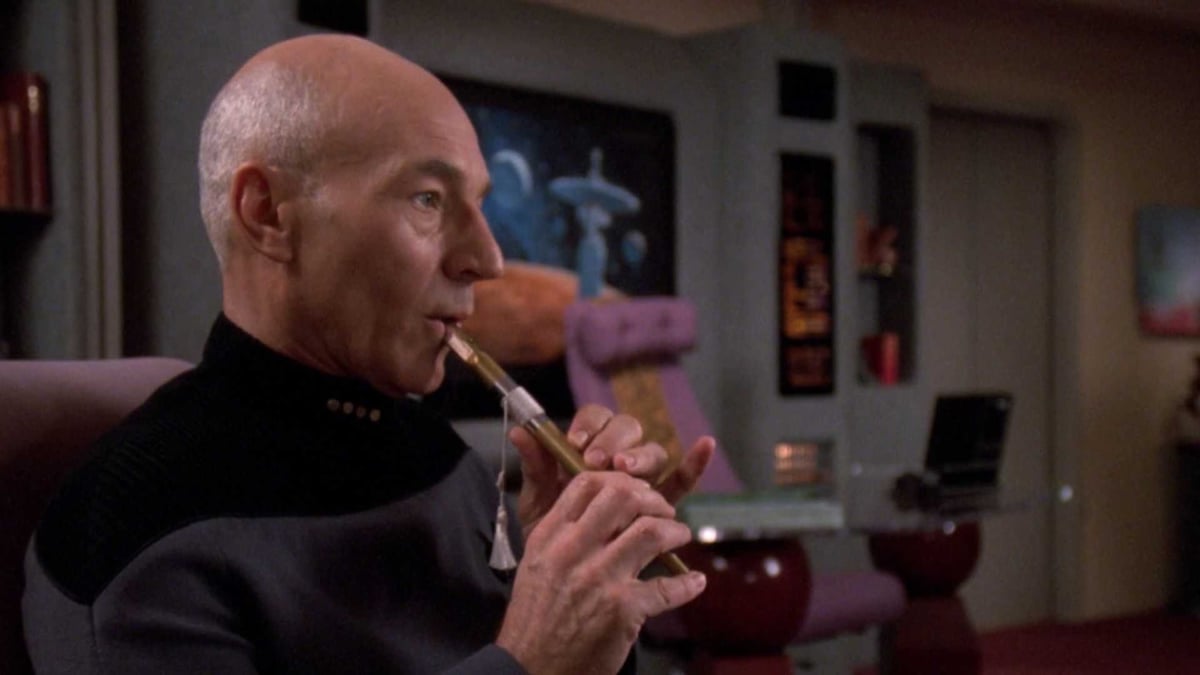
In the wake of Patrick Stewart’s death the other day, I watched a couple episodes of Star Trek: The Next Generation — the two-part series finale All Good Things… in fact.1 Wanting to add more Picard-centric episodes to my watchlist, I did some research.
There are several lists out there of the episodes of ST:TNG and Star Trek: Picard where Captain Jean-Luc Picard particularly shines. Some episodes appear on nearly every list; these are the consensus favorites:
- The Inner Light. “Captain Jean-Luc Picard is struck unconscious by an energy beam from an alien probe. While just 25 minutes pass for the rest of the crew between Picard being struck unconscious and eventually regaining consciousness on the Enterprise bridge floor, the probe makes Picard experience 40 years of lifetime as Kamin, a humanoid scientist whose planet is threatened by the nova of its sun.”
- Family. “Captain Jean-Luc Picard visits his brother’s family in France, where he begins to come to terms with his treatment by the Borg.”
- The Best of Both Worlds. “In this two part episode, the Enterprise must battle the Borg who are intent on conquering Earth, with a captured and assimilated Captain Picard as their emissary.”
- Darmok. “The crew of the Enterprise is unable to establish meaningful communication with the crew of an alien vessel, which is resolved by the struggle of the ships’ captains to defend each other from a vicious beast.”
- All Good Things… “The plot involves Captain Jean-Luc Picard jumping through time and the formation of an anomaly that defies causality, the whole situation being a test that allows Picard to demonstrate human potential to the Q Continuum by making an intuitive leap of faith to understand the cause of, and how to eliminate, the anomaly before it destroys humanity.”
- The Measure of a Man. “In this episode, the rights of the android officer Lt. Commander Data are threatened by a scientist who wishes to dismantle him to produce replicas of him. Captain Jean-Luc Picard fights in a Starfleet court for Data’s right of self-determination, not to be declared mere property of Starfleet, while Commander William Riker is obliged to argue on behalf of the scientist.”
- Starship Mine. “While the Enterprise is evacuated for hazardous maintenance, Captain Picard must, alone, contend with thieves posing as a work crew aboard the ship. The plot has been noted for its similarity to the 1988 action film Die Hard.”
- Chain of Command. “Jean-Luc Picard is relieved of command of the Enterprise and reassigned to lead a covert mission, while his replacement is assigned to deal with the Cardassians openly. The second part of the episode is noted for the intense performance of Patrick Stewart and its depiction of brutal torture and interrogation scenes.”
- Tapestry. “Q allows a supposedly deceased Captain Jean-Luc Picard to re-visit a pivotal event in his youth that he since regrets. Picard changes the past, but upon returning to the present he finds that the event made him the man he became.”
- The Drumhead. “An explosion aboard the Enterprise leads to a high-level investigation headed by Admiral Norah Satie, a retired officer renowned for her skill at exposing conspiracies.”
You can check out the lists at Screen Rant, Collider, Comicbook.com, That Love Podcast, and Popular Mechanics for more good Picard episodes.
The movies seemed to be out of scope for these lists, but I’ve always loved First Contact and Picard’s unhinged pursuit of the Borg — “The line must be drawn here!”
Did I tear up at the final scene at the poker table? When Picard says, “I should have done this a long time ago”? Yes. Yes, I did. Did I tear up again watching just that scene just now? Yes. 💞 ↩
Great Art Explained: Henri Matisse’s The Red Studio. “Even Matisse wasn’t entirely sure what he had created and nobody wanted to buy it.”
The top 10 paintings of Judith beheading Holofernes. “I feel like Artemisia has actually thought through the logistics of overpowering a grown man and hacking his head off.”

Three-Body Orbits

There are no generalized solutions to the three-body problem. Say you have three planets orbiting each other: it’s impossible to calculate how they will move using Newton’s laws of motion and gravity.
Unlike the two-body problem, the three-body problem has no general closed-form analytic solution. The differential equations that govern the motions of three gravitating bodies are not integrable and cannot be solved to give explicit formulas for the positions of the bodies as a function of time. For most initial conditions, the dynamical system for three orbiting bodies is chaotic, and the only way to predict their motions is to estimate them using numerical methods.
But thousands of stable three-body orbits have been found — their paths repeat after a given interval. The Three Body Orbits website is an atlas of some of those orbits: you can watch each three-body system play itself out in a wide variety of different shapes and complexities. There’s this simple figure 8, this slightly less simple one, and this one that looks like a spirograph.





The site even enables you to search for new stable solutions to the problem in your browser. This is what one of my unsuccessful tests looked like — two of the planets locked in a gravity death spiral while the other one peaces out in the other direction:

James Bridle on making chairs with LLMs. “What we have here is, quite literally, a chair designed by someone who has read a lot about chairs but never actually sat in one.”

In a late-stage trial, personalized mRNA vaccines for melanoma “reduced the risk of death or recurrence by 42 percent compared to standard treatment”.
Na, Na, Na, Na, Na, Na, Na, Na, Site Search!
After years in the making (or more accurately, years in the wanting), I finally figured out how I wanted to do search for KDO posts. I’ve been tinkering with this specific implementation since the beginning of the summer and it finally all came together. If you’re a member, please help me to kick the tires on this for a few days. (That link, as well as the search links below, will 404 for non-members for now.)
Hopefully it’s pretty close and then I can open it up to everyone. I’ve been using it for the past week or two and it’s been really helpful so far, especially in surfacing older posts about topics I’m currently writing about or generally interested in. The tag pages are good for that too, but search can help hone in on specifics — like posts I’ve made about fascism or posts that link to McSweeney’s. Search also pulls in results from Quick Links, which aren’t included on tag pages. The rankings still need some work here and there (it’s not magic), but your searches will help calibrate things.
For now, the search only looks at posts from 2014 to the present. You can search by keyword, describe what you remember (“the guy who walks in Japan”), or paste a link to find posts that link to it. Search is fuzzy-ish but it’s not an AI bot or anything like that so if you ramble on with a 25-word query, it’s probably not going to work that well. You can sort by best match or newest, search all posts or just Quick Links or main posts, and filter by time (past month, past 3 months, etc.)
I’ll share more about how search works in a subsequent post. For now, kick the tires and let me know what you think in the comments or via email. As always, bug reports, comments, and suggestions are welcome.
Listen to a Long-Lost Daft Punk Mix From 1997
A DJ named Ralph Lawson, who hosted a radio show called Trans Europe Express, found an incredible time capsule in his collection: an hour-long mixtape sent to him by Daft Punk in 1997, shortly after the release of their debut album, Homework. The tape was badly damaged, but he worked with a specialist to restore it and has put the whole mix up on Soundcloud.
As I write this, the mix has been up for a little over a day and has just over 7000 plays. It’s unclear whether Lawson ever even played it on the show, so we could be among the first people, outside of Daft Punk themselves, to hear this mix in almost 30 years.
See also Daft Punk Live DJ Sets From the 90s.
Rest In Peace, Patrick Stewart (1940-2026)

Sir Patrick Stewart, best known for his role as Captain Jean-Luc Picard on Star Trek: The Next Generation, has died at the age of 86. He passed at home in Los Angeles from Alzheimer’s disease and Lewy body dementia.
He was largely considered an unknown when the “Star Trek” offer came along. At the invitation of a friend, a university professor, Mr. Stewart had been in Los Angeles conducting master classes on Shakespeare when, one evening, he gave a lecture and performed some bits of the plays in a program that was open to the public.
A TV producer who was involved in developing a new “Star Trek” series happened to attend and soon persuaded Mr. Stewart to audition — even though, as Mr. Stewart later wrote, he knew “next to nothing” about the franchise.
Surprised to get the part — the “Star Trek” creator, Gene Roddenberry, who was overseeing the new series, had not been keen to hire him at first — Mr. Stewart expected the project to be a short-term commitment. How, he remembered thinking, could the show possibly succeed with a middle-aged pacifist captain with a French name and a British accent?

This is hard news to take, even though Stewart lived a full and fulfilling life. The Next Generation will always be my favorite Star Trek series and Picard my favorite captain. Stewart got off to a rough start on the series:
So when he was on set shooting the show’s debut season and co-stars like Jonathan Frakes, Denise Crosby and Brent Spiner would tease him or ad-lib a joke or laugh when they flubbed their lines, it would low-key infuriate him.
“I could be a severe bastard,” he writes. “My experiences at the Royal Shakespeare Company and the National Theatre had been intense and serious… On the TNG set, I grew angry with the conduct of my peers, and that’s when I called that meeting in which I lectured the cast for goofing off and responded to Denise Crosby’s, ‘We’ve got to have some fun sometimes, Patrick’ comment by saying, ‘We are not here, Denise, to have fun.’”
“In retrospect,” Stewart continues, “everyone, me included, finds this story hilarious. But in the moment, when the cast erupted in hysterics at my pompous declaration, I didn’t handle it well. I didn’t enjoy being laughed at. I stormed off the set and into my trailer, slamming the door.”
But he found his footing and eventually found meaning in the role of Picard (archive):
Q: There’s a passage where you say that, from your father, “I drew Picard’s stern, intimidating tendencies. But I like to think that my mother is in the captain too, in his moments of warmth and sensitivity.” Do you see Picard as your way of reconciling that conflict between your parents?
A: Very much so, yes. Both Star Trek and therapy have been responsible for that. Having to open the doors into my childhood in order to be an actor became utterly intriguing to me in a way that it never had been before. And I regret that when I look back on some of the roles I played, what I might have brought to them if I just released myself a little bit more.
Might watch an episode or two this evening in remembrance. If you’re not a Trek fan, you can watch Stewart play Macbeth in 2010:
An Italian farmer planted some decades-old seeds he found in his attic. Wheat with seven ears per stalk came up and the farmer found a reference to this type of nutritious, drought-resistant wheat in the Bible’s book of Genesis.

Star Wars: The Radio Drama
Somehow I’d never heard of this before: NPR produced and aired1 radio dramatizations of the films in the original Star Wars trilogy. The first program was particularly popular, garnering NPR hundreds of thousands of new listeners. The original versions are available in full on The Internet Archive:
- Star Wars: A New Hope (1981)
- Star Wars: The Empire Strikes Back (1983)
- Star Wars: The Return of the Jedi (1996)
Or get all three parts ripped from the CD.
All three programs contain elements of John Williams’ original soundtrack. Mark Hamill and Anthony Daniels reprised their movie roles for the first two radio programs2 and some other bold-faced names made appearances throughout: Billy Dee Williams as Lando Calrissian, John Lithgow as Yoda (??), Ed Begley Jr. as Boba Fett (???), David Alan Grier as a nameless X-wing fighter pilot, and Nia Vardalos.
The radio programs were based on the original film scripts with some added scenes; from Open Culture:
With science-fiction novelist Brian Daley brought on to add or restore scenes to the script of the original dialogue-light feature film, the story stretches out to thirteen episodes for a total runtime of six hours. The series thus stands as an early example of the expansion of the Star Wars universe that, in all kinds of media, has continued apace ever since.
And from Wikipedia:
Daley adapted the script partly using material from earlier drafts of Lucas’s scripts, and restored several scenes cut from the final edit of the film, as well as adding original new scenes created specially for the audio version. The narrative of the first two episodes takes place entirely before the opening scene of the 1977 film, and expands the background to events leading up to the capture of the Tantive IV spacecraft above the planet Tatooine. Episode 1, largely based on cut scenes from the original, explores the life of Luke Skywalker on Tatooine. During the story, Luke’s skyhopper (a vehicle seen in the background in Luke’s garage during the film) is damaged during a desert race; Luke sees the distant Star Destroyer battle in the sky; and he is reunited with his childhood friend, Biggs Darklighter. Episode 2, made up of material written entirely by Daley, provides backstory to Princess Leia’s acquisition of the Death Star plans from agents of the Rebel Alliance on the planet Toprawa. In scenes set on the planet Alderaan, Leia discusses the plans with her father, Prestor Organa, and determines to go in search of Obi-Wan Kenobi.
There are recut fan versions of the three programs as well, including Nigel’s Edits (Hope, Empire, Jedi); he added some of Ben Burtt’s sound effects into the mix:
These versions, boldly called The Definitive Editions (Hope, Empire, Jedi), include opening scrolls and images taken from Star Wars comic books and trading cards:
Yes, that’s a script turned into a movie turned into an audio drama turned into a, uh, quasi-cinematic Powerpoint? (via open culture)
Dumpster Archeology. “Lew Blink’s passion for dumpster diving, his tenacity in connecting the dots, and his magnetic charisma as he unearths the secrets of others were a captivating lens through which to explore themes of privacy, waste…”
What’s the largest tweetable number? You’ve got 280 characters. So: “9999…” or “one centillion” or “googol!!!!!!…” or an image of a number? Turns out it’s complicated!
Rolling Stone: The 200 Greatest Rock Songs of the 21st Century So Far. I cannot argue with the top pick: Maps by the Yeah Yeah Yeahs. There’s a Spotify playlist with all 200 songs…a great way to spend 15 hours and 25 minutes.

The Remarkable Serbian Election
I’ve been reading a bit about the recent election in Serbia and some of the details are fascinating. A student-led coalition toppled the 12-year corrupt reign of “the increasingly authoritarian leader” Aleksandar Vučić in recent elections. But in order to ensure voters and allies that this wasn’t a grab for power on the part of the students, the students ruled themselves out.
Supporters had the votes, but they needed the losing side to stay. The strict rules were a promise: to those who had opposed running, that it would not turn the movement into a party; to voters, that the list was no party in disguise.
No student may run: anyone enrolled in 2024/25, or with studies on hold, is excluded. The drafters wanted no suggestion that students were building political careers. Former members of the ruling coalition’s 20 parties are barred, and so are former officials of parliamentary opposition parties. That leaves doctors, academics, artists, former athletes and activists. Ordinary members of opposition parties were not barred, but almost none with a party past. The list is led by Ilija Srdanović, a cardiologist and professor in Novi Sad.
The result is the Student List. From a pre-election piece in the NY Times: Something Astonishing Is Happening in My Country. The World Should Take Note.
The students’ list of 250 candidates is remarkable in itself. Comprising professors, scientists, doctors, workers, actors and activists, the candidates — most of whom had been unknown to the public — were selected through a lengthy sequence of scrutiny and interviews. University faculties proposed candidates, then reviewed nominees from across the country. After discussing the options, student assemblies made their choices. Thousands participated in this decision-making process — an extraordinary experiment in bringing direct democracy into mainstream politics.
The established opposition, meanwhile, has been pushed aside, with many of its parties backing the student list. The student movement has turned the election into something like a referendum on the regime, captured in its slogan: “Serbia or the mafia.” Many assumed the students were too inexperienced or naïve for electoral politics. But with some polls putting support for the student list above 40 percent, the race appears to be tight.
The students are coming for the machine. And, astonishingly, they might win.
Super interesting, right? US electoral politics don’t work the same as Serbia’s, but I wonder if there’s a way to inject some aspect of the Student List into US elections?
See also How to Give Away a Fortune, which resonates with the Serbian movement IMO.
Socials & More