
Alex Hollender led the recent redesign of Wikipedia and wrote up some notes on the project and process. “We felt confident that if we gave it some overdue attention we could make it better for both reader and editors.”

Advertise here with Carbon Ads
This site is made possible by member support. 💞
Big thanks to Arcustech for hosting the site and offering amazing tech support.
When you buy through links on kottke.org, I may earn an affiliate commission. Thanks for supporting the site!
kottke.org. home of fine hypertext products since 1998.
Beloved by 86.47% of the web.
Entries for March 2023
The So-Called “Culture Wars”
Political cartoonist Jen Sorensen recently published this cartoon at The Nib about the harmful mischaracterization of human rights battles as mere “culture wars”.
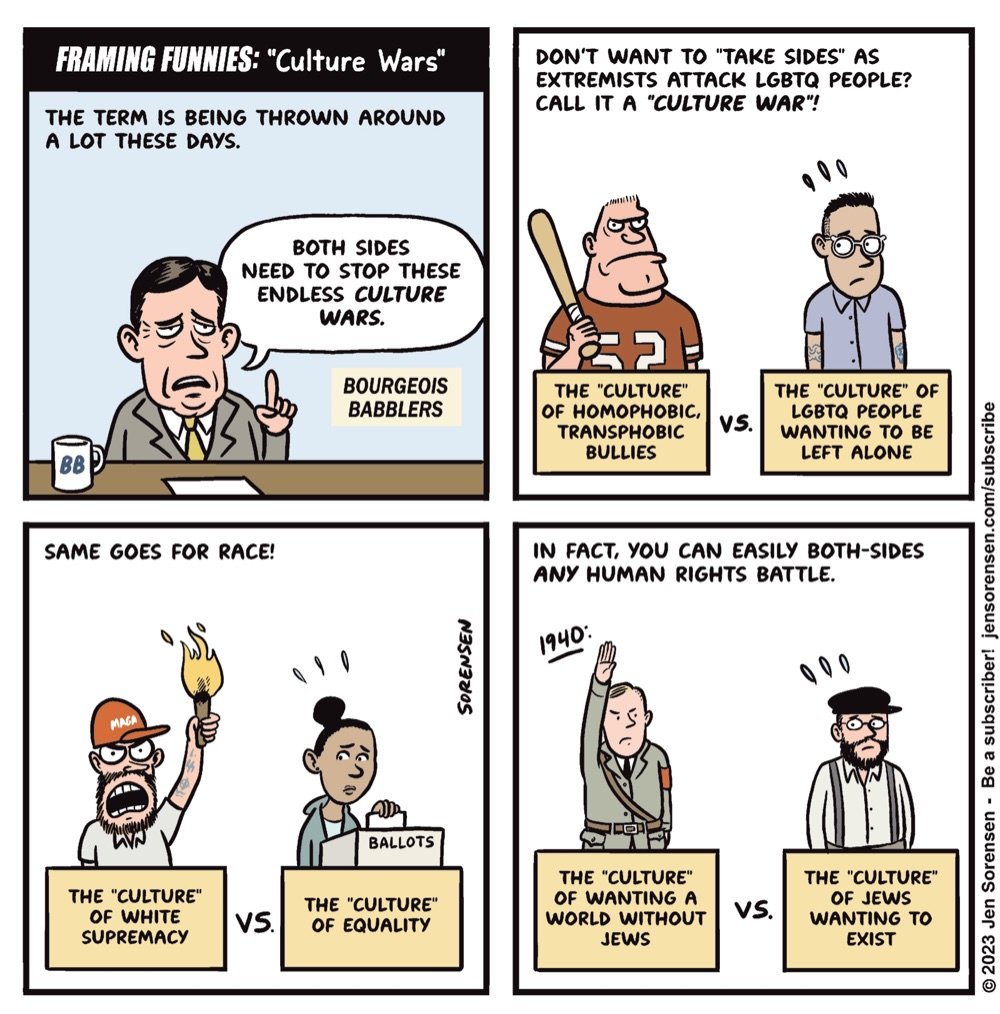
Here’s what she wrote about it:
The term “culture wars” is used by many well-meaning people, including many progressive writers and activists I admire. It’s a convenient way to refer to a number of issues. But in this current political moment, I think it’s a highly misleading euphemism. What we are experiencing in America right now is an asymmetrical attack on basic freedoms — a fascist movement that thrives on targeting certain groups, erasing history, and spreading dangerous falsehoods through a vast media apparatus. To call this a “culture war” is to legitimize the contemporary GOP and its extremist counterparts as a coherent and authentic “culture” worthy of respect. This is a misuse of the concept of culture, creating a false equivalence between marginalized groups and those who would harm or eliminate them in a quest for ever more power.
Yeah, spot on. You can follow Sorensen’s work on Mastodon, The Nib, Daily Kos, and Patreon.
From the University of Colorado Boulder, a five-week mini-course on web scraping. The syllabus and code samples are available on Github.
Interesting class from Ana Marie Cox that sounds like part writing workshop, part therapy. The Third Story Workshop is “designed to help people reclaim the narrative of their lives in an essay they can share with others”.
A Prelude to a Supernova

Folks, I told you that this was going to become a JWST fan blog and if you didn’t hear me the first time, consider yourself notified. NASA’s newest space telescope is still stretching its legs, but even back in its early days last summer, it captured this breathtaking near-infrared and mid-infrared image of a star preparing to go supernova.
The 10 light-years-wide nebula is made of material cast off from the aging star in random ejections, and from dust produced in the ensuing turbulence. This brilliant stage of mass loss precedes the star’s eventual supernova, when nuclear fusion in its core stops and the pressure of gravity causes it to collapse in on itself and then explode.
Images like these are useful for studying dust, which sounds a little boring but actually is fascinating (italics mine):
The origin of cosmic dust that can survive a supernova blast and contribute to the universe’s overall “dust budget” is of great interest to astronomers for multiple reasons. Dust is integral to the workings of the universe: It shelters forming stars, gathers together to help form planets, and serves as a platform for molecules to form and clump together — including the building blocks of life on Earth. Despite the many essential roles that dust plays, there is still more dust in the universe than astronomers’ current dust-formation theories can explain. The universe is operating with a dust budget surplus.
Currently imagining a sci-fi office dramedy about the dust budget surplus — someone over at HBO Max or Apple+ get on this.
On the occasion of the 50th anniversary of hip-hop, Jelani Cobb contrasts the central place it occupies in our culture with “the disparities of health, health care, and longevity” in America’s Black and brown communities.
Most rare book librarians don’t wear special white gloves when handling old books and manuscripts. “The best way to handle a rare book is with clean hands and caution.”
The American Kennel Club: the most popular purebred dog in the US in 2022 was the French Bulldog. “This ends the Labrador Retriever’s 31-year reign as the most popular dog breed in America.”
A History of Rock in Guitar Riffs
Musician Andrea Boma Boccarusso’s tour of rock ‘n roll history through guitar riffs is a lot of fun. Each year from 1965 to 2022, Boccarusso plays one iconic riff that represents the vibe of rock at the time. Here are a few that made the list:
1965 - The Rolling Stones, Satisfaction
1975 - Queen, Bohemian Rhapsody
1977 - David Bowie, Heroes
1982 - Michael Jackson, Beat It
1985 - Dire Straits, Money for Nothing
1992 - Rage Against the Machine, Killing in The Name of
1995 - Oasis, Wonderwall
2003 - The White Stripes, Seven Nation Army
The riffs get a little less iconic as the 2000s go on, but that’s to be expected in the age of the ascendancy of hip hop. (via digg)
From Wikipedia, a list of extraterrestrial volcanoes - a tally of “active, dormant, and extinct volcanoes located beyond planet Earth”.
Recent analysis of images from the early-90s Magellan mission has revealed signs of active volcanism on Venus.
We’re getting (at least) two more seasons of The Last of Us TV series because the “more expansive” Part II of the video game will be split into two TV seasons.
Loving these articles about the secrets of successful people. “Winners Wake Up at 4:30 a.m.: The Science of How We Can All Become Rich by Being Less Pathetic.”
Aerial Autumnal Views of the Bavarian Forest
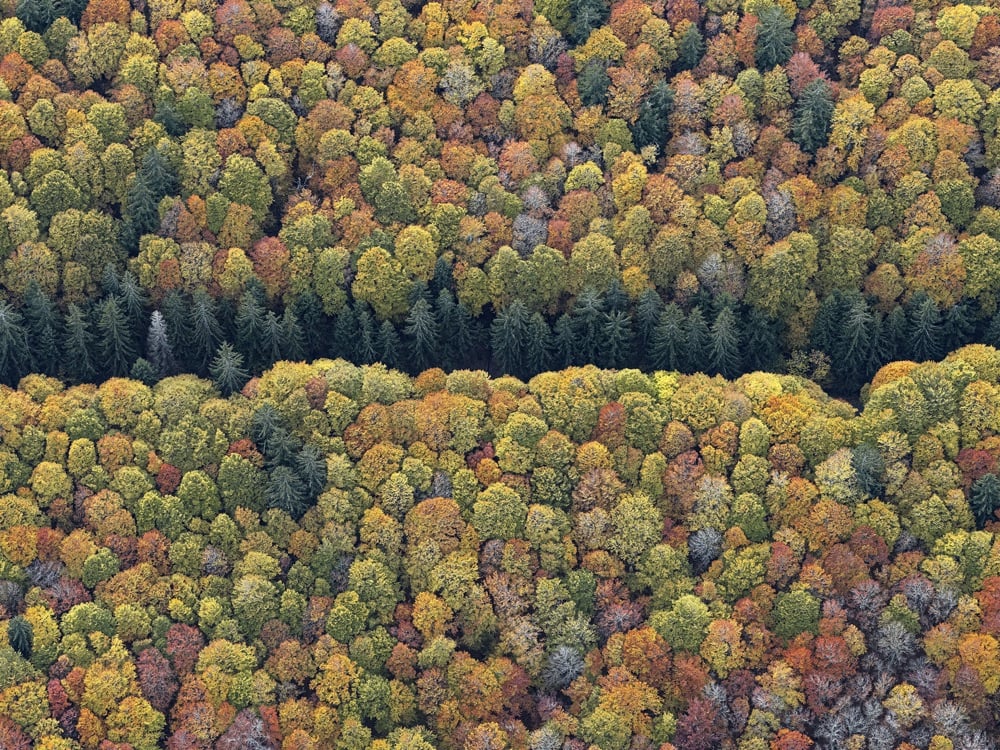
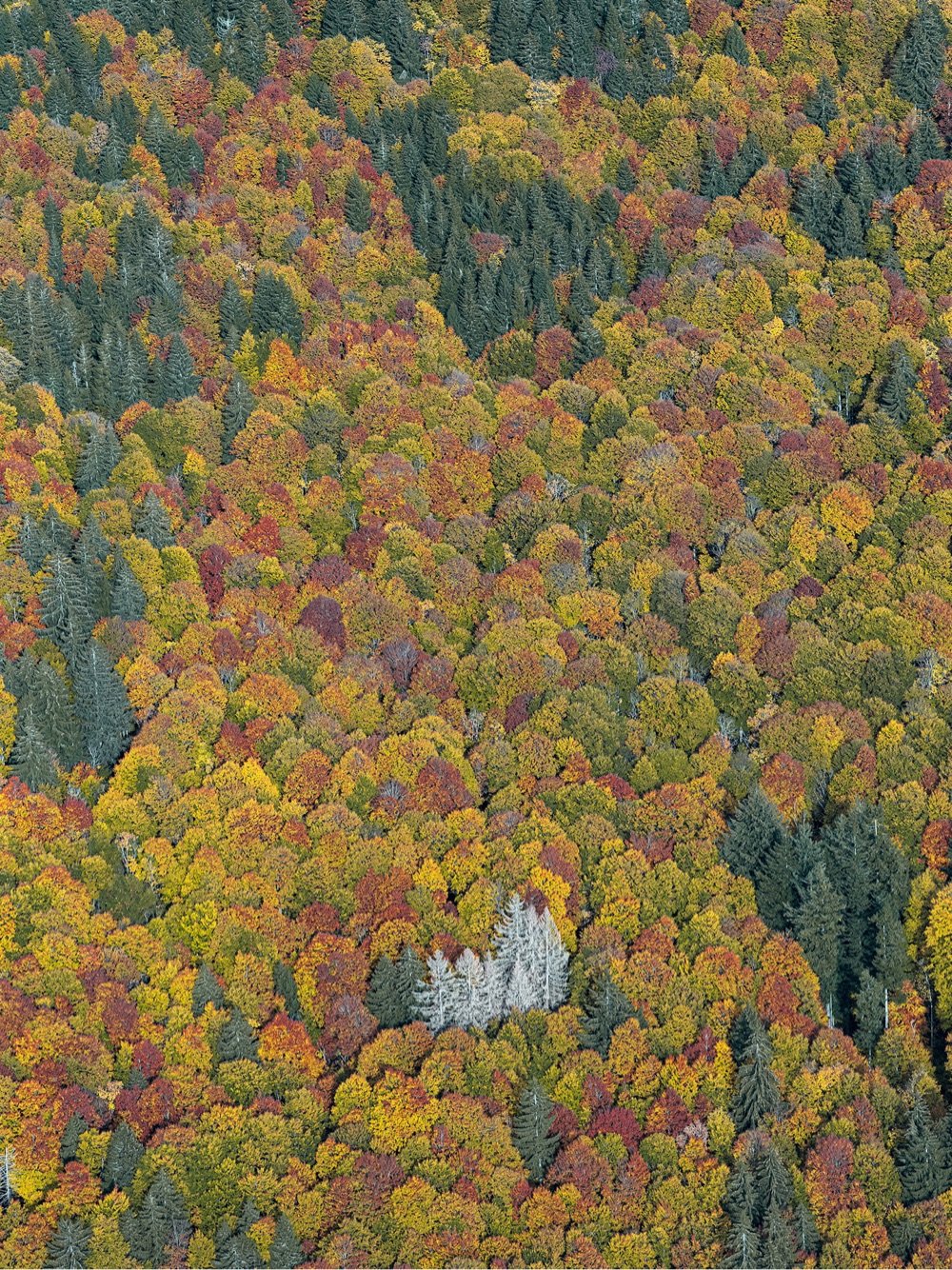
Living in Vermont, I have a special appreciation for all the amazing colors that trees turn in the fall. So I very much enjoyed looking at Bernhard Lang’s series of aerial photos of the Bavarian Forest. Says Lang of the series:
Most of the topics of my Aerial Views project, which I have been following since 2010, deal with the intervention and often also the destruction of our environment by humans.
This new aerial photo series about the Bavarian Forest, the first Nationalpark in Germany founded in 1970, shows nature that is largely left to its own devices again, true to the park’s motto “NATUR NATUR SEIN LASSEN”.
The nature zone of the Bavarian Forest National Park is thus one of the very few places in geographically divided and densely populated Germany where, in the sense of human non-intervention, at least secondary wilderness should be possible again, especially in spite of the age of the Anthropocene, in which there is no completely uninfluenced nature anymore.
Lang has lots of other great aerial projects to peruse on his website. (via colossal)
On the difficulty of ranking Steven Spielberg’s movies (also includes several rankings of his movies). “Spielberg has dipped into every genre, flexed every cinematic muscle, and made too many classics for too many varying tastes.”
A hard truth for websites who want people to log in before they can read their free content: “Not reading is easier than reading — and *way easier* than logging in.”
The Algorithmic Trick That Can Solve Rubik’s Cubes
Any Rubik’s Cube can be solved in 20 moves or less. The “meet in the middle” algorithmic trick can help a computer program solve a Cube in minutes or hours instead of millenia.
If you’re interested, there’s a lot more information about algorithms and Rubik’s Cubes in the video’s description.
See also MIT Robot Solves Rubik’s Cube in 0.38 Seconds and A Self-Solving Rubik’s Cube.
Why Is There an Empty Picture Frame in Joe Biden’s Oval Office?
For his new video series, David Friedman of Ironic Sans finds out the secret behind an unusual object that Joe Biden has placed in the Oval Office: an empty picture frame. The object turns out to be….well, I won’t spoil it, but a few other presidents have had this thing in their Oval Offices as well.
Joe Biden put an empty picture frame in the Oval Office and it’s got a lot of people asking questions. Has a photo been removed? Is something being censored and hidden from the public? I have the answer! And it takes us down a bit of a rabbit hole.
Friedman also uploaded a copy of the White House tour brochure for Biden’s White House.
Nebraska state senator Machaela Cavanaugh is 3 weeks into filibustering an anti-trans bill. “If this Legislature collectively decides that legislating hate against children is our priority, then I am going to make it…painful for everyone.”
Cony Hawk, Pro Skater. This traffic cone is a way better skater than I’ll ever be and I’m not even mad about it.
50 Years Later, We’re Still Living in the Xerox Alto’s World. “Using it feels so familiar and natural that it’s sometimes difficult to appreciate just how extraordinary, how different it was when it first appeared.”
Almost every letter in English speech can be silent, except for possibly V. “The letter E quietly resides in the middle of the word vegetable.”
The Difficulty of Living in Exponential Time
In a piece about how the pace of improvement in the current crop of AI products is vastly outstripping the ability of society to react/respond to it, Ezra Klein uses this cracker of a phrase/concept: “the difficulty of living in exponential time”.
I find myself thinking back to the early days of Covid. There were weeks when it was clear that lockdowns were coming, that the world was tilting into crisis, and yet normalcy reigned, and you sounded like a loon telling your family to stock up on toilet paper. There was the difficulty of living in exponential time, the impossible task of speeding policy and social change to match the rate of viral replication. I suspect that some of the political and social damage we still carry from the pandemic reflects that impossible acceleration. There is a natural pace to human deliberation. A lot breaks when we are denied the luxury of time.
But that is the kind of moment I believe we are in now. We do not have the luxury of moving this slowly in response, at least not if the technology is going to move this fast.
Covid, AI, and even climate change (e.g. the effects we are seeing after 250 years of escalating carbon emissions)…they are all moving too fast for society to make complete sense of them. And it’s causing problems and creating opportunities for schemers, connivers, and confidence tricksters to wreck havoc.
It Took Me Nearly 40 Years To Stop Resenting Ke Huy Quan. “I blamed Quan, Gedde Watanabe, Pat Morita, and any number of other Asian-American actors for perpetuating these constructed stereotypes.”
Great Art Explained: Georges Seurat’s A Sunday on La Grande Jatte
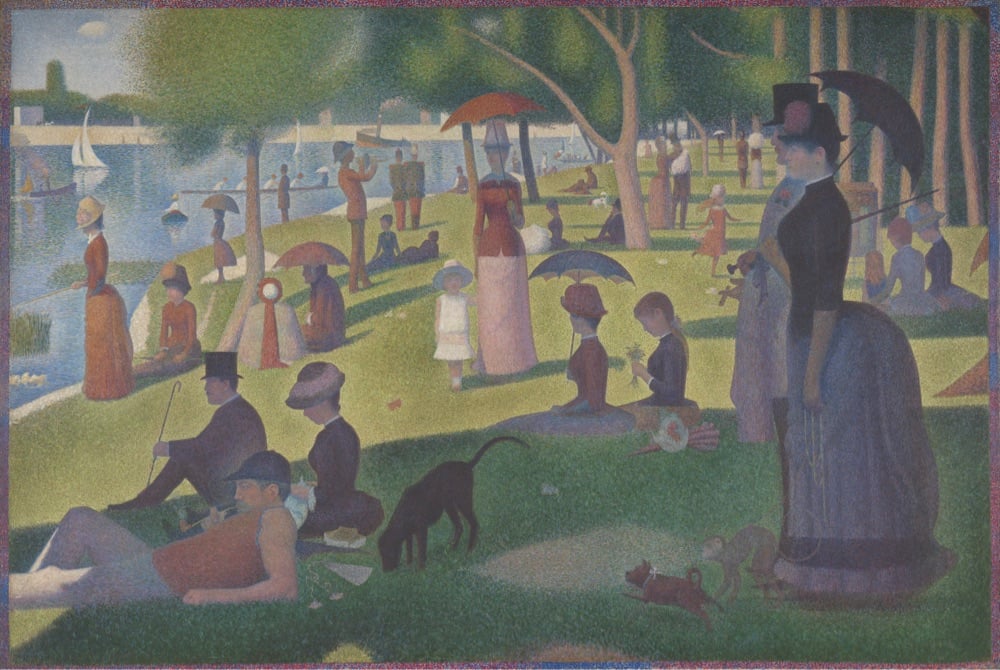
Say what you will about The Algorithms, but YouTube’s reliably informs this art history lover of every new episode of Great Art Explained and for that I am grateful. This latest episode is about the pointillist masterpiece by Georges Seurat, A Sunday on La Grande Jatte. I had a chance to see this painting in person last summer at The Art Institute of Chicago — spent quite a bit of time looking at it from all angles and distances — so this episode was the perfect accompaniment to that visit.
The lack of narrative means we really should look to the artist’s obsession with form, technique and theory — which is practically all he wrote about — and not to meaning or subject matter - which he didn’t write about at all. The painting is really his manifesto. His protagonists don’t have faces or body language, neither a history nor individuality. They are reduced to a hat, a corset, or a pet. They are just characters in his frieze. They exist only to give perfect balance to the composition.
Some paintings are designed for the viewer to “empathise with” but Seurat keeps us at arm’s length. We are not invited to “participate” in the promenade, and their psychological distance is clear. Both with their neighbors, and with us. It was ancient art that Seurat looked to — of Egypt and Greece. He once said that he “wanted to make modern people move about as they do on the Parthenon Frieze”, and placed them on canvases organized by harmonies of colour. It is what makes the painting so intriguing.
Teaser trailer for season two of The Bear. Always interesting to see if the lightning-in-a-bottle of shows like this can carry over into a second season.
Kottke 25: One More Chance for Hypertext Tees

In celebration of the site’s 25th anniversary, I’ve turned ordering back on for Kottke Hypertext Tees for the next day or so. Here’s what I wrote about them last month:
For much of the nearly 25-year lifespan of kottke.org, the site’s tagline has been “home of fine hypertext products”. I always liked that it felt olde timey and futuristic at the same time, although hypertext itself has become antiquated — no one talks of hypertextual media anymore even though we’re all soaking in it.
And so but anyway, I thought it would fun to turn that tagline into a t-shirt, so I partnered with the good folks at Cotton Bureau to make a fine “hypertext” product that you can actually buy and wear around and eventually it’ll wear out and then you can use it to wash your car. If you want to support the site and look good doing it, you can order a Kottke.org Hypertext Tee right now.
You can check out my original post for more details. These shirts were super popular (I sold almost 3X as many as I thought I would) so I figured I’d make them available again for folks who hadn’t seen them the first time around.
OpenAI has introduced their GPT-4 language model. You can try it out right now if you’re a ChatGPT Plus user. “GPT-4 is more reliable, creative, and able to handle much more nuanced instructions than GPT-3.5.”
Kottke.org Is 25 Years Old Today and I’m Going to Write About It
I realize how it sounds, but I’m going to say it anyway because it’s the truth. When I first clapped eyes on the World Wide Web, I fell in love. Here’s how I described the experience in a 2016 post about Halt and Catch Fire:
When I tell people about the first time I saw the Web, I sheepishly describe it as love at first sight. Logging on that first time, using an early version of NCSA Mosaic with a network login borrowed from my physics advisor, was the only time in my life I have ever seen something so clearly, been sure of anything so completely. It was a like a thunderclap — “the amazing possibility to be able to go anywhere within something that is magnificent and never-ending” — and I just knew this was for me and that it was going to be huge and important. I know how ridiculous this sounds, but the Web is the true love of my life and ever since I’ve been trying to live inside the feeling I had when I first saw it.
My love for the web has ebbed and flowed in the years since, but mainly it’s persisted — so much so that as of today, I’ve been writing kottke.org for 25 years. A little context for just how long that is: kottke.org is older than Google. 25 years is more than half of my life, spanning four decades (the 90s, 00s, 10s, and 20s) and around 40,000 posts — almost cartoonishly long for a medium optimized for impermanence. What follows is my (relatively brief) attempt to explain where kottke.org came from and why it’s still going.
It’s an absurd understatement to say that the web has changed a lot in the nearly 30 years since I experienced that “thunderbolt that completely changed my life” — it’s now a massive, overwhelmingly corporate entity that encompasses and organizes an ever-growing share of human information and activity. As a web designer in the 90s and early 00s, I helped companies figure out how to use the web for business, but the core of my own personal experience of the web has always been self-expression and making websites for individual humans to read & experience.
I started making personal websites shortly after discovering the web, first using Notepad and then a program called HTML Assistant. My first site had an audience of exactly one — it lived on a 3.5” floppy disk and was mostly a jazzed-up version of my bookmarks file that I carried back and forth from my dorm room to the physics lab. When I was finally able to finagle public server access, I launched a site called “some web space” (all lowercase, because 90s)1 that included a hand-drawn graphic of swiss cheese and a bunch of links related to Pulp Fiction. This is me right around that time:
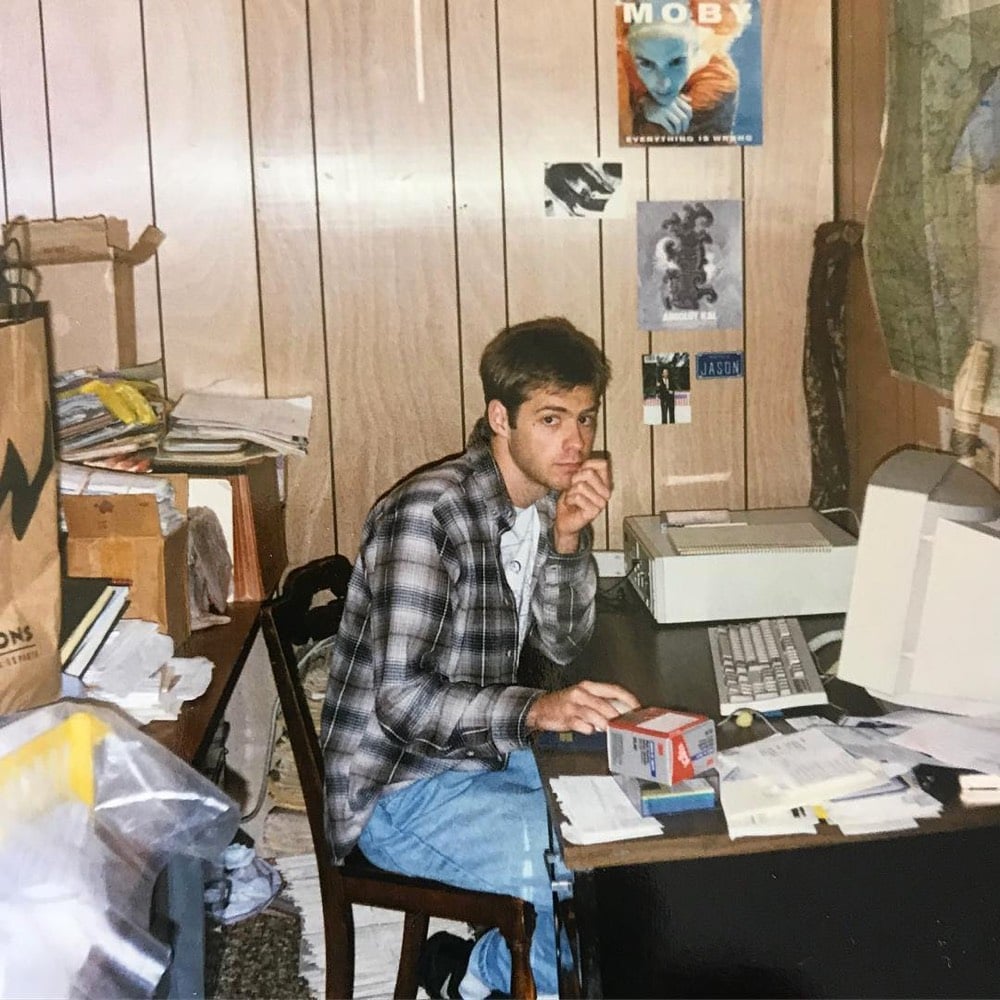
That tiny baby Jason loved cheese, Quentin Tarantino, and the World Wide Web, bless his little heart.
Anyway, the sites I built then were terrible at first, but I was obsessed and slowly they improved. some web space turned into a site called 0sil8, which became a playground of sorts for my experiments in writing and design. Every few weeks/months, I’d create a new “episode” to put up on 0sil8 and gradually I gained an online following and became part of a community of folks who were likewise experimenting with the web.
Around this time, more and more of what I was reading online were diaries and these things called weblogs.2 The updates on weblogs & diaries were smaller but more frequent than on other personal sites — their velocity felt different, exhilarating. But by the time I actually got interested enough to start my own weblog, there were so many of them — hundreds! maybe thousands! — that I thought I was too late, that no one would be interested. I forged ahead anyway and on March 14, 1998, I started the weblog that would soon become kottke.org. It was called Notes and here’s what it looked like:
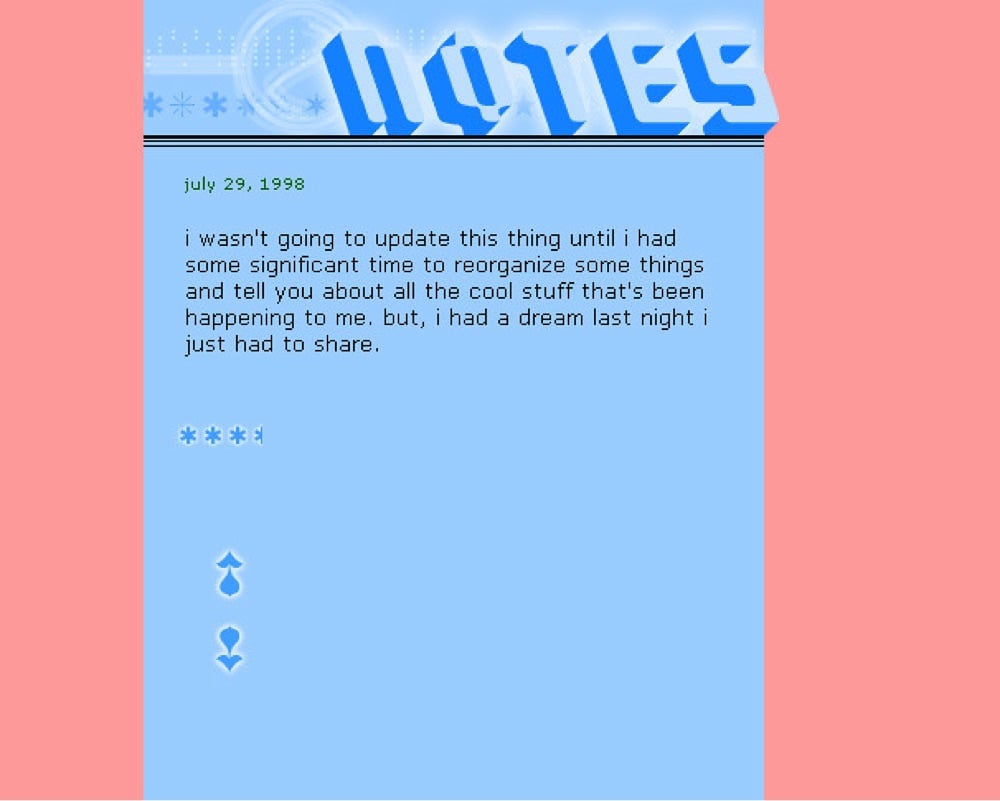
I’m not gonna go through the whole history of the site, but it eventually took off in a way that I didn’t anticipate. Since 2005, kottke.org has been my full-time job and supports my family. I’ve met so many people from all over the world through my work here, including many life-long friends and my (now ex-) wife. I’ve spoken at conferences and travelled the world. I got to be on TV. I launched a membership program (which you should totally join if you haven’t already) that has given the site an incredible boost as it powers through its third decade.
On the occasion of the 20th anniversary of kottke.org, I wrote this:
I’ve been reading back through the early archives (which I wouldn’t recommend), and it feels like excavating down through layers of sediment, tracing the growth & evolution of the web, a media format, and most of all, a person. On March 14, 1998, I was 24 years old and dumb as a brick. Oh sure, I’d had lots of book learning and was quick with ideas, but I knew shockingly little about actual real life. I was a cynical and cocky know-it-all. Some of my older posts are genuinely cringeworthy to read now: poorly written, cluelessly privileged, and even mean spirited. I’m ashamed to have written some of them.
But had I not written all those posts, good and bad, I wouldn’t be who I am today, which, hopefully, is a somewhat wiser person vectoring towards a better version of himself. What the site has become in its best moments — a slightly highfalutin description from the about page: “[kottke.org] covers the essential people, inventions, performances, and ideas that increase the collective adjacent possible of humanity” — has given me a chance to “try on” hundreds of thousands of ideas, put myself into the shoes of all kinds of different thinkers & creators, meet some wonderful people (some of whom I’m lucky enough to call my friends), and engage with some of the best readers on the web (that’s you!), who regularly challenge me on and improve my understanding of countless topics and viewpoints.
I had a personal realization recently: kottke.org isn’t so much a thing I’m making but a process I’m going through. A journey. A journey towards knowledge, discovery, empathy, connection, and a better way of seeing the world. Along the way, I’ve found myself and all of you. I feel so so so lucky to have had this opportunity.
That all still rings incredibly true and I cannot improve upon it as an explanation of why I’m still here doing this moderately anachronistic thing. Thank you all so much for reading. ♥
P.S. You can read my thoughts on past anniversaries and view some previous site designs here: 10 years, 18-ish years, 20 years, and 24 years.
P.P.S. I wrote a separate post about this yesterday, but if you find value in what I do here, I’d appreciate if you’d support the site by purchasing a membership. And to everyone who has supported the site over the years, thank you so much!
P.P.P.S. Last one: I’m gonna write more about this later today, but I’ve turned ordering back on for Kottke Hypertext Tees for the next 24 hours or so. Go get ‘em!
P.P.P.P.S. Ha, I’ve thought of one more thing: I’ve turned comments on for this post! kottke.org used to allow comments on every post, but it’s been almost 8 years since the last time they were on. I figured it would be fun to try them out today. No idea if they’re even going to work or how long they will be available, but let’s try it out. If you’d like to share how long you’ve been reading the site or leave any memories or observations, feel free. My inbox is open as well. Ok, that’s really all for now! Thank you!
Update: A bunch of comments got hung up in a spam filter in my CMS that I didn’t even know was active. They should be all through now…sorry about that!
Fun fact: when kottke.org started, I wrote everything in lowercase. At some later point, I switched to mixed-case and went back through the old entries and edited them to use mixed-case too.↩
Peter Merholz wouldn’t coin the word “blog” until sometime in early 1999; they were known as weblogs before then.↩
The Notre Dame in Paris is scheduled to reopen in late 2024. “The reconstruction itself started last year, after more than two years of work to make the monument stable and secure enough for artisans to start rebuilding it.”
How to Draw Fantasy World Maps
I am not a particular fan of fantasy games, but I do like watching people draw and talk about their process, particularly when it’s accessible to beginners. On his YouTube channel, JP Coovert shows people how to draw maps for fantasy games, books, and other media. Here’s a few examples to whet the appetite.
(via the kid should see this)
Kottke 25: It’s Membership Time!

Good morning! Tomorrow marks 25 years of blogging here at kottke.org and it’s been more than three months since I returned from my sabbatical, so I thought it would be a good time to:
a) Once again express my heartfelt thanks to those of you who have supported the site over the years by purchasing a membership. Kottke.org has been my full-time job since 2005, and I’ve said this many times before but: this membership support is essential in keeping the site running so smoothly, with few membership solicitations like this one, very minimal advertising, no popup newsletter sign-up forms, a full-text RSS feed w/ no ads, etc. etc. etc.
And perhaps nearest and dearest to my heart, member support keeps the site free, open, and available to everyone on an internet that is increasingly paywalled. It’s not difficult to imagine an alt-universe kottke.org with ads crammed into every bit of whitespace, email collection forms popping up on every visit, and half the site behind a members-only paywall. No shade to those who have gone that route to keep things running — I’d probably make more money with members-only content on Substack or whatever and that pull is tempting. But seriously, I love you folks so much for collectively keeping all of kottke.org on the open web. Thank you.
b) Cajole those of you who aren’t currently members to sign up for a membership today or, in the case of former members, to restart your memberships.1 I’m not going to give you the hard sell here — I listed some reasons to join in the preceding paragraphs and if you’re a regular reader, I don’t have to tell you the value you get from the site; you already know that for yourself. What I’m asking is: if you appreciate what I do here and you can manage it, please support the site by purchasing a membership.
—-
I also wanted to give you a brief update & behind-the-scenes about what happened with memberships during my sabbatical and in the months since I’ve returned. One of my biggest hesitations about taking time off from the site was losing revenue from both memberships and advertising. I was unsure how my announcement would be received and was worried I was somehow idiotically crashing this tiny, fragile business of mine onto the shoals. After probably too much thinking/anxiety about it, I decided I needed the break more than the revenue and that I could build memberships back up again after I returned. It was a risk, but one I decided I needed to take.
When I announced the sabbatical back in May 2022, something completely unexpected happened: memberships went up. People signed up or increased their membership levels specifically to support me taking time off, and very few people cancelled. I actually burst into tears when I checked my member dashboard and saw this happening in the hours after the announcement. That display of support — and the hundreds of emails2 I received — allowed me the space and peace of mind I needed to fully disengage and disconnect from my work here to reflect and recharge (and, like, get some chores done around the house for a change).
Fast forward to the end of October. I wasn’t quite ready to return to work yet. Because I’d launched the membership program back in November of 2016, I’d say about 60-70% of all annual memberships still renew in early November.3 You may be able to guess what happened: despite a brief update on my plans to return soon, many people cancelled their memberships. That decline has continued in the following months, even after I returned to work. In fact, there are about 10% fewer members now than there were right before I logged off in May. So, the drop-off in revenue I expected when I took a break was just delayed by a few months.
When I returned at the beginning of December, I wanted to knuckle down and focus on the site and not bug you about memberships. Ship first, worry about revenue later. Now that I’ve been back at it full-time for three-and-a-half months, I’d like to build membership levels back up again, ideally to pre-sabbatical levels. Once again, you can check out your membership options here if you’d like to help me reach that goal.
Fun fact: right now, there are more former members of kottke.org than there are current members. Would like to change that!↩
I read every single email and responded to as many as I could. My apologies if I didn’t reply to yours…there were just too many!↩
Just as a sidebar, this creates an interesting cashflow situation — I get like 60% of my total revenue for the whole year delivered to my bank account in a space of 2 weeks. But I obviously have expenses and estimated tax payments that occur throughout the year, so I need to budget and manage that carefully. I’ve gotten used to it, but it’s taken awhile to acclimate.↩
Everything Everywhere All at Once!
I loved Everything Everywhere All at Once so much when I saw it in the theater last spring. It caught me in a low moment and swept me up in a protective embrace; it was magic. I was afraid this joyously weird movie would get lost in the Very Serious Film shuffle come awards time but I was beyond thrilled when I woke up this morning to the news that EEAAO swept the major categories for which it was nominated at the Oscars. Here are all the film’s wins from last night:
Best Picture - Daniel Kwan, Daniel Scheinert, and Jonathan Wang, producers (acceptance speech).
Best Director - Daniel Kwan and Daniel Scheinert (acceptance speech).
Best Actress - Michelle Yeoh (acceptance speech).
Best Supporting Actor - Ke Huy Quan (acceptance speech).
Best Supporting Actress - Jamie Lee Curtis (acceptance speech).
Best Original Screenplay - Daniel Kwan and Daniel Scheinert (acceptance speech).
Best Film Editing - Paul Rogers (acceptance speech).
So happy for Michelle Yeoh and Ke Huy Quan in particular! Here are their acceptance speeches:
I am disappointed, but only slightly, that Stephanie Hsu didn’t win Best Supporting Actress — her audition for the role of Joy/Jobu Tupaki is amazing if you haven’t seen it. (And she also sang with David Byrne (who wore hot dog fingers) last night?)
Watch Stephanie Hsu’s brilliant audition for Everything Everywhere All At Once. I won’t say Jamie Lee Curtis didn’t deserve her Oscar, but Hsu would have been my choice.
Kottke 25: The Talk Show With John Gruber
Kottke.org is turning 25 years old this Tuesday and I’ll be doing a few posts this week related to the (silver!) anniversary. First up: John Gruber was kind enough to host me for a short chat on his podcast, The Talk Show. Our time together was pretty limited, but we still managed to talk about the good ol’ days of the web & blogging, my recent sabbatical, burnout, Dean Allen, kottke.org’s 25th anniversary, Suck.com, hypertext, Stellar, and several other topics I can’t remember.
You can listen this episode of The Talk Show on Apple Podcasts, Spotify, or wherever you listen to podcasts.
SpaceX Crew Member Realizes He Fired After Being Locked Out Of Capsule. “Judging by the fact that I have no space shuttle access, everyone is ignoring me, and I’m floating endlessly in space, I think I can put two and two together…”
I know parents are always on the lookout for engaging tabletop games for their kids; check out these roleplaying games from AMPERSAND RPG that kids and parents can play together.
Finally, the Answers to Cold Weather Mysteries
If you live in any sort of winter climate, you have, at one time or another, wrestled with the two great mysteries of cold weather life:
1. Why does 50°F in the fall make you want to bundle up while 50°F in the spring makes you want to go for a walk in short sleeves?
2. Why the hell do kids wear shorts during the winter or go without coats when it’s literally freezing out? Like seriously, what the hell?
This short video answers both questions with one magical substance: brown fat.
55 degrees in the summer feels colder than 55 degrees in the winter. And 55 degrees as an adult likely feels colder than 55 degrees as a kid. But it’s not just a feeling. It all has to do with how our bodies use fat - specifically brown fat, a lesser-known type of fat that can produce roughly 300 times more heat than any other tissue in the body.
Brown fat isn’t the type of fat that adds to our weight (that’s white fat). Brown fat has the sole purpose of being burnt for heating the body, and it’s extremely effective at that. It only appears in specific parts of the body: around the neck, spine, heart, and kidneys. (It clumps around major blood vessels, in order to warm the blood as it passes through the body.)
In brief: 1. We have more brown fat in the spring, and 2. Kids have more brown fat in their bodies than adults. Cool! (har har)
Zeynep Tufekci: Here’s Why the Science Is Clear That Masks Work
You may have seen the online kerfuffle a few weeks ago about a study that was released recently that indicated that there was no evidence that masks work against respiratory illnesses (see Bret Stephen’s awful ideologically driven piece in the NY Times for instance). As many experts said at the time, that’s not what the review of the studies actually meant and the organization responsible recently apologized and clarified the review’s assertions.
In a typically well-argued and well-researched piece for the NY Times, Zeynep Tufekci explains what the review actually shows and why the science is clear that masks do work.
Scientists routinely use other kinds of data besides randomized reviews, including lab studies, natural experiments, real-life data and observational studies. All these should be taken into account to evaluate masks.
Lab studies, many of which were done during the pandemic, show that masks, particularly N95 respirators, can block viral particles. Linsey Marr, an aerosol scientist who has long studied airborne viral transmission, told me even cloth masks that fit well and use appropriate materials can help.
Real-life data can be complicated by variables that aren’t controlled for, but it’s worth examining even if studying it isn’t conclusive.
Japan, which emphasized wearing masks and mitigating airborne transmission, had a remarkably low death rate in 2020 even though it did not have any shutdowns and rarely tested and traced widely outside of clusters.
David Lazer, a political scientist at Northeastern University, calculated that before vaccines were available, U.S. states without mask mandates had 30 percent higher Covid death rates than those with mandates.
Randomized trials are difficult to do with masks and are not the only way to scientifically prove something. I’m hoping for an update that the entire premise of that Stephens piece is incorrect and will be removed from the Times’ website, but I don’t think it’s going to happen.
A Marvelously Huge Wall of Working Elevator Buttons
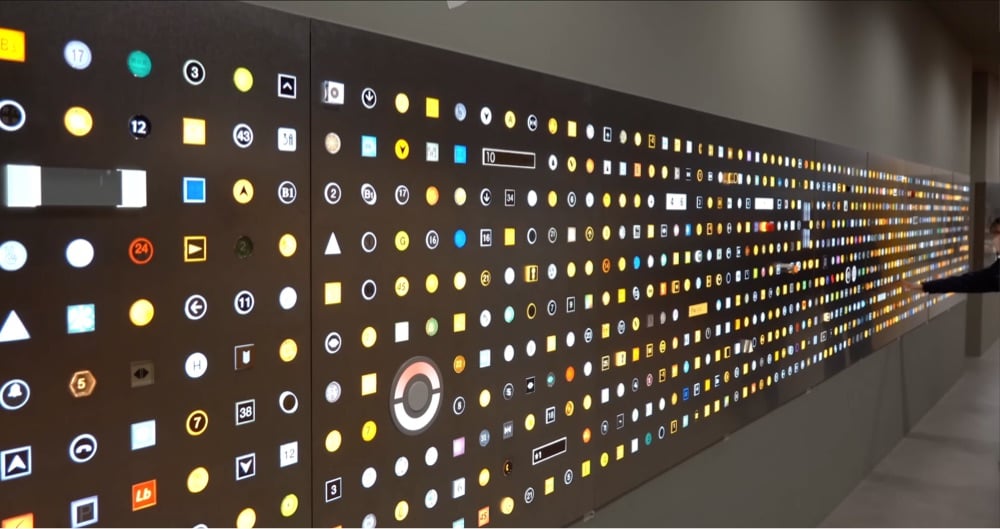
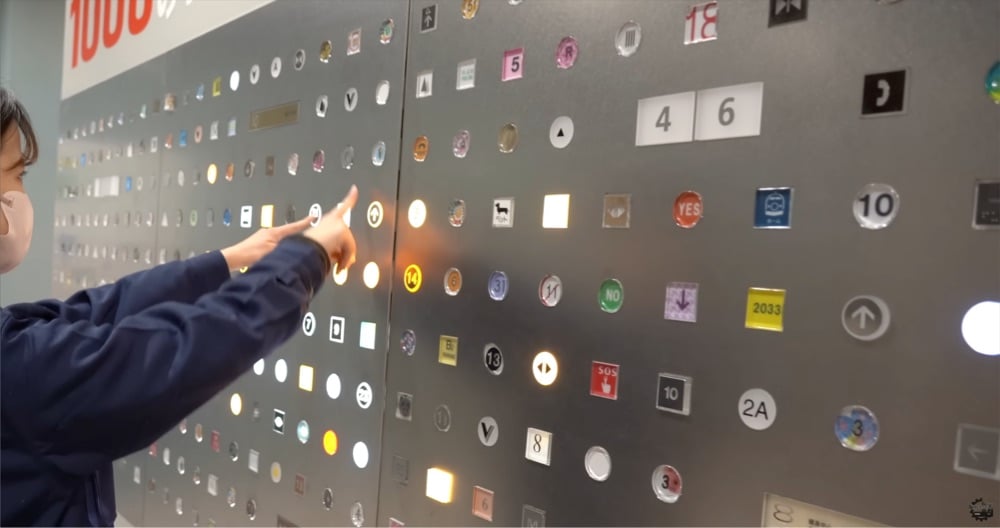
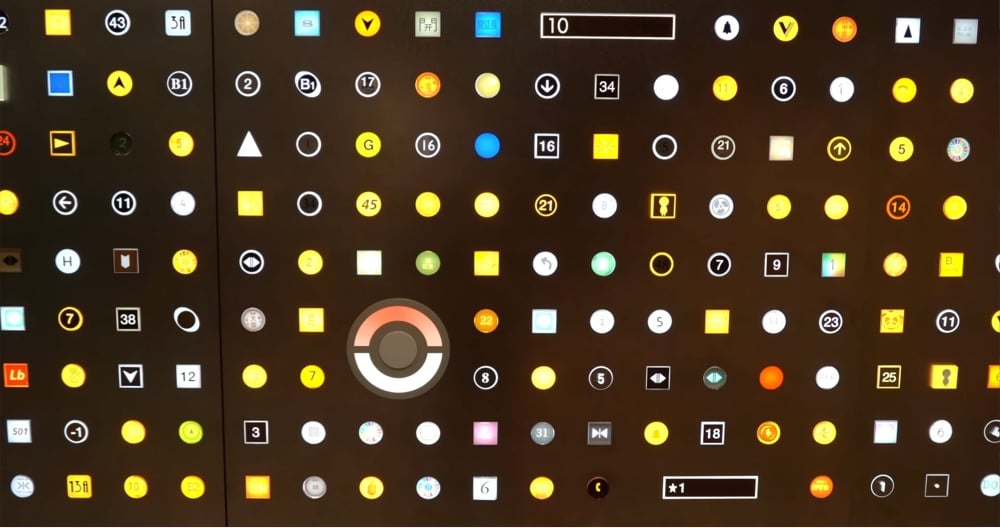
I enjoyed this video on how Shimada Electric Manufacturing Company makes elevator buttons, but I was utterly captivated by the giant wall of working buttons that they have in their office — Great Glass Elevator vibes for sure. Some screencaps are above…you can see the wall in action at the end of the video.
I want to visit! What fun to be able to press all of those buttons without the fear of irritating everyone else in the tiny box you’re all travelling in! Looks like they offer factory tours — maybe I’ll try to do that when I finally visit Japan. (Also, this would make a great art installation in a museum. You could say it was commentary on humanity’s helplessness against increasingly powerful and prolific technology (AI, if you want to be trendy). But really, people would just enjoy pushing the buttons.)
Remember that lunar lander game from earlier in the week? Someone made an autopilot for it that makes a perfect landing every time.
Blood Money is a new book about the international for-profit blood plasma industry. “There are people doing it to buy groceries and to pay for housing. There are also people who are selling plasma to take a vacation.”
Living Off the Power Grid in NYC
Starting last May and continuing through at least January of this year, Joshua Spodek has cut the ultimate cord: living off of the electrical grid in perhaps the most electrically connected place in the United States: Manhattan. Spodek wrote a fascinating article about his experiment in urban off-the-grid living for Ars Technica.
Some changes that made the experiment work included reading more books, writing by hand, choosing salads over cooked foods, going out instead of staying in, and shifting work to daytime hours. At first, I considered these changes sacrifices, but looking back, I view them more as a cultural shift, a bit like when I lived overseas and couldn’t find a good bagel. Finding the local equivalent-croissants in Paris or vegetable steamed buns in Shanghai-worked better than complaining, and it expanded my world.
Whenever I was tempted to lament the sacrifices I was making, I reminded myself that people have been living in Manhattan for around 10,000 years — technology shouldn’t make me less able or resilient than them.
The one thing I couldn’t sacrifice was my pressure cooker, which was the most efficient way to cook (and my greatest single consumer of energy). A full battery charge would power the cooker to make stew good for five meals and still leave a couple of hours’ charge for my computer and phone. I used almost no other appliances. I began waking up with the sun at 5 am to avoid needing lights. My battery has a one-watt LED that sufficed for cooking and eating, so I haven’t used my floor lamp.
There are some cheats and caveats (like, it’s impossible to live in Manhattan without indirectly benefiting from all the generated energy around you) but what an intriguing experiment. (via @irwin)
What to Expect When You’re Expecting to Be a Gen-X Girl. “Your parents will never, not once, wonder if you’re hydrated.”
AI is being used to find formerly undetectable samples from songs by Daft Punk, Mobb Deep, etc. “Google Assistant can even detect samples less than a second long, and is usually able to detect samples that have been chopped or time-stretched.”
A Guitar Made From Ikea Furniture
Tchiks is a luthier from Belgium who, after his daughter outgrew her crib, turned it and a bunch of other Ikea products into a guitar.
The guitar started out as a joke. I remember going upstairs and telling my wife “I’m gonna make a guitar out of Zoé’s old bed”. She rolled her eyes to the ceiling and asked me “why”. Then I immediately thought “This is the way”.
It sounds good! Like any good craftspeople, luthiers can get a little fussy about their materials and the specs list for the Ikea guitar at the end of the video pokes some gentle fun at that:
Body: baby crib, chair, shelf
Neck: baby crib
Fretboard: photo ledge
Knob: chopping board
(via linkfest)
Rosecrans Baldwin: Los Angeles Is a Fantastic Walking City. No, Really. “Probably most of Greater L.A. is awful to experience on foot. Yet there’s so much of it, radiating from multiple cores, that the amount worth walking is colossal.”
From There I Ruined It, a “yeah” medley featuring Britney, The Beatles, Nirvana, Dua Lipa, Snoop Dogg, and Queen.
Socials & More