



Legendary record producer Steve Albini on the B-52’s 1980 SNL performance of Rock Lobster. “What an incredible band. Everything about them is minimal and immediate.” Be sure to watch the video; it’s great.

Advertise here with Carbon Ads
This site is made possible by member support. 💞
Big thanks to Arcustech for hosting the site and offering amazing tech support.
When you buy through links on kottke.org, I may earn an affiliate commission. Thanks for supporting the site!
kottke.org. home of fine hypertext products since 1998.
Beloved by 86.47% of the web.
Entries for March 2023
This is unfortunate: a Holocaust-themed video game depicted in Tomorrow, and Tomorrow, and Tomorrow includes many similar elements to Brenda Romero’s game Train. “A theme in the book is how women struggle to get credit for their work.”
For over 100 years, the NY Times’ logo included a period - like so: “The New York Times.” - until it was dropped in the 60s. “Dropping the period caused much consternation and soul-searching at the Times…”
The Sun, In All Its Glory


Good morning, sunshines! Well, amateur astrophotographer Andrew McCarthy has done it again. Collaborating with Jason Guenzel, he has produced this absolutely gobsmacking image of the Sun.
The aptly named “Fusion of Helios” is a fusion from the minds of two astrophotographers, Andrew McCarthy and Jason Guenzel. Using a custom-modified hydrogen alpha solar telescope, the combined data from over 90,000 individual images was jointly processed to reveal the layers of intricate details within the solar chromosphere. A geometrically altered image of the 2017 eclipse as an artistic element in this composition to display an otherwise invisible structure. Great care was taken to align the two atmospheric layers in a scientifically plausible way using NASA’s SOHO data as a reference.
I’ve included the full image and my favorite crop (the solar tornado the height of 14 Earths was a close second) above, but do yourself a big favor and check out the largest image available (which is still way smaller than the 140 megapixel final image they produced). If you’re curious about the process, here’s how McCarthy gets his Sun photos:
So how do I resolve atmospheric details, like spicules, prominences, and filaments? The trick is tuning the telescope to an emission line where these objects aren’t drown out by the bright photosphere. Specifically, I’m shooting in the Hydrogen-alpha band of the visible spectrum (656.28nm). Hydrogen Alpha (HA) filters are common in astrophotography, but just adding one to your already filtered telescope will just reduce the sun’s light to a dim pink disk, and using it without the aperture filter we use to observe the details on the photosphere will blind you by not filtering enough light. If you just stack filters, you still can’t see details. So what’s the solution?
A series of precisely-manufactured filters that can be tuned to the appropriate emission line, built right into the telescope’s image train does the trick! While scopes built for this purpose do exist (look up “coronado solarmax” or “lunt solar telescope” I employ a heat-tuned hydrogen alpha filter (daystar quark) with an energy rejection filter (ERF) on a simple 5” doublet refractor. That gives me a details up close look at our sun’s atmosphere SAFELY. I’ve made a few custom modifications that have helped me produce a more seamless final image, but am not *quite* yet ready to share them, but just the ERF+Quark on a refractor will get you great views.
Photography has always been a combination of technology, artistry, and wrangling whatever light you can get to best express the feeling that you’re going for — astrophotography certainly dials that wrangling up to 11.
Prints of this image (and some digital downloads) are available in various sizes from McCarthy and Guenzel.
The Humbling Tyranny Of The Photos Our Kids Take Of Us. “These pictures remind us that while we study our children, they study us back.”
A Flower a Day
Every day for three years, Iancu Barbarasa drew a flower for his partner and recently he compiled all the drawings into this lovely short film set to Chopin’s Minute Waltz. I loved his acknowledgement of his sources and influences:
Questlove once said that “all creative ideas are derivative of another.” My project would not exist (or at least not in this form) without the influences of: Katsuji Wakisaka, textile designer and founder of Sou·Sou, who has drawn over 10,000 postcards for his wife — Christoph Niemann’s work and also his short film “A Tribute to Maurice Sendak” — “Beyond Noh (Masks of our world)” short film by Patrick Smith — “Plante” short film by Reka Bucsi — and Philippa Perry’s “The Book You Wish Your Parents Had Read (and Your Children Will Be Glad That You Did)”. Last but not least, the end credits are a tribute to Hayao Miyazaki’s wonderful “My Neighbour Totoro” film.
A set of postcards featuring the flower drawings are available from Barbarasa’s shop.
I will also never tire of looking at photos of waves crashing on shore - these from Kevin Krautgartner of O’ahu’s Banzai Pipeline just exude power and complexity.
The Impossible Job of Refereeing
From William Ralston in The Guardian, a long read on “the impossible job” of being a Premier League referee.
No one disputes that referees are as fit as they’ve ever been. The problem, according to many observers, is that referees are also worse than they’ve ever been. In 2017, then-Arsenal manager Arsène Wenger claimed that English referees’ level “drops every season”. The next season, Cardiff manager Neil Warnock despaired at how the “best league in the world” could possibly have “the worst officials”.
Today, that story of perpetual decline has given way to one of full-blown crisis. Every week brings a new wave of anger — from fans, players, managers and pundits — about alleged errors, inconsistencies and incompetence. This is at the polite end of the spectrum. On social media, referees’ mistakes are often blamed not on inevitable human error, or even simple ineptitude, but on elaborate conspiracies to derail this or that club. (The fact that every fanbase believes there is a conspiracy against their particular club does not seem to give people pause.)
There is no statistical evidence to support this story of decline. In fact, all such evidence suggests that referees are making fewer mistakes a match, with accuracy rising each season. (However, these statistics themselves are difficult to assess, given that they are collected not by a truly independent body, but by PGMOL and the Premier League, and very little of this data has ever been made public.) Instead, the critics point to a large, often indisputable, collection of individual errors and baffling decisions. These errors amount to only a tiny percentage of all decisions, but having been replayed and discussed over and over, they are the ones etched into memory.
In season one of his podcast Against the Rules, Michael Lewis explored the disconnect between how referees are perceived and their actual performance, not just in sports but also in governance, business, and even the arts.
There are interesting bits throughout the piece, many of which deal with human psychology (esp. of groups) and even philosophy. I found this bit worth quoting:
On the next day I spent with England, 5 November, he was refereeing the champions, Manchester City, at home to Fulham. In a room at a swanky hotel on the outskirts of Manchester, England and his team gathered for their pre-match meeting. His usual assistants had been replaced, because they support Manchester clubs. (Every official must declare their allegiances, and will not be assigned that team’s matches or those of their closest rivals. Other factors that determine appointments include how many times an official has refereed each club that season, how close they live to the stadium, and which teams their family members support.)
Fascinating! Do any of the sports leagues in the US do this? Or is, as I suspect, the support for one’s team in England just so much more intense and foundational to one’s personal identity than in America?
A Map of Places in the US with the Same Name. “We calculated what place someone is most likely referring to, depending on where they are.” For instance, in most of the country, when you say “Springfield”, people think “Springfield, MA”.
Poverty, By America is a new book by Matthew Desmond in which he argues that a major cause of poverty in the US is because “affluent Americans knowingly and unknowingly keep poor people poor”. Here’s a review in The Atlantic.
A collection of recent photos taken from the International Space Station. I will never get tired of looking at photos of Earth taken from space.
Mattias Adolfsson’s Whimsical Illustrations
I’ve featured the work of Mattias Adolfsson before, but I ran across some of his marvelously dense & vaguely steampunk illustrations again the other day and wanted to point you in his direction once again.
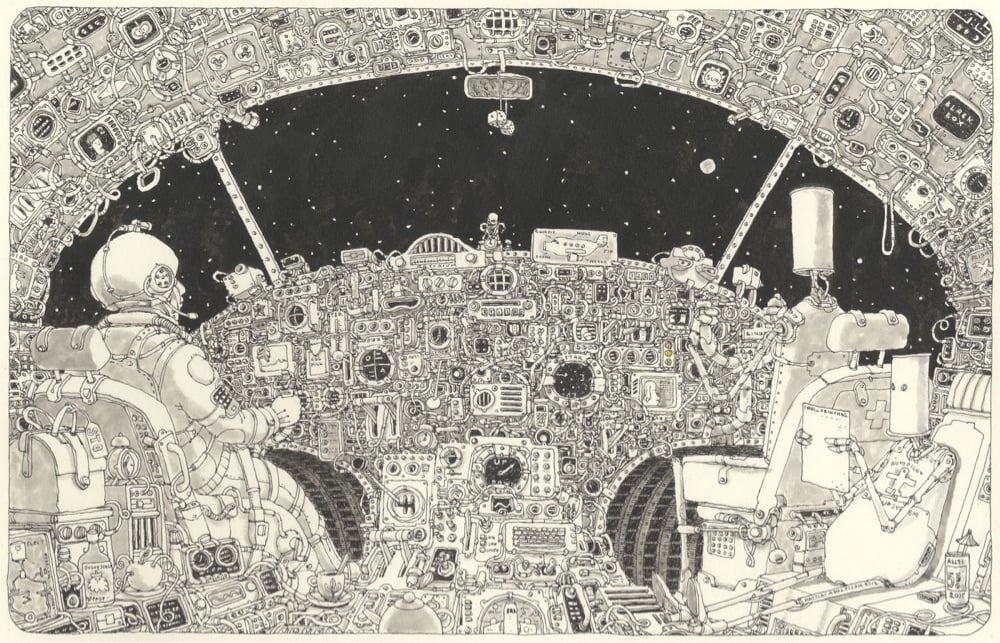


The fantastical & whimsical nature of Adolfsson’s work reminds me of Mark Alan Stamaty, Richard Scarry, Shel Silverstein, and perhaps even a little Quentin Blake and Aardman.
Zoos being closed to visitors during the pandemic gave scientists the opportunity to study how visitor interactions benefitted or harmed the welfare of the animals.
Jurassic Park But With a Cat
I’d seen Titanic with a Cat but hadn’t realized there were a whole collection of videos featuring OwlKitty cleverly edited into them. I really like the Jurassic Park one embedded above. The licking! The purring! Fantastic, no notes.
You can check out a bunch of other movies featuring OwlKitty on YouTube (LOTR, Top Gun, Home Alone, John Wick, Mandalorian), including some behind-the-scenes of how they’re made. Here’s how they did the Jurassic Park one:
The power of at-home filmmaking software and equipment is just incredible.
Oh man, Amazon is shuttering DPReview, effective early next month. I spent a lottttt of time on this site before my phone camera got too good to think about carrying something else.
US maternal mortality is more than 10 times higher than in Australia. “What do we make of a nation that has made giving birth so dangerous - yet forces more and more women to do it?”
Ai Weiwei’s Lego Version of Monet’s Water Lilies


Lego bricks and Impressionism are a natural pairing, and so Chinese artist Ai Weiwei has recreated Claude Monet’s massive Water Lilies triptych with 650,000 Lego bricks. Spanning nearly 50 feet across, the Lego sculpture is part of Ai’s upcoming show at the Design Museum in London. Here is a tantalizing behind-the-scenes view.
Ai has been creating Lego works for years now — including these Warhol-esque portraits and A Sunday on La Grande Jatte — and was even denied from buying bricks from the company at one point.
How Loneliness Reshapes the Brain. Lonely people “tend to end up with a more negative spin on whatever information they receive — facial expressions, texting, whatever — and that drives them even deeper into this loneliness pit.”
A Potential Major Discovery: An Aperiodic Monotile

The authors of a new preprint paper claim that they’ve discovered what’s called an aperiodic monotile, a single shape that can cover a two-dimensional space with a pattern that never repeats itself exactly. One of the authors, Craig Kaplan, explains on Mastodon:
How small can a set of aperiodic tiles be? The first aperiodic set had over 20000 tiles. Subsequent research lowered that number, to sets of size 92, then 6, and then 2 in the form of the famous Penrose tiles.
Penrose’s work dates back to 1974. Since then, others have constructed sets of size 2, but nobody could find an “einstein”: a single shape that tiles the plane aperiodically. Could such a shape even exist?
Taylor and Socolar came close with their hexagonal tile. But that shape requires additional markings or modifications to tile aperiodically, which can’t be encoded purely in its outline.
In a new paper, David Smith, Joseph Myers, Chaim Goodman-Strauss and I prove that a polykite that we call “the hat” is an aperiodic monotile, AKA an einstein. We finally got down to 1!
The full paper is here. You can play around with the tiles here & here and watch an animation of an infinite array of these monotiles.
If you’re looking for a quick explanation of what aperiodic tiling is, check out the first 20 seconds of this video:
This video from Veritasium and this Numberphile one might also be helpful in understanding the concept. (thx, caroline)
Update: Siobhan Roberts wrote a good layperson’s account of the discovery and its import & implications. One of the paper’s authors discovered the hat shape while working with paper shapes:
“It’s always nice to get hands-on,” Mr. Smith said. “It can be quite meditative. And it provides a better understanding of how a shape does or does not tessellate.”
Essential Japanese Cinema: A Journey Through 50 of Japan’s Beautiful, Often Bizarre Films.
This year in Serious Eats’ Starch Madness bracket, rice dishes from around the world go grain-to-grain. Some personal faves: risotto, halal cart chicken & rice, sushi rice, arancini, and broken rice.
Bono and The Edge’s Tiny Desk Concert
The most recognizable half of U2 made the trip to the NPR offices to perform a Tiny Desk Concert recently. Accompanied by the Duke Ellington School of the Arts Choir, the pair sang four songs from their 2000 album All That You Can’t Leave Behind, including Beautiful Day.
See also Tiny Desk Concerts from Alicia Keys, Dua Lipa, Max Richter, Coldplay, and the Sesame Street gang.
Photos of houses completely buried by snow in Mammoth Lakes, CA. If you haven’t been following, more than 65 feet of snow has fallen in the area this winter.
Will Sharpe (Ethan from White Lotus s02) will direct the film adaptation of Michelle Zauner’s Crying in H Mart, which I read last summer and loved.
The latest IPCC report on the climate crisis says it’s the last chance for humanity to keep warming under the critical 1.5°C threshold - “only swift and drastic action can avert irrevocable damage to world”.
Physicist Chien-Shiung Wu produced the first experimental evidence of quantum entanglement in 1949 but faced both sexism and racism in gaining recognition for this and her other achievements. Many scientists believe she should have won a Nobel.
This is lovely: a keyboard visualization of an instrumental piece from Howl’s Moving Castle. The piece is instantly recognizable as Studio Ghibli - Joe Hisaishi “composed the music for nearly all of Ghibli’s films”.
“The Puzzling Gap Between How Old You Are and How Old You Think You Are”
For The Atlantic, Jennifer Senior writes about how and why people’s subjective age — the age you are in your head — differs from their actual age.
But “How old do you feel?” is an altogether different question from “How old are you in your head?” The most inspired paper I read about subjective age, from 2006, asked this of its 1,470 participants — in a Danish population (Denmark being the kind of place where studies like these would happen)-and what the two authors discovered is that adults over 40 perceive themselves to be, on average, about 20 percent younger than their actual age. “We ran this thing, and the data were gorgeous,” says David C. Rubin (75 in real life, 60 in his head), one of the paper’s authors and a psychology and neuroscience professor at Duke University. “It was just all these beautiful, smooth curves.”
Why we’re possessed of this urge to subtract is another matter. Rubin and his co-author, Dorthe Berntsen, didn’t make it the focus of this particular paper, and the researchers who do often propose a crude, predictable answer-namely, that lots of people consider aging a catastrophe, which, while true, seems to tell only a fraction of the story. You could just as well make a different case: that viewing yourself as younger is a form of optimism, rather than denialism. It says that you envision many generative years ahead of you, that you will not be written off, that your future is not one long, dreary corridor of locked doors.
I am not entirely sure I can even answer the question of “How old are you in your head?” I’ve always had trouble even remembering how old I actually am and don’t really think about it all that much. Maybe that’s changed a bit in recent years, as milestone anniversaries pass and the ol’ body breaks down. When pressed, I used to tell people I’ve always felt like I was 30 years old, even when I was 12. As a kid attending mixed-age gatherings, I often sheered clear of hanging out with kids my age — I preferred the adults. Here’s Senior again:
Of course, not everyone I spoke with viewed themselves as younger. There were a few old souls, something I would have once said about myself. I felt 40 at 10, when the gossip and cliquishness of other little girls seemed not just cruel but dull; I felt 40 at 22, when I barely went to bars; I felt 40 at 25, when I started accumulating noncollege friends and realized I was partial to older people’s company. And when I turned 40, I was genuinely relieved, as if I’d finally achieved some kind of cosmic internal-external temporal alignment.
And as a 40-something, my curiosity has kept me interested — I would even say aspirationally interested — in what the younger generations are up to. Anyway, back to the original question: fine, twist my arm, I’m 35 in my head.
A perhaps related digression: I don’t know if I’ve written about this before, but despite being smack in the middle of the Gen X age range, I’ve always felt more culturally like a Millennial. My guess is that as an internet early adopter, I experienced being Extremely Online right around the same time as many Millennials did as teens and preteens. I’d be interested to hear how other folks who were very active in online culture as adults in the mid-to-late 90s feel about this.
See also Meet the Perennials, Up With Grups, and How to Age Gracefully.
Amélie Was Actually a KGB Spy
Jean-Pierre Jeunet, director of the 2001 romantic comedy The Fabulous Destiny of Amélie Poulain, has recut his beloved movie into a cheeky short film that reveals that Amélie was actually a KGB spy.
Did no one ever wonder how a young waitress afforded such sophisticated decoration for a flat in Montmartre, one of Paris’s most expensive districts?
Film editors are magicians. (via @pacanukeha)
2023 anti-trans bills tracker. “We track legislation that seeks to block trans people from receiving basic healthcare, education, legal recognition, and the right to publicly exist.”
What’s the Deal with Ozempic, the “Breakthrough” Diabetes and Weight-Loss Drug?
In the last several months, semaglutide, a drug originally developed to help manage type 2 diabetes, has been in the news for its “breakthrough” weight loss abilities. This video from Vox is a good overview of what the drug does and the interest & controversy around it.
Both Ozempic and Wegovy, Ozempic’s counterpart approved specifically for weight loss by the FDA, are brand names of a drug called semaglutide. Semaglutide is one of several drugs that mimics a crucial digestive hormone called glucagon-like peptide 1, or GLP-1. It amplifies a process our bodies perform naturally.
GLP-1 is released in our intestines when we eat, and there are receptors for the hormone in cells all over the body. In the pancreas, GLP-1 promotes the production of insulin and suppresses the production of glucagon. This helps insulin-resistant bodies, like those with type 2 diabetes or obesity, manage blood sugar levels. In the stomach, GLP-1 slows gastric emptying, extending the feeling of being full. In the brain, GLP-1 suppresses appetite, which also promotes satiety and curbs hunger, so we eat less.
Jia Tolentino wrote a long piece about semaglutide for the New Yorker this week: Will Ozempic Change How We Think About Being Fat and Being Thin?
But, as I kept reminding Ozempic-curious friends, these medications were designed for chronic conditions, obesity and diabetes. For people who are dealing with those conditions, Ozempic appears to create a path toward a healthy relationship to food. For those who aren’t, it might function more like an injectable eating disorder. As the side effects make clear, it’s not a casual thing to drastically alter your body’s metabolic process, and there is no large-scale data about the safety of these drugs when taken by people who are mainly interested in treating another chronic condition, the desire to be thin.
Julia Belluz wrote a piece for Vox on Obesity in the age of Ozempic and Eric Topol wrote about The New Obesity Breakthrough Drugs.
Update: In the shuffle of the last few months, I’d missed reading Paul Ford’s piece about “the post-hunger age”, A New Drug Switched Off My Appetite. What’s Left?
I can see my anxiety mirrored in the wave of reactions starting to appear — op-eds, TV segments, people explaining why it’s good, actually, that the vast majority of those using this drug lose a quarter of their body weight. On social media, fat activists are pointing out that our lives were worthy even without this drug. The wave of opinion will not crest for years.
And that’s fair because this is new — not just the drug, but the idea of the drug. There’s no API or software to download, but this is nonetheless a technology that will reorder society. I have been the living embodiment of the deadly sin of gluttony, judged as greedy and weak since I was 10 years old-and now the sin is washed away. Baptism by injection. But I have no more virtue than I did a few months ago. I just prefer broccoli to gloopy chicken. Is this who I am?
Even outside the context of drugs, I find the tension between accepting who you are versus trying to change some behavior you find unappealing is challenging to navigate — it’s something that comes up in therapy a lot. (thx, anil)
America’s Test Kitchen: you can use your SodaStream to double the life of your salad greens. Carbon dioxide “slows the respiration process of the greens and in turn slows the process of ripening and wilting”.
Everything Is Temporary. One man stands alone against the flow of time.
Roger Deakins Breaks Down His Most Iconic Films
Do you want to sit in on a 30-minute cinematography masterclass with Roger Deakins as he talks about the process behind some of his most iconic films? We’re talking Sicario, The Shawshank Redemption, 1917, Fargo, Blade Runner 2049, and No Country for Old Men here. Of course you do. And when you’re done with that, you can listen to all of these other filmmakers and actors talking about their films.
Cargo e-bikes are selling like hotcakes now. “It feels as if the industry and the government have simultaneously woken up to the enormous potential of cargo e-bikes to replace car trips and improve the environment.”
Kenji López-Alt Spent 5 Months Studying Chicago Thin-Crust Pizza. Here’s What He Learned. “Among his many revelations: a game-changing technique for yielding that crisp crust at home.”
This weekend, 41-year-old Zlatan Ibrahimovic became the oldest goal scorer in Serie A history. He could have retired after a serious knee injury last year, but he did surgery & rehab and now he’s back scoring goals. Incredible.
Museums Rename Artworks and Artists as Ukrainian, Not Russian. “Museums in the United States and Europe are complicit in its colonization, the critics argue, if they don’t honor the artistic contributions of Ukrainians.”
Deadline’s chief film critic: “Not only have I never played the iconic ’80s video game Tetris, I had never heard of it before encountering this new film Tetris…” How is this even possible?!
Kottke 25: What a Week!
Hey everyone. I just wanted to thank you all for the well-wishes on kottke.org’s 25th anniversary. Reading all your comments, tweets, Mastodon posts, DMs, and emails really put a hop in my step this week. And an extra special thank you to those who bought a t-shirt (ordering is now closed nope, back open…people are still clamoring) or supported the site with a membership.
I also managed to make some tweaks to how the Quick Links look/work around here. I’m still not completely happy with it, but I hope the recent effort has laid the groundwork for better things ahead.
Coming up next week: the epic Ask Me Anything. I can’t promise I’m going to answer all 330+ questions you folks sent me, but I will do my best.
Have a good weekend, everyone.
So this is a bit of a mind-bender: the release of Tetris is closer to the World War II than it is to today. WTAF?
The Cooper Hewitt Design Museum recently announced the establishment of a digital curatorial department, “which will collect and care for born-digital work”.
Lance Reddick, who played Cedric Daniels on The Wire, has died at the age of 60.
Imagined Alt-Universe Tech Products
I spent more than a few minutes scrolling through Dana Sibera’s Mastodon feed (also on Twitter) featuring her imagined oddball tech items. Like this marble Mac:

A NeXT laptop? A NeXT laptop!

A foldable Powerbook:

And a widescreen Apple Lisa:

I found out about Sibera’s work via Marcin Wichary’s Shift Happens newsletter — you can find more examples of her work there, on Mastodon, or on Twitter.
The International Criminal Court has issued an arrest warrant for Russian President Vladimir Putin for war crimes in Ukraine, namely the forced deportation of children from Ukraine to Russia.
The FCC is ordering phone companies to block scam text messages. Carriers must block texts from “invalid, unallocated, or unused numbers” and those from numbers that never send text messages. Finally!
Stop Making Sense
This is a clever little promo from A24 for the rerelease of Jonathan Demme’s Stop Making Sense, a concert film from 1984 featuring The Talking Heads — it, the promo, features David Byrne dropping into his dry cleaners to pick up an old, big suit. As for the film, it’s getting a 4K restoration and will be out sometime later this year.
“Stop Making Sense” stars core band members David Byrne, Tina Weymouth, Chris Frantz and Jerry Harrison along with Bernie Worrell, Alex Weir, Steve Scales, Lynn Mabry and Edna Holt. The live performance was shot roughly 40 years ago over the course of three nights at Hollywood’s Pantages Theater in December of 1983. It features Talking Heads’ most memorable songs, including “Burning Down the House,” “Once in a Lifetime” and “This Must Be the Place.”
“There was a band. There was a concert,” the Talking Heads said in a statement. “This must be the movie!”
The legendary New Yorker film critic Pauline Kael loved the film, calling it “close to perfection” in this contemporary review:
The director, Jonathan Demme, offers us a continuous rock experience that keeps building, becoming ever more intense and euphoric. This has not been a year when American movies overflowed with happiness; there was some in Splash, and there’s quite a lot in All of Me — especially in its last, dancing minutes. Stop Making Sense is the only current movie that’s a dose of happiness from beginning to end. The lead singer, David Byrne, designed the stage lighting and the elegantly plain performance-art environments (three screens used for back-lit slide projections); there’s no glitter, no sleaze. The musicians aren’t trying to show us how hot they are; the women in the group aren’t there to show us some skin. Seeing the movie is like going to an austere orgy — which turns out to be just what you wanted.
Here’s the new spacesuit that astronauts will wear when they return to the Moon. The prototype is dark gray but the actual suits will be white for thermal reasons.
Landing an Airplane on a Tiny Helipad on Top of a Dubai Hotel
As I’ve discussed previously, the Piper Super Cub is an amazing short takeoff and landing airplane that can, under the right conditions, takeoff and land in as little as 10 or 20 feet of runway.
In a recent stunt for Red Bull, Luke Czepiela landed a Super Cub on an 88-foot-wide helipad located on the 56th story of the Burj Al Arab Hotel in Dubai. Fantastic. And I love what he did right afterwards… (via digg)
The Media Better Be Smart and Get Wise to DeSantis’ Bad-Faith Press Operation. “If a reporter can’t recognize propaganda and call it out when he sees it, then what’s even the point?”
Socials & More