
Results of a new study suggest that CBD can treat and slow the transmission of Covid-19. “Our results suggest that CBD can block SARS-CoV-2 infection at early and even later stages of infection.”

Advertise here with Carbon Ads
This site is made possible by member support. 💞
Big thanks to Arcustech for hosting the site and offering amazing tech support.
When you buy through links on kottke.org, I may earn an affiliate commission. Thanks for supporting the site!
kottke.org. home of fine hypertext products since 1998.
Beloved by 86.47% of the web.
Entries for January 2022
Great Art Cities Explained: Paris
Great Art Explained is one of my recent favorite YouTube channels (see The Mona Lisa, Hokusai’s The Great Wave Off Kanagawa, Michelangelo’s David, and Starry Night, all fascinating) and host James Payne, along with Joanne Shurvell, are now doing a related series on Great Art Cities Explained. They tackled London first and have moved onto Paris, where they feature three of the city’s lesser known museums that were originally art studios: those of Eugène Delacroix, Suzanne Valadon, and Constantin Brancusi.
“There Will Be Another Variant. Here’s What the World Can Do Now.” But the world probably won’t do anything so basically what you’re saying is…there’s going to be another variant.
“It’s a Terrible Idea to Deny Medical Care to Unvaccinated People”
For The Atlantic, Ed Yong writes about an idea that has gained a certain amount of traction in recent weeks as hospital systems have been overwhelmed by the Omicron surge: medical care for unvaccinated people should be limited. Yong says that’s a very bad idea:
I ran this argument past several ethicists, clinicians, and public-health practitioners. Many of them sympathized with the exasperation and fear behind the sentiment. But all of them said that it was an awful idea — unethical, impractical, and founded on a shallow understanding of why some people remain unvaccinated.
“It’s an understandable response out of frustration and anger, and it is completely contrary to the tenets of medical ethics, which have stood pretty firm since the Second World War,” Matt Wynia, a doctor and ethicist at the University of Colorado, told me. “We don’t use the medical-care system as a way of meting out justice. We don’t use it to punish people for their social choices.” The matter “is pretty cut-and-dry,” Sara Murray, a hospitalist at UC San Francisco, added. “We have an ethical obligation to provide care for people regardless of the choices they made, and that stands true for our unvaccinated patients.”
Unvaccinated people are unvaccinated for a wide variety of reasons, many of them structural constraints beyond their control. Yong connects the care of the unvaccinated to the difficulty in receiving quality care already faced by women, Black people, and disabled people:
As health-care workers become more exhausted, demoralized, and furious, they might also unconsciously put less effort into treating unvaccinated patients. After all, implicit biases mean that many groups of people already receive poorer care despite the ethical principles that medicine is meant to uphold. Complex illnesses that disproportionately affect women, such as myalgic encephalomyelitis, dysautonomia, and now long COVID, are often dismissed because of stereotypes of women as hysterical and overly emotional. Black people are undertreated for pain because of persistent racist beliefs that they are less sensitive to it or have thicker skin. Disabled people often receive worse care because of ingrained beliefs that their lives are less meaningful. These biases exist-but they should be resisted. “Stigma and discrimination as a prism for allocating health-care services is already embedded in our society,” Goldberg told me. “The last thing we should do is to celebrate it.”
That is a compelling argument and provides a necessary dose of empathy for those of us who might feel betrayed by people who are unvaccinated at this point in the pandemic. Blaming individuals for these collective responsibilities and failures is of a kind with asserting that mask-wearing and vaccination are solely personal choices rather than necessary collective actions to be undertaken by communities to keep people safer. This is the same sort of individualist thinking that has people focused on their personal “carbon footprint” instead of what massive corporations, high-emissions industries, and governments should be doing to address the climate crisis.
On the benefits of deliberate ignorance. “It’s a way to maintain our beliefs about ourselves and others, it can be a mechanism for fairness or to remove bias, or a way to avoid overwhelm when bombarded with information.”
Sea State

This morning, I randomly ran across this New Yorker review of a memoir by Tabitha Lasley called Sea State. I couldn’t stop reading it, this review, and went down a rabbit hole of other reviews of the book: the NY Times, the Guardian, and the London Review of Books.
After losing four years of progress on a novel, Lasley’s work on Sea State began when she visited Aberdeen, Scotland to research what life is like for oil rig workers, saying she “wanted to see what men were like with no women around”. And then, more or less immediately, she started a relationship with one of her (married) subjects.
Lasley’s first interviewee is an offshore worker from Teesside, an area that was once a hub of steel and chemical manufacturing. Caden has clear blue eyes, a jockey’s body, and tattoos of the names of his wife and twin daughters. He likes the gym, ironing, the autobiographies of Mafia dons, and bio-pics about soccer hooligans. Lasley spots him at an airport, where his kit bag — a kind of waterproof duffel, designed in accordance with helicopter requirements — gives him away. She approaches him, explains her project, and asks for his contact details. Caden demurs, but gives her number to a friend, who invites her to a pub with a group of fellow-riggers. Afterward, Lasley invites Caden to her hotel. Within weeks, he’s skiving off family life to sleep with Lasley in airport hotel rooms, laying the blame on the state of the sea — too rough for the chopper to take off — for not being able to make it home.
Now involved and “around”, Lasley turned the book into a hybrid: personal memoir + a class-oriented look at the concentrated masculinity of life aboard oil rigs. And somehow, according to the reviews, this actually works. Fascinating!
Thread on the Omicron wave in the US. “Having ~40% of the population infected by a single pathogen in the span of 8 weeks is remarkable and I can’t think of an obvious modern precedent.”
Hyperrealistic Paintings of Rich Vegetation



Why am I showing you these photos of lush, grassy, leafy plants? Because they are actually meticulously constructed hyperrealistic paintings of lush, grassy, leafy plants by Serbian artists Jelena and Aleksandar Paunkovic. The couple have been inspired by their verdant surroundings (I mean, just look at this) to produce these paintings:
From the big city we moved our studio near the mountain Kosmaj where we started with the production of paintings. We throw plastic bags out of everyday life and instead of them we made our canvas bags that still serve us today. We establish our own small garden, and started producing our natural non-hybrid food. We started composting organic food residues which we will use later as a soil that is rich in ingredients that will help other plants during growth. We meet new people and come to incredible information and knowledge. There will be more about that and other topics on our blog. When we harvested our first fruits after two months, there was no end to our happiness. For a moment we went back to our childhood, we remembered growing up, beautiful moments, and we had the privilege of feeling like a kids again.
With the pleasure of contact with plants, we discovered that we love hiking, but not for the reason of conquering the peaks, they are free and there is nothing to conquer. They can teach us that what we see there should be respected. All the paintings we create are created on those places. Each tour on new mountain, or visiting new environment, becomes material that will later serve us in the studio as a sketch for a new painting. We have found a way to bring the nature to a home or gallery and hang it on the wall to serve as a reminder that we need to think more about how our modern lifestyle affects the environment.
You can follow their progress on Instagram or order prints of their work. (via colossal)
Recently on the Kottke Ride Home Podcast
It’s been awhile since we’ve checked in on the Kottke Ride Home podcast here, so let’s see what host Jackson Bird has been talking about on the show lately. (If you’re just joining us, KRH is a daily podcast that promises “in just 15 minutes, the coolest stuff that happened in the world today”. Subscribe here!)
From today’s episode, we learn that shortages of various kinds (lumber, food) are still happening in America. The lumber shortage is a climate change story:
The week of Thanksgiving, British Columbia had an atmospheric river. Typically it’s snow. But they had counter-seasonal, torrential rain in Vancouver and up into the lumber-producing region. And when you have fires, you don’t have soil control, so now you have erosion-and when it rains, you have mudslides and floods.
And that is what started the second lumber rally. I think the second lumber rally was inevitable, but this started it early. You could pinpoint the bottom and the reversal in price to the pictures and the headlines of the flood. It destroyed not the trees, not the sawmill operations, but the infrastructure to get the lumber to market.
On Tuesday’s show, Jackson talked about why we might benefit at times from “deliberate ignorance”:
Deliberate ignorance is not rare. It’s an often reached for mental tool that pervades much of our lives, even outside of extreme wartime situations. It even has many benefits: It effectively helps regulate emotions by warding off negative ones and prolonging positive ones. It’s a way to maintain our beliefs about ourselves and others, it can be a mechanism for fairness or to remove bias, or a way to avoid overwhelm when bombarded with information.
And on Monday’s episode, MLK Day and the legacy of Martin Luther King Jr. was the main topic. From The public has underestimated the radicalism of Martin Luther King Jr.’s early work by Victoria W. Wolcott:
King wrote Scott a letter to thank her for the book and included his response to Bellamy’s utopian vision. “I imagine you already know that I am much more socialistic in my economic theory than capitalistic. … Today capitalism has outlived its usefulness. It has brought about a system that takes necessities from the masses to give luxuries to the classes.” He finished his letter, “Let us continue to hope, work, and pray that in the future we will live to see a warless world, a better distribution of wealth, and a brotherhood that transcends race or color.” This utopian socialist vision of full equality, embraced by both Scott and King, was central to the campaigns they launched in the next decades.
If you find those sorts of stories interesting, you should consider adding Kottke Ride Home to your daily podcast routine.
How Does The James Webb Space Telescope Work?
The James Webb Space Telescope is still winging its way to its permanent home at the L2 point1 about 930,000 miles from Earth — it’s due to arrive in about 4 days. It’s a massive and fascinating project and for his YouTube series Smarter Every Day, Destin Sandlin talked to Nobel laureate John Mather, the senior project scientist for the JWST, about how the telescope works.
Also worth a watch is Real Engineering’s The Insane Engineering of James Webb Telescope:
It really is a marvel of modern science & engineering — I can’t wait to see what the telescope sees once it’s fully operational.
Can’t Help Myself
In an artwork commissioned by the Guggenheim Museum called Can’t Help Myself, Sun Yuan and Peng Yu designed a robotic arm that is designed to keep a blood-colored liquid from straying too far away.
Placed behind clear acrylic walls, their robot has one specific duty, to contain a viscous, deep-red liquid within a predetermined area. When the sensors detect that the fluid has strayed too far, the arm frenetically shovels it back into place, leaving smudges on the ground and splashes on the surrounding walls.
Sounds a bit like everyone trying to do everything these days. This artwork has been popular on TikTok because people are empathizing that the machine is slowing down.
“It looks frustrated with itself, like it really wants to be finally done,” one comment with over 350,000 likes reads. “It looks so tired and unmotivated,” another said.
The Postage Stamp Pictures of Paul Edlin
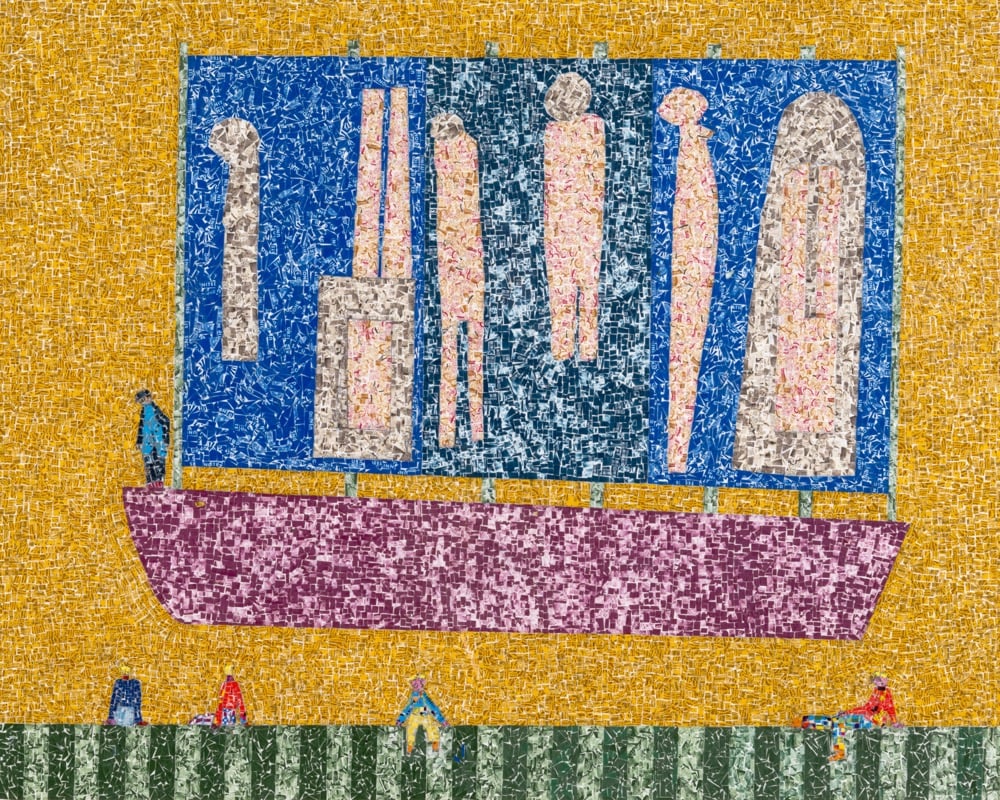
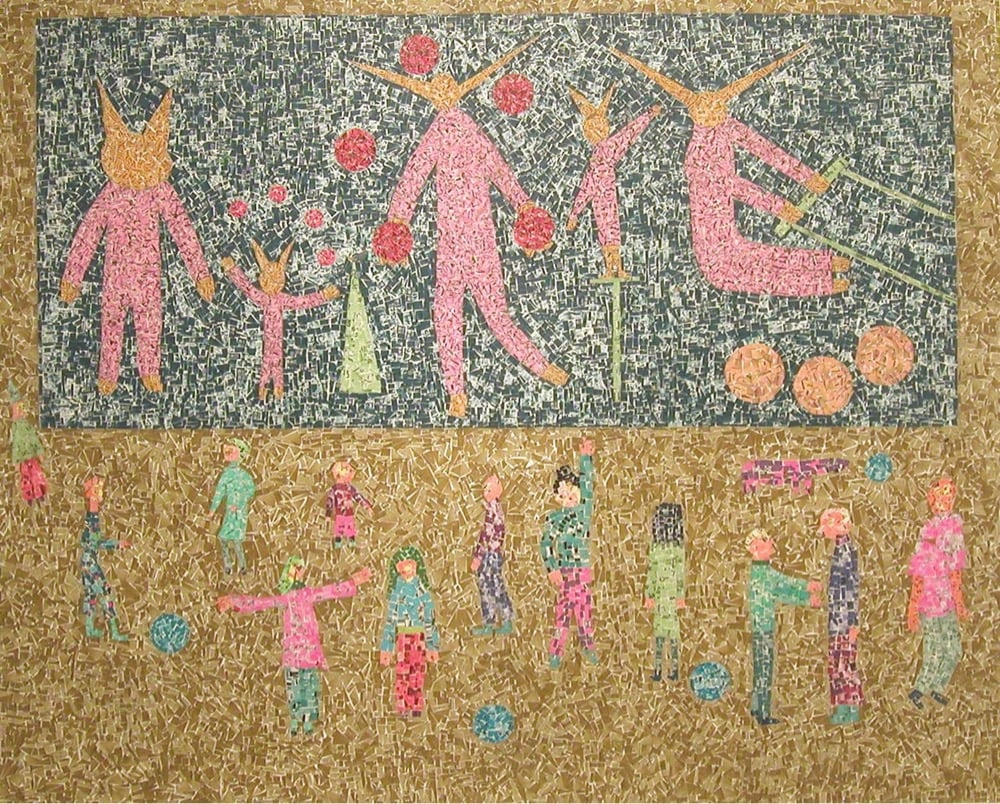
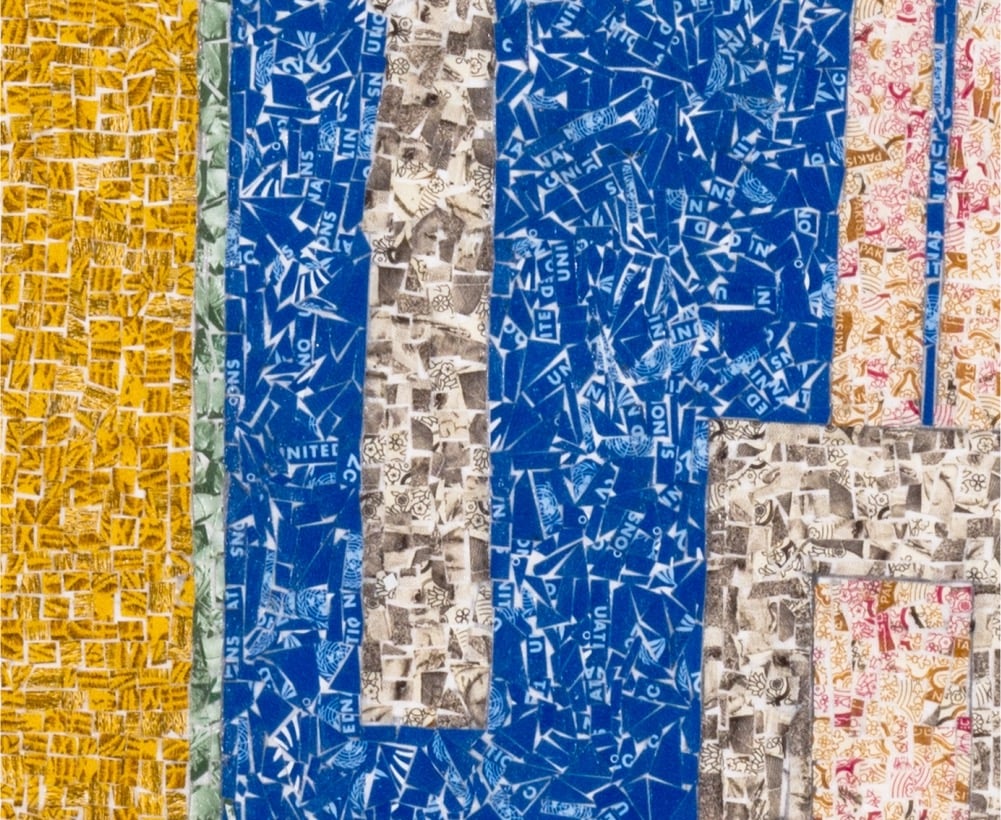
Artist Paul Edlin used tiny fragments of postage stamps to create these beautiful abstract collages. Here’s closeup of the top image where you can see the fragments more clearly:
(thx, philip)
The five levels of hype. Marketing claims > exaggerated claims > utopian futures > magical thinking > othering (“the technology has become a group identity for its boosters”).
Play a 9-hole course of mini-golf where each hole is shaped like a gerrymandered voting district. The 8th hole, of comically shaped 4th district in Illinois, is a par 12. (Hole 9 is a par 26 in Maryland.)
Soap Bubbles Freeze in the Icy Cold
Watch soap bubbles dance and twist in the cold weather until they freeze into perfectly round little ice domes. See also Freezing Soap Bubbles. (via the kid should see this)
Being Bad at Wordle Doesn’t Mean You’re Dumb. “Simply put, intuiting the perfect word to fit in a sentence requires different knowledge of a language from thinking of a five-letter word starting with A and E as its fourth letter.”
Bold Proposal to Make Central Berlin a Mostly Car-Free Zone

A group of Berlin residents has put forward a proposal to turn all of central Berlin (an area larger than Manhattan) into a car-free zone. What would that mean in practice? Adele Peters at Fast Company explains:
As in other cities, “car free” doesn’t literally mean that no cars could enter the area, but private car use would dramatically drop. Special permits would be given to emergency vehicles, garbage trucks, taxis, commercial and delivery vehicles (though many deliveries in Berlin already happen on cargo bikes), and residents with limited mobility who depend on cars. Others would be able to use a car, likely through a car-sharing program, up to 12 times a year to run longer errands. But most people, most of the time, would walk, bike, or take public transportation.
That sounds amazing and reasonable. There are five main goals the plan is trying to achieve for Berliners: better quality of life (walkable vibrant streets), better health (less pollution & noise), space for people (not vehicles), less climate impact, and street safety:
Berlin’s streets must become safer. There are still too many traffic deaths and injuries in Berlin. Especially the weakest must be protected: pedestrians and cyclists. Children and senior citizens in particular should be able to feel safe on Berlin’s streets; otherwise their mobility will be restricted because the risk or fear of an accident is too great.
The city is currently considering whether to turn the proposal into a law. This would be amazing to see in Berlin (and in some American cities too).
Wikipedia History Timeline Game
This game from Tom Watson is great fun: you’re presented with a succession of people, places, and things with associated dates that you have to correctly place in chronological order, like so:

All the data is pulled from Wikipedia and it gets harder as you go along because the gaps in time between dates already on the timeline get shorter. Did the discovery of radium happen before or after Queen Victoria’s death? Was Jane Austen born before or after the American Revolution? I know everyone is all about Wordle right now, but this game is much more my speed (and I can’t stop playing). (via waxy)
Update: For fans of this, there are at least two board games that are similar: Chronology and Timeline.
You may have also noted that the data is a little…wrong in places. The dangers of building a game based on a non-structured dataset. Think of it as an unintentional “hard mode”. (thx @bobclewell & peter)
The Wirecutter recommends the best pandemic partner for most people. “Licensed carpenters have abilities that are transferrable to home and leisure pursuits, e.g., slicing summer squash and Thai eggplants on a mandoline without cutting off fingertips…”
Fun thread about a castle that some jackass built in Connecticut. “Suits of armor watching you eat!”
My Recent Media Diet, the Belated End of 2021 Edition
“Recent” is increasingly becoming a lie with these media diet posts…the last one I did was back on Sept 13, right before my life went to hell in a handcart for a couple of months.1 So let’s get to it: a list of short reviews of all the movies, books, music, TV shows, podcasts, and other things I’ve enjoyed (or not) in the last few months of 2021 (as well as a few 2022 items). As usual, don’t pay too much attention to the letter grades — they are subjective and inconsistent. Oh and some of this stuff might have already popped up in my end-of-2021 review, but I’ll try and say something different about them here.
The Great British Baking Show. I already covered this in the last media diet (and the year-end review), but I wanted to include it here as well because it’s become a real favorite. Rahul 4eva! (A)
Project Hail Mary. After my whole family read this and couldn’t stop talking about it, I had to read it too. And……it was alright. I guess I don’t quite get the acclaim for this book — reminded me of a sci-fi Da Vinci Code. Looking forward to the movie being better. (B)
The French Dispatch. Maybe my favorite Wes Anderson movie since The Royal Tenenbaums? (A)
The Hunger Games. I watched all four movies in this series because I needed something familiar and also mindless to switch my brain off. (B+)
Ted Lasso (season two). Not quite as good as the first season and definitely not as beloved because they had some new ground to cover, but I enjoyed the season as a whole. And put me down as a fan of the Coach Beard Rumspringa episode. (A-)
Izakaya Minato. I don’t exactly know what it was about this meal, but I’m still thinking about it more than 3 months later. Really fresh, clean, creative food. (A)
Magnus on Water. Amazing cocktails, great service, and the outdoor seating area was just right. (A-)
The Lost Daughter. Gah, so good! Olivia Colman, Dakota Johnson, and Jessie Buckley are all fantastic and the direction and cinematography (all those tight, almost suffocating shots) were just great. Gonna be thinking about this one for awhile. (A+)
Therapy. I’ve got more to say about this at some point, but I’ve been seeing a therapist since September and it’s been really helpful. (A)
Shang-Chi and the Legend of the Ten Rings. I enjoyed this quite a bit, more than Black Widow or The Eternals (haven’t seen latest Spidey yet). (B+)
Shang-Chi and the Legend of the Ten Rings soundtrack. Really, really good — been blasting this in the car a lot lately. (A)
Dune. Felt good to see a serious blockbuster in the theater again. And to be able to rewatch it on HBO Max a couple of weeks later. (A-)
Ravine. I’ve only played this a couple of times with the kids, but it got high marks all around for fun and quick rounds. (B+)
The Power of the Dog. A slow burn with a great payoff. Wonderful cast & direction. (A)
No One Is Talking About This by Patricia Lockwood. I loved the first half of this book — lots of pithy observations about social media. (B+)
Don’t Look Up. Everyone is comparing this to Dr Strangelove and while it’s not quite on that level, it certainly does some of the same things for climate change that DS did for nuclear war. (A)
When We Cease to Understand the World by Benjamin Labatut. A super interesting mix of historical fact and narrative fiction about the swift technological changes that took place in the early 20th century that altered history in small and large ways. (A-)
Wingspan. Bought this game after reading Dan Kois’ review and our family has been enjoying it. (B+)
Pirates of the Caribbean. Still fun. I remember being very skeptical before seeing this for the first time back when it came out, but as soon as Jack Sparrow stepped off his sinking ship right onto the dock, I knew it was going to be good. (A-)
Clear and Present Danger. I don’t actually remember watching much of this…must have switched off my brain too much. (-)
Spies in Disguise. I read the plot synopsis of this on Wikipedia and I still don’t remember watching any of it. I think the kids liked it? (-)
The Courier. Solid spy thriller starring Benedict Cumberbatch. Based on a true story. (B+)
Finch. Charming but nothing much actually happens? (B)
Eternals. Now that the Infinity Saga is done, I’m not sure how much interest I’m going to have in some of these new characters & storylines. (B)
Mad Max Fury Road. Seventh rewatch? Eighth? I just plain love this movie. (A)
No Time to Die. I am not really a James Bond fan but I liked this one. (B+)
Succession (season three). This got off to a bit of a slow, meandering start, but the last few episodes were just fantastic. (A)
Omicron variant. You think you’re out but they keep pulling you back in. (F-)
Swimming with bioluminescent plankton. Thought the water was going to glow as I swam through it, but it was more like sparkly fireworks. Magical. (A)
Xolo Tacos. We stumbled in here for dinner after nothing else looked good and were rewarded with the best tacos on Holbox. The carne asada taco might be the best taco I’ve had in years and we ended up ordering a second round. (A)
Beautiful World, Where Are You by Sally Rooney. I liked this one slightly less than her first two novels. But only slightly. (A-)
Free Guy. Fun entrant into the video game movie genre. (B+)
Hacks. It was fine but ultimately didn’t understand why so many people on my timeline were raving about this. (B+)
NY Times Crossword app. I’ve never been much for crossword puzzles, but the Times app does all the fiddly work (e.g. of finding the current clue’s boxes, etc.) for me so I’ve been enjoying dipping my toe into the Monday and Tuesday puzzles. But the Minis and Spelling Bee are where it’s at for me. (B+)
The Hunt for Red October. Still a great thriller. (A-)
Avatar: The Last Airbender. After watching The Legend of Korra, the kids and I went back to watch Avatar. The first season and a half is kinda uneven, but overall we really liked it. The beach episode has to be one of the weirdest things I’ve ever seen on television and the one where Aang is hallucinating from the lack of sleep made my kids laugh so hard I thought they were going to pass out. (A-)
The Matrix Resurrections. I am someone who didn’t dislike the second and third Matrix movies as much as everyone else seemed to, and so it is with this one as well. Wish I could have seen this in the theater, but Omicron. (A-)
The Wrong Trousers. The last five minutes is still maybe the best chase scene in movie history. (A)
Preview of the next media diet: I am enjoying the hell out of Lauren Groff’s Matrix, want to read The Lost Daughter, just started the last season of The Expanse, listening to the audiobook version of Exhalation, want to check out Station Eleven on HBO Max, and plan on watching Pig, Drive My Car, and Licorice Pizza. Oh, and I need to dig into the second seasons of The Great and For All Mankind. And more GBBO! We’ll see how much of that I actually follow through on…
Past installments of my media diet are available here.
Nothing serious, I am embarrassed to say. I just got really into the weeds with a number of things and I kinda fell to pieces.↩
The site is live a day ahead of schedule: “Every home in the U.S. is eligible to order 4 free at-home COVID-19 tests. The tests are completely free.” (This is only working for some people. Site should be live for everyone tomorrow.)
Jon Hamm Narrates Plato’s Allegory of the Cave, Updated for the Timeline Era
In Plato’s allegory of the cave (part of his The Republic), the reader/listener is asked to imagine people trapped in a cave whose only experience of the outside world is observing shadows cast by people outside the cave, which becomes their reality. In this clip from the TV show Legion narrated by Jon Hamm, Plato’s allegory is extended to our present age, where we’re mediated by devices and social media algorithms into individualized shadowy caves of our own.
Now, what if instead of being in a cave, you were out in the world — except you couldn’t see it because you trusted that the world you saw through the prism was the real world. But there’s a difference. You see, unlike the allegory of the cave where the people are real and the shadows are false, here other people are the shadows, their faces, their lives.
(via open culture)
The Real Martin Luther King Jr
For the Guardian, Michael Harriot writes that “The real Martin Luther King would make white people uncomfortable”:
One does not have to reach back into the historical archives to explain why King was so despised. The sentiments that made him a villain are still prevalent in America today. When he was alive, King was a walking, talking example of everything this country despises about the quest for Black liberation. He railed against police brutality. He reminded the country of its racist past. He scolded the powers that be for income inequality and systemic racism. Not only did he condemn the openly racist opponents of equality, he reminded the legions of whites who were willing to sit idly by while their fellow countrymen were oppressed that they were also oppressors. “He who passively accepts evil is as much involved in it as he who helps to perpetrate it,” King said. “He who accepts evil without protesting against it is really cooperating with it.”
The Vega Brothers from Quentin Tarantino
One of the (I would assume) many movie ideas from Quentin Tarantino that never quite got off the ground was a prequel about the Vega brothers starring Michael Madsen (Reservoir Dogs’ Vic Vega) and John Travolta (Pulp Fiction’s Vincent Vega). In this imagined trailer for The Vega Brothers, Luís Azevedo cleverly uses footage from older films starring Madsen & Travolta that Tarantino synthesized into Reservoir Dogs & Pulp Fiction as well as subsequent movies starring Madsen & Travolta that were in turn influenced by Reservoir Dogs & Pulp Fiction and fashions it into a coherent, fun narrative.
“Every home in the U.S. can soon order 4 free at-home COVID-19 tests.” No shipping costs, ordering begins Jan 19.
A list of the best data visualization lists of 2021. Lots of fantastic work in here.
“A Grand Unified Theory of Buying Stuff”
I like Paul Ford. He’s a pal even.1 But here’s my problem with Paul Ford, professionally: there are so many good lines and observations in the things that he writes that it’s difficult to do the absurdly simple thing I need to do in my work here, i.e. pick the “best” selection of a piece of writing to get you to click through and read the rest of it. This is a problem even for his short pieces, like A Grand Unified Theory of Buying Stuff from Wired. Here goes:
The problem is that certain kinds of stuff simply attract more stuff. The home is an obvious one: It craves sofas, sweaters, buffet cabinets, chandeliers. Computers are another; they grow USB tendrils. Smartphones beget earbuds, cloud backups, and music service subscriptions. I am jealous of the people who make it work with an Eames chair, a fancy ottoman, some nice art books, and multigenerational inherited wealth. Their iPads are so empty, just a few apps, whereas I have 60 terabytes of storage spread across a variety of blinking devices because I download large data sets for fun.
But also: “I often trick myself into thinking that the road to less stuff might be paved with more stuff.”
And: “The supply chain is fractal: Zoom in on your stuff and there’s more stuff, ad infinitum.”
Ok maybe just go read the whole short thing.
Ok T for truth here…I have an intellectual crush on Paul Ford that’s now entering its third decade.↩
Tiny Bubbles Quilt
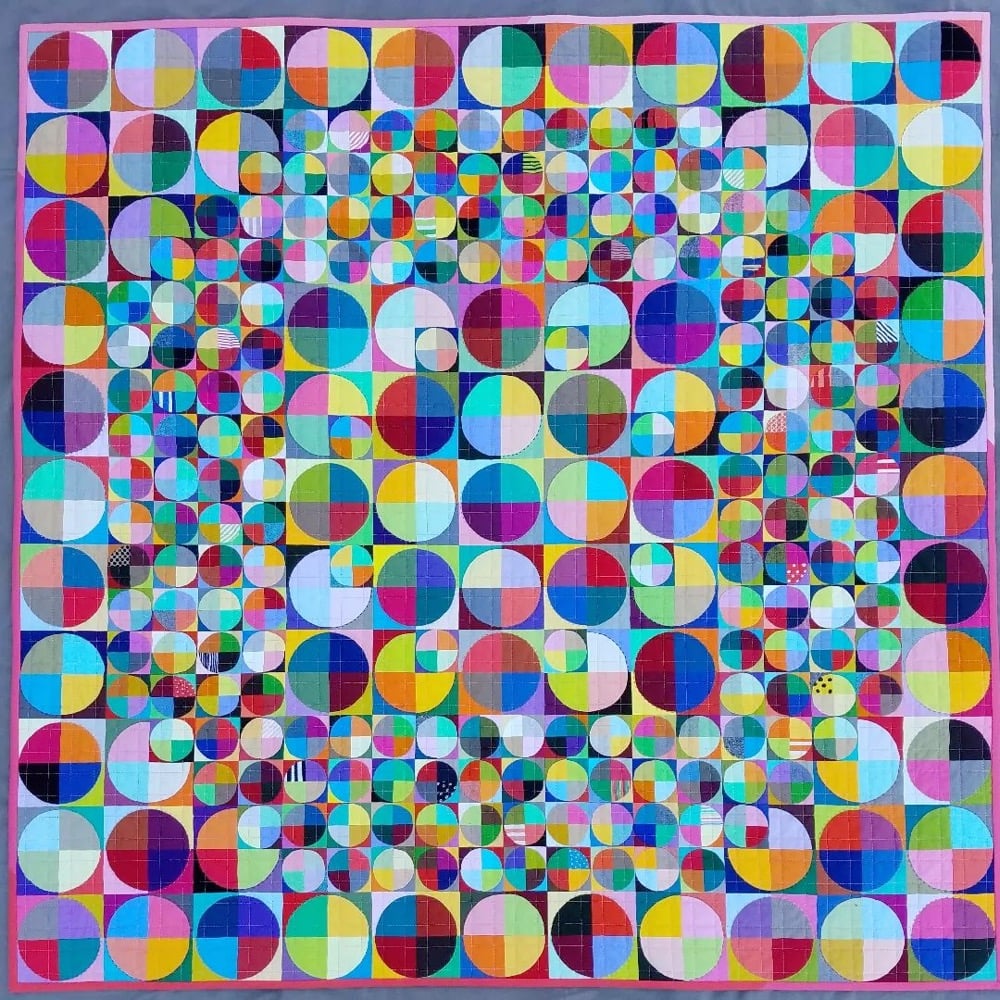
Oh I love the look of this quilt made by Marla Varner of Penny Lane Quilts. Here’s a closer look:
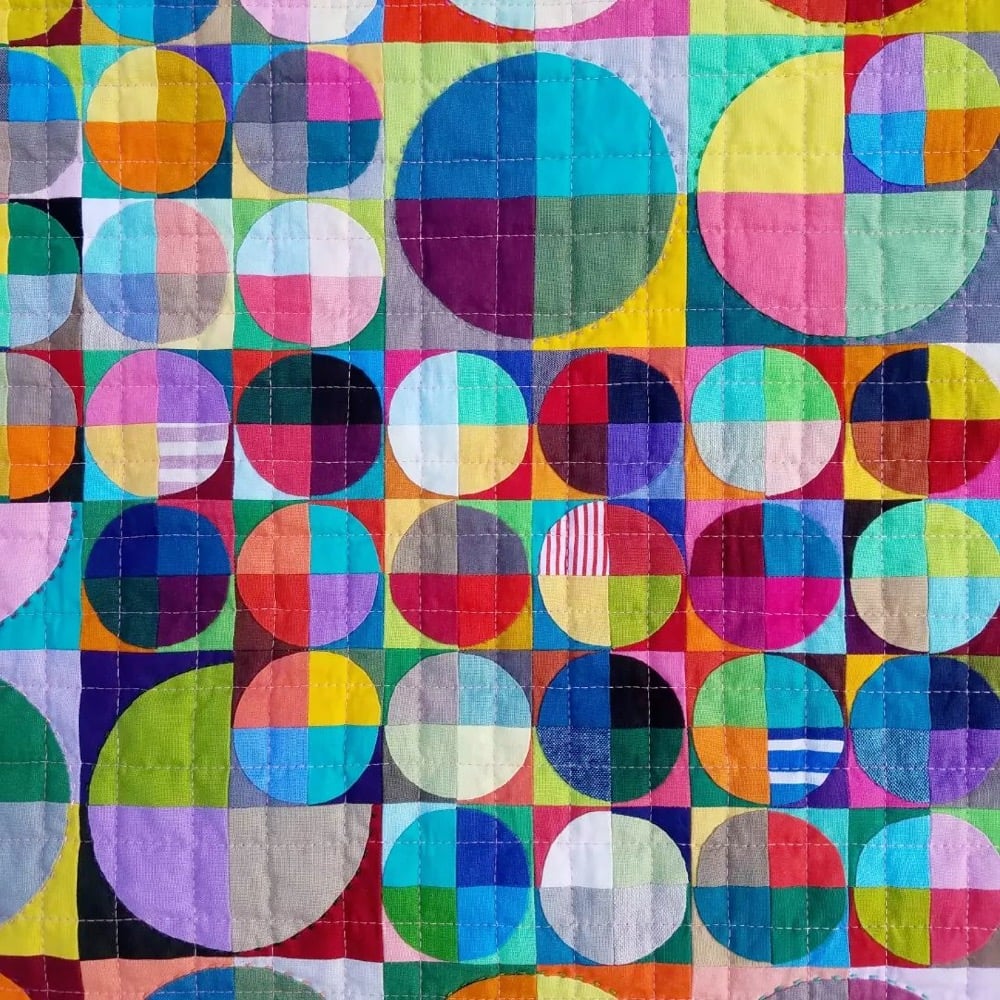
The colors and pattern are just perfect. You can check out several of her other large quilts on her website or on Instagram. (via austin kleon)
bell hooks reviews Beyoncé’s Lemonade (2016). “Images of female violence undercut a central message embedded in Lemonade that violence in all its forms, especially the violence of lies and betrayal, hurts.”
One-Minute Time Machine
A Groundhog Day-esque short film about some of the unintended consequences of time travel, even for short hops. (See also…)
Builders Compete for Best Earthquake-Proof Toothpick Tower
Perhaps intuiting our shared love and fond remembrance of school engineering competitions (egg drop! toothpick bridge!), Spencer Wright alerted me to the latest issue of The Prepared, specifically this bit about a competition to design toothpick towers that can withstand simulated earthquakes. Wright writes:
I’m a big fan of egg drop contests, in which teams make some kind of contraption that lets a raw egg fall — and not break — from a high height. Well, Sojo University’s Department of Architecture holds a seismic loading competition, in which teams of high schoolers build toothpick towers that stay standing when shaken by a simulated earthquake. The towers fail in delightful ways — some lean slowly, some topple all at once, some twist up over a period of minutes before collapsing on themselves. The full 2021 competition (which was live streamed!) can be seen in this video, though highlights of the 2010 competition are perhaps more fun to watch.
I’ve embedded the 2010 competition highlight video above…it’s a fun watch. (via the prepared)
Randomly Bouncing Balls Arrange Themselves Into Satisfying Patterns
In this clever simulation, bouncing balls obeying the laws of physics somehow arrange themselves, mid-chaos, into neat patterns. This is immensely satisfying.
Spoiler: the trick here is a pair of simulations stitched together, like a physics Texas Switch: “Each sequence is obtained by joining two simulations, both starting from the time in which the balls are arranged regularly. One simulates forward in time, one backwards.”
The Physics of Wile E. Coyote’s 10 Billion-Volt Electromagnet. I am here for any vigorous fact-checking of cartoon physics.
Toni Morrison’s Ten Steps Towards Fascism
In a convocation address delivered at Howard University in March 1995, Toni Morrison noted that before fascist movements arrive at a “final solution” (the euphemism used by Nazi leaders to refer to the mass murder of Jews), there are preceding steps that they use to advance their agenda. From an excerpt of that speech published in The Journal of Negro Education:
Let us be reminded that before there is a final solution, there must be a first solution, a second one, even a third. The move toward a final solution is not a jump. It takes one step, then another, then another.
Morrison then continued, listing the pathway to fascism in ten steps:
- Construct an internal enemy, as both focus and diversion.
- Isolate and demonize that enemy by unleashing and protecting the utterance of overt and coded name-calling and verbal abuse. Employ ad hominem attacks as legitimate charges against that enemy.
- Enlist and create sources and distributors of information who are willing to reinforce the demonizing process because it is profitable, because it grants power and because it works.
- Palisade all art forms; monitor, discredit or expel those that challenge or destabilize processes of demonization and deification.
- Subvert and malign all representatives of and sympathizers with this constructed enemy.
- Solicit, from among the enemy, collaborators who agree with and can sanitize the dispossession process.
- Pathologize the enemy in scholarly and popular mediums; recycle, for example, scientific racism and the myths of racial superiority in order to naturalize the pathology.
- Criminalize the enemy. Then prepare, budget for and rationalize the building of holding arenas for the enemy — especially its males and absolutely its children.
- Reward mindlessness and apathy with monumentalized entertainments and with little pleasures, tiny seductions, a few minutes on television, a few lines in the press, a little pseudo-success, the illusion of power and influence, a little fun, a little style, a little consequence.
- Maintain, at all costs, silence.
As I have said before, you can see many of these steps playing out right now in America, orchestrated by a revitalized and emboldened right-wing movement that has captured the Republican Party. Jason Stanley, a scholar of fascism, recently wrote of Morrison’s speech:
Morrison’s interest was not in fascist demagogues or fascist regimes. It was rather in “forces interested in fascist solutions to national problems”. The procedures she described were methods to normalize such solutions, to “construct an internal enemy”, isolate, demonize and criminalize it and sympathizers to its ideology and their allies, and, using the media, provide the illusion of power and influence to one’s supporters.
Morrison saw, in the history of US racism, fascist practices — ones that could enable a fascist social and political movement in the United States.
Writing in the era of the “super-predator” myth (a Newsweek headline the next year read, “Superpredators: Should we cage the new breed of vicious kids?”), Morrison unflinchingly read fascism into the practices of US racism. Twenty-five years later, those “forces interested in fascist solutions to national problems” are closer than ever to winning a multi-decade national fight.
See also Umberto Eco’s 14 Features of Eternal Fascism and Fighting Authoritarianism: 20 Lessons from the 20th Century. (via jason stanley)
US Quarter Featuring Maya Angelou Starts Circulating
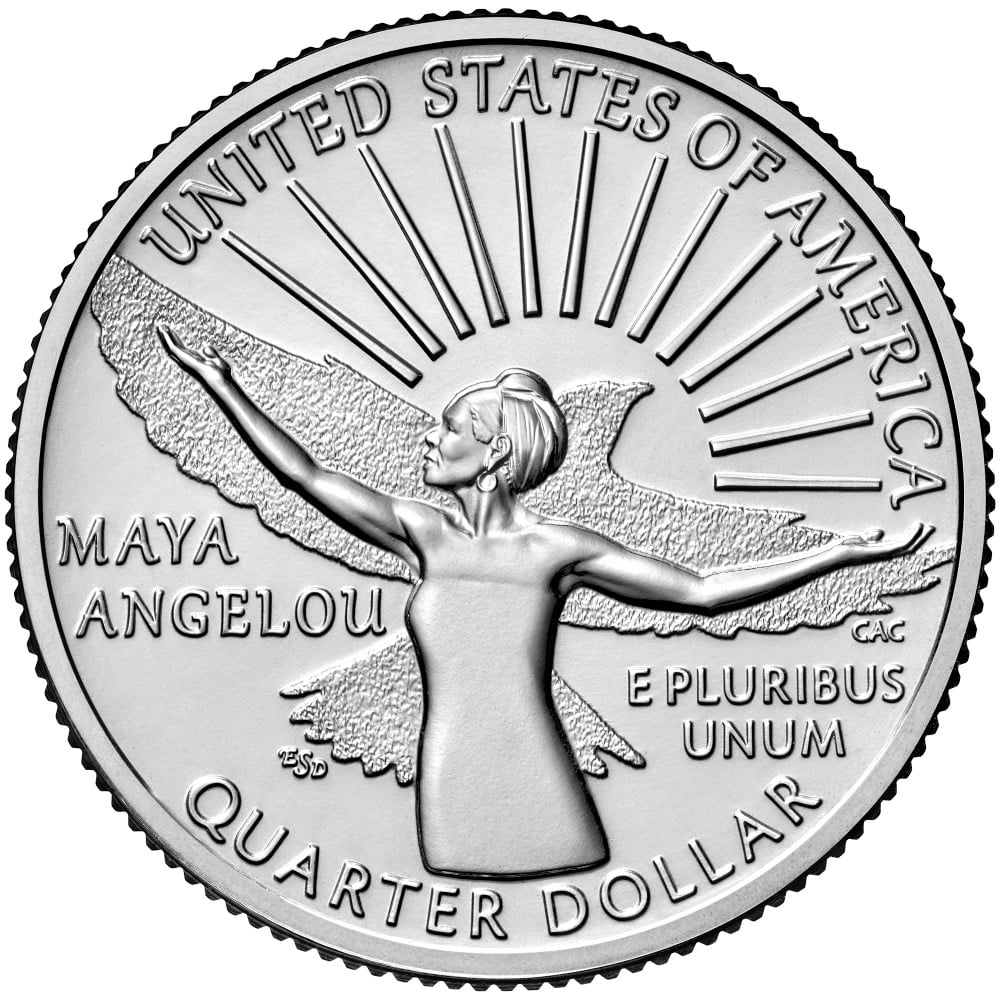
The US Mint has started shipping a quarter featuring poet & activist Maya Angelou on it.
A writer, poet, performer, social activist, and teacher, Angelou rose to international prominence as an author after the publication of her groundbreaking autobiography, “I Know Why the Caged Bird Sings.” Angelou’s published works of verse, non-fiction, and fiction include more than 30 bestselling titles. Her remarkable career encompasses dance, theater, journalism, and social activism.
The front of the Angelou quarter features a portrait of George Washington (a slaveowner, I feel it is important to note) that is different from the usual image on regular quarters. The new image was sculpted by Laura Gardin Fraser in 1931:
In 1931, Congress held a competition to design a coin to honor the 200th anniversary of George Washington’s birth. The original competition called for the obverse of the coin to feature a portrait of George Washington, based on the famed life-mask bust by French sculptor Jean-Antoine Houdon. The reverse was to feature a design that was to be “national” in nature.
Laura Gardin Fraser submitted a design that features a right-facing portrait of George Washington on the obverse, while the reverse shows an eagle with wings spread wide. In a 1932 letter to recommend Fraser’s design, the U.S. Commission of Fine Arts (CFA) wrote to (then) Treasury Secretary Andrew W. Mellon:
“This bust is regarded by artists who have studied it as the most authentic likeness of Washington. Such was the skill of the artist in making this life-mask that it embodies those high qualities of the man’s character which have given him a place among the great of the world…Simplicity, directness, and nobility characterize it. The design has style and elegance…The Commission believes that this design would present to the people of this country the Washington whom they revere.”
While her design was popular, it was not chosen. Instead, Secretary Mellon ultimately selected the left-facing John Flannigan design, which has appeared on the quarter’s obverse since 1932.

The Angelou quarter is the first in a series of quarters featuring notable American women:
Beginning in 2022 and continuing through 2025, the Mint will issue five quarters in each of these years. The ethnically, racially, and geographically diverse group of individuals honored through this program reflects a wide range of accomplishments and fields, including suffrage, civil rights, abolition, government, humanities, science, space, and the arts. The additional honorees in 2022 are physicist and first woman astronaut Dr. Sally Ride; Wilma Mankiller, the first female principal chief of the Cherokee Nation and an activist for Native American and women’s rights; Nina Otero-Warren, a leader in New Mexico’s suffrage movement and the first female superintendent of Santa Fe public schools; and Anna May Wong, the first Chinese American film star in Hollywood, who achieved international success despite racism and discrimination.
The Angelou quarter will start circulating later this month and early next month — look for it in your change soon!
Fashion for Hostile Architecture

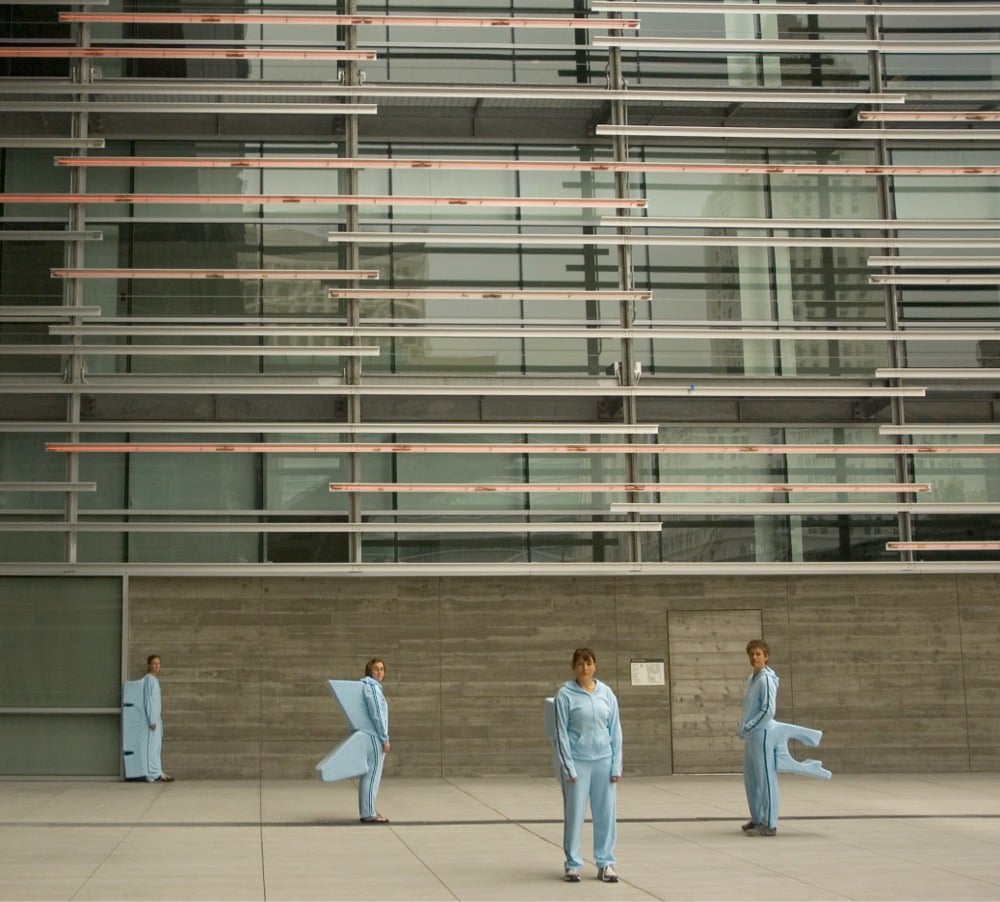
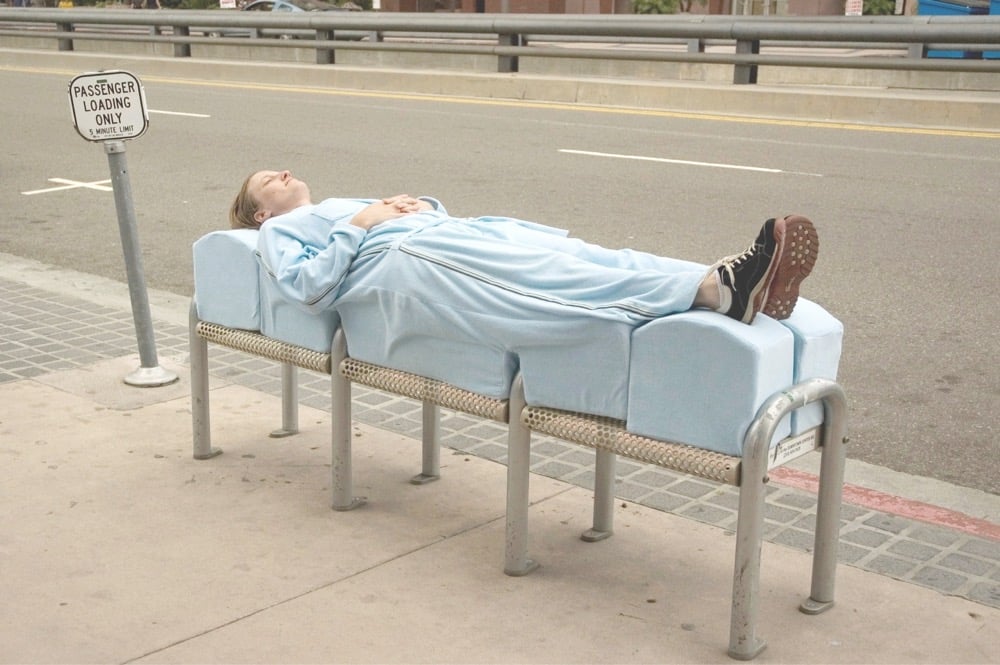
Artist Sarah Ross’s project Archisuits draws attention to architecture in LA that is specifically designed to prohibit people from sitting on it. Each suit is produced to fit into a specific hostile architectural element so that the wearer can sit or lie comfortably on it.
Socials & More