


This site is made possible by member support. 💞
Big thanks to Arcustech for hosting the site and offering amazing tech support.
When you buy through links on kottke.org, I may earn an affiliate commission. Thanks for supporting the site!
kottke.org. home of fine hypertext products since 1998.
Beloved by 86.47% of the web.
Entries for March 2018
20 years of gratitude and acknowledgements
I was on the road for an unexpectedly long time last week, so the post I wrote about kottke.org’s 20th anniversary was a little rushed and incomplete. I often call kottke.org my “one-man band” but it has been anything but. Today, I want to swing back around and thank all of the people and organizations who have supported me and the site with their encouragement, advice, criticism, well-wishes, hard work, and services.
I’ve thanked ‘em before and I’ll thank ‘em again: the support of kottke.org members has given this here webmaster new life. If you’d like to see kottke.org run another 20 years, the best way to do that is to sign up for a membership (it’ll only take you a minute).
I’ve been lucky to work with a bunch of talented guest editors over the years, including Sarah Pavis, Greg Allen, Adam Lisagor, Choire Sicha (now the editor of the NY Times Style section — fancy!), Deron Bauman of the dearly missed Clusterflock, Susannah Breslin, Cliff Kuang, Ainsley Drew, Jenni Leder, Joel Turnipseed, Lance Arthur, Andy Baio, and Chrysanthe Tenentes. Chris Piascik has provided the occasional high quality illustration. Aaron Cohen guest edited for a couple of weeks and then, unbidden & for reasons unknown, posted 3-5 posts each week for several months. (Aaron still bugs me bi-monthly about doing a Kottke Konference and someday he might actually persuade me to do it.)
And a special mention goes to Tim Carmody, who has guest edited several times and is now writing the Noticing newsletter and posting on Fridays. He’s like my smarter and more verbose brother, and I love what he contributes to the site.
Back in 2005, when I quit my job to work on kottke.org full-time, I asked my readers to support me in a precursor to the membership program. Hundreds of them did just that, and I’m forever grateful.
To Greg Knauss, Anil Dash, Heather Armstrong, Michael Sippey, Mark Wilkie, David Jacobs, Meg Hourihan, Jake Dobkin, and Jonah Peretti: your advice and counsel over the years has been invaluable to me. Best informal board of advisors ever.
I need to thank Greg Knauss & Mark Wilkie again, along with Finn Smith, for helping me out with the heavy lifting server admin stuff. Mark in particular hosted kottke.org on his own personal server for many years in the early days.
Along with his counsel, I’d like to thank Jonah Peretti for providing me with a space at Eyebeam Labs in 2005 as a senior fellow and again at Buzzfeed as a design advisor and a desk-squatter for almost 10 years.
kottke.org is proudly hosted by Arcustech, which keeps the site running at top speed with no downtime. I dunno, maybe the site’s been down once, for like 2 seconds in the middle of the night, but I was sleeping and didn’t notice.
The fonts for the site are courtesy of Hoefler & Co. I’m proud to have been one of the first sites on the web to use their web fonts.
I’d like to thank my advertising partners throughout the years: Carbon Ads, We Work Remotely (which started out as the job board for 37signals), and especially The Deck.
And last but not least, I’d like to thank all of you for reading all these years, despite the repeated use of cliches like “last but not least”. I ♥ you all!
CHICken: a coffee table book of beautiful chicken photos



The close reader of the Kickstarter project page for The Most Stunning High Quality Chicken Book Photos Ever Made will notice that the chicken photos coffee table book they’re making is called “CHICken” and not just “Chicken”. Chic chickens. Sheek-en. SHEEEEEEEEK-EN!! I am pronouncing it this way from now on for sure, especially in fancy restaurants. THA SHEEK-EN POR DOO SEAL VOO PLATE.1
See also The Illustrated Book of Poultry. (via colossal)
Perhaps you don’t find this as hilarious as I do, but I grew up in a household where Target and J.C. Penney were pronounced in the French manner, TAR-JHAY and JHOCK PENNAY respectively. I don’t know exactly who we were poking fun at with this: the French we knew nothing about, high-end fashion brands we couldn’t afford, or ourselves (a time-honored Midwestern pastime).↩
A Selfish Argument for Making the World a Better Place
This video, a collaboration between Kurzgesagt and economist Max Roser, makes a compelling argument for empowering the maximum amount of people around the world to become happier/wealthier/more free, so that everyone can all work on solutions to problems that affect everyone. The main gist is that while pre-industrial conditions favored zero-sum thinking, the Industrial & Green Revolutions and global telecommunications have created a situation in which non-zero-sum thinking is favored.
I couldn’t help thinking of the Lost Einsteins due to inequality in America.
I encourage you to take a moment to absorb the size of these gaps. Women, African-Americans, Latinos, Southerners, and low- and middle-income children are far less likely to grow up to become patent holders and inventors. Our society appears to be missing out on most potential inventors from these groups. And these groups together make up most of the American population.
The key phrase in the research paper is “lost Einsteins.” It’s a reference to people who could “have had highly impactful innovations” if they had been able to pursue the opportunities they deserved, the authors write. Nobody knows precisely who the lost Einsteins are, of course, but there is little doubt that they exist.
In addition to the ethical and moral arguments for improving the lives of all humans, the non-zero-sumness of today’s world makes a powerful economic argument for doing so as well. How to accomplish this is left as an exercise to the reader…
The cult of Trump and America’s increasingly authoritarian government
I missed Andrew Sullivan’s review of Cass Sunstein’s Impeachment: A Citizen’s Guide and Can It Happen Here?: Authoritarianism in America (also edited by Sunstein) but I think Sullivan’s twin conclusions are spot on: Trump is likely unimpeachable1 and America is steadily headed towards an authoritarian government.
The result is that an unimpeachable president is slowly constructing the kind of authoritarian state that America was actually founded to overthrow.
There is nothing in the Constitution’s formal operation that can prevent this. Impeachment certainly cannot. As long as one major political party endorses it, and a solid plurality of Americans support such an authoritarian slide, it is unstoppable. The founders knew that without a virtuous citizenry, the Constitution was a mere piece of paper and, in Madison’s words, “no theoretical checks — no form of government can render us secure.” Franklin was blunter in forecasting the moment we are now in: He believed that the American experiment in self-government “can only end in despotism, as other forms have done before it, when the people become so corrupted as to need despotic government, being incapable of any other.” You can impeach a president, but you can’t, alas, impeach the people. They voted for the kind of monarchy the American republic was designed, above all else, to resist; and they have gotten one.
That is an astonishing passage, not only because of the allegation that 225+ years of American democracy is now effectively over because the Constitution does not include the necessary checks to prevent it, but also because it rings true.
As I’ve said before, I don’t think Trump will resign or be impeached…or willingly leave the White House under any circumstance.↩
Errol Morris on Stephen Hawking, “a king of infinite space”
From an interview with Errol Morris on his friend Stephen Hawking (about whom he made a documentary), Morris shares why Hawking’s A Brief History of Time resonated with so many people beyond the scientific community.
I read the book on the plane on the way over. I was surprised, because I had been told that it was a book about theoretical physics and cosmology. But it was something much more than that. It was a work of literature.
He had done something strange and unusual and powerful. He had described himself and his own situation in terms of his science. Hawking’s greatest discovery — Hawking Radiation — was, in its own way, a tour de force. He was combining elements from general relativity, from quantum mechanics, and from thermodynamics in a new way. There’s something extraordinary about it, but what was most extraordinary about it is that here you have this entity, a black hole, from which nothing can escape. The gravitational field is so strong, surrounded by an event horizon. Nothing can escape from the black hole. Nothing inside that event horizon can get out.
What did Hawking show? Hawking showed that black holes are not entirely black. Radiation can escape from a black hole. He showed the mechanism through which this could occur.
At the same time, he’s telling you that he’s been condemned to this chair, to motor neuron disease, to ALS, and is really unable to talk. He’s lost his ability to speak, and now has to use a computer device, a clicker, a screen with a built-in dictionary and cursor. Despite the disease, he’s not trapped inside of himself. He’s able to communicate. He would always cite the famous line from Hamlet, “Bounded …”
“… in a nutshell, and count myself a king of infinite space.”
The whole thing is well worth a read. Like this bit about Hawking’s voice double:
Q: What was the process of working on the film with him like? Not all of those passages are from the book. Were you sending him questions?
A: Yes. He was writing answers, and some of the material was taken from lectures that he had given. Some of it was written for the film. I called him the first nontalking talking head. It became pretty clear that you had to assemble a dictionary of Hawking shots, but there’s no point in interviewing him for those, because it’s not synced. It’s a voice synthesizer. He gave us the voice synthesizer so we could just assemble his voice in the office in Cambridge, Massachusetts, which he insisted on calling “the pseudo-Cambridge.” There’s nothing like this project.
Q: Wait. He sent you the synthesizer so he could send you an answer and then you could feed it through the synthesizer to get the sound of his voice delivering the answer?
A: That’s correct.
New issue of Noticing, fresh off the presses. Featuring thoughts on time, attention, trees, and 20 years of blogging.
John Oliver on Bitcoin, blockchain, and cryptocurrency
Using Beanie Babies, Chicken McNuggets, and the comedy talents of Keegan-Michael Key, John Oliver tries to explain the wild world of Bitcoin, blockchain, and cryptocurrency, the latter of which he describes as “everything you don’t understand about money combined with everything you don’t understand about computers”.
My favorite part was the explanation of how difficult hacking the blockchain is: “[like] turning a Chicken McNugget back into a chicken”.
This was very hard to keep watching after Oliver started detailing cryptocurrency scams and charlatans trying to take advantage of people. One of Oliver’s targets, Brock Pierce, was actually canned from the company he co-founded after the segment aired.
Isle of Dogs cast interviews
As a promo for Wes Anderson’s Isle of Dogs, snippets from the cast interviews were animated using the dog characters played by Tilda Swinton, Bill Murray, Scarlett Johansson, Bob Balaban, and others. It’s amazing how much some of the dogs’ features & expressions mirror those of the actors who provide the voices. The bit starting at 2:30 with Jeff Goldblum is just straight flames.
Sports franchises have changed how players eat. Inside the Philadelphia 76ers’ executive chef’s operation:
Recipes by algorithm
Cover:Cheese is a website charting the progress of EMMA, the Evolutionary Meal Management Algorithm. This is what it sounds-like: a relatively basic attempt to automatically generate food recipes from other recipes.
The trick is, since it’s not just wordplay, and the results can’t be processed and validated by machines alone, somebody’s gotta actually make these recipes and see if they’re any good. And a lot of them are… not very good.
Ingredients
med okra
lot sugar
Instructions:
boil: sugar
okra sugarNOTE: This one is still around. Don’t make it. You basically end up with a pan full of mucus
But there are some surprises. Apparently eggplant mixed with angel’s food cake is pretty tasty. Or at least, tastier than you might guess. Anyways, at least the algorithm is learning, right?
Translating Homer in public
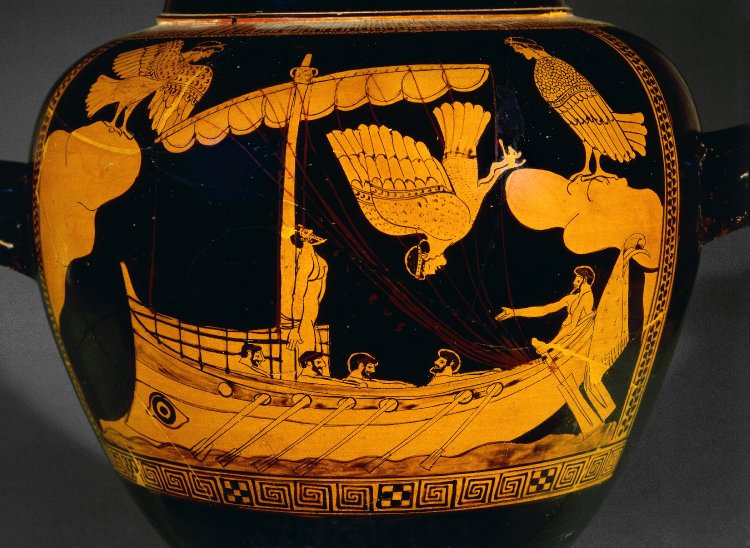
I can’t claim to have finished Emily Wilson’s translation of The Odyssey by Homer — epic poems are, well, epic — but I’m a huge fan of everything I’ve read, and especially Wilson’s Twitter feed, which is often devoted to explicating some small bit of Homeric text and comparing her approach to that of other translators.
Here, for example, she takes on the depiction of the Sirens. I’m going to pick and choose a few tweets, but you should read as much of the thread as you can.
Everyone knows the story of the Sirens from the Odyssey. They’re the singers who tempt all those who sail past to listen to them forever, forgetful of their families. Odysseus, instructed by Circe, has himself bound to the mast so he can listen to their song.
— Emily Wilson (@EmilyRCWilson) March 4, 2018
But the Homeric Sirens passage, in Book 12, is surprising in at least two ways. One is how short it is; the episode has become a much bigger part of the Odyssey in modern retellings than it is in the Homeric poem.
— Emily Wilson (@EmilyRCWilson) March 4, 2018
Secondly, the Sirens in Homer aren’t sexy. e.g. we learn nothing even about their hair — in contrast to other divine temptresses. The seduction they offer is cognitive: they claim to know everything about the war in Troy, and everything on earth. They tell the names of pain.
— Emily Wilson (@EmilyRCWilson) March 4, 2018
This last observation prompted a haunting distillation by Lev Mirov of Odysseus’s journey and his encounter with the Sirens:
This whole thread is amazing but, I think of this:
— Lev Mirov (@thelionmachine) March 5, 2018
the forbidden knowledge Odysseus cannot pass up?
Essentially:
tell me the name
of the hole in my heart
tell me what
this war meant
and what is wrong with me.
(nothing, nothing, nothing, the name of pain is sung.) https://t.co/LlFFxOqVaX
Back to Wilson, who translates the brutally short passage of the sirens this way:
Wilson:
— Emily Wilson (@EmilyRCWilson) March 4, 2018
“Now stop your ship and listen to our voices.
All those who pass this way hear honeyed song
poured from our mouths. The music brings them joy,
and they go on their way with greater knowledge”.
I don’t change my regular iambic pentameter.
She explains:
I wanted the Sirens to sound seductive, but in aural and cognitive ways. I tried to echo some of the alliterating sibilants in the original — a bit like Kaa in Jungle Book, “Trust in Me”. NB: it’s the mouth, not the lips, that matters in most of Odysseus’ troubles at sea.
— Emily Wilson (@EmilyRCWilson) March 4, 2018
Mouths (of giants, whirlpools, cyclopses and men) keep eating the wrong things, and mouths (of goddesses, men, witches, singers and shades) speak and sing to enable or thwart the onward journey. Not lips, which can be pretty and kissable. Mouths are powerful and dangerous.
— Emily Wilson (@EmilyRCWilson) March 4, 2018
Translation is hard, but translation in public is harder and better. There’s a richness in the commentary, and also a reckoning with the accretion of meanings that have come down through past readings, that you don’t often get without diving into scholarly apparatus. It’s not just peeling back the plaster; it’s trying to understand the work that plaster did in holding the whole structure together. Just remarkable.
Update: Dan Chiasson wrote about Wilson’s use of Twitter for the New Yorker.
A world-historical theory of tool use

I love reading and rereading about the origin of humanity. I love that it’s not settled science: we’re still making new discoveries about when humans first left Africa, how and when we interbred with other hominins, and what makes us human in the first place. It’s just the coolest story, which is also every story.
Popular Science has a really nice new primer on the current state of research on early humanity. Embedded in it is a series of studies on tool use by early humans in Kenya that caught my attention. Basically, the tools got smaller and more portable, the materials used were more exotic (sourced from farther away), and they were decorated with pigments.
“That’s where there’s a similarity to technology in recent times; things start out big and clunky and they get small and portable,” says Richard Potts, head of the Smithsonian’s Human Origins Program and a co-author of the papers. “The history [of] technology has been the same ever since.”
I wonder, though, if all three vectors hold up across history: greater portability, greater range of materials, and greater decorative value.
I suspect the null hypothesis would be that technologies that work tend to stay roughly the same over time. (For most of early human history, our tools didn’t change up that much, which is exactly why the burst of activity in east Africa is noteworthy.) You need something to shake things up: either sudden availability of new materials, or a deprivation of old ones (like the Bronze Age collapse, which eventually helped usher in the Iron Age).
As it turns out, that’s exactly what happened.
“One of the things we see is that around 500,000 years ago in the rift valley of southern Kenya, all hell breaks loose. There’s faulting that occurs, and earthquake activity was moving the landscape up and down. The climate record shows there is a stronger degree of oscillation between wet and dry. That would have disrupted the predictability of food and water, for those early people,” Potts says. “It’s exactly under those conditions that almost any organism—but especially a hunter-gatherer human, even an early one—would begin to expand geography of obtaining food or obtaining resources. It’s under those conditions that you begin to run into other groups of hominins and you become aware of resources beyond your usual boundaries.”
It’s been 10 years since The Wire was on TV. Here, some of the stars and creators look back at the show.
A literal world map
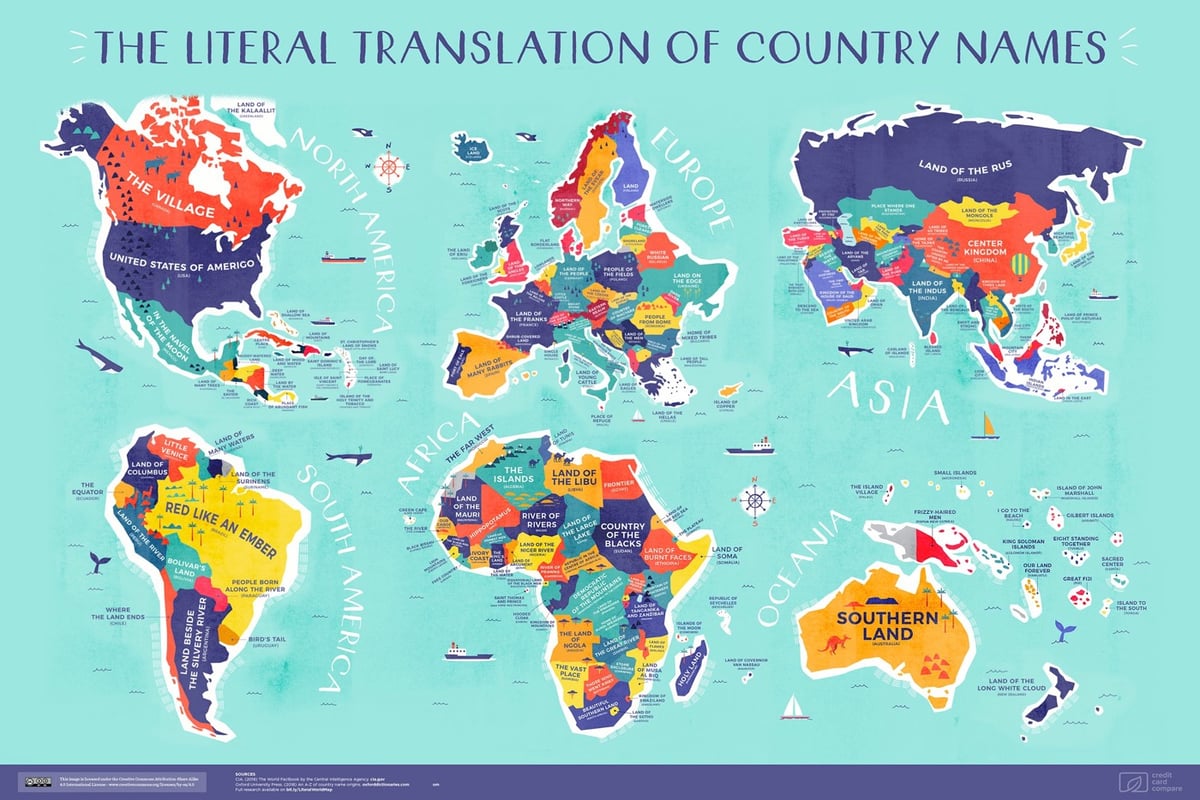

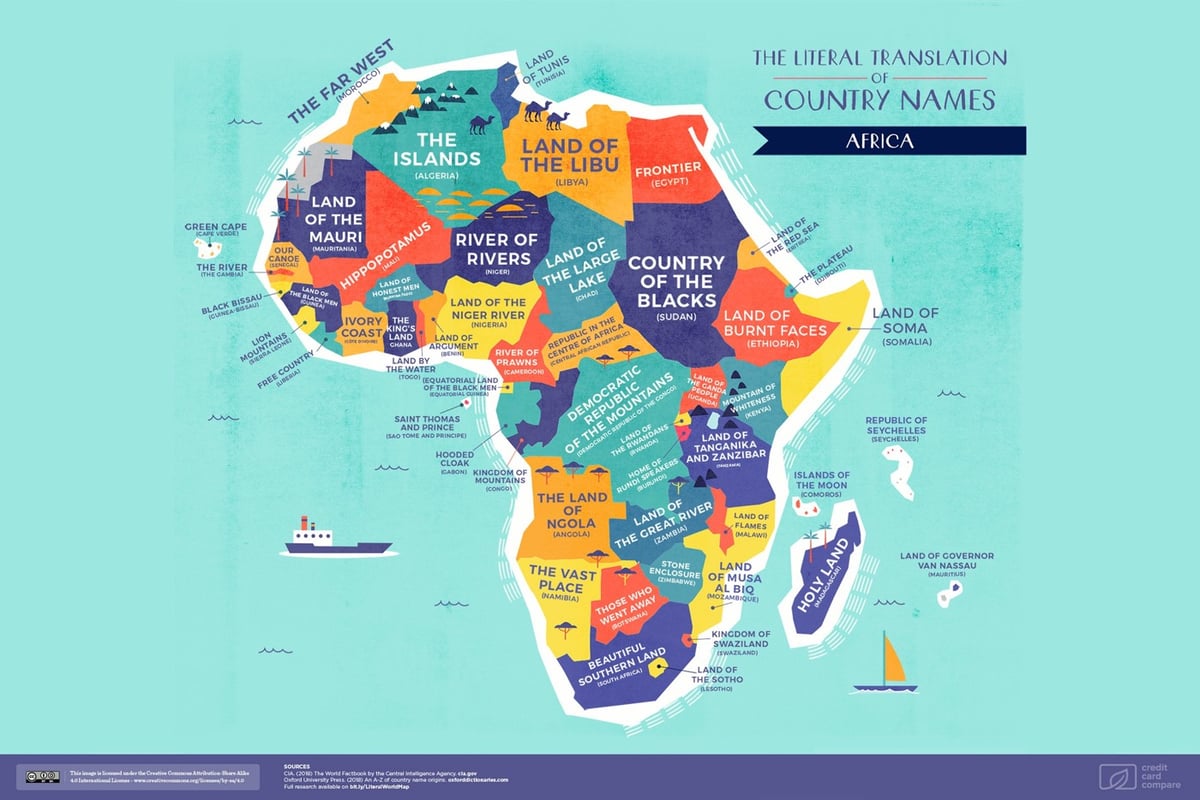
This is a map of the literal translations for the names of the world’s countries (bigger size). Some of the translations include:
Panama: Place of Abundant Fish
Paraguay: People Born Along the River
Namibia: The Vast Place
Ethiopia: Land of Burnt Faces
Egypt: Temple of the Soul of Ptah
Spain: Land of Many Rabbits
Hungary: 10 Arrows
Qatar: Land of Tar
Israel: He That Striveth with God
Thailand: Land of the Free
Nauru: I Go to the Beach
Australia: Southern Land
A spreadsheet of the translations and their sources is available here. See also a world map of every country’s tourism slogan. (via @danielhale)
Update: See also the Etymological Map of Africa. (via @danielhale)
Update: Two things. 1. This is not my map. I didn’t make it…it seems that (based on the logo in the lower right-hand corner) an Australian credit card comparison company did, but I can’t find any record of them having posted it anywhere online. 2. I have gotten many messages indicating the map is incorrect in one aspect or another, so you might want to take the whole thing with a healthy grain of salt (despite the research).
A surgery resident analyzes medical scenes from TV & movies
Annie Onishi is a general surgery resident at Columbia University and Wired asked her to break down scenes from movies and TV shows featuring emergency rooms, operating rooms, and other medical incidents. Spoiler alert: if you seek medical treatment from a TV doctor, you will probably die. Secondary spoiler alert: that adrenaline-shot-to-the-heart scene in Pulp Fiction is not as implausible as you might think, even if some of the details are wrong.
Astronomers have detected radio signals from when the earliest stars in the universe were forming 180 million years after the Big Bang. “If confirmed, this discovery deserves two Nobel Prizes.”
“To Share Something Is to Risk Losing It”
Remember the Broccoli Tree and its eventual fate?
For the past few years, Patrik Svedberg has been taking photos of a beautiful Swedish tree he dubbed The Broccoli Tree. In a short time, the tree gained a healthy following on Instagram, becoming both a tourist attraction and an online celebrity of sorts. (I posted about tree two years ago.) Yesterday, Svedberg posted a sad update: someone had vandalized the tree by sawing through one of the limbs.
Very soon after, it was decided by some authority that the vandalism meant the entire tree had to come down. A work crew arrived and now it’s gone.
In a short video, John Green shares his perspective on the loss of the tree and the meaning of sharing with others in the age of social media.
To share something is to risk losing it, especially in a world where sharing occurs at tremendous scale and where everyone seems to want to be noticed, even if only for cutting down a beloved tree. […] And the truth is, if we horde and hide what we love, we can still lose it. Only then, we’re alone in the loss.
“Oh My God!” People’s Reactions to Looking at the Moon Through a Telescope.
Wylie Overstreet and Alex Gorosh took a telescope around the streets of LA and invited people to look at the Moon through it. Watching people’s reactions to seeing such a closeup view of the Moon with their own eyes, perhaps for the first time, is really amazing.
Whoa, that looks like that’s right down the street, man!
I often wonder what the effect is of most Americans not being able to see the night sky on a regular basis. As Sriram Murali says:
The night skies remind us of our place in the Universe. Imagine if we lived under skies full of stars. That reminder we are a tiny part of this cosmos, the awe and a special connection with this remarkable world would make us much better beings — more thoughtful, inquisitive, empathetic, kind and caring. Imagine kids growing up passionate about astronomy looking for answers and how advanced humankind would be, how connected and caring we’d feel with one another, how noble and adventurous we’d be.
“She found a dating app on her boyfriend’s phone. Then she bought a samurai sword.” There are so many amazing quotes/details here.
A recap and photos of National School Walkout Day

I didn’t get to follow National School Walkout Day as closely as I wanted to yesterday, but I just wanted to say on the morning after that I am very much in support of these kids, very proud of them, and deeply ashamed that ours is a country that has to regularly lean so hard on some of our most vulnerable members of society to get people and politicians to react to gross social injustice.
Buzzfeed has a great roundup of action from around the country, including 16-year-old Justin Blackman, who was the only one to walk out at his school…and ended up with millions of people supporting his efforts online. The Atlantic’s In Focus has gathered 35 photos of the walkout from around the nation.
Ohio teenager’s raw photographs of his high school friends
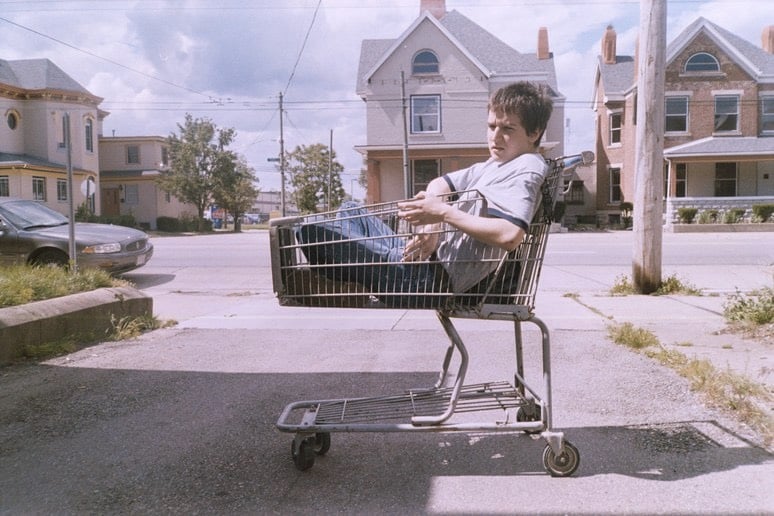

The New Yorker is featuring a selection of photos taken by high school senior Colin Combs, mostly of him and his friends in Dayton, Ohio, “sometimes called the heroin capital of the United States”.
Minimalism is the necessary ethos of both his concept and his process. His equipment consists of expired film and cheap or disposable cameras, which Combs receives from patrons, including Wolfgang Grossmann, a school security guard, and Amy Powell, his photography teacher. Powell, who sent The New Yorker a selection of Combs’s images last December — the magazine later had dozens of rolls developed — has indulged her student’s autodidacticism, a trait that some educators might mistake for disobedience. “Sometimes he won’t do the assignments for class,” she said recently, laughing. “But he is always so hungry, prolific, constantly shooting. I’ve never had a student produce as much.”
The piece compares Combs’ work with that of Nan Goldin; parallels with the work of Larry Clark (NSFW), Ryan McGinley (NSFW), and Harmony Korine are also present. I went to see the Stephen Shore show at MoMA the other day (very recommended) and Combs’ photos making their way to the New Yorker reminded me of a 14-year-old Shore asking Edward Steichen, then MoMA’s curator of photography, to review his portfolio. Steichen purchased three photos from him.
You can follow Combs’ work on Instagram or read more about his work in the local Dayton paper.
Gorgeous 8K video of the aurora borealis dancing in the skies during a lunar eclipse
8K resolution. Time lapse. 360º view. Aurora borealis. Lunar eclipse. I’m not really sure how you could pack much more into this video. Probably best experienced with some sort of VR rig, but for those of us without access to such a thing, watching it several times on a large screen while dragging the view around is a more than adequate substitute. If seeing the aurora borealis in person wasn’t already on your bucket list, it is now. Dang. (via the kid should see this)
Twenty.
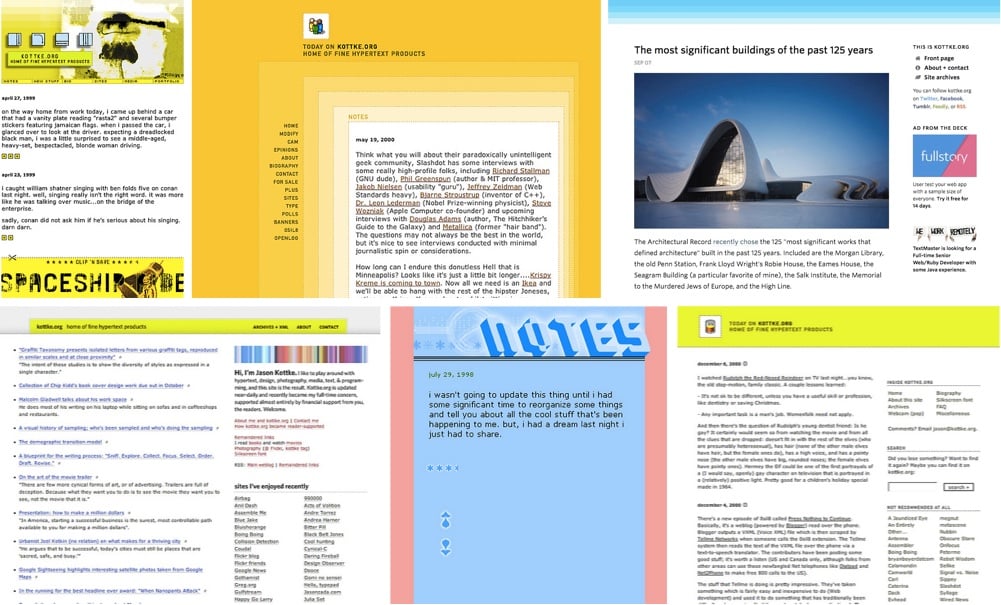
kottke.org is 20 years old today. Holy shit! On March 14, 1998, I launched a new episode of 0sil8 called “Notes”. 0sil8 was a previous website of mine, started in 1995 or 1996. The site’s format was episodic: every month or two the design and content was completely different. With Notes, I wanted to have somewhere to write regularly for my friends, modeled after the online diaries that were growing in popularity at the time. Weblogs were a thing, one of the many types of regularly updated personal sites that were in existence then; they wouldn’t take off and begin to consume all media for another year or two. In December 1998, I registered kottke.org (kottke.com was taken and I wasn’t a network so .org it was) and sometime later moved Notes over, where it’s been ever since. And now it’s one of the oldest regularly updated sites on the web.
I’ve been reading back through the early archives (which I wouldn’t recommend), and it feels like excavating down through layers of sediment, tracing the growth & evolution of the web, a media format, and most of all, a person. On March 14, 1998, I was 24 years old and dumb as a brick. Oh sure, I’d had lots of book learning and was quick with ideas, but I knew shockingly little about actual real life.1 I was a cynical and cocky know-it-all. Some of my older posts are genuinely cringeworthy to read now: poorly written, cluelessly privileged, and even mean spirited. I’m ashamed to have written some of them.
But had I not written all those posts, good and bad, I wouldn’t be who I am today, which, hopefully, is a somewhat wiser person vectoring towards a better version of himself. What the site has become in its best moments — a slightly highfalutin description from the about page: “[kottke.org] covers the essential people, inventions, performances, and ideas that increase the collective adjacent possible of humanity” — has given me a chance to “try on” hundreds of thousands of ideas, put myself into the shoes of all kinds of different thinkers & creators, meet some wonderful people (some of whom I’m lucky enough to call my friends), and engage with some of the best readers on the web (that’s you!), who regularly challenge me on and improve my understanding of countless topics and viewpoints.
I had a personal realization recently: kottke.org isn’t so much a thing I’m making but a process I’m going through. A journey. A journey towards knowledge, discovery, empathy, connection, and a better way of seeing the world. Along the way, I’ve found myself and all of you. I feel so so so lucky to have had this opportunity. When kottke.org turned 10, my post marking the anniversary ended with “I’ll see you in 2018”. In my recollection, that line was somewhat serious but also partially somewhere between a joke and a dare. Like, “how has this thing lasted 10 years, why not go for 20?” So…why not go for 30? 40? I’ll see you for sure in 2028 and perhaps even in 2038. Thank you so very much for being here with me, I surely don’t deserve such fine company.
P.S. And if you’ll indulge me for a moment in a brief shameless sale pitch, if you have found something valuable here over the past 20 years, please consider supporting the site with a membership. Member support has put the site on a stable financial path into the future and has personally re-energized my involvement and commitment to the site. Thanks!
This is still arguably the case.↩
Physics giant Stephen Hawking dead at age 76

Stephen Hawking, who uncovered the mysteries of black holes and with A Brief History of Time did more than anyone to popularize science since the late Carl Sagan, has died at his home in Cambridge at age 76. From an obituary in The Guardian:
Hawking once estimated he worked only 1,000 hours during his three undergraduate years at Oxford. In his finals, he came borderline between a first- and second-class degree. Convinced that he was seen as a difficult student, he told his viva examiners that if they gave him a first he would move to Cambridge to pursue his PhD. Award a second and he threatened to stay. They opted for a first.
Those who live in the shadow of death are often those who live most. For Hawking, the early diagnosis of his terminal disease, and witnessing the death from leukaemia of a boy he knew in hospital, ignited a fresh sense of purpose. “Although there was a cloud hanging over my future, I found, to my surprise, that I was enjoying life in the present more than before. I began to make progress with my research,” he once said. Embarking on his career in earnest, he declared: “My goal is simple. It is a complete understanding of the universe, why it is as it is and why it exists at all.”
From Dennis Overbye’s obit in the NY Times:
He went on to become his generation’s leader in exploring gravity and the properties of black holes, the bottomless gravitational pits so deep and dense that not even light can escape them.
That work led to a turning point in modern physics, playing itself out in the closing months of 1973 on the walls of his brain when Dr. Hawking set out to apply quantum theory, the weird laws that govern subatomic reality, to black holes. In a long and daunting calculation, Dr. Hawking discovered to his befuddlement that black holes — those mythological avatars of cosmic doom — were not really black at all. In fact, he found, they would eventually fizzle, leaking radiation and particles, and finally explode and disappear over the eons.
Nobody, including Dr. Hawking, believed it at first — that particles could be coming out of a black hole. “I wasn’t looking for them at all,” he recalled in an interview in 1978. “I merely tripped over them. I was rather annoyed.”
That calculation, in a thesis published in 1974 in the journal Nature under the title “Black Hole Explosions?,” is hailed by scientists as the first great landmark in the struggle to find a single theory of nature — to connect gravity and quantum mechanics, those warring descriptions of the large and the small, to explain a universe that seems stranger than anybody had thought.
The discovery of Hawking radiation, as it is known, turned black holes upside down. It transformed them from destroyers to creators — or at least to recyclers — and wrenched the dream of a final theory in a strange, new direction.
“You can ask what will happen to someone who jumps into a black hole,” Dr. Hawking said in an interview in 1978. “I certainly don’t think he will survive it.
“On the other hand,” he added, “if we send someone off to jump into a black hole, neither he nor his constituent atoms will come back, but his mass energy will come back. Maybe that applies to the whole universe.”
Dennis W. Sciama, a cosmologist and Dr. Hawking’s thesis adviser at Cambridge, called Hawking’s thesis in Nature “the most beautiful paper in the history of physics.”
Roger Penrose, the eminent mathematician and physicist who collaborated with Hawking on discoveries related to black holes and the genesis of the universe, wrote a lengthy scientific obituary for Hawking in The Guardian.
Following his work in this area, Hawking established a number of important results about black holes, such as an argument for its event horizon (its bounding surface) having to have the topology of a sphere. In collaboration with Carter and James Bardeen, in work published in 1973, he established some remarkable analogies between the behaviour of black holes and the basic laws of thermodynamics, where the horizon’s surface area and its surface gravity were shown to be analogous, respectively, to the thermodynamic quantities of entropy and temperature. It would be fair to say that in his highly active period leading up to this work, Hawking’s research in classical general relativity was the best anywhere in the world at that time.
And then there was that time Hawking threw a party for time travellers but didn’t advertise it until after the party was over (to ensure only visitors from the future would show up).
Tonight is perhaps a good night to watch Errol Morris’ superb documentary on Hawking (with a wonderful Philip Glass soundtrack) or build a version of Hawking out of Lego.
The first trailer for Fantastic Beasts: The Crimes of Grindelwald. I am not loving Jude Law as young Dumbledore.
Holy Mountains Haloed by Drone Light
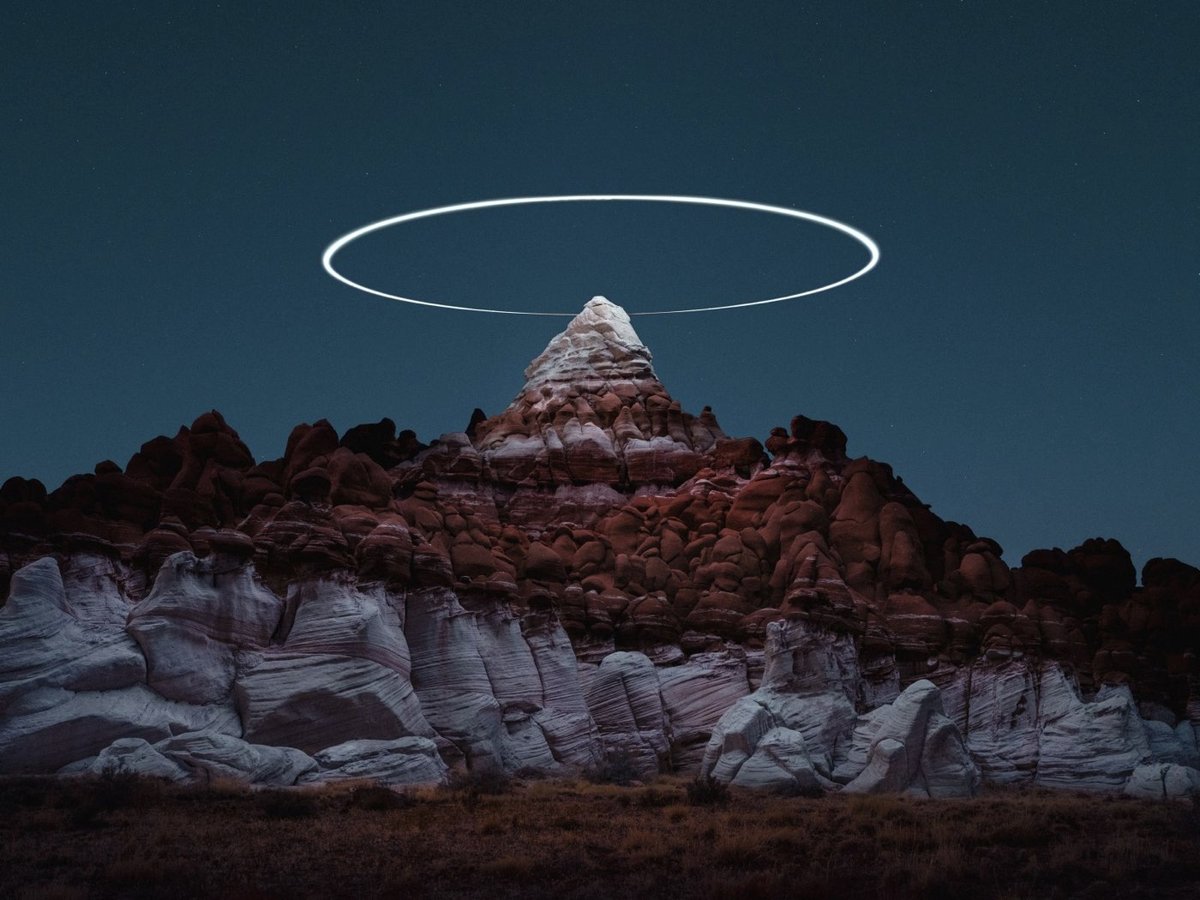

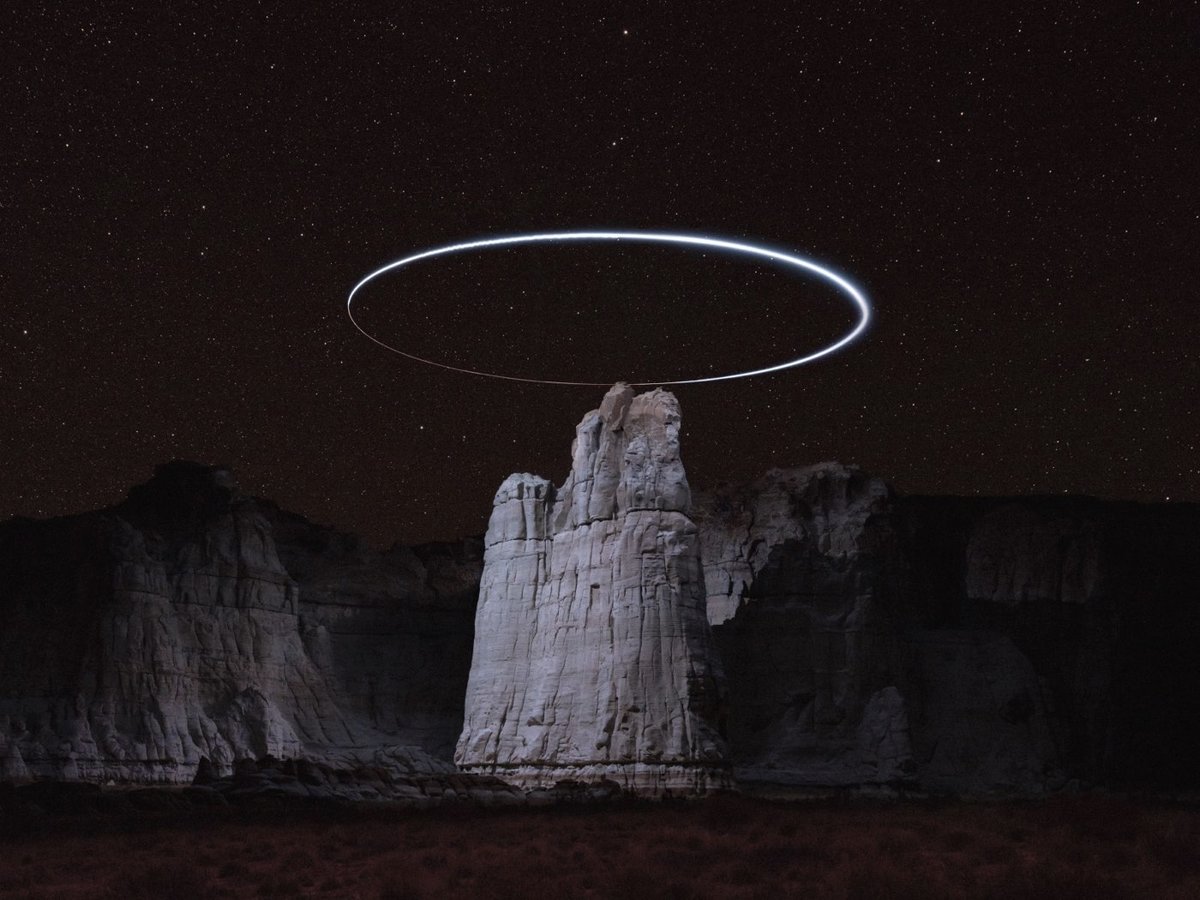
Oh, I love these photos by Reuben Wu. As part of his project Lux Noctis, Wu flies drones in circles around mountain peaks and takes long-exposure photos, creating these beautiful haloed landscapes. Wu spoke to Colossal about his interest in zero-trace land art:
Recently Wu has evolved his process of working with the drones to form light paths above topographical peaks in the mountainous terrain. “I see it as a kind of ‘zero trace’ version of land art where the environment remains untouched by the artist, and at the same time is presented in a sublime way which speaks to 19th century Romantic painting and science and fictional imagery,” said Wu to Colossal.
Broad Band, Claire Evans’ book about “The Untold Story of the Women Who Made the Internet”
I’m looking forward to reading Broad Band: The Untold Story of the Women Who Made the Internet by Claire Evans. Addie Wagenknecht recently did an interview with Evans about the book.
The easy thing is to say that Broad Band is a feminist history of the Internet. That’s what I’ve been telling people. Maybe it’s more accurate to say that it’s a history of the Internet told through women’s stories: boots-on-the-ground accounts of where the women were, how they were feeling and working, at specific, formative moments in Internet history. It emphasizes users and those who design for use, while many popular tech histories tend to zero in on the box. I’ve always been fascinated with what happens after hardware hits the market; it’s what we do with it that counts.
When I first heard of the book, I thought immediately of Halt and Catch Fire, a connection that Adi Robertson picked up on as well.
Robertson: It’s funny how much this book reminded me of Halt and Catch Fire.
Evans: Yes! Oh my god. One of my great regrets about the timing of me writing this book is that Halt and Catch Fire is over now, and I can’t con my way into a consulting job on that show. It was so fun being deep in the process of researching arcana and internet history and then seeing these little nuggets appear in a more glamorous form on my favorite TV show. It kind of felt surreal. But definitely made me feel like I was headed in the right direction.
National Geographic: “For Decades, Our Coverage Was Racist.”
As part of their issue on race, National Geographic asked historian John Edwin Mason to dive into their archives to examine the magazine’s past coverage of people of color, both in the US and abroad. What he found was not pretty.
What Mason found in short was that until the 1970s National Geographic all but ignored people of color who lived in the United States, rarely acknowledging them beyond laborers or domestic workers. Meanwhile it pictured “natives” elsewhere as exotics, famously and frequently unclothed, happy hunters, noble savages — every type of cliché.
Unlike magazines such as Life, Mason said, National Geographic did little to push its readers beyond the stereotypes ingrained in white American culture.
“Americans got ideas about the world from Tarzan movies and crude racist caricatures,” he said. “Segregation was the way it was. National Geographic wasn’t teaching as much as reinforcing messages they already received and doing so in a magazine that had tremendous authority. National Geographic comes into existence at the height of colonialism, and the world was divided into the colonizers and the colonized. That was a color line, and National Geographic was reflecting that view of the world.”
Some of what you find in our archives leaves you speechless, like a 1916 story about Australia. Underneath photos of two Aboriginal people, the caption reads: “South Australian Blackfellows: These savages rank lowest in intelligence of all human beings.”
A laudable move, particularly for a publication owned by Rupert Murdoch.
Puzzle twins



For her project entitled Within 15 Minutes, artist Alma Haser made identical jigsaw puzzles out of portraits she’d taken of identical twins and then swapped every other piece when putting them together, creating these serendipitously fragmented portraits. She said of her first attempt last year:
So today for no apparent reason I thought I’d test out a crazy idea I had. For the project I have been switching just the faces of the identical twins, but today I decided to see what it would look like to swap every other pieces with reach other. Completely entwining the beautiful @being__her sisters. And wow, what an effect! It really make you double take at their faces, trying to decipher one for the other.
You can follow Haser’s work, including the twin puzzles, on Instagram.
Socials & More