Entries for October 2016
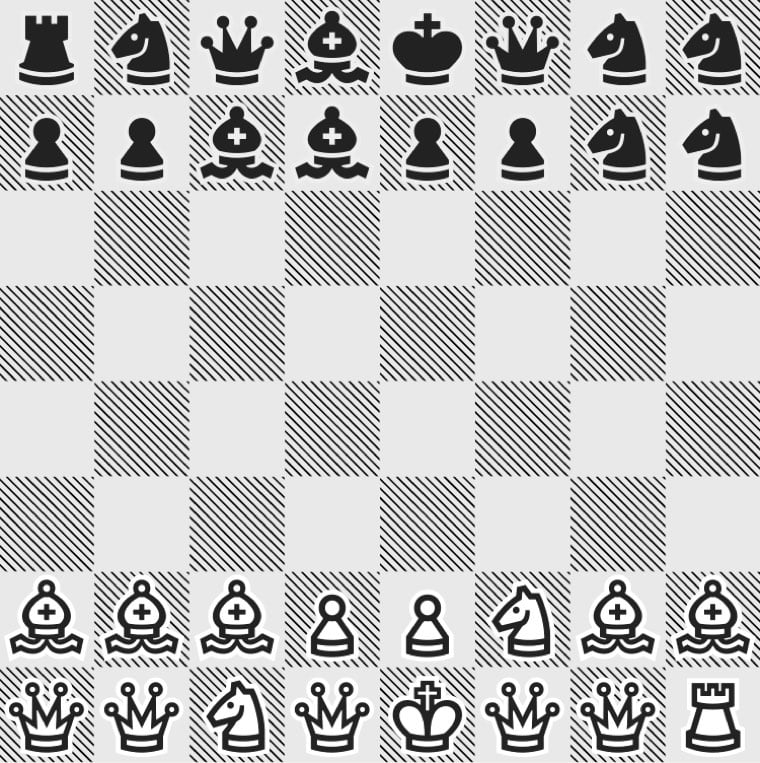
Really Bad Chess is an iOS game by Zach Gage that randomizes the distribution of pieces when the board is set up, so that you might start a game with 4 queens, 3 knights, and only 2 pawns in the back row. The result is that you get a completely new strategic game each time, but you still play with the familiar tactical rules of chess. What a great idea…I can’t tell if people who really love chess will love or hate this.
Update: See also Knightmare Chess:
Knightmare Chess is played with cards that change the default rules of chess. The cards might change how a piece moves, move opponent’s pieces, create special squares on the board or otherwise alter the game.
and Chess960 invented by Bobby Fischer:
It employs the same board and pieces as standard chess; however, the starting position of the pieces on the players’ home ranks is randomized. The random setup renders the prospect of obtaining an advantage through the memorization of opening lines impracticable, compelling players to rely on their talent and creativity.
(via @JonRelf & @akasian)
Per the second law of thermodynamics, the total entropy of a closed system is always increasing. So how does complexity arise out of that? More colloquially, if everything in the Universe is always falling apart, how do complex organisms like living things come into being? Well, entropy and complexity are actually two different things…
In the NY Times, Rory Smith writes about how video games like FIFA and Football Manager have changed professional soccer.
As Iwobi suggests, however, they increasingly do more than that: They are not merely representations of the game, but influencers of it. Iwobi is not the only player who believes that what he does on the field has been influenced by what he has seen rendered on a screen.
Ibrahimovic said that he would “often spot solutions in the games that I then parlayed into real life” as a young player. Mats Hummels, the Bayern Munich and Germany defender, has suggested that “maybe some people use what they learn in FIFA when they find themselves on a pitch.”
As a teen, Matt Neil went from a player of Football Manager to researcher for the game to working as a analyst for a League Two club.
I’m now an analyst at Plymouth. We’ve just signed the goalkeeper Marc McCallum, who some FM players will remember was an incredible prospect at Dundee United as a kid. I used to sign him all the time. When he came for a trial this summer, he walked in and it was one of the strangest moments in my life. I’ve never met him in person — I’d only ever seen his face on a computer game — but straight away I knew it was him.
I spoke to him at a pre-season game the next day. We got around to the subject of Football Manager and he’d been in charge of Argyle on the last game, getting them to the Premier League and signing himself. I asked him what he did when he first took over, and he said he got rid of all the staff. So I said: “Did you sack me?” And it turned out he’d actually sacked me as well. It was a strange opening conversation to have with someone.
American football and the Madden franchise have a similar relationship. The game is so realistic that prospective players can learn NFL-style offenses and established players like Drew Brees use the game to prep for the games ahead.
The New Orleans Saints quarterback told Yahoo! Sports in an interview this week that modern football simulation games such as Madden NFL have become so realistic that playing them during downtime can actually have a positive impact on the athlete’s on-field performance.
“Down the road it is going to be even more so,” Brees said. “The games are getting more lifelike every year, and everything in Madden is based on what really happens on the field.
“The plays are the same, it is updated all the time and you can go through a lot of stuff without having to get hit. I can definitely see a time when these things are used a lot more to help players.”
vintage post from Oct 2016
· gift link
If you watch any of Steven Spielberg’s movies, you’ll notice a distinctive element: the Spielberg Face.
If Spielberg deserves to be called a master of audience manipulation, then this is his signature stroke.
You see the onscreen character watching along with you in wonder, awe, apprehension, fear, sadness. It’s the director’s way of hitting pause, to show the audience this is a critical scene, to reinforce how the audience should be feeling in that moment.
vintage post from Oct 2016
· gift link
Note: There are some *major* unavoidable spoilers about the finale of season three of Halt and Catch Fire in this post. If you’ve been watching (and you definitely should be), you might want to catch the finale first and then come back.
The final two episodes of Halt and Catch Fire aired last night. The previous eight episodes of the season took place in the mid-1980s with Joe running something like Norton or McAfee in San Francisco, and Cameron, Donna, and Gordon running a dial-up service like Compuserve for playing online video games, chatting, and selling stuff on a nascent Etsy. In the 8th episode, a lot of that changed and the characters headed their separate ways.
For the final two episodes, the show jumps forward to 1990, and in the last episode, Donna brings the four main characters (plus Cameron’s husband Tom, who works for Sega in Japan) back together to talk about a new and potentially revolutionary idea that’s crossed her desk at the VC firm where she’s now a senior partner: the World Wide Web. The five of them meet over two days, trying to figure out if there’s a business to be built on the Web — Joe argues metaphorically that they should build a stadium while Cameron says that no one’s gonna come to the stadium unless you have a kickass band playing (lack of compelling content) and then Gordon retorts that rock n’ roll hasn’t even been invented yet (aka there’s no network for this to run on). The discussion, some anachronisms and having the benefit of hindsight aside, is remarkably high level for a television audience…I doubt I could explain the Web so well.
At the second meeting, Joe, who is a Steve Jobs / Larry Ellison sort of character, has had some time to think about the appeal of the Web and lays out his vision (italics mine):
Joe: Berners-Lee wrote HTML to view and edit the Web and HTTP so that it could talk to itself. The chatter could be cacophonous, it could be deafeningly silent. Big picture: What will the World Wide Web become? Short answer: Who knows?
Donna: Ok, so what’s your point?
Joe: It’s a waste of time to try to figure out what the Web will become, we just don’t know. Because right now, at the end of the day, it’s just an online research catalog running on NeXT computers on a small network in Europe.
Cam: So, you’re saying everything we’ve talked about since we got here has been a waste of time?
Joe: I’m saying let’s take a step back. Literally step back.
Gordon: What is this on the board?
Joe: It’s the code for the Web browser.
Tom: And you wrote it all on the whiteboard.
Donna: The online catalog of research?
Cameron: Full of Norwegian dudes’ physics papers and particle diagrams and stuff?
Gordon: And we care about this because why?
Joe: How did we all get here today? The choices we made? The sheer force of our wills, something like that? Here’s another answer: the winds of fate, random coincidence, some unseen hand pushing us along. Destiny. How did we all get here today? We walked through this door. We don’t have to build a big white box or stadium or invent rock n’ roll. The moment we decide what the Web is, we’ve lost. The moment we try to tell people what to do with it, we’ve lost. All we have to do is build a door and let them inside.
When I was five, my mother took me to the city. And we went through the Holland Tunnel and it was basic, concrete and steel, but it was also my excitement sitting in the backseat, wondering when it was going to be our turn to emerge, it was the explosion of sunlight. And when we exited the tunnel, all of Manhattan was laid out before us. And that was the best part of the trip: the amazing possibility to be able to go anywhere within something that is magnificent and never-ending.
This is the first Web browser, the one CERN built to view and edit research. I wrote it up here for you to see how simple it is. It takes up one whiteboard — that’s basic concrete and steel — but we can take this and we can build a door and we can be the first ones to do it because right now, everyone else sees this…
Donna: …as an online research catalog…
Gordon: …running on NeXT…
Cameron: …on a network in Europe.
Joe: And with this handful of code, we can build the Holland Tunnel.
It’s Don Draper’s carousel speech from Mad Men…but for the Web. And it hit me right in the feels. Hard. When I tell people about the first time I saw the Web, I sheepishly describe it as love at first sight. Logging on that first time, using an early version of NCSA Mosaic with a network login borrowed from my physics advisor, was the only time in my life I have ever seen something so clearly, been sure of anything so completely. It was a like a thunderclap — “the amazing possibility to be able to go anywhere within something that is magnificent and never-ending” — and I just knew this was for me and that it was going to be huge and important. I know how ridiculous this sounds, but the Web is the true love of my life and ever since I’ve been trying to live inside the feeling I had when I first saw it.
Which is why this scene wrecked me so hard. The Web that they are talking about on the show, the open Web, is ailing, dying. It was like listening to a eulogy at a funeral, this thing that I love, poured the best of my self into, gone forever. Of course that’s not strictly true, the Web is still a fabulous place where anyone can set up a site to do, say, or sell whatever they want, but instead of the promise of small pieces loosely joined, what we mostly got was large pieces tightly coupled. Today’s Web browsers and apps are Holland Tunnels that open up right into shopping malls instead of open city streets. Facebook makes it absurdly easy to start your own blog that all your friends and family can conveniently read, but you give up the freedom to say anything you want, it’s impossible to move those words elsewhere if you’d like (I’m talking with URLs and social graph intact), and they sell advertising against your words & images and you don’t get a cut.
Now, I’m not advocating a Make The Web Great Again policy because the open Web of the 90s had many problems, the greatest of which was a lack of access for anyone without the free time and skills necessary to set up a web server, install software, etc. etc., not to mention the expense involved. Today’s Web is much more accessible to people of all ages, backgrounds, and skill levels and as a result you see much more participation across the socioeconomic spectrum, especially in developing countries.
But the open Web enthusiasts and advocates missed an opportunity to take what the Web was in the 90s and make that available to everyone. Instead of walled gardens like Facebook, Pinterest, and Medium (which echo the closed online services like AOL, Prodigy, and Compuserve that predated the Web), imagine a bunch of smaller services bound together with open protocols where individuals have both freedom and convenience. At this stage, building an open Twitter or open Facebook is nearly impossible, but it wouldn’t have been 10-12 years ago. I hope I’m wrong, but with all of the entrenched incumbents and money pumping into online services, I’m afraid that time has truly passed. And it’s breaking my heart.
Trials rider Danny MacAskill busts out some more amazing tricks as he takes a mountain bike out for a ride in the area around Edinburgh. This could double as a tourism video for Scotland…the scenery almost steals the show here. (via @mathowie)
Blade Runner was made by Ridley Scott partly as an homage to classic film noir movies like The Maltese Falcon, The Big Sleep, and The Woman in the Window. This trailer turns the noir factor up to 11; aside from a shot or two here and there, it portrays a film that could have been made in the 40s. (via one perfect shot)
In the village of Nanshan in China, traditional Suomian noodles are still very much made by hand. The noodles are made and dried outside, which puts the whole process at the mercy of the weather.
The noodle maker has to add different amounts of salt and flour according to the seasons and has to be very observant about the weather when it comes to choosing the days to dry the noodles.
The video doesn’t say, but I’d be very interested to hear what the unique stretching and drying process does to the taste and texture of the noodles.
From the BBC, an hour-long documentary on Ada Lovelace, the world’s first computer programmer.
You might have assumed that the computer age began with some geeks out in California, or perhaps with the codebreakers of World War II. But the pioneer who first saw the true power of the computer lived way back, during the transformative age of the Industrial Revolution.
Happy Ada Lovelace Day, everyone!

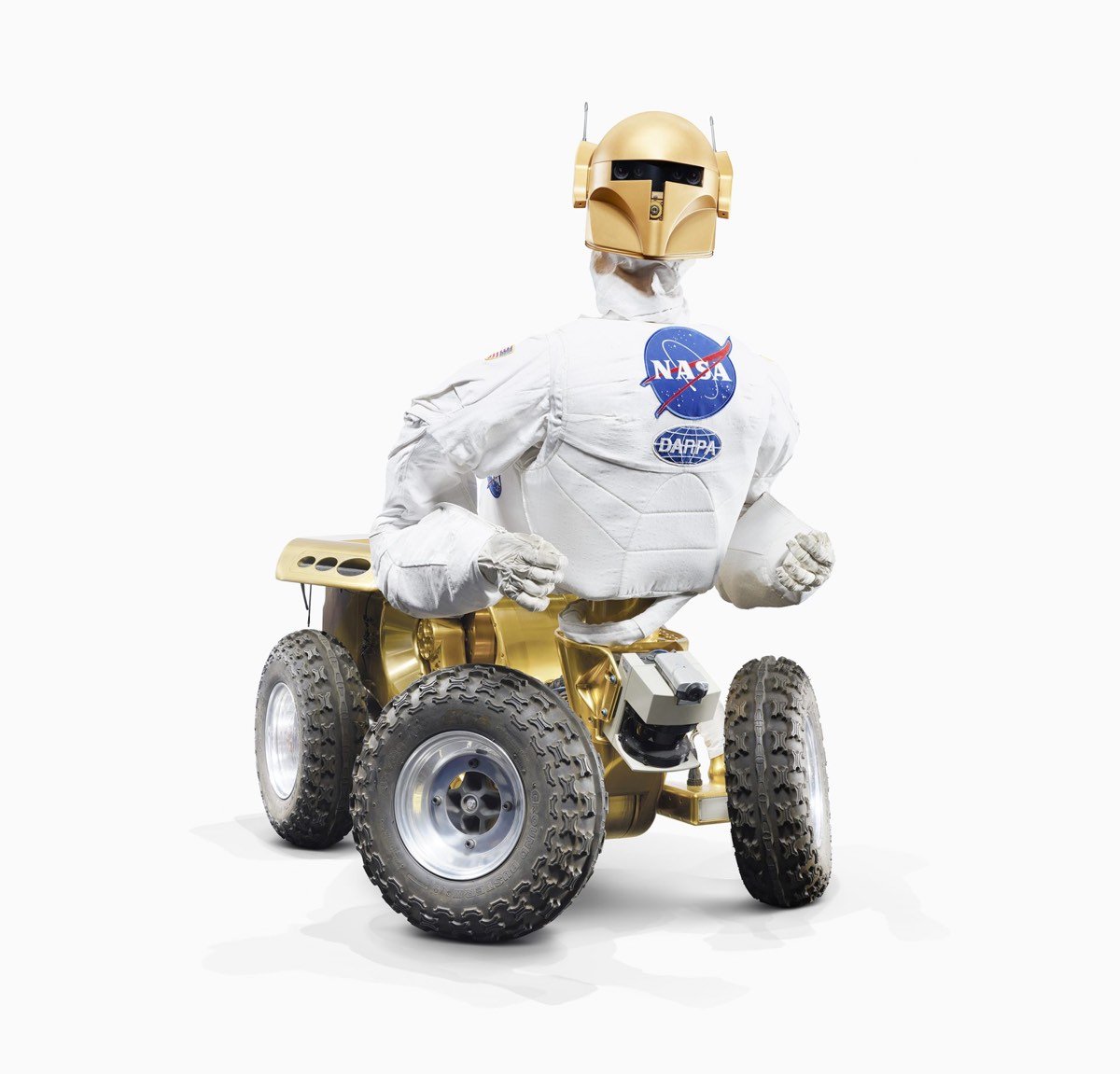
Wired took an exclusive tour of NASA’s rockets and robots with photographer Benedict Redgrove and the photographic results are — sorry! — out of this world. Best viewed on Redgrove’s site, who must be — still sorry!! — over the moon about how they turned out. But seriously, that DARPA centaur-on-wheels robot…how cool is that?
Also, you may remember Redgrove from his short film on how tennis balls are made. How that for service? (Stop. Just stop it. (You love it. (STOP!)))
I reported back in February that the BBC was doing another season of Planet Earth with David Attenborough (aka the voice of nature). Now there’s a trailer out (with a Sigur Ros soundtrack) and the show is set to debut in the UK on BBC One later this month. In US? Who knows… probably in 8 months with Ellen Degeneres narrating.
Update: Planet Earth II, a massive hit in Britain already, will debut on US television tomorrow (Feb 18). You can catch the first episode on AMC, BBC America, and Sundance TV. And unlike the original Planet Earth, they’ve thankfully kept the original Attenborough narration for the US version of Planet Earth II.
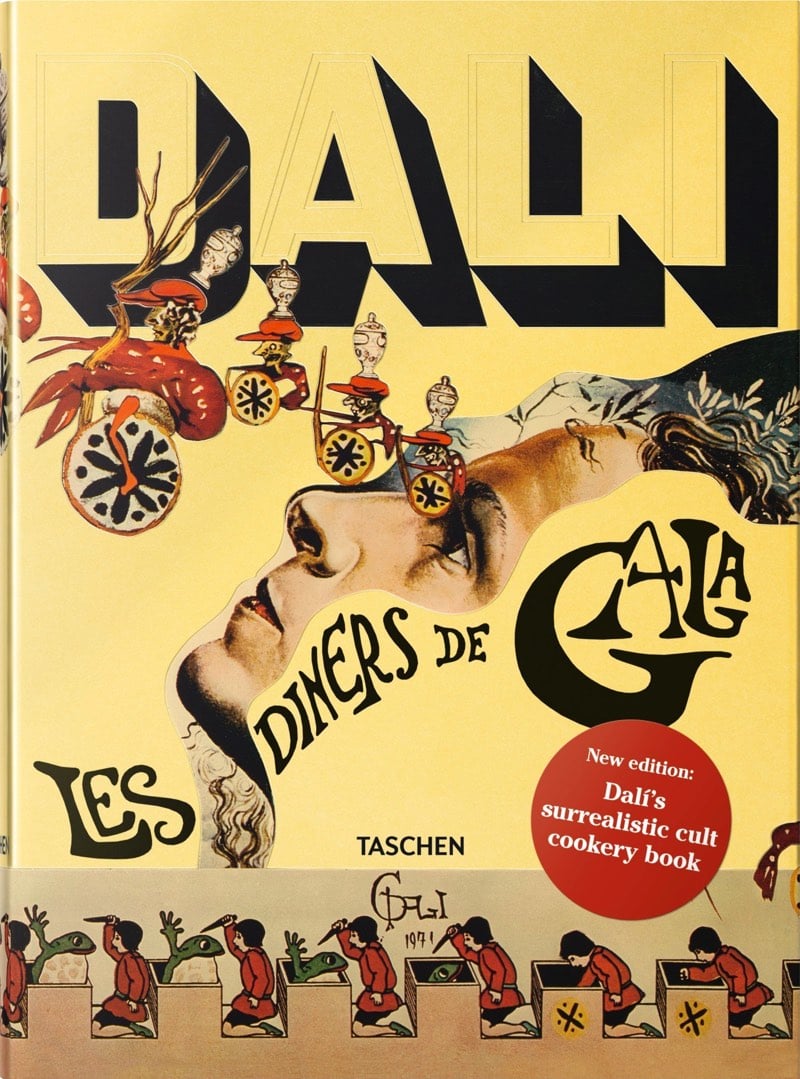
More than 40 years ago, food enthusiast and artist Salvador Dali published a cookbook called Les Diners de Gala. The book mixes Dali’s surrealist imagery and with dozens of recipes, including some that originated from the top restaurants in Paris at that time. The original book is quite rare and valuable now, but Taschen is reprinting it; it’s available for pre-order here.
This reprint features all 136 recipes over 12 chapters, specially illustrated by Dal’i, and organized by meal courses, including aphrodisiacs. The illustrations and recipes are accompanied by Dal’i’s extravagant musings on subjects such as dinner conversation: “The jaw is our best tool to grasp philosophical knowledge.”
See also The Artists’ and Writers’ Cookbook. (via colossal)
In the late 1980s, five black and Latino teenagers were wrongly convicted of raping a woman jogging in Central Park. The Central Park Five is a documentary film directed by Ken Burns, Sarah Burns, and David McMahon which tells the story from the perspective of the those five teens. I’ve seen the film, it’s excellent, and it’s currently available to watch for free on the PBS website.
The five men and this terrific miscarriage of justice are back in the news because of Donald Trump. In 1989, just a few weeks after the attack in Central Park, Trump took out a full-page ad in the Daily News denouncing the crime and the teens in which he calls for bringing back the death penalty.
Perhaps he thought it gave him gravitas, that spring, to weigh in on the character of the teen-agers in the park: “How can our great society tolerate the continued brutalization of its citizens by crazed misfits? Criminals must be told that their CIVIL LIBERTIES END WHEN AN ATTACK ON OUR SAFETY BEGINS!”
When NYC finally settled with the wrongly convicted men in 2014, Trump denounced the settlement, joining a police detective in calling it “the heist of the century.” And just before Trump’s crowing about sexual assault of women broke over the weekend, Trump reaffirmed that despite all evidence to the contrary, he believes that the five men are still guilty.
Frontline has posted their 2-hour documentary about Donald Trump, Hillary Clinton, and the 2016 presidential election to YouTube.
Hillary Clinton and Donald Trump are two of the most polarizing presidential candidates in modern history. Veteran FRONTLINE filmmaker Michael Kirk goes beyond the headlines to investigate what has shaped these two candidates, where they came from, how they lead and why they want one of the most difficult jobs imaginable.
This looks excellent…I might watch this instead of the debate tonight.1
When the story about Donald Trump bragging about sexually assaulting women broke, the NY Times took the unusual step of publishing exactly what the presidential candidate said.
In the three-minute recording, which was obtained by The Washington Post, Mr. Trump recounts to the television personality Billy Bush of “Access Hollywood” how he once pursued a married woman and “moved on her like a bitch, but I couldn’t get there,” expressing regret that they did not have sex. But he brags of a special status with women: Because he was “a star,” he says, he could “grab them by the pussy” whenever he wanted.
“You can do anything,” Mr. Trump says.
He also said he was compulsively drawn to kissing beautiful women “like a magnet” — “I don’t even wait” — and talked about plotting to seduce the married woman by taking her furniture shopping. Mr. Trump, who was 59 at the time he made the remarks, went on to disparage the woman, whom he did not name, saying, “I did try and fuck her. She was married,” and saying, “She’s now got the big phony tits and everything.”
It was unusual because of the Times’ policy of not printing profanity, even if the profane words themselves are newsworthy. In this case, the editors felt they had no choice but to print the actual words spoken by Trump.
In piece published earlier the same day the Trump story broke, Blake Eskin, who has been tracking the Times’ non-use of profanity at Fit to Print, highlights the racial and classist implications of the policy.
As I’ve noticed over the years while documenting how the Times writes around profanity, a lot of the expletives the Times avoids come up around race: in stories about hip-hop, professional sports, and police shootings. (I’m getting all the data into a spreadsheet so I can back up this assertion.)
The Times seems compelled both to tell readers that people curse in these contexts and to frown upon it.
It’s as if profanity is like a sack dance or a bat flip, a classless flourish that the archetypal Times reader, who is presumably white, can take vicarious pleasure in without having to perform it himself.
You cannot tell authentic stories about people who are systematically discriminated against in our society without using their actual words and the actual words spoken against them related to that discrimination. Full stop.
Update: Eskin wrote a follow-up about his data analysis of the NY Times profanity avoidance for Quartz.
The “other” category includes faux-folksy formulations such as “a word more pungent than ‘slop,’” and “a stronger version of the phrase ‘gol darn,’” as well as the straightforward, “He swore.” When I began the Fit to Print project, I could enjoy the cleverness of some of these contortions. But after reading through hundreds of examples over several years, expletive avoidance no longer strikes me as an interesting puzzle for a writer to solve. The policy just seems prissy, arbitrary, and delusional.
The more I think about the Times’ policy, the more absurd it becomes. There seems to be a relatively simple solution: if the profanity does work in the service of journalism — particularly if the entire article is about the profanity in question — print it. It is doesn’t, don’t. I mean, are Times editors afraid their reporters will start handing in articles with ledes like “Well, this fucking election is finally winding down, thank Christ.”?
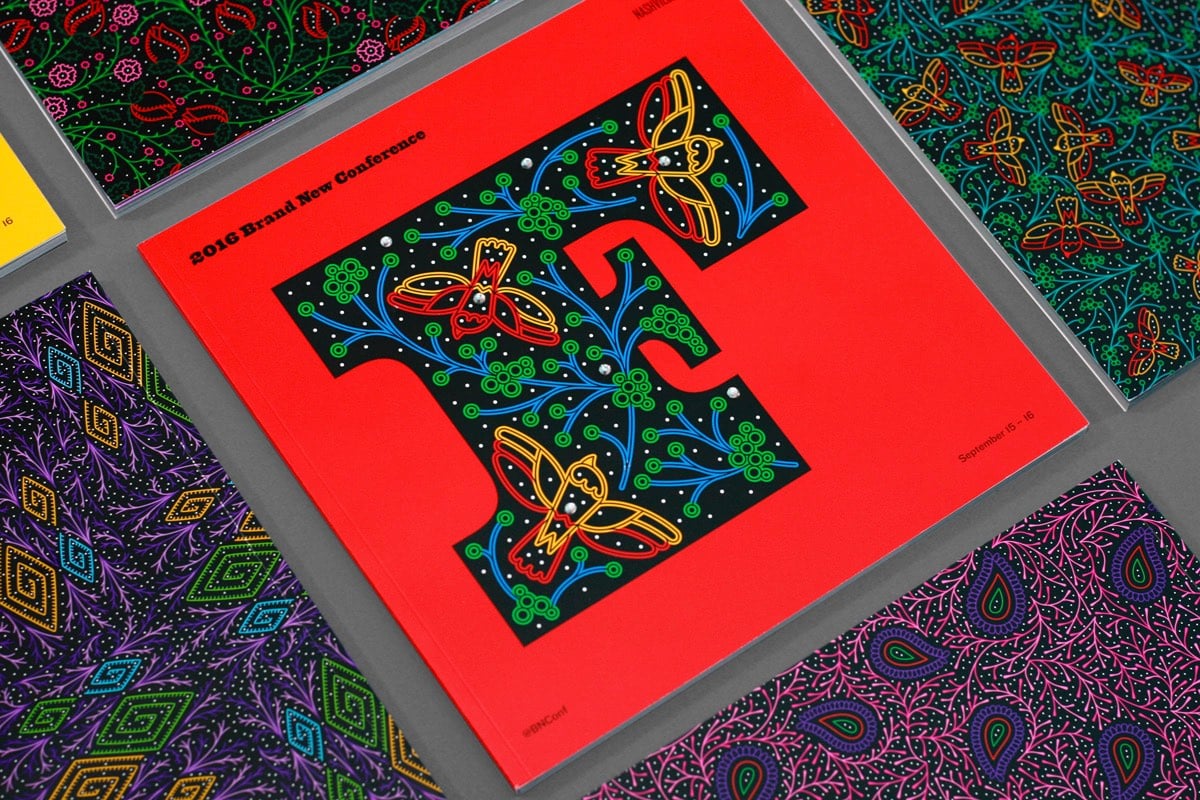

I love this design work from UnderConsideration for their recent conference in Nashville. It’s got a Western rhinestone + woodtype vibe but it also feels digital — the first thing that popped into my head when I saw that gorgeous F was a circuit board. Wonderful. (via @Colossal)
In the latest issue of The Economist, President Obama wrote a letter about the “four crucial areas of unfinished business in economic policy” that his successor will have to deal with.
Wherever I go these days, at home or abroad, people ask me the same question: what is happening in the American political system? How has a country that has benefited-perhaps more than any other-from immigration, trade and technological innovation suddenly developed a strain of anti-immigrant, anti-innovation protectionism? Why have some on the far left and even more on the far right embraced a crude populism that promises a return to a past that is not possible to restore — and that, for most Americans, never existed at all?
It’s true that a certain anxiety over the forces of globalisation, immigration, technology, even change itself, has taken hold in America. It’s not new, nor is it dissimilar to a discontent spreading throughout the world, often manifested in scepticism towards international institutions, trade agreements and immigration. It can be seen in Britain’s recent vote to leave the European Union and the rise of populist parties around the world.
Much of this discontent is driven by fears that are not fundamentally economic. The anti-immigrant, anti-Mexican, anti-Muslim and anti-refugee sentiment expressed by some Americans today echoes nativist lurches of the past — the Alien and Sedition Acts of 1798, the Know-Nothings of the mid-1800s, the anti-Asian sentiment in the late 19th and early 20th centuries, and any number of eras in which Americans were told they could restore past glory if they just got some group or idea that was threatening America under control. We overcame those fears and we will again.
Look at Obama, busting out the Know-Nothings like it ain’t nothing.
The trailer for the third season of Charlie Brooker’s excellent Black Mirror just dropped. If you haven’t seen the first two seasons, I’d recommend catching yourself up. And did I spy Mackenzie Davis and Kelly Macdonald in the trailer? I did, I did. The new season starts October 21 on Netflix.
EA Sports’ FIFA is one of the most popular sports video games in the world. But it’s also a challenging game to master, which can make for some blooper-filled afternoons with your mates. In these two videos, real players get out onto the pitch to imitate the mannerisms and slip-ups of their video game counterparts.
Hello! For today’s installment of I Totally Didn’t Know This, we’re going to talk about voice doubles. When you’re making a movie or a TV show and you’re in the editing phase, cutting a trailer, or doing promotional videos, sometimes you need some extra dialogue that you didn’t get during the main filming. So you get the actor to come in to do the new dialogue. But sometimes, if the actor is famous and super busy, they might not be available. So there are voice actors whose job it is to impersonate the real actor’s voice. Saaaaay whaaaaat?
It’s an example of ADR, Automated Dialogue Replacement. Amy Landecker, who plays Sarah Pfefferman on Transparent, has done this job for movies starring Julia Roberts. She sounds amazingly like Julia:
She even did most of Julia’s dialogue in this Duplicity trailer:
Jim Hanks has done voiceover work for his brother Tom in the past:
He does the voice for Woody in all the Toy Story video games…it’s not an exact match, but it’s pretty good. (via vulture)
Update: Nolan North voice doubles for Christopher Walken.
(via @Han_So)
In The Oxford History of Board Games published in 1999, scholar David Parlett wrote that there are four types of classical board game: race, chase, space, and displace. The book is out of print (but is available direct from the author as a PDF), so I found this description of Parlett’s categorization in a book by Stewart Woods called Eurogames.
In categorizing these public domain or “folk” games, Parlett (1999) draws on the work of H.J.R. Murray (1952) and R.C. Bell (1979) in describing four types of game, as identified by the game goals: race games, in which players traverse a track in an attempt to be the first to finish (e.g. Nyout, Pachisi); space games, in which players manipulate the position of pieces to achieve prescribed alignments, make connections, or traverse the board (e.g. Noughts and Crosses, Twixt, and Halma, respectively); chase games, in which asymmetrical starting positions and goals cast players in the role of pursuer and pursued (e.g. Hnefatafl, Fox & Geese); and games of displacement, where symmetrically equipped players attempt to capture and eliminate each other’s pieces (e.g. Chess, Draughts).
You’re probably unfamiliar with some of these games (as I was). For race games, Parcheesi is a modern version of pachisi…other examples would be Sorry, Candyland, or Snakes and Ladders. Noughts and crosses is tic-tac-toe; other space games include Go and Connect 4. A modern example of a chase game might be Clue. And as written above, chess and draughts (checkers) are classic displace games. (via @genmon)
In 1959, physicist Richard Feynman, who had already done work that would win him the Nobel Prize a few years later, gave a talk at Caltech that didn’t have much to do with his main areas of study. The talk was called There’s Plenty of Room at the Bottom and it was a scientist at the peak of his formidable powers asking a question of the scientific community: What about nanotechnology?
I would like to describe a field, in which little has been done, but in which an enormous amount can be done in principle. This field is not quite the same as the others in that it will not tell us much of fundamental physics (in the sense of, “What are the strange particles?”) but it is more like solid-state physics in the sense that it might tell us much of great interest about the strange phenomena that occur in complex situations. Furthermore, a point that is most important is that it would have an enormous number of technical applications.
Even though he made no formal contribution to the field, Feynman’s talk has been credited with jumpstarting interest in the study of nanotechnology. No recording exists of the original talk, but in 1984, Feynman gave a talk he called Tiny Machines, in which he recalled his original talk and spoke of the progress that had been made over the past 25 years. (via @ptak)
During the German occupation of France, teenager Adolfo Kaminsky forged thousands of documents for Jews about to be deported to concentration camps. He worked at a shop that dyed clothes and a Jewish resistance cell recruited him because he knew how to remove ink stains, a skill that served him well in altering documents.
If you’re doubting whether you’ve done enough with your life, don’t compare yourself to Mr. Kaminsky. By his 19th birthday, he had helped save the lives of thousands of people by making false documents to get them into hiding or out of the country. He went on to forge papers for people in practically every major conflict of the mid-20th century.
Now 91, Mr. Kaminsky is a small man with a long white beard and tweed jacket, who shuffles around his neighborhood with a cane. He lives in a modest apartment for people with low incomes, not far from his former laboratory.
When I followed him around with a film crew one day, neighbors kept asking me who he was. I told them he was a hero of World War II, though his story goes on long after that.
A remarkable story and a remarkable gentleman. The video above is based on a book Kaminsky’s daughter wrote about him.
From Candice Drouet, a quick supercut of some of notable athletic shoes in movies, including Marty’s self-lacing Nikes from Back to the Future II (which you can win in a raffle). Michael Keaton’s Batman wore Nikes?

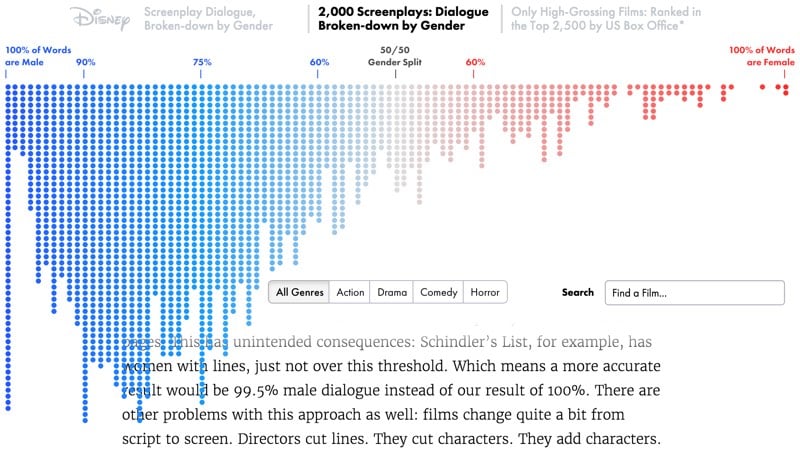

The Information is Beautiful Awards have announced the shortlist of nominees for the best infographics, data visualizations, and data journalism for 2016. Literally hours of exploration here. Some well-deserved shouts out to Polygraph (multiple projects, including their breakdown of film dialogue by gender and age), Nicholas Felton’s Photoviz, climate spirals, FiveThirtyEight’s 2016 election forecast map, and many other projects you might have seen here or elsewhere.
The images above are from Adventures in Mapping, Polygraph, and Shipmap.

From a new Kickstarter publication called The Creative Independent, Philip Glass was interviewed about the importance of artists owning their work and getting paid for it.
My personal position was that I had wonderful parents. Really wonderful people. But my mother was a school teacher. My father had a small record shop in Baltimore. They had no money to support my career. I began working early. You’re too young to know this, but when you get your first Social Security check, you get a list of every place you’ve worked since you began working. It’s fantastic! I discovered that I was working from the time I was 15 and putting money into the Social Security system from that age onward. I thought it was much later. No, I was actually paying money that early.
The point is that I spent most of my life supporting myself. And I own the music. I never gave it away. I am the publisher of everything I’ve written except for a handful of film scores that the big studios paid. I said, “Yeah, you can own it. You can have it, but you have to pay for it.” They did pay for it. They were not gifts.
A lot in this interview resonates, including this:
It’s never been easy for painters, or writers, or poets to make a living. One of the reasons is that we, I mean a big “We,” deny them an income for their work. As a society we do. Yet, these are the same people who supposedly we can’t live without. It’s curious, isn’t it?
And this bit about making work vs performing (italics mine):
What happens, is that the artists are in a position where they can no longer live on their work. They have to worry about that. They need to become performers. That’s another kind of work we do. I go out and play music. The big boom in performances is partly because of streaming, isn’t it? We know, for example, that there are big rock and roll bands that will give their records away free. You just have to buy the ticket to the concert. The cost of the record is rather small compared to the price of the ticket. It’s shifted around a little bit; they’re still paying, but they’re paying at the box office rather than at the record store. The money still will find its way.
Then you have to be the kind of person who goes out and plays, and some people don’t.
I’ve been thinking a lot about the economics of writing online. Making a comfortable living only by writing is tough and very few independents are able to do it. More successful are those who are able to get away from writing online by speaking at conferences, writing books, starting podcasts, selling merchandise,1 post sponsored tweets and Instagram photos, building apps, consulting for big companies, etc. This stuff is the equivalent of the band that tours, sells merch, composes music for TV commercials, etc. But as Glass said, what about those who just want to write? (And I count myself among that number.) How can we support those people? Anyway, more on this very soon (I hope).
Photo is of a Chuck Close painting of Philip Glass taken by me at The Whitney.
“Open source soccer”. Fascinating piece by @dens on how to build a pro soccer club from scratch in under a year.
British swear words ranked by offensiveness. Surprised that “wanker” is rating so strongly; it’s pretty tame in US.
From a New Zealand sketch comedy show called Funny Girls, a send-up of a typical manly man “built tough” truck commercial. I barely watch any actual TV anymore, but those truck commercials have always been the worst. (thx, sarah)
Newer posts
Older posts





Socials & More