



Life Itself, the documentary about Roger Ebert, is free to watch online this week

Advertise here with Carbon Ads
This site is made possible by member support. 💞
Big thanks to Arcustech for hosting the site and offering amazing tech support.
When you buy through links on kottke.org, I may earn an affiliate commission. Thanks for supporting the site!
kottke.org. home of fine hypertext products since 1998.
Beloved by 86.47% of the web.
Entries for October 2016
Solve trolley problem scenarios with MIT’s Moral Machine
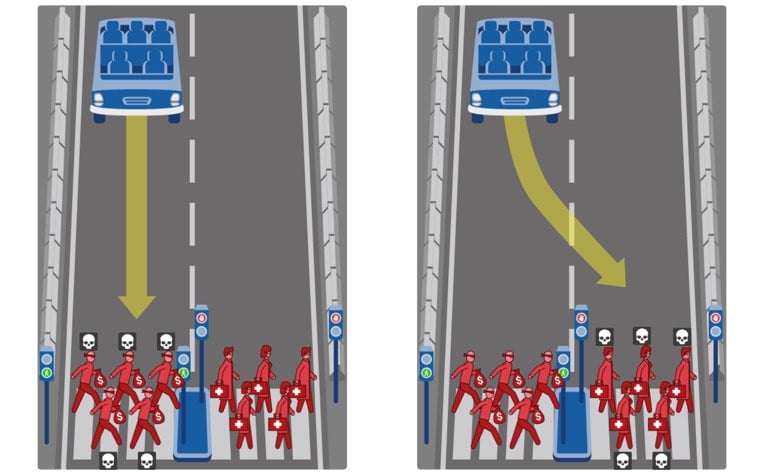
A group at MIT built an app called the Moral Machine, “a platform for gathering a human perspective on moral decisions made by machine intelligence, such as self-driving cars”. They want to see how humans solve trolley problem scenarios.
We show you moral dilemmas, where a driverless car must choose the lesser of two evils, such as killing two passengers or five pedestrians. As an outside observer, you judge which outcome you think is more acceptable. You can then see how your responses compare with those of other people.
That was a really uncomfortable exercise…at the end, you’re given a “Most Killed Character” result. Pretty early on, my strategy became mostly to kill the people in the car because they should absorb the risk of the situation. The trolley problem may end up not being such a big deal, but I hope that the makers of these machines take care1 in building them with thoughtfulness.
Uber’s self-driving cars terrify me. The company has shown little thoughtfulness and regard for actual humans in its short history, so why would their self-driving car be any different? Their solution to the trolley problem would likely involve a flash bidding war between personal AIs as to who lives. Sorry, the rich white passenger outbid the four poor kids crossing the street! ↩
The opposite of a muse

Isabelle Mège does not call herself an artist, but she has nonetheless been working on an interesting project for the last 30 years. Mège contacts photographers she likes and asks them to incorporate her into their work, keeping a copy of each photograph afterwards. She has over 300 photographs and has curated 135 of them into what she calls “the collection”.
After each shoot, Mège would follow up and ask the artist for a print, signed and sometimes numbered by its edition. The print would go into her archive, along with any artifacts related to its making; Elkoury’s letter, for instance, is accompanied in the archive by Mège’s notes about their encounter (he was late to their first meeting, and arrived with his shoelaces untied). Also in her archive are the heels that Witkin attached to her feet during the 1990 shoot, and a news item about Japanese customs having seized incoming copies of the magazine ARTnews to prohibit their circulation; the photograph, in which Mège’s pubic hair is visible, was considered obscene. Her diarizing and collection of correspondence, clippings, image reproductions, and relevant items reveal that the planning around certain images often lasted years. Several times, having worked with an artist to make an image, she was unhappy with the results and excluded it from her collection. When approached by artists who wanted to work with her but for whose work she had no feeling, she refused.
Mège felt strongly that no money should be exchanged in these interactions. (“As soon as there’s a question of payment, it’s dead, you fall asleep,” she told me.) She also asked each artist to sign a contract printed on a three-inch slip of paper, stating that she would have the right to exhibit or publish the image for noncommercial reasons only.
Mège’s project fits neatly into contemporary selfie culture. Her collection reminds me of other creative people who have incorporated themselves into their media of behalf of someone or something else. Call them “selfie auteurs”. Adam Lisagor has starred in many of the videos his company makes for tech clients. Casey Neistat films himself going on adventures for clients like J. Crew and Nike. Noah Kalina was commissioned by VH1 to take photos of himself posing with celebrities in his Everyday stance. I’m sure there are many more examples1 but few have done it as cleanly and purely as Mège.

Maybe kottke.org should be in this list as well. This is my website — my name’s right at the top for crying out loud — and I share my opinion about things here all the time, but in a significant way, the site isn’t actually about me. It’s mainly about other people’s work and ideas. Sure, if you read long enough you learn about who I am as a person in the process, but it’s not the point.↩
Zoomable tree of all life on Earth
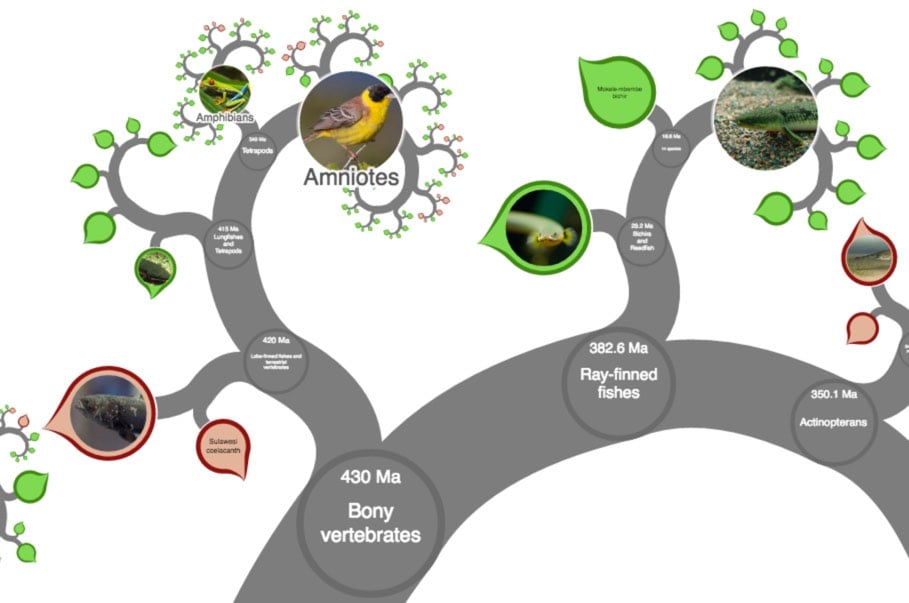
OneZoom is an interactive zoomable map of “the evolutionary relationships between the species on our planet”, aka tree of life. Browsing around is fun, but you’ll want to use the search function to find specific groups and animals, like mammals, humans, and mushrooms. The scale of this is amazing…there are dozens of levels of zoom. (via @pomeranian99)
Designing Your Life
Designing Your Life is one of the most popular courses at Stanford. Taught by Bill Burnett and Dave Evans, the class teaches how you can use design thinking and techniques to shape your life and career. Burnett and Evans just came out with a book based on the class, Designing Your Life: How to Build a Well-Lived, Joyful Life.
In this book, Bill Burnett and Dave Evans show us how design thinking can help us create a life that is both meaningful and fulfilling, regardless of who or where we are, what we do or have done for a living, or how young or old we are. The same design thinking responsible for amazing technology, products, and spaces can be used to design and build your career and your life, a life of fulfillment and joy, constantly creative and productive, one that always holds the possibility of surprise.
The course itself isn’t available online, but there are a couple of lectures from the class available on YouTube: Reframe Your Passion and Prototypes for Personal Success.
Optimizing the dining experience for couples
This is entertaining: Megan McArdle considers four possible economic approaches to how couples should order food in restaurants.
3. Individual property rights, with option trading. Now we’re moving toward a more centrally planned economy. The menu is individually consulted, and then the two parties state their preferences. If these preferences are strong, then matters proceed much as in the above strategy. However, if indecision is expressed, the trading is opened: “If you get the clam chowder, I’ll get the mushroom crostini, and we can split.” Option trading is usually, but not always, confined to the appetizer course. Any offer can be refused, and a substitute offered — “What if I got the clam chowder, and you got the ham timbales?” — or both parties may reluctantly conclude that no trade is possible, and revert to their original choices.
Well done, Team Restaurant! You are now beginning to realize the magnificent benefits of trade. Coordination and cooperation have permitted you to agree on choices that jointly improve utility.
However, I must tell you that you are still probably not at the highest valued use of your food dollar. You are almost certainly investing most of your effort in appetizers or shared desserts, which are the minority of your spending, time and consumption. If you want not merely to improve your utility, but to maximize it, then you are going to have to invest more effort in coordination.
Her conclusion is spot on; it’s the best way to dine out.
Portraits of culinary students in a program for low-income and homeless people


Episcopal Community Services runs a program called CHEFS that provides food industry training for homeless and low-income people in San Francisco. Photographer Wesley Verhoeve visited the program to take portraits of the students and staff. The photos accompany a San Francisco Magazine article that has more information on the program.
The seven-month program culminates in a 240-hour internship at participating eateries like Nopa and Kokkari; Hanks completed her internship at Lotta’s Bakery in Nob Hill, where she was struck by the universal power of food. “We cook when somebody dies, we cook when a child is born,” she says. “I’ve realized cooking is related to everything: to family, to religion, to happiness, to sadness.”
How German physicists reacted to the Hiroshima bomb
During World War II, a group of scientists led by Werner Heisenberg worked on designing a nuclear weapon for Nazi Germany. They were, thankfully, unsuccessful. After the war, the Allies detained ten German scientists in England for six months. Hoping to learn about the German bomb program, they secretly taped the scientists’ conversations. In August 1945, the scientists were told about the US dropping a nuclear bomb on Japan. Here’s a transcript of the resulting reaction and conversation.
Shortly before dinner on the 6th August I informed Professor HAHN that an announcement had been made by the B.B.C. that an atomic bomb had been dropped. HAHN was completely shattered by the news and said that he felt personally responsible for the deaths of hundreds of thousands of people, as it was his original discovery which had made the bomb possible. He told me that he had originally contemplated suicide when he realized the terrible potentialities of his discovery and he felt that now these had been realized and he was to blame. With the help of considerable alcoholic stimulant he was calmed down and we went down to dinner where he announced the news to the assembled guests.
“Professor HAHN” is Otto Hahn, who co-discovered nuclear fission in Germany right before the war and won the 1944 Nobel Prize in Chemistry for it. The rest of the world may have gotten there eventually, but think of how different the war (and resulting Cold War period) would have been if Germany had sequestered their scientific progress a couple years earlier or if Hahn and Lise Meitner had made the discovery a year or two later.
WEIZSÄCKER: I think it’s dreadful of the Americans to have done it. I think it is madness on their part.
HEISENBERG: One can’t say that. One could equally well say “That’s the quickest way of ending the war.”
HAHN: That’s what consoles me.
HAHN: I was consoled when, I believe it was WEIZSÄCKER said that there was now this uranium - I found that in my institute too, this absorbing body which made the thing impossible consoled me because when they said at one time one could make bombs, I was shattered.
WEIZSÄCKER: I would say that, at the rate we were going, we would not have succeeded during this war.
HAHN: Yes.
WEIZSÄCKER: It is very cold comfort to think that one is personally in a position to do what other people would be able to do one day.
I particularly like Heisenberg’s distinction between between theoretical and applied science:
There is a great difference between discoveries and inventions. With discoveries one can always be skeptical and many surprises can take place. In the case of inventions, surprises can really only occur for people who have not had anything to do with it. It’s a bit odd after we have been working on it for five years.
If this stuff interests you at all, I’d highly recommend reading Richard Rhodes’ The Making of the Atomic Bomb. (via real future)
Update: The complete transcripts of the secret recordings were collected into a book called Hitler’s Uranium Club. The story of the Allied sabotage of a key element in producing a German bomb is told in Neal Bascomb’s The Winter Fortress. Alex Wellerstein writes that the Nazis didn’t know very much about the Manhattan Project. (via @CarnegieDeputy, @hellbox, @AtomicHeritage)
A timeline of Barack Obama’s presidency
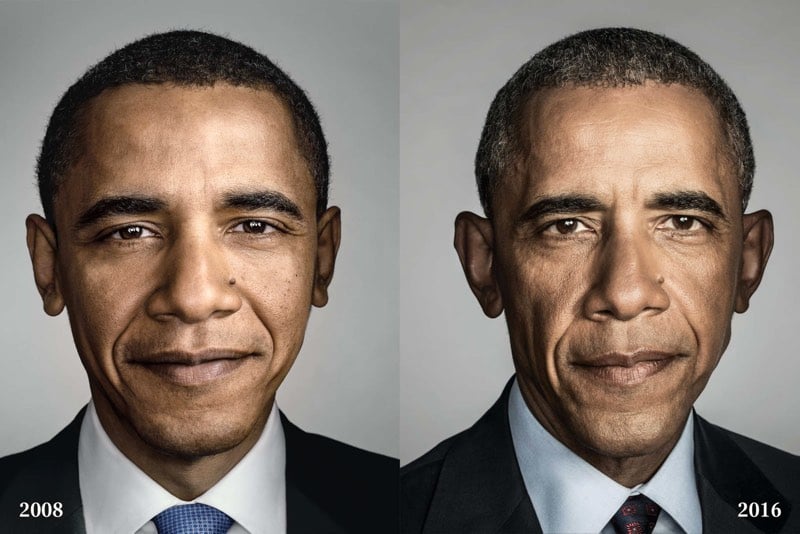
In a big feature, New York Magazine chronologically recaps Barack Obama’s presidency with help from dozens of participants, including the President himself.
More than “hope,” Obama’s candidacy promised “one America.” It is the deep irony of his presidency, and for Obama himself probably the tragedy, that the past eight years saw the country fiercely divided against itself. The president still managed to get a ridiculous amount done, advancing an unusually progressive agenda. But however Americans end up remembering the Obama years decades from now, one thing we can say for sure is that it did not feel, at the time, like an unmitigated liberal triumph. It felt like a cold civil war.
Or a never-breaking political fever. There was the tea-party rage and Occupy Wall Street. Every other week, it seemed, a new shooting. Each movement was met by a countermovement, and yet, somehow, both the left and the right were invigorated, watched over by a president marked so deeply by temperamental centrism even his supporters called him Spock. Whether you noticed or not, our culture was shaken to its core. There was a whole new civil-rights era, both for those whose skin color and for those whose love was long met by prejudice. The first iPhone was released during the 2008 campaign. We got our news from Facebook, debated consent, and took down Bill Cosby. Elon Musk built a spaceship to Mars.
The dude got a lot done, despite a Congress that fought him tooth and nail for all eight years. Writing that just reminded me: Obama’s March nomination of Merrick Garland to the Supreme Court is still pending in the Senate. They’re holding it for a possible Trump-nominated judge.
Film Meets Art
Vugar Efendi has made a pair of videos showing scenes from films that have been inspired by famous paintings. The second video is especially good, showing references in There Will Be Blood, Lost In Translation, and a Jacques-Louis David reference from About Schmidt.
Socials & More