


This site is made possible by member support. 💞
Big thanks to Arcustech for hosting the site and offering amazing tech support.
When you buy through links on kottke.org, I may earn an affiliate commission. Thanks for supporting the site!
kottke.org. home of fine hypertext products since 1998.
Beloved by 86.47% of the web.
Entries for August 2016
Brendan Dassey’s conviction has been overturned by a federal judge
Brendan Dassey, who was one of two men convicted for the murder of Theresa Halbach, may be released from prison soon. A federal judge issued a ruling overturning his conviction today:
Concluding the 91-page decision, Duffin found that investigators made false promises to Dassey during multiple interrogations.
“These repeated false promises, when considered in conjunction with all relevant factors, most especially Dassey’s age, intellectual deficits, and the absence of a supportive adult, rendered Dassey’s confession involuntary under the Fifth and Fourteenth Amendments. The Wisconsin Court of Appeals’ decision to the contrary was an unreasonable application of clearly established federal law,” Duffin wrote.
Prosecutors have 90 days to decide to retry Dassey or release him. It was fairly clear to me, having watched Making a Murderer, that Dassey was innocent (or at the very least, was not given a fair trial).
I Am - Somebody
From 1971, here’s Jesse Jackson on Sesame Street doing a call-and-response with the children of the poem I Am - Somebody.
I Am
Somebody
I Am
Somebody
I May Be Poor
But I Am
Somebody
I May Be Young
But I Am
Somebody
I May Be On Welfare
But I Am
Somebody
It’s difficult to imagine something like this airing on the show now. Sesame Street was originally designed to serve the needs of children in low-income homes, but now the newest episodes of the show air first on HBO…a trickle-down educational experience. (via @kathrynyu)
No Man’s Sky soundtrack
I don’t have a PS4 or Windows machine, so I can’t play No Man’s Sky (which seems to deliver on the long-ago promise of Will Wright’s Spore), but through the magic1 of Spotify, I was listening to the soundtrack this morning.
Other video game soundtracks I enjoy include Monument Valley and FTL.
Update: See also Robin Sloan on the appeal of No Man’s Sky and how it is like reading.
I still miss Rdio. :(↩
Limits are fun? Limits are fun!
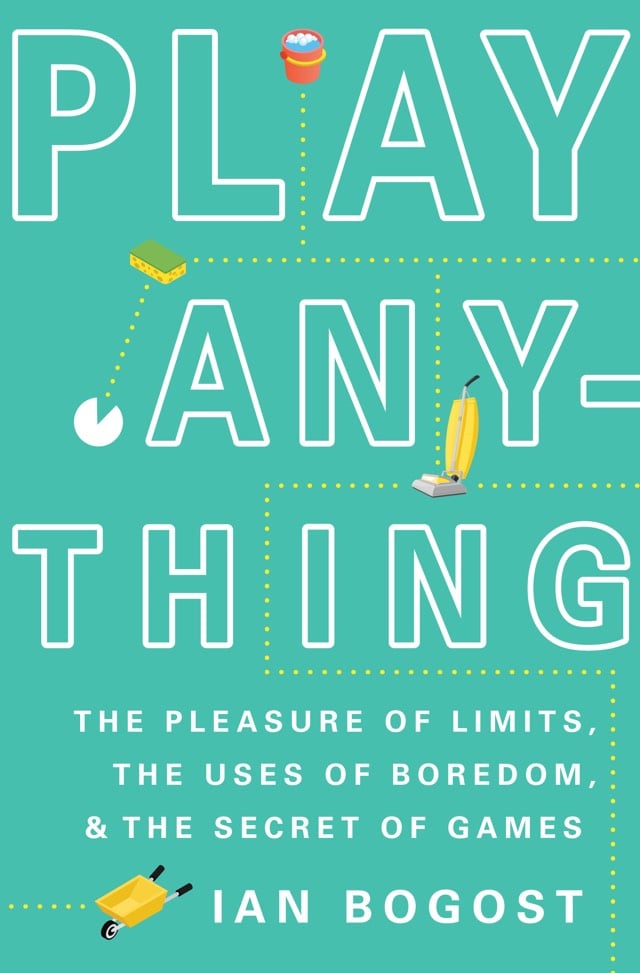
Play Anything is a forthcoming book by game designer and philosopher Ian Bogost. The subtitle — The Pleasure of Limits, the Uses of Boredom, and the Secret of Games — provides a clue as to what it’s about. Here’s more from the book’s description:
Play is what happens when we accept these limitations, narrow our focus, and, consequently, have fun. Which is also how to live a good life. Manipulating a soccer ball into a goal is no different than treating ordinary circumstances — like grocery shopping, lawn mowing, and making PowerPoints — as sources for meaning and joy. We can “play anything” by filling our days with attention and discipline, devotion and love for the world as it really is, beyond our desires and fears.
Reading this little blurb, I immediately thought of two things:
1. One thing you hear from pediatricians and early childhood educators is: set limits. Children thrive on boundaries. There’s a certain sort of person for whom this appeals to their authoritarian nature, which is not the intended message. Then there are those who can’t abide by the thought of limiting their children in any way. But perhaps, per Bogost, the boundaries parents set for their children can be thought of as a series of games designed to keep their lives interesting and meaningful.1
2. This recent post about turning anxiety into excitement. Shifting from finding life’s limitations annoying to thinking of them as playable moments seems similar. Problems become opportunities, etc.
3. Ok, three things. I once wrote a post about bagging groceries and mowing the lawn as games.
Two chores I find extremely satisfying are bagging groceries and (especially) mowing the lawn. Getting all those different types of products — with their various shapes, sizes, weights, levels of fragility, temperatures — quickly into the least possible number of bags…quite pleasurable. Reminds me a little of Tetris. And mowing the lawn…making all the grass the same height, surrounding the remaining uncut lawn with concentric rectangles of freshly mowed grass.
What I’m saying is, I’m looking forward to reading this book. See also Steven Johnson’s forthcoming book, Wonderland: How Play Made the Modern World.
I don’t know about other parents, but 75% of my parental energy is taken up by thinking about what limits are appropriate for my kids. (The other 25% is meal-planning.) What do they need right now? What do they want? What can I give them? How do I balance all of those concerns? What makes it particularly difficult for me sometimes is that my instincts and my intellect are not always in agreement with what is appropriate. What is easiest for me is not always best for them. This shit keeps me up at night. :| ↩
Gone Girl: lessons from the screenplay
Using Gillian Flynn’s screenplay for Gone Girl as an example, Michael Tucker walks us through some important aspects of screenwriting techniques. This makes me want to read a book on screenwriting and watch Gone Girl again. (via one perfect shot)
Update: As expected, I got recommendations from readers for screenwriting books: Lew Hunter’s Screenwriting 434 and Invisible Ink. There is also Story by Robert McKee, who you may remember as the screenwriting guru consulted by Donald Kaufman in Adaptation. (via @byBrettJohnson & @poritsky)
Intermediaries and the financial crisis of 2008
In the most recent video from Marginal Revolution University, Tyler Cowen explains how the role of financial intermediaries contributed to the financial crisis of 2008. He highlights homeowners and banks taking on too much leverage, poorly planned incentive systems, securitization of mortgages, and banks making loans that are over-reliant on investor confidence.
By 2008, the economy was in a very fragile state, with both homeowners and banks taking on greater leverage, many ending up “underwater.” Why did managers at financial institutions take on greater and greater risk? We’ll discuss a couple of key reasons, including the role of excess confidence and incentives.
In addition to homeowners’ leverage and bank leverage, a third factor played a major role in tipping the scale toward crisis: securitization. Mortgage securities during this time were very hard to value, riskier than advertised, and filled to the brim with high risk loans. Cowen discusses several reasons this happened, including downright fraud, failure of credit rating agencies, and overconfidence in the American housing market.
Finally, a fourth factor joins homeowners’ leverage, bank leverage, and securitization to inch the economy closer to the edge: the shadow banking system. On the whole, the shadow banking system is made up of investment banks and various other complex financial intermediaries, highly dependent on short term loans.
When housing prices started to fall in 2007, it was the final nudge that pushed the economy over the cliff. There was a run on the shadow banking system. Financial intermediaries came crashing down. We faced a credit crunch, and many businesses stopped growing. Layoffs ensued, increasing unemployment.
How populous is NYC? Big enough to fit 8 states into it.

The population of NYC is equal to the combined populations of Vermont, Alaska, New Mexico, North Dakota, South Dakota, Wyoming, Montana, and West Virginia. Here’s what that looks like on a map.
Put another way: 16 US Senators represent as many people in those states as a fraction of one of New York States’ Senators represent the population of NYC. A Senator from Wyoming represents 290,000 people while one from New York represents 9.8 million people…and in California, there are 19 million people per Senator. That gives a Wyoming resident 65 times the voting power of a California resident.
Instagram Stories on the web
Alec Garcia has built an extension for Chrome that lets you view the Instagram Stories of the people you follow. You can even save/download them.
BTW, I am really liking Instagram Stories. Yeah, sure, Snapchat rip-off blah blah blah,1 but Insta nailed the implementation and my network is already all there, so yeah. I’ve been posting occasional Stories, which you can see if you follow me on Instagram.
And yes, like Craig Mod, I use Instagram’s website many times a day. What percentage of their users even knows they can check Instagram on the web? 50%? 30%? 10%?
The “Instagram ripped off Snapchat” narrative conveniently ignores that Snapchat has been praised in recent months for quickly backfilling functionality of services like Instagram. So, spare me your tiny violins.↩
Trump quotes in Zapp Brannigan’s voice
ZAPP presents…Famous Trump Quotations! pic.twitter.com/cFq1rQ4veY
— Billy West (@TheBillyWest) August 11, 2016
ZAPP presents … Famous Trump Quotes! #WednesdayWisdom #ManWithAPlan pic.twitter.com/dpKJOVkTmA
— Billy West (@TheBillyWest) August 10, 2016
Billy West, who does the voice of Futurama’s Zapp Brannigan, is taking quotes from Donald Trump and speaking them in Brannigan’s voice. This is silly and dumb, but I can’t help loving these.
Update: The addition of Kif’s reactions really takes these to the next level.
Zapp (& Kif) present…Famous Quotes from Donald J Trump#MakeAmericaBrannigan@MAURICELAMARCHE pic.twitter.com/g7zEzy3sGZ
— Billy West (@TheBillyWest) August 15, 2016
Kif sighs for all of America. And this one, I mean…if they wrote this dialogue for the show it would be rejected because not even Zapp is that outlandishly dim and egotistical.
Zapp presents…Famous Quotations from Donald J Trump! pic.twitter.com/eorklqXsMk
— Billy West (@TheBillyWest) August 12, 2016
The coming CRISPR revolution
Perfect eyesight. Curing cancer. Designer babies. Super-soldiers. Because of CRISPR, genetic engineering might make tinkering with life as easy as playing with Lego.
Imagine you were alive back in the 1980’s, and were told that computers would soon take over everything — from shopping, to dating, and the stock market, that billions of people would be connected via a kind of web, that you would own a handheld device orders of magnitudes more powerful than supercomputers.
It would seem absurd, but then all of it happened. Science fiction became our reality and we don’t even think about it. We’re at a similar point today with genetic engineering. So let’s talk about it.
Relatedly, I’m finishing up Neal Stephenson’s Seveneves right now and while it starts out as space science fiction, much of the book is concerned with the sort of genetic engineering issues discussed in the video.
Ocean’s Ocho
They’re rebooting Ocean’s Eleven with an all-female ensemble including Helena Bonham Carter, Mindy Kaling, Rihanna, Sandra Bullock, and Cate Blanchett. As a lover of Soderbergh’s Ocean’s Eleven, I am totally on board with this.
Ocean’s Eleven director Steven Soderbergh, who is based in New York and is expected to be deeply involved with the spinoff — perhaps taking on a below-the-line job like he has done on other studio films like Magic Mike XXL — is producing solo (Oceans Eleven producer Jerry Weintraub passed away last year). Olivia Milch and Ross wrote the screenplay.
And while we’re at it, let’s reboot everything with female leads. We’ve already got Ghostbusters and Ocean’s Ocho. Someone I was talking with at a party last week suggested an all-women A-Team reboot, which would be fantastic.1 What else? Reservoir Dogs? Indiana Jones? Back to the Future? Any movie Tom Hanks/Cruise/Hardy has ever made?
The same person also suggested a Charlie’s Angels reboot with male leads. Charlie is a woman and they’re still referred to as her Angels. I am also on board with this.↩
Ten lessons learned by rereading Jane Jacobs
Martin Pedersen recently reread Jane Jacobs’ The Death and Life of Great American Cities and came away with ten lessons.
3. Jacobs was remarkably prescient on gentrification.
She didn’t invent the term or even use it. But she observed (and I don’t know how, since most cities were in decline at the time) that lively diverse neighborhoods are always at risk for becoming victims of their own success, because newcomers invariably alter the characteristics that made these neighborhoods appealing to them in the first place. Today this seems obvious and self-evident, but that’s largely because of Jane Jacobs.
Yeah, it’s time for a reread…it’s been more than 12 years for me. (via @michaelbierut)
The biggest war in animal history
According to theoretical biologist Suzanne Sadedin, the biggest war in animal history (humans included) is happening right now.
Once upon a time there was a tiny brown ant who lived by a swamp at the end of the Paraná River in Argentina. Her name, Linepithema humile, literally means “humble” or “weak”. Some time during the late 1800s, an adventurous L. humile crept away from the swamp where giant river otter played and capybaras cavorted.
She stowed away on a boat that sailed to New Orleans. And she went to war.
Update: And bang, here’s the supporting science in the form of a 2010 study.
Here, we perform inter-continental behavioral analyses among supercolonies in North America, Europe, Asia, Hawaii, New Zealand and Australia and show that these far-flung supercolonies also recognize and accept each other as if members of a single, globally distributed supercolony. Furthermore, populations also possess similar genetic and chemical profiles. However, these ants do show aggression toward ants from South Africa and the smaller secondary colonies that occur in Hawaii and California. Thus, the largest and most dominant introduced populations are likely descended from the same ancestral colony and, despite having been established more than 100 years ago, have diverged very little. This apparent evolutionary stasis is surprising because, in other species, some of the most rapid rates of evolutionary change have occurred in introduced populations. Given the spatial extent of the Argentine ant society we report here, there can be little doubt that this intercontinental supercolony represents the most populous known animal society.
The “25 years and beyond” section of the Facebook product roadmap contains a single word, unlined twice in red ink: ants. Can ants be trained to look at ads though?
Update: Radiolab also did a segment on these ants. (via @minwoolee)
Update: Wow, the Argentine ant is having a bit of a moment…I didn’t expect this to be my most updated post of the week. Annalee Newitz just dropped a long article about their world domination: Meet the worst ants in the world.
UC Berkeley environmental scientist Neil Tsutsui helmed an effort to sequence the genome of L. humile, in part to find out where the invading group had originated. He and an international team of colleagues published the results of their analysis in 2011. They compared the genomes of Argentine ants in California to those of native populations, and Tsutsui told Ars that they were initially surprised by the results. “I was expecting Buenos Aires to be the source, but it was actually a city upstream called Rosario,” he said. “It turns out that in the late 19th century, when the ants were moving around, Rosario was actually a bigger shipping port than Buenos Aires. So it made more sense as a source for introduced populations.”
Genetic evidence supports the idea that the ants made their way from Port Rosario all across the globe. Subsequent sightings of the ants in the United States show that they also hitched rides on trains from New Orleans, ultimately arriving in California in 1904. Trucks probably transported them throughout the state. But how could such fragile creatures survive these journeys in giant machines and go on to found insectile empires? With their countless queens and nomadic lifestyle, they turned out to be the ultimate adapters.
Che Guevara and Lionel Messi are also from Rosario and have taken over the world in their own way. (via @tcarmody)
Graphic Means
Graphic Means is a documentary film by Briar Levit about the history of graphic design production from the 1950s to the 1990s.
It’s been roughly 30 years since the desktop computer revolutionized the way the graphic design industry works. For decades before that, it was the hands of industrious workers, and various ingenious machines and tools that brought type and image together on meticulously prepared paste-up boards, before they were sent to the printer.
Features interviews with Steven Heller, Ellen Lupton, Tobias Frere-Jones, and more. (via @cleverevans)
Kanye West’s favorite noises
A compilation of all the unusual noises — henh! hwuah! masanoonaa! eescrong! — Kanye West makes in his songs.
How it happened: the discovery of bacteria in the 1670s
Antonie van Leeuwenhoek ran a draper’s shop and was a local politician in Delft, Netherlands in the mid-17th century. During this time, he developed an interest in making lenses and hit upon a technique for making lenses with extremely high magnifications for the time, 270x and perhaps even 500x normal magnification. These lenses allowed him to discover that there were tiny organisms living in his mouth.
Ed Yong, Joss Fong, and Julia Belluz discuss van Leeuwenhoek’s achievement and microorganisms in general in the video above and in an interview.
It is undeniable that antibiotics have been a tremendous health good, maybe one of the greatest health goods of all time. They have brought so many infectious diseases to heel and saved so many lives.
But it’s also clear that they have negative effects on our microbiome. So they are indiscriminate weapons. They kill the microbes that we depend upon and that are good for us as well as the ones that are causing disease and causing us harm. They’re like nukes, rather than precision weapons.
So we’re in a difficult situation now, where on the one hand we’re running out of antibiotics, and the rise of antibiotic-resistant bacteria is a huge public health threat. But at the same time we’re aware of the need to preserve the microbiome.
Yong just came out with a book on microbes called I Contain Multitudes. (Perhaps Whitman was speaking literally?)
The Origin of (almost) Everything
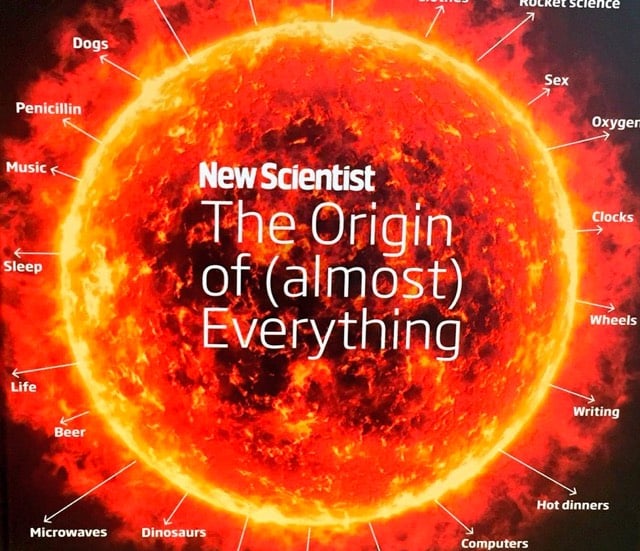
Oh, this new book from Jennifer Daniel and New Scientist looks great: The Origin of (almost) Everything.
Together they take us on a whistle-stop tour from the start of our universe (through the history of stars, galaxies, meteorites, the Moon and dark energy) to our planet (through oceans and weather to oil) and life (through dinosaurs to emotions and sex) to civilization (from cities to alcohol and cooking), knowledge (from alphabets to alchemy) ending up with technology (computers to rocket science). Witty essays explore the concepts alongside enlightening infographics that zoom from how many people have ever lived to showing you how a left-wing brain differs from a right-wing one.
And Stephen Hawking wrote the foreword. You fancy, Jennifer Daniel!
The infamous Collatz Conjecture
For a recent episode of Numberphile, David Eisenbud explains the Collatz Conjecture, a math problem that is very easy to understand but has an entire book devoted to it and led famous mathematician Paul Erdős to say “this is a problem for which mathematics is perhaps not ready”.
The problem is easily stated: start with any positive integer and if it is even, divide it by 2 and if odd multiply it by 3 and add 1. Repeat the process indefinitely. Where do the numbers end up? Infinity? 1? Loneliness? Somewhere in-between? My favorite moment of the video:
16. Whoa, a very even number.
I love math and I love this video. (via df)
Time lapse video of pills dissolving in water
Time lapse video filmed with a macro camera of various pills dissolving in water. Pills are often colorful so some of these end up looking like decaying clowns. You might want to take a couple tabs of something, throw this on the biggest screen you can, dim the lights, and trip your balls off.
The trailer for Transparent season 3
Transparent returns to Amazon for a third season on September 23. I’ve said this before, but Transparent is my favorite show on TV right now. If you haven’t watched it yet, summer is the perfect opportunity to catch up before the new season starts.
The Perseid meteor shower should be great this year
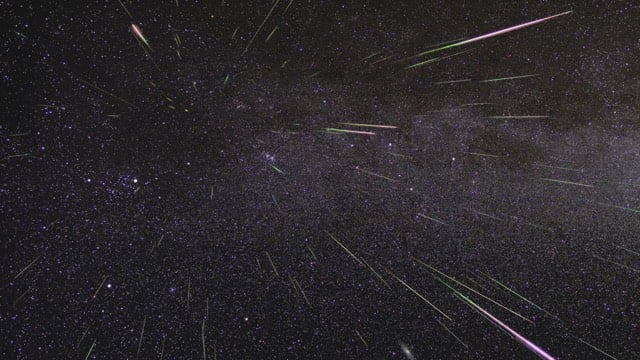
Every year, the Earth moves through the debris from the Swift-Tuttle comet, resulting in the Perseid meteor shower. This year, the Earth is predicted to move through a particularly dense part of the comet’s wake, which may mean twice the number of shooting stars during this year’s shower. Here’s how to watch:
The best way to see the Perseids is to go outside between midnight and dawn on the morning of Aug. 12. Allow about 45 minutes for your eyes to adjust to the dark. Lie on your back and look straight up. Increased activity may also be seen on Aug. 12-13.
I always find these directions confusing, so to be clear: the best viewing for the Perseids is the night of Aug 11 (Thu) into the morning of Aug 12 (Fri). Good luck!
Chemical make-up of movie theater air shifts w/ movie moments
A study undertaken by a group of German scientists suggests that the chemical makeup of the collective breath of movie audiences change in reaction to what’s happening on the screen.
Human beings continuously emit chemicals into the air by breath and through the skin. In order to determine whether these emissions vary predictably in response to audiovisual stimuli, we have continuously monitored carbon dioxide and over one hundred volatile organic compounds in a cinema. It was found that many airborne chemicals in cinema air varied distinctively and reproducibly with time for a particular film, even in different screenings to different audiences. Application of scene labels and advanced data mining methods revealed that specific film events, namely “suspense” or “comedy” caused audiences to change their emission of specific chemicals.
The Human Family
A new commercial from Apple pairs photos & videos shot on iPhone 6 with a poem from Maya Angelou called Human Family.
We seek success in Finland,
are born and die in Maine.
In minor ways we differ,
in major we’re the same.I note the obvious differences
between each sort and type,
but we are more alike, my friends,
than we are unalike.We are more alike, my friends,
than we are unalike.We are more alike, my friends,
than we are unalike.
You can hear Angelou recite the entire poem here:
Investors have bet big on Uber. But is there a way to short it?
Amateur professionalism in online video
Evan Puschak does a good job of explaining why Casey Neistat’s videos are so entertaining: a combination of seeming amateurism and professionally honed skills in storytelling & video production. I don’t keep up with them regularly, but I love Neistat’s videos. He is definitely among a handful of video producers who have developed genuinely potent forms of video entertainment in the age of YouTube.
18th century Instagram
A cute Ikea ad imagines what Instagram might have been like in the 18th century…it involves a painter and a lot of driving around in a carriage soliciting likes.
Barack Obama on feminism in Glamour: “the idea that when everybody is equal, we are all more free”. Amen.
Prince, Technology, the Great Migration, and US Highway Policy
At the EyeO Festival in June, Anil Dash did a talk about Prince, “immigration & migration, artistry & technology, grave injustices & profound triumphs”. The talk is an examination of the past century of American history through the lens of Dash’s family history and one of the world’s greatest artists…well worth the 55 minutes it takes to watch.
The music and the opening titles of Stranger Things
Like many of you, I have been watching Stranger Things on Netflix. My 80s movie fixations tilted towards the War Games/Explorers/Goonies end of the spectrum rather than the supernatural/horror/Steven King end so I’m not obsessed, but I am definitely enjoying it. You can watch the first 8 minutes of the show to judge for yourself.
But I love the opening credits, especially the music. (Both remind me of the opening credits for Halt and Catch Fire.) The title song was composed by Kyle Dixon and Michael Stein, members of Austin synth band Survive. Someone did a 10-minute extended version of the song and put it up on Soundcloud:
Currently on repeat for the last hour with no sign of stopping. You may also be interested in a pair of playlists featuring music from the show:
What else? Here’s a deep dive into the font used for the opening credits (which was also used for the Choose Your Own Adventure books back in the 80s). Alissa Walker wrote about the free-range children on display in ST, something that also grabbed my attention. When I was a kid, I rode my bike everywhere. On summer weekends, I typically ate breakfast at my house and was gone until dinnertime. My parents had no clue where I was or what I was up to…and none of my classmates’ parents did either.
Update: Garrett Shane Bryant made a 50-track playlist of songs that sound like the score of the show. Outstanding. (via @dozens)
Update: From the NY Times, The ‘Stranger Things’ School of Parenting.
Still, “Stranger Things” is a reminder of a kind of unstructured childhood wandering that — because of all the cellphones, the fear of child molesters, a move toward more involved parenting or a combination of all three — seems less possible than it once was.
The show’s references to beloved films of the ’80s have been much remarked upon, but “Stranger Things” also calls to mind all those books and TV shows — from “The Chronicles of Narnia” to “Muppet Babies” — where parents are either absent or pushed into the background.
These stories let children imagine breaking the rules, but they also allow them to picture themselves solving mysteries or hunting down monsters all on their own. Often it’s only when the parents aren’t watching that a child can become a hero.
(via @CognoscoCuro)
Update: The official soundtrack for the show is available on iTunes. It’s the score though, not the classic 80s tunes.
Update: Vox spoke to a creative director at Imaginary Forces about their process for designing the opening titles.
Update: And the score is now available on Spotify. This is my working music for the day.
Update: Dixon and Stein talked about how the music for the show came about.
Socials & More