Entries for August 2016
The editors of BBC Culture polled 177 film critics from around the world about the best films made since 2000 and compiled the results into this list. The top film? David Lynch’s Mulholland Drive. Here’s the top 20:
20. Synecdoche, New York (Charlie Kaufman, 2008)
19. Mad Max: Fury Road (George Miller, 2015)
18. The White Ribbon (Michael Haneke, 2009)
17. Pan’s Labyrinth (Guillermo Del Toro, 2006)
16. Holy Motors (Leos Carax, 2012)
15. 4 Months, 3 Weeks and 2 Days (Cristian Mungiu, 2007)
14. The Act of Killing (Joshua Oppenheimer, 2012)
13. Children of Men (Alfonso Cuarón, 2006)
12. Zodiac (David Fincher, 2007)
11. Inside Llewyn Davis (Joel and Ethan Coen, 2013)
10. No Country for Old Men (Joel and Ethan Coen, 2007)
9. A Separation (Asghar Farhadi, 2011)
8. Yi Yi: A One and a Two (Edward Yang, 2000)
7. The Tree of Life (Terrence Malick, 2011)
6. Eternal Sunshine of the Spotless Mind (Michel Gondry, 2004)
5. Boyhood (Richard Linklater, 2014)
4. Spirited Away (Hayao Miyazaki, 2001)
3. There Will Be Blood (Paul Thomas Anderson, 2007)
2. In the Mood for Love (Wong Kar-wai, 2000)
1. Mulholland Drive (David Lynch, 2001)
Eternal Sunshine, Inside Llewyn Davis, and Zodiac seem too high on the list but I’m not sure what I would move up instead. It’ll be interesting to see how the consensus changes as these films age. Also, I’ve seen exactly half of the films on the full list…time to get watching.
Update: The film critics of the NY Times give us their picks for the top 25 movies of the 21st century (so far). The top 10:
1. There Will Be Blood
2. Spirited Away
3. Million Dollar Baby
4. A Touch of Sin
5. The Death of Mr. Lazarescu
6. Yi Yi
7. Inside Out
8. Boyhood
9. Summer Hours
10. The Hurt Locker
Also making appearances on the list are Mad Max: Fury Road, Moonlight, and The 40-Year-Old Virgin. I think I prefer the BBC list? (via @tcarmody)

This is a pretty good sentence from Phil Plait:
Clouds are a glimpse into the mighty power of fluid dynamics, complicated equations made real and actual and gorgeous, painted across the sky.
Earlier this month, Netflix debuted a number of slow TV shows on their service, including shows about knitting and firewood, which were very popular in Norway. Here’s the complete roster:
National Firewood Evening
National Firewood Morning
National Firewood Night
National Knitting Evening
National Knitting Morning
National Knitting Night
Northern Passage
Northern Railway
Salmon Fishing
The Telemark Canal
Train Ride Bergen to Oslo
Update: Looks like a few of these programs, most notably Northern Passage and Northern Railway, are not the complete end-to-end shows that were originally broadcast. So, FYI.
Also, these shows are getting terrible ratings on Netflix. Aside from the two shorter shows mentioned above, each show has a rating of only one star. (Further update: Netflix’s ratings are personalized, which means those ratings are specific to me. Others might see 4 or 5 stars. thx, @Rudien)
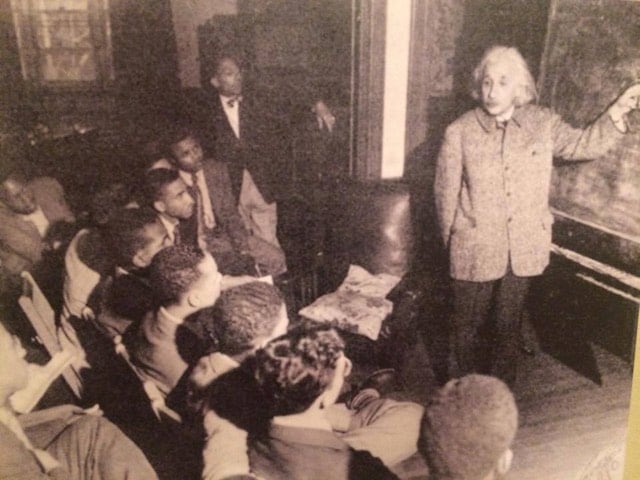
In 1946, Albert Einstein, who had come to the US in 1933 and stayed to become a citizen due to Adolf Hitler’s rise to power in Germany, wrote a magazine article titled The Negro Question. In it, he called the prejudice against black Americans a “deeply entrenched evil”.
What soon makes the new arrival devoted to this country is the democratic trait among the people. I am not thinking here so much of the democratic political constitution of this country, however highly it must be praised. I am thinking of the relationship between individual people and of the attitude they maintain toward one another.
In the United States everyone feels assured of his worth as an individual. No one humbles himself before another person or class. Even the great difference in wealth, the superior power of a few, cannot undermine this healthy self-confidence and natural respect for the dignity of one’s fellow-man.
There is, however, a somber point in the social outlook of Americans. Their sense of equality and human dignity is mainly limited to men of white skins. Even among these there are prejudices of which I as a Jew am clearly conscious; but they are unimportant in comparison with the attitude of the “Whites” toward their fellow-citizens of darker complexion, particularly toward Negroes. The more I feel an American, the more this situation pains me. I can escape the feeling of complicity in it only by speaking out.
Recognizing the parallels between the treatment of Jews in Germany in the 1930s with blacks in the US, Einstein put his efforts and his money where his mouth was. He was a member of the NAACP. In 1946, the same year that letter was published, he received an honorary degree from Pennsylvania’s Lincoln University, the historically black school that was the alma mater of Langston Hughes and Thurgood Marshall. In a speech at the school that was not covered by a mainstream American press that otherwise couldn’t get enough of him, Einstein called racism “a disease of white people”:
My trip to this institution was in behalf of a worthwhile cause. There is a separation of colored people from white people in the United States. That separation is not a disease of colored people. It is a disease of white people. I do not intend to be quiet about it.
When singer Marian Anderson was denied a hotel room in Princeton for being black, Einstein hosted the singer at his home for this and several subsequent trips. He also came to the aid of W.E.B. Du Bois in his case against the US government:
Einstein continued to support progressive causes through the 1950s, when the pressure of anti-Communist witch hunts made it dangerous to do so. Another example of Einstein using his prestige to help a prominent African American occurred in 1951, when the 83-year-old W.E.B. Du Bois, a founder of the NAACP, was indicted by the federal government for failing to register as a “foreign agent” as a consequence of circulating the pro-Soviet Stockholm Peace Petition. Einstein offered to appear as a character witness for Du Bois, which convinced the judge to drop the case.
These and his other activities in this arena are documented in a 2006 book called Einstein on Race and Racism by Fred Jerome and Rodger Taylor.
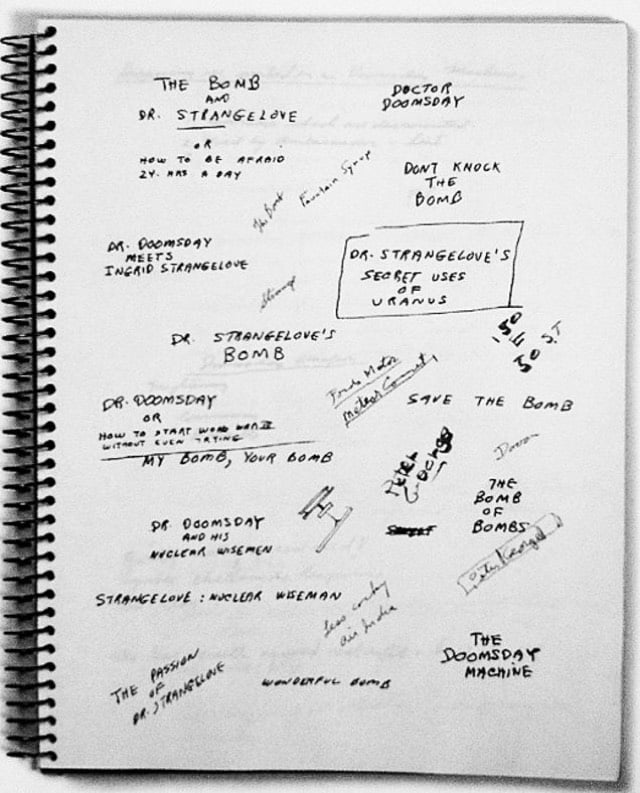
This is a page from one of Stanley Kubrick’s notebooks, on which he jotted down more than a dozen different titles for the movie that came to be called Dr. Strangelove, or: How I Learned to Stop Worrying and Love the Bomb. Among the rejected titles were:
Dr. Doomsday or: How to Start World War III Without Even Trying
Dr. Strangelove’s Secret Uses of Uranus
My Bomb, Your Bomb
Strangelove: Nuclear Wiseman
The Bomb and Dr. Strangelove or: How to be Afraid 24hrs a Day
The Passion of Dr. Strangelove
Fun titles, but they remind me of a chess quote I tweeted the other day: “When you see a good move look out for a better.” Glad Kubrick stuck with it.
The alternate titles made me curious to look at the script, which I’d never seen before. Even glancing at the first few pages are illuminating. I knew the main characters names were full of suggestive puns — General Buck Turgidson, President Merkin Muffley, General Jack D. Ripper — but that’s nothing compared to some of the names in the script, many of which do not appear in the film:
General “Buck” Schmuck
Admiral Percy Buldike
Ambassador de Sade (“Alexei de Sadeski” in the film)
Von Klutz
Frankenstein
Cadaverly
Didley
Crudley
Waffel
Funkel
Major Nonce
Lieutenant Quentin Quiffer
Lieutenant “Binky” Ballmuff
And under “General Notes”, Kubrick lays out how he wants the film to look and feel:
1. The story will be played for realistic comedy - which means the essentially truthful moods and attitudes will be portrayed accurately, with an occasional bizarre or super-realistic crescendo. The acting will never be so-called “comedy” acting.
2. The sets and technical details will be done realistically and carefully. We will strive for the maximum atmosphere and sense of visual reality from the sets and locations.
3. The Flying sequences will especially be presented in as vivid a manner as possible. Exciting backgrounds and special effects will be obtained.
Nailed it. (via @monstro)

In today’s installment of terrifying graphics about climate change, the NY Times made a series of three maps showing the potential rise of 100 degree temperatures across the United States if current greenhouse gas emission trends continue through the end of this century. Look at the areas in orange and red on the 1991-2010 map: what sort of landscape do you picture? Keeping that landscape picture in your mind, look at the orange and red areas on the 2060 and 2100 maps. Yep! And Phoenix with 163 days above 100 degrees — that’s every day from March 25th to September 4th over 100 degrees.
P.S. A word about climate change and rising temperatures. The temperature that climate scientists typically reference and care about with regard to climate change is “the average global temperature across land and ocean surface areas”. According to the NOAA, the average temperature of the Earth in the 20th century was 13.9°C (57.0°F). In 2015, the average global temperature was 0.90°C (1.62°F) above that.
In order to avoid dangerous effects of climate change, climate scientists advocate keeping the global average temperature increase below 2 degrees (and more recently, below 1.5 degrees). In late 2015, 195 nations came together in Paris and agreed to:
[Hold] the increase in the global average temperature to well below 2°C above pre-industrial levels and to pursue efforts to limit the temperature increase to 1.5°C above pre-industrial levels, recognizing that this would significantly reduce the risks and impacts of climate change
That’s degrees Celsius, not Fahrenheit. I don’t know about you, but as an American, when I hear 2 degrees, I think, oh, that’s not bad. But 2°C is an increase of 3.6°F, which does seem significant.
Note also that it specifies keeping the temperature “below pre-industrial levels” and not below 20th century levels. It is maddeningly difficult to track down an exact figure for the pre-industrial global temperature, partially because of a lack of precise data, partially because of politics, and partially because of the impenetrability of scientific writing. From a piece Eric Holthaus wrote for FiveThirtyEight earlier this year:
It sounds easy enough to measure global warming: see how hot it was, compare it to how hot it used to be. But climate scientists have several ways of measuring how hot it used to be. NASA’s base period, as I mentioned above, is an average of 1951-80 global temperatures, mostly because that was the most recently available 30-year period when the data set was first created. By chance, it’s also pretty representative of the world’s 20th-century climate and can help us understand how much warmer the world has become while many of us have been alive.
Other organizations go further back. The Intergovernmental Panel on Climate Change, the body of climate scientists that was formed to provide assessments to the United Nations, bases its temperature calculations on an 1850-1900 global average. There was about 0.4 degrees of warming between that time period and the NASA base period.
Climate scientists often refer to that 1850-1900 timespan as “pre-industrial” because we don’t have comprehensive temperature data from the 1700s. But meteorologist Michael Mann, director of Penn State University’s Earth System Science Center, has argued that an additional 0.25 degrees of warming occurred between the start of the Industrial Revolution (around 1750) and 1850. Including Mann’s adjustment would bring February 2016 global temperatures at or very near 2 degrees above the “pre-industrial” average.
I now completely understand why some people deny that anthropogenic climate change is happening. Seriously. I looked for more than 30 minutes for a report or scientific paper that stated the average global temperature for 1850-1900 and I couldn’t find one. I looked at UN reports, NASA reports, reports from the UK: nothing. There were tons of references to temperatures relative to the 1850-1900 baseline, but no absolute temperatures were given. Now, I don’t mean to get all Feynman here, but this is bullshit. When the world got together in Paris and talked about a 1.5 degree increase, was everyone even talking about the same thing? You might begin to wonder what the scientists are hiding with their obfuscation.
Anyway, the important point is that according to climate scientists, we are already flirting with 1.5°C of global warming since pre-industrial times. Which means that without action, the spread of those Phoenician temperatures across the circa-2100 United States is a thing that’s going to happen.

Frank Ocean dropped his long-awaited album the other day and to go along with it, he gave away a magazine called Boys Don’t Cry for free at four pop-up locations in LA, NYC, Chicago, and London. Kanye West contributed to the album and magazine, penning a poem about McDonald’s for the latter. Here’s the poem:
McDonald’s man
McDonald’s man
The French fries had a plan
The French fries had a plan
The salad bar and the ketchup made a band
Cus the French Fries had a plan
The French fries had a plan
McDonald’s man
McDonald’s
I know them French fries have a plan
I know them French fries have a plan
The cheeseburger and the shakes formed a band
To overthrow the French fries plan
I always knew them French fries was evil man
Smelling all good and shit
I don’t trust no food that smells that good man
I don’t trust it
I just can’t
McDonald’s man
McDonald’s man
McDonald’s, man
Them French fries look good tho
I knew the Diet Coke was jealous of the fries
I knew the McNuggets was jealous of the fries
Even the McRib was jealous of the fries
I could see it through his artificial meat eyes
And he only be there some of the time
Everybody was jealous of them French fries
Except for that one special guy
That smooth apple pie
Man, I can’t help but like Kanye. Just when you think he takes himself way too seriously, he does something like this and you can’t tell if he’s taking himself way WAY too seriously or not seriously at all. McDonald’s, man. Kanye drawing courtesy of Chris Piascik. (via @gavinpurcell)


These composite photos from the NY Times of athletes competing at the Olympics are fantastic. See also the same treatment for Simone Biles and Usain Bolt. (via @feltron, who wrote the book on this stuff)
The one thing everyone talks about w/r/t Stranger Things is its references to 70s and 80s sci-fi, adventure, and horror films. As this video by Ulysse Thevenon shows, there’s good reason for that…the references are many and explicit.
The ones I noticed the most were to E.T., The Goonies, and Explorers, which I just watched again recently and doesn’t hold up very well in a lot of ways. I also feel like there might be a bit of D.A.R.Y.L. in there too, but I haven’t seen that movie since I was 12. See also Every Spielberg Reference in Stranger Things.
Ah, my Friday is off to a bit of a rough start, but a phone chat with a friend and the soundtrack for Halt and Catch Fire dropping on Spotify is patching things up nicely.
P.S. Season 3 starts on Aug 23rd. Here’s a clip from the new season:
And another one. I am excite. (via @aaroncoleman0)

The scientific rumor mill is saying that astronomers in Chile have discovered an Earth-like exoplanet orbiting the star nearest Earth, Alpha Proxima, a mere 4.25 light years away. As they say, “huge if true”.
The hunt for exoplanets has been heating up in recent years. Since it began its mission in 2009, over four thousand exoplanet candidates have been discovered by the Kepler mission, several hundred of which have been confirmed to be “Earth-like” (i.e. terrestrial). And of these, some 216 planets have been shown to be both terrestrial and located within their parent star’s habitable zone (aka. “Goldilocks zone”).
But in what may prove to be the most exciting find to date, the German weekly Der Spiegel announced recently that astronomers have discovered an Earth-like planet orbiting Proxima Centauri, just 4.25 light-years away. Yes, in what is an apparent trifecta, this newly-discovered exoplanet is Earth-like, orbits within its sun’s habitable zone, and is within our reach. But is this too good to be true?
If you read the article, there’s cause for skepticism but an official announcement is coming next week so we’ll know for sure one way or the other.
The other cool thing? If there is a planet there, plans are already underway to build a project to get probes to nearby Alpha Centuri in 20 years, Project Starshot:
In the last decade and a half, rapid technological advances have opened up the possibility of light-powered space travel at a significant fraction of light speed. This involves a ground-based light beamer pushing ultra-light nanocrafts - miniature space probes attached to lightsails - to speeds of up to 100 million miles an hour. Such a system would allow a flyby mission to reach Alpha Centauri in just over 20 years from launch, and beam home images of possible planets, as well as other scientific data such as analysis of magnetic fields.
Perhaps they can redirect their target slightly?
Update: It appears as if the rumors were true. Phil Plait writing at Slate:
The planet, called Proxima Centauri b or just Proxima b (exoplanets are given their star’s name plus a lower case letter in order of discovery, starting with “b”), orbits Proxima every 11.2 days. It has a mass of no less than 1.3 times the Earth’s, so if it’s rock and metal like Earth it’s only a bit bigger. It’s a mere 7.3 million kilometers from the star-a lot closer than Earth’s distance from the Sun of 150 million kilometers!-but Proxima is so faint and cool it receives about two-thirds the amount of light and heat the Earth does. That means that it’s in Proxima’s habitable zone: It’s possible (more or less) that liquid water could exist on its surface.
That’s coooool.
Update: Project Blue wants to built a space telescope for the purpose of observing and photographing Earth-like planets around Alpha Centuri.
Project Blue is a consortium of leading space and research organizations on a mission to build and launch a small space telescope to observe planets around our nearest stellar neighbors: Alpha Centauri A and B. The goal is simple: to capture an image, visible to the human eye, of orbiting planets. Seeing a “pale blue dot” could indicate the presence of oceans or an atmosphere — the potential to support life. It would be our first view of another world like our own. With a modest budget and a planned launch by 2020, this goal is tantalizingly close.
Update: According to some recent observations, it seems likely that the Earth-like planet orbiting Proxima Centauri has been fried to a crisp many times by solar flares.
When they calculate the total energy of the big flare, it is ten times more powerful than one of the Sun’s bigger flares! That’s a lot of energy. So much, in fact, that the planet, Proxima b, would get good and fried by it. I mean crispy. The planet orbits the star much closer than Earth does the Sun, about 7 million kilometers from Proxima, so the energy from the flare would hit it a lot harder. Assuming these flares happen relatively often (a very safe bet), over the lifetime of the planet these would basically sandblast the planet, ripping the atmosphere right off the planet. They’d strip away any oceans, too, and sterilize whatever was left.
It’s hard to overstate the damage. These flares, over billions of years, are downright apocalyptic. It’s hard to imagine anything being able to survive. The planet may very well be a completely zapped airless lifeless ball of rock.
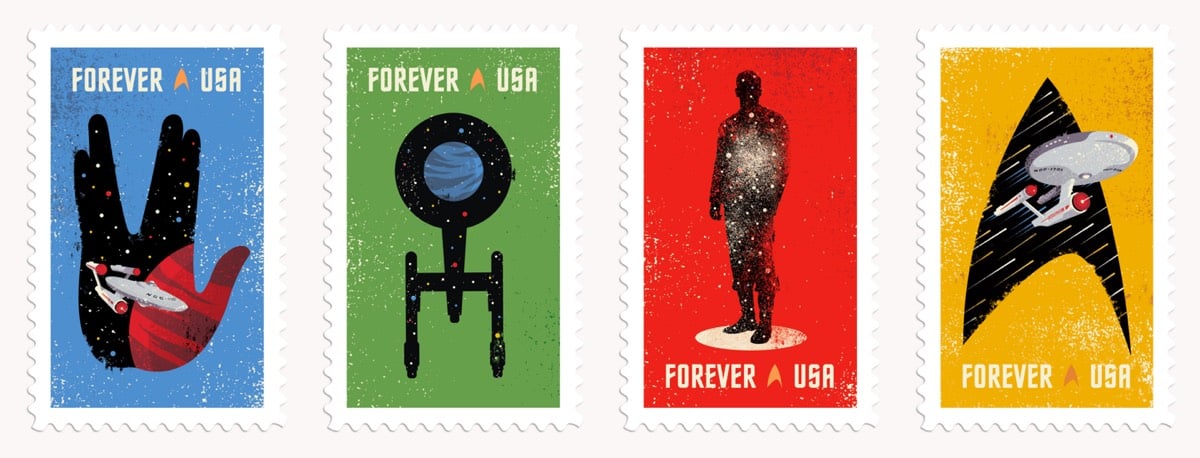
The USPS is releasing a set of four commemorative Star Trek stamps on the 50th anniversary of the original series. The stamps were designed by Heads of State and you can buy there here.
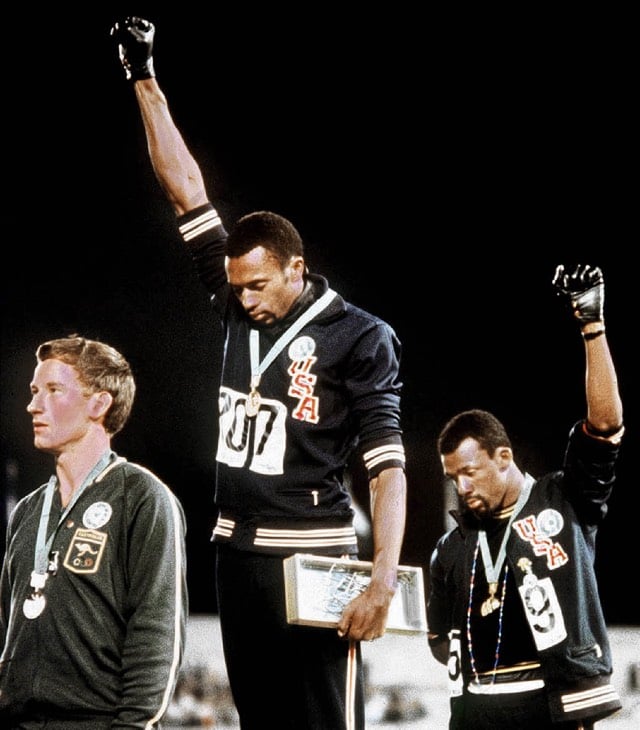
During the medals ceremony for the 200 meter race the 1968 Olympics, gold medalist Tommie Smith and bronze medalist John Carlos, both standing shoeless on the podium, each raised one black-gloved fist in the air during the playing of the US national anthem as a gesture in support of the fight of better treatment of African Americans in the US. It was an historic moment immortalized in photos like the one above.
The white man in the photo, silver medalist Peter Norman from Australia, could be considered a sort of symbolic visual foil against which Smith and Carlos were protesting, but in fact Norman was a willing participant in the gesture and suffered the consequences.
Norman was a white man from Australia, a country that had strict apartheid laws, almost as strict as South Africa. There was tension and protests in the streets of Australia following heavy restrictions on non-white immigration and discriminatory laws against aboriginal people, some of which consisted of forced adoptions of native children to white families.
The two Americans had asked Norman if he believed in human rights. Norman said he did. They asked him if he believed in God, and he, who had been in the Salvation Army, said he believed strongly in God. “We knew that what we were going to do was far greater than any athletic feat, and he said “I’ll stand with you” — remembers John Carlos — “I expected to see fear in Norman’s eyes, but instead we saw love.”
Update: In 2011, Democracy Now! interviewed Carlos about the salute and the aftermath. He was joined by sportwriter Dave Zirin and the pair told a story about why Norman didn’t want to be represented alongside Carlos and Smith with a statue on the San Jose State campus:
DAVE ZIRIN: OK, just checking. Well, they made the decision to make this amazing work of art, these statues on campus. And they were just going to have Tommie Smith and John Carlos, with a blank space where Peter Norman stood. And when John heard about that, he said, “Oh, no, no. I don’t want to be a part of this. And I don’t even want this statue if Peter Norman’s not going to be on it.” And the people at San Jose State said, “Well, Peter said he didn’t want to be on it.” And John said, “OK, let’s go to the president’s office and get him on the phone.” So they called Peter Norman from the president’s office at San Jose State, and sure enough, they got Peter on the phone. I believe Peter said — what did he say? “Blimey, John”? What did he say?
JOHN CARLOS: Yeah, “Blimey, John. You’re calling me with these blimey questions here?” And I said to him, I said, “Pete, I have a concern, man. What’s this about you don’t want to have your statue there? What, are you backing away from me? Are you ashamed of us?” And he laughed, and he said, “No, John.” He said — you know, the deep thing is, he said, “Man, I didn’t do what you guys did.” He said, “But I was there in heart and soul to support what you did. I feel it’s only fair that you guys go on and have your statues built there, and I would like to have a blank spot there and have a commemorative plaque stating that I was in that spot. But anyone that comes thereafter from around the world and going to San Jose State that support the movement, what you guys had in ‘68, they could stand in my spot and take the picture.” And I think that’s the largest thing any man would ever do. And as I said, I don’t think that my co-partner, my co-heart, Tommie Smith, would have done what Peter Norman done in that regards. He was just a tremendous individual.
(via @unlikelywords)
When Jurassic Park came out in the summer of 1993, it signaled a shift in the use of digital visual effects in Hollywood films. The movie wasn’t the first to use any particular technique, but it was the first movie to showcase convincing, realistic digital effects. I watched Jurassic Park again recently and for a 23-year-old movie, the effects hold up surprisingly well. (For reference, 23 years ago, the top-of-the-line desktop computer was a 486 running at 50 MHz.)
In the 100m dash at this year’s Olympics, Andre De Grasse finished third behind Usain Bolt and Justin Gatlin with a time of 9.91 seconds. Jesse Owens, running on a cinder track with heavier, stiffer leather shoes, won the gold at the 1936 Olympics with a time of 10.3 seconds. CBC took De Grasse to a dirt track, gave him a replica pair of Owens’ shoes, and timed him. I won’t give away the result, but Owens looks pretty good in comparison. As David Epstein said in his TED talk, perhaps technology is responsible for much of the improvement of athletic achievement:
Consider that Usain Bolt started by propelling himself out of blocks down a specially fabricated carpet designed to allow him to travel as fast as humanly possible. Jesse Owens, on the other hand, ran on cinders, the ash from burnt wood, and that soft surface stole far more energy from his legs as he ran. Rather than blocks, Jesse Owens had a gardening trowel that he had to use to dig holes in the cinders to start from. Biomechanical analysis of the speed of Owens’ joints shows that had been running on the same surface as Bolt, he wouldn’t have been 14 feet behind, he would have been within one stride.
In De Grasse’s defense, he was running on dirt, not cinders and didn’t have much of a chance to train on the surface or with the shoes. But still.
The Clinton campaign is currently wrestling with how to prepare for the first debate with Trump coming up at the end of September. Part of that challenge is picking a proper sparring partner for the mock debates.
It’s one of the most uncomfortable and important jobs in Democratic politics: trying to embarrass the woman who could be the next president.
The person picked to be Hillary Clinton’s sparring partner in her upcoming debate prep sessions is expected to confront her about the death of Vincent Foster, label her a rapist’s enabler, and invoke the personally painful memories of Monica Lewinsky and Gennifer Flowers.
I’ve been thinking about this since the Republican convention and there’s an obvious choice here: Stephen Colbert. Clinton needs to prepare to deftly counter energetically delivered nonsense, personal insults, and things no politician would ever say. Does that sound like the host of a certain Comedy Central show? Colbert’s smart, quick, knows the issues, and, with his talent, could tweak his Colbert Report persona toward the Trumpesque. He wouldn’t have a problem tearing Clinton down in person; he did the same thing to George W. Bush at the 2006 White House Correspondents Dinner. I bet he’d jump at the chance to do it too. Let’s make this happen, America!
Update: They’re getting closer…
At least a few old Clinton hands have suggested enlisting professional entertainers, like Jon Stewart or Alec Baldwin.
Colbert! He could do it with his eyes shut!
Mike Upchurch was a writer for Mr. Show and MADtv but now he’s making these clever little videos with additional actors spliced into the narratives of Cocktail (the Tom Cruise movie) and the Dragnet TV series.
Both feature actor/comedian Chris Fairbanks in the lead role and are noted as “proof-of-concepts” for a series called Electric Television that Upchurch is presumably developing. Someone should greenlight it. (via @dunstan)
From Accio to Wingardium Leviosa, this is a supercut of every spell uttered in the 8 Harry Potter movies. Lots of Expecto Patronum, Expelliarmis, and Stupefy. As supplementary reading, here’s a list of spells in Harry Potter from Wikipedia.

Frodo (and Sam) made their way from Hobbiton to Mordor in six months and now you can see the route they took on Google Maps. “This route has trolls.” LOL. Full size image here. (via bb)
Update: From 2002, Mapquest directions for walking from Hobbiton to Mt Doom. (thx, seth)
This is an hour-long documentary on the Louvre’s recent restoration of Leonardo da Vinci’s The Virgin and Child with Saint Anne.
The Virgin and Child with Saint Anne is one of the most beautiful paintings in the world. It is also one of the most mysterious. Disfigured and even jeopardised by “repairs” and by the successive layers of varnish applied to it over the centuries, it was also in very bad condition. To save the painting, it had to be restored.
The spectacular operation, the likes of which occurs only once a century, took over three years to complete. The complex and outstanding restoration process provided a unique opportunity to get as close as possible to the painting, to how it was originally painted, and to better understand the complex relationship Leonardo da Vinci had with one of his finest masterpieces.
Restorations are fascinating. I only had time today for the first five minutes, but it hooked me enough that I’m going to go back to it tonight. (via @BoleTzar)
Univision is buying Gawker Media for $135 million. Sounds like a good home. Hope they finally ditch that logo!
Alfred Hitchcock liked to insert himself, briefly, into his films. As the video above shows, he appears in 39 of his films, mostly near the beginning so he doesn’t distract his audiences by looking for him the entire time.
Introverts have limited reserves of energy and attention stored up for socializing with others and when they’re used up, the aftermath can feel very much like a hangover from too much drinking.
After a few hours, I couldn’t take it any more. I slipped away like a thief, skulking about the house, searching for a place where it was quiet. I came across a half-lit room and saw my future brother-in-law sitting in there, staring out the window. Knowing him to be an introvert himself, I decided this was my best option for escape and sat down across the room, wrapping my arms around my knees. I remember hoping he wouldn’t think I was intruding upon his own solitude before I allowed myself to zone out, letting my thoughts drown out the raucous laughter from downstairs, breathing deeply and feeling the tension drain away. I don’t know how long it was before my now-husband came looking for me, but I remember him laughing at finding the two introverts seeking refuge together.
This happened to me a couple of weeks ago. I travelled to a friend’s wedding but got to town a few days early to go see a show and meet up with some other friends. By the time the wedding rolled around, I had spent time with so many people in different social groups that I left after the ceremony and didn’t stay for dancing and karaoke or anything (sorry!). I didn’t even get to congratulate the bride (so so sorry!!)…I was just done. After that, I mostly just holed up in my hotel room, reading, and walked around by myself, even though there were so many other things I could have been doing with so many other people. Several years ago, I would have felt weird and horrible about this, but I know myself well enough now that I just roll with it…I read so much of a book I was enjoying that the time spent can hardly be considered a loss.
It all comes down to the limbic systems and your prefrontal cortex. Your monkey brain vs. your human brain. And the one thing that has been shown to weaken your limbic response and strengthen the response of your prefrontal cortex? Mindful meditation. (via @christopherjobs)
vintage post from Aug 2016
· gift link

In 1944, the OSS (the precursor to the CIA) produced a document called the Simple Sabotage Field Manual (PDF). It was designed to be used by agents in the field to hinder our WWII adversaries. The CIA recently highlighted five tips from the manual as timelessly relevant:
1. Managers and Supervisors: To lower morale and production, be pleasant to inefficient workers; give them undeserved promotions. Discriminate against efficient workers; complain unjustly about their work.
2. Employees: Work slowly. Think of ways to increase the number of movements needed to do your job: use a light hammer instead of a heavy one; try to make a small wrench do instead of a big one.
3. Organizations and Conferences: When possible, refer all matters to committees, for “further study and consideration.” Attempt to make the committees as large and bureaucratic as possible. Hold conferences when there is more critical work to be done.
4. Telephone: At office, hotel and local telephone switchboards, delay putting calls through, give out wrong numbers, cut people off “accidentally,” or forget to disconnect them so that the line cannot be used again.
5. Transportation: Make train travel as inconvenient as possible for enemy personnel. Issue two tickets for the same seat on a train in order to set up an “interesting” argument.
Ha, some of these things are practically best practices in American business, not against enemies but against their employees, customers, and themselves. You can also find the manual in book or ebook format. (via @craigmod)
Someone spent hours making a playable version of Super Mario Bros in Excel. See also the Excel spreadsheet artist. (via digg)
Update: Two corrections. The spreadsheet program is actually OpenOffice, not Excel. (Excel is almost a genericized trademark at this point.) And the in-spreadsheet game isn’t actually playable…this is a stop motion video of still frames.
On a recent episode of the Serious Eats podcast Special Sauce, Ed Levine talks to Danny Meyer about the origins of the Shake Shack.
Did Meyer have any idea that that hot dog cart would eventually become the massive sensation it is today? Not at all. It was a happy accident, born of his love of burgers, Chicago hot dogs, and the custard that’s still served at Ted Drewes in his native St. Louis.

From the Worst of McMansions blog, McMansions 101: What Makes a McMansion Bad Architecture?.
McMansions lack architectural rhythm. This is one of the easiest ways to determine between a McMansion and a, well, mansion. Here is an example of a house with terrible rhythm. On the example below, none of the main windows match any of the other main windows. The contrasting materials distract the eye from an otherwise somewhat asymmetrically balanced (if massive) house. The inconsistency of the window shapes as well as the shutters make this house incredibly tacky.
It’s been awhile since I’ve looked at the typical oversized American suburban house. Some of the examples cited are truly hideous. The post on columns is worth a look too.
The advertising that Volkswagen ran in American magazines and newspapers in the 1960s was legendary, perhaps the greatest ad campaign ever. This is a great little documentary about how the ads came about — pitching “a Nazi car in a Jewish town”.

I had only ever seen a few of these ads…what an amazing campaign. For this one, they didn’t even bother showing you the car, an assurance to the buyer that you knew what you were getting.

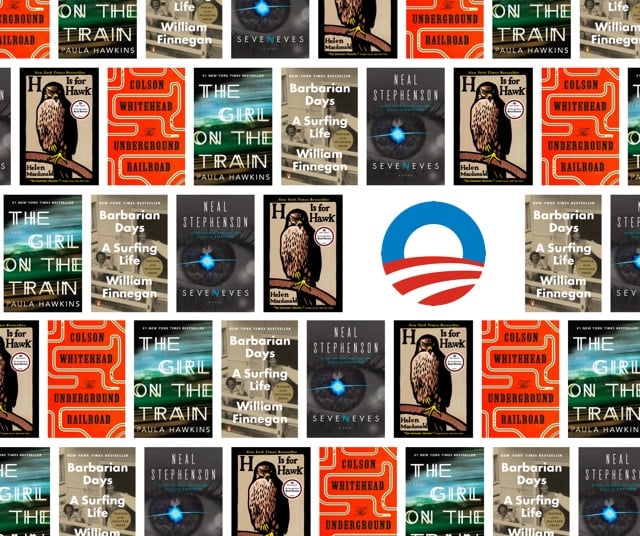
The White House just released President Obama’s summer reading list. Here’s what’s on it:
Barbarian Days: A Surfing Life by William Finnegan
The Underground Railroad by Colson Whitehead
H Is for Hawk by Helen Macdonald
The Girl on the Train by Paula Hawkins
Seveneves by Neal Stephenson
I’m currently reading Seveneves and The Underground Railroad is next. More convinced than ever that a) Barry and I would be good friends if such an opportunity arose, and b) he should be reading kottke.org if he isn’t already. He could peruse it between his fifth and sixth almonds at the end of the day. Think about it, Mr. President.

Morbotron is a screencap search engine for Futurama. The cap above is perhaps the most popular use case. It also does animated GIFs. See also Frinkiac, the Simpsons screencap search engine.
Louisiana is currently experiencing a 500-year rainstorm, pushing rivers to record highs and causing historic floods. In Baton Rouge, a woman was rescued from her car just before it sank into the water by a courageous rescue crew. Well done, guys.
Newer posts
Older posts






Socials & More