



A reminder of the crushing sexism in America when Hillary Clinton was younger. E.g. marital rape was legal.

Advertise here with Carbon Ads
This site is made possible by member support. 💞
Big thanks to Arcustech for hosting the site and offering amazing tech support.
When you buy through links on kottke.org, I may earn an affiliate commission. Thanks for supporting the site!
kottke.org. home of fine hypertext products since 1998.
Beloved by 86.47% of the web.
Entries for June 2016
What’s the most “normal” place in the US?
There’s been a lot of talk in this election cycle about “average Americans” and “real Americans”. In a piece for FiveThirtyEight, Jed Kolko used age, education, and race & ethnicity to find the city most demographically similar the US as a whole. Here’s his top 5:
1. New Haven-Milford, CT
2. Tampa-St. Petersburg-Clearwater, FL
3. Hartford-West Hartford-East Hartford, CT
4. Oklahoma City, OK
5. Springfield, MA
Economist Lyman Stone thought Kolko’s methodology was flawed:
See, he used 3 variables: race, education, and age, to proxy for “normalcy.” His method looked at how typical a given “race” group in a given city was on educational/age factors, and a given educational group in a given city on race/age factors, etc. In other words, he didn’t truly ask “What city is most normal?” He asked “In what city is each group of people most typical of that group of people nationally?” That’s a cool question, but it’s totally not “normalcy.” The reason is simple: as best I can tell, Jed doesn’t fully capture the role of aggregate composition. He’s trying to get specific and avoid calling a place “abnormal” just because it has one weird demographic lump; he wants cell-specific abnormality. But nobody cares if Graduate-Degree-Holding Native Americans happen to be much younger in St. Louis than elsewhere. We care if St. Louis has a weirdly large number of Graduate-Degree-Holding-Native-Americans. Composition of the population is the most important measure of normalcy, and one that Kolko’s method will tend to under-emphasize.
Stone ran his own analysis with that in mind, using 20 different demographic variables, and came up with a different list of the most normal places in America:
1. Oklahoma City, OK
2. Tulsa, OK
3. Jacksonville, FL
4. Spokane-Spokane Valley, WA
5. Phoenix-Mesa-Scottsdale, AZ
The above table shows the places with the lowest weirdness-scores. Two of them are in Oklahoma. I’ll talk about them together. Oklahoma City is less than 1 standard deviation from the mean on every single variable. It is exactly the mean for the poverty rate, and almost exactly the mean for educational attainment. It’s biggest oddity is housing costs compared to income, which are a bit high, and the percent of households with a car, which is also just a teentsy bit high. Other than that? If you’re looking for “Normal America” then look to Oklahoma City. Tulsa’s story is the same, except it also has a bit of a low share of civilian government workers.
Among the weirdest places on Stone’s list? San Jose, NYC, and Jacksonville, NC.
New York is up next. Again, a large foreign-born share makes New York weird. But the real weirdness is actually in New York’s transit access. New York’s car-ownership share is a whopping nine standard deviations below the national average. New York’s housing costs also make it weird, as does the percent of people who are renting. In other words, New York is weird because it’s just so darn urban.
Obama endorses Hillary Clinton in YouTube video. That’s a strong, compelling statement.
Behind the scenes of Legoland’s model workshop
Wired recently talked to a couple of Lego Master Builders about how they create new pieces for display at Legoland. They have a custom CAD program for making Lego structures (and people and animals) which can show MRI-like slices for whatever thing they’re working on for ease of construction. The subway station mosaic detail at the end is super cool.
World map of the origin of agricultural crops

From the International Center for Tropical Agriculture, a map showing where the world’s most used crops originated. Potatoes and tomatoes are from the Andes, watermelon from southern Africa, bananas from south & southeast Asia, and blueberries from North America. (via @CharlesCMann)

2001: A Picasso Odyssey
Bhautik Joshi took 2001: A Space Odyssey and ran it through a “deep neural networks based style transfer” with the paintings of Pablo Picasso.
See also Blade Runner in the style of van Gogh’s Starry Night and Alice in a Neural Networks Wonderland.
Who are the characters in HBO’s Silicon Valley based on? Peter Thiel, Marissa Mayer, and Sean Parker for starters.
Actual headline: “Uranus takes a pounding more frequently than thought.” First line is “Uranus isn’t just gassy…”
An atlas of audiovisual artifacts and glitches

The AV Artifact Atlas keeps track of the anomalies that can affect audio and visual signals. Start at the table of contents…all of the glitchy video effects have names! Like quilting, carrier leak, and DV record head clog.
The most frequently stolen books
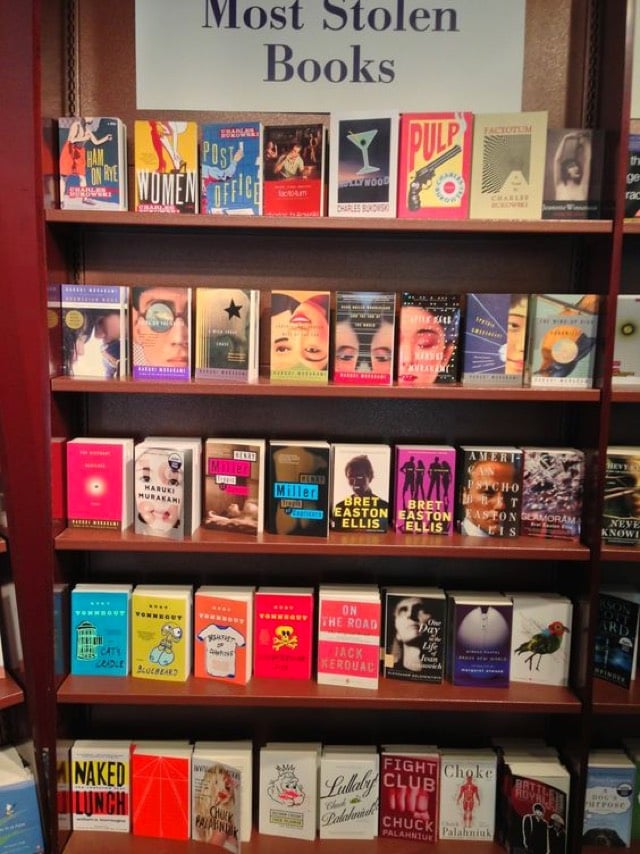
Vintage/Anchor Books recently tweeted out a photo of a Most Stolen Books shelf at a bookstore. Some of the books on the shelf include The Wind-Up Bird Chronicle (one of many Murakamis), Charles Bukowski’s Hollywood, and On the Road by Jack Kerouac.
According to research by Candice Huber, books by Bukowski and Kerouac are indeed popular targets for theft from bookstores, along with those by Hemingway, David Sedaris, and The Great Gatsby. All of the books listed are by men, and most by “manly” men. This 2009 list from the UK is slightly different: J.K. Rowling’s Harry Potter books and Abbie Hoffman’s Steal This Book both rank high.
Libraries are a different story. According to Huber, the most frequently stolen library books are the Guinness Book of World Records, which is a favorite around our house,1 and The Bible. Thieves could use the Good Book’s wisdom more than many, I guess. Art books, the Sports Illustrated swimsuit issue, and test prep books are also popular with the light-fingered. Judging from my personal experience hanging around garages and auto mechanics when I was a kid, Chilton’s Auto Repair manuals were also lifted quite often.
“Daddy, our copy is from 2014. We should get the one from this year, so we can check if any of the records have been broken.”↩
The changing American diet

From Flowing Data, an animated infographic that shows how the American diet has changed since 1970. We eat less beef, potatoes, margarine, and whole milk than we used to, but more chicken, cooking oil, bananas, and Italian cheese.
The best rule-breaking films of all time
From Cinefix, a list of 10 movies (plus dozens more runners-up) that broke the rules of filmmaking most effectively by using jump cuts, nonlinear narrative, lack of plot, surrealism, and breaking the fourth wall.
Companies hear “wedding” & start charging you high prices. Here are some suggestions on how to route around that.
A video essay on video essays
Jarrett Fuller examines the video essay, typically used for film criticism (e.g. Every Frame a Painting, F is for Fake), and argues for its use in design criticism. (via @tonyszhou)
Missed this last fall: Matt Zoller Seitz’s collection of Mad Men recaps. “This book is a time machine.”
Today on the grammar rodeo: that vs. which
New Yorker copy editor Mary Norris explains when the magazine uses “which” and when it uses “that”, a distinction I confess I had little knowledge of until just now.1 A cheeky example of the difference by E.B. White:
The New Yorker is a magazine, which likes “that.”
The New Yorker is the magazine that likes “which.”
(via df)
This is why, when anyone asks me what I do for a living, the answer is never “writer”. Writing for me is a brute-force operation; I’ll use whatever is necessary to make it sound like I’m talking with you in person. (Wait, is a semicolon appropriate there? Should I have used “as though” instead of “like”? Who gives a shit!) I use too many commas (but often not between multiple adjectives in front of nouns), too many “I”s, too many “that”s (OMG, the thats), too many weirdo pacing mechanisms like ellipses, dashes, & parentheses, mix tenses, overuse the passive voice, and place unquoted periods and commas outside quotation marks like the Brits, although I was doing it before I learned they did because it just seemed to make sense. So, anyway, hi, I’m not a writer…who writes a lot.↩
A visual comparison of Stanley Kubrick and Wes Anderson
The films of Wes Anderson and Stanley Kubrick share some interesting visual similarities. Any influence was a one-way street, of course. With the exception of Bottle Rocket, which was cinematically spare compared to his later work, all of Anderson’s films were shot after Kubrick finished shooting Eyes Wide Shut.
The Ultimate Wedding Playlist: FiveThirtyEight polled readers for their wedding reception playlists. Hey Ya was #1.
The legally blind astronomer
Tim Doucette is a legally blind astronomer. A pair of surgeries when he was younger to help improve his vision left him with a superpower: because his pupils were permanently dilated, he could see in the dark better than other people. He built an observatory and with the aid of his telescope, he can see details of far-off stars and nebula that no one else can, including UV and infrared light.
Super sad supercut
A collection of super sad moments from movies like The Iron Giant, E.T., Wrath of Khan, Up, and Old Yeller. This’ll have you sobbing in 3 minutes or your money back.
Happy sobs: girl w/ prosthetic leg gets a doll w/ prosthetic leg. This is why representation is important.
Michael Lewis on irrationality in human decision-making
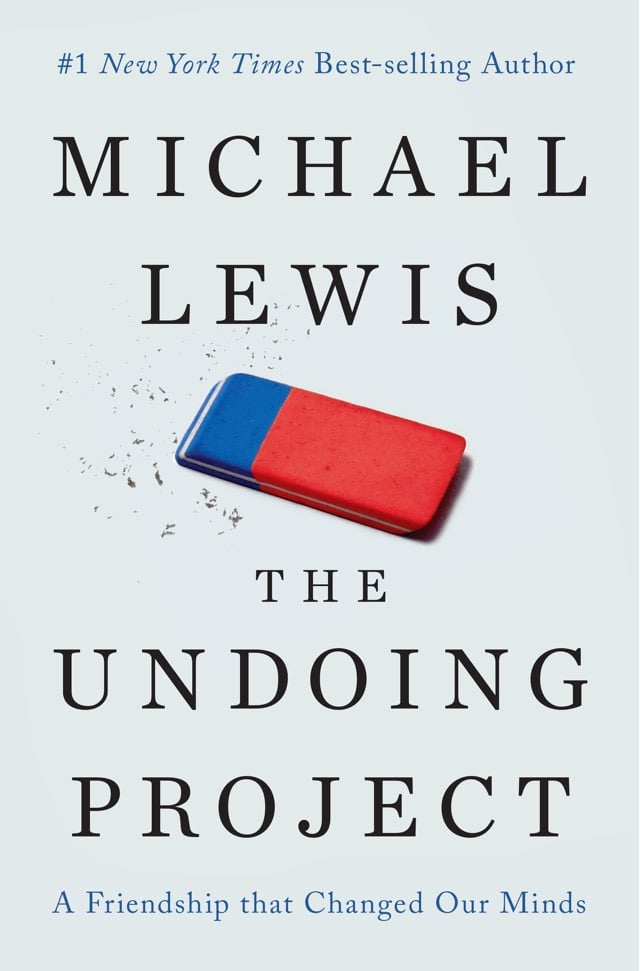
Michael Lewis (c’mon, you know, Moneyball, The Big Short) is coming out with a new book in December called The Undoing Project: A Friendship that Changed Our Minds about the flaws that crop up in human decision-making.
Forty years ago, Israeli psychologists Daniel Kahneman and Amos Tversky wrote a series of breathtakingly original studies undoing our assumptions about the decision-making process. Their papers showed the ways in which the human mind erred, systematically, when forced to make judgments about uncertain situations. Their work created the field of behavioral economics, revolutionized Big Data studies, advanced evidence-based medicine, led to a new approach to government regulation, and made much of Michael Lewis’s own work possible. Kahneman and Tversky are more responsible than anybody for the powerful trend to mistrust human intuition and defer to algorithms.
Kahneman won the Nobel Prize in economics in 2002 and is the author of the well-regarded Thinking, Fast and Slow. (via nytimes)
John Oliver takes on the debt buying industry
On Last Week Tonight last night, John Oliver not only blasted the debt buying industry but ended up starting a company, bought $15 million worth of medical debt from Texas, and forgave it.
Update: I forgot to add, Occupy Wall Street did a similar thing back in 2012.
OWS is going to start buying distressed debt (medical bills, student loans, etc.) in order to forgive it. As a test run, we spent $500, which bought $14,000 of distressed debt. We then ERASED THAT DEBT. (If you’re a debt broker, once you own someone’s debt you can do whatever you want with it - traditionally, you hound debtors to their grave trying to collect. We’re playing a different game. A MORE AWESOME GAME.)
Update: It’s disappointing that Last Week Tonight did not acknowledge the work and assistance of the Debt Collective and their Rolling Jubilee.
At the last minute Wilson told us LWT did not want to associate themselves with the work of the Rolling Jubilee due to its roots in Occupy Wall Street. Instead John Oliver framed the debt buy as his idea: a giveaway to compete with Oprah. The lead researcher who worked on this segment invoked the cover of journalism to justify distancing themselves from our project.
Why is Game of Thrones stuck in medieval times?
Riffing on Ken Mondschein’s Strategies of War in Westeros, Evan Puschak explores why Westeros seems culturally and technologically stuck in the Middle Ages.
Update: Or does Game of Thrones depict the early modern period?
What Martin actually gives us is a fantasy version of what the historian Alfred Crosby called the Post-Columbian exchange: the globalizing epoch of the 16th and 17th centuries. A world where merchants trade exotic drugs and spices between continents, where professional standing armies can number in the tens or hundreds of thousands, where scholars study the stars via telescopes, and proto-corporations like the Iron Bank of Braavos and the Spicers of Qarth control global trade. It’s also a world of slavery on a gigantic scale, and huge wars that disrupt daily life to an unprecedented degree.
(via @arbesman)
A tour of the Svalbard Seed Vault
Tucked away in a mountain located on the Svalbard archipelago in Norway, also home to The Northmost Town on Earth, is the Svalbard Global Seed Vault. The Vault is home to more than 860,000 plant seed samples deposited by dozens of different countries from around the world (even North Korea) and is closed to access about 350 days per year. But the folks from Veritasium were able to finagle a tour of the facility during one of its rare open days.
This facility was built to last about 200 years and withstand earthquakes and explosions. It was placed on the side of a mountain so even if all the ice on Earth melts, it will still be above sea level.
Other fun facts about the Vault: the temperature in the storage rooms are kept at minus 0.4 degrees Fahrenheit to hinder seed growth/deterioration, the permafrost in which the Vault is built will maintain the low storage temp in case of electrical failure, GMO seeds are forbidden due to Norwegian law, and the first withdrawal was made last year by Syria because of the civil war.
PT Anderson working on a movie about the fashion industry w/ Daniel Day-Lewis, set in NYC in the 50s
From Winnie Cooper to math whiz
As a child, Danica McKellar played Winnie Cooper on The Wonder Years. After the show was over, McKellar had difficulty breaking away from other people’s perceptions of her. But in college, she discovered an aptitude for mathematics, went on to have a theorem named after her — not because she was famous but because she’d helped prove it — and forged a new identity. (via @stevenstrogatz)
What would happen if all humans disappeared?
If all humans just up and disappeared one day, life on Earth would suffer in the short term but fare much better in the long run.
The Gene: An Intimate History
Siddhartha Mukherjee, who wrote The Emperor of All Maladies, a biography of cancer and one of my favorite recent reads, is out with a new book called The Gene: An Intimate History.
Siddhartha Mukherjee has a written a biography of the gene as deft, brilliant, and illuminating as his extraordinarily successful biography of cancer. Weaving science, social history, and personal narrative to tell us the story of one of the most important conceptual breakthroughs of modern times, Mukherjee animates the quest to understand human heredity and its surprising influence on our lives, personalities, identities, fates, and choices.
The book comes recommended by Tyler Cowen, who IIRC also recommended Emperor of All Maladies to me.
This book filled in a number of gaps in my knowledge, plus it is engaging to read. Overall it confirmed my impression of major advances in the science, but not matched by many medical products for general use.
This is on the must-read list this summer. Somehow. When I get a second.
On Bullshit and Donald Trump
In this video, Harry Frankfurt, author of On Bullshit, talks about what bullshit is and how dangerous it is to society.
The reason why there’s so much bullshit I think is that people just talk. If they don’t talk, they don’t get paid. The advertiser wants to gain sales. The politician wants to gain votes. Now, that’s ok but they have to talk about things that they don’t really know much about. So, since they don’t have anything really valid to say, they just say whatever they think will interest the audience, make it appear they know what they’re talking about. And what comes out is bullshit.
The bullshitter is more creative. He’s not submissive. It’s not important to him what the world really is like. What’s important to him is how he’d like to represent himself. He takes a more adventurous and inventive attitude towards reality, which may be sometimes very colorful, sometimes amusing, sometimes it might produce results that are enjoyable. But it’s also very dangerous.
It’s at this point that the video cuts to Donald Trump, who is the Lionel Messi of bullshitting; it is his singular dazzling gift. He cultivates convenient facts and deliberately remains ignorant of inconvenient ones so as to be most effective. As Frankfurt notes, bullshit is a serious threat to the truth because it’s not the opposite of truth…it cannot be refuted like a lie can:
Liars attempt to conceal the truth by substituting something for the truth that isn’t true. Bullshit is not a matter of trying to conceal the truth, it is a matter of trying to manipulate the listener, and if the truth will do, then that’s fine and if the truth won’t do, that’s also fine. The bullshitter is indifferent to the truth in a way in which the liar is not. He’s playing a different game.
It is Trump’s indifference to the truth that makes him so effective and so powerful. Much of what I read from people who oppose Trump attempts to counter his rhetoric with facts. That hasn’t worked and is not going to work. The truth is not the antidote for bullshit. So how do you defeat the bullshitter? This has been a genuine problem for his political opponents thus far. Frankfurt doesn’t offer any advice in the video (perhaps his book does?), and I’m at a loss as well, but I do know that factual refutation will not make any difference. I hope someone figures it out soon though.
The Bot Power List for 2016. Super idea. I hope they keep this updated.
The Star Wars prequels predicted our current political moment
Cass Sunstein, author of the recently published The World According to Star Wars, says that while most people might dislike the three Star Wars prequels, they function well as “a quick guide to current political struggles”.
A long time ago, in a galaxy far, far away, paralyzing political divisions threatened democratic governments. Disputes over free trade, and the free movement of people and goods, were a big reason. Stymied by polarization and endless debates, the Senate proved unable to resolve those disputes.
As a result, nationalist sentiments intensified, leading to movements for separation from centralized institutions. People craved a strong leader who would introduce order — and simultaneously combat growing terrorist threats.
A prominent voice, Anakin Skywalker, insisted, “We need a system where the politicians sit down and discuss the problem, agree what’s in the interest of all the people, and then do it.” And if they didn’t, “they should be made to.”
Eventually, something far worse happened. The legislature voted to give “emergency powers” — essentially unlimited authority — to the chief executive. An astute observer, Padme Amidala, noted, “So this is how liberty dies… with thunderous applause.”
Well, that was kind of terrifying to read. My ill-feeling peaked at “a democratic body, a senate, not being able to function properly because everybody’s squabbling” as a cause of Hitler’s rise in Germany. As Sunstein notes, the parallels between that situation and our do-nothing Congress & the authoritarian gentleman currently running for President are obvious and possibly significant.
The NY Times is sharing memorable obituaries from their archive. Today’s is Helen Keller’s.
The 50 greatest films by black directors
Slate gathered a panel — made up of people like film critic Dana Stevens, Selma director Ava DuVernay, and historian Henry Louis Gates Jr. — to choose The Black Film Canon, the 50 greatest movies by black directors.
We must recognize that even with the financial and systemic odds stacked against them, black filmmakers have long been creating great and riveting stories on screen. The academy’s failure may have inspired a memorable hashtag, but that failure is deeply linked to the way nearly all movie fans remember cinematic history. In our never-ending conversation — or argument — about which films deserve to be remembered, which films are cultural touchstones, which films defined and advanced the art form, we habitually overlook stories by and about black people.
Included on the list are 12 Years a Slave, Boyz n the Hood, Killer of Sheep, and Do the Right Thing.
Hussam and the Death Way
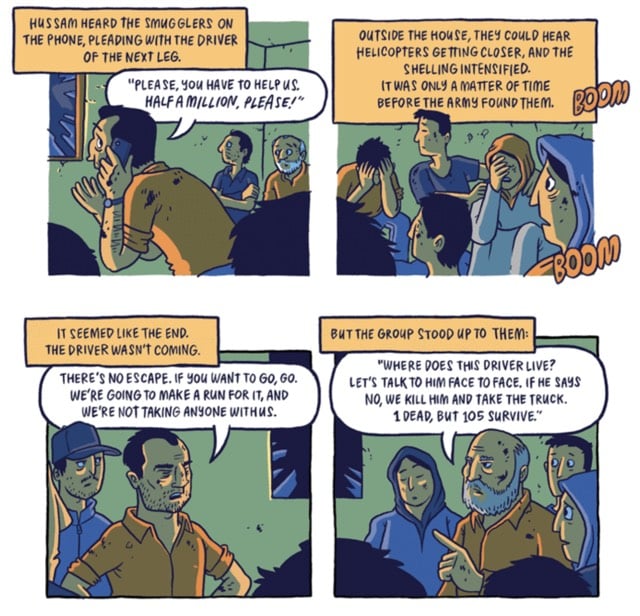
From comic artist Toby Morris, a harrowing tale of Hussam and his family, who escaped the civil war in Syria to a refugee camp in Jordan.
Socials & More