Entries for June 2016
Gary Hustwit, director of Helvetica and Objectified, is directing a movie on legendary product designer Dieter Rams. Here’s the Kickstarter campaign.
This Kickstarter campaign will fund the film and also help to preserve Dieter’s incredible design archive for the future. There’s a trove of drawings, photographs, and other material spanning Dieter’s fifty plus years of work, and it needs to be properly conserved.
To that end, we’re working with the Dieter and Ingeborg Rams Foundation to help them catalog, digitize, and save these documents. The public has never seen most of this material, and we intend to share some of these discoveries with our backers during the process of making the film.
Rams’ designs have influenced an entire generation of designers, including one Jony Ive from a small company called Apple.
They race motorcycles with sidecars and it is the nuttiest thing: the sidecar passengers throw themselves all over the place in order to shift the center of gravity of the bike in the turns. (via digg)
Update: Ok, Sidecar Motocross might be even nuttier:
(thx, david)
John Green shares delightful and interesting stories about 21 of the world’s most famous houses, including the Playboy Mansion, Winchester Mystery House, and Graceland.
The Bear Jew. Hugo Stiglitz. The Jew Hunter. Bridget von Hammersmark. Names, identity, and personal reputation management are important elements in Inglourious Basterds, as they are in all of Tarantino’s films (Vincent Vega, our man in Amsterdam; Mr. Pink; The Bride / Beatrix Kiddo / Black Mamba). In this video essay, Drew Morton shows how Tarantino’s characters assert their identities over and over again, with varying results.
First of all, they’re not actually black. (They’re orange.) They capture more than 80 types of on-board information, including the last two hours of cockpit voice communications. And someday, they might get replaced by uploading data to the cloud (a secure cloud, one hopes).
Aaron Christian shot footage of the fashionably dressed gentlemen attending the Pitti Uomo menswear trade show and paired it with David Attenborough-esque commentary about peacocks.
Unlike the cues outside of the city shows, where photographers have a few seconds to snap their favourite look. Pitti Uomo is a four day long menswear trade show, in Florence, Italy.
It’s a vast space where attendees spend all day walking around, visiting stands, eating in the sun or catching up with fellow fashion colleagues — and so consequently it has become a prime spot for the worlds top street style photographers to document and shoot some of the most stylish men on the planet.
It’s become a peacock parade where the men show off their outfits in all their glory hoping to get snapped by the top photographers.
It’s quite comical, the way the fully grown men pace around subtly trying their best to get snapped, and it’s the perfect location for this wildlife style mockumentary to take place.
Icelandic band Sigur Rós is doing a live slow TV event: a broadcast of a drive around the entirety of Iceland with a soundtrack generated by software based on a new song of theirs.
driving anti-clockwise round the island, the journey will pass by many of the country’s most notable landmarks, including vatnajökull, europe’s largest ice-sheet; the glacial lagoon, jökulsárlón; as well as the east fjords and the desolate black sands of möðrudalur.
the soundtrack to the journey is being created moment-by-moment via generative music software. the individual musical elements of unreleased song, and current sigur rós festival set opener, óveður, are seeded through the evolving music app bronze, to create a unique ephemeral sonic experience. headphones, external speakers and full-screen viewing are recommended.
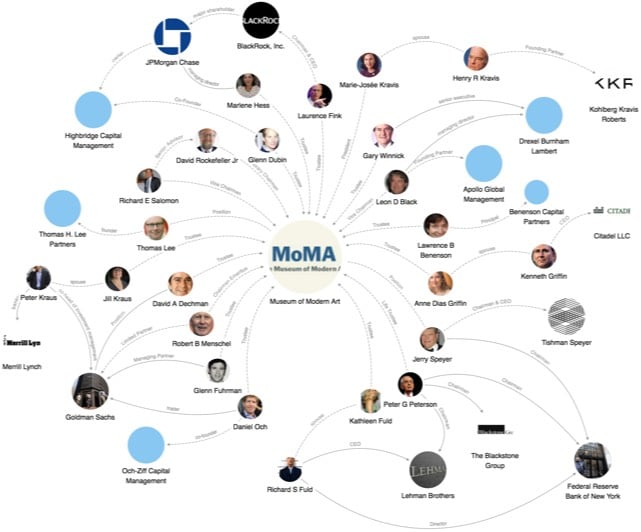
LittleSis is a freely available database that documents personal and business connections in the worlds of government and business. For instance, here’s George Soros. And Dick Cheney. Love the Lombardi-esque influence maps. (via @kellianderson)
(P.S. Does anyone remember the name of a similar project done in Flash many years ago by one of the hotshot Flash developers? Can’t find it…)
Update: The Flash site was They Rule by Josh On “with the indispensable assistance of LittleSis.org”. Well, how about that. (via @ajayskapoor)
Morning of Owl is a dance crew from Korea and they are from The Matrix, I think?
How did you do that? You moved like they do. I’ve never seen anyone move that fast.
Amazing athleticism and coordination. (via @aaroncoleman0)
Two hydroelectric dams on the Elwha River in Washington were removed in order to restore the river’s ecosystem — in particular, the salmon habitat. It was the largest dam removal in the US history and, as the video explains, has been successful so far in attracting fish back to its waters. But for our purposes here today, the first 30 seconds shows how the dams were unbuilt and the rivers reshaped.
See also this time lapse of another Washington dam being disabled and its reservoir drained:

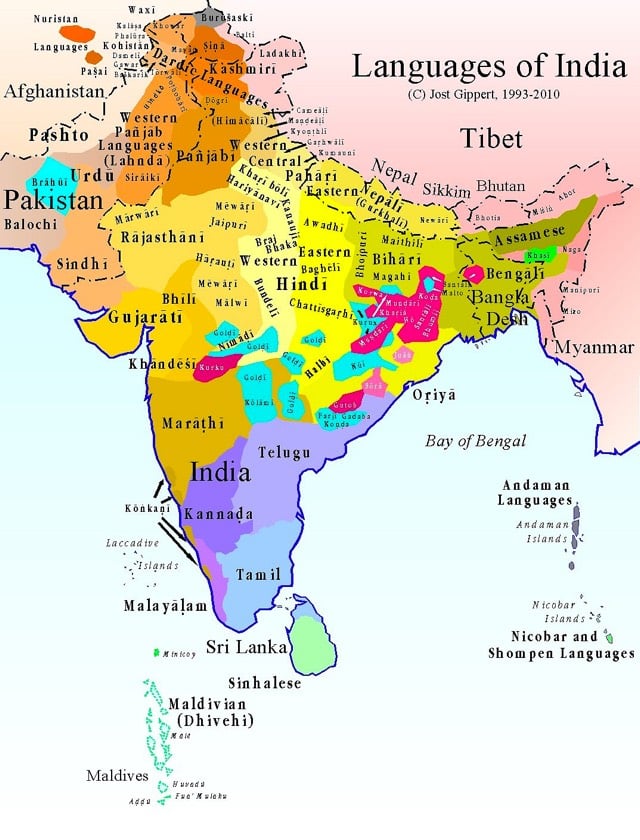

Tim Merrill is using Pinterest to collect maps showing where ethnic groups live and what languages are spoken in Asia.
All greeting cards are bad, but can we agree that Father’s Day cards are particularly bad?
Cards for dads are a lot like T-shirts for toddlers: aggressively, relentlessly gendered. It’s telling many of the sports-themed cards look like wallpaper you might find in a child’s bedroom. As it turns out, the blue-is-for-boys, pink-is-for-girls anxiety doesn’t end in childhood. Now it’s beer-is-for-dads, wine-is-for-moms. To that end, Mother’s Day cards aren’t much better — hope you like flowers! — but there’s something striking about cards for dads, as though they exist to remind dads they are Manly Men Who Like Things For Manly Men, As Randomly Determined By Popular Culture.
A greeting card is a strange commercial product for lots of reasons, not least because of agency problems. By definition, the person buying a card is pretty much never the person whom it’s for. Add in whatever traditions are associated with the occasion, gaps in power or familiarity between the gifter and giftee, and it’s practically a recipe for people to tighten up and go super-conservative.
This does remind me of a thread in the webcomic Achewood where Roast Beef is inspired to create his own line of greeting cards for everyday occasions. By the end, he and his friend Ray are coming up with “Dude-to-Dude” cards like “Dogg Let’s Go Eat Dishes With Chorizo When Our Ladies Aren’t Around” or “Dogg It Must Feel Sick As Hell To Recieve A Card From A Dude.” (If I were to ever receive either of these cards from my son for Father’s Day, I’d be thrilled.)
About a hundred years ago, a tiny asteroid making its way around the sun got caught in Earth’s gravity well. Now it’s locked in an irregular orbit far around our planet, between 38 and 100 times the distance between the Earth and its proper moon.

As it orbits the sun, asteroid 2016 HO3 spends about half of the time closer to the sun than Earth, and passes ahead of our planet. The other half of the time it falls behind.
It’s also in a tilted orbit, which causes it to weave up and down on the orbital plane like a bob on choppy waters. As NASA’s Paul Chodas put it in a press statement, “In effect, this small asteroid is caught in a little dance with Earth.”
In another couple of centuries, the asteroid will probably get far enough away that it’ll leave Earth behind forever. I wonder how many times this has happened — how many times the asteroids have been bigger, closer, but still not big or close enough to stay.
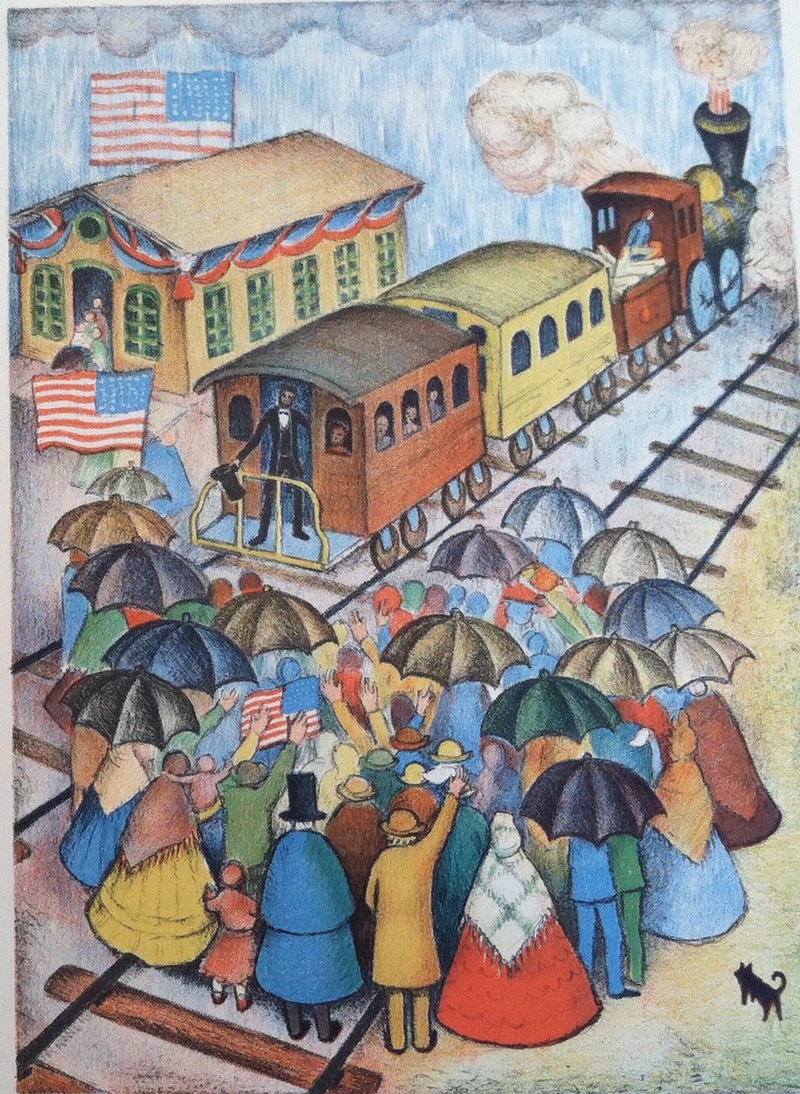
Ingri and Edgar Parin D’Aulaire, a married team of writer-artists, are best known for their popular late works on Greek and Norse mythology. (After Calvin and Hobbes, D’Aulaires’ Book of Greek Myths was probably the most important book of my childhood.) But after some early works on Norse folktales (Ingri was Norwegian, Edgar German/Swiss; they met in Germany and emigrated to the US in the 1920s), the D’Aulaires made a series of award-winning books on American history and folklore, much in the mythic, dreamy style of their later work.
Like any mythological hero, the D’Aulaires’ George Washington has powers beyond those of ordinary men. He’s stronger than other boys and rides his horse more skillfully. He can hurl a rock across the width of the river. He’s shot, but unharmed. Lincoln is also demigod-like, when they tell of how he “wrestled with the strongest and toughest of them all, and threw them to the ground.”
Veronique Greenwood’s story on a new method to infer someone’s physical appearance from DNA evidence doubles as a skeptical mini-history of forensic science:
In 2009 the National Academy of Sciences released a blistering report calling into question the scientific validity of the analysis of fingerprints, bite marks, blood spatters, clothing fiber, handwriting, bullet markings, and many other mainstays of forensic investigation. It concluded that with one exception [DNA evidence], no forensic method could be relied on with a high degree of certainty to “demonstrate a connection between evidence and a specific individual or source.”
And even with DNA, it’s tricky. The common theme: academics doing pure research have a better track record than criminal investigators trying to prove or crack a case, or companies trying to develop a product. (See also: everything.)
Not everyone can distinguish between left and right. Besides natural affinity (or lack of it), health, drug use, other chemical changes, and stress can all cause our basic body compass to break down.
Telling left from right necessitates complex brain processes that include spatial perceptions, memory, language, and the integration of sensory information. The task is made increasingly complex when a person must identify laterality on someone else. Yoga teachers and other fitness instructors have it extra rough: While calling out to students to bend their left knee, the instructor has to raise their own right to mirror the class…
However, the field under the most pressure to avoid lateral confusion is medicine. In the dentist’s chair, there’s money wasted when hygienists x-ray the wrong tooth. It’s even worse when a left-right-disoriented dentist pulls one or more teeth from the incorrect side of the mouth. It’s even more serious in general surgery: A 2011 report estimates that there are 40 wrong-site surgeries done weekly in the U.S., and many of those involve mixing up a patient’s left and right. This is a devastating problem: If a doctor removes the healthy kidney and not the cancerous one, the results can be fatal. Wrong eye? Now we have a fully blind patient.
There’s nothing inherent about left, right, up, and down — or what are sometimes called “egocentric coordinates.” Speakers of Guugu Yimithirr in Australia famously use a coordinate system that leans much more heavily on absolute geocentric references at right angles (their equivalent of north, south, east, and west).
This plays a little easier when you’re playing off objects with fixed positions, like landmarks, or especially, the sun, than it does in big twisty-turny cities. But you could imagine in a world with ubiquitous handheld maps and compasses that a north/south/east/west orientation might make more sense.
What’s more, some of the old tech people used to train themselves to distinguish or remember left and right — miming handwriting, or wearing a wristwatch on one arm — aren’t as common or dominant as they once were. See also: distinguishing angular position by analogy with the face of an analog clock.
Either we come up with new tricks and new metaphors, or it’s conceivable that what’s seemed like an intuitive, natural way to think about the relative position of bodies in space could become a whole lot less intuitive for more and more people.
I love James Joyce’s Ulysses, spent a huge chunk of my life in grad school trying to figure out that book, still follow a ton of modernist scholars and Joyce freaks on social media, and even I managed to forget that today was Bloomsday, the anniversary of Stephen Dedalus and Leopold and Molly Bloom’s treks across Dublin in that book.
I also love Star Trek: The Next Generation, probably even more than I do James Joyce, and I had no idea that today was also “Captain Picard’s Day,” when the children on the Enterprise honor him (and make him deeply uncomfortable) by presenting him with arts and crafts.
What I needed (for a peculiar definition of “need”) was a calendar plugin, something to put the anniversary of Terminator 2’s Judgment Day, The Simpsons’ Whacking Day, and Roy Batty’s inception date directly into my stream of doctor’s appointments, scheduled phone calls, NBA games shown on broadcast basic cable, and Facebook friends’ birthdays.
And that’s exactly what the staff at Atlas Obscura made: a pop culture calendar of imaginary holidays. It doesn’t solve real problems, unless those problems include properly commemorating The Purge. But it is pretty fun.
When did America break your heart? For @tressiemcphd, it was the Rodney King beating
Gravitational waves from two colliding black holes were first detected last September and announced in February. This week, the same science team announced a second wave detection of two smaller black holes in December.
If the first one confirmed the long-held predictions of general relativity, the new detections are a signal to get started on some all-new science.
A black hole’s gravity is so strong that even light can’t escape, so black holes are essentially impossible to see with telescopes. But they do give off gravitational waves.
“Light’s always been how we do astronomy,” Professor Jo Dunkley, an astrophysicist at Oxford University who didn’t work on the experiment, told BuzzFeed News. “Everything we know about space, we’ve got from light. This can show the stuff you can’t see with light.”
Counting black holes, combining telescope with gravitational measurements to better understand neutron stars, all the usual origin-of-the-universe stuff.
If gravitational waves don’t require cataclysmic collisions between enormous black holes for us to measure them, but can be detected on the regular, we can use them to try to figure out a whole lot more than just whether or not Einstein was totally right. That is a very nice tool to have in your pocket.
Adam Summers is a biomechanist who worked as a consultant on fish behavior and anatomy for Pixar’s Finding Nemo and its sequel, Finding Dory. How do you figure out where and how to stick to the known science (or sneak it in sideways) in a movie about talking fish? It’s not an easy question to answer.
This question is very important for the entertainment industry: does it matter whether you’re right, when you’re telling a story to entertain? Under some circumstances, I don’t think it matters. But with an animated movie about real, living systems, when you use the truth — their complexity and beauty — as a springboard for the story, you add a level of gravitas that is vitally important to creating a broad and deep appeal. A young audience is much more sophisticated than you think, and a story informed by a lot of facts alerts them to the presence of real concepts. I got an e-mail from an eight-year-old about Finding Nemo, explaining that characters could not emerge from a whale’s blowhole if they were in its mouth, because there is no link between the trachea and the oesophagus.
There are over 100 inaccuracies in Finding Nemo, but Summers says only one is a genuine error. (He doesn’t name it, but it might be Mr. Ray, who lists names of classes in his song about aquatic species.) Everything else, from the whale’s blowhole to ignoring clownfish’s ability to switch between male and female (although what if Marlin does become female, but just never spawns again?) is an intentional gloss or omission for storytelling purposes.
Or aesthetic ones. “The claspers — external, stick-like sexual organs on sharks — were cut off Bruce the great white shark,” says Summers, “not because of family values, but because he’s spherical, and when you add a bunch of sticks to spherical sharks, they look really stupid.” Noted.
Summers admits there’s also just a lot about the species in Pixar’s fish movies that nobody really knows.
They did ask me some questions about the biology of whale sharks (Rhincodon typus) that we just don’t know the answers to. It’s the largest fish in the sea, yet I think there’s just one record of a pregnant female, which revealed that they can have more than 300 pups at a time. That’s not much to know about the reproductive biology of such an iconic fish.
It’s a throwaway line in a longer talk and we probably shouldn’t make too much of it, but I will anyway.
In five years time Facebook “will be definitely mobile, it will be probably all video,” said Nicola Mendelsohn, who heads up Facebook’s operations in Europe, the Middle East and Africa, at a conference in London this morning. Mark Zuckerberg, Facebook’s CEO, has already noted that video will be more and more important for the platform. But Mendelsohn went further, suggesting that stats showed the written word becoming all but obsolete, replaced by moving images and speech.
“The best way to tell stories in this world, where so much information is coming at us, actually is video,” Mendelsohn said. “It conveys so much more information in a much quicker period. So actually the trend helps us to digest much more information.”
Maybe this is coming from deep within the literacy bubble, but:
Text is surprisingly resilient. It’s cheap, it’s flexible, it’s discreet. Human brains process it absurdly well considering there’s nothing really built-in for it. Plenty of people can deal with text better than they can spoken language, whether as a matter of preference or necessity. And it’s endlessly computable — you can search it, code it. You can use text to make it do other things.
In short, all of the same technological advances that enable more and more video, audio, and immersive VR entertainment also enable more and more text. We will see more of all of them as the technological bottlenecks open up.
And text itself will get weirder, its properties less distinct, as it reflects new assumptions and possibilities borrowed from other tech and media. It already has! Text can be real-time, text can be ephemeral — text has taken on almost all of the attributes we always used to distinguish speech, but it’s still remained text. It’s still visual characters registered by the eye standing in for (and shaping its own) language.
Because nothing has proved as invincible as writing and literacy. Because text is just so malleable. Because it fits into any container we put it in. Because our world is supersaturated in it, indoors and out. Because we have so much invested in it. Because nothing we have ever made has ever rewarded our universal investment in it more. Unless our civilization fundamentally collapses, we will never give up writing and reading.
We’re still not even talking to our computers as often as we’re typing on our phones. What logs the most attention-hours — i.e., how media companies make their money — is not and has never been the universe of communications.
(And my god — the very best feature Facebook Video has, what’s helping that platform eat the world — is muted autoplay video with automatic text captions. Forget literature — even the stupid viral videos people watch waiting for the train are better when they’re made with text!)
Nothing is inevitable in history, media, or culture — but literacy is the only thing that’s even close. Bet for better video, bet for better speech, bet for better things we can’t imagine — but if you bet against text, you will lose.
In today’s post on “What is barbecue?” I skipped past “is a hot dog a sandwich?” so quickly that I forgot to answer the question. So in the same spirit in which someone can boldly declare that only smoked, slow-cooked pork is barbecue, here is my minimal definition of a sandwich:
A sandwich is any solid or semi-solid filling between two or more slices of bread. Not a roll, not a wrap, not a leaf of lettuce: sliced bread. What is inside far less than the container.
Consequently:
- A hot dog is not a sandwich.
- A burrito is not a sandwich.
- A wrap is not a sandwich.
- A cheeseburger on a roll is not a sandwich. Sliced bread only.
- A lobster roll is not a sandwich.
- A hoagie is not a sandwich.
- An ice cream sandwich is not a sandwich.
- A hot turkey sandwich is not a sandwich.
- An open-faced sandwich is not a sandwich.
- If you make a sandwich using one end of the bread and one proper slice, it’s kind of a sandwich still, but not really. See also folding over a single slice of bread for a half-sandwich.
- If you make a sandwich using both ends of the bread, it is no longer a sandwich at all.
- A peanut butter or grilled cheese sandwich is a sandwich.
- A mayonnaise, butter, or ketchup sandwich is probably a sandwich — I’m not sure whether those fillings are solid enough — just not a very good one.
- A sandwich made with crackers instead of bread is not a sandwich, but an imitation of a sandwich.
- A sandwich made with crackers between two slices of bread is a sandwich, but not a very good one.
Alternatively, “sandwich” is a family-resemblance concept and we can’t appeal to definitional consistency to get away from the fact that language is a complex organism and its rules don’t always make perfect sense.
(PS: I do not speak for Jason or Kottke.org on this matter, please do not argue with him about sandwiches)
Update (from Jason): Boy, you leave Tim to his own devices for a few hours and he establishes the official kottke.org stance on sandwiches. [That new emoji of the yellow smiley face grabbing its chin and looking skeptical that you might not have on Android IDK I’m Apple Man] I was just talking to my kids the other day about this important issue and Ollie, who is almost 9, told me that both hamburgers and hot dogs are sandwiches because “the meat is sandwiched in between the bread; it’s right there in the word”. When Ollie and Minna take over the family business in 2027, they can revisit this, but for now, Tim’s definition stands.
Update: Tim’s definition has been weakened further. In talking with Stephen Colbert, Justice Ruth Bader Ginsberg asserted that a hot dog is a sandwich.
At Eater, Chris Fuhrmeister hits on another topic near to my amateur linguist heart: policing the word “barbecue”:
When it comes to American barbecue — I certainly won’t attempt to set ground rules for other barbecue cultures across the globe — there are absolute rights and wrongs. Sure, there’s some room for interpretation, but good-intentioned “barbecue” lovers across this country are blaspheming day in and day out. Before declaring what barbecue isn’t, it’s best to define what it is: pork that’s slow-cooked with smoke.
This is controversial, because “barbecue” is also used to mean:
- n. other slow-cooked smoked meats, e.g., beef
- v. the act of cooking or eating such meats,
- v. grilling anything outdoors,
- n. an outdoor grill
- a. a type or flavor of sauce, potato chips, and other foods
- and so forth.
It’s also odd because, as Fuhrmeister notes, it’s an American controversy, and Americans tend to play faster and looser with food words than people elsewhere. Cognac has to be from Cognac, champagne from Champagne, and so on. Americans have lots of different regional words and practices when it comes to food (soda vs pop, sub vs hoagie, etc.), and we’re definitely competitive when it comes to where and how food is made best, but we’re generally pretty pluralist about definitions. Which is probably why “barbecue” has metastasized to mean so many different but related things.
I tried to come up with a shortlist of honest-to-goodness American food word debates.
- What is barbecue?
- Is a hot dog a sandwich?
- Is Chicago-style pizza really pizza?
- Is it donut or doughnut?
- Is a wrap a burrito?
- Why do we say “chai tea” when “chai” means “tea”?
From here you start to get into all the ways Americans abuse imported food words, which is a much longer list. British English also has a debated distinction between cake and biscuit that I don’t fully understand. Some of us like “is a patty melt a hamburger?,” because the ontology of hamburger is pretty complex stuff. But this is enough to get started.
Donut/doughnut is a straight-up style dispute, and doesn’t have anything to do with definitions. “Are hot dogs sandwiches?” is almost too much about definitions — there’s no history, no implied values, or real stakes. Chicago vs NYC pizza is a regional value rivalry posing as a definitional one: press people, and they’ll say, “yeah, what they make is pizza, it’s just not as good as ours.”
Barbecue is the debate that has everything. It’s a regional rivalry with value attached to it, that’s making definitional claims. And there are so many possible distinctions! Texas and Carolina partisans might unite to reject “barbecue” to mean “cookout,” but fall apart again over the merits of beef vs pork. You can even vote on it; the voting will decide nothing. It is an infinite jewel.
“Mx.” (pronounced “mix” or “mux”) is a gender-neutral honorific. It’s used by people who don’t want to be identified by gender, whether their gender identity isn’t well-represented by the older forms, or they just don’t want to offer that information or assume it when addressing someone else. “Mx.” was added to Merriam Webster’s unabridged dictionary in April, has begun to be used on official forms in the UK (the Royal Bank of Scotland has been an early adopter), and appeared in two recent stories in the New York Times, once as a preferred honorific for a Barnard College student who doesn’t identify as male or female, and once in a story about “Mx.” itself.
Linguistic experts say it is harder to change usage habits of words uttered frequently in speech, such as “she” and “he.” But a realignment in honorifics may be more quickly achieved because courtesy titles are less often spoken than written, like in the completion and mailing of government, health care and financial documents, as well as in newspapers and other media publications.
This second story, quoting Oxford University Press’s Katherine C. Martin, also notes that some of the earliest uses of “Mx.” were in the 1980s, “when some people engaged in nascent forms of digital communication and did not know one another’s gender.”
Likewise, “Latinx” aims to be more comprehensive and more inclusive than the older terms Latino and Latina. “The ‘x’ makes Latino, a masculine identifier, gender-neutral,” writes Raquel Reichard. “It also moves beyond Latin@ - which has been used in the past to include both masculine and feminine identities - to encompass genders outside of that limiting man-woman binary.”
This lights up my amateur linguist brain in all sorts of ways, but here’s one of them: the telescoping (maybe kaleidoscoping?) between usage, in all its messiness, and forms, in their desire for clear standards and finite options.
You can break that down further into usage within a community or group versus usage outside that community, and the formal protocols a publication like a newspaper or dictionary might follow versus paperwork or a database run by a business or government office. They all interplay with each other, and linguistic change happens or doesn’t happen through all of them.
And I guess the last thought is about how digital culture, by expanding and transforming the kinds of communities, identities, forms, and publications that are possible, can accelerate those changes or hold them back.
This tweet by NBC News is a good example: the tweet uses “Latinx” (and “Hispanic”) — the linked story, like the name of the news vertical and twitter account, overwhelmingly uses “Latino,” in both the body and the headline.
Or take Planned Parenthood. Many of the health provider’s affiliates have updated their intake forms and other paperwork and communication. The new language is more gender-neutral, gender-inclusive, and more specific, separating anatomy, sexual activity, and gender identity. The national office is working on a new style guide to help other affiliates make their own changes.
Language about certain kinds of birth control has changed as well. “Male condoms” and “female condoms” are now referred to as internal and external condoms at Planned Parenthood of New York City.
“The language we’re using today reflects the fact that gender is a spectrum and not a simple system, a binary system of male and female,” says [PPNYC’s Lauren] Porsch. “We really talk about having sexual and reproductive health services: women who have penises, men who have vaginas, and there are people with all different types of anatomy that may not identify with a binary gender at all,” she says.
Again, while the changes eventually get reflected in Planned Parenthood’s intake forms and other official language, it was implemented early in digital and social media — specifically, in response to users on Tumblr.
“The Tumblr audience is smart. They understand feminism. They understand that sex ed isn’t one-size-fits-all—even though that’s what they were taught in school,” says Perugini. “And they know that words matter. They didn’t see themselves reflected in the language we were using on our social media pages or our website, and they let us know.”
This is happening. It’s happening in progressive, diverse, digital communities first. And for all their fractiousness, and the inherent difficulty in dealing with areas as complex and personal as identity, gender, and sexuality, it does feel like some standards are emerging. These are words worth watching. If you work with digital technology and people (and yeah, that’s almost everyone), I hope you’re paying attention.
Fake trees to pull carbon dioxide out of the air, sun shields to deflect heat and radiation without damaging the atmosphere, giant ice cubes mined from comets to cool down the oceans. Okay, that last one is from a Futurama episode. But some researchers really do think we can try to slow or reverse climate change with technology built for that purpose — and that we’ve already changed the Earth’s environment so much that we may have no choice. I guess it’s worth a try.
This essay by astrophysicist Adam Frank in the New York Times is upbeat, confident: “Yes, There Have Been Aliens.” Basically, he argues that we’ve now observed enough Earth-like planets outside our solar system that unless the odds of life (and intelligent life, and intelligent life capable of radio communications, etc.) coming into being are much, much smaller than most scientists have believed, then alien civilizations that are at least something like our own have appeared before elsewhere in the galaxy.
But! Frank and his colleague Woodruff Sullivan get to this conclusion in a way that’s pretty distressing. They relax any assumptions about how long such a civilization might last.
See, if you’re trying to figure out the odds of contact between humans and aliens, you need to have some idea about how long alien civilizations stick around. If, in general, civilizations last a long time and keep moving up the Kardashev Scale, they’re more likely to bump into each other. If, on the other hand, they usually wipe out their own species with nuclear weapons, global climate change, gamma rays, or (insert calamity here) shortly after getting a little light industry going, then they’ll keep missing each other.
In his treatment of the Fermi Paradox, Tim Urban calls this “The Great Filter.” We don’t know if the Great Filter is ahead of us or behind us. If it’s behind us, then complex/intelligent life is super rare — much smaller than even Frank and Sullivan’s consensus low estimates. If it’s ahead of us, then we, or any other species lucky enough to make it this far, will most likely die off or (best case scenario) get stuck more or less where we are now.
In short, humanity may not be first, but it might very will be next.
My friend Matt Thompson grew up in Orlando, and like many of the shooters’ victims, he’s gay, a person of color, and a child of immigrants to the US. His wonderful essay grapples with the shooting and tries to untie the fear and risk and hope and community that’s knotted up in those identities.
My own parents were the very last people in my life I was out to, years after I’d been out to friends and colleagues. I didn’t know how they’d react to the fact of my sexuality, and among my friends, there was often impatience with that uncertainty. If they’re good parents, these friends would say, they will love you without conditions and without hesitation.
But this reaction was rare among those of us who grew up, like me, knowing that our parents left their homes and settled here mainly in pursuit of visions of what their children’s lives would be. They had imagined their sons as men with wives, and their daughters as women with husbands, and cultivated these visions throughout our adolescence and beyond. Some of our parents had tended to these visions so zealously that they missed all the signs that these weren’t, in fact, the people we’d become. When we came out, they were forced both to reckon with these people they no longer recognized and mourn the visions of us they had nurtured all those years.
“I can’t stop thinking about the possibility that someone like us was hurt or murdered at Pulse on Sunday morning,” Matt writes. “outed in the very worst way, in a phone call every family dreads. For some parents, such a call would be a double heartbreak.”
This is fun: an oral history of Ghost Town DJ’s 1996 hit “My Boo.” Did you know that Lil Jon started out in A&R for So So Def? Or that he picked the title “My Boo” over “I Want To Be Your Lady” and pushed to include it on an early label comp? (I did not.)
I was also very late to hear about the Running Man Challenge, which put “My Boo” back into circulation and the sales charts back in April, but in my defense: I am old.
You may also like: this oral history of hyphy and the Bay Area hip-hop scene at the turn of the millennium. It’s a little distended and the photo layout almost feels like Beats By Dre sponsored content, but it’s a loving look at a moment that’s gone.
And who shows up halfway through, helping to break hyphy nationwide? Lil Jon! That guy is everywhere.
(Hat-tip: @xohulk, @myhairisblue)
Microsoft is buying LinkedIn, and I can’t think of anyone I’d rather read thinking through what that might mean more than Paul Ford.
Microsoft is a software company, sure, but it’s also a bit of a nation-state with an enormously broad mandate. LinkedIn is an unbelievable data-mining platform; it has the ground truth about the global economy, especially around the technology industry, and it has a lock on that data. Microsoft will know what’s going with Facebook before Zuckerberg does; it’ll know what skills are being added to Googlers’ resumes; it’ll know what kind of searches HR departments are doing across the world, and it can use that information to start marketing its own services to those companies…
It’s…terrifying. And we’ll never really know what’s going on. Which makes it kind of brilliant. But still terrifying.
Filled with straightforward observations (hey, Microsoft now has a huge, well-targeted advertising network to match Google’s and Amazon’s) to delightfully bizarre ones, like LinkedIn’s secret synergy with Minecraft (!), 9 Things Microsoft Could Do With LinkedIn blends consulting memo, standup routine, and Borgesian counterfiction. I’ve always aspired to this sort of thing, and Paul just rattles it off. Dang it.
Mister Softee used to dominate ice cream sales on Manhattan’s streets. Now Midtown is run by a splinter group called New York Ice Cream, former Softee franchisees (for a little while the trucks read “Master Softee”) who cut out the overhead but kept their corners.
The New York Times ran a story about the ice cream turf wars in late May:
“Let me tell you about this business,” Adam Vega, a thickly muscled, heavily tattooed Mister Softee man who works the upper reaches of the Upper East Side and East Harlem, said on Wednesday. “Every truck has a bat inside.”
Mr. Vega, 41, said that if he comes across a rival on his route, “I jump out and say, ‘Listen young man, this is my route, you gotta get out of there.’”
The same day that story was printed, a New York Ice Cream driver was arrested for attacking a pretzel vendor in Midtown with a baseball bat.
This week, Crain’s New York had a deep-dive into the nitty-gritty of NYC food carts, from managing licenses and fees, dealing with wholesalers, appealing tickets, and paying taxes. The wholesalers run out of Hell’s Kitchen; the expediters and permit brokers are in Astoria.
A thousand and one systems, legal, quasi-legal, and extra-legal, overlapping each other like nervous and circulatory networks in a body. All of the unseen navigation that makes a city run.
Tesla has two cars, the S60 and the S75, that are physically more or less identical, but one costs $8500 more than the other. The cheaper car ($66K base price) has a software block on its battery which limits its range to 208 miles on a full charge. Pay $8500 up front, or $9000 for an over-the-air update later, and you get an extra 40 miles.
Same car, same battery. About 20 percent more efficient, for $9000. Better software license.
Cars are big computers, and have been for a while, but we’re slowly starting to treat them like it. Different expectations, different pricing, different ownership structures, different usage; different everything.
Here’s another story on managing expectations for cars, about steering wheels. Steering wheels have a basic function; they control the car. But if a car is capable of driving itself, and is also an interface for a wide range of general computing tools, what does that mean?
Volvo’s Concept 26 vehicle, which debuted in November at the Los Angeles Auto Show, features a retractable steering wheel. Robin Page, Volvo chief of interior design, says Volvo chose to keep the familiar shape of the steering wheel.
“We wanted to keep that recognition of a round steering wheel,” he said. “People need to get used to autonomous drive, so being able to get back to that steering wheel and grab hold of it, that’s comforting. We decided to have it there as a recognizable icon.”
The steering wheel becomes a skeuomorph. It becomes a surveillance device, registering pressure to tell whether you have both hands firmly on the wheel, or if you’ve fallen asleep or are in distress. It becomes an entertainment console. It transforms and retracts into the dash to signal when you’ve shifted between user-controlled and autonomous modes. Its familiar presence soothes you through the transition. Eventually, you forget it was ever there at all.
Hello, Kottke readers! Jason has the week off, so he asked me to fill in. He’s given me the keys to the shop about once a year since 2010, and it’s always been a treat. Sometimes I have themes or a plan; this time, I have a few ideas, but I’m mostly just going to try to write loose and think through some connections. If you have any tips or see any problems, let me know (you should be able to figure out how). Please read and share and enjoy.
People are doing amazing things with motion capture these days. (via colossal)
Luc Bergeron’s Space Story is a mashup of more than 20 movies that take place in space, from Alien to Apollo 13 to 2001 to Star Trek to Moon. Stick with it for a couple minutes…it starts slow but gets going around then.
See also Star Wars x Star Trek: The Carbonite Maneuver.
[Spoilers!] This season, Game of Thrones is experimenting with time travel. A few years ago, Harrison Densmore created a chart showing the three kinds of time travel that happens in movies: fixed timeline (as in 12 Monkeys), dynamic timeline (as in Back to the Future), and multiverse (as in Terminator 2). So which kind of time travel is happening in Game of Thrones?
P.S. In addition to the extensive spoilers about what’s already happened on the show, the latter moments of the video also offers some fan theories about what might happen on the show in the future. If that sort of thing bothers you, maybe stop watching around the 4:05 mark.
Newer posts
Older posts





Socials & More