Entries for April 2014

If you have children in your home, you have likely seen the movie Frozen and heard the song Let It Go like 50 billionty times. The movie did great in the US, coming in as the 19th biggest movie ever, but it’s done amazingly well overseas: #8 on the alltime list with a $1.1 billion gross.
So it’s a no-brainer for Disney to release an album with 50 different versions of Let It Go, sung in languages ranging from Arabic to Icelandic to Romanian to Vietnamese. (via @cabel)
Update: Here’s a video of the entire song sung in 25 languages:
(via @waxpancake & @Ilovetoscore)
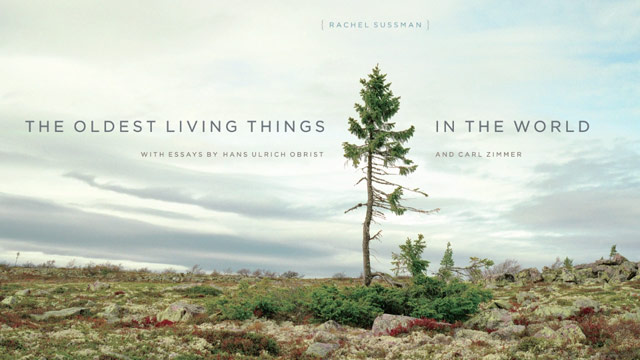
The very first Kickstarter campaign I ever backed was Rachel Sussman’s project to photograph the oldest living organisms in the world.
I’m researching, working with biologists, and traveling all over the world to find and photograph continuously living organisms that are 2,000 years old and older. I started the project 5 years ago, and have since photographed nearly 25 different organisms, ranging from the Bristlecone Pine and Giant Sequoias that you’ve surely heard of, to some truly unusual and unique desert shrubs, bacteria, a predatory fungus, and a clonal colony of Aspen trees that’s male and, in theory, immortal.
Her goal was to compile the photographs into a book. Almost four years later, the book is out. Looks like it was worth the wait. The trailer does a nice job explaining what the book is all about:
A dronie is a video selfie taken with a drone. I featured Amit Gupta’s beautiful dronie yesterday:
Other people have since taken dronies of their own and the idea seems like it’s on the cusp of becoming a thing. Here’s one taken by Joshua Works of him and his family on the shore of a lake in Nevada:
The Works clan sold most of their worldly possessions in 2011 and has been travelling the US in an Airstream ever since, logging more than 75,000 miles so far.
Adam Lisagor took this dronie of him and fellow drone enthusiast Alex Cornell standing on the roof of a building in LA:
Adam was inspired to begin playing with drone photography because of Alex’s recent video on Our Drone Future.
Have you taken a dronie? Let me know and I’ll add it to the list.
Update: Jakob Lodwick reversed Amit’s dronie from a pull back shot to a Spielbergesque close-up. This reel from Antimedia begins with a dronie. Steffan van Esch took a group dronie. This video opens with a quick dronie. I like this one from Taylor Scott Mason, if only for the F1-like whine of the receding drone:
Here’s a Powers of Ten-inspired dronie that combines a Google Earth zoom-in with drone-shot footage covering the last few hundred feet:
Adam Lisagor wrote a bit about drone photography and how photographers always come back to the human subject, no matter what format the camera takes:
There’s a reason that you’re going to see a lot of these from drone flyers like me, and it’s this: once you get past the novelty of taking a camera high up in the air, getting a bird’s eye view of stuff is actually a little boring.
What birds see is actually a little boring. Humans are interesting. Getting close to stuff is interesting. I bet if we could strap tiny cameras to bird heads, most of what we’d want to look at would happen when they fly close to people. If we could, we’d put cameras on bird heads to take pictures of ourselves.
The company that Amit runs, Photojojo, is going to start doing rentals soon, including kits for drone photography. And they’re gonna do flying lessons as well. For now, there’s a tutorial on the page about how to make “the perfect dronie”. (thx to everyone who sent in videos)
Update: More dronies from David Chicarelli, SkyCamUSA, and Bob Carey.
Update: From Joshua Works, a pair of new dronies, including one shot from a moving vehicle:
What a great way to record his family’s travels.
Update: DroneBooth is a drone photobooth project from a quartet of ITP students.
Uh oh, Donald Rumsfeld and I agree on something. Each year, with his tax return, Rumsfeld sends a letter to the IRS explaining that neither he or his wife are sure of how accurate their taxes are because the forms and tax code are too complex. Here is this year’s letter:
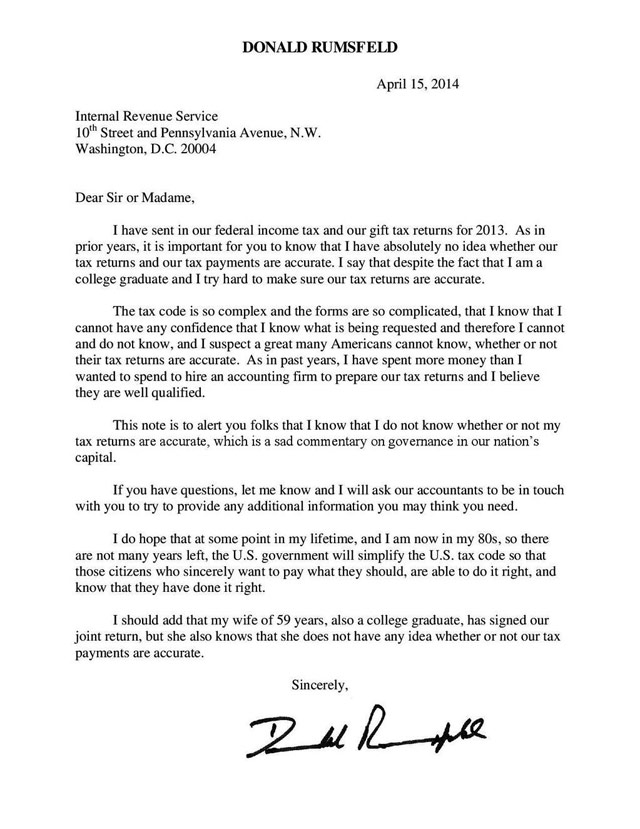
If only he had been less certain of his accuracy in an even more complex situation, like, say the whole WMD/Iraq War thing.
If Aaron Sorkin (Sports Night, The West Wing, The Newsroom) wrote a TV show featuring McDonald’s as a workplace, it might go something like this:
Top notch parody right there…you’ve got the fast dialogue, the walk-and-talks, and the patented Sorkin sermonizing.
What feels are these? Is this poignant? Disturbing? Whatever you take away from it, this video of an obviously inebriated man trying to negotiate a fence is a metaphor for something.
(via ★interesting)
Asher Svidensky’s photographs from Mongolia of apprentice eagle hunters are fantastic. (FYI, they hunt with eagles, not for them.) Among Svidensky’s subjects is a 13-year-old girl, Ashol Pan:
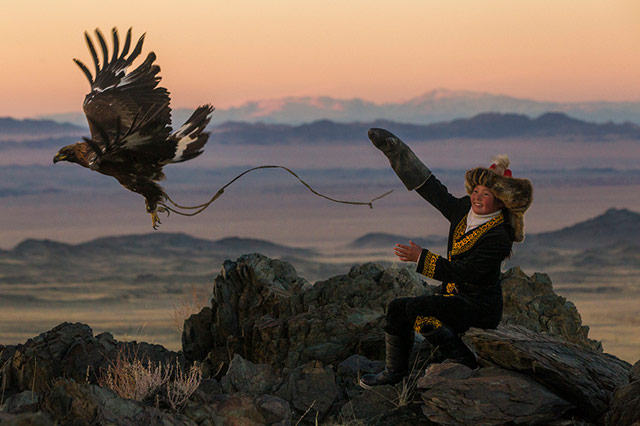
At the end of the photographing session, I sat down with her father and the translator to say my goodbyes, and I asked him this:
“How did it feel watching your daughter dressed in Kazakh uniform, on a mountain top, sending the eagle off and calling it back again?”
“Very good”
“And honestly… would you have considered truly training her? Would she become Mongolia’s first ever female eagle huntress?”
I expected a straightforward “No” or a joking “Maybe”, but after a short pause he replied:
“Up until two years ago my eldest son was the successor of the eagle hunting tradition in our family. Alas, two years ago he was drafted to the army, and he’s now an officer, so he probably won’t be back with the tradition. It’s been a while since I started thinking about training her instead of him, but I wouldn’t dare do it unless she asks me to do it, and if she will? Next year you will come to the eagle festival and see her riding with the eagle in my place.”
From the father’s answer I realized that the idea of women’s participation in keeping the tradition is a possible future, but just like many other aspect of Mongolian life, it’s an option which women will need to take on by themselves.
(via @rebeccablood)
For the past couple of months, Amit Gupta has been playing around with taking moving self-portraits with a camera mounted on a drone. Here’s an early effort. This past weekend, Amit’s efforts crossed over into the realm of art. This is beautiful:
In the comments at Vimeo, Alex Dao dubbed this type of photograph a “dronie”. We’ll see if that catches on.
Update: More examples of dronies here.
American favorites (blue jeans, whiskey, burgers) have been embraced by the Japanese, who have been turning out improved versions of the originals.
In Japan, the ability to perfectly imitate-and even improve upon-the cocktails, cuisine and couture of foreign cultures isn’t limited to American products; there are spectacular French chefs and masterful Neapolitan pizzaioli who are actually Japanese. There’s something about the perspective of the Japanese that allows them to home in on the essential elements of foreign cultures and then perfectly recreate them at home. “What we see in Japan, in a wide range of pursuits, is a focus on mastery,” says Sarah Kovner, who teaches Japanese history at the University of Florida. “It’s true in traditional arts, it’s true of young people who dress up in Harajuku, it’s true of restaurateurs all over Japan.”
It’s easy to dismiss Japanese re-creations of foreign cultures as faddish and derivative-just other versions of the way that, for example, the new American hipster ideal of Brooklyn is clumsily copied everywhere from Paris to Bangkok. But the best examples of Japanese Americana don’t just replicate our culture. They strike out, on their own, into levels of appreciation and refinement rarely found in America. They give us an opportunity to consider our culture as refracted through a foreign and clarifying prism.
Another example, not mentioned in the piece, is coffee. From the WSJ a couple of years ago:
“My boss won’t let me make espressos,” says the barista. “I need a year more, maybe two, before he’s ready to let customers drink my shots undiluted by milk. And I’ll need another whole year of practice after that if I want to be able to froth milk for cappuccinos.”
Only after 18 years as a barista in New York did his boss, the cafe’s owner, feel qualified to return home to show off his coffee-making skills. Now, at Bear Pond’s main branch, he stops making espressos at an early hour each day, claiming that the spike on the power grid after that time precludes drawing the voltage required for optimal pressure.
Back in the olden days, you just tied your cameraman right to the car:
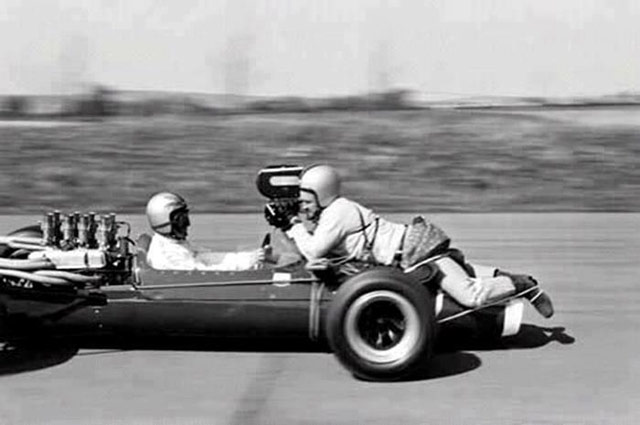
Looks almost as goofy as Google Glass. Legendary F1 driver Jackie Stewart wore this stills-only proto-GoPro at the Monaco Grand Prix in 1966 (though not during the actual race):
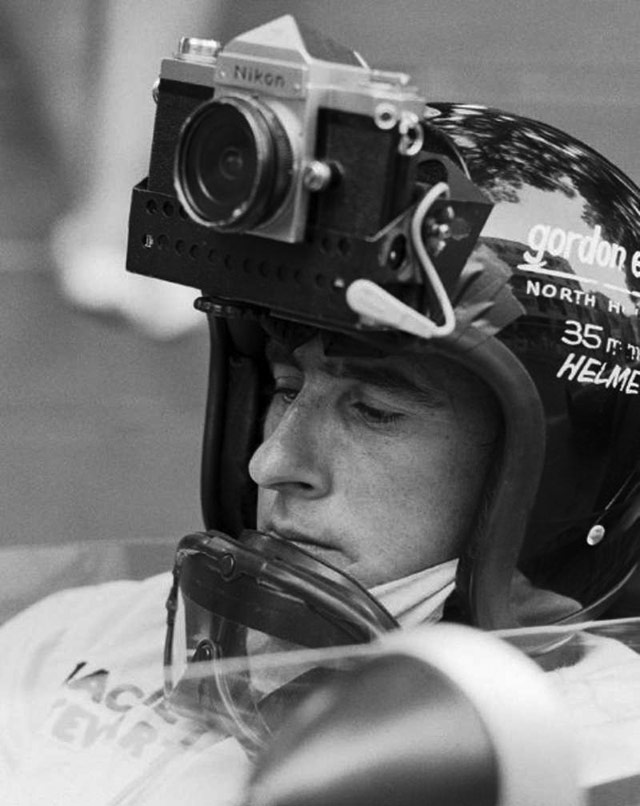
Stewart ended up winning that race. I believe Stewart is also the model for this contraption, which looks like a film camera counterbalanced with a battery pack?
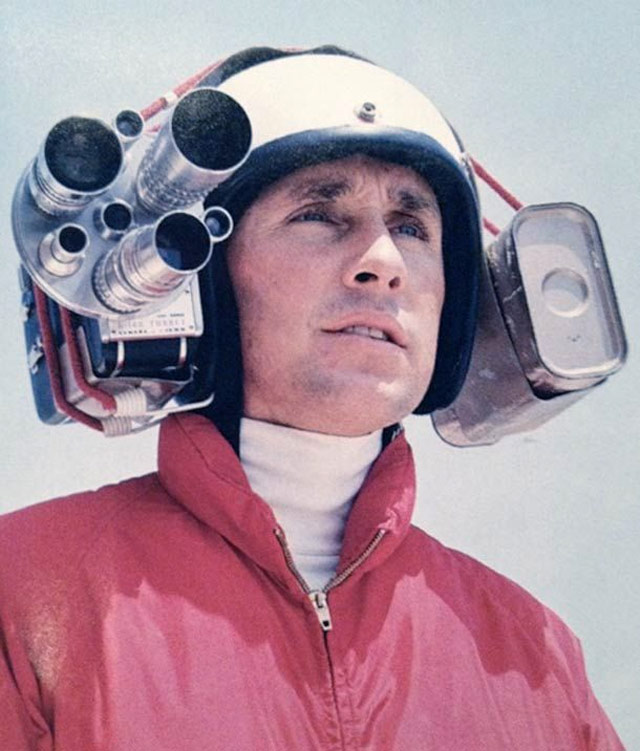
That couldn’t have been comfortable. For some reason, neither of Stewart’s helmet cams are recognized by Wikipedia as being the first documented helmet cam, which is instead attributed to a motorcycle race in 1986:

Update: Another early use of the helmet cam comes from the world of skydiving. Here’s Bob Sinclair with a camera setup from 1961:
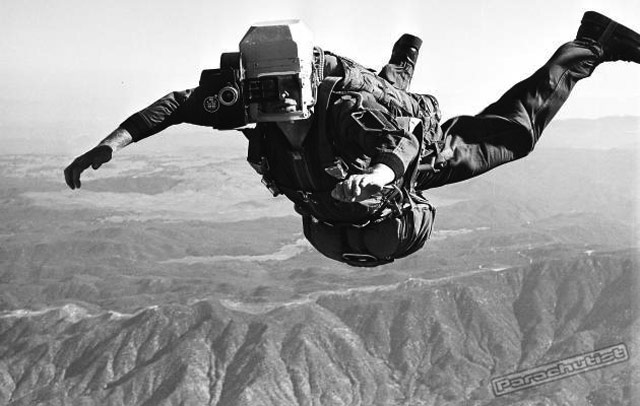
(thx, david)
Update: Not even a bulky taped-up helmet camera can keep Steve McQueen from looking cool:
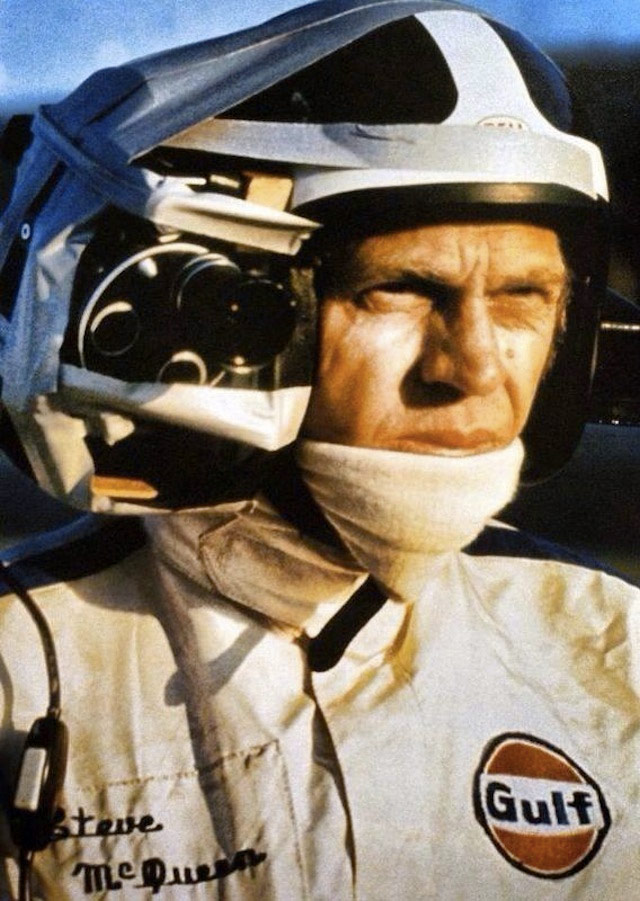
Well, he just barely looks cool. McQueen wore the helmet during the filming of 1971’s Le Mans. While researching this, I came across another film featuring McQueen that used helmet cams to get footage: 1971s On Any Sunday, a documentary about motorcycle racing. (via @jackshafer)

If you buy this digital scale on Amazon, the site assumes you might be a drug dealer. Nestled among the calibration weights listed in the Customers Who Bought This Item Also Bought section are tobacco pipe screens, rolling papers, powders for cutting drugs (I assume), zipper bags of all sizes (including some decorated with golden skulls), empty pill capsules, and even a Dr Pepper can safe.
See also the mega-packs of whipped cream chargers which are frequently purchased with balloons for the purpose of getting high. (via mr)
The US Navy is working on technology to convert seawater into fuel to power unmodified combustion engines. They recently tested the fuel (successfully!) in a replica P-51 and hope to make it commerically viable.
Navy researchers at the U.S. Naval Research Laboratory (NRL), Materials Science and Technology Division, demonstrated proof-of-concept of novel NRL technologies developed for the recovery of carbon dioxide (CO2) and hydrogen (H2) from seawater and conversion to a liquid hydrocarbon fuel.
Fueled by a liquid hydrocarbon — a component of NRL’s novel gas-to-liquid (GTL) process that uses CO2 and H2 as feedstock — the research team demonstrated sustained flight of a radio-controlled (RC) P-51 replica of the legendary Red Tail Squadron, powered by an off-the-shelf (OTS) and unmodified two-stroke internal combustion engine.
Using an innovative and proprietary NRL electrolytic cation exchange module (E-CEM), both dissolved and bound CO2 are removed from seawater at 92 percent efficiency by re-equilibrating carbonate and bicarbonate to CO2 and simultaneously producing H2. The gases are then converted to liquid hydrocarbons by a metal catalyst in a reactor system.
“In close collaboration with the Office of Naval Research P38 Naval Reserve program, NRL has developed a game-changing technology for extracting, simultaneously, CO2 and H2 from seawater,” said Dr. Heather Willauer, NRL research chemist. “This is the first time technology of this nature has been demonstrated with the potential for transition, from the laboratory, to full-scale commercial implementation.”
Discover has more, in slightly more accessible language.
Your Monday morning needs a soundtrack and Danny Elfman’s score for Errol Morris’ The Unknown Known is just the thing. Available at Amazon or on iTunes.

New from Michael Ruhlman: a cookbook about the mighty egg, “A Culinary Exploration of the World’s Most Versatile Ingredient”.
For culinary visionary Michael Ruhlman, the question is not whether the chicken or the egg came first, it’s how anything could be accomplished in the kitchen without the magic of the common egg. He starts with perfect poached and scrambled eggs and builds up to brioche and Italian meringue. Along the way readers learn to make their own mayonnaise, pasta, custards, quiches, cakes, and other preparations that rely fundamentally on the hidden powers of the egg.
Ruhlman shares a bit about the book with NPR:
But often, Ruhlman argues, we don’t treat our eggs very well. Take scrambled eggs. “It’s one of the most overcooked dishes in America,” he says. “We kill our eggs with heat.”
Instead, we need, in most instances, to give the egg gentle heat. “When you cook them very slowly over very gentle heat, the curds form. And as you sit, the rest of the egg sort of warms but doesn’t fully cook and becomes a sauce for the curds. So it should be a creamy and delicious and delicate preparation.”
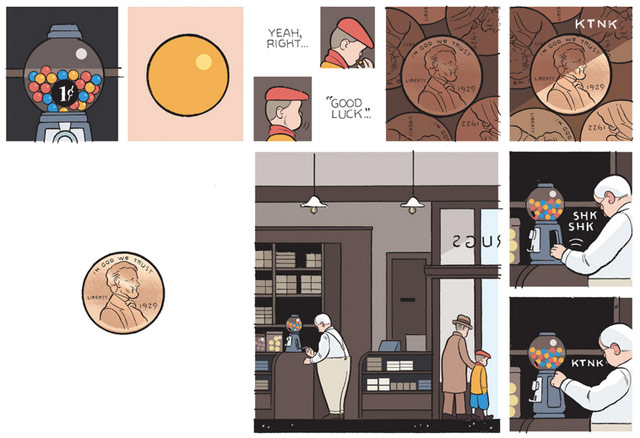
Chris Ware follows the wanderings of a penny in his latest piece for the NY Times.
Life magazine asks: Is this the happiest photo ever made?

The photo was taken by Alfred Eisenstaedt, who was covering the University of Michigan’s marching band. When some children playing nearby set off after this practicing drum major, he snapped the photo. Said Eisenstaedt, “This is a completely spontaneous, unstaged picture.”
The photographer took many notable photos — the famous V-J Day kiss in Times Square, of Marilyn Monroe, of Albert Einstein, of Joseph Goebbels — but the drum major one above and his ballet series are my favorites (particularly this one).
Recent studies show that our physical level of hunger, in fact, does not correlate strongly with how much hunger we say that we feel or how much food we go on to consume.
As Maria Konnikova reports, a lot of things can make you hungry — a song, a book, a smell, even a study.
Being genuinely hungry, on the other hand — in the sense of physiologically needing food — matters little.
In other news, Tater Tots.
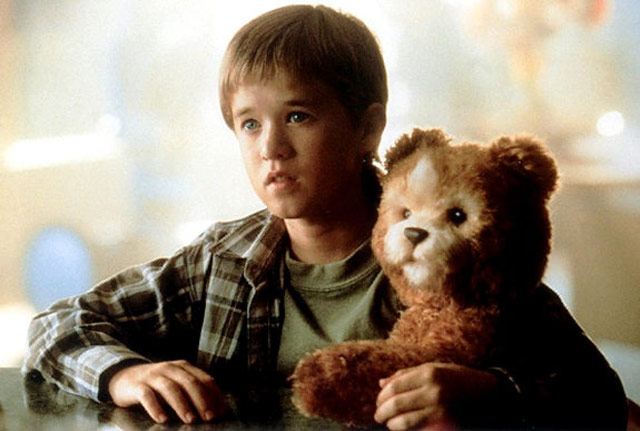
Today I learned that Hasbro released a toy based on the talking teddy bear in Kubrick/Spielberg’s A.I. W? T? F? And of course it’s super creepy:
Noel Murray has the whole story, along with an appreciation of the movie and Spielberg’s direction of it.
A.I. in particular still strikes me as a masterpiece. I thought it might be back in 2001; now I’m certain of it. But it isn’t any easier to watch in 2014 than it was before my first child was born. Like a lot of Spielberg’s films — even the earlier crowd-pleasers — A.I. is a pointed critique of human selfishness, and our tendency to assert our will and make bold, world-changing moves, with only passing regard for the long-term consequences. Spielberg carries this theme of misguided self-absorption to child-rearing, implying that parents program their kids to be cute love machines, unable to cope with the harshness of the real world. He also questions whether humankind is nothing but flesh-based technology, which emerged from the primordial ooze (represented in the opening shot of A.I. by a roiling ocean), and has been trained over millennia to respond to stimuli in socially appropriate ways. A.I. blurs the lines between human and mecha frequently, from an early shot of Monica that makes her look exactly like one of Professor Hobby’s creations, to the way Martin walks, thanks to mechanical legs.
Farnam Street is featuring a handout given by the late David Foster Wallace to his fiction writing class in 2002. It’s titled YOUR LIBERAL-ARTS $ AT WORK and covers five common usages gotchas.
2. And is a conjunction; so is so. Except in dialogue between particular kinds of characters, you never need both conjunctions. “He needed to eat, and so he bought food” is incorrect. In 95% of cases like this, what you want to do is cut the and.
In recent years, Chipotle has worked to promote their managers from within the company. And the tactic seems to be working.
The common element among the best-performing stores was a manager who had risen up from crew. So Moran started to outline a program that would retain and train the best managers, and reward them to the point where they would be thrilled to stay on.
After Flores expressed his frustration, Moran showed him his early notes for the restaurateur program, which is unique among fast food restaurants in that it ties pay and promotion to how well you mentor people, rather than store sales.
“It was a great meeting but I didn’t know what was going to happen. At most companies you meet the top execs and then you never hear from them again,” Flores says.
A few weeks after the October meeting, while vacationing in Houston, Flores got a call on his cell from Ells and Moran letting him know that he had been promoted to restaurateur and was getting a $3,000 bonus. Rather than waiting until he returned to Milwaukee to get him the check, it was delivered to him in Houston the following day. At the time his salary was around $38,000, and the bonus was meaningful.
“That’s when I knew the company was special,” Flores said.
Interesting bits of business wisdom throughout this piece.
From Wikipedia, a list of former trademarks and brands that have become generic terms. Some surprises: Heroin, Videotape, Zipper, Laundromat, Kerosene, Dry Ice, and Escalator.
Years of Living Dangerously is a 9-part documentary series on climate change which features celebrity correspondents like Harrison Ford, Oliva Munn, Jessica Alba, and Matt Damon reporting from around the world on different aspects of our changing climate.
The series combines the blockbuster storytelling styles of Hollywood’s top movie makers, including James Cameron and Jerry Weintraub, with the investigative skills of 60 Minutes veterans Joel Bach and David Gelber and a team of leading national news journalists and scientists.
Each YEARS correspondent — including top Hollywood stars recognized for their commitment to spotlighting and acting on the biggest issues of our time — delves into a different impact of climate change. From the damage wrought by Hurricane Sandy in the tri-state area to political upheaval caused by droughts in the Middle East to the dangerous level of carbon emissions resulting from deforestation, the series takes the viewer on a journey to understand the current and intensifying effects of climate change through vivid stories of heartbreak, hope and heroism.
The show starts airing on Showtime on April 13, but the entire first episode is available on YouTube right now:
The show is getting great reviews so far; I hope it helps move the needle. (thx, tobin)
Coming into this season, Formula One made a lot of rule changes: new engines, better turbo systems, two different power sources (fuel & electrical), fixed-ratio gearboxes, etc. The cars had to be redesigned from top to bottom. Whenever a situation like this occurs, there’s an opportunity for technical innovation (rather than the gradual improvements that tend to occur when the environment remains mostly unchanged). This year, the Mercedes team built their engines to get more out of the new turbo system than the other teams.
What Mercedes’ boffins have done, according to Sky Sports F1 technical guru Mark Hughes, is split the turbo in half, mounting the exhaust turbine at the rear of the engine and the intake turbine at the front. A shaft running through the V of the V6 engine connects the two halves, keeping the hot exhaust gases driving the turbo from heating the cool air it’s drawing into the engine.
Aside from getting cooler air into the engine and extracting more power (maybe as much as 50 horsepower), this setup also allows Mercedes to keep drivetrain components closer to the center of the car. It also allowed the team to use a smaller intercooler, which cools off the heated air before going into the engine, compared to the rest of the cars.
And the result so far? Utter Mercedes domination. Out of the three races this year, the two drivers for the Mercedes team (Lewis Hamilton and Nico Rosberg) have three first-place finishes and two second-place finishes (Hamilton had to retire with engine issues in the first race). Mercedes was certainly competitive last year, finishing second, but Red Bull-Renault easily beat them in the points race and one of their drivers finished 1st in 13 out of 19 races. More relevant to the discussion here is how easily these races are being won by Mercedes. In each of the three races, a member of the Mercedes team qualified in pole position, recorded the fastest lap, and beat the other teams’ drivers by more than 24 seconds in each case. To put that last stat in perspective, last year the winning team beat the second place team by more than 20 seconds in only three races, with the margin typically in the 3-10 second range.
So yeah, Mercedes is killing it so far. And the other teams aren’t happy about it. Shades of the situation over Speedo’s LZR Racer swimming suit.
Update: I said earlier that one of the changes was “no refueling during races” which has been the case for a few years now (hence the 2-second pit stop). Also, this video is a great explanation of how Mercedes turbo is designed and how it helps make their car go faster:
(thx, @coreyh & @gazbeirne)
Update: The 2014 Formula One season is over and the Mercedes team sustained their advantage throughout. If anything, their advantage increased over the course of the season. Just take a look at the driver’s standings; in only one race (out of 19) did a Mercedes driver fail to finish in the top two slots. And when they won, it was usually by large margins. In the 2014 Brazilian Grand Prix for example, the two Mercedes drivers finished within 1.5 seconds of each other with the 3rd place driver finishing almost 40 seconds later. The Mercedes team finished with 701 points overall, nearly 300 points more than the second place finishers and almost equalling the number of points of the 2nd and 3rd place teams combined. Whatever the team’s technical advantage was, it was too much for the other teams to deal with.
Let’s get right to it. This is a real photo of a real human being:

It hasn’t been dramatically retouched or anything. Valeria Lukyanova has made herself into a human Barbie doll.
Her brand-new hair extensions, the color of Chardonnay, hang straight down, reaching her nonexistent hips. Her mouth is frozen in a vacant half-smile; the teeth are small and almost translucent. She’s holding a handbag shaped like a lantern. A one-eyed smiling-skull pin perches on her sky blue top, pushed to the side by the veritable shelf of silicone around which her whole body seems arranged. In the flesh — the little of it that she hasn’t whittled away with what she says is exercise and diet — Valeria looks almost exactly like Barbie. There might be some Loretta Lux-style postproduction to her photos, sure, but it’s not crucial. This is live. This is happening.
She’s also a recent convert to breatharianism (living exclusively on a diet of air), feels that humans are less beautiful now because of “race-mixing”, and gets her nails painted with “a fractal pattern from the twenty-first dimension” that came to her in a dream. There is also a human Ken doll, Justin Jedlica, who has achieved his look through more than 100 plastic surgeries:

But there’s a problem. Ken doen’t like Barbie.
But you’re not a fan?
I don’t really get her. I don’t get why people think she’s so interesting. She has extensions. She wears stage makeup. She’s an illusionist.
You’ve certainly had more surgeries. What’s your favorite one?
My baby is my shoulders, because nobody has anything like them. I divided these so there’s six pieces-front, middle, and back. Just like the actual anatomy.
Gofor imagines a future world where drones are cheap and ubiquitous. What sorts of things would we have personal drones do for us? Follow us home in unsafe neighborhoods? Personal traffic copters? Travel location scouting?
How long before someone uses a personal drone for the same purpose as the US government? Just think how easy and untraceable it would be to outfit a drone with a weapon, shoot someone, and then dump the drone+weapon in a lake or ocean. When it happens, the reaction will be predictable: ban personal drones. Guns don’t kill people, drones kill people, right?
Bradley Campbell drew the story structures of various public radio shows down on cocktail napkins. Here’s the structure of This American Life:
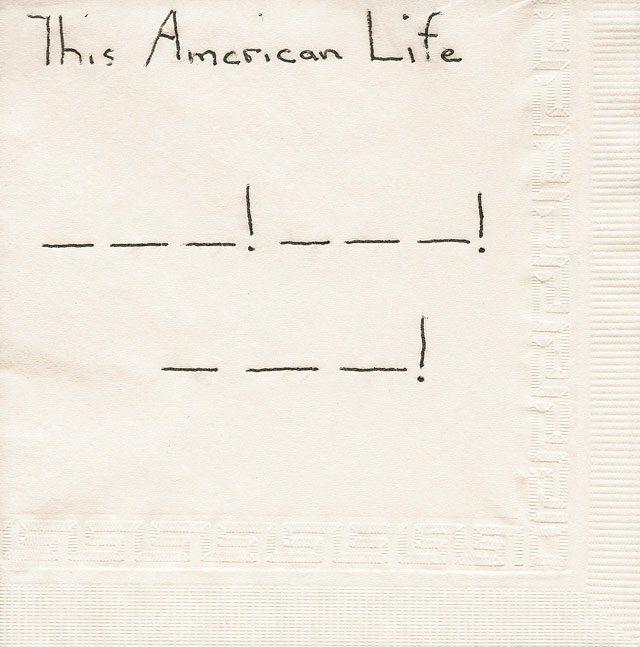
“Napkin #1” is Bradley’s drawing for This American Life, a structure Ira Glass has talked about ad infinitum: This happened. Then this happened. Then this happened. (Those are the dashes.) And then a moment of reflection, thoughts on what the events mean (the exclamation point).
The description of Radiolab is the most fun to read. That show doesn’t quite have the non-linearity of Pulp Fiction, but it’s a good example of hyperlink radio (a la hyperlink cinema). (via explore)

Andrew Kim of Minimally Minimal got his hands on an original Sony Walkman and provides an interesting look back at a seminal piece of personal technology. Initially, the Walkman was billed as the “Walking Stereo with Hotline”:
Next to the dual headphones is a button labeled “Hot Line”. This was another key feature of the TPS-L2. When the user pressed the Hot Line button, the device would would override the music with audio from the built in microphone. It allowed you to listen to Subway announcements or talk to a friend without taking off your headphones. I find it to be a particularly clever idea as it uses existing parts from tape recorders. Hot Line wasn’t really a sought after feature though, and was axed in later models.
(via @sippey)
For the first post on his new blog, Tobias Frere-Jones discovers that most of the type foundries in New York in the 1800s and 1900s were all located within a few blocks of each other in lower Manhattan. Why there? Newspapers and City Hall.
I was able to plot out the locations for every foundry that had been active in New York between 1828 (the earliest records I could find with addresses) to 1909 (see below). All of the buildings have been demolished, and in some cases the entire street has since been erased. But a startling picture still emerged: New York once had a neighborhood for typography.
Gruber beat me to the punch in noting that Frere-Jones’ site doesn’t use any of the fonts from the company he was recently ousted from but instead a pair of faces (Benton Modern and Interstate) he designed before he formed his partnership with Jonathan Hoefler. Before I discovered Whitney (another Frere-Jones creation), Interstate was my go-to font for graphics for the site. Big TFJ fan, is what I’m saying.
After many days of analysis by scientists and internet sleuths alike, it’s likely that the thing pictured whizzing by the skydiver in this video is not a meteorite but a plain old rock that got packed in with his parachute. Phil Plait reports:
I actually became convinced last night, when BA Tweep Helge Bjorkhaug sent me a link to a slowed-down version of the video. Immediately before the rock flies past, I saw a second piece of debris just to the right of the skydiver’s parachute strap. It was in several frames, and clearly real.
So yeah, bummer, not a meteorite. But as Plait notes, that’s how science works.
That’s how you get to the truth, folks. Open inquiry, honest investigation, and acceptance of the line of evidence no matter where it leads.

Smithsonian Magazine has announced the finalists in their annual photography contest. The shot above is a finalist in the Mobile category…it was taken with an iPhone 5. (via colossal)
I am not a religious person, but Reverend Smith spoke a few lines of the Prayer of Saint Francis on an episode of Deadwood I watched recently and I can’t stop thinking about it. The prayer in full:
Lord, make me an instrument of Thy peace;
Where there is hatred, let me sow love;
Where there is injury, pardon;
Where there is error, truth;
Where there is doubt, faith;
Where there is despair, hope;
Where there is darkness, light;
And where there is sadness, joy.
O Divine Master, Grant that I may not so much seek
To be consoled as to console;
To be understood as to understand;
To be loved as to love.
For it is in giving that we receive;
It is in pardoning that we are pardoned;
And it is in dying that we are born to eternal life.
The Reverend put it slightly differently:
Lord, grant that I may seek rather to comfort than to be comforted, to understand, than to be understood, to love, than to be loved…
Believer in eternal life or not, that’s a way of living life I can get behind.
Oh, this is the dumbest thing but it made me laugh today: Celebrities that Look Like Mattresses.
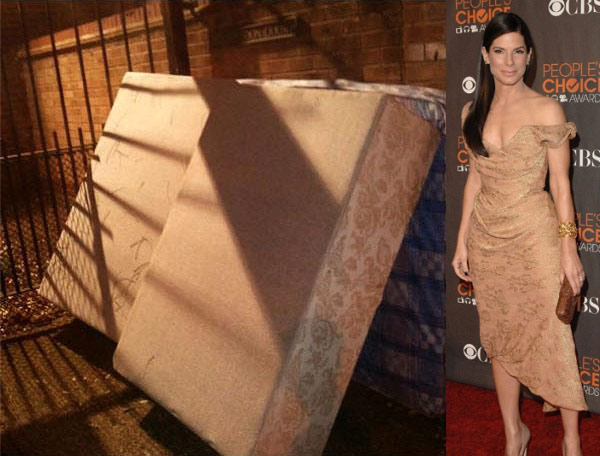

How on Earth did they find these pairings? Has Google perfected their Mattress Recognition technology? (via @Rebeccamead_NYC)
Super-cool video from i-D of dance styles for each letter of the alphabet.
(via @Han)
Well, they do sometimes but not very often. Left turns cross traffic, which wastes time and causes accidents. So UPS routes are designed with mostly right turns…three rights make a left, you know.
UPS engineers found that left-hand turns were a major drag on efficiency. Turning against traffic resulted in long waits in left-hand turn lanes that wasted time and fuel, and it also led to a disproportionate number of accidents. By mapping out routes that involved “a series of right-hand loops,” UPS improved profits and safety while touting their catchy, environmentally friendly policy.
I wonder though, does this make the drivers unhappy?
HBO put the entire first episode of Mike Judge’s new show Silicon Valley up on YouTube:
vintage post from Apr 2014
· gift link
In a five part series called “emoji-nation”, Ukrainian Nastya Ptichek mixes the work of well-known painters with graphical elements of new media. In the second part of the series, the works of Edward Hopper are augmented with social media interface icons:
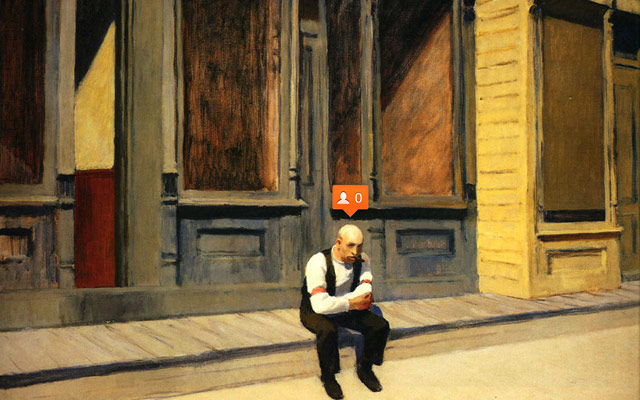
The first part finds emoji doppelgangers for works of fine art while the third part uses paintings as movie poster imagery for the likes of Kill Bill and Home Alone (paired with Munch’s The Scream). For part four, Ptichek places modal dialogs over art works:
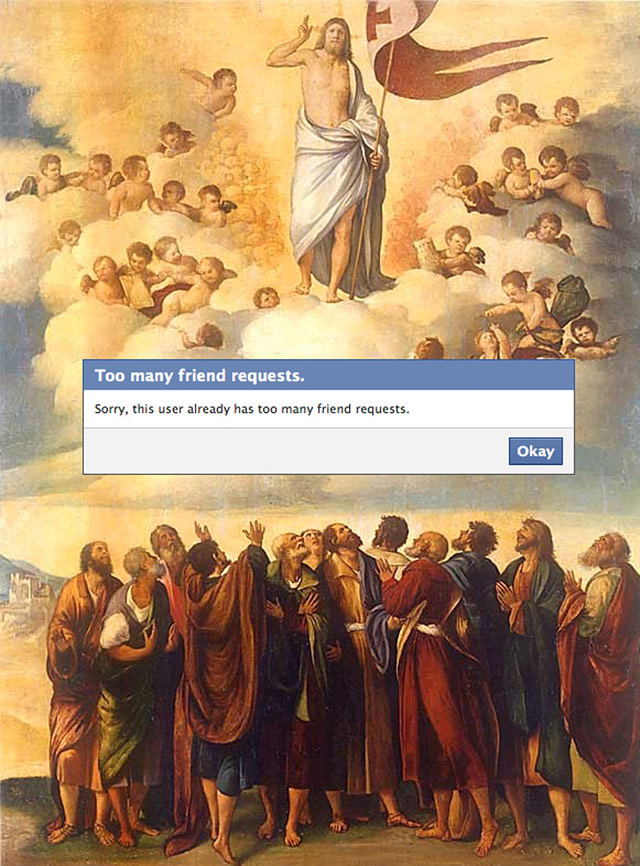
And part five plays around with several Google interface elements:
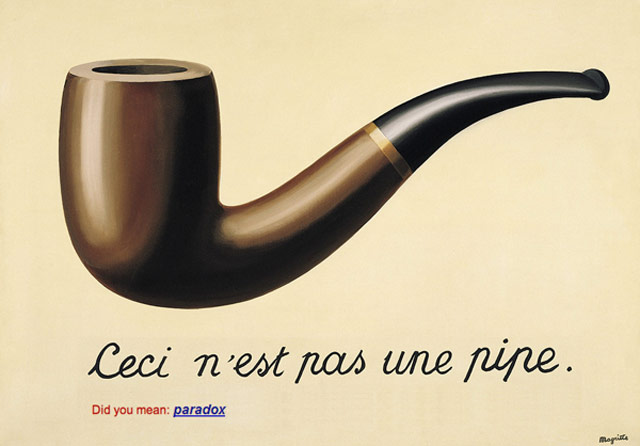
Love this kind of thing. Feels like I’ve seen something like it before though. Anyone recall?
Using Google Earth, dialect coach Andrew Jack gives a tour of the accents of Great Britain and Ireland.
The audio is originally from this BBC program. See also Peter Sellers doing various English accents. (via devour)
Saturday was the 20th anniversary of the death of Kurt Cobain at the age of 27. Many have written of the anniversary, but I liked Dennis Cooper’s piece published in Spin a few weeks after Cobain’s death.
Cobain’s work nailed how a ton of people feel. There are few moments in rock as bewilderingly moving as when he mumbled, “I found it hard / It’s hard to find / Oh well, whatever / Nevermind.” There’s that bizarre, agonized, and devastating promise he keeps making throughout “Heart-Shaped Box”: “Wish that I could eat your cancer when you turn black.” Take a look in his eyes the next time MTV runs the “Heart-Shaped Box” video, and see if you can sort out the pain from the ironic detachment from the horror from the defensiveness.
(via NYT Now app)
Errol Morris’s latest documentary on Donald Rumsfeld, The Unknown Known, just came out in theaters. But it’s also available right now to rent/buy on Amazon and iTunes. Here’s a trailer if you need convincing.
Researchers at Stanford have observed that foraging harvester ants act like TCP/IP packets, so much so that they’re calling the ants’ behavior “the anternet”.
Transmission Control Protocol, or TCP, is an algorithm that manages data congestion on the Internet, and as such was integral in allowing the early web to scale up from a few dozen nodes to the billions in use today. Here’s how it works: As a source, A, transfers a file to a destination, B, the file is broken into numbered packets. When B receives each packet, it sends an acknowledgment, or an ack, to A, that the packet arrived.
This feedback loop allows TCP to run congestion avoidance: If acks return at a slower rate than the data was sent out, that indicates that there is little bandwidth available, and the source throttles data transmission down accordingly. If acks return quickly, the source boosts its transmission speed. The process determines how much bandwidth is available and throttles data transmission accordingly.
It turns out that harvester ants (Pogonomyrmex barbatus) behave nearly the same way when searching for food. Gordon has found that the rate at which harvester ants — which forage for seeds as individuals — leave the nest to search for food corresponds to food availability.
A forager won’t return to the nest until it finds food. If seeds are plentiful, foragers return faster, and more ants leave the nest to forage. If, however, ants begin returning empty handed, the search is slowed, and perhaps called off.
(via wordspy)
Slow television is the uninterrupted broadcast of an ordinary event from start to finish. Early efforts included burning Yule logs on TV around Christmas and driver’s views of complete British rail journeys (not to mention Andy Warhol and the pitch drop experiment), but Norwegian public television has revived the format in recent years. The first broadcast was of a 7-hour train trip from Bergen to Oslo, which was watched at some point by ~20% of Norway’s population. You can watch the entire thing on YouTube:
Not content with that, in 2011 an entire ship voyage was broadcast for 134 continuous hours. The entire voyage is available for viewing, but you can watch a 37-minute time lapse of the whole thing if you can’t spare the 5½ days:
As the show progressed and the ratings climbed (half of the Norwegian population tuned in at some point), the show became an interactive event, with people meeting the ship along to coast in order to appear as extras in the cast. Some even followed in smaller boats, filming as they went along in the ship’s wake.
Other shows included 12 hours about firewood (including 8 uninterrupted hours of a burning fireplace), 18 hours of salmon swimming upstream (which some felt was too short), 100 hours of Magnus Carlsen playing chess, a 30-hour interview with a noted author, and several continuous hours of sweater production, from shearing to knitting.
Shows currently in the planning stages include A Day in the Life of a Snail and “a 24-hour-long program following construction workers building a digital-style clock out of wood, shuffling planks to match each passing minute”. The slow TV concept might soon be coming to American TV as well.
P.S. Does this 10-hour video of Tyrion Lannister slapping Joffrey count as slow TV? Either way, it’s great.

The Vatican is beginning the process of digitizing its extensive library of books and manuscripts, previously only available to a select few scholars and historians. Their plan calls for an initial 3000 manuscripts to be scanned, with the rest of the 82,000 other documents to hopefully follow.
That’s 41 million pages spanning nearly 2,000 years of church history that will soon be clickable, zoomable, and presumably, printable. When all is said and done, you’ll be able to read the Psalms handwritten across 13th-century vellum on your iPhone — so long as you speak ancient Greek.
From a large collection of photos shot on the set of 2001: A Space Odyssey, two of my favorites:
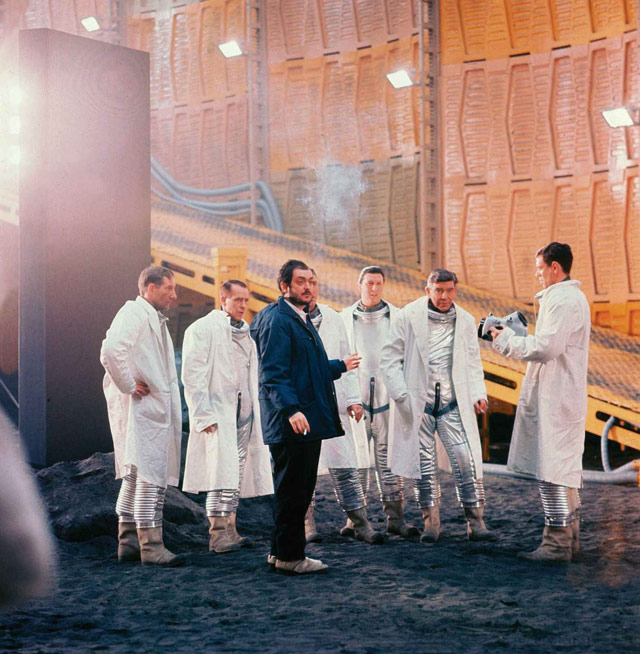
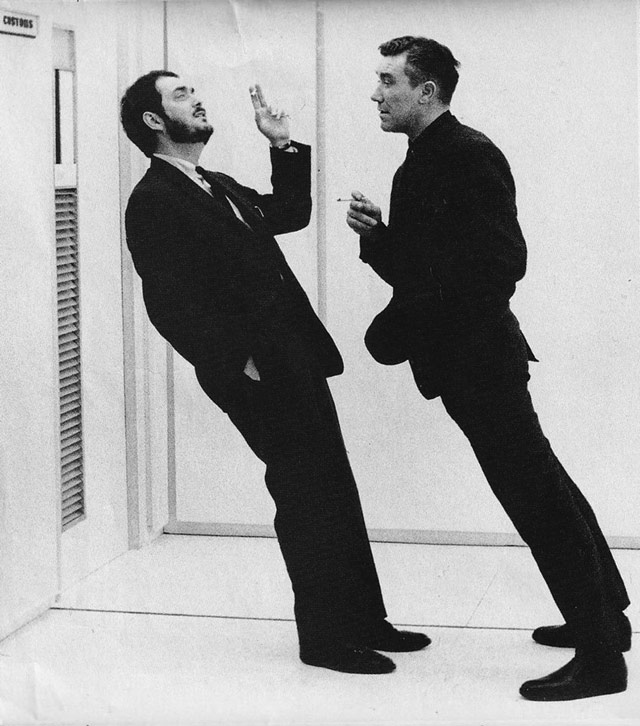
Those are a pair of smooth criminals right there.

Last week, the New York Public Library released a massive collection of maps online…over 20,000 maps are available for high-resolution download. An incredible resource.
Tom O’Donnell imagines how the police would function in a totally libertarian society.
I was shooting heroin and reading “The Fountainhead” in the front seat of my privately owned police cruiser when a call came in. I put a quarter in the radio to activate it. It was the chief.
“Bad news, detective. We got a situation.”
“What? Is the mayor trying to ban trans fats again?”
“Worse. Somebody just stole four hundred and forty-seven million dollars’ worth of bitcoins.”
The heroin needle practically fell out of my arm. “What kind of monster would do something like that? Bitcoins are the ultimate currency: virtual, anonymous, stateless. They represent true economic freedom, not subject to arbitrary manipulation by any government. Do we have any leads?”
“Not yet. But mark my words: we’re going to figure out who did this and we’re going to take them down … provided someone pays us a fair market rate to do so.”
“Easy, chief,” I said. “Any rate the market offers is, by definition, fair.”
(via @moleitau)
My friend Aaron has compiled an Rdio playlist of every song ever played on MTV’s Amp, a show from the mid-90s that featured electronic music. Lots of Underworld, Prodigy, Aphex Twin, and Orbital on here.
Some songs weren’t available on Rdio, but there’s more than 18 hours of music here.
Holy cow, Aardman is making a Shaun the Sheep Movie! Here’s a teaser trailer:
The movie will be out in March 2015 and the plot centers on the sheep going to the big city to retrieve the Farmer. As I wrote last year, Shaun the Sheep is wonderful family entertainment. I wonder how the lack of dialogue will translate to the feature length format? (thx, greg)
2008 article by Clive Thompson on how Weight Watchers is like a RPG (role playing game).
Think about it. As with an RPG, you roll a virtual character, manage your inventory and resources, and try to achieve a goal. Weight Watchers’ points function precisely like hit points; each bite of food does damage until you’ve used up your daily amount, so you sleep and start all over again. Play well and you level up — by losing weight! And the more you play it, the more you discover interesting combinations of the rules that aren’t apparent at first. Hey, if I eat a fruit-granola breakfast and an egg-and-romaine lunch, I’ll have enough points to survive a greasy hamburger dinner for a treat!
Even the Weight Watchers web tool is amazingly gamelike. It has the poke-around-and-see-what-happens elegance you see in really good RPG game screens. Accidentally snack on a candy bar and ruin your meal plan for the day? No worries: Just go into the database and see what spells — whoops, I mean foods — you can still use with your remaining points.
And those 35 extra points you get every week? They’re like a special buff or potion — a last-ditch save when you’re on the ropes.
It’s funny how quaint this seems now…the quantified self and gamification of diet & health is everywhere now. (via @arainert)
No idea if this is an April Fools thing or not, but skydiver Anders Helstrup claims that a rock whooshed past him during a wingsuit flight in 2012. And he caught the incident on video:
The relevent bit starts at about 25 seconds in. Here’s a news story and a longer version of the video report with English subtitles:
Although Helstrup is still not completely convinced that it was indeed a meteorite that flew past him, the experts are in no doubt.
“It can’t be anything else. The shape is typical of meteorites — a fresh fracture surface on one side, while the other side is rounded,” said geologist Hans Amundsen.
He explained that the meteorite had been part of a larger stone that had exploded perhaps 20 kilometres above Helstrup.
Amundsen thinks he can make out coloured patches in the stone, and believes that in that case it may be a breccia — a common type of meteorite rock.
According to the article, the search is on to find the meterorite on the ground. I poked around a bit for information on a fireball sighting over Norway on the date in question (June 17, 2012) but didn’t find anything. Smells like a hoax to me, but if it’s real, it’s the first time a post-fireball meteor has been observed and filmed while still falling.
Update: Even Phil Plait at Bad Astronomy allows this may be real.
Filmmaker IQ has a nice exploration of the history of the movie trailer. And yes, they actually used to play at the end of (i.e. “trail”) the film.
Coming into the 1960s, a new generation of star directors began to redefine the trailer - among them was the legendary Alfred Hitchcock. Instead of showing scenes from the movie, Hitchcock, who had become quite well known to audiences from his “Alfred Hitchcock Presents” TV series, cashed in on his celebrity… taking audiences on a tour using his gallows humor style in this trailer for 1960’s Pscyho.
The reemergence of Cubism in film and commercial art in the 1960s was not lost on another emerging filmmaker - Stanley Kubrick. Having experimented with fragmented cutting styles in the trailer to 1962’s Lolita, Kubrick comes back strong in 1964’s “Dr. Strangelove” with a trailer that I consider one of the most bold and brazen pieces of movie advertising ever made.
Newer posts
Older posts






Socials & More