Entries for April 2014
Mason Currey’s book about the daily routines of scientists, painters, writers, and other creative people looks interesting. Sarah Green collected a list of common practices among some of the book’s “healthier geniuses”.
A workspace with minimal distractions. Jane Austen asked that a certain squeaky hinge never be oiled, so that she always had a warning when someone was approaching the room where she wrote. William Faulkner, lacking a lock on his study door, just detached the doorknob and brought it into the room with him — something of which today’s cubicle worker can only dream. Mark Twain’s family knew better than to breach his study door — if they needed him, they’d blow a horn to draw him out. Graham Greene went even further, renting a secret office; only his wife knew the address or telephone number. Distracted more by the view out his window than interruptions, if N.C. Wyeth was having trouble focusing, he’d tape a piece of cardboard to his glasses as a sort of blinder.
I love reading about people’s workspaces; here’s an old post about George Bernard Shaw’s rotating writing room. (via myself apparently?)
Michael Lewis’s new book about high-frequency trading dropped on Monday with less than 24 hours notice and the media is scrambling to catch up. There’s plenty of love for Lewis and his books out there, but Tyler Cowen has been linking to some critiques. For Bloomberg, Matt Levine writes:
In my alternative Michael Lewis story, the smart young whippersnappers build high-frequency trading firms that undercut big banks’ gut-instinct-driven market making with tighter spreads and cheaper trading costs. Big HFTs like Knight/Getco and Virtu trade vast volumes of stock while still taking in much less money than the traditional market makers: $688 million and $623 million in 2013 market-making revenue, respectively, for Knight and Virtu, versus $2.6 billion in equities revenue for Goldman Sachs and $4.8 billion for J.P. Morgan. Even RBC made 594 million Canadian dollars trading equities last year. The high-frequency traders make money more consistently than the old-school traders, but they also make less of it.
And here’s Matthew Philips on What Michael Lewis Gets Wrong About High-Frequency Trading:
1. HFT doesn’t prey on small mom-and-pop investors. In his first two TV appearances, Lewis stuck to a simple pitch: Speed traders have rigged the stock market, and the biggest losers are average, middle-class retail investors-exactly the kind of people who watch 60 Minutes and the Today show. It’s “the guy sitting at his ETrade account,” Lewis told Matt Lauer. The way Lewis sees it, speed traders prey on retail investors by “trading against people who don’t know the market.”
The idea that retail investors are losing out to sophisticated speed traders is an old claim in the debate over HFT, and it’s pretty much been discredited. Speed traders aren’t competing against the ETrade guy, they’re competing with each other to fill the ETrade guy’s order.
And Felix Salmon:
This vagueness about time is one of the weaknesses of the book: it’s hard to keep track of time, and a lot of it seems to be an exposé not of high-frequency trading as it exists today, but rather of high-frequency trading as it existed during its brief heyday circa 2008. Lewis takes pains to tell us what happened to the number of trades per day between 2006 and 2009, for instance, but doesn’t feel the need to mention what has happened since then. (It is falling, quite dramatically.) The scale of the HFT problem - and the amount of money being made by the HFT industry - is in sharp decline: there was big money to be made once upon a time, but nowadays it’s not really there anymore. Because that fact doesn’t fit Lewis’s narrative, however, I doubt I’m going to find it anywhere in his book.
Michael Paul Smith takes photographs of classic cars that evoke feelings of nostalgia for America in the 30s, 40s, 50s, and 60s. Take a look, these are about as Pleasantville as you can get:

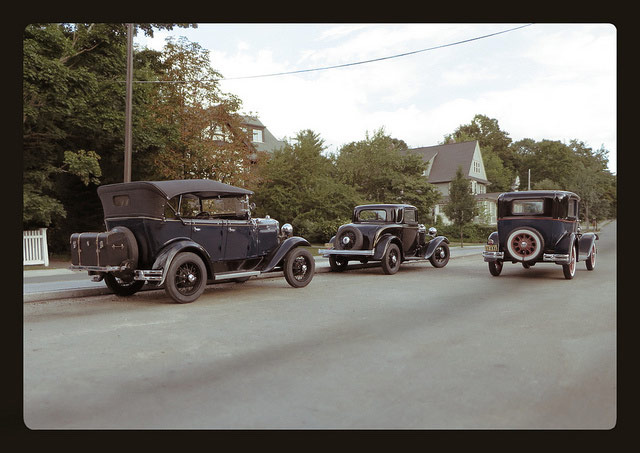
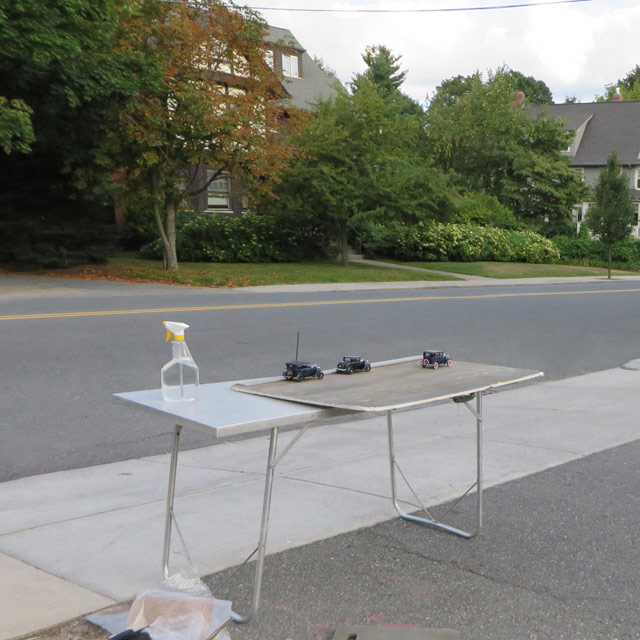
But as you’ll discover browsing through Smith’s collection, the cars he photographs are scale models. Here’s the set-up for that second shot:
And here’s further evidence of Smith’s trickery:
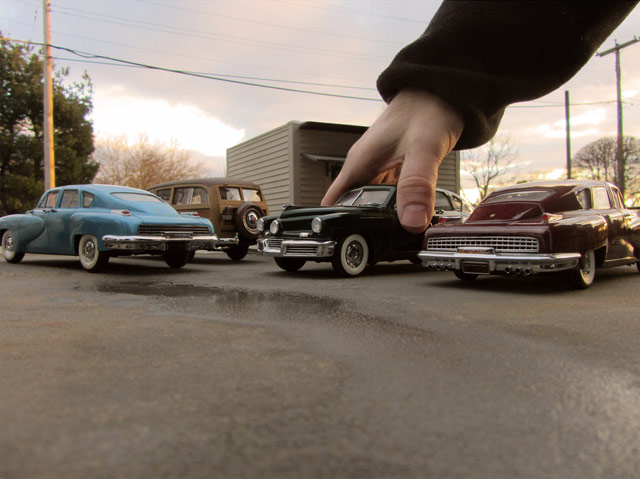
No Photoshop here…all effects are done in-camera. As Smith notes, “It is the oldest trick in the special effects book: lining up a model with an appropriate background, then photographing it.” (via @osteslag)
Now that I’ve caught up on True Detective, I have to agree with Emily Nussbaum’s take on the show and finale: a stylish well-acted show with a “hollow center”.
To state the obvious: while the male detectives of “True Detective” are avenging women and children, and bro-bonding over “crazy pussy,” every live woman they meet is paper-thin. Wives and sluts and daughters — none with any interior life. Instead of an ensemble, “True Detective” has just two characters, the family-man adulterer Marty, who seems like a real and flawed person (and a reasonably interesting asshole, in Harrelson’s strong performance), and Rust, who is a macho fantasy straight out of Carlos Castaneda. A sinewy weirdo with a tragic past, Rust delivers arias of philosophy, a mash-up of Nietzsche, Lovecraft, and the nihilist horror writer Thomas Ligotti. At first, this buddy pairing seems like a funky dialectic: when Rust rants, Marty rolls his eyes. But, six episodes in, I’ve come to suspect that the show is dead serious about this dude. Rust is a heretic with a heart of gold. He’s our fetish object — the cop who keeps digging when everyone ignores the truth, the action hero who rescues children in the midst of violent chaos, the outsider with painful secrets and harsh truths and nice arms. McConaughey gives an exciting performance (in Grantland, Andy Greenwald aptly called him “a rubber band wrapped tight around a razor blade”), but his rap is premium baloney. And everyone around these cops, male or female, is a dark-drama cliche, from the coked-up dealers and the sinister preachers to that curvy corpse in her antlers. “True Detective” has some tangy dialogue (“You are the Michael Jordan of being a son of a bitch”) and it can whip up an ominous atmosphere, rippling with hints of psychedelia, but these strengths finally dissipate, because it’s so solipsistically focussed on the phony duet.
I enjoyed the show and am seated in the McConaissance cheering section, but True Detective is far from TV’s best thing evar. And Nussbaum hits the nail right on the head: the lack of good women characters is to blame.
Something I’ve noticed about my favorite TV shows: they are mostly testosterone fests where the women are more interesting than the men. Mad Men is the perfect example. Game of Thrones is another. And Six Feet Under. Even in Deadwood, which I am rewatching now and is loads better than True Detective, women more than hold their own against the men. It’s fun to watch the men on these series generate bullshit, but it’s much more interesting to watch the great actresses who play these women navigate and elevate through the predictable male privilege.
The MoMA is hosting a series of debates on the intersection of design and violence. The first one took place last week and pitted Rob Walker against Cody Wilson on the topic of open source 3D printed guns. The next two center on a machine that simulates the “pain and tribulation” of menstruation and Temple Grandin’s humane slaughterhouse designs.
The debates this spring will center upon the 3-D printed gun, The Liberator; Sputniko!’s Menstruation Machine; and Temple Grandin’s serpentine ramp. Debate motions will be delivered by speakers who are directly engaged in issues germane to these contemporary designs — the Liberator’s designer Cody Wilson; Chris Bobel, author of New Blood: Third-Wave Feminism and the Politics of Menstruation, and distinguished professor of law Gary Francione, to name a few. We want them — and you — to explore the the limits of gun laws and rights, the democracy of open-source design, the (im)possibility of humane slaughter, and design that supports transgender empathy.
Tickets are still available; only $5 for students!
Now showing at IFC Center in NYC: Finding Vivian Maier. Maier is the Chicago street photographer whose extensive and impressive body of work was recently discovered at an auction. John Maloof bought Maier’s work, started posting it to a blog several years ago, did a Kickstarter (one of the first I backed) to fund a documentary about Maier and her photos, and now the film is showing in theaters around the US and Canada.
Ben Sack makes these amazingly detailed maps of cities, all drawn by hand.
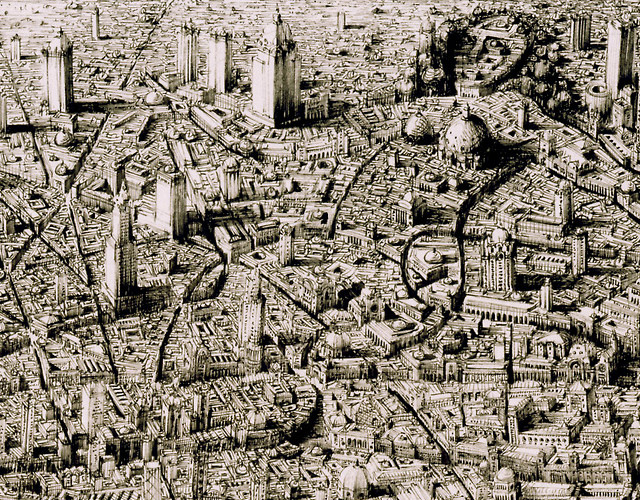
And just so you can get a sense of how large these drawings are:
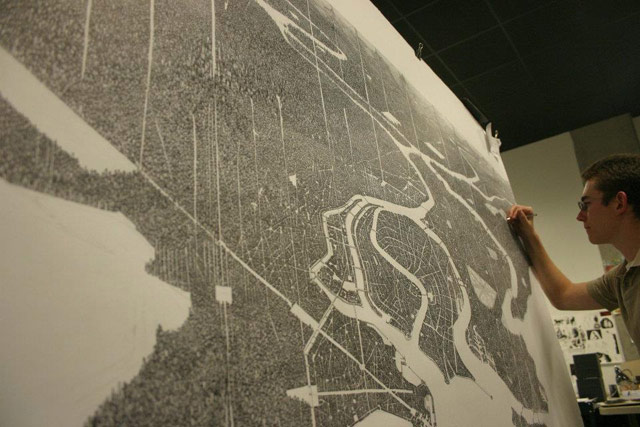
Here’s a peek at his process:
Reminiscent of Stephen Wiltshire’s work. And every time I see something like this, I think about when I went to the Met a few years ago and noticed the sketchbook of this guy working the membership desk. It was filled with beautifully intricate drawings of NYC-style city streets. I chatted with him about them briefly, but I wish I’d asked if he had put any of it online. Would have been neat to share his drawings with you. (via waxy)

Whoa, Ben Purdy made a 16x16 pixel remake of The Legend of Zelda in 48 hours. Here’s how he did it.
Over the two days of work, I built the game from the map forward. What I mean is that my first goal was to get individual map pages rendering on screen. From there I moved on to the game manager component, building out the startup logic and render loop. This lead to the entity system, which in turn lead to the player entity. Once I had the player moving around I built code to check for collisions with obstacles in the map and changing the view when the player hits the edges of the screen. At this point you could explore the whole world map! It was pretty boring though.
Next I started making monsters and items for the player to interact with. Since I had common code to check for collisions, get lists of entities occupying particular squares, etc, the monsters weren’t terribly difficult to implement. The most time consuming part was getting the combat mechanics to a good place where it was challenging but not frustrating.
(via waxy)
Kenji Lopez-Alt and the folks at the Harlem Shake restaurant have invented a burger that’s all delicious brown crust.
See, by placing a ball of meat on a hot, un-oiled griddle and smashing it down firmly into a flat, thin disk, you greatly increase the contact points between the meat and the griddle, which in turn increases the Maillard reaction. That’s the series of chemical reactions that creates the rich brown crust that makes our steaks and burgers taste so freaking good. Maximum crust = maximum flavor = maximum craving.
I’ve already discussed the basic ins and outs of smashed burgers in the past, but after writing that article, I found myself wondering, what if I were to take this to the extreme? Is there a way I can pack even more flavor into a burger?
Spoiler alert: the answer is a big fat (or should I say short smashed?) yes.
Newer posts





Socials & More