Entries for March 2013
You may have heard by now that Google is shutting down Google Reader, their RSS reading service. It’ll be gone by July 4. Fortunately you can export your subscriptions and use another service…here are some suggestions from Matt Haughey and Gizmodo. Or you can wait for Digg’s reader.
If you want to forego RSS readers altogether but still want to keep up with kottke.org without having to visit the site regularly, try following kottke.org on Twitter, Facebook, or Tumblr.
In 1968, Richard Nixon, then a candidate for President, used backchannel negotiations to scuttle peace talks that may have ended the Vietnam War. Nixon was afraid an end to the war meant an end to his campaign.
By the time of the election in November 1968, LBJ had evidence Nixon had sabotaged the Vietnam war peace talks — or, as he put it, that Nixon was guilty of treason and had “blood on his hands”.
The war went on for seven more bloody years, most of them under Nixon’s watch. Shameful.
Watch as Ludovic Woerth & Jokke Sommer fly through a hole in a building in central Rio de Janeiro that looks not much more than 15 feet wide. Jesus.
And speaking of Jesus, another pair of wingsuiters flew under the arms of the Christ the Redeemer statue in Rio a few years ago. (via @rands)
LightSail Energy, headed up by 25-year-old Danielle Fong, is developing technology to store energy as compressed air.
A stumbling block to increasing our reliance on electricity from cleaner energy sources such as solar panels and wind farms has always been figuring out how to efficiently store the energy for use when the wind isn’t blowing and the sun isn’t shining. Danielle Fong could make clean energy significantly more practical on a large scale by introducing a novel way to use tanks of compressed air for energy storage. “It could radically reorient the economics of renewable energy,” she says.
The idea of using compressed air to store energy is not new. Electricity from solar panels or wind turbines can turn a motor that’s used to compress the air in a large tank, and the air pressure can then be converted into power to drive a generator when the power is needed. The problem is that during compression the air reaches temperatures of almost 1,000 ^0C. That means energy is lost in the form of heat, and storage in conventional steel vessels becomes impractical.
Fong stumbled on a possible solution while skimming through a nearly century-old book: water spray is great at cooling air. She asked, why not spray water into the air while compressing it, so that the air stays cool? To make the process practical, she developed a technique for separating the heated water from the compressed air and diverting the water into a tank, so the heat can be recaptured to minimize energy loss. The process is about as efficient as the best batteries: for every 10 kilowatt-hours of electricity that goes into the system, seven kilowatt-hours can be used when needed.
Fong sounds like an impressive person; she dropped out of middle school at 12 to attend college, graduating five years later with degrees in physics and computer science.
Artist Phillip Stearns makes blankets and tapestries out of glitch art. Some of the source images are taken from intentionally short-circuited digital cameras.
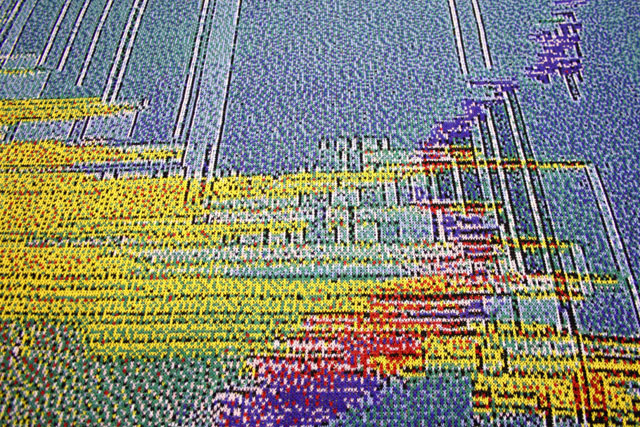
All items are woven in the US and cost $200 and up (plus shipping).
Excerpted from a book called The Art of Making Magazines, a piece on how fact-checking works at the New Yorker.
So that was the old New Yorker. The biggest difference between David Remnick’s New Yorker today and the Shawn New Yorker is timeliness. During the Shawn years, book reviews ran months, even years out of sync with publication dates. Writers wrote about major issues without any concern for news pegs or what was going on in the outside world. That was the way people thought, and it was really the way the whole editorial staff was tuned.
All this changed when Tina Brown arrived. Whereas before, editorial schedules were predictable for weeks or a month in advance, under Tina we began getting 8,000-, 10,000-, 12,000-word pieces in on a Thursday that were to close the following Wednesday. But something else changed in a way that is more important. Prior to Tina, the magazine really had been writer-driven, and I think this is why they gave the writers so much liberty. They wanted the writers to develop their own, often eccentric, interests.
Under Tina, writing concepts began to originate in editors’ meetings, and assignments were given out to writers who were essentially told what to write. And a lot of what the editors wanted was designed to be timely and of the moment and tended to change from day to day. So the result was that we were working on pieces that were really much more controversial and much less well-formulated than anything we had dealt with previously, and often we would put teams of checkers to work on these pieces and checking and editing could go on all night.
A nascent trend on YouTube is to take contemporary dramas and imagine what their 1995-style opening credits sequences might look like. The first one appears to be this Walking Dead one, followed by Breaking Bad, which is the best of the bunch:
The Game of Thrones one is pretty great as well:
These seem to be a variation on the recut trailers meme, e.g. The Shining as a romantic comedy or Toy Story as a horror film. (via @aaroncoleman0)
Andy Marx shares the story of how a lunch with his grandfather, Groucho, and a few of his grandfather’s guests ended up helping save every episode of the seminal 50s TV show You Bet Your Life.
No longer out of the limelight, my grandfather was enjoying his status as a cultural icon now that such classic Marx Brothers films as “Duck Soup” and “A Night at the Opera” had been discovered by a whole new generation eager for something to go with the free-wheeling attitudes and politics of the late ’60s and early ’70s. Groucho and his brothers fit the bill perfectly and my grandfather was more than happy to oblige his new-found fans, many of them Hollywood celebrities. Among my favorite celebrity sightings at my grandfather’s house in those days were Alice Cooper and Rolling Stones guitarist Ronnie Wood.
This particular day, my grandfather asked me to be ready to accompany him on the piano, since he planned to sing for the invited guests: Jack Nicholson, Elliot Gould and the great French mime, Marcel Marceau. As I said, you never knew who would arrive for lunch with Groucho.
(also via df)
Gabriele Galimberti takes photos of kids with their most prized possessions.

But how they play can reveal a lot. “The richest children were more possessive. At the beginning, they wouldn’t want me to touch their toys, and I would need more time before they would let me play with them,” says the Italian, who would often join in with a child’s games before arranging the toys and taking the photograph. “In poor countries, it was much easier. Even if they only had two or three toys, they didn’t really care. In Africa, the kids would mostly play with their friends outside.”
This reminds me of Peter Menzel’s photos of what families from different parts of the world eat in a typical week. (via df)
From Joshua Hammer at Smithsonian magazine, an update on the so-called “uncontacted” tribes of people living deep in the Amazon rain forest and what’s being done to help them stay isolated.
After two hours, we docked at a pier at the Maloca Barú, a traditional longhouse belonging to the 30,000-strong Ticuna tribe, whose acculturation into the modern world has been fraught with difficulties. A dozen tourists sat on benches, while three elderly Indian women in traditional costume put on a desultory dance. “You have to sell yourself, make an exhibition of yourself. It’s not good,” Matapi muttered. Ticuna vendors beckoned us to tables covered with necklaces and other trinkets. In the 1960s, Colombia began luring the Ticuna from the jungle with schools and health clinics thrown up along the Amazon. But the population proved too large to sustain its subsistence agriculture-based economy, and “it was inevitable that they turned to tourism,” Franco said.
Not all Ticunas have embraced this way of life. In the nearby riverside settlement of Nazareth, the Ticuna voted in 2011 to ban tourism. Leaders cited the garbage left behind, the indignity of having cameras shoved in their faces, the prying questions of outsiders into the most secret aspects of Indian culture and heritage, and the uneven distribution of profits. “What we earn here is very little,” one Ticuna leader in Nazareth told the Agence France-Presse. “Tourists come here, they buy a few things, a few artisanal goods, and they go. It is the travel agencies that make the good money.” Foreigners can visit Nazareth on an invitation-only basis; guards armed with sticks chase away everyone else.
Aside from 2005’s installment, I have a copy of every Feltron Annual Report ever produced and I am eagerly awaiting the 2012 version.
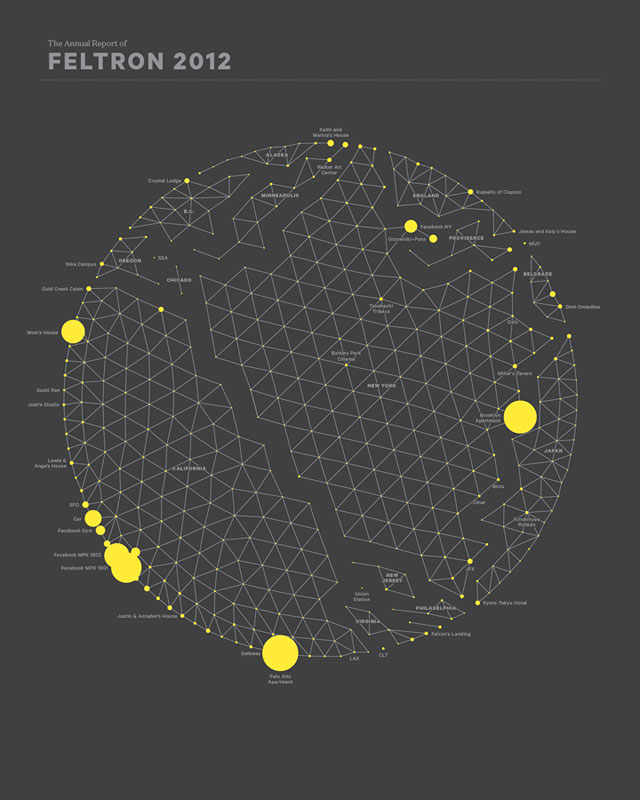
Order yours here.
Photographer Rebecca Martinez photographs reborn dolls and the people who collect/care for them.
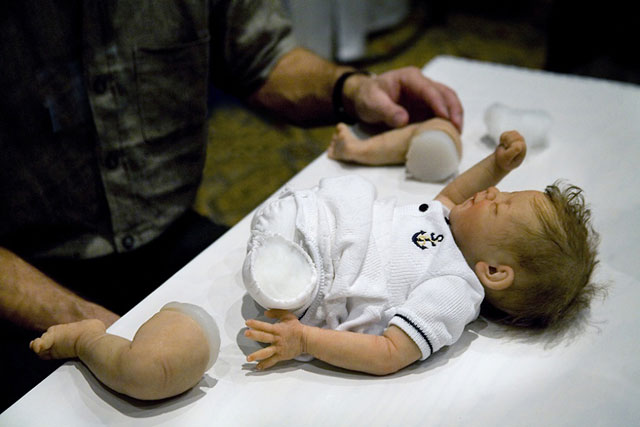
Babies create strong emotions for the bearer, holder, and observer. I have discovered this holds true even when it is known the baby is not real.
I am photographing dolls that are created to look and feel like living babies. They are constructed and weighted to feel like infants, which includes a head that must be supported while in one’s arms. They are the most powerful objects I have ever worked with, I am struck by the strong and palpable emotional reactions they produce. They provoke the dominant biological instinct to nurture and the entire spectrum of human behavior.
Some of the collectors care for their reborn dolls as if they were their own children:
Many of the women involved have an especially strong passion for the stage of mothering babies and this is a method to keep this stage permanently in their lives. There is a wide range of personal stories and motivations for being involved in this community. Some create or collect these dolls because they cannot continue to give birth to living babies, or have lost a child, or cannot have one of their own. Some women admire the art form and are doll collectors, others create nurseries in their homes and integrate the babies as part of their families and lives.
Sometimes literally:
Sometimes, women who have lost a newborn have commissioned artists to make a reborn doll that looks exactly like their deceased baby. Modeled after photographs of the real infant, these dolls are called portrait babies.

This looks beautiful: A Map of the World is a collection of maps by illustrators and storytellers. I’ve featured at least a few of the maps in the book here on kottke.org. Here’s a sample:
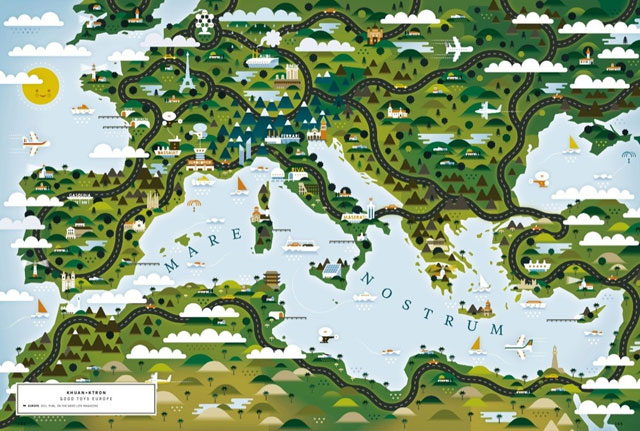
You can see more of the maps in the book on the publisher’s web site. (via raul, who says “This book is insanely beautiful. Buy it if you love maps. It will make you happy.”)
In the pages of Sidereus Nuncius, Galileo described the four large moons of Jupiter in a series of 64 sketches which looked a lot like ASCII art in the text:

Using an online tool for computing the positions of Jupiter’s moons, Ernie Wright compared Galileo’s sketches to the moons’ actual motions.

Click through for an animated GIF of all the comparisons. Not bad for the telescopic state of the art in 1610. For a taste of how celestial objects actually appeared when viewed through Galileo’s telescope, check out this video starting around 7:30. (thx, john)
A fascinating piece by Nathaniel Rich about deep water diving. I had no idea that people building marine oil wells live for weeks at a time at depths of 1000 feet.
Not everybody is cut out for the job. A diver cannot be claustrophobic or antisocial, because he must spend much of his time in a tiny sealed capsule with several other divers. He must be well-disciplined and perceptive, for he is likely to encounter a variety of unexpected hazards on the job. Many divers are military veterans, or have worked as roofers or mechanics. “The best are those who have a great deal of confidence in themselves and their abilities,” one former diver, Phil Newsum, told me. “You have to be willing to adapt to any situation. Philosophically, when you go out on a dive job, you’re expecting something is going to go wrong.”
Often, because of the depth, the job is performed in the dark, with only a headlamp to light the way. Divers have told me stories of sudden encounters with manta rays, bull sharks, and wolf eels, which can grow eight feet long and have baleful, recessed eyes, a shovel-shaped snout, and a wide, snaggletoothed mouth. One diver sent me a video, filmed from a camera in the diver’s helmet, of an enormous turtle that was playing a game of trying to bite off the diver’s feet and hands every few minutes. The diver finally sent the animal swimming away by pressing a power drill to its head. Someone else sent me a photograph of a diver riding a speckled whale shark, as if on a rodeo bronco.
Newsum, who is now the director of an industry group called the Association of Diving Contractors International (ADCI), estimates that only three of every fifteen people who graduate from commercial diving school are able to withstand the rigor of the profession for a full career. Many are enticed by the high salaries, but few can endure the job’s physical and psychological toll. Those who stick it out tend to do so out of a passion for the job’s eccentricities.
The life of a commercial diver is somewhat less stable than that of a traveling salesman or mercenary soldier. He does not make his own schedule and has little control over his own fate, which is one reason why divers between jobs have a reputation for, as Newsum puts it, “living hard.” The diver never knows when his next job will come, but as soon as he gets called for an assignment, he must head directly to the nearest port or helicopter pad. A successful diver will work offshore about 160 days a year, cumulatively. A job might last a day, or two months. Work is most consistent, at least in the Gulf of Mexico, in the warmer months, from late March through November, but hurricane season falls within that period. Hurricanes are a mixed blessing-they disrupt ongoing jobs, but they create new ones.
Alex Cornell has constructed a handy infographic to help you decide where to sit at a restaurant or dinner party table.
7 Person Rectangle: It’s very easy to get screwed in this scenario. While it may appear like you can sit anywhere except the ends, this is not so. You are at risk of sitting next to the lonely end-seat, which requires you to speak soley to that person for the duration of the meal.
Mark Tipple takes underwater photos of people swimming under crashing waves, which happens to be my favorite genre of surfing photography.

Prints are available. (via @DavidGrann)
vintage post from Mar 2013
· gift link
This story by Kevin Guilfoile about his aging father (who worked for the Pirates and the Baseball Hall of Fame) and the mystery of what happened to the bat that Roberto Clemente got his 3,000th hit with is one of my favorite things that I’ve read over the past few months.
[My father’s] personality is present, if his memories are a jumble. He is still funny, and surprisingly quick with one-liners to crack up the staff at the facility where he lives. He is exceedingly polite, same as he ever was. He is good at faking a casual conversation, especially on the phone. But if you sit and talk with him for a long time, he gets very anxious. He starts tapping his forehead with his fingers. “Shouldn’t we be going?” he’ll say. You tell him there’s no place we need to be, but 30 seconds later he’ll ask again, “Shouldn’t we be going?”
What happens to memories when they’re collapsed inside time like this? They don’t exactly disappear, they just become impossible to unpack. And so my father, who loved stories so much — who loved to tell them, who loved to hear them — can no longer comprehend them. The structure of any story, after all, is that this happened and then that happened, and he can’t make sense of any sequence.
That is the real hell of this disease. His own identity has become a puzzle he can’t solve.
Objects have stories, too. Puzzles that need to be solved. Like a pair of baseball bats, for instance, that each passed through Roberto Clemente’s hands before they passed through my father’s. One hung on my bedroom wall throughout my childhood. The other is in the Baseball Hall of Fame.
These objects never forget, but they never tell their stories, either.
Without a little bit of luck, we’d never hear them.
Or more than a little luck:
My father has lots of old baseball bats given to him by players he worked with over the years. He has Mickey Mantle bats from his years with the Yankees, and Willie Stargell and Dave Parker bats from his days with the Pirates. The one I always loved best was an Adirondack model with R CLEMENTE embossed in modest block letters, instead of the usual signature burned into the barrel. On the bottom of the knob, Roberto had written a tiny “37” in ballpoint pen, presumably to indicate its weight: 37 ounces. It also had a series of scrapes around the middle where someone had scratched off the trademark stripe that encircled all Adirondack bats. Former Pirates GM Joe Brown gave my dad this bat several years after Roberto died. For much of my childhood it hung on the wall of my bedroom, on a long rack with about a dozen other game-used bats.
My dad had been working at the Hall of Fame for more than a decade when, in 1993, his old friend Tony Bartirome, a one-time Pirates infielder who had become their longtime trainer, came to Cooperstown for a visit. Tony and his wife went to dinner with my folks and then came back to our house to chat. The only way to go to the first-floor washroom in that house was through my old bedroom, and on a trip there, Tony noticed that Adirondack of Clemente’s hanging on the wall.
Tony carried it into the living room. He said to Dad, “Where did you get this bat?” My dad told him that Joe Brown had given him the bat as a gift, sometime in the late ’70s. “Bill,” Tony said. “This is the bat Roberto used to get his 3,000th hit.”
My father was confused by this. “That’s impossible,” he told Tony. “The day he hit 3,000 I went down to the clubhouse, and Roberto himself handed me the bat he used. I sent it to the Hall of Fame. I walk by it every day.”
“Well,” Tony said. “I have a story to tell you.”
It’s a wonderful story, read the whole thing. Or get the book: the story is excerpted from Guilfoile’s A Drive into the Gap, available here or for the Kindle.
It’s science fiction for now, but two companies are betting that mining asteroids for minerals will be possible in the near future.
The potential bonanza is, well, astronomical. A single 500-metre metal-rich asteroid might contain the equivalent of all the platinum-group metals mined to date. Icy bodies could provide water to sustain astronauts or be processed into rocket fuel for future missions to Mars.
Linus Edwards proposes building a museum comprised of exacting recreations of famous sets from movies.
Thinking about the specifics of this museum, the sets would either be actual sets from the movie (if they still existed), or meticulously recreated sets. The recreated sets would have to be very exacting, and basically made to look indistinguishable from the real thing. I realize that even if you had an actual set, many of them are missing things, like ceilings or fourth walls. Those pieces would all be recreated to match the rest of the set and create an entire room. The key would be every room you enter would be a complete 360 degree environment, and you would feel as if you actually were in the movie.
I imagine a person walking from set to set, at one moment in a 40s noir movie, and the next in an 80s comedy. It would be a surreal place to visit, as you would enter into these various worlds you’ve spent your entire life watching. Each room’s set would be lighted to match exactly how it looked on film, and there would be ambient sound playing in the background matched to the reality of the place. So a set of a New York City apartment would have genuine street sounds, while a set of a space ship might have the hum of the ship’s engine. All the sounds will be taken directly from the movie if at all possible.
Some of Edwards’ proposed sets include the 7 1/2 floor office from Being John Malkovich, Ferris’ bedroom from Ferris Bueller’s Day Off, and Vito Corleone’s office from The Godfather.
Possible fossils found in meteorite fragments? orig. from Mar 11, 2013
Petition the White House to eliminate daylight saving time orig. from Mar 10, 2013
* Q: Wha? A: These previously published entries have been updated with new information in the last 24 hours. You can find past updates here.
New York Day is a film by Samuel Orr that crams a whole NYC day into about three and a half minutes.
Orr is using Kickstarter to raise funds to make a longer version (~20 min.) of the film. (via @dhmeyer)
This is a clip from Samsara, a 2011 film directed by Ron Fricke, who was the director of photography for Koyaanisqatsi. The chicken picker machine hoovering up chickens and depositing them into drawers is one of the most dystopian things I’ve ever seen.
The whole film doesn’t look this depressing, but this short clip really gives full visual meaning to the mass production of food. (via @colossal)
Well, here’s something potentially interesting: researchers at Cardiff University think they have found fossils in meteorite fragments from Sri Lanka.
The most startling claims, however, are based on electron microscope images of structures within the stones (see above). Wallis and co say that one image shows a complex, thick-walled, carbon-rich microfossil about 100 micrometres across that bares similarities with a group of largely extinct marine dinoflagellate algae.
They say another image shows well-preserved flagella that are 2 micrometres in diameter and 100 micrometres long. By terrestrial standards, that’s extremely long and thin, which Wallis and co interpret as evidence of formation in a low-gravity, low-pressure environment.
Gotta take this with a massive grain of salt, but it will be interesting to see how this one plays out.
Update: One of the authors of this study holds some unusual views about life on Earth.
On May 24, 2003 The Lancet published a letter from Wickramasinghe, jointly signed by Milton Wainwright and Jayant Narlikar, in which they hypothesized that the virus that causes Severe Acute Respiratory Syndrome (SARS) could be extraterrestrial in origin and not originated from chickens.
Wickramasinghe and his mentor Fred Hoyle have also used their data to argue in favor of cosmic ancestry, and against evolution.
Like I said, big grain of salt. (thx, onno)
While ice climbing in Wales, Mark Roberts gets hit by some ice and falls more than 100 feet…and his helmet cam caught the whole thing.
He was not seriously injured but that fall went on for way longer than I expected. (via @DavidGrann)
National Geographic has launched a new Tumblr site that features the less-celebrated-but-still-awesome parts of its vast photographic archive. I want this car:
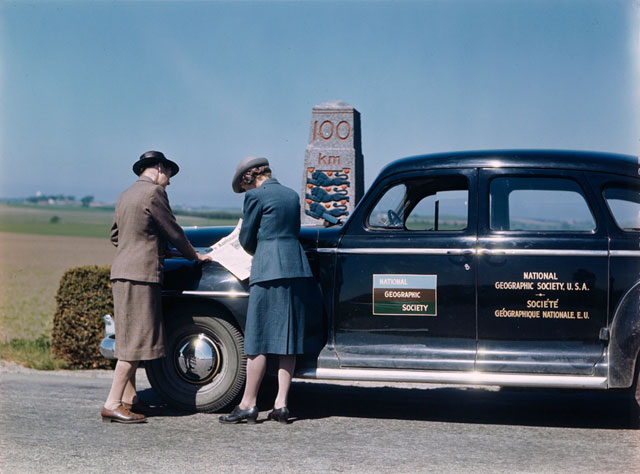
(via the verge)
Ask anyone with young children what they think of daylight saving time and you’ll probably get a stabbing in the eye. It just totally fucks your world for two+ weeks a year with zero benefit. This petition needs 100,000 digital signatures for the White House to issue an official response to it. Sign it or I might get stabby.
Update: I honestly don’t care which time we keep (DST or standard time), as long as the biannual time switching nonsense stops.
I have no idea how I ever got subscribed to it (automatically?) nor can I find a way on Quora’s site to subscribe to it, but my favorite weekly email newsletter by far is my Quora Weekly Digest. Wren Lanier wrote an appreciation of their weekly email last January:
And yet every week, without fail, the most interesting email that lands in my Inbox is the Quora Weekly Digest. It’s a simple email, just 5 Quora questions along with the first hundred words of the “best” answer. But what makes the Quora Weekly Digest so awesome is that those 5 questions were chosen just for me, and every week at least one of them teaches me something I didn’t even know I wanted to learn.
Topics covered in this week’s newsletter include “Could a professional fighter survive an encounter with a fully grown healthy gorilla determined to kill him, without feigning death?”, “What is the smartest thing a child has ever said?”, and “What can humans learn about fighting/self defense strategy from the other animals and beings?”
You’ve likely seen the graph of the Earth’s average global temperature over the past 2000 years…it’s mostly a straight line until you get to the industrial revolution and then it shoots up. It looks like a hockey stick. In a study published today in Science, that graph has been extended back 11,300 years and you can really see the scope of the abrupt temperature change.

From a summary of the report at TPM:
The decade of 1900 to 1910 was one of the coolest in the past 11,300 years - cooler than 95 percent of the other years, the marine fossil data suggest. Yet 100 years later, the decade of 2000 to 2010 was one of the warmest, said study lead author Shaun Marcott of Oregon State University. Global thermometer records only go back to 1880, and those show the last decade was the hottest for this more recent time period.
“In 100 years, we’ve gone from the cold end of the spectrum to the warm end of the spectrum,” Marcott said. “We’ve never seen something this rapid. Even in the ice age the global temperature never changed this quickly.”
Using fossils from all over the world, Marcott presents the longest continuous record of Earth’s average temperature. One of his co-authors last year used the same method to look even farther back. This study fills in the crucial post-ice age time during early human civilization.
Marcott’s data indicates that it took 4,000 years for the world to warm about 1.25 degrees from the end of the ice age to about 7,000 years ago. The same fossil-based data suggest a similar level of warming occurring in just one generation: from the 1920s to the 1940s. Actual thermometer records don’t show the rise from the 1920s to the 1940s was quite that big and Marcott said for such recent time periods it is better to use actual thermometer readings than his proxies.
(via digg)
Paul Frampton is a 69-year-old theoretical particle physicist who has co-authored papers with Nobel laureates. In late 2011, the absentminded professor met a Czech bikini model online. Over email and Yahoo chat, they became romantically involved and she sent him a plane ticket to come meet her at a photo shoot in Bolivia. Then she asked him to bring a bag of hers with him on his flight.
While in Bolivia, Frampton corresponded with an old friend, John Dixon, a physicist and lawyer who lives in Ontario. When Frampton explained what he was up to, Dixon became alarmed. His warnings to Frampton were unequivocal, Dixon told me not long ago, still clearly upset: “I said: ‘Well, inside that suitcase sewn into the lining will be cocaine. You’re in big trouble.’ Paul said, ‘I’ll be careful, I’ll make sure there isn’t cocaine in there and if there is, I’ll ask them to remove it.’ I thought they were probably going to kidnap him and torture him to get his money. I didn’t know he didn’t have money. I said, ‘Well, you’re going to be killed, Paul, so whom should I contact when you disappear?’ And he said, ‘You can contact my brother and my former wife.’ ” Frampton later told me that he shrugged off Dixon’s warnings about drugs as melodramatic, adding that he rarely pays attention to the opinions of others.
On the evening of Jan. 20, nine days after he arrived in Bolivia, a man Frampton describes as Hispanic but whom he didn’t get a good look at handed him a bag out on the dark street in front of his hotel. Frampton was expecting to be given an Hermès or a Louis Vuitton, but the bag was an utterly commonplace black cloth suitcase with wheels. Once he was back in his room, he opened it. It was empty. He wrote to Milani, asking why this particular suitcase was so important. She told him it had “sentimental value.” The next morning, he filled it with his dirty laundry and headed to the airport.
Crazy story. (via @stevenstrogatz)
The Flint and Tinder folks are back with another Kickstarter campaign and this time they are selling a hooded sweatshirt with a ten-year warranty. It’s a premuim-quality sweatshirt, made entirely in the USA, and if rips or comes apart at the seams in the next ten years, just send it to them and they will mend it and send it back.
The Flint and Tinder team overheard a conversation in a factory we were visiting. Someone was talking about using coarse thread with delicate fabric. Doing this accelerates the process of wearing holes into a garment as it goes through the dryer time and time again.
It’s a common trick of the trade. It’s one of several techniques companies secretly use to ensure that if you like what you’ve bought, you’ll be forced to replace it soon.
In the manufacturing industry, this is known as “planned obsolescence.”
It doesn’t have to be this way though — far from it. Eager to prove a point, send a message, and make a sweatshirt that could last a lifetime (the way your favorite sweatshirt should), we set out to make a premium piece that’s so well constructed customers would rather have it mended (free of charge, of course) than replaced.
Backed.
9 minutes and thirty nine seconds of Ron Swanson dancing to Daft Punk. Years from now this video could be the basis of a religion.
Soon after Jake Mohan and his wife bought a house, something went wrong with the plumbing. And then something went right with the plumbing.
Rick called his friend Tom, a plumber. If I’d thought Rick was eccentric, I hadn’t seen anything yet. Tom was the Kramer to his Seinfeld. Leather-skinned and gray-mustached, Tom swaggered into the house, took one look at me, and asked me if I was a model. I still hadn’t had any coffee, so I wasn’t sure if I was suffering auditory hallucinations. “A model?”
“Yeah, you look like you could be a model.”
I told him I was a teacher, possibly the furthest thing from a model. “Well, you might have a second calling, brother.”
Ordinarily I might have been flattered, but I was disoriented and increasingly angry that our perfect new house was anything but, its actual guts in a state of delinquent disarray. Rick and Tom set about looking at the shoddy plumbing work, shaking their heads and clucking their tongues (the phrases “crap work” and “lipstick on a pig” were uttered). Not only was the cleanout valve worthless, but the downstairs bathroom’s waste line, which runs directly from the toilet, was routed directly into the cleanout valve.
(via @ftrain)
Broadcasters are starting to experiment with using footage taken from cameras worn by in-game referees. Here’s footage from a rugby ref’s vantage point:
And from a hockey ref:
PRIDE Fighting Championships has been using ref cams since at least 2004. Also: roller derby, girls high school basketball, and paintball. (thx, david)
Poignant video profile of Ralph Baer, the inventor of the Magnavox Odyssey, the first home console gaming system. He’s still inventing at age 90.
From Dave Gilson at Mother Jones, a fact-checking of ten arguments used by the gun lobby.
Myth #5: Keeping a gun at home makes you safer.
Fact-check: Owning a gun has been linked to higher risks of homicide, suicide, and accidental death by gun.
For every time a gun is used in self-defense in the home, there are 7 assaults or murders, 11 suicide attempts, and 4 accidents involving guns in or around a home.
43% of homes with guns and kids have at least one unlocked firearm.
In one experiment, one third of 8-to-12-year-old boys who found a handgun pulled the trigger.
(via @Mike_FTW)
Danny Meyer’s Union Square Hospitality is opening two Shake Shacks and a Blue Smoke in Delta’s new Terminal 4 at JFK airport.
Facebook has so many features that at least one of them has to be useful, right? Here’s the page on Facebook that just shows you links shared by the people you follow. No tweets, no photos, no jingoistic rants from distant cousins. Just the links. (And if you like links on Facebook, you should like kottke.org on Facebook.)
Lego Stephen Hawking kit orig. from Mar 06, 2013
* Q: Wha? A: These previously published entries have been updated with new information in the last 24 hours. You can find past updates here.
Whenever I start to feel sick, I hit the Internet and start searching for more information about my symptoms. When a doctor writes me a prescription and I start feeling something unexpected, I search the web for side effects. And I’m not the only one whose first instinct is to turn my head and search. So many of us have adopted this behavior that researchers are gathering valuable information by studying our search queries and “have for the first time been able to detect evidence of unreported prescription drug side effects before they were found by the Food and Drug Administration’s warning system.”
Rand Paul has had the floor to the Senate for 10 hours now, filibustering against the nomination of John Brennan as CIA director. You can watch here. What’s a filibuster?
A filibuster in the United States Senate usually refers to any dilatory or obstructive tactics used to prevent a measure from being brought to a vote. The most common form of filibuster occurs when a senator attempts to delay or entirely prevent a vote on a bill by extending the debate on the measure, but other dilatory tactics exist. The rules permit a senator, or a series of senators, to speak for as long as they wish and on any topic they choose, unless “three-fifths of the Senators duly chosen and sworn” (usually 60 out of 100 senators) brings debate to a close by invoking cloture under Senate Rule XXII.
What’s Paul upset about? Drones:
Paul said that all presidents must honor the Fifth Amendment. “No American should ever be killed in their house without warrant and some kind of aggressive behavior by them,” Paul said on the Senate floor. “To be bombed in your sleep? There’s nothing American about that … [Obama] says trust him because he hasn’t done it yet. He says he doesn’t intend to do so, but he might. Mr. President, that’s not good enough … so I’ve come here to speak for as long as I can to draw attention to something that I find to really be very disturbing.”
“I will not sit quietly and let him shred the Constitution,” Paul added.”No person will be deprived of life, liberty, or property without due process,” he said, quoting the Fifth Amendment.
I have written about Obama’s continued use of drones before.
Matt Kahn is reading every bestselling novel from each of the past 100 years.
For this blog I plan, among other things, to read and review every novel to reach the number one spot on Publishers Weekly annual bestsellers list, starting in 1913. Beyond just a book review, I’m going to provide some information on the authors and the time at which these books were written in an attempt to figure out just what made these particular books popular at that particular time.
A few things. The Silmarillion?! Was the top selling book in 1977? John Grisham appears on the list 11 different times; the guy is a machine. And it’s interesting to see when popularity and critical acclaim part ways, when the Roths, le Carrés, and E.L. Doctorows give way to the Clancys, Grishams, and Dan Browns.
The awesome Lego Stephen Hawking model I posted a few years ago is available from Amazon as a kit!

Update: Or, if you have a massive trove of bricks, here are the instructions to build your own. (via @nickmelville)
Your endurance challenge for today: see how much of this video of the final round of the 2012 O. Henry Pun-Off World Championship you can watch before flinging your computing device across the room.
For bonus points, see if you can get through some of the comments…they are PUNishing. (Gah, I’ve been infected.)
Dazed and Confused came out in 1993 and Esquire asked a number of writers for their thoughts on the film. Here’s Tom Junod:
But the movie caught, like no other piece of art I’m aware of, what really was at play in 1976 — that weed was the solvent that, for one blessed moment, managed to cut through the most rigid social stratifications in existence, which are the social stratifications of high school. The class of ‘76 wasn’t just one big party; it was a big democratic party, and a glimpse of how things could be different. But it didn’t last, or else we were too stoned to care, and Dazed and Confused captures that feeling as well. For a long time, I felt that the greatest cultural failure of my generation was its refusal to accept punk rock and admit it to the rock and roll pantheon — that we decided we’d rather listen to Boston than the Clash. Now I think its greatest failure is its refusal to see itself in the mirror of Dazed and Confused.
I love Dazed and Confused…it’s one of those films where I will watch it anywhere anytime with anyone on any device. The Austin Film Society is doing an anniversary screening and cast reunion tonight. Wiley Wiggens, who played Mitch, is going with his wife, who has never seen the film before.
The vortex view of planetary motion around the Sun orig. from Mar 01, 2013
* Q: Wha? A: These previously published entries have been updated with new information in the last 24 hours. You can find past updates here.
vintage post from Mar 2013
· gift link
This is a clip from the BBC series Edwardian Farm that shows how rope was made in the olden days.
The entire series is available to watch online.
NYC Past has hundreds of large format historical photos of New York City. Like this one:

I’m not through all 49 pages yet, but I am getting pretty close.
Christoph Niemann of Abstract City and I Lego NY fame has released an iPad app for kids called Petting Zoo.
Christoph Niemann’s first interactive picture book. Swipe and tap the 21 animals and be surprised at how they react. This app combines the charm of hand made animations and Niemann’s wry humor with state of the art technology. What would an elephant in your bathroom do? Can a dog breakdance?
Four little thumbs-up in my household for this one.
Chairman and CEO Warren Buffett recently released his annual letter to the shareholders of Berkshire Hathaway for the 2012 fiscal year. In his estimation, Berkshire didn’t have such a good year.
When the partnership I ran took control of Berkshire in 1965, I could never have dreamed that a year in which we had a gain of $24.1 billion would be subpar, in terms of the comparison we present on the facing page.
But subpar it was. For the ninth time in 48 years, Berkshire’s percentage increase in book value was less than the S&P’s percentage gain (a calculation that includes dividends as well as price appreciation). In eight of those nine years, it should be noted, the S&P had a gain of 15% or more. We do better when the wind is in our face.
Perhaps with Anne Hathaway’s Oscar win in February, they’ll have a better year this year.
Newer posts
Older posts





Socials & More