


NFL TV maps for the 2011-2012 season
These maps are updated every week and they tell you which games are on TV in which parts of the country. Not an issue if you have DirectTV or whatever, but for the rest of us… (thx, joshua)

This site is made possible by member support. 💞
Big thanks to Arcustech for hosting the site and offering amazing tech support.
When you buy through links on kottke.org, I may earn an affiliate commission. Thanks for supporting the site!
kottke.org. home of fine hypertext products since 1998.
Beloved by 86.47% of the web.
These maps are updated every week and they tell you which games are on TV in which parts of the country. Not an issue if you have DirectTV or whatever, but for the rest of us… (thx, joshua)
Dinosaur feathers have been found preserved in amber, Jurassic Park-style.
Dinosaur and bird feathers preserved in amber from a Late Cretaceous site in Canada reveal new insights into the structure, function, and color of animals that date back to about 78 million years ago.
Researchers led by University of Alberta paleontologist Ryan McKellar say these specimens represent distinct stages of feather evolution, from early-stage, single filament protofeathers to much more complex structures associated with modern diving birds. After analyzing the preserved pigment cells, the authors add that these feathered creatures may have also had a range of transparent, mottled, and diffused colors, similar to birds today. They can’t determine which feathers belonged to birds or dinosaurs yet, but they did observe filament structures that are similar to those seen in other non-avian dinosaur fossils. Their findings appear in the current issue of the journal Science.
Click through for a slideshow of photos.
I like Peyton Manning, but I found this whole article to be a little weird.
And in the most the most important single passing statistic, the one that correlates best with winning, yards per throw, Manning has an edge, 7.6 to 7.4 [for Tom Brady].
The most important stat? Is 0.2 yards really much of a difference? Correlates best with winning? Let’s look at the stats. That lists Brady being slightly *ahead* of Manning…and Tony Romo and Philip Rivers ahead of both of them. I call shenanigans. For me, it’s a toss-up between Manning and Brady…you’d have to flip a coin to find the winner. Both are really fun to watch and I hope Manning does make it back from his injury.
Adrian Fisk recently traveled through China asking the young people there to write anything they wanted down on a piece of paper. The results are interesting.
“After watching television I have many ideas, but am unable to realize them.” Yunnan, Luo Zheng Chui, 30 years old, farmer.
“I’d like to see any supernatural thing such as alien, UFO, mysterious thing.” Chan Jie Fang, 28 years old, supervisor in bag making company in Guangdong province but learning English in Guangxi province.
“We are the lost generation. I’m confused about the world.” Guangxi, Avril Lui, 22-years-old, post-grad student.
More are available on Fisk’s site (click on New Stories and then Ispeak China). (via @bryce)
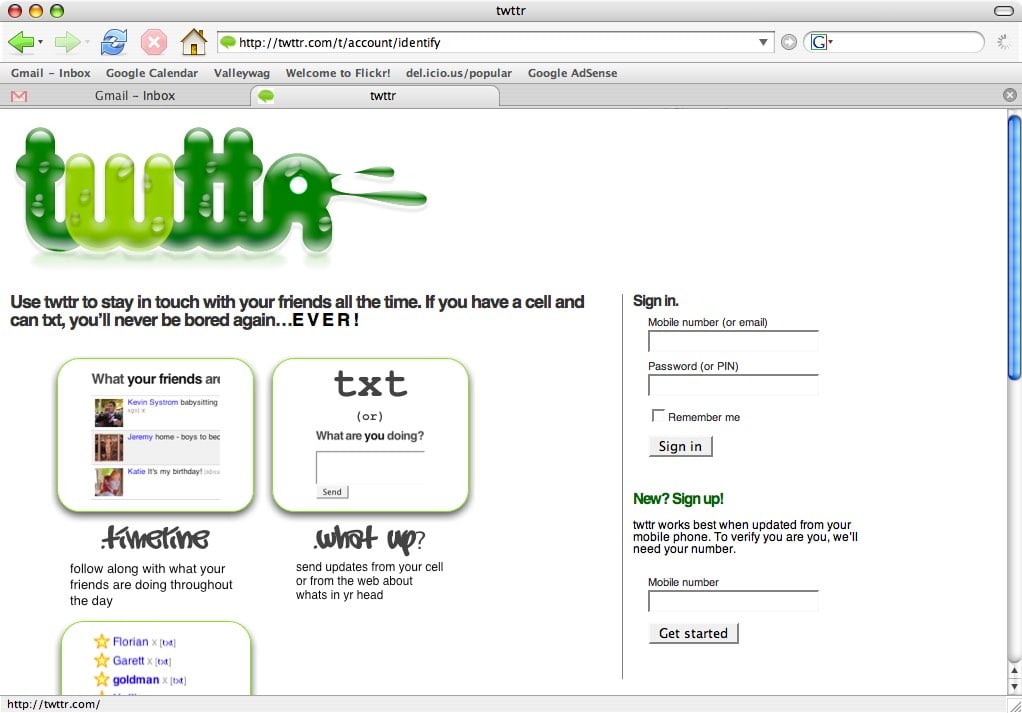
Or at least a very early version. From humble beginnings…
ps. Here’s an early Facebook screenshot, an early Google homepage, and Yahoo’s homepage circa 1994, and an early screencap of Tumblr’s dashboard.
Update: If you look at the screenshot closely, there’s a familiar name at the top of the “What your friends…” box: Instagram co-founder Kevin Systrom (his Twitter user id is 380…meaning that he was one of the first 400 people to sign up for the service).
Moore’s law states that “the number of transistors that can be placed inexpensively on an integrated circuit doubles approximately every two years”. In the IEEE Annals of the History of Computing Jonathan Koomey states what you could refer to as Koomey’s law: “the electrical efficiency of computation has doubled roughly every year and a half”…which results in crazy stuff like:
Imagine you’ve got a shiny computer that is identical to a Macbook Air, except that it has the energy efficiency of a machine from 20 years ago. That computer would use so much power that you’d get a mere 2.5 seconds of battery life out of the Air’s 50 watt-hour battery instead of the seven hours that the Air actually gets. That is to say, you’d need 10,000 Air batteries to run our hypothetical machine for seven hours.
This crazy-experimental therapy uses a modified HIV virus to attack cancer cells in humans. Only three people have tried this therapy for chronic lymphocytic leukemia; two are in complete remission and one showed improvement.
Doctors removed a billion of his T-cells — a type of white blood cell that fights viruses and tumors — and gave them new genes that would program the cells to attack his cancer. Then the altered cells were dripped back into Mr. Ludwig’s veins.
At first, nothing happened. But after 10 days, hell broke loose in his hospital room. He began shaking with chills. His temperature shot up. His blood pressure shot down. He became so ill that doctors moved him into intensive care and warned that he might die. His family gathered at the hospital, fearing the worst.
A few weeks later, the fevers were gone. And so was the leukemia.
There was no trace of it anywhere — no leukemic cells in his blood or bone marrow, no more bulging lymph nodes on his CT scan. His doctors calculated that the treatment had killed off two pounds of cancer cells.
A year later, Mr. Ludwig is still in complete remission. Before, there were days when he could barely get out of bed; now, he plays golf and does yard work.
(via @marcprecipice)
Watch as Vladimir Putin rides a horse, drives a race car, tags a tiger, does judo, goes on archeological dives, looks at leopards, stands on a boat, arm wrestles, attempts to bend a frying pan, rides a snowmobile, flies a plane, hugs a dog, rides a motorcycle, looks at a bear, swims the butterfly, signs autographs, shoots a whale with a crossbow, plays the piano, feeds a moose, talks with a biker gang, steers a boat, walks through brush with a gun, sits in a tank, blacksmiths, plays hockey, hugs a horse, dives almost a mile in a submersible, and adjusts sunglasses.
He has made many more important posts on In Focus and Big Picture over the years, but Alan Taylor has really outdone himself with this one…each photo is somehow more wonderfully unlikely than the previous one. See also Kim Jong-il Looking at Things.
Bill Cunningham New York, a documentary film about the unassuming king of street fashion photography, is out on DVD today.
“We all get dressed for Bill,” says Vogue editor Anna Wintour. The Bill in question is 80+ New York Times photographer Bill Cunningham. For decades, this Schwinn-riding cultural anthropologist has been obsessively and inventively chronicling fashion trends he spots emerging from Manhattan sidewalks and high society charity soirees for his beloved Style section columns On The Street and Evening Hours.
Cunningham’s enormous body of work is more reliable than any catwalk as an expression of time, place and individual flair. The range of people he snaps uptown fixtures like Wintour, Brooke Astor, Tom Wolfe and Annette de la Renta (who appear in the film out of their love for Bill), downtown eccentrics and everyone in between reveals a delirious and delicious romp through New York. But rarely has anyone embodied contradictions as happily and harmoniously as Bill, who lived a monk-like existence in the same Carnegie Hall studio at for fifty years, never eats in restaurants and gets around solely on bike number 29 (28 having been stolen).
It got great reviews…currently 98% on Rotten Tomatoes.
You know how your hands and feet get all wrinkly when they’re immersed in water for a long time? There’s speculation the wrinkles might be an adaptation that allows for better gripping in wet conditions.
Now a paper in the journal Brain, Behavior and Evolution offers more evidence that wet wrinkles serve a purpose. Much like the tread on a tire, they improve traction.
In the study, an evolutionary neurobiologist and his co-authors examined 28 fingers wrinkled by water. They found that they all had the same pattern of unconnected channels diverging away from one another as they got more distant from the fingertips.
The wrinkles allow water to drain away as fingertips are pressed to wet surfaces, creating more contact and a better grip.
(via stellar)
From the current issue of Lapham’s Quarterly, a collection of facts and anecdotes about food. I can’t pick a favorite, so here are three:
Paul Newman’s character amazingly eats fifty hard-boiled eggs in one hour in Cool Hand Luke. Sixty-five hard-boiled eggs eaten in sixty minutes and forty seconds is the actual world record, held by Sonya Thomas.
As to why he didn’t drink water, an inebriated W. C. Fields purportedly responded, “Fish fuck in it.”
“As if I swallowed a baby,” said William Makepeace Thackeray about eating his first oyster.
(via @claytoncubitt)
The Cassini spacecraft caught this remarkable photo of Saturn eclipsing the Sun in 2006.

Click through for the big image and the massive image. If you look close can see the Earth in the image, for reals!
“First they ignore you, then they laugh at you, then they fight you.” — Gandhi
“Give me death.” — Patrick Henry
“The world is more dangerous than sincere.” — Martin Luther King Jr.
“People will forget what you said, people will forget what you did.” — Maya Angelou
“To err is human.” — Alexander Pope
Journalist Walt Harrington has known George W. Bush for more than twenty-five years and wrote an article for The American Scholar about his conversations with the former President over the years.
President Bush — and he was, no doubt, by then a real president — talked expansively about Afghanistan, Iraq, Iran, China, Korea, Russia. He talked about his reelection strategies, Iran’s nuclear ambitions, WMD and how he still believed they would be found, Colin Powell and Condoleezza Rice, Vladimir Putin. He talked about his aides and how tough their lives were, the long hours and stress and time away from their families, about how difficult it was for his daughters. He said that compared with everyone around a president, the president had the easiest job. He was the same confident, brash man I had met years ago, but I no longer sensed any hint of the old anger or the need for self-aggrandizement.
(via ★bryce)
From a New York magazine profile of some young Stanford hackers, a fun Mark Zuckerberg anecdote:
Zuckerberg doesn’t code much for Facebook anymore, the same way that Steve Jobs never hand-coded software for the iPhone. But, as the Groups team was adding the finishing touches to its product, Zuckerberg said he wanted to write a few lines. “Everybody was like, Ohhhh, Zuck’s gonna write code,” says Feross. Someone set up an easy bug for him to fix-adding a link to a picture, or something-and he went to work. Five minutes passed. Twenty minutes. An hour. “It took him like two hours to do something that would take one of us who’s an engineer like five minutes,” says Feross. It was like a retired slugger coming back for one last at-bat, for old time’s sake, and finding he’d lost more of his game than he’d reckoned. Still, he got props from Feross & Co. for getting his hands dirty.
1. Amazon has every single episode available on Instant Video. (thx, matthew)
2. PBS Kids has a bunch of episodes available with a kid-friendly video player. (thx, chris)
3. Episode guides and more at The Neighborhood Archive Blog. (thx, jeff)
After reading the fantastic Tom Junod piece on Fred Rogers earlier in the week, I poked around on YouTube for some Mister Rogers clips and shows. There are only a few full episodes on there but two of them are particularly relevant as kids across the nation go back to school for the fall:
I watched the first episode with Ollie yesterday (he was a big fan of the trolley, which was always my favorite part of the show too) and then we watched how crayons are made and how people make trumpets.
After our YouTube supply is exhausted, we’ll move on to DVDs (here’s a music compilation and episodes from the first week of the show), Netflix, or Amazon Instant Video, which has a bunch of episodes available for free (!!) for Prime subscribers.
Ikea is modifying their popular Billy bookcase to hold more than just books.
TO SEE how profoundly the book business is changing, watch the shelves. Next month IKEA will introduce a new, deeper version of its ubiquitous “BILLY” bookcase. The flat-pack furniture giant is already promoting glass doors for its bookshelves. The firm reckons customers will increasingly use them for ornaments, tchotchkes and the odd coffee-table tome-anything, that is, except books that are actually read.
In the first five months of this year sales of consumer e-books in America overtook those from adult hardback books. Just a year earlier hardbacks had been worth more than three times as much as e-books, according to the Association of American Publishers. Amazon now sells more copies of e-books than paper books. The drift to digits will speed up as bookshops close. Borders, once a retail behemoth, is liquidating all of its American stores.
As the bookshelf industry scrambles to retool, a Kindle cozy industry rises. (via @austinkleon)
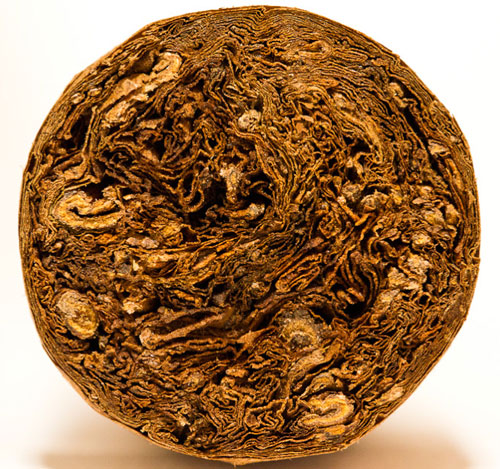
Cigars each have their own unique fingerprint of sorts as these cross-sectional photos attest.
(thx, frank)
The Atlantic asked their readers to tell them what other people don’t get or appreciate about their jobs. Here’s what they said, from Army Soldier to Zookeeper.
What people don’t understand about my job [as an IRS employee] is that chances are you are not the person I’m examining. I examine doctors who expense three Cadillacs, insurance brokers who claim jet skis for business use only, and real estate agents who haven’t paid taxes in eight years. The public doesn’t realize that tax auditors are the only people between a balanced effective tax rate among all social classes and the bourgeoisie stealing what isn’t bolted down. Don’t kid yourself; these people are stealing from you. This money helps pay for schools, roads and with any luck can keep mortgage interest deduction alive for a few more years. I read a report on NPR that Italy has 40% of its population evading taxes. Imagine our debt crisis if we had the same problem. (Our tax evasion rate is estimated between 8-18%).
So if you’re one of those “Joe the Plumber” people who take time out of work to throw teabags at me on my way into the office in the morning: You are the middle class! I’m helping you!
(thx, jonathan)
Ten photography lessons learned from Henri Cartier-Bresson orig. from Sep 07, 2011
* Q: Wha? A: These previously published entries have been updated with new information in the last 24 hours. You can find past updates here.
The giants of physics (and Morgan Freeman, who can be a giant of anything he wants) explain quantum mechanics using relatively simple terms and autotune.
(via devour)
Gothamist is trying something new: long-form articles available for a small fee ($2-3) on the Kindle or as a PDF. The first one in the series is a real corker…Confessions of a “Rape Cop” Juror, a piece written by a member of the jury that acquitted two NYPD officers charged with raping a young woman in her East Village apartment.
The former cop sprang from his chair and rushed toward me, and before I could step back, the stocky arms of the ex-boxer were curled around my shoulders. To my left, I saw a crowd of faces; to my right, a place setting. One knife, one fork, and one dull spoon wrapped in a white cloth napkin — not much help if he started strangling me. The arms tightened, and then the high-pitched, soft-spoken voice I recognized from the witness stand whispered, “Thank you.”
My chest sank with a long exhale, and a whirlwind of high-powered suits and smiles rose from their glasses of Cabernet. They floated toward me with outstretched hands and watery eyes, the aroma of freshly baked focaccia robiolas mixing with their cologne. One floor below, diners in this Murray Hill Italian restaurant chattered away ignorant of the strange encounter at the top of the back staircase. The man hugging me was supposed to be the monster I had spent seven weeks analyzing and seven days judging. This was Kenneth Moreno, Rape Cop.
I haven’t read the piece but The Awl’s Choire Sicha has:
It’s a fascinating read, and I mean that in a very honest sense. In large part it’s about how unbelievably important jury service is in America, and about how we treat those accused of crimes. Whether you like the verdict or not, or whether you like the case presented by prosecutors or not (SIGH), this view into the thinking and process of the jurors is really valuable.
Different languages are spoken at varying speeds but thanks to correlated differences in data-density, the same amount of information is conveyed within a given time period.
For all of the other languages, the researchers discovered, the more data-dense the average syllable is, the fewer of those syllables had to be spoken per second — and the slower the speech thus was. English, with a high information density of .91, is spoken at an average rate of 6.19 syllables per second. Mandarin, which topped the density list at .94, was the spoken slowpoke at 5.18 syllables per second. Spanish, with a low-density .63, rips along at a syllable-per-second velocity of 7.82. The true speed demon of the group, however, was Japanese, which edges past Spanish at 7.84, thanks to its low density of .49. Despite those differences, at the end of, say, a minute of speech, all of the languages would have conveyed more or less identical amounts of information.
(via @mulegirl)
A few things you might learn about photography by following Henri Cartier-Bresson’s example.
4. Stick to one lens
Although Henri Cartier-Bresson shot with several different lenses while on-assignment working for Magnum, he would only shoot with a 50mm if he was shooting for himself. By being faithful to that lens for decades, the camera truly became “an extension of his eye”.
Update: That link is having some trouble so here’s the cached copy from Google.
A forthcoming book from Tyler Cowen: An Economist Gets Lunch: New Rules for Everyday Foodies. No description yet, but if you’re a regular reader of Marginal Revolution (the Food and Drink stuff in particular), you can probably figure out what it’ll entail.
I absolutely loved this 1998 Esquire profile of Mister Rogers by Tom Junod. I was a big Mister Rogers fan…loved him even more than Sesame Street. One my favorite things I’ve read all year.
Once upon a time, a long time ago, a man took off his jacket and put on a sweater. Then he took off his shoes and put on a pair of sneakers. His name was Fred Rogers. He was starting a television program, aimed at children, called Mister Rogers’ Neighborhood. He had been on television before, but only as the voices and movements of puppets, on a program called The Children’s Corner. Now he was stepping in front of the camera as Mister Rogers, and he wanted to do things right, and whatever he did right, he wanted to repeat. And so, once upon a time, Fred Rogers took off his jacket and put on a sweater his mother had made him, a cardigan with a zipper. Then he took off his shoes and put on a pair of navy-blue canvas boating sneakers. He did the same thing the next day, and then the next … until he had done the same things, those things, 865 times, at the beginning of 865 television programs, over a span of thirty-one years. The first time I met Mister Rogers, he told me a story of how deeply his simple gestures had been felt, and received. He had just come back from visiting Koko, the gorilla who has learned — or who has been taught — American Sign Language. Koko watches television. Koko watches Mister Rogers’ Neighborhood, and when Mister Rogers, in his sweater and sneakers, entered the place where she lives, Koko immediately folded him in her long, black arms, as though he were a child, and then … “She took my shoes off, Tom,” Mister Rogers said.
Koko was much bigger than Mister Rogers. She weighed 280 pounds, and Mister Rogers weighed 143. Koko weighed 280 pounds because she is a gorilla, and Mister Rogers weighed 143 pounds because he has weighed 143 pounds as long as he has been Mister Rogers, because once upon a time, around thirty-one years ago, Mister Rogers stepped on a scale, and the scale told him that Mister Rogers weighs 143 pounds. No, not that he weighed 143 pounds, but that he weighs 143 pounds. … And so, every day, Mister Rogers refuses to do anything that would make his weight change — he neither drinks, nor smokes, nor eats flesh of any kind, nor goes to bed late at night, nor sleeps late in the morning, nor even watches television — and every morning, when he swims, he steps on a scale in his bathing suit and his bathing cap and his goggles, and the scale tells him that he weighs 143 pounds. This has happened so many times that Mister Rogers has come to see that number as a gift, as a destiny fulfilled, because, as he says, “the number 143 means ‘I love you.’ It takes one letter to say ‘I’ and four letters to say ‘love’ and three letters to say ‘you.’ One hundred and forty-three. ‘I love you.’ Isn’t that wonderful?”
Here’s the Emmy speech mentioned in the piece:
an NPR piece on Rogers’ death with Junod as a guest, and a eulogy by Junod for Rogers.
The other day while listening to Watch the Throne I wondered if someone had made a supercut of all of Kanye’s “HUH”s, “HANH”s, and “UHH”s…and of course someone has.
HENH??!
Current TV has compiled a list of the fifty contemporary documentaries that you must see before you die. Lots of familiar names on the list…here are my personal favorites:
The Kid Stays in the Picture
When We Were Kings
Dogtown and Z-Boys
Man on Wire
Capturing the Friedmans
Touching the Void
The Fog of War
Grizzly Man
The Thin Blue Line
Hoop Dreams
Jim Romenesko is shutting down The Obscure Store and Reading Room after thirteen years. TOS&RR was an early blog that helped shape many that came after it…it was one of my favorites back in the day.
Romenesko was also one of the first, if not the first, full-time bloggers…the Poynter Institute brought him on in 2000 to write the MediaNews blog. Romenesko is stepping away from Poynter (he’ll continue as a part-time staffer) and will launch a site on his own domain soon.
(Fun fact: I did the design for TOS&RR back in, what, 2002? 2003? I was amazed (and somewhat embarrassed) to discover that the logo survived until the present day.)
Absolutely beeeeeyooootiful typography on these Sanborn fire insurance maps.
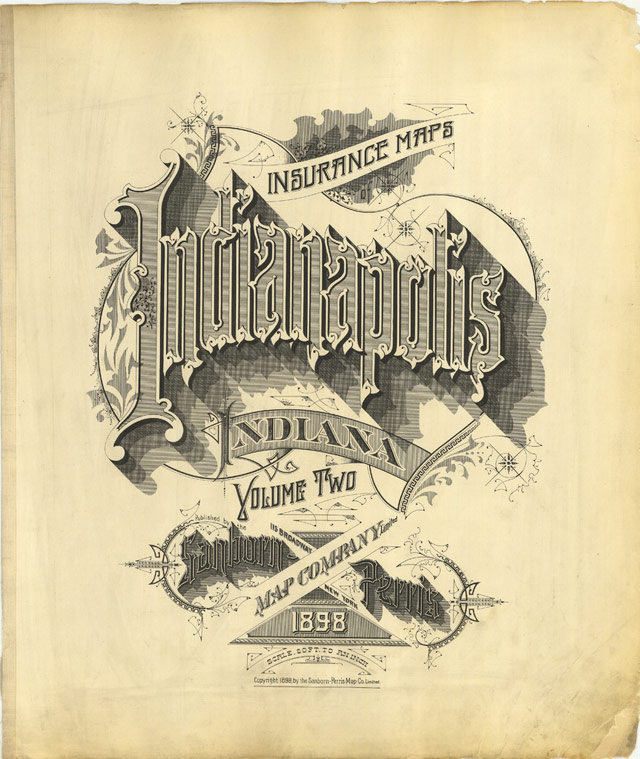
Sanborn’s fire insurance enterprise produced not only excellent and detailed urban maps, but they also maintained an elegant aesthetic in the headings and legends on the maps themselves, and in the title pages of the (larger) city volumes. The ornamental flair is diverse — I don’t think any of the examples above repeat type styles — and lends an air of individuality and refinement to each of the towns surveyed.
Although this sort of artistic embellishment was unlikely to have increased map sales on its own, it’s a charming addition which will have perhaps made the purchasers feel a sense of pride and a little more secure about their own unique town. And it’s certainly in keeping with the cartographic tradition of decorative trimmings.
Chris Ware must have a stack of these babies near his drawing table from which to crib.
Mastergram takes photos from well-regarded photographers (Capa, Burtynksy, Weegee, etc.) and runs them through Instagram filters.
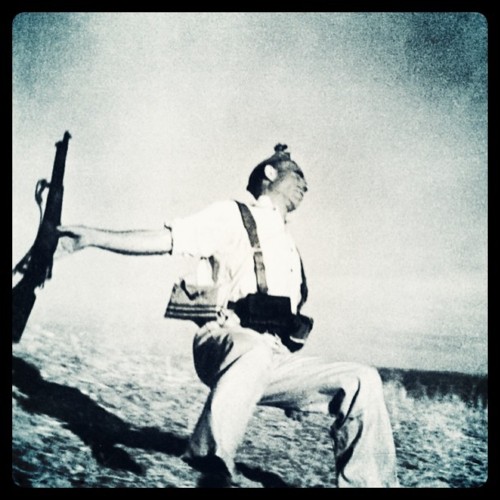
If the Instagram effect can make mundane images appear to be works of art, what happens when we apply the same filters to images that have historically been held in high regard? Is the imagery degraded or enhanced as a result?
Kurt Vonnegut explains the shapes of stories orig. from Sep 02, 2011
* Q: Wha? A: These previously published entries have been updated with new information in the last 24 hours. You can find past updates here.
Austin Kleon explicitly tied the last two posts together and fed Kurt Vonnegut’s story shape graphs into Google Correlate’s search by drawing feature. This is SO GOOD.
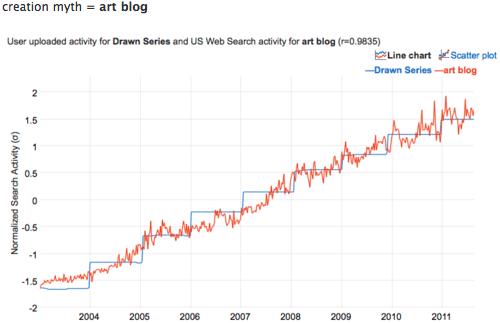
This is kind of amazing…you draw a graph and Google Correlate finds query terms whose popularity matches the drawn curve. I drew a bell curve, a very rough one peaking in 2007, and it matches a bunch of searches for “myspace”.
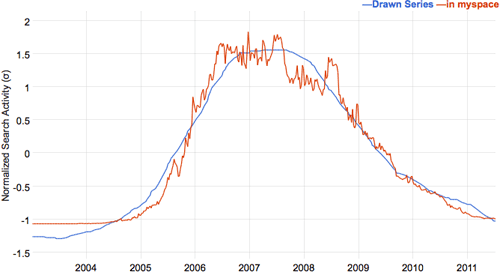
This fits beautifully with the previous post about Vonnegut’s story shape graphs.
Using a chalkboard and a simple graphical axis, watch as Kurt Vonnegut explains the different shapes that stories can take.
(via @coudal)
Update: This is part of a longer talk that Vonnegut gave…a transcript is here.
I want to share with you something I’ve learned. I’ll draw it on the blackboard behind me so you can follow more easily [draws a vertical line on the blackboard]. This is the G-I axis: good fortune-ill fortune. Death and terrible poverty, sickness down here-great prosperity, wonderful health up there. Your average state of affairs here in the middle [points to bottom, top, and middle of line respectively].
(thx, clifford)
This short film of a 3-D rendered hand made by Ed Cattmull (Pixar founder) and Fred Parke in 1972 might be the first digital 3-D rendered film ever.
This is kind of amazing…from 1972! The story that goes along with the film is worth a read as well.
The best part of this film is not even the 3D rendering itself, but the outtakes and “making of” footage that has been interwoven throughout, including footage of a plaster replica of Ed’s hand onto which he is meticulously mapping the polygon vertices that make up the three dimensional model (around 1:30). That’s really remarkable. The math that we take for granted for rendering 3D was being invented, real time, to create this video. (Ed’s credited for having working out that math to handle things like texture mapping, 3D anti-aliasing and z-buffering.)
See also Vol Libre, a film from 1980 that, for the first time, used fractals to generate graphics. (via @beep)
This handy chart of defunct country names can help you determine the age of your globe.

When you find the FORMER place name on your globe instead of the NEW name, you have confimed the age of your globe.
Update: XKCD’s sliiiiiightly fictitious Guide to Figuring Out the Age of an Undated World Map would be a good way to present the chart above.
Monsters of Grok offers “fake band t-shirts for history’s greatest minds”. The Tesla/Edison send-up of AC/DC is nearly genius, but I like the Machiavelli/Metallica one better for some reason.

These remind me of IFC’s Cinemetal shirts. (via many different vectors)
Ursus Wehrli is coming out with a new book, The Art of Clean Up, which features pairs of photographs of different objects, in disorder and then sorted. Here’s my favorite pair:


Photos from the book are disappearing from various sites around the web as takedown notices are sent out, but you can get the gist of the book by watching this video by Wehrli about how one of the photos was made:
How do you know a natural disaster is really bad? The Waffle House is closed.
When a hurricane makes landfall, the head of the Federal Emergency Management Agency relies on a couple of metrics to assess its destructive power.
First, there is the well-known Saffir-Simpson Wind Scale. Then there is what he calls the “Waffle House Index.”
Green means the restaurant is serving a full menu, a signal that damage in an area is limited and the lights are on. Yellow means a limited menu, indicating power from a generator, at best, and low food supplies. Red means the restaurant is closed, a sign of severe damage in the area or unsafe conditions.
“If you get there and the Waffle House is closed?” FEMA Administrator Craig Fugate has said. “That’s really bad. That’s where you go to work.”
(via @buzz)
Washing machine self-destructs orig. from Aug 31, 2011
* Q: Wha? A: These previously published entries have been updated with new information in the last 24 hours. You can find past updates here.




Socials & More