It’s simply a way of recording what you see — point the camera at it, and press a button. How hard is that? And what’s more, in this digital age, its free — doesn’t even cost you the price of film. It’s so simple and basic, it’s ridiculous.
and difficult about photography:
It’s so difficult because it’s everywhere, every place, all the time, even right now. It’s the view of this pen in my hand as I write this, it’s an image of your hands holding this book, Drift your consciousness up and out of this text and see: it’s right there, across the room — there… and there. Then it’s gone. You didn’t photograph it, because you didn’t think it was worth it. And now it’s too late, that moment has evaporated.
Graham also describes photography as “an intuitive expression of liquid intelligence”, which seems an apt expression of creativity in general. (via noah kalina)
Several times in Last Year at Marienbad, the characters play a game called Nim. The gameplay is simple: a) players take turns removing objects from rows, b) they can remove as many objects as they want from a single row in one turn, and c) the player who removes the last object loses. The strategy is somewhat more difficult to understand, even though the player who goes first and follows the optimal strategy will always win. Although somewhat less glamourous than the film version, a Flash version of Nim is available to play.
For an interview with Gerard Butler (aka the head Spartan in 300), Esquire sent Cal Fussman in cold. He was given an address and a first name and told to go get the story.
We agree that the balcony upstairs is the best spot. There’s a magnificent view of L. A. Gerry hits a button and an awning lowers. His assistant, who has the aura of someone who could be running a Fortune 500 company, sets down a fruit plate and some water.
“Whatever you do, I get the impression that you do it well.”
Gerry seems not to comprehend that I truly don’t know what he does.
“I went more for the energy than for something big and bombastic. It was great when my mom came over and stood on the balcony. The boy did good.”
Just then, a small gift balloon that says MOM rises directly in front of us, out above the trees.
“Where the fuck did that balloon come from?” he says. “I’ve had some of the craziest synchronicities in my life.”
“Where are you from?”
“You don’t even know where I’m from. This is unbelievable.”
By his own admission, Fussman “really hadn’t seen many movies” before six months ago. There’s something a touch New Journalism about this interview…or perhaps it’s just the opposite.
We Choose the Moon is a site that tracks the activities of the Apollo 11 mission as it happened 40 years ago. Nice work. The transmissions from the spacecraft, CAPCOM, and the lunar lander are cleverly published to and pulled in from Twitter.
With all this 40th anniversary stuff, I’m having trouble getting my mind around that the first Moon landing is as far removed from the present as the low point of The Great Depression was from my birth (i.e. the Moon landing, culturally speaking, is Ollie’s Great Depression). See also timeline twins. (via jimray)
According to what’s known as the Expensive Tissue Hypothesis, early humans compensated for the energy used in their heads by cutting back on the energy used in their guts; as man’s cranium grew, his digestive tract shrank. This forced him to obtain more energy-dense foods than his fellow-primates were subsisting on, which put a premium on adding further brain power. The result of this self-reinforcing process was a strong taste for foods that are high in calories and easy to digest; just as it is natural for gorillas to love leaves, it is natural for people to love funnel cakes.
How do you follow up a kooky-titled bestseller like Freakonomics? With a book called SuperFreakonomics. It’s due out on October 20 and has a subtitle of “Tales of Altruism, Terrorism, and Poorly Paid Prostitutes”.
In bad times and in good, New York City is the idea capital of the world. Here is where commerce intersects with what Lionel Trilling described as “the bloody crossroads where literature and politics meet.” The New York Review of Ideas will report on that intersection, telling the stories that will shape the future of American culture.
Ooh, and check out that ever-present blue border. (via snarkmarket)
The fact that any of the 146 [Cheesecake Factory restaurants] around the country can put out this astonishing variety of food is an impressive work of corporate organization and efficiency.
Frank Ahearn used to be a private investigator but now uses his PI experience to charge up to $30,000 to help people disappear.
There are three key steps to disappearing. First, destroy old information about yourself. Call your video store or electricity company and replace your old, correct phone number with a new, invented one. Introduce spelling mistakes into your utility bills. Create a PO Box for your mail. Don’t use your credit cards and the like.
Then, create bogus information to fool private investigators who might be looking for you. Go to one city and apply for an apartment. Rent a car in another one.
The next, final step is the most important one. Move from point A to point B. Create a dummy company to pay your bills. Only use prepaid mobile phones and change them every month. It is nearly impossible to find out where you are unless you make a mistake.
Eternal Moonwalk is also an incidental tutorial in the basic properties of cinema. It returns motion pictures to their origin point, when the medium’s core appeal was the chance to watch strangers performing, their bodies moving from Point A to Point B, their familiar or amusing actions serving as an emotional connection point, a reminder that we’re members of the same species inhabiting the same small world.
The fact that both of these important brain networks become active together suggests that mind wandering is not useless mental static. Instead, Schooler proposes, mind wandering allows us to work through some important thinking. Our brains process information to reach goals, but some of those goals are immediate while others are distant. Somehow we have evolved a way to switch between handling the here and now and contemplating long-term objectives. It may be no coincidence that most of the thoughts that people have during mind wandering have to do with the future.
This jibes well with the picture of the absentmindedness typical of some brilliant people.
All the other reporters of my generation would come back from an assignment and be done with their piece in a half hour. For the rest of the afternoon they’d be reading books or playing cards or drinking coffee in the cafeteria, and I was always very much alone. I didn’t carry on conversations during those hours. I just wanted to make my article perfect, or as good as I could get it. So I rewrote and rewrote, feeling that I needed every minute of the working day to improve my work. I did this because I didn’t believe that it was just journalism, thrown away the next day with the trash. I always had a sense of tomorrow. I never turned in anything more than two minutes before deadline. It was never easy, I felt I had only one chance. I was working for the paper of record, and I believed that what I was doing was going to be part of a permanent history.
It had better be good too, because my name was on it. I’ve always thought that. I think this came from watching my father work on suits. I was impressed by how carefully he would sew, and he never made much money, but I thought he was the real thing. His name was on those suits-the buttons couldn’t fall off tomorrow. They had to look great, had to fit well, and had to last. His business wasn’t profitable, but from him I learned that I wanted to be a craftsman.
The September Issue is the much-anticipated documentary that follows Anna Wintour and her staff at Vogue through the process of creating the magazine’s September issue, AKA the world’s thickest magazine issue.
An apt demonstration that an editor/curator’s main job is saying no to almost everything.
Let’s take a look at who’s still alive here. Brad Pitt: yes. Aaron Sorkin: yes. Steven Soderbergh: no. Expected soon: Michael Bay, Alan Ball, Sam Mendes, McG, and M Night Shamalamadingdong. (thx, david)
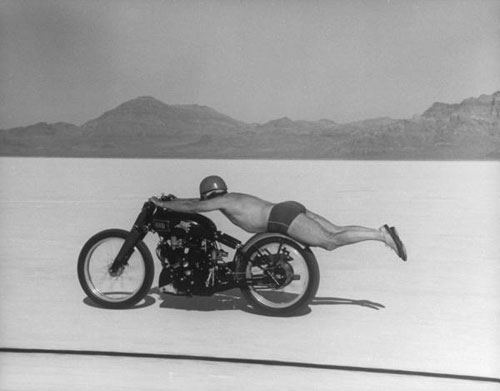
His first attempt shattered the record with a speed of 148.6mph. Rollie wasn’t satisfied. Convinced his safety leathers were creating unnecessary drag, he stripped down to nothing but a pair of swim trunks and goggles.
That’s Rollie Free breaking the world speed record for motorcycles in 1948.
GVSHP first proposed the street co-naming in 2006 shortly after Jacobs’ death; the proposal was approved by the local community board and the City Council, and then sat in limbo for 2 1/2 years.
Also, the townhouse that Jacobs lived in on the street is for sale. (thx, meg)
Sometimes in this blog I’ve made disparaging remarks about HomeSite, but that’s not because I disliked it. It’s just that it’s hard to look at something you created so long ago without seeing all the mistakes that you’ve learned not to make since then. I’m actually very proud of HomeSite, and very thankful that it enabled me to quit my job and work at home. And, funny enough, HomeSite is also what paid for the home I’m living in now.
All of my web stuff up until mid-2002 was done in HomeSite…it’s where 0sil8 thrived and kottke.org was born. I still haven’t found a piece of web authoring software that feels as comfortable as HomeSite did back then.
“There’s a massive misperception that incandescents are going away quickly,” said Chris Calwell, a researcher with Ecos Consulting who studies the bulb market. “There have been more incandescent innovations in the last three years than in the last two decades.”
Flash games are currently the ghetto of the game development industry. Compared to the number of players it serves, the Flash game ecosystem makes little money, launches few careers, and sustains few developer owned businesses. Despite the vast potential of the ecosystem, Flash games contribute surprisingly little to the advancement of game design as an art or a craft.
This is just the first installment…two or three more are yet to come. (via @anildash)
I, Pencil is a 1958 ode to mass production, industrial specialization, commodity economics, and the invisible hand using the manufacture of a simple graphite pencil as an example.
Consider the millwork in San Leandro. The cedar logs are cut into small, pencil-length slats less than one-fourth of an inch in thickness. These are kiln dried and then tinted for the same reason women put rouge on their faces. People prefer that I look pretty, not a pallid white. The slats are waxed and kiln dried again. How many skills went into the making of the tint and the kilns, into supplying the heat, the light and power, the belts, motors, and all the other things a mill requires? Sweepers in the mill among my ancestors? Yes, and included are the men who poured the concrete for the dam of a Pacific Gas & Electric Company hydroplant which supplies the mill’s power!
Really great. A nice illustration of embodied energy to boot.
First, you need some water. Fuse two hydrogen with one oxygen and repeat until you have enough. While the water is heating, raise some cattle. Pay a man with grim eyes to do the slaughtering, preferably while you are away. Roast the bones, then add to the water.
Now let us not lose our precious bit of lead while we prepare the wood. Here’s the tree! This particular pine! It Is cut down. Only the trunk is used, stripped of its bark. We hear the whine of a newly invented power saw, we see logs being dried and planed. Here’s the board that will yield the integument of the pencil in the shallow drawer (still not closed). We recognize its presence in the log as we recognized the log in the tree and the tree in the forest and the forest in the world that Jack built. We recognize that presence by something that is perfectly clear to us but nameless, and as impossible to describe as a smile to somebody who has never seen smiling eyes.
Thus the entire little drama, from crystallized carbon and felled pine to this humble implement, to this transparent thing, unfolds in a twinkle. Alas, the solid pencil itself as fingered briefly by Hugh Person still somehow eludes us! But he won’t, oh no.
There are many explanations of why one would use a moving average, but I’ll just say that it covers your weight trends and lessens the daily fluctuations. This means if you drop 0.1 pounds every day for a week then one morning you weigh in at one full pound heavier than the previous day, your entire week wasn’t shot that morning because you’d still be trending downwards. If you stick to your plans you’ll often see weight continue to go down even with the occasional hiccup.
Two things of which you should not fret the daily movement: the stock market and your weight.
The first war between G.I. Joe and Cobra (1985-86), as documented in the G.I. Joe animated series, was the most violent conflict in history never to result in a single casualty. Through a combination of terrible aim, superhuman jumping ability, and impossibly reliable parachutes, every combatant escaped even the most dire of situations without so much as the angle of his beret askew.
The world of the movie is one in which everyone tells the truth all the time…until Gervais invents lying. It also stars every other Hollywood actor and comic in the world, including Jennifer Garner, Jason Bateman, Patrick Stewart, Jeffrey Tambor, Tina Fey, Christopher Guest, Rob Lowe, Louis C.K., and John Hodgman. (You know it’s quite an august list when you have to stick “and John Hodgman” on the end of it.)
If I ever write a book, it might have something to do with the two minds that govern creative expertise: the instinctual unconscious mind (the realm of relaxed concentration) and the thinking mind (the realm of deliberate practice). The tension between these two minds is both the key to and fatal flaw of human creativity. From the world of sports1, here’s Rockies pitcher and college physics major Jeff Francis describing the interplay of the minds on the mound:
Even though I do understand the forces and everything, there’s a separation when I’m pitching. If I throw a good pitch, I know what I did to do it, but there has to be a separation between knowing what I did and knowing why what I did helped the ball do what it did, if that makes any sense at all. If I thought about it on the mound, I’d be really mechanical and trying to be too perfect instead of doing what comes naturally.
But you don’t need to be a physics major to wrestle with the consequences of the conflict between the two minds. After an injury and subsequent surgery, Francis’ instinctual mind works to protect his body from further injury:
Francis repeatedly pulled the ball back in preparation to throw. But as he flashed his arm forward, his hand would, mind unaware, bring the ball back toward his ear rather than at full extension. It was his body essentially shortening the axis of his arm to decrease the force on his shoulder, protecting him from pain. And Francis could not stop it.
After his 10th pitch and first muffled groan of pain, he stopped.
“It’s hurting you?” Murayama said.
“Yeah,” Francis said.
“I can tell. You’re getting out ahead of your arm. Slow down, stay back a little more.”
“Does it look like I’m scared to throw a little?”
“Are you scared?”
“Not consciously.”
To fully recover and regain his former effective pitching motion, Francis will utilize his thinking mind to retrain his unconscious mind through deliberate practice to ignore the injury potential. (thx, adriana)
[1] Most of the examples I’ve cited over the years deal with sports, mostly because professional athletes are among the most trained, scrutinized, studied, and optimized creative workers in the world. For a lot of other professions and endeavors, the data and scrutiny just isn’t as evident. ↩
Finding ways to process the raw materials on a domestic scale is also an issue. For example, my first attempt to extract metal involved a chimney pot, some hair-dryers, a leaf blower, and a methodology from the 15th century — this is about the level of technology we can manage when we’re acting alone. I failed to get pure enough iron in this way, though if I’d tried a few more times and refined my technique and knowledge of the process I probably would’ve managed in the end. Instead I found a 2001 patent about industrial smelting of Iron ores using microwave energy.
Microwaves, as we all know, are just so much more convenient — and so I tried to replicate the industrial process outlined in the patent using a domestic microwave. After some not-so-careful experimentation which necessitated another microwave, followed by some careful experimentation, I got the timing and ingredients right and made a blob of iron about as big as a 10p coin.
Mistakes, bugs, incompatibilities, and related issues that used to affect a handful now affect hundreds. 1% is real number now. This requires some organizational change. More caution, more testing, more contingency planning, more disaster planning.
His refusal to come out against the Vietnam War, particularly as it continued after he left the Defense Department, has angered many. There’s ample evidence that he felt the war was wrong. Why did he remain silent until the 1990s, when “In Retrospect” was published? That is something that people will probably never forgive him for. But he had an implacable sense of rectitude about what was permissible and what was not. In his mind, he probably remained secretary of defense until the day he died.
One angry person once said to me: “Loyalty to the president? What about his loyalty to the American people?” Fair enough. But our government isn’t set up that way. He was not an elected official, he said repeatedly. He served at the pleasure of the president.
McNamara also had a huge influence on the economics profession, most of all through his 13-year presidency at the World Bank. He focused the Bank on poverty reduction, he brought Communist China into the Bank, he introduced the practice of five-year lending plans, he significantly increased the Bank’s budget, he grew staff from 1600 to 5700, he favored sector-specific research, he raised money from OPEC, he strongly encouraged “scientific project evaluation,” and he started a largely successful program to combat “river blindness”; the latter may have been his life’s achievement.
Google Chrome OS will run on both x86 as well as ARM chips and we are working with multiple OEMs to bring a number of netbooks to market next year. The software architecture is simple — Google Chrome running within a new windowing system on top of a Linux kernel. For application developers, the web is the platform. All web-based applications will automatically work and new applications can be written using your favorite web technologies. And of course, these apps will run not only on Google Chrome OS, but on any standards-based browser on Windows, Mac and Linux thereby giving developers the largest user base of any platform.
Google isn’t worried about Yahoo! or Microsoft’s search efforts…although the media’s focus on that is probably to their advantage. Their real target is Windows. Who needs Windows when anyone can have free unlimited access to the world’s fastest computer running the smartest operating system? Mobile devices don’t need big, bloated OSes…they’ll be perfect platforms for accessing the GooOS. Using Gnome and Linux as a starting point, Google should design an OS for desktop computers that’s modified to use the GooOS and sell it right alongside Windows ($200) at CompUSA for $10/apiece (available free online of course). Google Office (Goffice?) will be built in, with all your data stored locally, backed up remotely, and available to whomever it needs to be (SubEthaEdit-style collaboration on Word/Excel/PowerPoint-esque documents is only the beginning). Email, shopping, games, music, news, personal publishing, etc.; all the stuff that people use their computers for, it’s all there.
But in many important ways, the GooOS I was talking about is largely already here and has little to do with Google Chrome OS. The underlying assumption in that post (stated more clearly in this post from Aug 2005) is that all of these apps are running in the browser. Which they now do: Gmail, Google Reader, Google Apps (word processing, spreadsheets), Aviary, Flickr, Pandora, YouTube, IM, etc. There are even online storage and backup mechanisms…do you even need local file storage? Hell, you can even use powerful apps like Mathematica in a browser. With little effort, many people can do 95% of their daily work entirely within a web browser. That’s the real GooOS/WebOS, the important GooOS/WebOS.
Sure, GooOS is not an operating system as a programmer would define it but it’s an OS from the perspective of the user — “An operating system…is an interface between hardware and user” — the browser is increasingly the sole point of interface for our interaction with computers. In a way, real operating systems are becoming irrelevant. Google’s got it exactly right with Google Chrome OS: a browser sitting on top of a lightweight Unix layer that acts as the engine that the user doesn’t need to know a whole lot about with the browser as the application layer. OS X might be the last important traditional desktop operating system, if only because it runs on desktops, laptops, the iPhone, and the inevitable Apple netbook/tablet thingie. But even OS X (and Windows and Google Chrome OS and Gnome and etc.) will lose marketshare to the WebOS…as long as users can run Firefox, Safari, or Chrome on whatever hardware they own, no one cares what flavor of Unix or tricked-out DOS that browser runs on.
Make the list entirely random consisting of selections from the entire Twitter userbase. After signing up, each new user sees 100 recommended accounts randomly chosen out of a HUGE pool of non-spam accounts (where HUGE = hundreds of thousands) that have been active for more than 3 months, tweet more than 5 times a week & fewer than 10 times a day, and have 2 times as many followers as followees (or something like that). Twitter has to be doing similar calculations to find spam accounts…just reverse it and whitelist accounts for the recommended list. That way, Twitter gets what they want (new users following people) and the super-user & conflict of interest problems are eliminated.
Exit Strategy NYC is an iPhone app that tells you where to get on the subway train so as to be in an optimal position when you get off.
Taking the 1 train uptown to 28th street? Get on right behind the middle conductor. Need to transfer to the L at Union Square from the N downtown? Ride in the 1st car. Detailed diagrams eliminate the guesswork and frustration from your ride, making your subway trip easier and faster.
I’m sure the nearest college student can tell you what “an electro-pop project from members of Vampire Weekend and Ra Ra Riot” means, but I can tell you that I’m really enjoying this album by Discovery (on sale at Amazon for $3.99 today only). I almost want to say that it reminds me of The Postal Service except 1) that would be wrong and 2) someone could get themselves slapped around for saying something like that.
If you’re moving 3,000 (or even 300) miles to live in San Francisco; live in San Francisco. And by I don’t simply mean that you should not live in the East Bay or the Peninsula or Marin. I mean live in a part of the city that your great-grandparents would recognize as being San Francisco. Somewhere that was entirely residential, and all of the homes in your neighborhood existed, prior to 1915. If you’ve only lived in SoMa, you haven’t lived in San Francisco.
I’m not a fan of SF, but Mat does a nice job in highlighting the aspects of the city that are difficult to beat.
For a first world city, San Francisco is dirty. No, filthy. No, disgusting. Whenever I travel outside of San Francisco, I’m amazed at what a disastrous anomaly it is. Sidewalks are routinely covered in broken glass, trash, old food, and human excrement. The smell of urine is not uncommon, nor is the sight of homeless persons in varying states of dishevelment. I frequented tough neighborhoods in DC and Baltimore — then the murder capital of the nation — and only in San Francisco have I been actively threatened on the street.
Nailed it. Payne’s points are exactly why I didn’t like SF at all.
The Great Ghostbusters Campaign must start today. Here. Starting with this inarguable, scientific fact: Ghostbusters is still the most successful comedy film of all time, with a 1984 box-office return of $229.2 million. But this, of course, in turn, makes it the most successful film OF ALL TIME, FULL STOP — given that comedy is the supreme genre, and rules over every other format, such as “serious”, “foreign” or “black and white”.
There will also be one large meal, a free picnic in Central Park where eight chefs will each contribute a dish to what Luc Dubanchet, the founder of Omnivore, calls a “bento box performance.” Then there will be a series of demonstrations at the Alliance Francaise, master classes held by an impressive roster of French and American chefs (the final program is still being decided).
IFC lists the 50 greatest trailers of all time. Trailers are like episodes for Law & Order for me — ten minutes after viewing and I can’t remember a thing about them — so I don’t really have any favorites, but this list seems like a solid collection.
Note: If you are a member and tried to log in, it didn't work, and now you're stuck in a neverending login loop of death, try disabling any ad blockers or extensions. Or try logging out and then back in. Still having trouble? Email me!






Socials & More