“When I lived with money, I was always lacking,” he writes. “Money represents lack. Money represents things in the past (debt) and things in the future (credit), but money never represents what is present.”
The idea started to take shape when Suelo was on a Peace Corps mission to Ecuador. As he monitored the health of the population of the village he was staying in, he noticed that their health declined as they made more money — “It looked like money was impoverishing them.” You can find out more about Suelo’s philosophy on his web site and follow his adventures on his blog, both of which he updates at the public library.
“I’m good at that. I must be good at this, too,” we tell ourselves, forgetting that in wars and on Wall Street there is no such thing as absolute expertise, that every step taken toward mastery brings with it an increased risk of mastery’s curse.
When I joined the couple for lunch at their favorite all-you-can-eat salad bar in the Tokyo suburb of Hachioji, he insisted on being called only by this new nickname, addressing his body-pillow girlfriend using the suffix “tan” to show how much he adored her. Nemutan is 10, maybe 12 years old and wears a little blue bikini and gold ribbons in her hair. Nisan knows she’s not real, but that hasn’t stopped him from loving her just the same. “Of course she’s my girlfriend,” he said, widening his eyes as if shocked by the question. “I have real feelings for her.”
Baseball historian Bill James makes a compelling argument that steroids will eventually become an accepted aspect of sports (and society as a whole) and that baseball players who are now more or less banned from entering the Hall of Fame (though not officially) will eventually be elected to Cooperstown.
If we look into the future, then, we can reliably foresee a time in which everybody is going to be using steroids or their pharmaceutical descendants. We will learn to control the health risks of these drugs, or we will develop alternatives to them. Once that happens, people will start living to age 200 or 300 or 1,000, and doctors will begin routinely prescribing drugs to help you live to be 200 or 300 or 1,000. If you look into the future 40 or 50 years, I think it is quite likely that every citizen will routinely take anti-aging pills every day.
How, then, are those people of the future — who are taking steroids every day — going to look back on baseball players who used steroids? They’re going to look back on them as pioneers. They’re going to look back at it and say “So what?”
First broadcast on the radio in 1947, You Are There presented historic events as they would have been reported by modern news broadcasters. In 1953, the program jumped to television with Walter Cronkite as the host, who also hosted a brief revival of the show in the 70s.
The series also featured various key events in American and world history, portrayed in dramatic recreations, with one addition — CBS News reporters, in modern-day suits, would report on the action and interview the characters. Each episode would begin with the characters setting the scene. Cronkite, from his anchor desk in New York, would give a few words on what was about to happen. An announcer would then give the date and the event, followed by a bold, “You Are There!”
Cronkite would then return to describe the event and its characters more in detail, before throwing it to the event, saying, “All things are as they were then, except… You Are There.”
At the end of the program, after Cronkite summarizes what happened in the preceding event, he reminded viewers, “What sort of day was it? A day like all days, filled with those events that alter and illuminate our times… and you were there.”
Here’s a clip from an episode from the 70s version of the show about the siege of the Alamo. Cronkite reports and Fred Gwynne (Herman Munster) plays Davy Crockett.
What a fantastic idea for a show…I’d love to see a contemporary version of this. Well, not too contemporary; watching a CNBC-style presentation of the 1929 stock market crash wouldn’t really be that fun.
Strange Maps has a map of What’s On Earth Tonight, basically a TV Guide for the Milky Way. The map is not that big yet because TV signals have only been sent out from Earth since the late 1920s.
The first tv images of World War II are about to hit Aldebaran star system, 65 light years [ly] away. If there’s anybody out there alive and with eyes to see it, the barrage of actual and dramatised footage of WW2 will keep them shocked and/or entertained for decades to come. Which is just as well, for they’ll have to wait quite a few years to catch the first episodes of such seminal series as The Twilight Zone and Bonanza (both 1959), just about now hitting the (putative) extraterrestrial biological entities of the Mu Arae area (appr. 50 ly). The Cosby Show, Miami Vice and Night Court (all 1984) should be all the rage on Fomalhaut (25 ly). Meanwhile, the sentient, tv-watching creatures near Alpha Centauri (4.4 ly), our closest extrasolar star, are just recovering from the infamous “wardrobe malfunction” during Janet Jackson and Justin Timberlake’s halftime show during the 2004 Superbowl.
Sounds like an interesting list, right? I like lists and since 95% of the news coverage out there is about bad things happening to good people and good things happening to bad people, I enjoy reading stuff that swims against that tide, so when this came up in my newsreader just now, I got a bit excited to see if this particular effort was worth a damn. But if you actually click through, it’s just 50 women in bikinis. Don’t get me wrong, I like women in bikinis, but as G.O.B. would say, “Come on!”
Restaurants may be the only place on earth where the last impression is the most important. Admit it: Your opinion can be swayed, or at least rescued, by excellent desserts. Similarly, it’s true for the house, and if you make a strong exit, they’ll remember you next time on the way in. So, in addition to the aforementioned good tip, this means a few things: When you sense the restaurant wants the table back, give it to them (once you’re a Regular, you’ll have the corner booth for as long as you need it). Thank your server by name if he or she is in earshot when you get up to leave.
As noted in the comments, it’s best not to try all of these at once, but this is pretty solid advice.
Eight Michigan credit unions are offering an unusual way to save: putting $25+ into a one-year CD comes with an entry to a raffle with a monthly prize of $400 and a yearly grand prize of $100,000.
This unusual CD is federally guaranteed by the National Credit Union Administration and pays between 1% and 1.5% annual interest, a bit lower than conventional rates. In 25 weeks, the program has attracted about $3.1 million in new deposits, often from people who have never been able to set money aside.
Why not put the lottery effect to work with Kiva? Instead of straight-up loans, enter lenders in a raffle and slightly decrease the return rate to account for the prize money. I bet (ha!) the lending rate would increase accordingly. (via waxy)
Update: Several people pointed out that British Premium Bonds have worked this way for decades. (thx, christopher)
Get your Wednesday started off on the right foot: load this video up in HD, full-screen, let it buffer, and then just watch for awhile. You’ll feel right as the mail.
The main tank [at the Okinawa Churaumi Aquarium in Japan] called the “Kuroshio Sea” holds 7,500-cubic meters (1,981,290 gallons) of water and features the world’s second largest acrylic glass panel, measuring 8.2 meters by 22.5 meters with a thickness of 60 centimeters. Whale sharks and manta rays are kept amongst many other fish species in the main tank.
This tank is the second largest aquarium tank in the world.
An annotated list of 61 essential postmodern reads. I’ve read only five — Heartbreaking Work…, House of Leaves, Infinite Jest, The Wind-Up Bird Chronicle, Hamlet (??) — and started (but didn’t finish) another — 2666.
Gothamist’s Jake Dobkin attended a public discussion of “Rules for City Issued Press Credentials” in NYC today and took some good notes. The proposed new rules address some inconsistencies in the city’s issuing process…in particularly the denial of press passes to bloggers and other online publications.
Restrictions limiting press passes to certain mediums will be removed — in the future, online, offline, on-air, etc. will all be treated equally. To qualify for a press pass, the journalist or journalism organization will need to provide six clips from the last 24 months showing news-gathering activity that would merit a press card — that would include live reportage from police and fire scenes, public assemblies, government press conferences, or similar events.
Public dollars helped create Central Park in the 1850s. And public responsibility dictates that we transform this underutilized asset into something we so desperately need today. Manhattan Airport will prove New York City no longer allows it’s vestigial prewar cityscape to languish in irrelevance but instead reinvents these spaces with a daring and inspired bravado truly befitting one of the world’s great cities. The moment is now.
And about those special Central Park landmarks?
Under the current plan the Imagine mosaic and Strawberry Fields will be preserved however they will be located indoors within the main terminal concourse. Tavern on the Green will be given the option of applying for a franchisee lease in the concourse food court.
I grew my mustache when I was nineteen in order to look older. I never shaved it off even though it overran its usefulness many, many years ago. Once you get started in television, people associate you with your physical appearance — and that includes the mustache. So I can’t shave it off now. If I did, I’d have to answer too much mail.
In Biomimicry, she names an emerging discipline that seeks sustainable solutions by emulating nature’s designs and processes (e.g., solar cells that mimic leaves, agriculture that models a prairie, businesses that run like redwood forests).
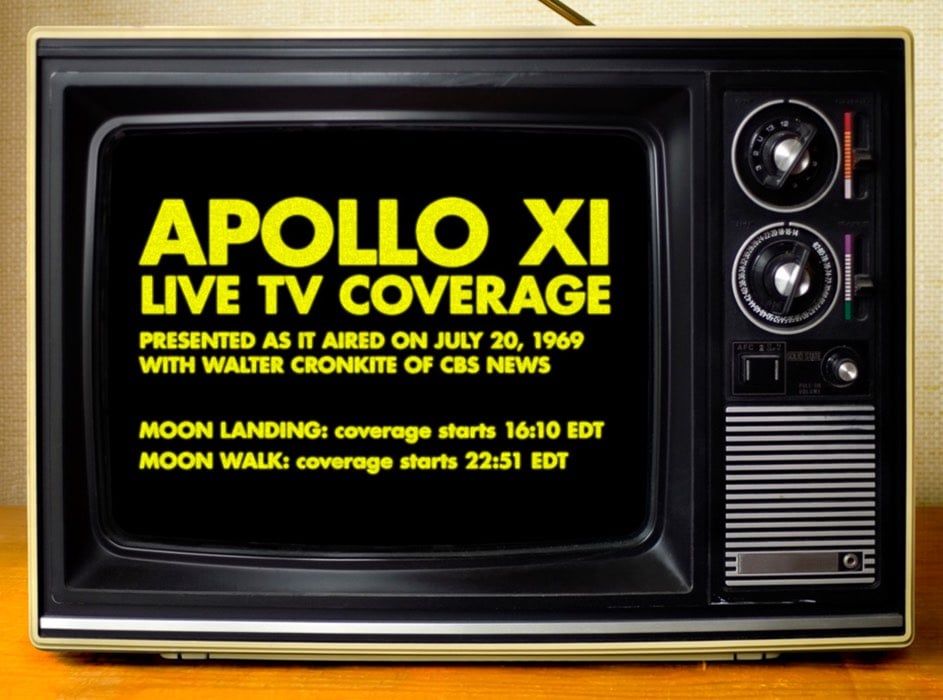
For those of you who missed the show last night or if you just want a replay, the CBS News footage of the Apollo 11 Moon landing and Moon walk, presented by Walter Cronkite, is available on YouTube. The Moon landing video is here and the first of 7 videos of the Moon walk is here.
Fired from the Canon is a collection of well-regarded books that perhaps shouldn’t be so revered. Includes White Noise, One Hundred Years of Solitude, On the Road, and A Tale of Two Cities.
On July 17, 1969, The New York Times issued a correction related to an editorial the paper published in 1920 that dismissed the idea of rocket travel in the vacuum of space. The editorial read, in part:
That Professor Goddard, with his ‘chair’ in Clark College and the countenancing of the Smithsonian Institution, does not know the relation of action to reaction, and of the need to have something better than a vacuum against which to react — to say that would be absurd. Of course he only seems to lack the knowledge ladled out daily in high school.
The correction stated:
Further investigation and experimentation have confirmed the findings of Issac Newton in the 17th Century and it is now definitely established that a rocket can function in a vacuum as well as in an atmosphere. The Times regrets the error.
The Times regrets the error! Wish I’d written that next to a few muffed physics exam questions. Here’s a pretty good explanation of why rockets work in vacuums. (via @davidfg)
Just leave this page open in your browser and at the appointed times (schedule is below), the broadcast will begin (no manual page refresh necessary).
Schedule:
Moon landing broadcast start: 4:10:30 pm EDT on July 20
Moon landing shown: 4:17:40 pm EDT
Moon landing broadcast end: 4:20:15 pm EDT
Moon walk broadcast start: 10:51:27 pm EDT
First step on Moon: 10:56:15 pm EDT
Nixon speaks to the Eagle crew: approx 11:51:30 pm EDT
Moon walk broadcast end: 12:00:30 am EDT on July 21
If you’ve never seen this coverage, I urge you to watch at least the landing segment (~10 min.) and the first 10-20 minutes of the Moon walk. I hope that with the old time TV display and poor YouTube quality, you get a small sense of how someone 40 years ago might have experienced it. I’ve watched the whole thing a couple of times while putting this together and I’m struck by two things: 1) how it’s almost more amazing that hundreds of millions of people watched the first Moon walk *live* on TV than it is that they got to the Moon in the first place, and 2) that pretty much the sole purpose of the Apollo 11 Moon walk was to photograph it and broadcast it live back to Earth.
Thanks to Meg for her JS help…any errors or sloppy code are mine. Please note that schedule times are approximate, based on your computer’s clock, and that the syncing of the videos might not be perfect. You need to have JS and Flash 8+ to view. This is just like real TV…if you miss the appointed time, there’s no rewind or anything…the video is playing “live”. I have not done extensive browser testing so it may not work perfectly in your browser. Bug reports are welcome and I will try to fix things as they crop up. If you run into any problems, just reload the page. To ensure that you have the latest (hopefully bug-free) version before the broadcast begins, reload the page. Other than that, if you leave it open, the broadcast will happen automatically.
If you still need proof that electronic media that continually phones home — DRM’d and otherwise — cannot be owned and is actually just rented, read on. Due to a publisher change of heart, Amazon went into some of their customers’ Kindles and erased “purchased” books written by an author with a certain familiarity with similar actions (click through to see who).
This is ugly for all kinds of reasons. Amazon says that this sort of thing is “rare,” but that it can happen at all is unsettling; we’ve been taught to believe that e-books are, you know, just like books, only better. Already, we’ve learned that they’re not really like books, in that once we’re finished reading them, we can’t resell or even donate them. But now we learn that all sales may not even be final.
This stinks like old cheese. I wish they’d just call these Kindle book transactions what they are, but I guess “Rent now with 1-Click® until we decide to take it back from you or maybe not” doesn’t fit neatly on a button.
This is an apology for the way we previously handled illegally sold copies of 1984 and other novels on Kindle. Our “solution” to the problem was stupid, thoughtless, and painfully out of line with our principles. It is wholly self-inflicted, and we deserve the criticism we’ve received. We will use the scar tissue from this painful mistake to help make better decisions going forward, ones that match our mission.
Here’s what you buy when you buy a Kindle book. You buy the right to display a grouping of words in front of your eyes for your private use with the aid of an electronic display device approved by Amazon.
Can you put a dollar value on a human life? Peter Singer writes that the US needs to do just that if we’re serious about making our healthcare system work.
You have advanced kidney cancer. It will kill you, probably in the next year or two. A drug called Sutent slows the spread of the cancer and may give you an extra six months, but at a cost of $54,000. Is a few more months worth that much?
If you can afford it, you probably would pay that much, or more, to live longer, even if your quality of life wasn’t going to be good. But suppose it’s not you with the cancer but a stranger covered by your health-insurance fund. If the insurer provides this man - and everyone else like him - with Sutent, your premiums will increase. Do you still think the drug is a good value? Suppose the treatment cost a million dollars. Would it be worth it then? Ten million? Is there any limit to how much you would want your insurer to pay for a drug that adds six months to someone’s life? If there is any point at which you say, “No, an extra six months isn’t worth that much,” then you think that health care should be rationed.
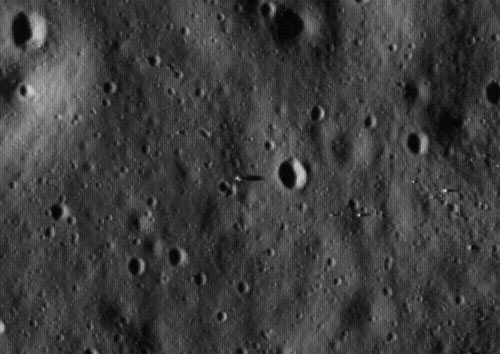
The lunar module is the small white bit in the middle casting the long shadow. The Apollo 14 site is the coolest…you can see the path the astronauts took out to some scientific instruments. The LRO hasn’t reached its final orbit yet so future images “will have two to three times greater resolution”. !!! See also my giant Apollo 11 post.
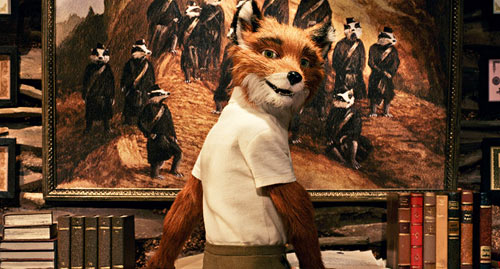
I didn’t know The Fantastic Mr. Fox, directed by Wes Anderson, was scheduled to come out so soon…IMDB says it’ll be out on November 13 of this year. Here’s a screenshot:
It’s a stop-motion animation film based on a story by Roald Dahl. The main character is voiced by George Clooney, with Michael Gambon, Meryl Streep, Bill Murray, Owen Wilson, Willem Dafoe, Jason Schwartzman, Adrien Brody, Anjelica Huston, Brian Cox, Roman Coppola, Jarvis Cocker, and Mario Batali providing some of the other voices. According to Wikipedia, a trailer will be out on July 31.
Yesterday was the 40th anniversary of the launch of Apollo 11 and Monday is the same for both the first Moon landing and the first walk on the surface. In this entry, I’ve collected some of the best resources on the web related to the anniversary…articles, historical documents, audio, video, transcripts, photos, and the like. Enjoy.
We Choose the Moon is tracking the activities of the Apollo 11 mission as it happened 40 years ago. Very nicely done.
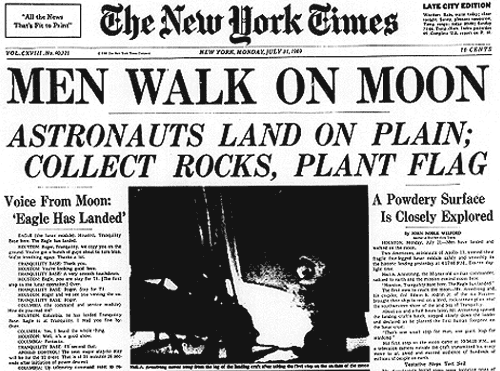
For its July 21, 1969 issue, The NY Times used 96 pt. type to declare that MEN WALK ON MOON.
The landing was made four miles west of the aiming point, but well within the designated area. An apparent error in some data fed into the craft’s guidance computer from the earth was said to have accounted for the discrepancy.
Suddenly the astronauts were startled to see that the computer was guiding them toward a possibly disastrous touchdown in a boulder-filled crater about the size of a football field.
Mr. Armstrong grabbed manual control of the vehicle and guided it safely over the crater to a smoother spot, the rocket engine stirring a cloud of moon dust during the final seconds of descent.
John Noble Wilford, the Times journalist who wrote the front page story underneath the 96 pt. type — “the biggest single story of my career” — recounts his Apollo 11 experience and ponders the Apollo program’s legacy in a great piece for the Times.
It then occurs to me that if Columbus and Capt. James Cook were alive, they might be less astonished by two men landing on the Moon than by the millions of people, worldwide, watching every step of the walk as it happens. Exploring is old, but instantaneous telecommunications is new and marvelous.
In just 1.3 seconds, the time it takes for radio waves to travel the 238,000 miles from Moon to Earth, each step by Armstrong and Aldrin is seen, and their voices heard, throughout the world they have for the time being left behind. In contrast to exploration’s previous landfalls, the whole world shares in this moment.
Let the lunar surface be the ultimate global commons while we focus on more distant and sustainable goals to revitalize our space program. Our next generation must think boldly in terms of a goal for the space program: Mars for America’s future. I am not suggesting a few visits to plant flags and do photo ops but a journey to make the first homestead in space: an American colony on a new world.
Robotic exploration of Mars has yielded tantalizing clues about what was once a water-soaked planet. Deep beneath the soils of Mars may lie trapped frozen water, possibly with traces of still-extant primitive life forms. Climate change on a vast scale has reshaped Mars. With Earth in the throes of its own climate evolution, human outposts on Mars could be a virtual laboratory to study these vast planetary changes. And the best way to study Mars is with the two hands, eyes and ears of a geologist, first at a moon orbiting Mars and then on the Red Planet’s surface.
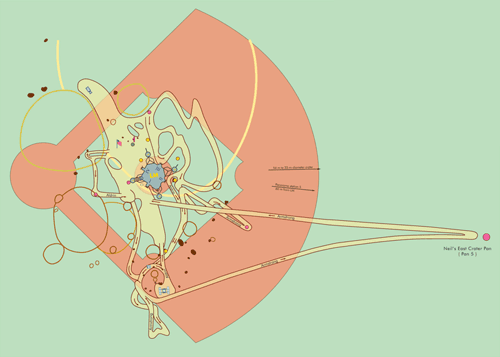
Around these [landing sites] are scattered smaller artefacts and personal items, such as Neil Armstrong’s boots and portable life-support system, scientific instruments and their power generators — and, of course, the iconic US flag which remains planted in the moon’s surface. Then there are the footprints and rover tread paths. Despite the passing of the years, these remain carved into the dust because the moon has no wind or rain to wash them away.
Anthropologist P. J. Capelotti of Penn State University in Abington has mapped out five “lunar parks”. These cover the areas where the majority of the artefacts are concentrated and could be used as a basis for future preservation efforts. “Nobody’s saying that the whole moon has to be off limits, but as people are starting to make plans for tourism and mineral extraction, or for putting a base there, they just need to be aware of them and work around them.”
Since returning from the Moon, Neil Armstrong has been less and less willing to speak in public about his Apollo 11 experience. For the 40th anniversary, Armstrong will not take part in the NASA event to commemorate the landing. His only appearance related to the anniversary will be a 15-minute lecture at a Smithsonian Institution event on Sunday night. I found this event on the National Air and Space Museum site…maybe that’s it? If so, then Armstrong’s lecture will be webcast live on the NASA TV site that evening.
7. When Buzz Aldrin joined Armstrong on the surface, he had to make sure not to lock the Eagle’s door because there was no outer handle.
Moonwalk One is a documentary film about Apollo released in 1970 to little fanfare, even though it won an award at the Cannes Film Festival. The film was commissioned by NASA but with so much Apollo activity and information happening in the late 60s and early 70s, no one was interested in distributing or seeing the film and it was soon forgotten. Recently, the only remaining 35mm print of the film was located under the director’s desk, restored, and offered for sale on DVD in time for the 40th anniversary.
To get a feel of what it was like in the Soviet Union during the Apollo 11 mission, Scientific American interviewed Sergei Khrushchev, son of former Russian premier Nikita Khrushchev. The reaction was somewhat more subdued than in other parts of the world.
Of course, you cannot have people land on the moon and just say nothing. It was published in all the newspapers. But if you remember [back then] when Americans spoke of the first man in space, they were always talking of “the first American in space” [not Yuri Gagarin]. The same feeling was prevalent in Russia. There were small articles when Apollo 11 was launched. Actually, there was a small article on the first page of Pravda and then three columns on page five. I looked it up again.
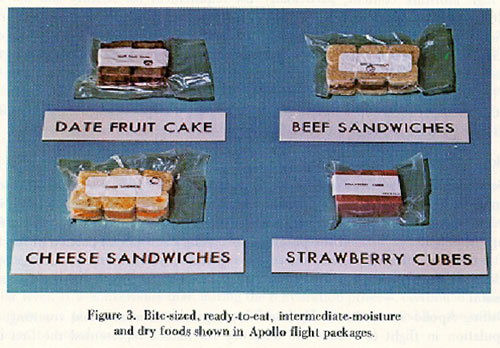
The Apollo crew even dined on thermo-stabilized cheddar cheese spread and hot dogs during the moon mission, bringing at least a bit of America in July to the sterile flight craft. And yes, there was bacon - foreshadowing the current bacon craze, the first meal eaten by man on the moon was none other than bacon cubes, coated with gelatin to combat crumbs.
Finally, there’s still some good stuff to be had on the old telly on Monday. The History Channel has As It Happened: Man on the Moon at 8pm ET:
This special takes viewers back to July 1969 to experience the actual CBS News/Walter Cronkite coverage of man’s first lunar landing. Using minimal editing and leaving the original footage untouched viewers will feel as if they are watching the CBS coverage in July of 1969. While today we know the outcome of Apollo 11’s mission it was not a given then. This will become evident watching Walter Cronkite and his colleagues as they watch the historic lunar mission unfold before them.
Everybody, including Congress, was caught up in the adrenal rush of it all. But then, on the morning after, congressmen began to wonder about something that hadn’t dawned on them since Kennedy’s oration. What was this single combat stuff — they didn’t use the actual term — really all about? It had been a battle for morale at home and image abroad. Fine, O.K., we won, but it had no tactical military meaning whatsoever. And it had cost a fortune, $150 billion or so. And this business of sending a man to Mars and whatnot? Just more of the same, when you got right down to it. How laudable … how far-seeing … but why don’t we just do a Scarlett O’Hara and think about it tomorrow?
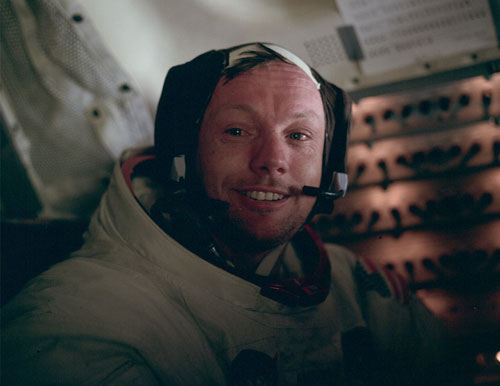
He was the first man to walk on the moon, taking that one giant leap for mankind — yet most of the famous shots are of his fellow astronaut Buzz Aldrin, as it was Armstrong who manned the stills camera.
New Scientist overlaid the Apollo lunar excursion maps on top of cities in Google Earth. Neil and Buzz didn’t even leave Trafalgar Square on their trip to the Moon.
Lunar archaeologists, interested in making the Apollo 11 site a National Historic Landmark, hope the planned photos will answer some of these longstanding questions: What is the condition of Tranquility Base after 40 years? Was the American flag blown over on the Eagle’s ascent and is it now a bleached skeleton? What are the relatively long term effects of the lunar environment on human artifacts?
This should quiet the people who still think it was all a hoax…although NASA could be faking these photos as well.
A relatively small piece of the Sahara could theoretically provide electricity for the entire planet if it were covered in solar thermal mirrors. Plus think of all those jobs to build a solar plant the size of Britain. The new transmission grid would be quite a project as well…
Update: Hmm, the site appears to be down and redirected to same squatter spam thing. I’ll put the link back up when the site (hopefully) returns.
Update: The Infrastructurist site is still down but I found the original link on the Guardian.
Autism is often described as a disease or a plague, but when it comes to the American college or university, autism is often a competitive advantage rather than a problem to be solved. One reason American academe is so strong is because it mobilizes the strengths and talents of people on the autistic spectrum so effectively. In spite of some of the harmful rhetoric, the on-the-ground reality is that autistics have been very good for colleges, and colleges have been very good for autistics.
Today is the 40th anniversary of the liftoff of Apollo 11. You can follow along on We Choose the Moon, on Twitter, and with a NASA audio program. (Is there a video launch being broadcast anywhere?)
NASA is also releasing “greatly improved video imagery” of the Apollo 11 moon walks. !!! So look for that later today.
The folks at Oxford University Press have finally finished their Historical Thesaurus of The Oxford English Dictionary after more than 40 years of effort. The book contains 4448 pages and nearly every word in the English language (according to the OED). I like that the synonyms are listed chronologically but this thing is crying out to be put online (or in some electronic format)…what a boon it would be for period novelists to able to press the “write like they did in 1856” button. Available for pre-order at Amazon for $316. (via long now)
The process starts with boxes of raw beef and lamb trimmings, and ends with what looks like oversized Popsicles the shade of a Band-Aid. In between, the meat is run through a four-ton grinder, where bread crumbs, water, oregano and other seasonings are added. A clumpy paste emerges and is squeezed into a machine that checks for metal and bone. (“You can never be too careful,” Mr. Tomaras said.) Hydraulic pressure — 60 pounds per square inch — is used to fuse the meat into cylinders, which are stacked on trays and then rolled into a flash freezer, where the temperature is 20 degrees below zero.
But forget how they’re made…how do you pronounce the damn word? The article gives what I would guess is the proper pronounciation of gyro: YEE-ro. I’ve ordered gyros using this pronounciation and have sometimes gotten confused looks in return. Alternate pronounciations that have worked in various situations include YUR-o, GEE-ro, JI-ro, and GUY-ro. The last pronounciation somehow seems the least correct to me but yields the best results. Somehow tzatziki is a lot easier.
A few weeks ago, I wrote the foreword for Infinite Summer, a summer-long collective read of Infinite Jest, David Foster Wallace’s big-ass novel and one of my favorite books. That piece was actually my second draft. My first attempt was a list of advice on reading the novel…the submission of which prompted InfSum’s dungeon master, Matthew Baldwin, to write back with a frowny face and a pointer to this piece published — unbeknownst to me (I have the Time Machine backups to prove it!) — the day before I submitted my draft.
Anyway, here’s that first draft on how to read Infinite Jest:
1. If you haven’t already, buy the book, get it from your local library, or download to your Kindle. I got my copy in 2001 at a local San Francisco bookstore; I bought it used along with a used copy of Don DeLillo’s Underworld (which I started but never finished). I was upset at something that day and purchased the books as a sort of Fuck You to whatever it was that was pissing me off. “Oh yeah? Well, I’m gonna read both of these huge books. Fuck You!” Best $10.80 I ever spent.
2. Warning! This book contains several footnotes. Hundreds, in fact. They run on, at a very small point size, for almost 100 pages at the conclusion of the main text. One of the footnotes, which contains the complete filmography of a fictional filmmaker, goes for more than 8 pages and itself has 6 footnotes. Every single oh-my-God-this-thing-is-a-doorstop review of IJ since 1996 has trumpeted this fact so you’re probably already up to speed re: the footnotes but I didn’t want you to be caught unawares or pants down.
3. You’re going to want to but don’t skip the footnotes. They are important. Yes, even the filmography one.
4. Physically, Infinite Jest is a large book: 2.2 inches thick and, according to Amazon.com, has a shipping weight of 3.2 pounds. Some readers have found it useful to rip the book in half for easier reading on the subway or on the beach. If you do this, you also need to tear the footnotes from the back half and tape them to front half. This technique has the side effect of giving you the appearance of A Very Serious Reader of Infinite Jest, which will either keep onlookers’ questions to a minimum or maximum, depending on the onlooker.
5. If you opt not to destroy your copy of IJ, you should use the three bookmark method. One bookmark for where you are in the main text, another for your current footnote location, and a third for page 223, which lists the years covered by the novel in chonological order, from the Year of the Whopper (which corresponds to 2002) to the Year of Glad (2010). To say that IJ skips around quite a bit chronologically is an understatement, so keeping the timeline straight is important.
7. Get a copy of Greg Carlisle’s Elegant Complexity, *the* reference book for Infinite Jest. Reading EC’s notes for each IJ section after you finish will greatly increase your understanding and enjoyment of the book. Here’s an informative review of the guide. As a bonus: “The book is 99% spoiler-free for first-time readers of Infinite Jest.”
8. Finally, you may have heard or read that Wallace committed suicide last year. He was 46 and left a wife and dogs and at least one unpublished novel and a vast literary legacy. This will be difficult, but try not to think too much about the suicide and Wallace’s life-long struggle with depression while reading Infinite Jest. The book is undoubtably autobiographical in some aspects — tennis: check; addiction: check; depression: check; grammar: check — but a strict reading of IJ as a window into Wallace’s troubled soul is a disservice to its thematic richness.
The great thing about Infinite Jest is that it begins at the end, so even though you’re only a few pages in at this point, you already know how the whole thing is going to end. So get to it, it’ll be easier than you think. I wish you way more than luck.
Law of Gravitation - An Example of Physical Law
The Relation of Mathematics and Physics
The Great Conservation Principles
Symmetry in Physical Law
The Distinction of Past and Future
Probability and Uncertainty - The Quantum Mechanical View of Nature
Seeking New Laws
Making the phrase more direct and personal by adding the words “you should” increased the clickthrough rate by 38% to 10.09%.
Curtis started out with “I’m on twitter” and eventually increased the clickthrough rate by more than double by changing the wording to “You should follow me on Twitter here.” (And Jesus, gorgeous site design too.)
Matt Haughey reflects on running MetaFilter for ten years. MeFi in the early-to-mid 00s was a cesspool; Matt deserves several gold stars for pushing through, somehow making the site better than it ever was in the early days, and turning the site into a thriving business. Over the years as community fads have changed online, people moved from wanting to build their own Slashdot to Gawker to Digg to Facebook to Twitter, but MeFi as a model of online community deserves more scrutiny…people should be trying to make their own MetaFilters but nobody really does.
Anyway, here’s to you and The Blue, Matt. Congrats!
People like to go fast and film themselves doing so. Modern technology offers a variety of ways to both go faster than ever before and record that speed for posterity. But for something to look fast on video, there needs to be a frame of reference for the viewer — something to hurtle past or whoosh by — and maybe even a hint of danger. Here are a selection of videos of people doing just that: traveling at high speeds in cars, on train tracks, through the air, and down mountains in close proximity to traffic, large rocks, and thin atmospheres. Most of these videos are filmed from a first-person perspective so that when you watch them, you can imagine that you’re the one zooming along.
In 1976, Claude Lelouch mounted a camera on the front of his Mercedes-Benz 450SEL 6.9 and drove through the streets of Paris — running red lights, jumping curbs and possibly reaching speeds upwards of 120 mph — before reaching his date near the Sacré Coeur. The result is the film C’était un rendez-vous, 8 uncut minutes of insane urban driving.
Base jumpers equipped with wingsuits can glide very fast very close to the ground. Perhaps the most insane videos on the page…they’re not doing 1200 mph or anything, but they are awfully close to the ground with few safety options if they slip up.
The lads at Top Gear took the Bugatti Veyron to its top speed of 253 mph on a test track. The test driver seems to have had what I would term a religious experience at the top speed.
Two gents in powder-blue suits speed down a California hill on skateboards. Holy crap!
240 mph on a Suzuki Hayabusa motorcycle. Oh, and he does a wheelie from 70 to 140 mph. (Note: Wikipedia says the bike has an “electronically restricted” top speed of 188 mph. Either the owner a) removed the restriction, or b) tweaked the speedometer to display higher than normal speeds.)
In 1960, Joseph Kittinger reached a speed of 714 mph after jumping from a helium balloon at an altitude of 102,800 feet.
A French TGV train reaches a top speed of 357 mph in a 2007 test.
A camera mounted on the external tank records the launch of the Space Shuttle Atlantis in May 2009. There’s not a lot to whoosh past here, but at an eventual 18,000 mph, the pace at which the Shuttle leaves the Earth behind is astounding.
While skydiving, both of Michael Holmes’ chutes failed as his helmet camera recorded his crash landing into some thick bushes. (He lived.)
Footage of Alex Roy and David Maher on the road as they sped across the entire United States in just over 32 hours, an unofficial world record. There is a book and a blog of the experience.
Passenger seat and road-side views of a Lamborghini Murcielago doing 219 mph on the 202 freeway in Mesa, Arizona.
For the first few months, the new heart did nearly all the work, but this “rest” gave Hannah’s own heart a chance to begin recovery. By the time of the second heart was finally removed, Hannah’s heart was doing virtually all the work itself.
It’s amazing what doctors can entice the human body to do.
The Typography Manual has several useful features and resources for designers, including a visual type anatomy glossary, a font size ruler, an em calculator, and a enough content to fill a 60 page book. It has the all the essentials of a desk reference in a regularly updated pocket resource.
Note: If you are a member and tried to log in, it didn't work, and now you're stuck in a neverending login loop of death, try disabling any ad blockers or extensions. Or try logging out and then back in. Still having trouble? Email me!







Socials & More