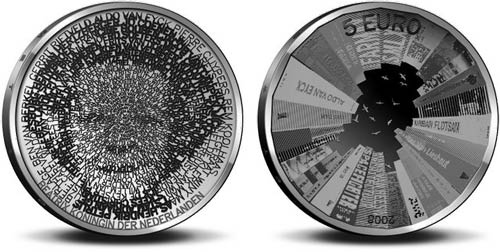
On the front, the names of famous Dutch architects form an image of the queen while some Dutch architecture books on the back form an outline of The Netherlands. The design was done using free software running on Ubuntu/Debian. (via design observer)
During the 2007-2008 flu season, an early version of Google Flu Trends was used to share results each week with the Epidemiology and Prevention Branch of the Influenza Division at CDC. Across each of the nine surveillance regions of the United States, we were able to accurately estimate current flu levels one to two weeks faster than published CDC reports.
Asking two complete strangers to not only pose with each other, but to also touch each other while doing that… And this in a culture whose discomfort with touching someone you don’t know, or touching something that someone else might have touched still baffles me, even after having spent almost ten years in it! I remember I asked Richard how he actually did that. How do you ask complete strangers to pose with and touch each other? How do you do that in New York City of all places?
The act of making a photograph turns the subjects into actors, and two actors touching each other isn’t that unusual. When I look at many of these photos, I see actors and that detracts from the intimacy. Even so, I love this one.
“When you write fiction,” he explains as part of his critique of a story about a young girl, her uncle, and the evil eye, “you are telling a lie. It’s a game, but you must get the facts straight. The reader doesn’t want to be reminded that it’s a lie. It must be convincing, or the story will never take off in the reader’s mind.”
One of his two senior college theses was on philosophy (the other became The Broom of the System):
His senior philosophy thesis, he claims, had nothing to do with writing. “It offered a solution in how to deal with semantics and physical modalities concerning Aristotle’s sea battle. If it is now true that there will be a sea battle tomorrow, is a sea battle necessary tomorrow? If it is now false, is a sea battle impossible tomorrow? It’s a way to deal with propositions in the future tense in modal logic, since what is physically possible at a certain time is weird because one has to distinguish the time of the possibility of the event from the possibility of the time of the event.”
The Mind-Blowingly Wonderful: It’s every single page of every single issue of the New Yorker, from 1925 to the present, available online whenever you need it. No 9 DVDs needed. No plug-ins either, just a plain old web browser. And it’s free with your subscription. Sweet fancy licorice!
The Good: Individual issues are bookmarkable. Forward and back arrows work to flip pages. If you’re not a subscriber, you can sign up for four-issue trial or subscribe to just the digital version (~$40/year). At full zoom, the text is clear and easy to read. When an article doesn’t appear for free on the New Yorker site, you’re directed to the article in the Digital Reader. The DR is in beta and they’re soliciting feedback.
The Bad and Not-So-Bad: The Digital Reader works on the iPhone…more or less. It’s definitely not optimized for the phone and crashes often but works in a pinch. Some of the issues are missing…1962 and 1963 are largely AWOL. Issue archive always defaults to 2008, even while you’re browsing an issue from 1937. Keyword search doesn’t seem to work on older issues, i.e. most of the archive. There are a bunch of cool features that they could build on top of this thing: archive-wide search, compile/share lists of articles with other subscribers (i.e. make your own NYer mag from articles from back issues), keyword cross-referencing, etc.
The Ugly: Sadly, the actual reading interface is the worst part of the DR. The reader’s interaction with the app relies too much on the mouse…more shortcut keys are needed (zoom, shortcut to TOC, move to top of next column, next/prev issue, etc.). Flipping through the digital magazine is easy enough but reading cannot comfortably be done at the page-flipping size. But when you zoom in, you need to zoom back out before you can flip to the next page. Guess how long it takes until that gets completely annoying? (A: After precisely one page turn.) I’d also like the magazine to fill as much of my screen as it can but instead the size of the viewing window is constrained. Bascially, make the thing as big as the screen will allow and give the reader one button to push to keep reading.
Even more maddening: after a short time, you have to re-login. I don’t know if this is triggered by a period of inactivity or what, but it gets on all my nerves. (A “remember me” option that works across browser sessions would be welcome too.)
All-in-all, not enough attention was paid to the overall experience…it feels a bit like drinking fine wine from a sippy cup. That the Digital Reader exists is a great start but its shortcomings put too many roadblocks between the reader and her enjoyment of these great magazines, making the experience less wonderful than it could be. People *love* this magazine and the New Yorker should do everything it can to make people love reading it online.
I don’t know what this is or how it works or why Sprint is involved, but man is it fun to just let the data just wash over you. Wait, the computer woman just said, “Feel free to touch it.” Uncomfortable! Who did this, BTW…Josh Davis, tha ltd., futurefarmers? (via airbag)
Dark Days is a documentary released in 2000 about a group of homeless people living in an abandoned Manhattan railway tunnel.
When he relocated from London to Manhattan, Marc Singer was struck by the number of homeless people he had seen throughout the city. Singer had befriended a good number of New York’s homeless and later, after hearing of people living underground in abandoned tunnel systems, he met and became close to a group of people living in The Freedom Tunnel community stretching north from Penn Station past Harlem. After living with them for a number of months, he decided to create a documentary in order to help them financially. The film’s crew consisted of the subjects themselves, who rigged up makeshift lighting and steadicam dollies, and learned to use a 16mm camera with black & white Kodak film. Singer himself had never been a filmmaker before, and saw the production of Dark Days as a means of gaining better accommodation for the residents of the tunnel.
MyFootballClub has about 31,000 members/owners from all over the world (including the author of this article), all of whom pay an annual subscription of about $60 to be a member of the nonprofit trust that owns “the Fleet.” The club is run on the principle of one person, one vote for every decision, major or minor. Ebbsfleet recently made headlines in the British press when members voted to sell John Akinde, a talented young striker, for about $250,000, the first vote of its kind.
For more than three decades Eugene Allen worked in the White House, a black man unknown to the headlines. During some of those years, harsh segregation laws lay upon the land. He trekked home every night, his wife, Helene, keeping him out of her kitchen. At the White House, he worked closer to the dirty dishes than to the large desk in the Oval Office. Helene didn’t care; she just beamed with pride. President Truman called him Gene. President Ford liked to talk golf with him. He saw eight presidential administrations come and go, often working six days a week. “I never missed a day of work,” Allen says. His is a story from the back pages of history. A figure in the tiniest of print. The man in the kitchen.
A month after the bombing of Hiroshima in 1945, the US government imposed a code of censorship in Japan, which means that photos of the effects of the nuclear device are somewhat difficult to come by. Enter diner owner Don Levy of Watertown, MA.
One rainy night eight years ago, in Watertown, Massachusetts, a man was taking his dog for a walk. On the curb, in front of a neighbor’s house, he spotted a pile of trash: old mattresses, cardboard boxes, a few broken lamps. Amidst the garbage he caught sight of a battered suitcase. He bent down, turned the case on its side and popped the clasps.
He was surprised to discover that the suitcase was full of black-and-white photographs. He was even more astonished by their subject matter: devastated buildings, twisted girders, broken bridges — snapshots from an annihilated city. He quickly closed the case and made his way back home.
Big thanks to this week’s RSS sponsor, Glennz. Glennz is Glenn Jones, a New Zealand graphic designer and illustrator who began designing t-shirts for Threadless a few years back and became one of their most popular contributors. (You may have seen his genius Darth Vader trimming a shrub tshirt.) Now Jones has struck out on his own with a store featuring almost 30 t-shirts, a customizable desktop calendar, and gift certificates. According to their blog, a recent edition to the store is a shirt featuring the skeleton of a rocking horse (Equus Rockus).
When it looked as though Obama was going to win the election, former photojournalist Matt Mendelsohn went to the Lincoln Memorial in Washington DC expecting to find a huge crowd of celebrants.
I’d spent most of election night in front of the TV in Arlington, Va. But around 11 p.m. I couldn’t sit idle any longer, which is why I sped to the memorial. When I arrived, I found a TV crew sitting on the plaza above the Reflecting Pool, waiting, I assumed, for a mob to arrive. I approached with cameras in hand. One of them looked up and said with a slight roll of his eyes, “Nothing to see here.”
Instead he found a small group of people listening to Obama’s acceptance speech on a transistor radio and shot this wonderful picture of the scene. I can’t think of an image that better characterizes the grass-roots, get-out-the-vote, small-donations-by-millions-of-people aspect of Obama’s campaign. (via 3qd)
2666 is a novel written by Roberto Bolaño and published posthumously in Spanish in 2004. The English translation hits stores next Tuesday and the reviews couldn’t be better, especially considering the book’s 912 pages. From Jonathan Lethem’s review in the NY Times Book Review, reprinted in the IHT:
“2666” is the permanently mysterious title of a Bolaño manuscript rescued from his desk after his passing, the primary effort of the last five years of his life. The book was published in Spanish in 2004 to tremendous acclaim, after what appears to have been a bit of dithering over Bolaño final intentions — a small result of which is that its English translation has been bracketed by two faintly defensive statements justifying the book’s present form. They needn’t have bothered. “2666” is as consummate a performance as any 900-page novel dare hope to be: Bolaño won the race to the finish line in writing what he plainly intended as a master statement. Indeed, he produced not only a supreme capstone to his own vaulting ambition, but a landmark in what’s possible for the novel as a form in our increasingly, and terrifyingly, post-national world. “The Savage Detectives” looks positively hermetic beside it.
Lethem also compares a part of 2666 to Murakami’s The Wind-Up Bird Chronicle, which means, like, hey sign me up. (thx, matt)
By bringing scents of a Latin American culture more fitful, pop-savvy and suspicious of earthy machismo than that which it succeeds, Bolaño has been taken as a kind of reset button on our deplorably sporadic appetite for international writing, standing in relation to the generation of Garcia Márquez, Vargas Llosa and Fuentes as, say, David Foster Wallace does to Mailer, Updike and Roth. As with Wallace’s “Infinite Jest,” in “The Savage Detectives” Bolaño delivered a genuine epic inoculated against grandiosity by humane irony, vernacular wit and a hint of punk-rock self-effacement. Any suspicion that literary culture had rushed to sentimentalize an exotic figure of quasi martyrdom was overwhelmed by the intimacy and humor of a voice that earned its breadth line by line, defying traditional fictional form with a torrential insouciance.
Start worrying in a few million years about a cosmic dust collision, when the sun hits the closest spiral arm of our galaxy. Take your chances with an exploding star. Or manage to escape these threats, and you just get an extra 10^35 years before all matter decays anyway.
Hopefully I’ll have some time this afternoon to update the 2008 Election Maps page; I’ve got lots of good submissions waiting in my inbox. Thanks to everyone who sent in links and screenshots.
Idea for the Obama administration: fireside chats. On the radio, on satellite radio, as a podcast, transcripts available online soon after airing. Done live if possible, a genuine lightly scripted chat. Maybe Obama could have special guests on to talk about different aspects of policy and government. Bush does weekly radio addresses but they’re short, boring, and scripted.
And I gotta tell you, if change.gov is indicative of how the Obama administration is going to use the web to engage with Americans, this is going to be an interesting four years.
Ok, that’s probably the last Obama post for a bit. Back to your irregularly unscheduled programming.
“Teaching keeps you sharp,” Obama said. “The great thing about teaching constitutional law” — his subject — “is that all the tough questions land in your lap: abortion, gay rights, affirmative action. And you need to be able to argue both sides. I have to be able to argue the other side as well as Scalia does. I think that’s good for one’s politics.”
In writing the article, Finnegan ran across some people who thought Obama could be President someday but chose not to include those quotes because it felt “not only absurdly premature but like bad juju”.
Still no unanimous decision on the placement of Candy Corn, which as of 2006 remained unclassified, but as of 2007 had been tentatively placed in the Upper Chewy/Upper Devonian. 2008: no sighting.
The top tier is comprised of Caramellos, Milky Way, Snickers, Rolos, and Twix. Rolos? Please. Sub Peanut Butter Cups in there and you’ve got yourselves a pyramidal apex.
And so it begins. The Ralph Lauren Rugby store near Union Square took delivery of its Christmas decorations on Monday and the end of the year lists have already started appearing online. So far there’s Time’s best inventions of 2008 and Amazon’s best books of 2008.
If you followed or were at all interested in the 2008 presidential election, this seven-part series by a group of Newsweek reporters is a must read. The reporters were granted exclusive access to the campaigns of Barack Obama, John McCain, and Hillary Clinton for a year on the condition that they wouldn’t print anything until after the election was over. The series, of which the first three parts are currently up on the Newsweek site, is a fascinating look at how the political process works and contains all manner of salacious political gossip.
Part One: How Obama was persuaded to run and found his campaigning rhythm and his first scuffles with the Clinton campaign.
In some ways, running for president was a preposterous idea for someone who had served as a two-term state legislator and had spent only two years in the United States Senate. But Obama, a careful student of his own unique journey, could see the stars coming into alignment-the country was exhausted by the Iraq War (which he, alone among leading candidates, had opposed as “dumb” from the outset). As Obama saw it, the conservative tide in America was ebbing, and voters were turning away from the Republican Party. People were sick of politicians of the standard variety and yearned for someone new-truly new and different. Another politician with a superb sense of timing, Bill Clinton, perfectly understood why Obama saw a golden, possibly once-in-a-lifetime, opportunity. The former president believed that the mainstream press, whose liberal guilt Clinton understood and had exploited from time to time, would act as Obama’s personal chauffeur on the long journey ahead. “If somebody pulled up a Rolls-Royce to me and said, ‘Get in’,” Clinton liked to say, with admiration and maybe a little envy, “I’d get in it, too.”
Part Two: John McCain’s campaign gets off to a terrible start and then suddenly recovers.
Along about Thanksgiving, reporters began to notice a change. The size of the crowds was increasing, and McCain began to creep up in the polls, especially in New Hampshire. He was blessed by the quality of his opponents. In the grim days of summer, when a NEWSWEEK reporter had asked why he shouldn’t join the rest of the press corps in reading the last rites for McCain’s presidential aspirations, Rick Davis had responded with an incongruously cheerful smile. Nothing personal, he said; our opponents are all good men, some of them are my friends-but politically speaking? “Look, at the end of the day,” he said, “the rest of these guys suck.” However crude, his judgment was not off base. Ex-businessman Mitt Romney seemed to treat the campaign as a management-consulting project, as if he were selling a product and trying to increase market share. He had no fingertips as a politician and came off as a phony, even when he was perfectly sincere. Rudy Giuliani seemed to be building a cult of Rudy, constantly talking about his performance on 9/11 to a nation that wanted to forget about the terrorist attacks, and he badly miscalculated by believing that he could wait until the Florida primary in late January to make his move. Former senator Fred Thompson seemed old and half asleep. Former governor Mike Huckabee of Arkansas was emerging as an engaging showman and a lively dark horse-but as an evangelical minister with no foreign-policy experience, he almost certainly could not win.
Part Three: The role of the candidates’ spouses, the continuing clashes between the Obama and Clinton campaigns, and Obama’s Star Trek joke.
Obama carefully conserved his energy. He was not a man of appetites, like Bill Clinton, who would grab whatever goodie passed by on the tray. Obama was abstemious. Indeed, to the reporters following him, he appeared very nearly anorexic. Most candidates gain the Campaign 10 (or 15). Hillary was struggling with her waistline, as she gamely knocked back shots and beers in working-class bars and gobbled the obligatory sausage sandwiches thrust at her in greasy spoons along the Trail of the White Working-Class Voter. Obama, by contrast, lost weight. He regularly ate the same dinner of salmon, rice and broccoli. At Schoop’s Hamburgers, a diner in Portage, Ind., he munched a single french fry and ordered four hamburgers-to go. At the Copper Dome Restaurant, a pancake house in St. Paul, Minn., he ordered pancakes-to go. (An AP reporter wondered: who gets pancakes for the road?) A waiter reeled off a long list of richly topped flapjacks, but Obama went for the plain buttermilk, saying, “I’m kind of traditionalist.” Reporters joked that if he ate a single bite of burger or pancake once the doors of his dark-tinted SUV closed, they’d eat their BlackBerrys. Frustrated by reporters fishing for trivial “gaffes,” Obama did not like coming back to the plane to talk to the press. As he trudged back from time to time to deal with the reporters’ incessant questions, he looked like a suburban dad, slump-shouldered after a long day at the office, taking out the trash.
I got another sense, however: a sense that he was conserving focus. Fed went through all his subsidiary responsibilities as the President of Tennis (as Steve Tignor calls him) without concentrating on anything, or at least on as few things as possible.
Concentration takes mental energy, as anyone who has fought off five break points before shanking a ball on the sixth knows. And whenever I saw Federer on the grounds, he seemed to be using as little of it as possible. Practicing with Nicolas Kiefer on Ashe a few days before the tournament, he mostly just messed around. He would hit a few familiar Federer shots, the heavy forehand, the penetrating slice, then shank a ball and grin, or yell. Either way, he wasn’t really concentrating all that hard.
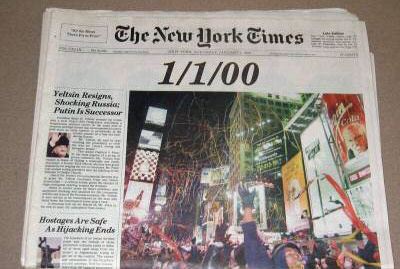
Update: The Times used 96 pt. type for the front page headline on at least one other occasion: January 1, 2000. I wonder if there are others. (thx, jeff)
Several folks on Twitter are talking about post-election sex and Obama babies (children conceived on election night…mark your calendars for late July 2009). The consensus seems to be that Barack got laid in a big way last night.
Update: Fuck you too, Arizona and Florida. Also, several people objected to the strong language I used here, saying that I can’t curse an entire state where many voted against the ban, it was all the Mormon Church’s fault, and in one case, that it was hypocritical of me as a New York resident to complain. You know what? I’m *upset* about this and a little profanity, a little lashing out, is totally fucking warranted.
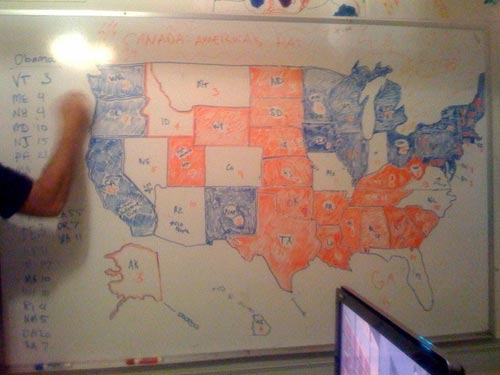
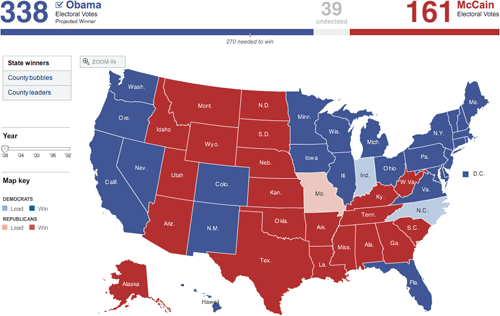
Last night as the election results were coming in online, I took screenshots of a bunch of the now-familiar red/blue electoral maps being used by the larger media sites to show election results and posted them all on this page. (There are currently 25 maps…I’m adding more in a few minutes.)
1. No one strayed from the red and blue. The red/blue combo is overwhelmingly symbolic but there are plenty of other colors in the crayon box; I would like to have seen someone try something different.
2. In the 2000 and 2004 elections, the red/blue map was the focal point of the media coverage. People were fixated by it. This time around, it didn’t matter so much. The maps were interesting for 3-4 hours until the overwhelming nature of Obama’s victory became apparent and then, not so much. By this morning, the maps are already shrinking or disappearing from the home pages of the Times, CNN, and the like.
3. Nate Silver and the rest of the 538 guys nailed it. They got Indiana wrong and there are a couple more states that are still too close to call, but they got the rest of the map right. Their final projection had Obama getting 348.6 electoral votes and they currently have him at 349.
Gladwell: Can an unlikely group succeed in a counterintuitive fashion?Can underprivileged outsiders have an advantage? As evidence, Gladwell cites the story of Sidney Weinberg, a high-school dropout who rose from the mailroom at Goldman Sachs to become a senior partner in the company and one of the most connected and powerful men on Wall Street.
This is the great mystery of Weinberg’s career, and it’s hard to escape the conclusion that Carnegie was on to something: there are times when being an outsider is precisely what makes you a good insider. It’s not difficult to imagine, for example, that the head of Continental Can liked the fact that Weinberg was from nothing, in the same way that New York City employers preferred country boys to city boys. That C.E.O. dwelled in a world with lots of people who went to Yale and then to Wall Street; he knew that some of them were good at what they did and some of them were just well connected, and separating the able from the incompetent wasn’t always easy. Weinberg made it out of Brooklyn; how could he not be good?
Your assignment: use the Astrometry and Exif data to stitch all these photos together into a huge Hockney-esque map of the sky. I am also wondering the extent to which you can fool Astrometry with, say, a painting of a portion of the sky. It would be neat if you could submit a drawing of a constellation and get the correct star IDs back. (via mouser)
On the one hand, lack of slack tells us the poor must make higher quality decisions because they don’t have slack to help buffer them with things. But even though they have to supply higher quality decisions, they’re in a worse position to supply them because they’re depleted. That is the ultimate irony of poverty. You’re getting cut twice. You are in an environment where the decisions have to be better, but you’re in an environment that by the very nature of that makes it harder for you apply better decisions.
Note: If you are a member and tried to log in, it didn't work, and now you're stuck in a neverending login loop of death, try disabling any ad blockers or extensions. Or try logging out and then back in. Still having trouble? Email me!







Socials & More