



The case of the Jena 6 is finally
The case of the Jena 6 is finally starting to get national attention. Buzzfeed has a nice collection of links to the coverage.

This site is made possible by member support. 💞
Big thanks to Arcustech for hosting the site and offering amazing tech support.
When you buy through links on kottke.org, I may earn an affiliate commission. Thanks for supporting the site!
kottke.org. home of fine hypertext products since 1998.
Beloved by 86.47% of the web.
The case of the Jena 6 is finally starting to get national attention. Buzzfeed has a nice collection of links to the coverage.
Eugene de Salignac was the official photographer for the NYC Department of Bridges from 1906 to 1934. His collection of photographs was recently uncovered and, as it turns out, de Salignac was a great photographer and his photographs charted the progress of New York growing into a big city. The New Yorker has a slideshow of some of his photos and there’s an exhibit of his work at the Museum of the City of New York until Oct 28. (thx, stacy)
Hometracked uncovered some musical history tidbits from the archive of the NY Times, including first descriptions of Edison’s phonograph and Marconi’s radio.
Michael Bierut dug his 1979 design portfolio out of the closet, which portfolio he used only once to get the last job he ever had to look for.
Jack Spade held an impromptu fashion show in Bryant Park outside the giant tent where Fashion Week was happening, enlisting passersby to carry Jack Spade bags up and back on the sidewalk. Wonderful stuff. (via design observer)
The newly designed US$5 bill is the worst one yet…the phrase “typographic train wreck” comes to mind. The purple 5 in the lower right, while useful, is one of the most amateur design choices I’ve seen on something that’s destined for such a wide market. (thx, tom)
While poking around in the newly opened archives of the New York Times yesterday, I stumbled upon an article called How We Dine (full text in PDF) from January 1, 1859. I’m not well versed in the history of food criticism, but I believe this is perhaps the first restaurant review to appear in the Times and that the unnamed gentleman who wrote it (the byline is “by the Strong-Minded Reporter of the Times”) is the progenitor of the paper’s later reviewers like Ruth Reichl, Mimi Sheraton, and Frank Bruni.
The article starts off with a directive from the editor-in-chief to “go and dine”:
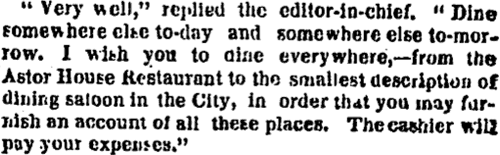
“Very well,” replied the editor-in-chief. “Dine somewhere else to-day and somewhere else to-morrow. I wish you to dine everywhere, — from the Astor House Restaurant to the smallest description of dining saloon in the City, in order that you may furnish an account of all these places. The cashier will pay your expenses.”
Before starting on his quest, the reporter differentiates eating from dining — noting that many believe “whereas all people know how to eat, it is only the French who know how to dine” — and defines what he means by an American dinner (as opposed to a French one). Here’s his list of the types of American dinner to be found in New York, from most comfortable to least:
1. The Family dinner at home.
2. The Stetsonian dinner.
3. The Delmonican, or French dinner.
4. The Minor dinner of the Stetsonian principle.
5. The Eating-house dinner, so called.
6. The Second-class Eating-house dinner.
7. The Third-class Eating-house feed.
The remainder of the article is devoted to descriptions of what a diner might find at each of these types of establishments. Among the places he dined was Delmonico’s, where dining in America is said to have originated:
Once let Delmonico have your order, and you are safe. You may repose in peace up to the very moment when you sit down with your guests. No nobleman of England — no Marquis of the ancienne nobless — was ever better served or waited on in greater style that you will be in a private room at Delmonico’s. The lights will be brilliant, the waiters will be curled and perfumed and gloved, the dishes will be strictly en règle and the wines will come with precision of clock-work that has been duly wound up. If you “pay your money like a gentleman,” you will be fed like a gentleman, and no mistake… The cookery, however, will be superb, and the attendance will be good. If you make the ordinary mistakes of a untraveled man, and call for dishes in unusual progression, the waiter will perhaps sneer almost imperceptibly, but he will go no further, if you don’t try his feelings too harshly, or put your knife into your mouth.
According to a series of articles by Joe O’Connell, Delmonico’s was the first restaurant in the US when it opened in 1830 and invented Eggs Benedict, Oysters Rockefeller, Baked Alaska, Lobster Newberg, and the term “86’d”, used when the popular Delmonico Steak (#86 on menu) was sold out, or so the story goes. O’Connell’s history of Delmonico’s provides us with some context for the How We Dine piece:
The restaurant was a novelty in New York. There were new foods, a courteous staff, and cooking that was unknown at the homes of even the wealthiest New Yorkers. The restaurant was open for lunch and dinner.
The restaurant featured a bill of fare, which was itself new. Those who dined at inns were fed on a set meal for a set price. As a result, everyone was fed the same meal and were charged the same price, whether they ate little or much. In Paris, however, restaurants offered their patrons a “bill of fare”, a carte, which listed separate dishes with individual prices. Each patron could choose a combination of dishes which was different from the other patrons. Each dish was priced separately. Thus, the restaurant was able to accommodate the tastes and hunger of each individual. The various dishes and their prices were listed on a carte or (the English translation) “bill of fare”. Today, we call it a menu.
And from Delmonico’s developed many different types of dining establishments, which the Strong-Minded Reporter set out to document thirty years later. Contrast his visit to Delmonico’s with the experience in the “sandwich-room” at Browne’s Auction Hotel, an eating-house:
The habitués of the place are rarely questioned at all. The man who has eaten a sandwich every day for the past ten years at the Auction Hotel no sooner takes his seat than a sandwich is set before him. The man who has for the same period indulged daily in pie or hard boiled eggs (there are some men with amazing digestion) is similarly treated. The occasional visitor, however, is briefly questioned by the attendant before whom he takes his place. “Sandwich?” or “Pie?” If he say “Sandwich,” in reply, the little man laconically inquires, “Mustard?” The customer nods, and is served. If his mission be pie, instead, a little square morsel of cheese is invariably presented to him. Why such a custom should prevail at these places, no amount of research has yet enabled me to ascertain. Nothing can be more incongruous to pie than cheese, which, according to rule and common sense, is only admissible after pie, as a digester. But the guests at the Auction Hotel invariably take them together, and with strict fairness — a bite at the pie, and a bite at the cheese, again the pie, and again the cheese, and so on until both are finished.
The experience of being a regular has barely changed in 150 years. And finally, our intrepid reporter visits an unnamed third class eating-house:
The noise in the dining hall is terrific. A guest has no sooner seated himself than a plate is literally flung at him by an irritated and perspiring waiter, loosely habited in an unbuttoned shirt whereof the varying color is, I am given to understand, white on Sunday, and daily darkening until Saturday, when it is mixed white and black — black predominating. The jerking of the plate is closely followed up by a similar performance with a knife and a steel fork, and immediately succeeding these harmless missiles come a fearful shout from the waiter demanding in hasty tones, “What do you want now?” Having mildly stated what you desire to be served with, the waiter echoes your words in a voice of thunder, goes through the same ceremony with the next man and the next, through an infinite series, and rushes frantically from your presence. Presently returning, he appears with a column of dishes whereof the base is in one hand and the extreme edge of the capital is artfully secured under his chin. He passes down the aisle of guests, and, as he goes, deals out the dishes as he would cards, until the last is served, when he commences again Da Capo. The disgusting manner in which the individuals who dine at this place, thrust their food into their mouths with the blades of their knives, makes you tremble with apprehensions of suicide…
The entire article is well worth the read…one of the most interesting things I’ve found online in awhile.
Update: According to their web site, a restaurant in New Orleans named Antoine’s claims that they invented Oysters Rockefeller. Another tidbit: from what I can gather, the Delmonico’s that now exists in lower Manhattan has little to do with the original Delmonico’s (even though they claim otherwise), sort of like the various Ray’s Pizza places sprinkled about Manhattan. (thx, everyone who sent this in)
NY Times columnist Paul Krugman writes, in the introduction to his new blog:
The story of modern America is, in large part, the story of the fall and rise of inequality.
Note that he says “fall” and then “rise”, not the other way around. A graph in the post illustrates his point nicely.
The Guardian has an extensive list of writers and the rooms in which they write (with photos and descriptions by the authors). For whatever reason, I became very interested in writers’ rooms after reading Witold Rybczynski’s The Most Beautiful House in the World, in which he describes several rooms built by writers specifically for working in, including one author who built a completely separate room apart from his house which combined his need for solitude with a short commute. (thx, youngna)
Hoax or art? Or both? Artist Xu Zhen climbed Mt. Everest and shaved off almost 2 meters of the top of the mountain, the literal peak of Everest, and is displaying it as art.
Audiences may not believe that this is real, which is similar to how people rarely question whether the height of Everest truly is 8848 meters. This relationship between belief and doubt has to deal with questions of standard, height, reality, and borders.
(via daily awesome)
Twelve essential photographic facts, formulas, and rules of thumb.
Anatomical gray card. Metering off an 18-percent neutral gray card is a good way to get a midtone reading that will give you a good overall exposure of a scene. Forgot your gray card? Hold your open hand up so it’s facing the light, take a reading off your palm, open up one stop, and shoot. (Various skin tones rarely account for even a full-stop difference.)
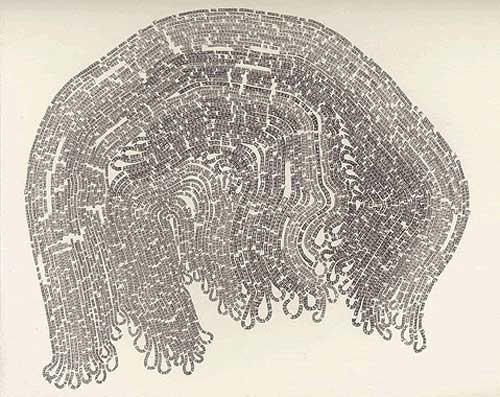
Justin Quinn’s wonderful typographic art (more here).
From the letters to the editor in the Sept 24 issue of the New Yorker, a letter from John Yohalem, New York City:
I enjoyed reading Tim Page’s essay on living with Asperger’s syndrome: the insomnia, the social puzzlement, the obsession with various subjects to the exclusion of more common ones — all are very familiar to me. (“Parallel Play,” August 20th). Then came this description: “In the late nineteen-seventies, I saw a ragged, haunted man who spent urgent hours dodging the New York transit police to trace the dates and lineage of the Hapsburg nobility on the walls of the subway stations.” I was the gentleman in question; although I didn’t care about clothes, I don’t think I was that ragged. I want to assure Mr. Page that I was never homeless or institutionalized (as he guessed), and I got only one ticket. Mr. Page and I had other things in common; like him, I was at the première of Steve Reich’s “Music for 18 Musicians” at Town Hall. Unlike Mr. Page, I did not find this particular music’s structure all-engrossing; I preferred to dance to it. At one performance of Reich’s music at the U.S. Custom House, I danced alone around and around the central musicians. For someone as acutely self-conscious as I had been, this seemed a moment of glorious emergence, of living my own life in everyone else’s world.
Here’s Tim Page’s piece on what it was like growing up with Asperger’s syndrome.
So preoccupied are we with our inner imperatives that the outer world may overwhelm and confuse. What anguished pity I used to feel for pinatas at birthday parties, those papier-mache donkeys with their amiable smiles about to be shattered by little brutes with bats. On at least one occasion, I begged for a stay of execution and eventually had to be taken home, weeping, convinced that I had just witnessed the braining of a new and sympathetic acquaintance.
Of course Yohalem has a blog — the 21st century equivalent to scribbling Hapsburg lineages on subway walls — which has a more complete version of the above posted there.
A photo album created by an SS officer stationed at Auschwitz has been donated to the United States Holocaust Memorial Museum. The unique album shows the life and activities of officers at the camp. Compare the SS officer photographs with photographs from an album showing prisoners arriving at the camp. (via nytimes)
Now that the NY Times has discontinued their Times Select subscription program and made much more of their 150+ years of content available for anyone to read and link to, let’s take a look at some of the more notable items that the non-subscriber has been missing.
- Access to the last two years-worth of columns from the NY Times’ noted Op-Ed columnists, including Thomas Friedman, Maureen Dowd, David Brooks, and Paul Krugman.
- The first mention of the World Wide Web in the Times in February 1993. According to the article, the purpose of the web is “[to make] available physicists’ research from many locations”. Also notable are this John Markoff article on the internet being overwhelmed by heavy traffic and growth…in 1993, and a piece, also by Markoff, on the Mosaic web browser.
- Early report of Lincoln’s assassination…”The President Still Alive at Last Accounts”.
- A report on Custer’s Last Stand a couple of weeks after the occurance (I couldn’t find anything sooner). The coverage of Native Americans is notable for the racism, both thinly veiled and overt, displayed in the writing, e.g. a story from September 1872 titled The Hostile Savages.
- From the first year of publication, a listing of the principle events of 1851.
- An article about the confirmation of Einstein’s theory of gravity by a 1919 expedition led by Arthur Eddington to measure the bending of starlight by the sun during an eclipse.
- A front page report on the 1906 San Francisco earthquake, including a seismograph of the quake which the Times labeled “EARTHQUAKE’S AUTOGRAPH AS IT WROTE IT 3,000 MILES AWAY”.
- The first mention of television (as a concept) in the Times, from February 1907. “The new ‘telephotograph’ invention of Dr. Arthur Korn, Professor of Physics in Munich University, is a distinct step nearer the realization of all this, and he assures us that ‘television,’ or seeing by telegraph, is merely a question of a year or two with certain improvements in apparatus.”
- First mention of Harry Potter. Before it became a phenomenon, it was just another children’s book on the fiction best-seller list.
- Some of the output by prolific Times reporter R.W. Apple is available (after 1981, pre-1981).
- A report during the First World War of the Germans using mustard gas. Lots more reporting about WWI is available in the Times archive.
- Not a lot is available from the WWII era, which is a shame. For instance, I wish this article about the dropping of the first atomic bomb on Hiroshima was available in the Times archive. Nothing about the moon landing, Kennedy’s assassination, Watergate, etc. etc. either. :(
- On The Table, Michael Pollan’s blog from last summer about food soon after the publication of The Omnivore’s Dilemma.
- Urban Planet, a blog about cities from Steven Johnson, author of The Ghost Map.
- Oddly, The Principles of Uncertainty, an illustrated blog by Maira Kalman isn’t available anymore. Update: Kalman’s blog is probably unavailable because it’s due to be published in book form in October. (thx, rafia) Further update: Kalman’s blog is back online and wonderful. The culprit was a misconfiguration at the Times’ end. (thx, rich)
- Several other previously unavailable blogs are listed here and here.
- It looks like most of the links to old NY Times articles I (and countless other early bloggers) posted in the late 90s and early 00s now work. Tens of thousands of broken links fixed in one pass. Huzzah!
I’ll also note that this move by the Times puts them in a much better position to win the Long Bet between Dave Winer and the Times’ Martin Nisenholtz at the end of this year.
In a Google search of five keywords or phrases representing the top five news stories of 2007, weblogs will rank higher than the New York Times’ Web site.
As of the end of 2005, the Times was not faring very well against blogs.
Update: One more: a report on the sinking of the Titanic. A small mention of the sinking was published in the paper the previous day.
An examination and celebration of the Leica by Anthony Lane in this week’s New Yorker.
Asked how he thought of the Leica, Cartier-Bresson said that it felt like “a big warm kiss, like a shot from a revolver, and like the psychoanalyst’s couch.” At this point, five thousand dollars begins to look like a bargain.
Exploring the Leica web site after reading the article, I was intrigued to learn of Leica’s á la carte program for customizing an MP or M7. Tempted… There’s also a limited edition titanium M7 that retailed for ~10,000 euros.
The lyrics for Around the World by Daft Punk.
Around the world, around the world
Around the world, around the world
Around the world, around the world
Around the world, around the world
Etc., etc., and so on. (via chris)
Both Katz’s deli and Shake Shack have had “Z” malfunctions on their signs. Something in the NYC water?
The third paragraph from a New Yorker profile of Donatella Versace (not online):
The trouble began when, between appointments, Donatella repaired to an outdoor terrace to smoke. Seated at a wrought-iron table, she thumbed open a pack of “special DV Marlboro Reds” (so called because her staff in Milan is instructed to cover the customary “Smoking Kills” label on every pack with a sticker bearing a DV monogram in medieval script).
…and that’s as far as I read before deciding that reading yet another article about someone wealthy enough to have a staff helping them opt out of reality is a waste of my time, no matter how well written the article.
An incredible archive of all the televised reviews of Siskel and Ebert (and Roeper) after 1986. Here, for example, is Siskel and Ebert’s review of Die Hard from 1988. (thx, martin)
It seems as though the only people who put out manifestos these days are designers and serial killers. 50 manifestos from such designers as Zaha Hadid, Stefan Sagmeister, Rem Koolhaas, and John Maeda.
Detailed satellite photo of the northern polar ice cap showing that for the first time in recorded history, the Northwest passage (the orange line) is open to sea traffic. The passage was a subject of intense interest to the European powers from the late 1400s, who wanted to find a way to Asia by boat that didn’t involve sailing around Africa. (via ben)
You are shrunk to the height of a nickel and your mass is proportionally reduced so as to maintain your original density. You are then thrown into an empty glass blender. The blades will start moving in 60 seconds. What do you do?
The obvious answer is “die”, but I don’t think that’s they’re after here. I have an idea…but what say you?
Timelapse animated map of the NYC subway that shows the order of the subway lines being built. See also the history of the NYC subway, photos of the IRT’s first stations, and if you really don’t have anything else to do for the next hour or so, an extensive trove of historical NYC subway maps.
Surprisingly, we find few tangible social or political impacts of the Klan. There is little evidence that the Klan had an effect on black or foreign born residential mobility, or on lynching patterns. Historians have argued that the Klan was successful in getting candidates they favored elected. Statistical analysis, however, suggests that any direct impact of the Klan was likely to be small. Furthermore, those who were elected had little discernible effect on legislation passed.
The full paper is available on Fryer’s web site. (via mr)
A history and analysis of the Batman logo from 1939 to the present, in five parts: 1, 2, 3. 4, 5. More logo studies by the same fellow here. (thx, david)
Anthony Bourdain’s menu of overrated, trendy items. (via eater)
When the water sommelier comes over, I reach for my gun.
No more Times Select. The NY Times finally admits what everyone else knew two years ago and stops charging for their content. Additionally, all content from 1987 to the present and from 1851 to 1922 will be offered free of charge.
What changed, The Times said, was that many more readers started coming to the site from search engines and links on other sites instead of coming directly to NYTimes.com.
How did that change not happen for the Times when it happened to the entire rest of the web 3-4 years ago?
Using adaptive optics, which corrects for atmospheric distortion, some astronomers have modified a ground telescope to yield sharper images than the Hubble.
Hubble’s optics provide greater detail over a wider angle, while the Lucky camera as used at Palomar gives ultra-high resolution only for a tiny slice of the sky at one time.
Goldenfiddle’s got the new Wes Anderson-directed AT&T commercials.
Trailer for No Country For Old Men, a film by the Coen Brothers based on a book by Cormac McCarthy.
Statetris: “Instead of positioning the typical Tetris blocks, you position states/countries at their proper location.” There are versions for the US, Africa, Europe, the UK, and more.
The New Yorker’s Nancy Franklin pans Ken Burns’ The War.
They’ve taken a subject that is inexhaustible and made it merely exhausting. Scene by scene, interview by interview, the series doesn’t bore, if you are of the school that believes that everyone’s experiences are at least somewhat interesting, and that the experiences of those who went through the Second World War are more interesting than most.
Steven Levitt notes a passage from Edward Conlon’s Blue Blood about the difference in pay between the police and homeless panhandling heroin addicts. The answer might surprise you.
Watch the baseball bat on the replay…it does some crazy stuff.
On finding your true self in a peer vacuum:
To move to a city where you are not afraid to try something new because all the people that labeled who THEY think you are (parents, childhood friends) are not their to say “that’s not you” or “you’ve changed”. Well, maybe that person didn’t change but finally became who they really are.
Video of a bunch of TV production company logos…you know, the ones that usually follow the shows, “sit Ubu sit, good dog” and the like.
Speaking of cool Etsy shops, elastiCo is selling pillows and tshirts with the most popular Google News search terms printed on them.
The logic of catastrophe is very different: either no one is affected or vast numbers of people are. After an earthquake flattens Tokyo, a Japanese earthquake insurer is in deep trouble: millions of customers file claims. If there were a great number of rich cities scattered across the planet that might plausibly be destroyed by an earthquake, the insurer could spread its exposure to the losses by selling earthquake insurance to all of them. The losses it suffered in Tokyo would be offset by the gains it made from the cities not destroyed by an earthquake. But the financial risk from earthquakes — and hurricanes — is highly concentrated in a few places. There were insurance problems that were beyond the insurance industry’s means. Yet insurers continued to cover them, sometimes unenthusiastically, sometimes recklessly.
Gaspar Noé is an Argentinian-born French filmmaker whose films are notable for their frank depictions of violence and rape, as in 2002’s Irréversible, which features a nine-minute uncut scene of Monica Bellucci’s character being raped and beaten.
Eva Herzigova is a Czech supermodel and actress. She’s appeared on too many magazine covers to count and is fluent in five languages.
No one knows what became of the kitten.
Eva’s son George was born in Italy in the summer of 2007.
Update: Of course the second video is no longer available on YouTube because it showed Eva breastfeeding or is copyrighted or both.
Hardware techies at Apple are regularly sent from California for intense two-week shifts to the city-sized FoxConn factory in Shenzhen, China where iPods are made and tested. Internally at Apple this is known as “being sent to Mordor.”
Jessica Lagunas’ Return to Puberty, an artwork consisting of a “video close-up of my pubis in a static single shot, in which I depilate most of my pubic hair with a pair of tweezers continuously for one hour”. It’s like the female version of Empire. NSFW.
This New Yorker article on light pollution makes mention of the Bortle Dark-Sky Scale, which is a measure of how bright the stars are in a particular part of the sky.
In Galileo’s time, nighttime skies all over the world would have merited the darkest Bortle ranking, Class 1. Today, the sky above New York City is Class 9, at the other extreme of the scale, and American suburban skies are typically Class 5, 6, or 7. The very darkest places in the continental United States today are almost never darker than Class 2, and are increasingly threatened. For someone standing on the North Rim of the Grand Canyon on a moonless night, the brightest feature of the sky is not the Milky Way but the glow of Las Vegas, a hundred and seventy-five miles away. To see skies truly comparable to those which Galileo knew, you would have to travel to such places as the Australian outback and the mountains of Peru.
Video of a Japanese game show where contestants have to clear hurdles while running on treadmills. There’s something Sisyphean about their task. No word on whether any of the contestants were able to take off.
Video of a Charlie Rose interview with Pixar’s John Lasseter and Steve Jobs. This was about a year after Toy Story had been released and a few months before Apple bought Jobs’ NeXT.
From an article about teen Christians campaigning against pop culture:
“At one point in Jared Hutchins’ young life, the Beatles were a big problem. ‘I had to stop listening to them for a while,’ said Hutchins, who lives in Cumming, Georgia, and plays the piano, guitar and harmonica. He said the group’s world view ‘had a negative effect on me,’ and made him irritable and angry.”
“‘We’re fighting for those who don’t know they have a voice, that are being manipulated by our pop culture indulging in things that, really, they’re not mature enough to be thinking about yet,’ Luce told CNN. ‘Kids are hurting,’ he said. And of those who he feels inflict these moral wounds, Luce said, ‘We call them terrorists, virtue terrorists, that are destroying our kids. They’re raping virgin teenage America on the sidewalk, and everybody’s walking by and acting like everything’s OK. And it’s just not OK.’”
“Virtue terrorists raping virgin teenage America” is quite the turn-of-phrase.
The top 100 greatest beatdowns in history, most of them related to sports. #1 is Secretariat’s 31-length victory at Belmont, the footage of which is well worth a look if you haven’t seen it. That horse so totally pours it on down the stretch that it gives me goosebumps every time I watch it. (thx, david)

Socials & More