



Because of the bulge in the earth
Because of the bulge in the earth at the equator, a 20,702 ft. high mountain in Ecuador is actually closer to outer space than Mt. Everest…1.5 miles closer. (via buzzfeed)

This site is made possible by member support. 💞
Big thanks to Arcustech for hosting the site and offering amazing tech support.
When you buy through links on kottke.org, I may earn an affiliate commission. Thanks for supporting the site!
kottke.org. home of fine hypertext products since 1998.
Beloved by 86.47% of the web.
Because of the bulge in the earth at the equator, a 20,702 ft. high mountain in Ecuador is actually closer to outer space than Mt. Everest…1.5 miles closer. (via buzzfeed)
Miranda July, who you might remember from her film Me and You and Everyone We Know, has a book coming out in May, a collection of stories called No One Belongs Here More Than You. The book has a web site that’s one of the most effective and creative I’ve seen in a long time. Here’s a screenshot of one of my favorite pages, just to give you a taste:
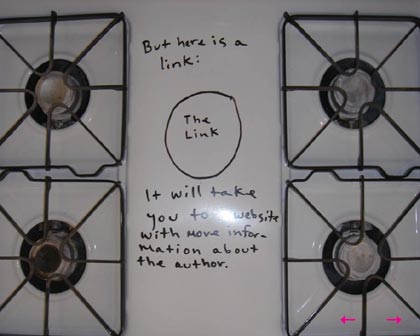
The really intriguing thing about the site is that it breaks pretty much every rule that contemporary web designers have for effective site design. The site is a linear progression of images, essentially 30 splash pages one right after another. It doesn’t have any navigation except for forward/back buttons; you can’t just jump to whatever page you want. July barely mentions anything about the book and only then near the end of the 30 pages. There’s no text…it’s all images, which means that the site will be all but invisible to search engines. No web designer worth her salt would ever recommend building a site like this to a client.
Yet it works because the story pulls you along so well; July’s using the site’s narrative to sell a book that is, presumably, chock full of the same sort of narrative. If you think the site sucks and quickly click away, chances are you’re not going to like the book either…it’s the perfect self-selection mechanism. The No One Belongs Here More Than You site is a lesson for web designers: the point is not to make sites that follow all the rules but to make sites that will best accomplish the primary objectives of the site.
A video from the Children of Men DVD that shows how they did some of the long takes in the film. The rig they built on the car and the roving camera are amazing.
The NY Times published an article this morning on the efforts to develop a code of conduct for online discourse. The code is a reaction to recent comments made about blogger Kathy Sierra. Three things bother me about the proposed rules.
We take responsibility for our own words and for the comments we allow on our blog.
I don’t want to take one bit of responsibility for someone else’s words. A person’s words are their own. By taking responsibility for them, you open yourself up to all sorts of problems, mostly legal in nature. Why should someone get sued for slander or libel because someone else posts something on your site? Of course, I also believe that Google isn’t responsible for people posting copyrighted videos to YouTube, that Napster wasn’t responsible for people trading copyrighted material via its service, and that ISPs aren’t responsible for what their customers publish to the web.
We do not allow anonymous comments.
There has to be a mechanism for anonymous comments, even if they need to be approved before being posted. As the EFF says, “anonymous communications have an important place in our political and social discourse”.
The missing piece in this discussion so far is: who’s going to police all this misconduct? Punishing the offenders and erasing the graffiti is the easy part…fostering “a culture that encourages both personal expression and constructive conversation” is much more difficult. Really fucking hard, in fact…it requires near-constant vigilance. If I opened up comments on everything on kottke.org, I could easily employ someone for 8-10 hours per week to keep things clean, facilitate constructive conversation, coaxing troublemakers into becoming productive members of the community, etc. Both MetaFilter and Flickr have dedicated staff to perform such duties…I imagine other community sites do as well. If you’ve been ignoring all of the uncivility on your site for the past 2 years, it’s going to be difficult to clean it up. The social patterns of your community’s participants, once set down, are difficult to modify in a significant way.
For now, my blogger code remains “B9 d+ t+ k++ s u= f++ i o x+ e++ l- c—”.
Tourism, iPod-created personal environments, and the death of peripheral vision. “I was brought up to be constantly aware of others around me, to keep a sharp eye out to see if I was blocking someone’s way, holding someone up.”
Photographs from the Arkansas State Prison 1915-1937. (via your daily awesome)
Fascinating stuff: the Washington Post hired a world-famous violinist to play for spare change outside a D.C. Metro station to see if anyone would notice and how much he’d make. “In a banal setting at an inconvenient time, would beauty transcend?” (thx, karan)
Update: A NYC subway musician’s take on the article: “The thing is Joshua Bell is a great violinist but he doesn’t know how to busk.” (thx, greg)
Logical, linguistical, and infographical analysis of the #1 single on the Billboard chart, This Is Why I’m Hot by Mims. “Mims is hot because he’s fly. But it raises the question: Does being hot guarantee one’s being fly? […] It would appear that fly and hot are interchangable. If you are one, you are both; if you aren’t at least one, you are neither.” (via khoi)
Apple and EMI jointly announced earlier this week that the iTMS would offer EMI’s music without DRM and at a bitrate of 256 kps instead of 128 kps. Twice the bitrate = twice as good, yeah? Not so fast…you might not even notice the difference.
Pat Venditte is a switch pitcher for his college team, a rarity at baseball’s higher levels. “Against Nebraska last year, a switch-hitter came to the plate right-handed, prompting Venditte to switch to his right arm, which caused the batter to move to the left-hand batter’s box, with Venditte switching his arm again.”
On the occasion of Helvetica’s NYC premiere tonight, Michael Bierut remembers a time when no one knew anything about type or fonts except for designers and typesetters. “[Today] we live in a world where any person in any cubicle in the world can pick between Arial and Trebuchet and Chalkboard whenever they want, risk free, copyfitting tables be damned, and where a film about a typeface actually stands a chance of enjoying some small measure of popular success.”
This is brilliant: the weird video of Dick Cheney lurking in the bushes during a press conference at the White House with Radiohead’s Creep playing over it. “I want you to notice when I’m not around….” (via cyn-c)
“The essence of the Overton window is that only a portion of [the total] policy spectrum is within the realm of the politically possible at any time. Regardless of how vigorously a think tank or other group may campaign, only policy initiatives within this window of the politically possible will meet with success.” (via rebecca blood)
I feel like I’ve linked to this before but here it is again (maybe): a list of how companies got their names. “Mattel - a portmanteau of the founders names Harold ‘Matt’ Matson and Elliot Handler.” (via khoi)
Artist Xia Xiaowan uses layers of glass to make 3-D paintings. A picture’s worth a thousand words of explanation in this case:

Xia Xiaowan surpasses the boundaries of painting and establishes a new way of “looking” at paintings. He draws his inspiration and method from X-ray photographs, giving two-dimensional painting a three-dimensional effect. He combines material, technology and painting, thus maintaining the hand-made qualities of painting while adding elements of installation and sculptural art and displaying the cold, absurd and strange qualities of realism.
More work by Xia Xiaowan here.
Update: Marilène Oliver does similar work. (thx, emmett)
David Remnick may be the current editor of the New Yorker, but it’s much-maligned former editor Tina Brown’s team that’s running the place. Love the comments at the end…the Gawker audience is almost shocked at something that’s actually researched, longer than three sentences, and doesn’t contain any overt drug references. Choire, you keep this up, I might have to start reading the site again.
Instead of giving out wasteful schwag bags and tshirts that no one wears, the Interesting 2007 conference is asking participants to provide their own used tshirts (they’ll screenprint the logo on it) and will be using plain old plastic bags with the conference logo screenprinted on them. What a great twist on recycling. (via bbj)
Stay Free interviews Giles Slade, the author of a book on planned obsolescence. “Companies profit more when products have shorter lifespans - because they sell more products that way. This is no conspiracy theory but, rather, simple economics. Small wonder, then, that product lifespans are shrinking across the board. In 1997, a PC was expected to last 4 or 5 years; by 2003, only two years, and today the life expectancy is even less.”
I love YouTube. This is a video clip of a chef pulling noodle dough, doubling it over 12 times until the noodles are unbelievably fine. The clip is from a 1987 PBS science show that I watched once when I was 14[1] and I’ve remembered it ever since as one of the simplest, coolest, and most concrete illustrations of mathematics I’ve ever seen. (via seriouseats)
[1] Ooh, watching science shows on PBS at 14….how popular was I in school?
Pentagram’s Paula Scher illustrates the typical lifecycle of a blog discussion for the NY Times. More and more, I’m seeing threads skip immediately to steps 9 & 10: “Impugn the character of thesis author” and “Impugn character of anyone who even considered agreeing”.
Exhibit on Helvetica (the font, not the film) opens tomorow at the MoMA and will be available for a good long time (until March 31, 2008). “Widely considered the official typeface of the twentieth century, Helvetica communicates with simple, well-proportioned letterforms that convey an aesthetic clarity that is at once universal, neutral, and undeniably modern.”
Video of the inside and outside of the just-completed new IAC headquarters. Building by Frank Gehry, his first in NYC. (via zach)
If you’re at a loss for something to wear tomorrow, check out the Wardrobe Remix photo pool on Flickr…12,000+ photos of normal people showing off what they’re wearing. “i believe the best stylists walk the streets, not the photo sets, nor the backstage of the runways. the real innovators are you and me: real, fashionable people, men and women alike.”
The British government is installing talking CCTV cameras in public places…the control center staff will be able to yell at people they see on the camera to stop littering and the like. “Smith! 6079 Smith W.! Yes, you! Bend lower, please! You can do better than that. You’re not trying. Lower, please! That’s better, comrade.”
An examination of the interaction between humans and computers in science fiction movies. Includes examples from The Matrix, Metropolis, Futurama, Minority Report, and Star Trek. (via bb)
Chicago chef Homaro Cantu talks a bit more about his plans for edible advertising. “You open up a magazine, there’s a small plastic thing in there, and you rip it open. It looks like a cheeseburger, tastes like a cheeseburger, it’s made from all organic ingredients.” The ads will also be allergen-free and may contain a bit of fluoride to help keep your teeth clean. (via seriouseats)
Short profile of Atul Gawande, surgeon and writer, one of the few New Yorker contributers I make a point of reading every single time I see his byline. “I now feel like writing is the most important thing I do. In some ways, it’s harder than surgery. But I do think I’ve found a theme in trying to understand failure and what it means in the world we live in, and how we can improve at what we do.”
Roger Ebert’s been out of commission for the past few months due to cancer surgery, but he’s eager to return to his normal duties. “I still love writing about the movies. Forty years is not enough.”
Rollercoaster version of the graph of US home prices adjusted for inflation…you basically ride the curve of the graph. Brilliant…I want to ride all the graphs I come across! (via is it real or is it magnetbox)
Ted Z at Big Screen Little Screen got his mitts on a copy of a script for Wes Anderson’s The Darjeeling Limited from May 2006. “I have serious reservations regarding how far Wes Anderson can take this twee-filmmaking before the rut is too worn to dig himself out.”
Winners of the Helvetica haiku contest I pointed to a couple of weeks ago. My favorite of all the ones listed: “i shot the serif / left him there full of leading / yearning for kerning”. Close second: “She misunderstood / When I said she was ‘Grotesque’ / Akzidenz happen”. I am a sucker for puns.
Looks like the change in Daylight Savings Time in the US didn’t have the intended effect on energy savings. No measurable impact on their business, say the power companies.
There’s a variant of Rock, Paper, Scissors that has 101 possible gestures instead of just three. (There’s also a 25-throw variant.) 101 gestures means 5,050 possible outcomes…like “bicycle carries butter”, “community rebukes Satan”, and “UFO collects blood”.
Why are the records in swimming being broken at such a great pace while those for, say, track and field are more sturdy? More time and money is available for swimming now, meaning that its participants are improving quicker…as opposed to running, which hit its time and money growth spurt awhile ago.
Finalists in Smithsonian magazine’s 2007 photo contest. Some good stuff in here, but some of it is a little cheesy.
Photojojo celebrates its first birthday with a tutorial on how to make video panoramas. The end result is pretty cool.
Results of the Type Directors Club type design competition for 2007. I really like Subtil. (via quipsologies)
A Stradivarius fetched $2.4 million at auction yesterday but anyone with the proper chops got to take a climate-controlled test drive before the auction. The violin’s minders at Christie’s screened potential players, in part, by looking for “the telltale bruise under the jaw that comes from resting on the chin rest of the violin”, which Lilly calls a “violin hickey”. There are several theories as to why Antonio Stradivari’s instruments sound so wonderful, but no one has cracked the mystery yet.
Craig Robinson of Flip Flop Flyin’ presents his life so far as a series of pie charts.
The secret ingredient in Jamba Juice’s “non-dairy blend”? Milk! (via bb)
Photos of the offices of prominent New Yorkers. You can tell which of these people actually use their offices to get work done…Martha Stewart’s computer monitor is stashed neatly away in a drawer. For a less rarefied look at people’s workspaces, try the Desk Space, My Desk, and My Cluttered Desk photo pools on Flickr.
Update: I read Martha’s item incorrectly…her keyboard is in a drawer, not her monitor. Still, I contend that she doesn’t do any real work in that office. (thx, haran and eric)
Quick quiz: Is this text set in Arial or Helvetica? If you’re struggling with that, check out How to Spot Arial. (thx, hubs)
Today is National Peanut Butter and Jelly Day and Serious Eats is celebrating by bringing you a whole bunch of PB&J-related stories, including one I sent over about Elvis jetting to Denver for the sole purpose of eating a Fool’s Gold Loaf…an entire hollowed-out loaf of bread crammed with a jar of peanut butter, a jar of jelly, and a pound of bacon. Mmm mmmmm!!
A man named Dusan Stulik is working to document and preserve all the different ways in which photographs have been made. “Surprisingly, the large photography companies — Kodak, Ilford, Fuji, Polaroid and Agfa — did not save samples of the hundreds of different films and papers they developed over the last century. We’re hoping that you did.”
The McMansion page on Wikipedia is surprisingly detailed. Other terms for a McMansion include Faux Chateau, Frankenhouse, Starter Castle, and Parachute Home. The Lawyer Foyer refers to “the two-story entry space typically found on many McMansions which is meant to be visually overwhelming but which contributes little to the useful space of the house”.
New evidence is bringing us closer to finding out what actually happened to Amelia Earhart. “In more than 50 nonfiction books and even a movie, writers embraced theories ranging from a crash at sea to abduction by aliens, from Earhart executed by the Japanese as a spy to living under another name in New Jersey.”
Time lapse video of someone painting the Mona Lisa in MS Paint.
Apple will begin to sell DRM-free songs from EMI via the iTunes Music Store in May. The songs are higher quality but will cost slightly more ($1.29 vs $0.99 for the DRM version). It’ll be interesting to see how many people choose to buy the non-DRM stuff at the higher price. My feeling is that typical consumers won’t care that much…lower price will win out over slightly higher quality and some nebulous future flexibility. I bet EMI is even half-hoping for failure on this thing: “see, customers *want* DRM…”
People cruising the streets for parking meters do so because meter pricing is too low. “Underpriced curb spaces are like rent-controlled apartments: hard to find and, once you do, crazy to give up. This increases the time costs (and therefore the congestion and pollution costs) of cruising.”
Socials & More