


An Elvis taxon is the apparent rediscovery of an animal that has vanished from the fossil record, but that is really the discovery of a look-alike animal. “The term Elvis taxon is used because of the large number of sightings of Elvis Presley long after his death, as well as for his many impersonators.”

Advertise here with Carbon Ads
This site is made possible by member support. 💞
Big thanks to Arcustech for hosting the site and offering amazing tech support.
When you buy through links on kottke.org, I may earn an affiliate commission. Thanks for supporting the site!
kottke.org. home of fine hypertext products since 1998.
Beloved by 86.47% of the web.
Entries for January 2007
The future of movies
David Denby had a great piece in the New Yorker last week about the present and future of movies. I was surprised to learn that Hollywood hates the movie theater-going experience as much or more than the rest of us:
Consider the mall or the urban multiplex. The steady rain of contempt that I heard Hollywood executives direct at the theatres has been amplified, a dozen times over, by friends and strangers alike. The concession stands were wrathfully noted, with their “small” Cokes in which you could drown a rabbit, their candy bars the size of cow patties; add to that the pre-movie purgatory padded out to thirty minutes with ads, coming attractions, public-service announcements, theatre-chain logos, enticements for kitty-kat clubs and Ukrainian bakeries-anything to delay the movie and send you back to the concession stand, where the theatres make forty per cent of their profits. If you go to a thriller, you may sit through coming attractions for five or six action movies, with bodies bursting out of windows and flaming cars flipping through the air-a long stretch of convulsive imagery from what seems like a single terrible movie that you’ve seen before. At poorly run multiplexes, projector bulbs go dim, the prints develop scratches or turn yellow, the soles of your shoes stick to the floor, people jabber on cell phones, and rumbles and blasts bleed through the walls.
If we want to see something badly enough, we go, of course, and once everyone settles down we can still enjoy ourselves. But we go amid murmurs of discontent, and the discontent will only get louder as the theatre complexes age. Many of them were randomly and cheaply built in response to what George Lucas conclusively demonstrated with “Star Wars,” in 1977: that a pop movie heavily advertised on national television could open simultaneously in theatres across the country and attract enormous opening-weekend audiences. As these theatres age, the gold leaf doesn’t slowly peel off fluted columns. They rot, like disused industrial spaces. They have become the detritus of what seems, on a bad day, like a dying culture.
Denby also considers what happens to movies when the primary target audience (12-30 year-olds make up 50% of the movie-going population) may prefer to watch movies on DVD, their computers, or on iPods.
No exhibition method is innocent of aesthetic qualities. Platform agnosticism may flourish among kids, but platform neutrality doesn’t exist. Fifty years ago, the length of a pop single was influenced by what would fit on a forty-five-r.p.m. seven-inch disk. The length and the episodic structure of the Victorian novel — Dickens’s novels, especially — were at least partly created by writers and editors working on deadline for monthly periodicals. Television, for a variety of commercial and spatial reasons, developed the single-set or two-set sitcom. Format always affects form, and the exhibition space changes what’s exhibited.
As a fan of watching movies on the big screen of a theater, I hope that sort of movie making doesn’t go away anytime soon.
Analysis of some studies that link political tendancies and factors like education level, how afraid we feel, and personality traits. “[A study] found that conservatives have a greater desire to reach a decision quickly and stick to it, and are higher on conscientiousness, which includes neatness, orderliness, duty, and rule-following. Liberals are higher on openness, which includes intellectual curiosity, excitement-seeking, novelty, creativity for its own sake, and a craving for stimulation like travel, color, art, music, and literature.” And an interesting conclusion about the effects of rational thought on all this.
Nicholas Felton’s personal annual report for 2006. “Disclaimer: Alcoholic beverages were consumed during the collection of this data and the author acknowledges that the occasional drink may have gone unrecorded.” Here’s the one for 2005. LOVE this.
Maybe one of the reasons that the US hasn’t embraced global warming as a national priority is because the country is so large that it never experiences collective weather extremes the way Europe does.
Whole Foods’ stock is going down, but maybe it shouldn’t be. “The whole idea of good food and gourmet eating has begun to transcend the PBS-store bag toter.”
The folks in the Christmas Tree Carcasses group on Flickr are keeping track of discarded Christmas trees. (thx, richard)
New York magazine tracked the media diets of 3 New Yorkers for a week. Lightweights. (via fimoculous)
Comparison of the iPhone with other smart phones…a nice companion piece to the comparison of my cardboard iPhone to various iPods, mobile phones, etc. So far, the market thinks that Apple’s got something good on their hands: Apple stock was up $7.10 today while RIMM (makers of Blackberry) dropped $11.16.
The Apple iPhone
Apple’s new iPhone looks like a thing of beauty. Widescreen touch interface, no buttons, runs OS X, useful widgets, integrated email, Google Maps, Google/Yahoo search, visual voicemail (see who voicemail is from before you call), SMS, Wifi, etc. etc. Oh, and it plays music.
A lot of people are wondering just how big this thing is. Using the technical specs from apple.com, I grabbed some cardboard, scissors, and glue and made a scale model of the iPhone. Here it is:
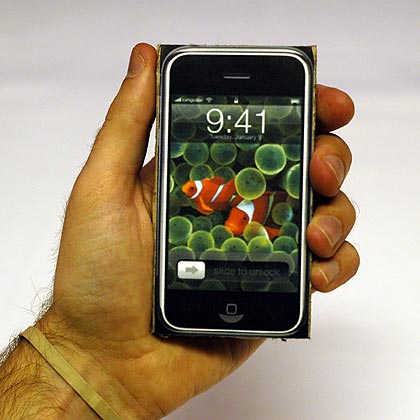
My hands aren’t that big (I can barely palm a basketball on a good day), but it still seems to fit pretty well. How does it stack up against similar devices?
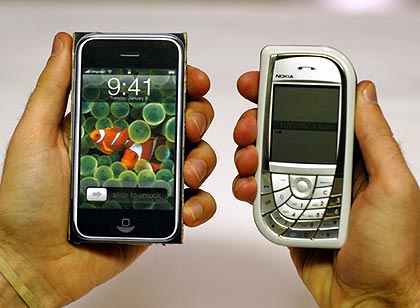
Here’s the iPhone vs. my current mobile phone, the Nokia 7610:
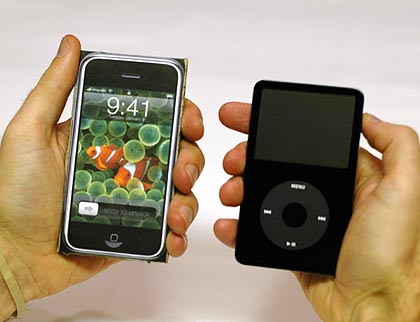
iPhone vs. a 5G iPod:
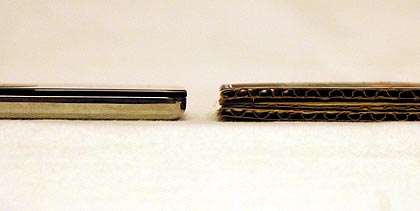
Thickness of the cardboard iPhone vs. the 5G iPod:
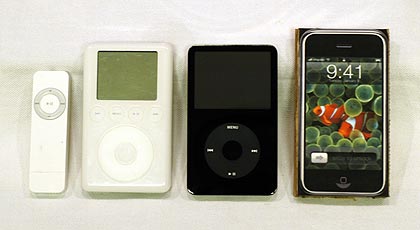
1G iPod shuffle, 3G iPod, 5G iPod and the iPhone:
iPhone vs. a TiVo remote and a Wii remote:
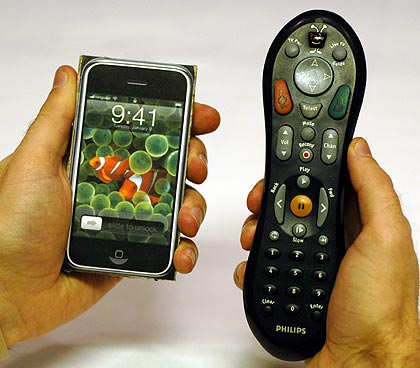
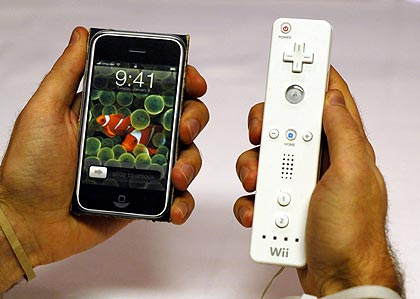
That’s all the gadgets I could find on a couple of hours notice.
I also dug up something I wrote a couple of years ago in the gigantic text file I keep on my Powerbook of ideas for kottke.org posts. 99% of the stuff in that file is completely dunderheaded, but I have to say I hit close to the mark on this one:
true convergence of phone + mp3 player will happen when someone solves this user experience puzzle: physically not enough room for two optimized interfaces (one for calls, one for music) on same small device. possible solution: no buttons, replace with touch screen that covers the whole front with one-touch switching between modes…
Once we’re able to get our hands on it and use the interface, the iPhone could turn out to be a disappointment, but they’re heading in the right direction at least. More thoughts soon.
(Like this story? Digg it.)
MacWorld 2007
Yesterday a weird smell descended on New York City, a miasma of natural gas odor. Today you might sense a low hum emanating from all over the Earth, localized in households whose inhabitants spend unhealthy portions of their paychecks on consumer electronics. Geeks the world over are vibrating in anticipation of Steve Jobs’ keynote at MacWorld starting in, oh, 5 minutes. Since I too am slightly vibrating and won’t be able to get anything done for the two-hour duration of his talk, I’ll be following along here, sipping from MacRumors’ live coverage. (Gizmodo, Engadget, and Twitter have coverage too.)
As an appetizer, here’s a few of the less hysterical predictions for what Our Fearless Leader is going to provide us with today:
- MacWorld Expo 2007 Predictions from John Gruber at Daring Fireball.
- Jason Fried’s Apple phone predicitons (I especially liked this one).
- Macalope’s predicitons.
- Some thoughts from Steven Frank.
- Regarding MacWorld 2007 by Dan Benjamin.
Ok, here we go….
- BREAKING NEWS: Attendees still taking their seats!
- Started. Gizmodo is stumbling badly. Zero updates.
- Sales updates. Apple now sells more music than Amazon.
- The Zune has 2% market share, the iPod has 62%. What brown can do for you, apparently.
- Apple TV in September. Not an actual TV, but a device that hooks to a TV. Here’s some specs: 802.11b/g/n, 40GB HD, 720p HD, component rca, usb2, ethernet, HDMI. Retails for $299. Shipping in Feb.
- New product: internet communicator, mobile phone, and widescreen ipod all in one. Steve is very excited about this one. Called the iPhone. No buttons. Multi-touch screen. (WHOA!) Runs OS X. Jobs: “Software on mobile phones is like baby-software.” It does all the stuff that OS X does. Calendar, mail, movies, music, podcasts, etc. Turns off the display and sound when you bring it to your ear to talk. It’s got an accelerometer (motion sensor) and a proximity sensor. 2 megapixel camera. Screen resolution is 160 ppi. Here’s what it looks like (photos from Engadget):


- Free IMAP email from Yahoo for iPhone customers. (Shot over Google’s bow.) And it’s “push-IMAP”…works just like a Crackberry.
- The iPhone has a full copy of Safari. Just browse away.
- Jobs just prank-called a Starbucks, attempted to order “4000 lattes to go”.
- Google and Apple pushing hard to partner. “Merging without merging.”
- Apple doing stuff with Yahoo too.
- Apple’s stock now at +$4.51.
- iPhone ships in June in the US. $499 for 4 gig, $599 for 8 gig. Available only with Cingular as the carrier. (Can you unlock?) Can purchase either at Cingular or Apple stores. Have to sign up for a 2-year contract.
- RIM stock is down more than 8 points. RIM makes the Blackberry. Palm, Motorola, and Nokia are all down as well. (thx, eli)
- Apple is changing their name from “Apple Computer, Inc.” to “Apple, Inc.”
Smashing Telly is aggregating good televsion shows that are available on the web. Bottom line: you can watch television at work!
True Hoop’s Henry Abbott does a bit of research into baby names inspired by NBA players. “[Kobe] was drafted in 1996, and in 1997 the name debuted at #553. 2001 was its best year ever, when it was the 223rd most common name in America. Donald, Keith, Troy, Lance, Simon, Chad, Dante, Douglas, Tony, Joe all ranked lower.”
How the New Yorker picks its cartoons. “
How the New Yorker picks its cartoons. “The funniest cartoon is not necessarily the best cartoon. Funnier means that you laugh harder, and everybody’s gonna laugh harder at more aggressive cartoons, more obscene cartoons. It’s a Freudian thing. It gives more relief. But is it a better joke? To me, better means having more truth in it, having both the humor and the pain and therefore having more meaning and more poetry.”
A list of the Midichlorian counts for major Star Wars characters.
Update: Given the subject mattter, I’m not sure a disclaimer is needed, but in case you’re really worried about veracity of the above list, here’s some useful information. (thx, oh no)
Geriatric and other distant sequels
Some upcoming and recently released sequels which are released a long time after the previous movie in the series, some real and some imagined:
Sylvester Stallone returns as the 50-something year-old title character in Rocky Balboa to fight the heavyweight champion of the world.
Police Academy 8: To the Moon. Steve Gutenberg leads a merry band of recruits and Bubba Smith to the moon to form the first extraterrestrial police force. Hijinks ensue. Special appearance by Henry Winkler, who jumps a shark on waterskis in the Sea of Tranquility.
ET 2. Henry Thomas needs the work.
Star Trek 12. William Shatner, Ricardo Montalban, and a wormhole. Enough said.
Sir Sean Connery as James Bond in Goldfinger 2. Turns out Oddjob wasn’t really dead. He and Bond battle it out after tempers flare and hats are thrown at a Florida condo board meeting. Pussy makes crabcakes for dinner.
Jaws 5. I think the shark talks this time.
Rambo IV: Pearl of the Cobra. Stallone has run out of material.
Marty travels forward in time to bring embryonic stem cells back to the present in Back to the Future Part IV.
Harrison Ford is set to star in Indiana Jones 4, slated to be released almost 20 years after the last installment of the film. Ford will be 65 years old at the time of the filming. Not sure how many swashes he’ll be buckling in the this one.
Star Wars: Episode 7. Han, Leia, and their high school-aged kids are ensconced in a Tatooine suburb (Chewy lives in the garage, R2 & 3PO in a little love-nest down the street) while Luke scours the galaxy for little kids with high midichlorian counts. Seventy-year-old Billy Dee Williams will appear as Lando Calrissian.
Clerks 2. Randal and Dante work through a midlife crisis for minimum wage while Jay and Silent Bob kick their habit.
Sharon Stone is still sexy and irritating at 47 in Basic Instinct 2.
Beverly Hills Cop IV. Axel does paperwork at his desk all day. Eddie Murphy does double duty by playing a elderly, sassy, obese black woman.
Karate Kid IV. Sadly, Pat Morita is unable to reprise his role as Mr. Miyagi and a 45-yo Ralph Macchio unconvincingly plays college sophomore Daniel LaRusso. Academy Award nominee William Zabka directs.
Bill & Ted’s Straightforward Trip to Home Depot. Station!
Breakin’ 3: Electric Boogaloo 2.
Disco is Dead. John Travolta runs a wrecking company that is contracted to tear down the very Brooklyn discotheque he danced in as a youth. Intense self-examination of his current path in life follows.
Ei8ht. Gwyneth’s character having been dispatched in the first film, Pitt is free to bring Angelina into this one as wife #2. This time, murders are committed where the first names of the victims match those of the children on the Eight Is Enough television program. I don’t want to ruin it for you, but Dick Van Patten’s head might end up in a box.
A California game company purchased the rights to Line Rider and plans to release versions of the game for the Nintendo Wii and DS. (thx, selena)
In case you were wondering, here’s a list of the almost 1000 books that Art Garfunkel has read since 1968. (thx, dave)
The folks at Photojojo sent me a Monsterpod late last month and while I haven’t used it a lot yet, it certainly does work as advertised: it’s a little tripod that sticks to pretty much everything. Chris Spurgeon has a short review.
Naked parties are all the rage at US upper-crust colleges. “The dynamic is completely different from a clothed party. People are so conscious of how they’re coming across that conversations end up being more sophisticated. You can’t talk about how hot that chick was the other night.” (via mr)
The story of Harold Hayes and Esquire during the 1960s, one of the best decades a magazine ever had.
Metacritic’s aggregated view of the film critics’ top 10 lists is always worth a look, both for the information and the information design. United 93 appeared on the most lists and tied with Army of Shadows for most #1 rankings.
Dear Mr. Old Man Winter,
Please consider this letter notice of your termination, effective immediately. Despite clear expectations and requirements — January temperatures not to exceed 40° F, consistent snow and blustery conditions, minimum of one blizzard with white-out per annum, &c. &c. — you have failed to date to meet expectations and deliver even rudimentary winter weather. A forecast high of 72° today in New York City is clear proof of your failure to do your job.
A replacement will be appointed immediately. Perhaps we will try a young go-getter for this role, someone who is willing to take on the many weather challenges of this magnificent season rather than rest on his “Great Winter of ‘02-‘03” laurels.
Yours truly,
Mother Nature
[Guest post by Meg Hourihan.]
Peter Merholz has some interesting thoughts on why Google Calendar is about to overtake Yahoo Calendar as the top web calendar app. “Here’s a product whose very definition was predicated on empathy for true customer needs. And it’s succeeding brilliantly.”
Does free will exist? “The conscious brain was only playing catch-up to what the unconscious brain was already doing. The decision to act was an illusion, the monkey making up a story about what the tiger had already done.”
Nice interview (particularly the last half) with Steven Johnson about his books and “interdisciplinary zeal”. His next book will be about “creativity that will involve the long zoom idea: thinking about creativity that’s not necessarily something that happens between you and your notepad, but everything from the neurons in your brain all the way up to the city you’re thinking in the middle of”…which sounds great.
Caught the first episode of Wired Science on PBS last night and it wasn’t so bad. It’s like Wired magazine, but on TV. If you missed it, the entire show is available online.
Interview with Ben Schott, author of the Schott’s Miscellany books. It sounds like we have a lot in common, job-wise. “One of the metaphors of what I do that I like is a sort of curator. Often it’s a question of finding information that might’ve otherwise been undiscovered or neglected or not focused upon. What’s fun — and I think this is one of the great joys of curating — is making juxtapositions.” I liked this bit too: “I think it’s easier to be snarky than it is to be decent. Anything to get a smile. It doesn’t last. And actually, it does date.”
Hillel Cooperman purchased a small autograph book dating from the 1940s in a Hong Kong shop and has posted scans of the book online in hopes that people will help translate it. A commenter says: “This book is used to leave comments — quite popular at graduation time when your classmates left you good wishes of your future. The owner of the book is named ‘Xi Rao’, and the college he graduated from in Spring 1942 is ‘Jiao Tong’ university.”
Food manufacturers are greenwashing their packaging, using homey organic colors and themes to sell food that isn’t even necessarily organic or healthy. “Start with a gentle image of a field or a farm to suggest an ample harvest gathered by an honest, hard-working family. To that end, strangely oversize vegetables or fruits are good. If they are dew-kissed and nestled in a basket, all the better. A little red tractor is O.K. Pesticide tanks and rows of immigrant farm laborers bent over in the hot sun are not.”
Power Washing 188 Suffolk St., a photo depicting how dirty NYC is. (via eliot)
Holy crap, Gina got her own hedcut portrait in the Wall Street Journal this morning! She’ll be under her desk for days over this.
Malcolm Gladwell on the difference between secrets and puzzles, particularly as it relates to something like the Enron scandal. I think this is one of the more interesting pieces from Gladwell in recent years. Having lived in California during the blackouts and the absurdly high electricity bills, I want Skilling’s head as much as anyone, but Gladwell has a good point here. There’s more on his blog, including a question: “According to the way the accounting rules were written at the time, what specific transgressions were Skilling guilty of that merited twenty-four years in prison?” Also note the similar themes to one of my favorite articles from last year, The Press’ New Paradigm.
Strange Maps post about the Vinland Map, a document proported to have been drawn in the 15th century from a 13th century map. The Vinland Map depicts an unknown land across the Atlantic Ocean called Vinland which some think is the part of North America visited by the Vikings in the 11th century.
1994 best/worst-of the internet lists with predicitons for 1995. “Pick any tragic event and you can probably recall seeing a newsgroup that taunted its seriousness. There was alt.tonya-harding.whack.whack.whack. Then we had alt.lorena.bobitt.chop.chop.chop. And no, I haven’t forgotten alt.oj-simpson.drive.faster.”
Proposal from Language Log: scientific and technical papers should come with an executable “recipe” for generating numbers, graphs, and tables from published data.
Great aerial photography of Africa by Michael Poliza. One of my favorites. Poliza’s work reminds me of Yann Arthus Bertrand. (via nickbaum)
Music video for the Softlightes song Heart Made of Sound features handmade typography, Post-It Notes, and stop-motion animation. See also: the opening credits for Napoleon Dynamite, Stefan Sagmeister, and Michel Gondry. (via buzzfeed)
Time-lapse video of Picasso making a painting, from start to finish. Tinselman has more info on the video.
Wesley Autrey jumped in front of an oncoming subway train to save the life of a man who had fallen on the tracks. I read this before I left for work yesterday and imagined the scenario when my train pulled into the station. I’d hope I would do the same thing as Mr. Autrey did, but that train moves awfully fast…
The Best Links 2006
Compiling a list of the best things I’ve linked to from kottke.org seems to get harder each year. I estimate posting about 2400 links to kottke.org in 2006, which is roughly one link every 2.5 hours on weekdays. Which is insane…I don’t know how you guys read all of that. Last year I managed to whittle down the best-of list to ~65 links (2004’s list had ~40 links), but I couldn’t manage less than 100 this year. (Hell, the overflow list contains another 100 links that didn’t quite make the cut…hopefully I’ll be posting those in a few days.)
But enough with the statistics. Besides containing some really entertaining, informative, and provoking reading/viewing material, this list also functions as kottke.org’s year in ideas for 2006, akin to the annual list in the NY Times Magazine. Climate change, the industrialization of childbirth, race & class in college & professional sports, the inherent messiness of science, adults who don’t want to grow up, the role of journalism in the age of information abundance, and how creative work gets done are all ideas represented in the links below. Even the funny YouTube videos signal the arrival in 2006 of online video, especially if you throw Ze Frank in the mix. Enjoy.
Pruned found art in petri dishes. More.
The M.C. Escher-inspired art of Rob Gonsalves.
David Remnick’s review of An Inconvenient Truth (and short biography of post-2000 Al Gore).
A collection of color photographs of WWII-era America from the Library of Congress. (I color-corrected some of the photos.)
New Yorker piece about the possible solving of the Poincare conjecture by Grigory Perelman.
NY Times Magazine piece by Michael Lewis on Michael Oher, excerpted from his book, The Blind Side.
The Smoking Gun’s takedown of James Frey was fair, accurate, and devastating.
Line Rider. Not quite a game, not quite a toy, but hours of fun.
Tetris documentary, From Russia With Love.
Stabilized version of the Zapruder film of John F. Kennedy’s assassination.
Matthew Barney and Bjork on the phone with Ikea.
The Omarosa Experiment reveals the inner workings of reality TV.
Dorodango: shiny balls of mud.
Olivo Barbieri’s aerial photographs taken with a tilt-shift lens spawned some amazing Photoshopped fakes on Flickr.
Details on how to speak to a live customer support person for hundreds of companies. Indispensable.
The story of how Pixar came to be.
Wasp creates zombie cockroaches.
Falling sand, another not-a-game game.
Tap out a rhythm and Song Tapper will tell you what song it’s from.
London Tube map where all the stations are sponsored by companies.
The Simpsons intro done with live actors.
Interview with Jonathan Rauch about his popular piece about introverts for The Atlantic Monthly.
Rotation Of Earth Plunges Entire North American Continent Into Darkness.
Pregnancy is a tug of war between mother and fetus over nutrients.
Extensive primers for more than three dozen film genres.
It’s a bad time to start a company.
Horrible Segues, With Local Anchorman Clive Rutledge.
American Express commercial directed by Wes Anderson.
Photo essay of female Israeli soldiers.
The four different types of explanations.
Pictures I Like For a Variety of Reasons.
David Copperfield thwarts would-be robbers with slight of hand. Hands down, the link of the year.
Magnum photographer Paul Fusco’s photo essay of Chernobyl survivors.
Dozens of old Sesame Street clips on YouTube.
How to cure your asthma or hayfever using hookworm.
How one man fell for a Nigerian email scam.
Steven Levitt and Stephen J. Dubner tell us that expert performers — in math, football, ballet, chess — are made, not born.
Michael Wolf’s 100x100, 100 photos of Hong Kong apartments each 100 square feet in size.
1989 New Yorker profile of Errol Morris.
Dozens of historical sounds in mp3 format.
10,000 sheep created by people hired online through Amazon’s Mechanical Turk program.
Web 2.OH, YEAAHH!! t-shirts. Pun of the year.
Extensive gallery of Russian/Soviet propaganda and advertising posters.
Implanting magnets in your fingertips gives you a sixth magnetic sense.
A history of Manhattan’s diamond district and its informal historian, Stephen Kilnisan.
Photographs of a flock of more than a million European starlings.
Photographs of burn victims by John Brownlow.
What if great photographers posted their work on the web?
Why play “what if”? Here’s an Henri Cartier-Bresson being rubbished on Flickr.
An image of human eyes placed above an honesty pay box results in more people paying for their food/drinks. More.
A blue-skinned family in the hills of Kentucky. More.
Daniel Raeburn writes about his stillborn daughter Irene. About two years later, her sister Willa is born.
Easily mispronounced domain names.
Turning innocuous video clips into naughty scenes with selective bleeping. Hilarious.
Kristoffer Garin follows a group of American men on a bride-hunting trip to the Ukraine.
MotherLoad, an extremely addictive online game.
Watch as Lake Peigner drains entirely into a hole created by an errant oil drill. More info.
The Art of the Shiv, a photo essay of prison weapons.
The Show with Ze Frank. The most consistently entertaining and informative online media in 2006.
The physical impossibility of gigantic and microscopic movie creatures.
Argentina on Two Steaks a Day.
Bijou’s Bag of Tricks. This photo makes me laugh until I cry.
Geoffrey Chaucer gets an Xbox 360.
Six years of daily photographs compiled into a movie.
The Voyager spacecraft escapes from the solar system.
David Foster Wallace writes about Roger Federer as Religious Experience.
The vast majority of the decisions in the Senate are made for economic reasons, not social ones.
1964 New Yorker profile of Bob Dylan.
How to Write a Fugue, featuring a fugue of Britney Spears’ “Oops, I Did It Again”.
State of Emergency, a surprisingly political fashion shoot from Vogue Italia.
What if the inflight announcement you heard while traveling was honest?
The photography of Corey Arnold, particularly of the Bering Sea crabbers.
Billionaire Steve Wynn pokes a hole in one of his Picassos with an errant elbow.
Malcolm Gladwell talks about the myth of prodigy.
Atul Gawande tells us how childbirth became industrialized.
2003 New Yorker profile of the late R.W. Apple by Calvin Trillin.
Time lapse video of a man putting on 155 t-shirts, one over the other.
The world’s best worst movie pitches.
Why There Almost Certainly Is No God by Richard Dawkins.
Scott Adams cures himself of losing his voice.
Phil Gyford’s beginner’s guide to freelancing.
New Yorker profile of Will Wright.
Maureen Gibson finds a picture of her rapist on the Engagements page of her hometown newspaper.
Comedian Aries Spears does great impressions of rappers Snoop Dogg, DMX, and Jay-Z.
A cognitive neuroscience grad student games Who Wants to Be a Millionaire.
How to talk to a climate skeptic.
NPR piece with Jason Simmons, professional rock, paper, scissors player.
Lasse Gjertsen’s Amateur music video.
What NFL games are going to be on in your part of the country?
Photo of young homeless man Beavis shooting up in the Tenderloin district of San Francisco.
NPR interview with Ed Burns, creator of The Wire.
Hans van der Meer’s photos of European soccer fields.
Giant magazine’s list of the 50 greatest commercials of the 80s (with accompanying videos).
Slate interview with Ed Burns, creator of The Wire.
Writers Dreamtools History by Decades…facts, figures, styles, language, and goings-on for fiction writers.
Thirteen photographs that changed the world, featuring Robert Capa, Man Ray, Matthew Brady, and Ansel Adams.
Shopsin’s, who closed their beloved eatery in the West Village last month, has updated their web site with plans to open in a stall at the Essex Street Market on the Lower East Side. (thx, janelle)
America the Overfull, Paul Theroux’s New Year’s musing on an America with twice as many people as when he grew up. “We are passing through a confused period of aggression and fear, characterized by our confrontational government, the decline of diplomacy, a pugnacious foreign policy and a settled belief that the surest way to get people to tell the truth is to torture them. It is no wonder we have begun to squint at strangers. This is a corrosive situation in a country where more and more people, most of them strangers, are a feature of daily life. Americans as a people I believe to be easygoing, compassionate, not looking for a fight. But surely I am not the only one who has noticed that we are ruder, more offhand, readier to take offense, a nation of shouters and blamers.” (thx, youngna)
Perched on top of Time magazine’s list of best video games for 2006? Wii Sports.
The Long Tale of 2006. “What makes the long tail so disingenuous is that what happens in the long tail has almost no ramifications on what happens in the head.” With the internet, some of the most popular sites are “places like YouTube and MySpace where large amounts of user generated content drives traffic and then deposits money in hands not of the creators, but instead in the coffers of the large corporate landlords”.
The Queen
Talking about it afterwards, a friend remarked, “I bet way more people in the US would go see this if they knew it was about Princess Diana”. It is and it isn’t, but I agree: the movie concerns Princess Diana and it’s great, so go see it. Trailer here.
Socials & More