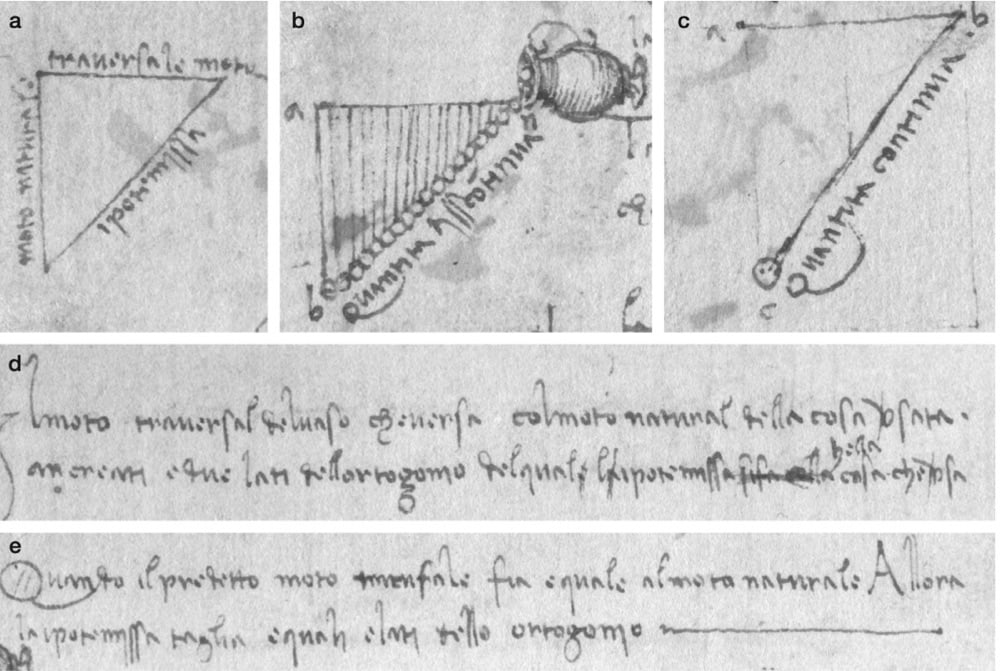
In an article published in the journal Leonardo, the researchers draw upon a fresh look at one of da Vinci’s notebooks to show that the famed polymath had devised experiments to demonstrate that gravity is a form of acceleration — and that he further modeled the gravitational constant to around 97 percent accuracy.
Da Vinci, who lived from 1452 to 1519, was well ahead of the curve in exploring these concepts. It wasn’t until 1604 that Galileo Galilei would theorize that the distance covered by a falling object was proportional to the square of time elapsed and not until the late 17th century that Sir Isaac Newton would expand on that to develop a law of universal gravitation, describing how objects are attracted to one another. Da Vinci’s primary hurdle was being limited by the tools at his disposal. For example, he lacked a means of precisely measuring time as objects fell.
As the piece notes, Leonardo didn’t get things exactly right:
Da Vinci sought to mathematically describe that acceleration. It is here, according to the study’s authors, that he didn’t quite hit the mark. To explore da Vinci’s process, the team used computer modeling to run his water vase experiment. Doing so yielded da Vinci’s error.
“What we saw is that Leonardo wrestled with this, but he modeled it as the falling object’s distance was proportional to 2 to the t power [with t representing time] instead proportional to t squared,” Roh says. “It’s wrong, but we later found out that he used this sort of wrong equation in the correct way.” In his notes, da Vinci illustrated an object falling for up to four intervals of time-a period through which graphs of both types of equations line up closely.
But it’s still pretty impressive how far he did get. The piece also notes that this work was discovered because the codex was made available online to the general public, demonstrating the value of easy access of materials like this.
This is an animation of how quickly an object falls 1 km to the surfaces of solar system objects like the Earth, Sun, Ceres, Jupiter, the Moon, and Pluto. For instance, it takes 14.3 seconds to cover that distance on Earth and 13.8 seconds on Saturn.
It might be surprising to see large planets have a pull comparable to smaller ones at the surface, for example Uranus pulls the ball down slower than at Earth! Why? Because the low average density of Uranus puts the surface far away from the majority of the mass. Similarly, Mars is nearly twice the mass of Mercury, but you can see the surface gravity is actually the same… this indicates that Mercury is much denser than Mars.
Universe Sandbox is a interactive space & gravity simulator that you can use to play God of your own universe.
You can create star systems: “Start with a star then add planets. Spruce it up with moons, rings, comets, or even a black hole.” You can collide planets and stars or simulate gravity: “N-body simulation at almost any speed using Newtonian mechanics.” You can model the Earth’s climate, make a star go supernova, or ride along on space missions or see historical events.
I found Universe Sandbox after watching this video about what would happen if the Earth got hit by a grain of sand going 99.9% the speed of light (spoiler: not much). This game/simulator/educational tool is only $30 but I fear that if I bought it, I would never ever leave the house again.
As of December 1, 2018, the LIGO experiment has detected gravitational waves from 10 black hole merger events. In the computer simulations shown in this video, you can see what each of the mergers looked like along with the corresponding gravitational waves generated and subsequently observed by the LIGO detectors.
Remember Alfonso Cuarón’s Gravity? A missile strike on a satellite causes a chain reaction, which ends up destroying almost everything in low Earth orbit. As this Kurzgesagt video explains, this scenario is actually something we need to worry about. In the past 60 years, we’ve launched so much stuff into space that there are millions of pieces of debris up there, hurtling around the Earth at 1000s of miles per hour. The stuff ranges in size from marbles to full-sized satellites. If two larger objects in low Earth orbit (LEO) collided with each other, the resulting debris field could trigger a chain reaction of collisions that would destroy everything currently in that orbit and possibly prevent any new launches. Goodbye ISS, goodbye weather satellites, goodbye GPS, etc. etc. etc. The Moon, Mars, and other destinations beyond LEO would be a lot harder to reach because you’d have to travel through the deadly debris field, particularly with crewed missions.
Back in September 2015, the LIGO experiment detected gravitational waves formed 1.3 billion years ago when two black holes merged into one. The physics is pretty straightforward but to get the measurement, scientists had to build one of the most sensitive machines ever built. How sensitive? To get an accurate result, they needed to measure a distance of 4km with an accuracy of 1/10000th the width of a proton. This video from Veritasium looks at how the scientists and engineers accomplished such an amazing feat.
It was hailed as an elegant confirmation of Einstein’s general theory of relativity — but ironically the discovery of gravitational waves earlier this year could herald the first evidence that the theory breaks down at the edge of black holes. Physicists have analysed the publicly released data from the Laser Interferometer Gravitational-Wave Observatory (LIGO), and claim to have found “echoes” of the waves that seem to contradict general relativity’s predictions.
The echoes could yet disappear with more data. If they persist, the finding would be extraordinary. Physicists have predicted that Einstein’s hugely successful theory could break down in extreme scenarios, such as at the centre of black holes. The echoes would indicate the even more dramatic possibility that relativity fails at the black hole’s edge, far from its core.
If the echoes go away, then general relativity will have withstood a test of its power — previously, it wasn’t clear that physicists would be able to test their non-standard predictions.
Gravitational waves from two colliding black holes were first detected last September and announced in February. This week, the same science team announced a second wave detection of two smaller black holes in December.
A black hole’s gravity is so strong that even light can’t escape, so black holes are essentially impossible to see with telescopes. But they do give off gravitational waves.
“Light’s always been how we do astronomy,” Professor Jo Dunkley, an astrophysicist at Oxford University who didn’t work on the experiment, told BuzzFeed News. “Everything we know about space, we’ve got from light. This can show the stuff you can’t see with light.”
Counting black holes, combining telescope with gravitational measurements to better understand neutron stars, all the usual origin-of-the-universe stuff.
If gravitational waves don’t require cataclysmic collisions between enormous black holes for us to measure them, but can be detected on the regular, we can use them to try to figure out a whole lot more than just whether or not Einstein was totally right. That is a very nice tool to have in your pocket.
After a potential detection of gravitational waves back in 2014 turned out to be galactic dust, scientists working on the LIGO experiment have announced they have finally detected evidence of gravitational waves. Nicola Twilley has the scoop for the New Yorker on how scientists detected the waves.
A hundred years ago, Albert Einstein, one of the more advanced members of the species, predicted the waves’ existence, inspiring decades of speculation and fruitless searching. Twenty-two years ago, construction began on an enormous detector, the Laser Interferometer Gravitational-Wave Observatory (LIGO). Then, on September 14, 2015, at just before eleven in the morning, Central European Time, the waves reached Earth. Marco Drago, a thirty-two-year-old Italian postdoctoral student and a member of the LIGO Scientific Collaboration, was the first person to notice them. He was sitting in front of his computer at the Albert Einstein Institute, in Hannover, Germany, viewing the LIGO data remotely. The waves appeared on his screen as a compressed squiggle, but the most exquisite ears in the universe, attuned to vibrations of less than a trillionth of an inch, would have heard what astronomers call a chirp — a faint whooping from low to high. This morning, in a press conference in Washington, D.C., the LIGO team announced that the signal constitutes the first direct observation of gravitational waves.
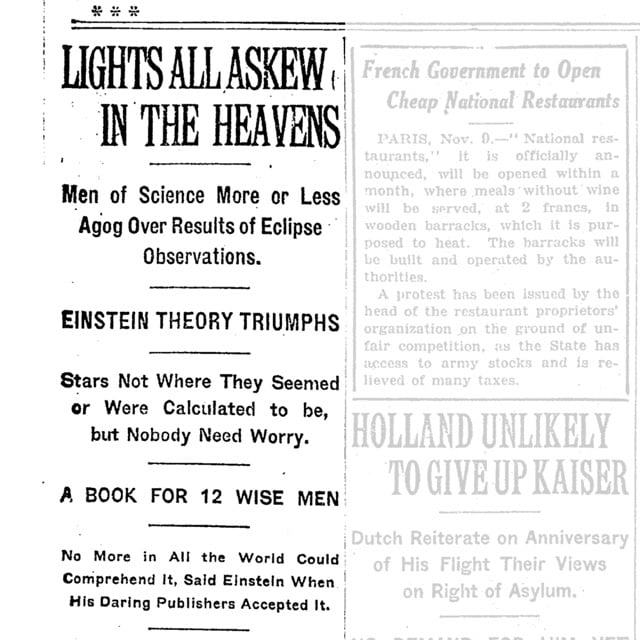
The NY Times headline above is from when the concept of gravitational lensing suggested by Einstein’s theory of relatively was confirmed in 1919. I thought it was appropriate in this case. Wish they still ran headlines like that.
Today, the LIGO team announced its second detection of gravitational waves-the flexing of space and time caused by the black hole collision. The waves first hit the observatory in Livingston, Louisiana, and then 1.1 milliseconds later passed through the one in Hanford, Washington.
By now, those waves are 2.8 trillion or so miles away, momentarily reshaping every bit of space they pass through.
A European Space Agency probe will be launched into space early next month to help test the last major prediction of Einstein’s theory of general relativity: the existence of gravitational waves.
Gravitational waves are thought to be hurled across space when stars start throwing their weight around, for example, when they collapse into black holes or when pairs of super-dense neutron stars start to spin closer and closer to each other. These processes put massive strains on the fabric of space-time, pushing and stretching it so that ripples of gravitational energy radiate across the universe. These are gravitational waves.
The Lisa Pathfinder probe won’t measure gravitational waves directly, but will test equipment that will be used for the final detector.
LISA Pathfinder will pave the way for future missions by testing in flight the very concept of gravitational wave detection: it will put two test masses in a near-perfect gravitational free-fall and control and measure their motion with unprecedented accuracy. LISA Pathfinder will use the latest technology to minimise the extra forces on the test masses, and to take measurements. The inertial sensors, the laser metrology system, the drag-free control system and an ultra-precise micro-propulsion system make this a highly unusual mission.
[Mild spoilers] During the production of Gravity, Jonas Cuaron (co-writer of the screenplay and Alfonso Cuaron’s son) shot a short film that shows the other side of the conversation that Sandra Bullock’s character had while in the Soyuz capsule. In the film, an Inuit fisherman struggles to communicate with the distressed voice on the other end of his radio.
The short was filmed “guerrilla style” on location on a budget of about $100,000 — most of which went toward the 10-person crew’s travel costs — and Cuaron completed it in time to meld the dialogue into Gravity’s final sound mix. The result is a seamless conversation between Aningaaq and Ryan, stranded 200 miles above him, the twin stories of isolated human survival providing thematic cohesion. Still, Jonas says he was careful “to make it a piece that could stand on its own.” Should both get Oscar noms, an interesting dynamic would emerge: Two films potentially could win for representing different sides of one conversation, to say nothing of having come from father and son.
Here’s the trailer for Visitors, a new film from Koyaanisqatsi collaborators Godfrey Reggio and Philip Glass. Most of the trailer consists of a single two-minute shot.
Also interesting is that Visitors is comprised of only 74 shots, which with a runtime of 87 minutes means the average shot lasts over a minute. According to a recent investigation by Adam Jameson, an ASL (average shot length) of more than a minute is unusual in contemporary film. Inception, for instance, has a ASL of just 3.1 seconds and even a film like Drive, with many long shots, has an ASL of 7 seconds. But as Jameson notes, Alfonso Cuarón’s upcoming Gravity contains only 156 shots, including a 17-minute-long shot that opens the film. But the Hollywood master of long-running shots? Hitchcock, I presume:
1. Rope (1948, Alfred Hitchcock), ASL = 433.9 [seconds]
OK, this isn’t a recent recent film, but it has to be noted, as it’s most likely the highest ASL in Hollywood. Hitchcock used only 10 shots in making it (the film’s Wikipedia page lists them). (As you probably know, Hitchcock designed those shots, then edited them such that the finished film appeared to be a single take.)
Newton said the speed of gravity is infinite but according to Einstein (and some nifty interstellar measurements), it most certainly is not.
But in general relativity, things are much more intricate, and incredibly interesting. First off, it isn’t mass, per se, that causes gravity. Rather, all forms of energy (including mass) affect the curvature of space. So for the Sun and the Earth, the incredibly large mass of the Sun dominates the curvature of space, and the Earth travels in an orbit along that curved space.
If you simply took the Sun away, space would go back to being flat, but it wouldn’t do so right away at every point. In fact, just like the surface of a pond when you drop something into it, it snaps back to being flat, and the disturbances send ripples outward!
Nothing like a little science on the Moon, I always say.
Astronaut David Scott in 1971, from the Apollo 15 Lunar Surface Journal. Scott was part of the Apollo 15 crew, and applied Galileo’s findings about gravity and mass by testing a falcon feather and a hammer. The film, shown in countless high school physics classes, is the nerdy, oft-neglected cousin of Neil Armstrong’s space paces.
Now you’re probably wondering where the rest of the depth data comes from if there are such big gaps from echosounding. We do our best to predict what the sea floor looks like based on what we can measure much more easily: the water surface. Above large underwater mountains (seamounts), the surface of the ocean is actually higher than in surrounding areas. These seamounts actually increase gravity in the area, which attracts more water and causes sea level to be slightly higher. The changes in water height are measurable using radar on satellites.
A moving mass has been shown to generate a gravitomagnetic field (just like a moving electrical charge creates a magnetic field) and “the measured field is a surprising one hundred million trillion times larger than Einstein’s General Relativity predicts”. (via rw)


Socials & More