kottke.org posts about video
Because many people have trouble with very large numbers, what if you reimagined the billions of humans on Earth as a slightly more manageable number? Say, 100? If 100 people represented the current population of the Earth:
25 people would be 0-14 years old
31 would be Christian
23 would be Muslim
15 would be Hindu
6 would speak Spanish
5 would speak English
54 would be urban dwellers
11 would live on less than $1.90 USD per day
95 live in an area with a mobile-cellular network
And some that are not on that page:
1 person would die every 15 months
2 people would be born every 6 months
1350 people would have died, all-time
When you perfectly match a video camera’s frame rate to the rotation of a helicopter’s rotors as it takes off, it looks like it’s magically floating away on the breeze. Here’s an older video of the same effect that I probably posted back in the day. Here’s an explanation of the effect:
Since each frame has to ensure the blade is in the same position as the last it therefore needs to be in sync with the rpm of the rotar blades. Shutter speed then needs to be fast enough to freeze the blade without too much motion blur within each frame.
Here the rotor has five blades, now lets say the rpm of the rotor is 300. That means, per rotation, a blade is in a specific spot on five counts. That gives us an effective rpm of 1500. 1500rpm / 60secs = 25.
Therefore shooting at 25fps will ensure the rotor blades are shot in the same position every frame. Each frame then has to be shot at a fast enough shutter speed to freeze the blade for minimal motion blur.
This is basically the same technique used by John Edmark for his strobe light sculptures.
Wired recently challenged neuroscientist Bobby Kasthuri to explain what a connectome is to people with five different levels of potential understanding: a 5-year-old, a 13-year-old, a college student, a neuroscience grad student, and an expert neuroscientist. His goal: “every person here can leave with understanding it at some level”.
Watching this, I kept thinking of Richard Feynman, who was particularly adept at describing concepts to non-experts without sacrificing truth or even nuance. See him explain fire, rubber bands, how trains go around curves, and magnets.
To The Right is a collection of left-to-right tracking shots from movies assembled by Candice Drouet. Included are films like Jackie Brown, Fight Club, Little Miss Sunshine, Psycho, The Shining, and The Grand Budapest Hotel.
Ezra Edelman’s fantastic documentary OJ: Made in America won the Oscar for best documentary this year. In a video for Fandor, Joel Bocko explains while the film’s focus is on Simpson, it also explores seven broader themes about contemporary America: sports, the media, Los Angeles, class, domestic abuse, policing, and race.
OJ: Made in America emerges not simply as a brilliant biography, it’s also a stunning social portrait that can stand beside any novel, epic film, or piece of longform journalism.
And in this video for The Atlantic, Edelman explains how, before murdering his ex-wife, Simpson was an advertising pioneer, the first black athlete to become a nationally known product pitchman, appearing in commercials for Hertz, Chevy, and Schick.
One of the most interesting aspects of Edelman’s film is how Simpson’s feelings about being black shifted after his arrest. For most of his life, he distanced himself from the black community, famously declaring “I’m not black, I’m OJ.” He didn’t get involved in the politics of the day or speak out like Muhammed Ali and other prominent black athletes did. He enjoyed preferential treatment by the LAPD, who help him keep his abuse of women under wraps. Black America had nothing to offer a man who enjoyed being rich and famous in white America. But then the trial happened and he hired Johnny Cochran, who made race into the central issue of the case, deftly aligning Simpson with a black community who had endured decades of racism and brutality in LA at the hands of society and the police.
Every time I watch or read something about how Rogue One was made, I come away more intrigued. And it’s not about how they made the film…it’s about the tools they built to help them make the film. A few weeks ago, I posted about the full-length story reel they made from bits of old movies so that director Gareth Edwards could determine the pacing:
There was no screenplay, there was just a story breakdown at that point, scene by scene. He got me to rip hundreds of movies and basically make ‘Rogue One’ using other films so that they could work out how much dialogue they actually needed in the film.
It’s very simple to have a line [in the script] that reads “Krennic’s shuttle descends to the planet”, now that takes maybe 2-3 seconds in other films, but if you look at any other ‘Star Wars’ film you realise that takes 45 seconds or a minute of screen time. So by making the whole film that way — I used a lot of the ‘Star Wars’ films — but also hundreds of other films too, it gave us a good idea of the timing.
In this video, we see a couple more tools the team used to facilitate the making of the film. The first is a VR video game of sorts that ILM built so that Edwards could move a virtual camera around in a virtual set to find just the right camera angles to capture the action, resulting in a process that was more flexible than traditional storyboarding.
The second tool jumped around a virtual set — a complete digital model of Jedha City — and rendered hundreds of street views from it at random. Then the filmmakers would look through the scenes for interesting shots and found scenes that looked more “natural” than something a digital effects artist might have come up with on purpose — basically massively parallel location scouting.
Both are attempts to introduce more serendipity and possibility into a digital filmmaking process that sometimes feels a little stilted. I think animation studios like Pixar have been using these techniques for years, but it’s interesting to see them applied to live-action films like Rogue One.
Update: The Verge’s Bryan Bishop talked to Edwards and visual effects supervisor John Knoll and came away with more interesting details about how they used technology in filming Rogue One.
Typically, you’d have to storyboard these things, and that means you’re pulling from some default, subconscious idea in your head, probably based on another film you’ve seen, where you feel like it should be this shot. I find you get much better, more unique, shots when you are in a real environment, trying to find something that’s unfolding in front of you. You get inspired because of the light and shapes and things. It was like being in the real world more, and like the way we shot a lot of the rest of the movie.
I think if I ever do a big film again, and there’s a big digital set piece in it, whatever that is, I would definitely want to pre-animate it and then go in with a camera and try and film it like it was real.
Read the whole thing…the bit about the LED screens is fascinating. Prior to the 1980s, aside from some relatively minor editing tricks, effects in movies were mainly done during shooting. More recently, most of the production happens after the cameras stop rolling: extensively green-screened footage of the actors is combined with entire sets and worlds that are completely digital. With Rogue One, they tried to move some of that production back into the shooting phase in order to give the director more control over the scenes and the actors a more immersive environment in which to act. (via @sippey)
Martin Luther King’s I Have a Dream speech is one of the greatest examples of American oratory. In this video, Evan Puschak looks at how King’s speech was constructed and delivered, examining King’s references to Lincoln’s Gettysburg Address & Shakespeare, his use of lyrical techniques like alliteration and anaphora (the repetition of a word or phrase at the beginning of successive clauses), and the mixture of plain and poetic language throughout the speech. Spoiler: King was a rhetorical genius and there’s a lot going on in that speech.
(Fair warning: Trump comes in abruptly at the 6:00 mark. I get the point he’s trying to make with the contrast, but I wish Puschak would have done without it.)
Tyler Cowen’s new book, The Complacent Class, comes out today. In it, he argues that as a society, Americans have stopped taking risks, are too comfortable, and rely too heavily on incremental improvements of existing goods & ideas, which has resulted in a stagnation of our culture and economy. This video by Cowen is a good introduction to what he means by that.
After about the 1970s, innovation on this scale slowed down. Computers and communication have been the focus. What we’ve seen more recently has been mostly incremental improvements, with the large exception of smart phones.
This means that we’ve experienced a ton of changes in our virtual world, but surprisingly few in our physical world. For example, travel hasn’t much improved and, in some cases, has even slowed down. The planes we’re primarily using? They were designed half a century ago.
Since the 1960s, our culture has gotten less restless, too. It’s become more bureaucratic. The sixties and seventies ushered in a wave of protests and civil disobedience. But today, people hire protests planners and file for permits. The demands for change are tamer compared to their mid-century counterparts.
Time published an excerpt of the book last week:
Americans traditionally have thought of themselves as the great movers, and indeed that was true in the nineteenth century and even through most of the twentieth. But since the 1980s, Americans have become much less restless in movements across the country, and more people are looking to simply settle down and entrench themselves.
Here is this change in a single number: The interstate migration rate has fallen 51 percent below its 1948-1971 average, and that number has been falling steadily since the mid-1980s. Or, if we look at the rate of moving between counties within a state, it fell 31 percent. The rate of moving within a county fell 38 percent. Those are pretty steep drops for a country that has not changed its fundamental economic or political systems. You might think that information technology (IT) would make it easier to find a job on the other side of the country, and maybe it has, but that has not been the dominant effect. If anything, Americans have used the dynamism of IT to help ourselves stay put, not to move around.
And in a recent piece in the NY Times that mentions Cowen’s book, David Brooks references a piece by Nicholas Eberstadt called Our Miserable 21st Century:
That means there’s an army of Americans semi-attached to their communities, who struggle to contribute, to realize their capacities and find their dignity. According to Bureau of Labor Statistics time-use studies, these labor force dropouts spend on average 2,000 hours a year watching some screen. That’s about the number of hours that usually go to a full-time job.
Fifty-seven percent of white males who have dropped out get by on some form of government disability check. About half of the men who have dropped out take pain medication on a daily basis. A survey in Ohio found that over one three-month period, 11 percent of Ohioans were prescribed opiates. One in eight American men now has a felony conviction on his record.
If you need a chaser, consider this from the introductory chapter of Homo Deus by Yuval Noah Harari (which I’m currently reading):
For the first time in history, more people die today from eating too much than from eating too little; more people die from old age than from infectious diseases; and more people commit suicide than are killed by soldiers, terrorists and criminals combined. In the early twenty-first century, the average human is far more likely to die from bingeing at McDonald’s than from drought, Ebola or an al-Qaeda attack.
Artist Garip Ay recently painted van Gogh’s Starry Night (along with his self-portrait) on top of water. Ebru, or paper marbling, is an art form where paint or ink is splattered or “painted” on the surface of water. Typically the painted scene is then transferred to paper with the finished product resembling polished marble stone. But Ay records his marbling on video and the effect is pretty cool.
See also the art of making marbled paper, which is well worth your attention.
A new video by Kurzgesagt explores the question of machine’s rights. Do machines deserve rights? Perhaps not right now, but what about if they achieve consciousness at some point in the future? (And what does that even mean?) If machines are programmed to feel pain and suffering, do they deserve protection? Or will machines not be allowed to be programmed to suffer and therefore be exempt from rights, for the potential benefit of humans? One thing seems certain: when the shift from machine as thing to machine as thinking, feeling being occurs, it will happen pretty quickly and humans will handle it poorly.
See also The Philosophy of Westworld and Bill Gates’ assertion that the robots who replace people in the workplace should pay taxes.
In a recent interview with Quartz, Gates said that a robot tax could finance jobs taking care of elderly people or working with kids in schools, for which needs are unmet and to which humans are particularly well suited. He argues that governments must oversee such programs rather than relying on businesses, in order to redirect the jobs to help people with lower incomes.
In 1938-39 on the eve of World War II, Nicholas Winton established an organization to rescue Jewish children living in Czechoslovakia from the Holocaust by giving them safe passage to Britain, which had recently approved a measure allowing refugees younger than 17 entry into the country. Winton’s organization ended up saving 669 children — future poets, politicians, scientists, and filmmakers among them. Getting these children out of Czechoslovakia was literally a matter of life and death. From Winton’s Wikipedia page:
The last group of 250, scheduled to leave Prague on 1 September 1939, were unable to depart. With Hitler’s invasion of Poland on the same day, the Second World War had begun. Of the children due to leave on that train, only two survived the war.
Although he continued his humanitarian work after the war, Winton rarely spoke of his efforts in saving the children. The full scope of what he had done was revealed only after his wife found a scrapbook in 1988 of the children’s names and the names of the British families that had taken them in. The public learned of Winton’s efforts on a TV show called That’s Life. Winton believed he was attending the show as an audience member, but it was revealed that he was actually sitting amongst about 2 dozen of the now-grown children that he had saved:
For his efforts, Winton was knighted by Queen Elizabeth II in 2003. He died just a year and a half ago, at the age of 106.
In a series of pieces written for King Frederick II of Prussia in 1747 called The Musical Offering, Johann Sebastian Bach included a canon that is popularly referred to as the Crab Canon. The piece is a puzzle to be worked out by the reader/player.
You may notice that the Crab Canon is performed by two instruments, but only one line is notated. What’s the deal?
Bach published the canons in the Musical Offering as puzzles, giving the reader the minimum amount of information with which they can figure out the piece as long as they understand its structure. To “solve” a puzzle canon is to give it a structure that makes it fit together in pleasing harmony.
The solution to the Crab Canon is that it can be played forwards or backwards or forwards and backwards together in accompaniment. It’s a musical palindrome of sorts. (via open culture)
Missed this early this month while I was on vacation: Computer Show is back with a new episode, partnering with HP to showcase one of their fast color printers. Yes it’s an ad, but yes it’s still funny.
Before the Roe v. Wade Supreme Court decision in 1973, most women seeking abortions in the US had to get them illegally. Illegal abortions were often unsafe & painful, and many women died, were injured, or were sexually assaulted by the men performing the procedures. In this video, three women who had abortions before 1973 and a woman who worked at a Brooklyn hospital in that era described their experiences.
“He said, ‘I’m not going to give you any anesthetic’ and he said ‘If you scream, they will hear you.’”
That’s how Connie described the illegal abortion she received in 1953 when she was 16 years old. Now a retired teacher, mother and grandmother, Connie said that after she received the abortion, the man who performed the procedure proceeded to sexually assault her as she lay bleeding on the table.
In this short video, Josh Begley shows all of the front pages of the NY Times in chronological order from 1852 to the present. The Times began publishing in 1851 so not every front page is represented, but that’s still more than 50,000 pages in less than a minute. Since they go by so quickly, here are some highlights:
Dec 11, 1861: The Times publishes their first illustrations on the front page. One is a map of Virginia and the other two are political cartoons lampooning James Gordon Bennett, founder of the New York Herald, one of the Times’ main rivals.
Apr 15, 1865: The front page columns were lined with black as they reported on the assassination of Lincoln.
Dec 1, 1896: The hyphen is dropped from “The New-York Times”.
Feb 10, 1897: The slogan “All the News That’s Fit to Print” appears for the first time on the front page.
May 30, 1910: The first news photograph appears on the front page, a photo of aviator Glenn Curtiss flying from Albany to NYC at the blistering pace of 54 mi/hr.
May 1, 1926: The Times prints the first photo “radioed” to the newspaper from London. Transmission time: 1hr 45m.
Jul 21, 1969: The first use of 96 pt. type on the front page announces the Apollo 11 landing on the Moon and subsequent moonwalk. The large type will also be used to announce Nixon’s resignation, the first day of 2000, 9/11, and the election of Barack Obama.
Sept 7, 1976: The columns on the front page are widened, reducing their number from 8 to 6.
Oct 16, 1997: The first color photo is printed on the front page of the Times. (The Times Machine scan is in B&W for some reason, but the photo was in color.)
Begley also made Best of Luck With the Wall, a video showing the entire extent of the US-Mexico border.
Since 2001, the Oscars have awarded The Academy Award for Best Animated Feature. The video above shows a scene from each of the winning movies: Shrek, Spirited Away, Finding Nemo, The Incredibles, Wallace & Gromit: The Curse of the Were-Rabbit, Happy Feet, Ratatouille, Wall-E, Up, Toy Story 3, Rango, Brave, Frozen, Big Hero 6, and Inside Out….as well as 2016’s five nominees: Kubo and the Two Strings, Moana, My Life as a Zucchini, The Red Turtle, and Zootopia. Pixar has dominated the category with 8 wins (and 10 nominations) out of 15 years, but the strong field this year meant the studio’s critically acclaimed blockbuster Finding Dory wasn’t even nominated, joining Cars 2, Monsters University, and The Good Dinosaur as the only Pixar films made during that period not to be nominated.
In the first of a three-part video series, Vox’s Joss Fong looks at how the technology used to film nature documentaries has changed over the past 50 years and how the producers of Planet Earth II used contemporary image stabilization techniques to make the series with a more cinematic style.
In the 1970s and ’80s, it was enough for the NHU to show people a creature they’d never seen before and provide the details in the narration. The films were illustrated zoology lectures. Since then, the producers have become sticklers for capturing specific behaviors, and in Planet Earth II, they showcase the drama of those behaviors. Each scene sets up the characters to perform something - something brave, something brutal, something bizarre. They’ve made room for our emotions; that’s what cinematic storytelling means.
And visually, the cinematic approach means the camera is often moving.
Hollywood filmmakers have kept the camera in motion for decades, but for obvious reasons, it’s much more difficult when your subject is wildlife. As we explain in the video at the top of this post, NHU producers used new stabilization tools throughout the production of Planet Earth II to move the camera alongside the animals.
The program doesn’t make you wait long to showcase this new approach. The tracking shot of a lemur jumping from tree to tree is one of the first things you see in the first episode and it put my jaw right on the floor. It’s so close and fluid, how did they do that? Going into the series, I thought it was going to be more of the same — Planet Earth but with new stories, different animals, etc. — but this is really some next-level shit. The kids were more excited after watching it than any movie they’ve seen in the past 6 months (aside from possibly Rogue One). The Blu-ray will be out at the end of March1 but there’s also a 4K “ultra HD” version that had me researching new ultra HD TVs I don’t really need.
Oh, and remember that thrilling sequence of the snakes chasing the newly hatched iguanas? Here’s a short clip on how they filmed it.
Update: The second video in the series is an ode to the BBC’s pioneering use of slow motion and time lapse photography in their nature programs.
Fong also explains one of my favorite things to come out of the first Planet Earth show, the slow motion buffer capture system used by the crew to catch great white sharks leaping out of the water.
But also, digital high-speed cameras came with a continuous recording feature. Instead of pressing a button to start recording and then pressing it again to stop, they could press the button as soon as they saw some action, and the camera would save the seconds that happened before the button was pressed. That’s how the cameraman captured this great white shark coming out of the water, not just in the air, for this sequence in the 2006 Planet Earth series.
I hope the third program is on sound, which has been bugging me while watching Planet Earth II. I could be wrong, but they seem to be using extensive foley effects for the sounds the animals make — not their cries necessarily, but the sounds they make as they move. Once you notice, it feels deceptive.
Update: The concluding video in the series shows how the filmmakers use thermal and infrared cameras to capture scenes at night.
The bit at the end about the Sony a7S is interesting — as cameras go, this one is much cheaper than the professional high-def cameras used for most of the scenes but is way better in low light.
Actor Michael K. Williams — who played Omar Little in The Wire and Chalky White in Boardwalk Empire — has a conversation with himself, musing if he’s been typecast for a certain type of role.
Face it, we from a certain type a people that come from a type a place that look a type a way. You know what that make us?
For a promotional video (for The Atlantic), that was unexpectedly poignant.
George Saunders has written his first novel and it’s just as unusual as his short stories. Lincoln in the Bardo is historical fiction about Abraham Lincoln mourning the death of his son Willie, who is caught between lives.
February 1862. The Civil War is less than one year old. The fighting has begun in earnest, and the nation has begun to realize it is in for a long, bloody struggle. Meanwhile, President Lincoln’s beloved eleven-year-old son, Willie, lies upstairs in the White House, gravely ill. In a matter of days, despite predictions of a recovery, Willie dies and is laid to rest in a Georgetown cemetery. “My poor boy, he was too good for this earth,” the president says at the time. “God has called him home.” Newspapers report that a grief-stricken Lincoln returns, alone, to the crypt several times to hold his boy’s body.
Buzzfeed has an excerpt of the novel, which takes the form of a collection of quotes.
The boy, frustrated at being denied the attention he felt he deserved, moved in and leaned against his father, as the father continued to hold and gently rock the—
the reverend everly thomas
Sick-form.
hans vollman
At one point, moved, I turned away from the scene and found we were not alone.
roger bevins iii
A crowd had gathered outside.
the reverend everly thomas
All were silent.
roger bevins iii
As the man continued to gently rock his child.
the reverend everly thomas
While his child, simultaneously, stood quietly leaning against him.
hans vollman
Then the gentleman began to speak.
roger bevins iii
Time to bust out the Google Cardboard: the NY Times VR team adapted a part of the novel into a 10-minute VR film.
Here’s a good interview with Saunders about the book and a review by Colson Whitehead. The book has been hovering near the top of the Amazon best sellers list since its release — it was #2 when I looked yesterday but is currently 6th, right after Orwell’s 19841 — and I’ve seen several people in my Instagram feed reading it…or at least socially signaling that they’re reading it. ;)
For their short film Ten Meter Tower, Maximilien Van Aertryck and Axel Danielson coaxed dozens of people to jump off of a 10-meter diving platform for the first time.
Our objective in making this film was something of a psychology experiment: We sought to capture people facing a difficult situation, to make a portrait of humans in doubt. We’ve all seen actors playing doubt in fiction films, but we have few true images of the feeling in documentaries. To make them, we decided to put people in a situation powerful enough not to need any classic narrative framework. A high dive seemed like the perfect scenario.
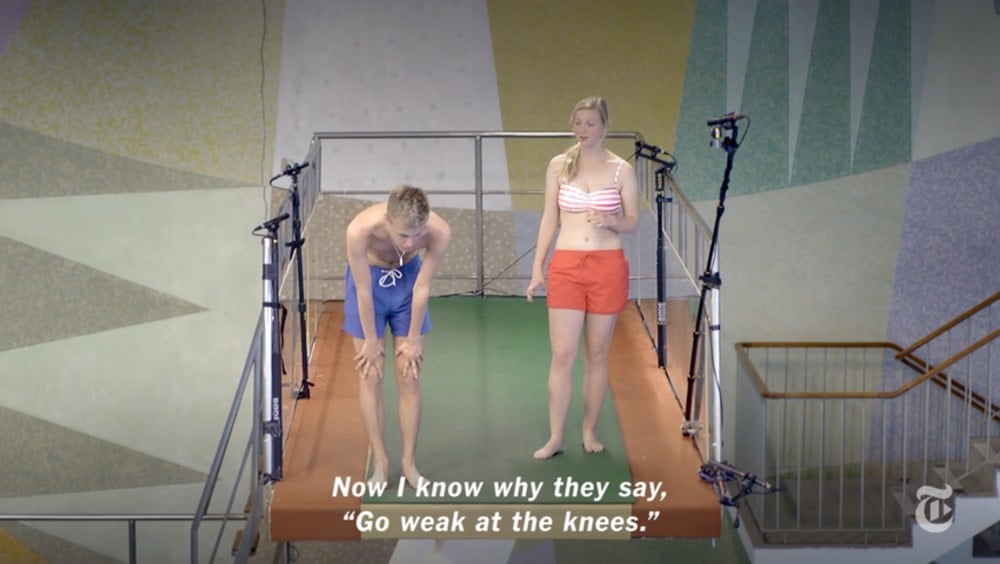
After the first 10 seconds, I was riveted to the screen for the remaining 16 minutes. It’s not at all obvious who will jump easily and who won’t.
My head says, “Go!” But my heart says, “No!”
People often worry about competition from others, but in the sporting world, the workplace, the home, and school, the struggle against the self — closing the gap between what you want your life to be like and reality, what your head wants and what your heart can provide — is always the most significant and difficult. (via @thisiseamonn)
In his newest video, Evan Puschak talks about Arrival, calling it “a response to bad movies”. Arrival was perhaps my favorite film of 2016, and I agree with him about how well-made this film is. There’s a top-to-bottom attention to craft on display, from how it looks to how it was cast (Amy Adams was the absolute perfect choice for the lead) to the integration of the theme with story to how expertly it was adapted from Ted Chiang’s Story of Your Life. The whole thing’s tight as a drum. If you happened to miss it, don’t watch this video (it gives the whole thing away) and go watch it instead…it’s available to rent/buy on Amazon.
Looking back through the archives, I’m realizing I never did a post about Arrival even though I collected some links about it. So, linkdump time!
Wired wrote about how the movie’s alien alphabet was developed.
Stephen Wolfram wrote about his involvement with the science of the film — his son Christopher wrote Mathematica code for some of the on-screen visuals. 1
Science vs Cinema explored how well the movie represented actual science:
Screenwriter Eric Heisserer wrote about how he adapted Chiang’s short story for the screen.
Jordan Brower wrote a perceptive review/analysis that includes links to several other resources about the film.
Update: The director of photography for Arrival was Bradford Young, who shot Selma and is currently working on the Han Solo movie for Disney. Young did an interview with No Film School just before Arrival came out.
I’m from the South, so quilts are a big part of telling our story. Quilting is ancient, but in the South it’s a very particular translation of idea, time, and space. In my own practice as an image maker, I slowly began to be less concerned with precision and more concerned with feeling.
Quiltmakers are rigorous, but they’re a mixed media format. I think filmmaking should be a mixed media format. I’m just really honoring what quiltmakers do, which is tell a story by using varying texture within a specific framework to communicate an idea. For me, with digital technology, lenses do that the best. The chips don’t do it now-digital film stock is basically all captured the same, but the lenses are how you give the image its textural quality.
(thx, raafi)
Update: James Gleick, author of Time Travel, wrote about Arrival and Story of Your Life for The New York Review of Books.
What if the future is as real as the past? Physicists have been suggesting as much since Einstein. It’s all just the space-time continuum. “So in the future, the sister of the past,” thinks young Stephen Dedalus in Ulysses, “I may see myself as I sit here now but by reflection from that which then I shall be.” Twisty! What if you received knowledge of your own tragic future-as a gift, or perhaps a curse? What if your all-too-vivid sensation of free will is merely an illusion? These are the roads down which Chiang’s story leads us. When I first read it, I meant to discuss it in the book I was writing about time travel, but I could never manage that. It’s not a time-travel story in any literal sense. It’s a remarkable work of imagination, original and cerebral, and, I would have thought, unfilmable. I was wrong.
(via @fquist)
I finally got the chance to see Hidden Figures the other day. Recommended. It’s a science/space story in the vein of Apollo 13, but the twin engines of the film are the three excellent lead actresses — Taraji P. Henson, Octavia Spencer & Janelle Monáe — and the persistent portrayal of the systemic biases of segregation and sexism. You watch this movie and think, how much higher could the human race have flown if women and people of color had always had the same opportunities as white men?1 How many Katherine Johnsons never got the chance to develop and use their skills in math, science, or technology because of their skin color or gender? Our society wastes so much energy and human lives telling people what they can’t do rather than empowering them to show everyone what they can do.
Hidden Figures was adopted from Margot Lee Shetterly’s book of the same name. The film takes some dramatic license with the timing of certain events but overall is historically accurate.
The film primarily focuses on John Glenn’s 1962 trip around the globe and does add dramatic flourishes that are, well, Hollywood. However, most of the events in the movie are historically accurate. Johnson’s main job in the lead-up and during the mission was to double-check and reverse engineer the newly-installed IBM 7090s trajectory calculations. As it shows, there were very tense moments during the flight that forced the mission to end earlier than expected. And John Glenn did request that Johnson specifically check and confirm trajectories and entry points that the IBM spat out (albeit, perhaps, not at the exact moment that the movie depicts). As Shetterly wrote in her book and explained in a September NPR interview, Glenn did not completely trust the computer. So, he asked the head engineers to “get the girl to check the numbers… If she says the numbers are good… I’m ready to go.”
You can view Johnson’s published reports on NASA’s site, including her initial technical report from 1960 on the Determination of Azimuth Angle at Burnout for Placing a Satellite Over a Selected Earth Position.
Some genius took footage from The Americans and cut it into an alternative music video for The Beastie Boys Sabotage. Compare with the real thing:
Pretty good! Plus it’s always great to hear that song. (thx, steve)
Not going to say much about this one. Just watch it…especially if somehow, as a curious, thoughtful person who reads this site regularly, you are unaware of how many in the Black community feel about the police and that they have conversations like this with their children about those who are supposed to protect and serve people.
In a bonus from the food series The Mind of a Chef, LA chef Ludo Lefebvre visits a butter factory where they make customized butter for restaurants.
So when we visited the Jean-Yves Bordier Butter factory in the Brittany region of France and had chef Ludo Lefebvre help in the process, it was nothing but pure amazement in his eyes. Le Beurre Bordier customizes it’s butter to the specifications of the chefs they send it to.
The video is subtitled and they go really quick, but I love the look on Lefebvre’s face after he runs his thumb through the finished butter: pure childlike wonder. The full episode featuring Lefebvre is available on PBS’s website (likely for US viewers only). This clip pairs well with this video on how to make croissants. (via the excellent the kid should see this)
I really like Keanu Reeves. He’s one of my favorite actors and seems like a genuinely nice person who has dealt well with his stardom. But after watching this collection of clips from every single movie he’s ever been in, I can’t tell if Reeves is actually a good actor or not. He definitely gets better as his career progresses, but many scenes where emotion or nuance are called for are just…oof. It’s like he’s reading the dictionary sometimes. But I still like him! Why is that?
See also: Danny Bowes believes Reeves belongs on the Mount Rushmore of Hollywood Action Stars along with John Wayne, Tom Cruise, and Harrison Ford.
Update: From Peter Suderman, Why Keanu Reeves is a perfect action star:
This may come off hyperbolic, or flat-out inaccurate, to those who don’t see Reeves as a great screen actor. And granted, his performance style doesn’t capture the tiny nuances of human reactions that are usually associated with great acting; he’s often characterized as a big-screen blank, and that’s not an entirely faulty statement.
But while it’s not wrong to label Reeves a blank, it’s also not enough. For nearly three decades, Reeves has proven himself one of Hollywood’s most durable and entertaining action stars, and the John Wick films show why: His total physical commitment to his action roles makes him a perfect avatar for the visions of ambitious action directors. At his very best, he becomes inseparable from the cinematic visions he embodies.
Aaron McAvoy’s washing machine makes a banging noise while washing clothes so he played The Devil Went Down to Georgia in time with the banging. This is the most perfect little internet entertainment…I actually started crying I was laughing so hard. A much needed respite from the world. See also the washing machine edition of Journey’s Don’t Stop Believin’ and a tribute to George Michael. (via @aaroncoleman0)
Update: McAvoy and his washing machine are back with this cover of AC/DC’s Thunderstruck.
As he says, don’t miss the “guest appearance by my white trash dryer”. See also Thunderstruck on the bagpipes (which is really one of my favorite online things of all time for some reason).
Someone located a VHS copy of an hour-long program from 1996 called Discovering the Internet and ripped it to YouTube. Total nostalgia bomb for me…even at 28.8K modem speeds, I probably spent 12 hours a day online back then, wrestling with HTML, Photoshop, frames, and JavaScript.
In this tutorial, we’ll take a look at the differences between The Internet and The World Wide Web, the differences between commercial OnLine Services such as the Microsoft Network, Prodigy, or America Online and the Internet, how to get connected to the Web, how to use something called a Web browser to navigate the Web, what a Web Page is, and how to search, locate, and download all types of files, from information files to video and audio files.
It’s worth skipping ahead to 17:30 to hear how the host pronounces “URL”.
See also a brief clip of Blogger/Twitter/Medium co-founder Evan Williams explaining the Internet in the mid-90s.
Look at that kid! He just knew the Internet was going to be a big deal, and boy was he right. (via laughing squid)
Richard Overton fought in the South Pacific in World War II, is 109 years old, still drives, sometimes drinks whiskey with breakfast, smokes 12 cigars a day (but doesn’t inhale), and still lives in the house he built himself in 1945. In this video from National Geographic, Overton talks about his military service, his faith, his long life, and soup. Overton’s short summary of World War II:
It wasn’t good, but we had to go.
I don’t really care to live to 100, but if I had Overton’s spirit and attitude, perhaps I’d consider it.
Update: Ryan Holiday recently visited with Overton and learned a thing or two about life.
The most animated Richard ever got was when he told me a story about the enormous pecan tree in his front yard. It seemed like an ordinary tree to me, until he told me his dog planted it seventy years ago. They had a pecan tree in the back, and the dog would grab the nuts and bury them in the front yard. With glee, Richard told me how eventually the tree grew and now it’s so big it’s nearly pushing up the foundation of his house. He loved the absurdity of it — a dog planting a tree! He was laughing at it still, seven decades later.
And then there’s this, about another instance of The Great Span:
It’s fascinating to think that when Richard was born Theodore Roosevelt was president. Overton is the oldest living American veteran now, but when he was born, Henry L. Riggs was still alive. Riggs was a veteran of the Black Hawk War (1832) and he was born in 1812…and Conrad Heyer, the Revolutionary War veteran and the oldest and earliest person to be photographed (born in 1749) was still alive when Riggs was born. Three overlapping lives, that’s all it took to get back to before even the idea of founding the United States. Richard’s brother fought in the first World War. He told me he remembered seeing Civil War veterans around when he was a kid. Not many, but they were there. It was Texas — those men fought to keep his mother in slavery. How long ago all that horribleness seems. How recent it is at the same time.
Update: Overton died last week at the age of 112.
This lovely video from a television station in Denmark highlights the similarities we all share across seemingly impassable social, economic, racial, and religious boundaries.
It’s easy to put people in boxes. There’s us and there’s them. The high-earners and those just getting by. Those we trust and those we try to avoid. There’s the new Danes and those who’ve always been here. The people from the countryside and those who’ve never seen a cow. The religious and the self-confident. There are those we share something with and those we don’t share anything with.
And then suddenly, there’s us. We who believe in life after death, we who’ve seen UFOs, and all of us who love to dance. We who’ve been bullied and we who’ve bullied others.
Last week I started reading The Undoing Project, Michael Lewis’s book about the friendship and collaboration of psychologists Daniel Kahneman and Amos Tversky. This passage on Tversky’s work seems relevant to this video.
From Amos’s theory about the way people made judgments of similarity spilled all sorts of interesting insights. If the mind, when it compares two things, essentially counts up the features it notices in each of them, it might also judge those things to be at once more similar and more dissimilar to each other than some other pair of things. They might have both a lot in common and a lot not in common. Love and hate, and funny and sad, and serious and silly: Suddenly they could be seen — as they feel — as having more fluid relationships to each other. They weren’t simply opposites on a fixed mental continuum; they could be thought of as similar in some of their features and different in others. Amos’s theory also offered a fresh view into what might be happening when people violated transitivity and thus made seemingly irrational choices.
When people picked coffee over tea, and tea over hot chocolate, and then turned around and picked hot chocolate over coffee — they weren’t comparing two drinks in some holistic manner. Hot drinks didn’t exist as points on some mental map at fixed distances from some ideal. They were collections of features. Those features might become more or less noticeable; their prominence in the mind depended on the context in which they were perceived. And the choice created its own context: Different features might assume greater prominence in the mind when the coffee was being compared to tea (caffeine) than when it was being compared to hot chocolate (sugar). And what was true of drinks might also be true of people, and ideas, and emotions.
The idea was interesting: When people make decisions, they are also making judgments about similarity, between some object in the real world and what they ideally want. They make these judgments by, in effect, counting up the features they notice. And as the noticeability of features can be manipulated by the way they are highlighted, the sense of how similar two things are might also be manipulated. For instance, if you wanted two people to think of themselves as more similar to each other than they otherwise might, you might put them in a context that stressed the features they shared. Two American college students in the United States might look at each other and see a total stranger; the same two college students on their junior year abroad in Togo might find that they are surprisingly similar: They’re both Americans!
By changing the context in which two things are compared, you submerge certain features and force others to the surface. “It is generally assumed that classifications are determined by similarities among the objects,” wrote Amos, before offering up an opposing view: that “the similarity of objects is modified by the manner in which they are classified. Thus, similarity has two faces: causal and derivative. It serves as a basis for the classification of objects, but is also influenced by the adopted classification.” A banana and an apple seem more similar than they otherwise would because we’ve agreed to call them both fruit. Things are grouped together for a reason, but, once they are grouped, their grouping causes them to seem more like each other than they otherwise would. That is, the mere act of classification reinforces stereotypes. If you want to weaken some stereotype, eliminate the classification.
That’s what this video did so effectively…it switched up the contexts. Rabid soccer fans became dancers, bullies became lonely people, people of different faiths were united by their believe in an afterlife. An exercise for investors and entrepreneurs building media companies and social networks (as well as people running small independent sites….I’m staring hard at myself in the mirror here): how can you build tools and platforms that give people more ways to connect to each other, to switch up the contexts in which people are able to group themselves?
Newer posts
Older posts




Socials & More