kottke.org posts about video
The official trailer for season five of The Americans is out and oooooooooh boy! I’m currently bingeing on The Night Manager and I love me some Halt and Catch Fire, but The Americans is my favorite pure-drama show1 right now. The actress who plays Paige is great and it looks like she’s going to be more involved in the plot than ever:
Look at her! Learning how to fight and reading Karl Marx! Oh, I can’t wait until March 7th! If you haven’t been following the show, all four of the previous seasons are available on Amazon Prime. I might have to rewatch!
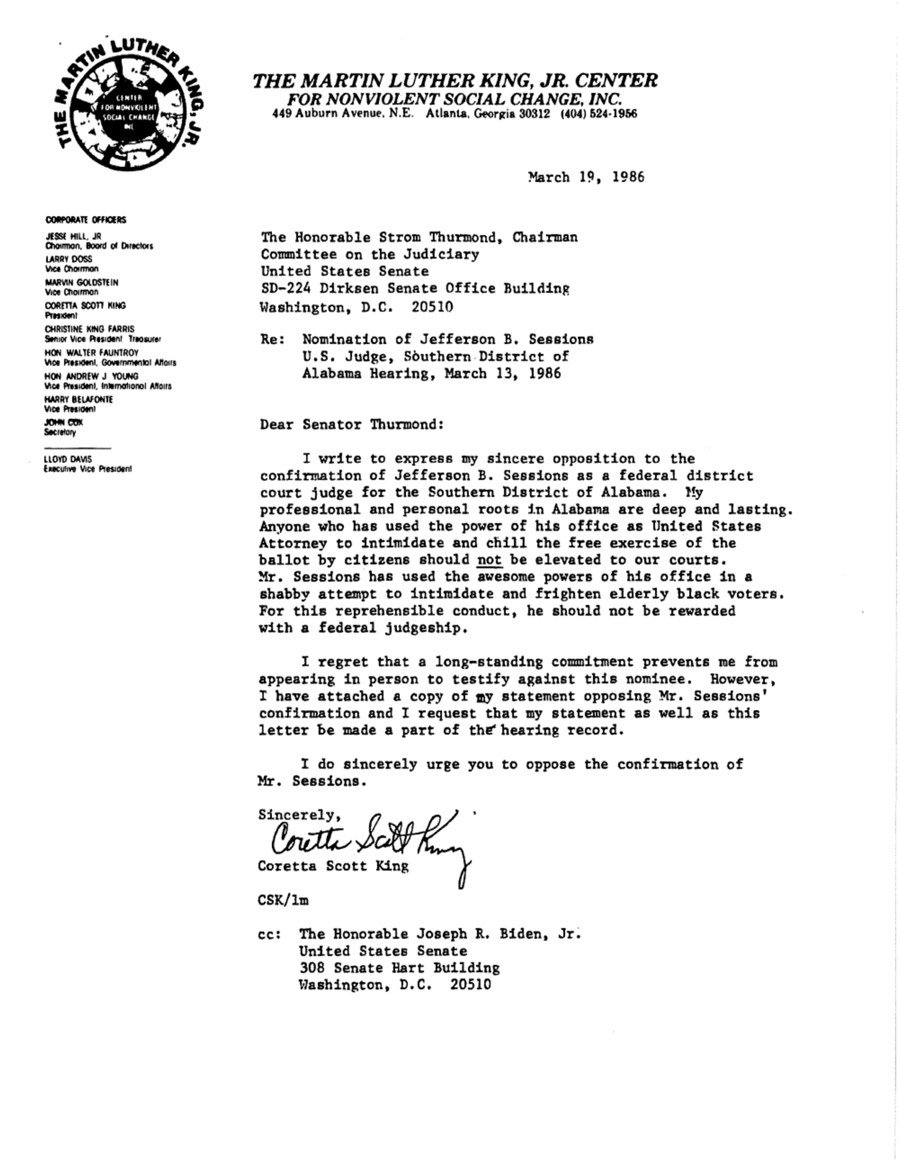
Last night, during the Senate confirmation hearing of Senator Jefferson Beauregard “Jeff” Sessions III1 for Attorney General, Senator Elizabeth Warren attempted to read a letter that Coretta Scott King had written to the Senate Judiciary Committee in 1986 opposing Sessions’ nomination for a federal judgeship (which he did not get).
The first page of the letter appears above and the entire contents may be read here. King pretty plainly states that Sessions abused his position in an attempt to disenfranchise black voters:
Mr. Sessions has used the awesome power of his office to chill the free exercise of the vote by black citizens in the district he now seeks to serve as a federal judge.
Under Senate Rule XIX and after two votes by the full Senate, Warren was barred from speaking and finishing the letter.
When Warren first spoke against Sessions Tuesday night, Sen. Steve Daines, a Republican from Montana, warned her that she was breaking the rules. When she continued anyway, Majority Leader Mitch McConnell retaliated by finding her in violation of Senate Rule XIX — which prevents any senator from using “any form of words [to] impute to another Senator… any conduct or motive unworthy or unbecoming a Senator.”
Warren later read the letter outside of the Senate chambers. How the Senate is supposed to debate the appointment of a Cabinet member without being able to criticize the actions, words, and beliefs of that candidate is left as an exercise to the reader. (Ok, I’ll answer anyway: it’s not supposed to debate. That’s the entire point of the Republicans’ actions w/r/t Trump’s political nominees thus far.)
King’s letter, which Buzzfeed called “a key part of the case against Sessions [in 1986]” was only published earlier this week in part because Judiciary Committee Chairman Strom Thurmond never officially entered it into the congressional record. Thurmond, you may remember, vehemently opposed the civil rights reforms of the 50s and 60s, even going so far as filibustering the Civil Rights Act of 1957 for more than 24 hours and switching political parties because of the Democrats’ support of the 1964 Civil Rights Act.
And Senate Rule XIX? Cornell Law School professor James Grimmelmann notes the precedent:
Let’s be clear on the precedent here: it’s the 1836-44 gag rule that forbade any consideration of abolition in the House.
Racist southern representatives were so frustrated by abolitionist petitions to Congress, that they adopted a series of rules.
All abolitionist petitions would immediately be tabled, and any attempt to introduce them would be prohibited.
From pro-slavery members of the House to Davis to Beauregard to Thurmond to Trump (and Bannon) to Sessions to McConnell (and the nearly all-white Republican majority). Paraphrasing Stephen Hawking, it’s white supremacy all the way down. Gosh, if you’re a black person in America, you might even think the system is tilted against you!
P.S. I like this part of Senate Rule XIX, right at the bottom:
8. Former Presidents of the United States shall be entitled to address the Senate upon appropriate notice to the Presiding Officer who shall thereupon make the necessary arrangements.
I’m not sure what it would accomplish, but seeing a former President address this Senate, after an appropriate period spent kiteboarding, would be pretty fun to watch.
P.P.S. In silencing Warren, McConnell said, “She was warned. She was given an explanation. Nevertheless, she persisted.” Not a bad explanation of the feminist movement in America there, Mitch. Folks on Twitter are having fun with the #shepersisted hashtag.
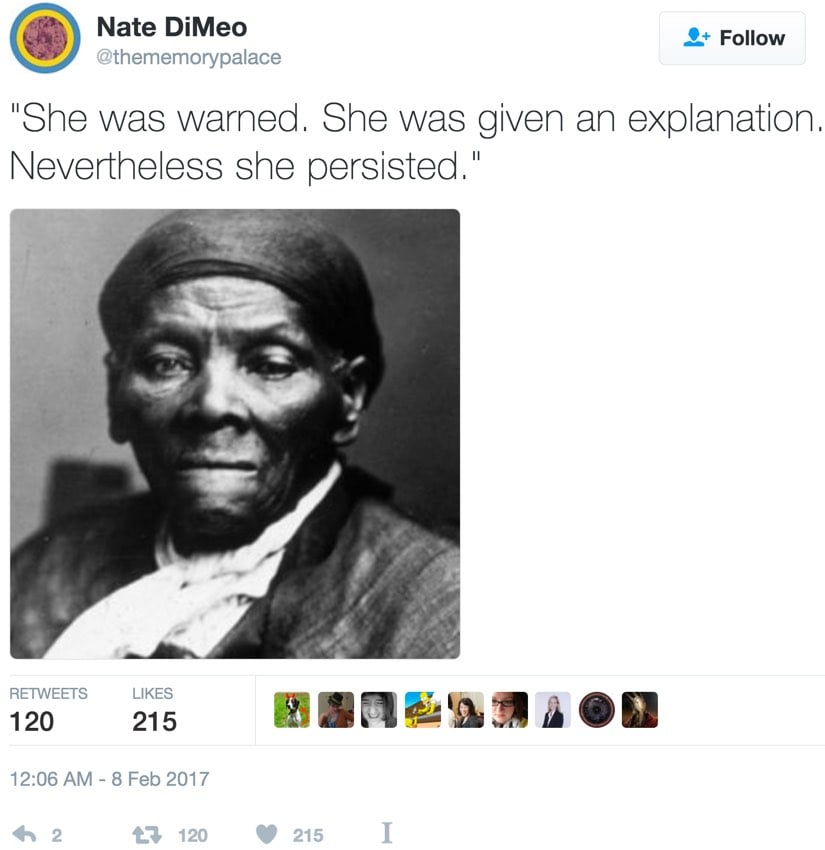
Update: While the precedent for Senate Rule XIX dates back to the abolition debates in the 1830s and 1840s, the actual rule was made after a fight broke out in the Senate in 1902. From a book called The American Senate: An Insider’s Story:
South Carolina’s “Pitchfork Ben” Tillman accused his South Carolina colleague, John McLaurin, of selling his vote for federal patronage. McLaurin called Tillman a malicious liar. Tillman lunged at him, striking him above the left eye. McLaurin hit Tillman back with an upper-cut to the nose.
Given the history of this rule and how it was recently applied, you will perhaps not be surprised to learn that Tillman was an outspoken advocate of lynching, once remarking in a speech:
“[We] agreed on on the policy of terrorizing the Negroes at the first opportunity by letting them provoke trouble and then having the whites demonstrate their superiority by killing as many of them as was justifiable.” (Tillman boasted during the same speech that his pistol had been used to execute seven black men in 1876.)
So we can squeeze Tillman in-between Beauregard and Thurmond in the abbreviated narrative of how it came to be that a white majority Senate silenced a white woman for reading a letter written by a black woman.
Need to sleep, focus on work, get away from the news, meditate, or just tickle your ASMR receptors? Try 10 hours of ambient noise from a Norwegian icebreaker idling in the frozen Arctic.
10 hours video of Arctic ambience with frozen ocean, ice cracking, snow falling, icebreaker idling and distant howling wind sound. Natural white noise sounds generated by the wind and snow falling, combined with deep low frequencies with delta waves from the powerful icebreaker idling engines, recorded at 96 kHz — 24 bit and designed for relaxation, meditation, study and sleep.
That is some “Calgon take me away”-level shit. See also the most relaxing song in the world. (via bb)
Since its initial release in 2009, Minecraft has matured to the point of being a platform for people who want to make art and also for people who want to make money. Phil Edwards of Vox highlights some of the beautiful structures being created by Minecraft players (some of which are collected in this coffee table book called Beautiful Minecraft) and the challenges faced by creators trying to make money within a game owned by a large company.
The creativity “Creative Mode” enables is obvious in the work that talented designers produce. Sometimes Minecraft artists will create interactive worlds that replicate historic events; other times, Minecraft’s many cubes coalesce into a sculptural image, the same way pointillism’s dots disappear to form a picture. These images and worlds can be eerie, magical, and surprisingly beautiful.
But perhaps most surprising of all, Minecraft worlds can also be a business. Companies like Blockworks make maps for private Minecraft servers (computer networks that host Minecraft games), and they also occasionally design maps in collaboration with institutions and companies like Minecraft owner Microsoft.
BlockWorks — company tagline: “creative Minecraft solutions” — has done some really fantastic designs for themselves and their clients.


Using PT Anderson’s 2012 film The Master as a jumping off point, Evan Puschak discusses how Scientology’s audit process works. You can take the Oxford Capacity Analysis test he mentions right here.
Steve Hackman, aka Stereo Hideout, composes, arranges, and conducts mashups of orchestral music and pop music. Not just mixes on Soundcloud, mind you, but entirely new compositions that are played by actual orchestras. The video embedded above is Brahms Symphony No. 1 mixed with Radiohead’s OK Computer but he’s also done a few others that are available on YouTube: Copland vs Bon Iver, Beethoven vs Coldplay, and Bartok vs Bjork. Hackman’s next project in this vein? Tchaikovsky vs Drake, which he’s premiering with the Pittsburgh Symphony in March. (thx, spencer)
Update: Here’s the Tchaikovsky vs Drake performance:
The 2017 Wind Games were recently held in Spain and featured skydivers from all over the world competing in a number of indoor skydiving1 events. Maja Kuczynska competed in the freestyle category and her routine/dance/performance was arresting.
My mind broke a little watching this. People are not supposed to move like this, like superheroes…it looks like not particularly well done special effects. At several points, the way she moves reminded me of Saruman toying with Gandalf before flinging him to the top of Orthanc in the Fellowship of the Ring.
Here’s her performance from another angle. Wow. Just wow. Kuczynska finished third in the event while Kyra Poh took first…here’s Poh’s winning routine.
I don’t know about you, but I could watch milling machines grinding down metal all day long (and very nearly did). Seeing metal behave like soft butter is weiiiird. Those blades are shaaaarp. Some words can be made looooong by repeating voooooowels. (via @rands)
In a 45-minute video called Riding Light, Alphonse Swinehart animates the journey outward from the Sun to Jupiter from the perspective of a photon of light. The video underscores just how slow light is in comparison to the vast distances it has to cover, even within our own solar system. Light takes 8.5 minutes to travel from the Sun to the Earth, almost 45 minutes to Jupiter, more than 4 years to the nearest star, 100,000 years to the center of our galaxy, 2.5 million years to the nearest large galaxy (Andromeda), and 32 billion years to reach the most remote galaxy ever observed.1 The music is by Steve Reich (Music for 18 Musicians), whose music can also seem sort of endless.
If you’re impatient, you can watch this 3-minute version, sped up by 15 times:
The Pixar Theory is an idea forwarded by Jon Negroni that all of Pixar’s movies take place in the same universe and are all connected to each other somehow. (Negroni turned the theory into a 100-page book.)
Centuries later, the animals from Brave that have been experimented on by the witch have interbred, creating a large-scale population of animals slowly gaining personification and intelligence on their own.
There are two progressions: the progression of the animals and the progression of artificial intelligence. The events of the following movies set up a power struggle between humans, animals, and machines.
The stage for all-out war in regards to animals is set by Ratatouille, Finding Nemo, and Up, in that order. Notice I left out A Bug’s Life, but I’ll explain why later.
Last week, the official Toy Story account released a video on Facebook that make explicit many of the connections between the films:
One of the dinosaurs from The Good Dinosaur shows up in Inside Out, a Monsters Inc. character is pictured in Brave, a Lightning McQueen toy is in Toy Story 3, a moped from Ratatouille is in Wall-E’s junkyard, etc. etc. This is a perfect bit of superfan trolling from the Pixar team. Kudos.
Abstract is an upcoming documentary series from Netflix that explores the art of design. Each of the eight episodes profiles a designer at the top of their discipline: photographer Platon, graphic designer Paula Scher, stage designer Es Devlin, illustrator Christoph Niemann, architect Bjarke Ingels, shoe designer Tinker Hatfield, interior designer Ilse Crawford, and automotive designer Ralph Gilles.
Step inside the minds of the most innovative designers in a variety of disciplines and learn how design impacts every aspect of life.
Looks like a Chef’s Table for design. All episodes will be available February 10.
From Now This, a short animated history of Planned Parenthood, the origins of which date back more than 100 years.
No woman can call herself free who does not own and control her body.
Voices in the video include Mindy Kaling, Amy Schumer, and Meryl Streep.
Real Engineering takes a look at some of the greatest innovations in F1 racing, including those that have made their way into passenger cars, like disc brakes, carbon fiber construction, and aerodynamics. The part about how the teams of engineers started competing with each other to increase the aerodynamics was really interesting. The 2014 F1 season was an instance where one team’s innovations were so dominant that the drivers were almost irrelevant. Mercedes dominated in 2015 and 2016 as well, but rule changes for 2017 (wider tires, wider cars, and lower spoilers mean faster cornering) will have everyone scrambling to find the advantages.
Evan Puschak looks at a single joke Louis C.K. tells about playing Monopoly with his daughters and takes it apart to see how Louis builds and delivers his material. By the end, you’ll likely have a new appreciation of the efficiency and power of Louis’ performance…every word he utters is doing work.
You know, more than anything else I think I’m obsessed with articulation, with the magic of putting things just the right way. There are 207 words in this joke and not a single one is wasted. They’re used either in meaning or in rhythm to contribute to the overall effect, an effect that lets us see the world from a different angle, and more importantly, makes us laugh.
Good phrase, “the magic of putting things just the right way”.
Jorge Luengo Ruiz has collected what he calls the most beautiful shots in the history of Disney. The scenes are pulled from nearly every Disney feature-length animation ever made, including Snow White, Peter Pan, The Lion King, and Moana. There’s a simple shot early on of Dumbo’s shadow passing over the ground that I really liked.
Buzzfeed did some stills of the best shots from Studio Ghibli movies, but it would be great to see a video collection. Both studios have produced amazing work, but Ghibli might best Disney in terms of sheer artistry and beauty.
The Recording Academy has produced a series of three short and breezy videos on the history of recorded music, from the wax cylinder phonograph to cassette tapes to CDs to MP3s. Interest piqued, I went to read more about the history of the CD. When developing the disc, the physical size of it was dictated by Beethoven:
The two companies argued about what size, shape and technology the CD should support. It was eventually settled on a disc of 115 millimetres in diameter and 74 minutes worth of storage. Why 74 minutes? To fit Beethoven’s 9th Symphony, of course.
When the format was released in 1982, players cost $900 and CDs themselves were $30 ($2270 and $75 in 2016 dollars)1 and fewer than 100 individual titles were available for sale.
Shigeru Miyamoto has designed dozens of the most popular video games in the world: Donkey Kong, Super Mario Bros, and the Legend of Zelda among them. In this video by Vox, Miyamoto shares how he thinks about game design.
This is one of the first times that a video game’s plot and characters were designed before the programming. [Miyamoto:] “Well, early on, the people who made video games, they were technologists, they were programmers, they were hardware designers. But I wasn’t. I was a designer, I studied industrial design, I was an artist, I drew pictures. And so I think that it was in my generation that people who made video games really became designers rather than technologists.”
Also worth watching is this video by Game Maker’s Toolkit about how Nintendo builds everything in their games around a fun and unique play mechanic.
It seems to me that these two videos slightly contradict each other, although maybe you’ll disagree.
Testing human blood for tropical diseases like malaria can be difficult in some parts of the world. Centrifuges used to separate the blood for testing are expensive and require electricity. Researchers from Stanford have developed an ingenious human-powered centrifuge made of paper and string inspired by a children’s toy invented 5000 years ago (paging Steven Johnson, Steven Johnson to the courtesy desk please).
In a global-health context, commercial centrifuges are expensive, bulky and electricity-powered, and thus constitute a critical bottleneck in the development of decentralized, battery-free point-of-care diagnostic devices. Here, we report an ultralow-cost (20 cents), lightweight (2 g), human-powered paper centrifuge (which we name ‘paperfuge’) designed on the basis of a theoretical model inspired by the fundamental mechanics of an ancient whirligig (or buzzer toy; 3,300 BC). The paperfuge achieves speeds of 125,000 r.p.m. (and equivalent centrifugal forces of 30,000 g), with theoretical limits predicting 1,000,000 r.p.m. We demonstrate that the paperfuge can separate pure plasma from whole blood in less than 1.5 min, and isolate malaria parasites in 15 min.
A million rpm from paper and string…that’s incredible. (via gizmodo)
If you spin these sculptures by artist John Edmark at a certain speed and light them with a strobe, they appear to animate in slowly trippy ways.
Blooms are 3-D printed sculptures designed to animate when spun under a strobe light. Unlike a 3D zoetrope, which animates a sequence of small changes to objects, a bloom animates as a single self-contained sculpture. The bloom’s animation effect is achieved by progressive rotations of the golden ratio, phi (ϕ), the same ratio that nature employs to generate the spiral patterns we see in pinecones and sunflowers. The rotational speed and strobe rate of the bloom are synchronized so that one flash occurs every time the bloom turns 137.5º (the angular version of phi).
The effect seems computer generated (but obviously isn’t) and is better than I anticipated. (via colossal)
Update: While not as visually smooth as his sculptures, Edmark’s rotation of an artichoke under strobe lighting deftly demonstrates the geometric rules followed by plants when they grow.
Here we see an artichoke spinning while being videotaped at 24 frames-per-second with a very fast shutter speed (1/4000 sec). The rotation speed is chosen to cause the artichoke to rotate 137.5º — the golden angle — each time a frame is captured, thus creating the illusion that the leaves are moving up or down the surface of the artichoke. The reason this works is that the artichoke grows by producing new leaf one at a time, with each new leaf positioned 137.5º around the center from the previous leaves. So, in a sense, this video reiterates the artichoke’s growth process.
(via @waxpancake)
Update: This similar sculpture by Takeshi Murata is quite impressive as well.
(via @kevmaguire)
If you point a video camera at a projection of the video camera’s output — and if the conditions are just so — you get some interesting patterns that look almost biological. It’s fascinating that video feedback strongly resembles the patterns on brain coral. There must be an underlying emergent process for filling space that links the two patterns together. The video was made by Ethan Turpin…you can see more of his work here. (via @sleeptest)
Cinefix takes a look at what makes ending credit sequences effective, the different techniques used to end movies, and picks a number of films with the best end credits.
The shape of the narratives movies tend to tell lend themselves to an emotional climax that hits right as the screen fades to black for the last time. Be it triumphant, tragic, bittersweet, or thoughtful, the most important feeling is often the last. So, wisely, one of the most common functions of the creative end title sequence is what we’re going to call the coda credits. They grab on to the final emotional note and let it ride out in a long sustain, letting the audience hold onto the final feeling and carry the echoes out with them as the credits roll.
A Canadian musician called TRONICBOX is taking contemporary pop songs like Katy Perry’s Firework, Baby by Justin Bieber, and Somebody I Used To Know by Gotye and remixing them so they sound like they came out in the 80s. The effect is unnerving for someone like me who grew up immersed in 80s pop music. Even though it’s impossible, I can almost remember listening to some of these songs back in my bedroom, probably taped off the radio during Casey Kasem’s top 40 countdown. Total time travel paradox nostalgia bombs. (via digg)
Garry Kasparov, who is one of the top chess players ever, said that his 1999 match against Veselin Topalov was the greatest game of chess he ever played. In this video, MatoJelic goes through the game, move by move. Even if you only have a passing interest in chess, I’d recommend watching…it gets really interesting after the first 10-12 moves (which are presented without explanation) and listening to someone who is passionate about a topic is often worth it.
Also entertaining and informative was his explanation of The Game of the Century, which pitted a 13-year-old Bobby Fischer against Donald Byrne, a top-ranked American player. (via farnam street)
Back in the days of silent film, directors and cinematographers had to be exceedingly clever to pull off visual effects that appeared real. There were obviously no computers so they had to rely on skewed perspectives, glass matte paintings, and double exposures. That famous clip of Harold Lloyd hanging off of a clock…here’s how that was done:
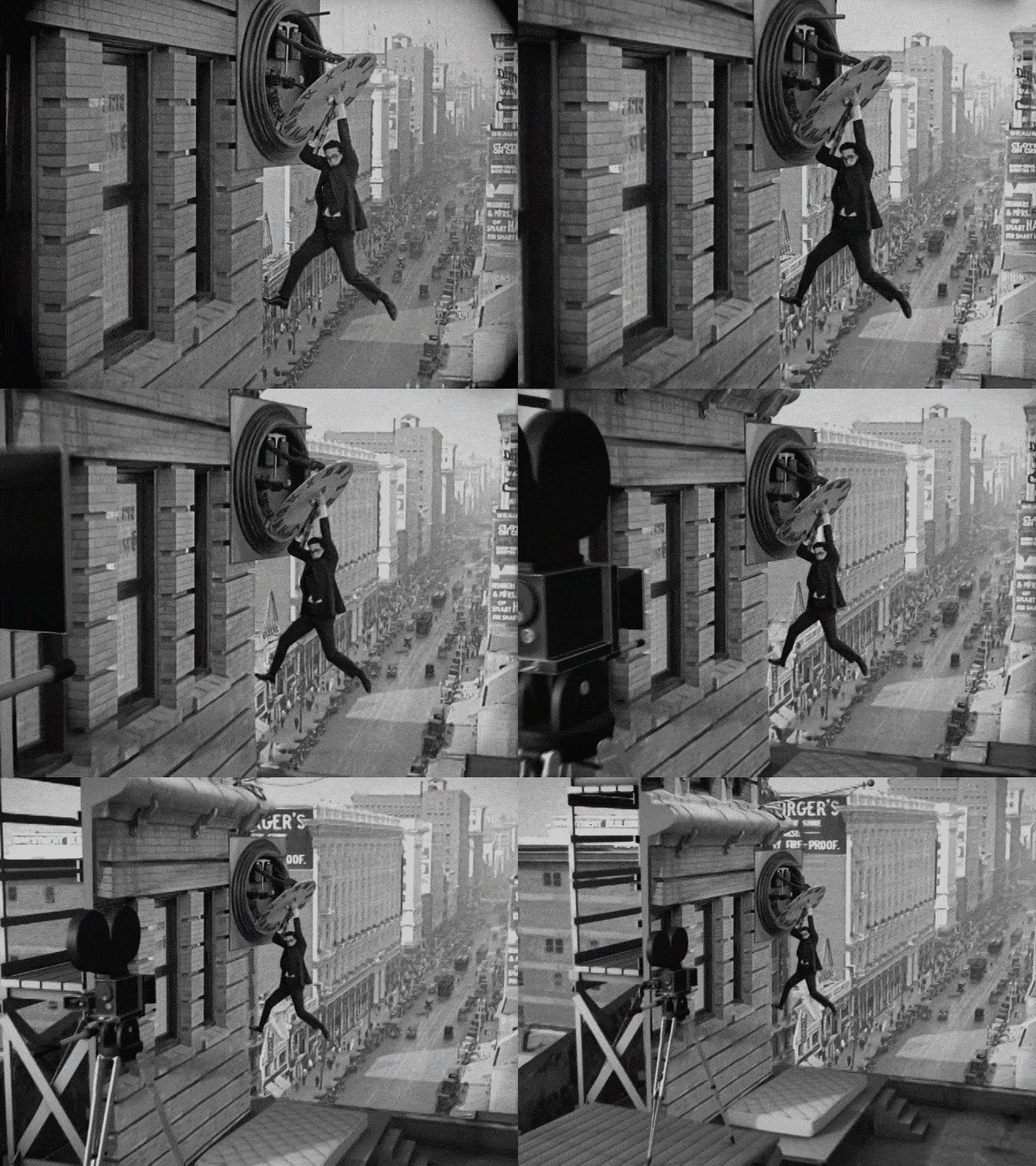
Here are several more examples. See also Disney’s multiplane camera. (via @mccanner)
It makes sense that villages and towns would develop a short distance away from each other so that people living nearby wouldn’t have to travel far to sell their goods, bank, or go to school. But what about cities? Geography has a lot ot do with where cities are located.
If you enjoy this video but haven’t read Jared Diamond’s Guns, Germs, and Steel yet, you probably should.
I know, I know. This is a car commercial and it’s morbid and at this moment in time it’s not really that funny, but it caught me at just the right time today and I laughed harder at this than I have at something in several weeks. So I guess even ad agencies are capable of enabling righteous acts (or at least inappropriately hilarious acts) these days?
Today marks the 10th anniversary of the introduction of the iPhone.
In the ten years since, iPhone has enriched the lives of people around the world with over one billion units sold. It quickly grew into a revolutionary platform for hardware, software and services integration, and inspired new products, including iPad and Apple Watch, along with millions of apps that have become essential to people’s daily lives.
You can watch Steve Jobs introduce the iPhone during the MacWorld 2007 keynote in the video above; it’s one of the best technology demos ever. Here’s my liveblog of the keynote, my thoughts from a couple of days later, and my review after getting an iPhone in June. (I also constructed a cardboard version of the phone to see how the size compared to my then-current mobile phone.)
I guess we know why iPod development has seemed a little sluggish lately. When the Zune came out two months ago, it was thought that maybe Apple was falling behind, coasting on the fumes of an aging product line, and not innovating in the portable music player space anymore. I think the iPhone puts this discussion on the back burner for now. And the Zune? The supposed iPod-killer’s bullet ricocheted off of the iPhone’s smooth buttonless interface and is heading back in the wrong direction. Rest in peace, my gentle brown friend.
It’s difficult to overstate the impact of the iPhone on the world. In just 10 short years, smartphones have completely and irreversibly changed how a large part of humanity communicates and is quickly changing how the rest will. And that all started with the iPhone. As I noted at the time, you could see a product like this coming but Apple put it all together in a way that became the blueprint, for better and for worse, for every device and mobile application that followed. Not bad for a computer that didn’t have copy/paste when it launched.
This is the trailer for I Am Not Your Negro, a film that “finishes” a book that writer James Baldwin was working on when he died.
In 1979, James Baldwin wrote a letter to his literary agent describing his next project, Remember This House. The book was to be a revolutionary, personal account of the lives and successive assassinations of three of his close friends — Medgar Evers, Malcolm X and Martin Luther King, Jr.
At the time of Baldwin’s death in 1987, he left behind only thirty completed pages of his manuscript.
Now, in his incendiary new documentary, master filmmaker Raoul Peck envisions the book James Baldwin never finished. The result is a radical, up-to-the-minute examination of race in America, using Baldwin’s original words and flood of rich archival material. I Am Not Your Negro is a journey into black history that connects the past of the Civil Rights movement to the present of #BlackLivesMatter. It is a film that questions black representation in Hollywood and beyond. And, ultimately, by confronting the deeper connections between the lives and assassination of these three leaders, Baldwin and Peck have produced a work that challenges the very definition of what America stands for.
The reviews so far are uniformly positive.
I don’t know about you, but those clips of Baldwin speaking in the trailer piqued my interest, so I’m going to make some time tonight to watch some Baldwin talks, speeches, and debates on YouTube: a 1969 talk in London, a 1963 debate with Malcolm X (audio only), a 1963 panel on civil rights w/ Sidney Poitier, Harry Belafonte, Marlon Brando, and Charlton Heston, and his 1965 debate with William F. Buckley on the question “Is the American Dream at the expense of the American Negro?”
Last night, as she accepted a lifetime achievement award at the Golden Globes, Meryl Streep made some comments about the current political situation and about Donald Trump in particular (although she never mentioned him by name). The clip above (which may not last long on YouTube) is worth watching.
But there was one performance this year that stunned me. It sank its hooks in my heart. Not because it was good; there was nothing good about it. But it was effective and it did its job. It made its intended audience laugh, and show their teeth. It was that moment when the person asking to sit in the most respected seat in our country imitated a disabled reporter. Someone he outranked in privilege, power and the capacity to fight back. It kind of broke my heart when I saw it, and I still can’t get it out of my head, because it wasn’t in a movie. It was real life. And this instinct to humiliate, when it’s modeled by someone in the public platform, by someone powerful, it filters down into everybody’s life, because it kinda gives permission for other people to do the same thing. Disrespect invites disrespect, violence incites violence. And when the powerful use their position to bully others we all lose. OK, go on with it.
And the NY Times — in an effort to “get both sides” of the story, I guess? — ran a story that I’m not going to link to called “Donald Trump Says He’s Not Surprised by Meryl Streep’s Golden Globes Speech”. Is it newsworthy, what he thought of Streep’s remarks? Unless he agrees with her and plans to honestly reevaluate how he treats others when he speaks, I would argue it’s not at all worth printing what’s essentially a Trump press release full of bullshit. And news outlets that actually care about the truth and not just printing spin should stop doing it.
Covering an actual time of 20 minutes, you can watch this time lapse of smog rolling into Beijing in a matter of a few seconds. The NY Times has a short piece on the video, which was filmed on January 2.
Residents have come to expect such dense air pollution in the late fall and winter, as people burn coal to heat their homes. Recently, the problem has been particularly bad, and the city has been enveloped in smog for extended periods starting in October.
Mr. Pope, writing on Twitter, pegged the air quality index, a measure of the pollution, above 400 around the time of the video. The United States government rates readings of 301 to 500 as “hazardous.”
What a disaster…and the air wasn’t that clear before the smog rolled in. I’ve been to Beijing once, back in 1995, and even though I’d love to see how the city has changed over the past 20 years, I have no interest in returning until they get their air quality under control.
Update: And it’s not just Beijing; cities around the world are struggling with pollution. Parts of London have blown through their annual 2017 emissions limits in just 5 days.
By law, hourly levels of toxic nitrogen dioxide must not be more than 200 micrograms per cubic metre (µg/m3) more than 18 times in a whole year, but late on Thursday this limit was broken on Brixton Road in Lambeth.
Many other sites across the capital will go on to break the annual limit and Putney High Street exceeded the hourly limit over 1,200 times in 2016. Oxford Street, Kings Road in Chelsea and the Strand are other known pollution hotspots.
Newer posts
Older posts




Socials & More