kottke.org posts about video
Have you ever wanted to see John C. Reilly play Travis Bickle in Taxi Driver? How about Ewan McGregor as Forrest Gump? Kevin Spacey as Dirty Harry? Zach Galifianakis playing Robin Williams’ character in Good Will Hunting? In this video, Ross Marquand does impressions of celebrity actors playing famous roles in movies they weren’t actually in. Though very brief, my favorite was Keanu Reeves as Jerry Maguire. Here are some more quick impressions by Marquand.
By subtly animating still photos of waves shot by Ray Collins (previously), Armand Dijcks created short looping videos of waves that never break. It’s the visual equivalent of the Shepard tone, a sound that has the illusion of a forever rising or falling pitch.
Damien Henry trained a machine learning algorithm with a bunch of videos recorded from train windows. Then, to test what it had learned, he asked the algorithm to make an hour-long video of a train journey — it began with a single frame and guessed subsequent frames as it went along. The video shows the algorithm getting smarter as it goes along…every 20 seconds the video gets a little more detailed and by the end of the video, you get stuff that looks like trees and clouds and power lines. Composer Steve Reich’s Music for 18 Musicians is the perfect accompaniment.
The small coastal Japanese town of Yuasa is known as the birthplace of soy sauce. Fermented sauces made using soybeans had been around for centuries in China, but a Buddhist monk who settled in Japan in the 13th century started making soy sauce “as we know it”.
Using the abundance of clear, spring water from the town of Yuasa he began producing a type of miso that he had learned about on his travels that had been used to preserve vegetables. A byproduct from this process — a liquid that collected in the barrels of the miso paste — was soy sauce.
More than 750 years later, factories in Yuasa still produce soy sauce using traditional methods.
You may remember Bill Wurtz from his video history of Japan, which I called “the most entertaining history of anything I have ever seen”. I still stand by that, but his new video on the history of the Earth from before the Big Bang — “a long time ago, actually never, also now, nothing is nowhere” — to the present day is just as good. On the development of the ozone layer billions of years ago:
Hey, can we go on land?
NO.
Why?
The Sun is a deadly lazer.
Oh, ok.
Not anymore, there’s a blanket.
Here’s your tiny moment of zen for today. If you put a camera at the bottom of a bucket placed in the middle of a desert, several different kinds of animals will come to drink from it.
Important note: “The swimming bees were rescued.”
In this short documentary film, Amy Nicholson features her dad and his wife and the menagerie of animals that they have collected and cared for over the years, including rescue chickens, a fish who couldn’t swim (the eponymous “Pickle”), a paraplegic possum that used a homemade wheelchair to get around, cross-eyed cats, and many many animals who met premature ends after being carted away by various prey.
I try to find a funny side to everything, and tragedy is no exception. This film’s unrelenting march of death has a light side, but hopefully between morbid curiosity and chuckling at the sheer volume of casualties, the audience will find a bit of themselves in this film. “Pickle” examines the depths of one couple’s devotion to their pets while exploring the complicated relationship that we humans have with all animals. If you find a hurt animal that you’re able to help, is it moral to come to its rescue, as we would with a human? Or is it true compassion to let nature take its course?
This man punching numbers into the device hanging from his belt with a calm ferocity is doing inventory. A commenter on Reddit explains:
He is doing an inventory audit on the store. First, he enters the price, then the number of items, then moves to the next item. The entering of items is done by doing them in groups. When I used to do this, I would count in 4s. It would be 4+4+4+4+4+3 to indicate 23 items. When he looks at the 10-key he is probably correcting an error he just made. It is pretty rare to double check the count unless you fat fingered something. The end report does not contain SKU numbers but a categorical pricing of all the items in the store.
In Japan, there are competitions and clubs for performing quickly on calculators. Asuka Kamimura, a young Japanese featured in the beginning of this video, can work her calculator at a rate of nine keystrokes per second.
(via @dunstan)
Jamie Scott worked for three years (on and off, one would presume) to make this time lapse video of hundreds of flowers opening for springtime. So lovely. His time lapse of NYC in the fall is nice too, but I like this one better. (via colossal)
Lessons from the Screenplay takes a look at the opening scene from Inglourious Basterds and dissects what makes it so suspenseful. The scene, which is one of my all-time favorites, shows SS officer Hans Landa showing up unannounced at a French farmhouse and sitting down for what starts off as a little chat with a farmer, a Monsieur LaPadite. With just a calm conversation and gestures, Landa ratchets up the tension in the scene, paving the way for an explosive climax.
When considering the massive success of Star Wars, special effects and the Jospeh Campbell-inspired story always get their due. But the sound design of the film was just as important and revolutionary as the visual effects. From Darth Farmer’s overdubbing with James Earl Jones’ voice and the now-famous breathing noise (created using a SCUBA apparatus) to the lightsaber battles (the lightsaber noise comes from the hum of film projectors plus the buzz from a CRT TV set), the sounds added to the film hold everything together, creating the illusion of reality where none actually exists.
This is the first full-length trailer for Blade Runner 2049 and how the heck are we supposed to wait until October for this? My God, that cinematography. I WANT IT NOW! See also the teaser trailer from December.
Update: Another trailer. This is still looking pretty strong.
Cinefix has begun the monumental task of compiling a list of the best shots in film. They’ve got a list of more than 1000 potential clips to evaluate and rank, but in part one of their series, they focus on the best shots by size — “breaking down some of the best close ups, mediums, wide shots and extremes in film history”.
Their picks include Psycho for the extreme close up, The Godfather Part II for the wide shot, and Lawrence of Arabia for the extreme wide shot.
Update: Here are the other three videos in Cinefix’s series:
The most recent video by The Pop Culture Detective Agency explores a trope in TV and movies they call Born Sexy Yesterday.
It’s a science fiction convention in which the mind of a naive, yet highly skilled, girl is written into the body of a mature sexualized woman. Born Sexy Yesterday is about an unbalanced relationship, but it’s also very much connected to masculinity. The subtext of the trope is rooted in a deep seated male insecurity around experienced women and sexuality.
Note that Born Yesterday isn’t meant literally. Born Sexy Yesterday can be written literally but it doesn’t have to be. If media uses a “fish out of water” plot to frame an adult woman as an inexperience child then it fits the trope.
Examples of this trope can be seen in The Fifth Element, Forbidden Planet, Tron: Legacy, Splash, My Stepmother is an Alien, Japanese anime, and just about any episode of Star Trek where Kirk seduces an alien woman.
Evan Puschak looks at Reservoir Dogs 25 years after it was released and analyzes whether the film still holds up. I’m probably not giving anything away by saying his answer is “yes” (with a small caveat). I’ve probably watched that movie more than a dozen times, but I hadn’t seen it in 10-12 years before a viewing a few months ago. It is very much a first film, almost like a student film — it’s definitely no Pulp Fiction, but what is? — but all of the stuff that makes Tarantino Tarantino is very much in evidence.
I was way into Quentin Tarantino in the mid-90s. When I was designing my very first personal homepage, a large part of it was going to be a Tarantino fan page. There were already several QT fan pages on the web, but I thought I could do better. While I dropped the QT content and went in a slightly more creative direction with my page back then, I eventually ended up making that fan page after all.
Macro Room, which has previously brought you close-up shots of melting ice cream and pills dissolving in water, recently filled an aquarium with water, shot various colors of ink into it, and filmed the swirling beauty in close-up slow motion.
P.S. It’s worth sitting though the bro-y thanks portion of the video to get a glimpse of their lo-fi rooftop setup. Did they shoot all that on a phone?
Jim Kovaleski is a nomadic gardener — he refers to what he does as “portable farming” at one point — who moves from place to place, renting out people’s yards to grow produce, which he then sells to stores and markets.
This nomadic gardener travels between Maine to Florida gardening leased front yards. With a frugal lifestyle and revenues as high as $1.5K a week, he’s living the dream.
That’s pretty cool. I have space for a garden at my place…I wonder if anyone local wants to farm it in exchange for some fresh produce? (via bb)
For the past 33 years, The Criterion Collection has been “dedicated to gathering the greatest films from around the world and publishing them in editions that offer the highest technical quality and award-winning, original supplements” and includes films like The 400 Blows, Hoop Dreams, and Seven Samurai. One of the more unusual movies in the collection is Michael Bay’s Armageddon. You definitely won’t find many other films with a Rotten Tomatoes rating of 39% in there.
On the commentary track included on the Armageddon DVD, Ben Affleck goes off for a couple of minutes about the scene where Bruce Willis’ character argues for sending oil drillers into space rather than training astronauts to drill. It’s hilarious.
I asked Michael why it’s easier to train oil drillers to be astronauts than it was to train astronauts to become oil drillers. He told me to “shut shut shut the fuck up.” So that was the end of that talk. … See here’s where we demonstrate that because Bruce is gonna tell the guys that they did a bad job of building the drill tank. See, he’s a salt of the earth guy and the NASA nerdonauts don’t understand his salt of the earth ways, his rough and tumble ways. Like somehow they can build rocket ships but they don’t understand, like what makes a good tranny.
But he didn’t actually hate the movie. Or perhaps he did.
But Ben Affleck is far from finished with this movie. He recounts an argument wherein an incredulous Michael Bay asked him why he’d never learned how to pretend like he was floating in acting school. Affleck told him most acting training does not, in fact, include “weightless mime.”
A duo called Palette-Swap Ninja has produced a mashup of Star Wars and the entirety of the Beatles’ Sgt. Pepper’s Lonely Hearts Club Band album. Each song on the album is paired chronologically with a scene from the movie:
Princess Leia’s Stolen Death Star Plans (Sgt. Pepper’s Lonely Hearts Club Band)
Luke Is In The Desert (Lucy In The Sky With Diamonds)
Being From The Spaceport Of Mos Eisley (Being For The Benefit Of Mr Kite!)
The effort here is amazing, particularly when this whole thing is going to get yanked at some point soon — it’s a race between Disney and Sony for quickest takedown notice. The whole video playlist is here and you can download the full album on their website or stream it on Soundcloud. (thx, tim)
This is cool. SpaceX has built a reusable rocket for launching things into space. The rocket takes off, separates from its payload, and then lands back on Earth, upright and intact on a landing pad. They’ve had several successful missions but this morning, they webcast the launch and return of the rocket with footage from long-range cameras and a camera fixed to the side of the rocket from start to finish.
The launch happens at 11:58, at 14:24 the main stage separates from the payload, and at 21:00, it’s on the ground — the whole thing is over in 9 minutes. And the views are super-clear (until clouds and exhaust from engines cloud the view right at the end) and the long continuous shot of the rocket is astounding…it looks totally fake, like out of a sci-fi movie.
Speaking of sci-fi, SpaceX CEO Elon Musk shared a better view of the rocket landing on Instagram…here it is on YouTube:
Look at the landing gear delicately fold down about 2 seconds before the landing. Looks totally CG! I’ve seen footage of these landings dozens of times and it’s still incredible.
IDAC is an entertaining short film by Casimir Nozkowski that explores the social mores of the awkward youth and, after a twist in the story, the malleability of memory.
When I was leaving for college, my aunt Dana told me I had a cousin I’d never met who was matriculating in the same year as me. We shared classes and had friends in common but for some strange reason I never introduced myself. All during college, and then into the real world, through a decade of overlapping connections, we never met. This film is an examination of that hesitation and an attempt to understand why I never made the easiest connection in the world… until it was too late.
The School of Life on four uses of literature. I especially liked this bit:
We’re weirder than we’re allowed to admit. We often can’t say what’s really on our minds, but in books, we find descriptions of who we genuinely are and what events are actually like described with an honesty quite different from what ordinary conversation allows for. In the best books, it’s as if the writer knows us better than we know ourselves. They find the words to describe the fragile and weird special experiences of our inner lives: the light on a summer morning, the anxiety we felt at a gathering, the sensations of a first kiss, the envy when a friend told us of their new business, the longing we experienced on the train looking at the profile of another passenger we never dare to speak to. Writers open our hearts and minds and give us maps to our own selves, so that we can travel in them more reliably and with less of a feeling of paranoia and persecution. As the writer Emerson remarked, “In the works of great writers, we find our own neglected thoughts.”
I would argue these points also apply, in one degree or another, to not just literature but to any artful endeavor: film, TV, comics, theater, painting, etc.
Sales Wick is a pilot for SWISS and while working an overnight flight from Zurich to Sao Paulo, he filmed the first segment of the flight from basically the dashboard of the plane and made a timelapse video out of it. At that altitude, without a lot of light and atmospheric interference, the Milky Way is super vivid.
Just as the bright city lights are vanishing behind us, the Milky Way starts to become clearly visible up ahead. Its now us, pacing at almost the speed of sound along the invisible highway and the pitch-black night sky above this surreal landscape. Ahead of us are another eight hours flight time, but we already stopped counting the shooting stars. And we got already to a few hundred.
I watched this twice already, once to specifically pay attention to all the passing airplanes. The sky is surprisingly busy, even at that hour. (via @ozans)
Update: Several people asked if this was fake or digitally composited (the Milky Way and ground footage shot separately then edited together). I don’t know for sure, but I doubt it. The answer lies in the camera Wick used to shoot this, the Sony a7S. It’s really good in low-light conditions, better than many more expensive professional cameras even. As the last bit of this Vox video explains, the camera is so good in low light that the BBC used it to capture some night scenes for Planet Earth II. Here’s a screen-capped comparison at 6400 ISO from that video:
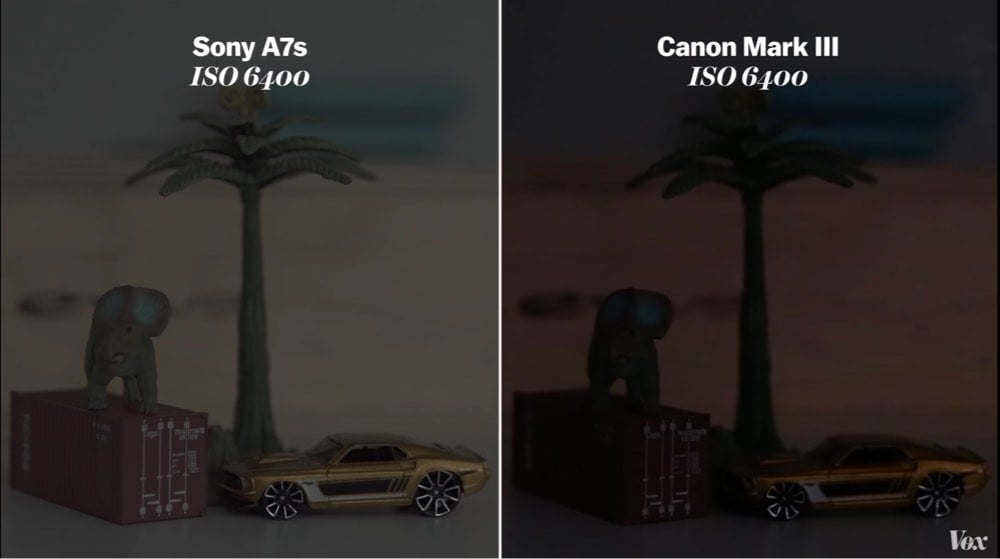
And the full scene at 32000 ISO:

That’s pretty amazing, right? Wick himself says on his site:
I had to take many attempts and a lot of trying to figure it out. Basically the challenge is to keep shutter speed as fast as possible in order to get razor sharp images. While you can use the 500 or 600 rule on ground this doesn’t work out the same way while being up in the sky. Well of course basically it does if you dont fly perpendicular to the movement of the night sky but even if its really smooth there are usually some light movements of the aircraft. So depending on the focal length of your lense you can get exposure times between 15” to 1”. Thats why you will need a camera that can handle high iso. Thats where the A7s comes into play and of course a ver fast lense. The rest is a good mounting and some luck. Last but not least you need to keep the flight deck as dark as possible to get the least reflections…and the rest is magic ;)
Back in September 2015, the LIGO experiment detected gravitational waves formed 1.3 billion years ago when two black holes merged into one. The physics is pretty straightforward but to get the measurement, scientists had to build one of the most sensitive machines ever built. How sensitive? To get an accurate result, they needed to measure a distance of 4km with an accuracy of 1/10000th the width of a proton. This video from Veritasium looks at how the scientists and engineers accomplished such an amazing feat.
The concept of road diets is an alternate approach to dealing with road congestion that’s gained popularity in recent years. The typical solution to heavy traffic on roads is to widen them with more travel lanes. The problem is such an approach can induce demand and instead of two lanes of traffic jam, you get four lanes going nowhere.1
Instead, with a road diet approach, you might turn a four-lane road into three lanes: two travel lanes and a turn lane in the middle.
Realizing these unintended outcomes, some localities implemented a type of road diet: reconfiguring the four lanes (two in each direction) into three (one each way plus a shared turn lane in the middle). The change dramatically reduced the number of “conflict points” on the road-places where a crash might occur. Whereas there might be six mid-block conflict points in a common four-lane arterial, between cars turning and merging, there were only two after the road diet.
Likewise, at an intersection, eight potential conflict points became four after a road diet.
The result was a much safer road. In small urban areas (say, populations around 17,000, with traffic volumes up to 12,000 cars a day), post-road diet crashes dropped about 47 percent. In larger metros (with populations around 269,000 and up to 24,000 daily cars), the crash reduction was roughly 19 percent. The combined estimate from all the best studies predicted that accidents would decline 29 percent, on average, after a four-to-three-lane road diet — DOT’s reported figure.
Pedestrian and bike usage tends to increase as well (b/c that extra street can be converted to bike lanes or sidewalks), speeding decreases, and car travel times are largely unaffected. This quick video by Jeff Speck shows four different approaches to road dieting:
Update: See also Braess’ paradox.
Braess’ paradox or Braess’s paradox is a proposed explanation for a seeming improvement to a road network being able to impede traffic through it. It was discovered in 1968 by mathematician Dietrich Braess, who noticed that adding a road to a congested road traffic network could increase overall journey time, and it has been used to explain instances of improved traffic flow when existing major roads are closed.
The paradox may have analogues in electrical power grids and biological systems. It has been suggested that in theory, the improvement of a malfunctioning network could be accomplished by removing certain parts of it.
(thx, david)
Update: A street in Oakland recently underwent a road diet: two of five lanes were converted into protected bike lanes. The result is an increase in biking and pedestrian use, a decrease in collisions, a decrease in speeding, and an increase in business along the street.
Along nine blocks of Oakland’s Telegraph Avenue, biking is up 78 percent since protected bike lanes were installed. Walking is up 100 percent - maybe because, thanks to the single lane of through traffic in each direction, the pedestrian yield rate doubled in the mornings and tripled in the afternoons.
Meanwhile, the number of traffic collisions fell 40 percent. Retail sales in a district that has sometimes struggled are up 9 percent, thanks in part to five new businesses.
And the median car speed is now the speed limit: 25 mph. As usual on such projects in urban areas, the main effect of removing a car passing lane was not to jam traffic, only to prevent irresponsible drivers from weaving between lanes in order to get to the next stoplight more quickly.
When you’re watching a nature documentary, you notice it right away: there’s something odd about the sound effects. They seem a little too…Hollywood. When Vox did their series on how the BBC made Planet Earth II, they didn’t mention the sound:
I hope the third program is on sound, which has been bugging me while watching Planet Earth II. I could be wrong, but they seem to be using extensive foley effects for the sounds the animals make — not their cries necessarily, but the sounds they make as they move. Once you notice, it feels deceptive.
Several other people noticed and complained, causing the BBC to explain that getting real sounds in many cases was impossible. Audio producer Matt North adds some context:
Whilst I’m no wildlife expert, it’s fairly straightforward to conclude that such an unpredictable and uncontrollable subject as wildlife would have prompted the need to often shoot on long lenses, thus making it almost physically impossible for a sound recordist to obtain ‘realistic’ recordings that would match the treatment and emotive style of the programme. Combine this with the shooting climate, as well as the need for frequent communication between crew just to capture the necessary shots that will cut well in the edit suite and you have a recipe for failure in regards to obtaining useable sound. Therefore, it’s not only impractical but virtually impossible to capture the ‘real’ sound that some of these disgruntled viewers may be protesting for.
As Simon Cade shows in the video above, sound is only one of the ways in which nature documentaries use editing to “fake” things. Is it manipulation? Or good storytelling? And what’s the difference between the two anyway? A silent security feed of a Walmart parking lot is not a documentary but The Thin Blue Line, with its many dramatizations and Philip Glass score, is a great documentary.
Update: 99% Invisible recently did a show on the sounds in nature documentaries as well. (thx, everyone)
Studio Ghibli has been making incredible animated movies since 1985. This video traces the history and the work of the studio and its principal director Hayao Miyazaki from his pre-Ghibli work (including Nausicaä of the Valley of the Wind) all the way up to Miyazaki’s recent unretirement & involvement in Boro the Caterpillar.
The name Ghibli was given by Hayao Miyazaki from the Italian noun “ghibli”, based on the Libyan-Arabic name for the hot desert wind of that country, the idea being the studio would “blow a new wind through the anime industry”. It also refers to an Italian aircraft, the Caproni Ca.309 Ghibli.
I still remember seeing Princess Mononoke in the theater in 1999 (having no previous knowledge of Ghibli or Miyazaki) and being completely blown away by it. Made me a fan for life. (via film school rejects)
Update: The Movies of Studio Ghibli, Ranked from Worst to Best. Happy to see Princess Mononoke in the top spot and surprised at Spirited Away’s relatively low placement.
This video of robot continuously building a looped track in front of a toy train is definitely a metaphor for something. Procrastination? Living paycheck to paycheck? Life with small children? I don’t know, but it makes me SO ANXIOUS! Why does it wait so long to place the next section of track?!! I couldn’t watch for more than 10 seconds or so.
See also the chase scene from The Wrong Trousers. (via @MachinePix)
My top bowling score is probably 1381 and took more than an hour because there were 6 people using the same lane and no one was really paying that much attention to anything other than conversation and chicken wings. This guy, using all the lanes in the alley, rolled a 300 in just under 90 seconds. With two hands…I’ve never seen that before. And I love the way he scampers from lane to lane.
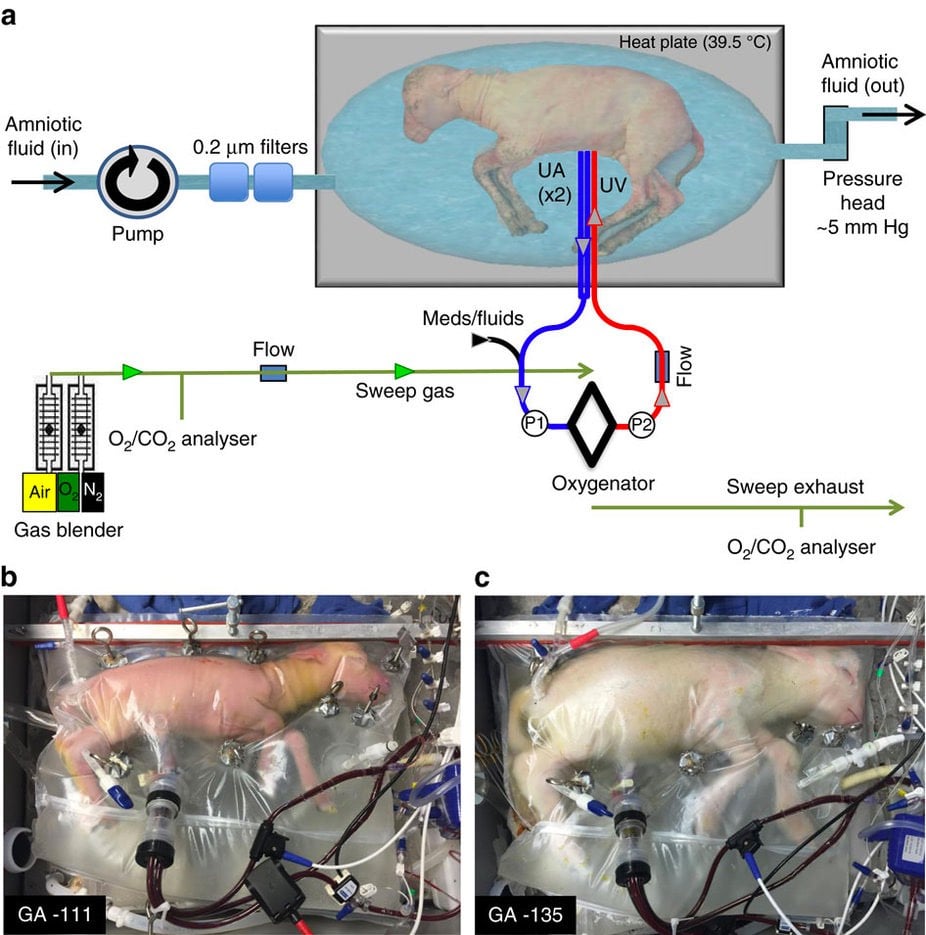
Researchers at The Children’s Hospital of Philadelphia have succeeded in gestating premature lambs in artificial wombs. The abstract from the paper in Nature Communications:
In the developed world, extreme prematurity is the leading cause of neonatal mortality and morbidity due to a combination of organ immaturity and iatrogenic injury. Until now, efforts to extend gestation using extracorporeal systems have achieved limited success. Here we report the development of a system that incorporates a pumpless oxygenator circuit connected to the fetus of a lamb via an umbilical cord interface that is maintained within a closed ‘amniotic fluid’ circuit that closely reproduces the environment of the womb. We show that fetal lambs that are developmentally equivalent to the extreme premature human infant can be physiologically supported in this extra-uterine device for up to 4 weeks. Lambs on support maintain stable haemodynamics, have normal blood gas and oxygenation parameters and maintain patency of the fetal circulation. With appropriate nutritional support, lambs on the system demonstrate normal somatic growth, lung maturation and brain growth and myelination.
The Atlantic’s Olga Khazan translates what that might mean for human babies born prematurely.
One reason preterm birth is so dangerous is that, for an underweight baby, the first few breaths of air halt the development of the lungs. “Infants that are currently born and supported in a neonatal intensive care unit with gas-based ventilation demonstrate an arrest of lung development,” Partridge says, “which manifests in a long-term, severe restriction of lung function.”
With the artificial womb, the infant would continue “breathing” through the umbilical cord as its floats in amniotic fluid, which would flow into and out of the bag. Using its tiny heart, the fetus would pump its own blood through its umbilical cord and into an oxygenator, where the blood would pick up oxygen and return it to the fetus-much like with a normal placenta. In addition to boosting lung growth, the amniotic fluid would protect the baby from infections and support the development of the intestines.
If this does work for humans, there’s a possibility that at some point using artificial wombs may be safer (or just preferable for some people) than women carrying babies to term…which would have an interesting effect on childbirth (to say the least). And as Khazan mentions, there are potential implications related to abortion rights:
If they ever materialize, artificial wombs may stir concerns among pro-choice advocates, since the devices could push the point of viability for human fetuses even lower. That might encourage even more states to curtail abortions after, say, 20 weeks’ gestation. But speaking with reporters Monday, the Philadelphia researchers emphasized they don’t intend to expand the bounds of life before the 23rd gestational week. Before that point, fetuses are too fragile even for the artificial wombs.
Update: There’s a short video clip of the lamb in the artificial womb as well:
Newer posts
Older posts


Socials & More